







Created BY
1) ANKIT WANKHEDE
ankit.wan@gmail.com
Mob.no:9561418177
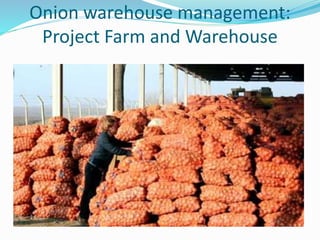
Onion warehouse management:
Project Farm and Warehouse
THEME
“NOW ONION WILL
NOT MAKE YOU CRY”
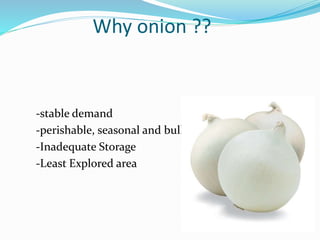
Why onion ??
-stable demand
-perishable, seasonal and bulky
-Inadequate Storage
-Least Explored area
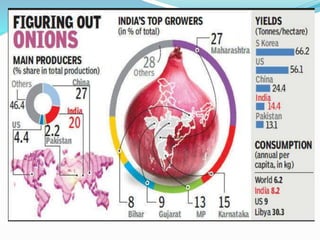
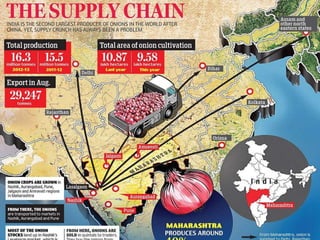
Problem focus
 Erratic rainfall in the main production centre
 Hoarding by the traders
 Loss of onion because of inadequate post harvest
storage
 Inherently unstable production.
 Decline in onion production from last five years.
“ONION GROWER IS IN TEARS
ONION SUPPLEIR CHEERS”
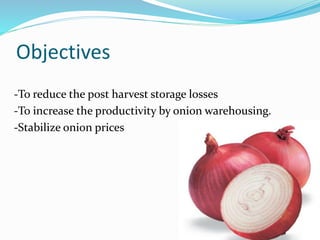
Objectives
-To reduce the post harvest storage losses
-To increase the productivity by onion warehousing.
-Stabilize onion prices
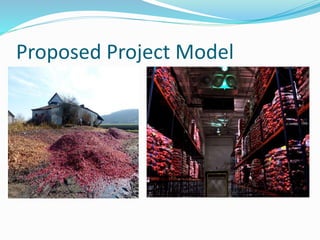
Proposed Project Model
Assumptions
 No influence of current onion market
 5000 farmers have signed the contract
 continuous Scope for export
Project inclusions
 Training to the farmers
 Provision of seeds
 Discount on Fertilizers
 Bilateral transport – onion potato
Project exclusions
 1) No storage provision for other agri product
(garlic)
 2)Opening of onion research centre.
 Other cold chain product will not be
entertrained (apple, potato) different storage
parameters
Benefits
 farmers upbringment
 Reducing the wastage of onion by proper
storage
 Stabilizing the onion prices in market for all type
of customers.
 profit
Future perspective
1) opening of onion research centre
2) Chopping and drying of onion and selling
3) Expand for other perishable agri. Products.
WAREHOUSE COSTING
COSTING
1) PROJECT COST
2)PROJECT FINANCE
3)COST SUMMARY
REPORT
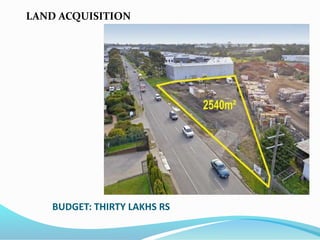
BUDGET: THIRTY LAKHS RS
LAND ACQUISITION
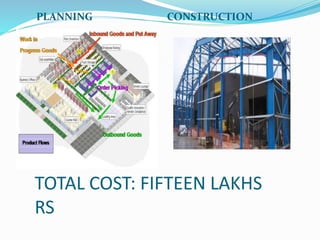
TOTAL COST: FIFTEEN LAKHS
RS
PLANNING CONSTRUCTION
HANDLING COST
1) SUPPLY CHAIN
2)POWER
3)DEPRECIATION
ON
EQUIPMENT
COST
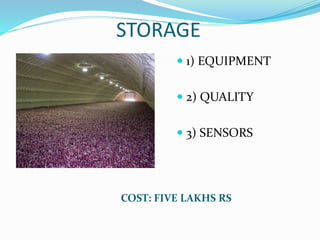
STORAGE
COST: FIVE LAKHS RS
 1) EQUIPMENT
 2) QUALITY
 3) SENSORS
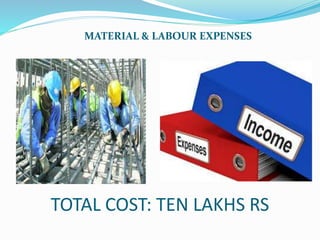
TOTAL COST: TEN LAKHS RS
MATERIAL & LABOUR EXPENSES
OVERHEADS
Cost: five lakhs Rs
 1) WORK
OVERHEADS
 2) ADMINISTRATIVE
OVERHEADS
 3) SELLING
OVERHEADS
 4)DISTRIBUTION
OVER HEADS
PROJECT FINANCE
DEFINITION
 Project finance is the long-
term financing
of infrastructure and industrial
projects based upon the projected
cash flows of the project
LONG TERM SOURCE OF
FUNDS
1) EQUITY CAPITAL
2) PREFERENCE SHARES
3) RETAINED EARNINGS
4) DEFRRED PAYMENT
GUARANTEE
5) DEBENTURES
6) LOAN FROM FINIANCIAL
INSTITUTIONS
7) LOAN FROM COMMERCIAL
BANKS
8) VENTURE CAPITAL FUNDING
9) ASSET SECURITISATION
10) INTERNATIONAL FINANCING
SPONSORS
 1) Nabard
 2) Individual district
level co-society banks
 3) urban co-operative
bank
 4) urban co-operative
bank
 5) Local Nabard bank
branch
 6) 26 district co-
operative society banks
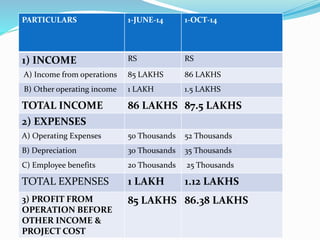
PARTICULARS 1-JUNE-14 1-OCT-14
1) INCOME RS RS
A) Income from operations 85 LAKHS 86 LAKHS
B) Other operating income 1 LAKH 1.5 LAKHS
TOTAL INCOME 86 LAKHS 87.5 LAKHS
2) EXPENSES
A) Operating Expenses 50 Thousands 52 Thousands
B) Depreciation 30 Thousands 35 Thousands
C) Employee benefits 20 Thousands 25 Thousands
TOTAL EXPENSES 1 LAKH 1.12 LAKHS
3) PROFIT FROM
OPERATION BEFORE
OTHER INCOME &
PROJECT COST
85 LAKHS 86.38 LAKHS
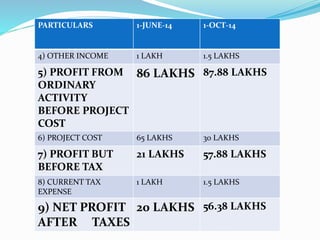
PARTICULARS 1-JUNE-14 1-OCT-14
4) OTHER INCOME 1 LAKH 1.5 LAKHS
5) PROFIT FROM
ORDINARY
ACTIVITY
BEFORE PROJECT
COST
86 LAKHS 87.88 LAKHS
6) PROJECT COST 65 LAKHS 30 LAKHS
7) PROFIT BUT
BEFORE TAX
21 LAKHS 57.88 LAKHS
8) CURRENT TAX
EXPENSE
1 LAKH 1.5 LAKHS
9) NET PROFIT
AFTER TAXES
20 LAKHS 56.38 LAKHS
Quality
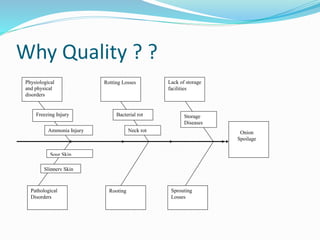
Why Quality ? ?
Rotting LossesPhysiological
and physical
disorders
Lack of storage
facilities
Sprouting
Losses
Pathological
Disorders
Rooting
Onion
Spoilage
Freezing Injury
Ammonia Injury Neck rot
Bacterial rot
Slippery Skin
Sour Skin
Storage
Diseases
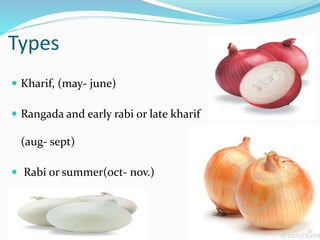
Types
 Kharif, (may- june)
 Rangada and early rabi or late kharif
(aug- sept)
 Rabi or summer(oct- nov.)
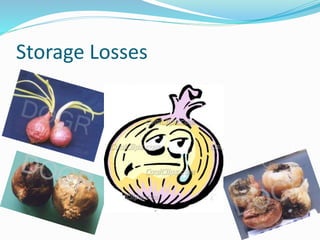
Storage Losses
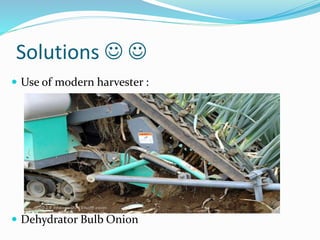
Solutions  
 Use of modern harvester :
 Dehydrator Bulb Onion
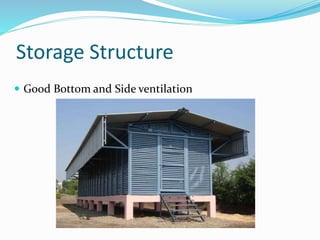
Storage Structure
 Good Bottom and Side ventilation
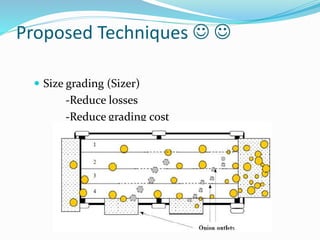
Proposed Techniques  
 Size grading (Sizer)
-Reduce losses
-Reduce grading cost
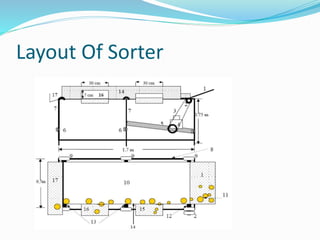
Layout Of Sorter
Salient Features of improved
structure
 1. Construction of storage godown on raised platform
 2. Use of Mangalore tiles roof
 3. Increased centre height and more
 4. Bottom ventilation
 5. Avoid direct sunlight on onion bulbs
 6. width of each stack to 60-70 cm for cool humid weather, 75-
90
cm for mild
 7. stacking height to 100 cm for small and multiplier onion
 8. Cubicles rather than continuous stack
 9. One cubic metre area of store accommodates about 750 kg
onions.
Risk Management
Risk register
Risk analysis-
Risk assessment matrix
- Qualitative risk
- -Quantitative risk
Risk factors
Farmer’s attitude
Nature
Government policies
Transportation
Risk Mitigation
 FARMERS- develop code of conduct
 Nature - contingency reserve for emergency
 Policies- modification in policies for farmers
and onion.
Who Are Business
Stakeholders?
• Core stakeholders are essential to the survival of the
firm
• Strategic stakeholders are vital to the organization
and the threats and opportunities the organization
faces
• Environmental stakeholders are all others in the
organization's environment
Identified stakeholders
 Customers
 Sponsor
 Supplier
 Environmental stakeholder
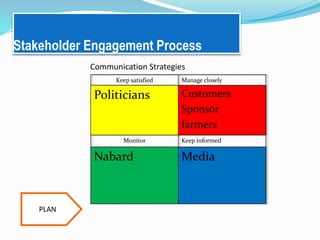
Stakeholder Engagement Process
PLAN
Keep satisfied Manage closely
Politicians Customers
Sponsor
farmers
Monitor Keep informed
Nabard Media
Communication Strategies
45

Onion warehouse management

  • 1.
    Created BY 1) ANKITWANKHEDE ankit.wan@gmail.com Mob.no:9561418177
  • 2.
  • 3.
  • 4.
    Why onion ?? -stabledemand -perishable, seasonal and bulky -Inadequate Storage -Least Explored area
  • 5.
    Problem focus  Erraticrainfall in the main production centre  Hoarding by the traders  Loss of onion because of inadequate post harvest storage  Inherently unstable production.  Decline in onion production from last five years.
  • 6.
    “ONION GROWER ISIN TEARS ONION SUPPLEIR CHEERS”
  • 7.
    Objectives -To reduce thepost harvest storage losses -To increase the productivity by onion warehousing. -Stabilize onion prices
  • 10.
  • 11.
    Assumptions  No influenceof current onion market  5000 farmers have signed the contract  continuous Scope for export
  • 12.
    Project inclusions  Trainingto the farmers  Provision of seeds  Discount on Fertilizers  Bilateral transport – onion potato
  • 13.
    Project exclusions  1)No storage provision for other agri product (garlic)  2)Opening of onion research centre.  Other cold chain product will not be entertrained (apple, potato) different storage parameters
  • 14.
    Benefits  farmers upbringment Reducing the wastage of onion by proper storage  Stabilizing the onion prices in market for all type of customers.  profit
  • 15.
    Future perspective 1) openingof onion research centre 2) Chopping and drying of onion and selling 3) Expand for other perishable agri. Products.
  • 16.
  • 17.
    COSTING 1) PROJECT COST 2)PROJECTFINANCE 3)COST SUMMARY REPORT
  • 18.
    BUDGET: THIRTY LAKHSRS LAND ACQUISITION
  • 19.
    TOTAL COST: FIFTEENLAKHS RS PLANNING CONSTRUCTION
  • 20.
    HANDLING COST 1) SUPPLYCHAIN 2)POWER 3)DEPRECIATION ON EQUIPMENT COST
  • 21.
    STORAGE COST: FIVE LAKHSRS  1) EQUIPMENT  2) QUALITY  3) SENSORS
  • 22.
    TOTAL COST: TENLAKHS RS MATERIAL & LABOUR EXPENSES
  • 23.
    OVERHEADS Cost: five lakhsRs  1) WORK OVERHEADS  2) ADMINISTRATIVE OVERHEADS  3) SELLING OVERHEADS  4)DISTRIBUTION OVER HEADS
  • 24.
  • 25.
    DEFINITION  Project financeis the long- term financing of infrastructure and industrial projects based upon the projected cash flows of the project
  • 26.
    LONG TERM SOURCEOF FUNDS 1) EQUITY CAPITAL 2) PREFERENCE SHARES 3) RETAINED EARNINGS 4) DEFRRED PAYMENT GUARANTEE 5) DEBENTURES 6) LOAN FROM FINIANCIAL INSTITUTIONS 7) LOAN FROM COMMERCIAL BANKS 8) VENTURE CAPITAL FUNDING 9) ASSET SECURITISATION 10) INTERNATIONAL FINANCING
  • 27.
    SPONSORS  1) Nabard 2) Individual district level co-society banks  3) urban co-operative bank  4) urban co-operative bank  5) Local Nabard bank branch  6) 26 district co- operative society banks
  • 28.
    PARTICULARS 1-JUNE-14 1-OCT-14 1)INCOME RS RS A) Income from operations 85 LAKHS 86 LAKHS B) Other operating income 1 LAKH 1.5 LAKHS TOTAL INCOME 86 LAKHS 87.5 LAKHS 2) EXPENSES A) Operating Expenses 50 Thousands 52 Thousands B) Depreciation 30 Thousands 35 Thousands C) Employee benefits 20 Thousands 25 Thousands TOTAL EXPENSES 1 LAKH 1.12 LAKHS 3) PROFIT FROM OPERATION BEFORE OTHER INCOME & PROJECT COST 85 LAKHS 86.38 LAKHS
  • 29.
    PARTICULARS 1-JUNE-14 1-OCT-14 4)OTHER INCOME 1 LAKH 1.5 LAKHS 5) PROFIT FROM ORDINARY ACTIVITY BEFORE PROJECT COST 86 LAKHS 87.88 LAKHS 6) PROJECT COST 65 LAKHS 30 LAKHS 7) PROFIT BUT BEFORE TAX 21 LAKHS 57.88 LAKHS 8) CURRENT TAX EXPENSE 1 LAKH 1.5 LAKHS 9) NET PROFIT AFTER TAXES 20 LAKHS 56.38 LAKHS
  • 30.
  • 31.
    Why Quality ?? Rotting LossesPhysiological and physical disorders Lack of storage facilities Sprouting Losses Pathological Disorders Rooting Onion Spoilage Freezing Injury Ammonia Injury Neck rot Bacterial rot Slippery Skin Sour Skin Storage Diseases
  • 32.
    Types  Kharif, (may-june)  Rangada and early rabi or late kharif (aug- sept)  Rabi or summer(oct- nov.)
  • 33.
  • 34.
    Solutions   Use of modern harvester :  Dehydrator Bulb Onion
  • 35.
    Storage Structure  GoodBottom and Side ventilation
  • 36.
    Proposed Techniques   Size grading (Sizer) -Reduce losses -Reduce grading cost
  • 37.
  • 38.
    Salient Features ofimproved structure  1. Construction of storage godown on raised platform  2. Use of Mangalore tiles roof  3. Increased centre height and more  4. Bottom ventilation  5. Avoid direct sunlight on onion bulbs  6. width of each stack to 60-70 cm for cool humid weather, 75- 90 cm for mild  7. stacking height to 100 cm for small and multiplier onion  8. Cubicles rather than continuous stack  9. One cubic metre area of store accommodates about 750 kg onions.
  • 39.
    Risk Management Risk register Riskanalysis- Risk assessment matrix - Qualitative risk - -Quantitative risk
  • 40.
  • 41.
    Risk Mitigation  FARMERS-develop code of conduct  Nature - contingency reserve for emergency  Policies- modification in policies for farmers and onion.
  • 42.
    Who Are Business Stakeholders? •Core stakeholders are essential to the survival of the firm • Strategic stakeholders are vital to the organization and the threats and opportunities the organization faces • Environmental stakeholders are all others in the organization's environment
  • 43.
    Identified stakeholders  Customers Sponsor  Supplier  Environmental stakeholder
  • 44.
    Stakeholder Engagement Process PLAN Keepsatisfied Manage closely Politicians Customers Sponsor farmers Monitor Keep informed Nabard Media Communication Strategies
  • 45.