Agenda
Industry
 Industry Analysis
 US Market Trends
 Juice & Smoothie Trends
 Home Delivery Trends
 Takeout Trends
 Market Growth
 Competitive Breakdown
 Opportunity
 Target Market
Woholle Juice
 Brick and Mortar
 Home Delivery
 Wholesale
 Keys to Success
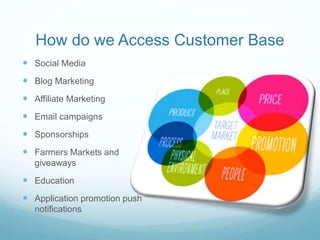
 How do we access the Customer Base
 Product Positioning
 Risks to achieving Success
 Risk Mitigation Plan
 Initial Investment Plan
 Recommendations
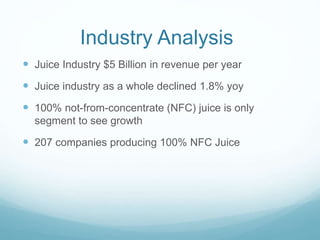
Industry Analysis
 Juice Industry $5 Billion in revenue per year
 Juice industry as a whole declined 1.8% yoy
 100% not-from-concentrate (NFC) juice is only
segment to see growth
 207 companies producing 100% NFC Juice
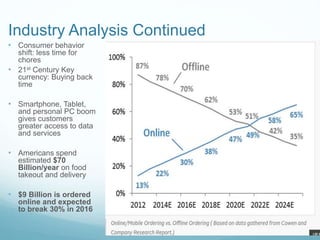
Industry Analysis Continued
• Consumer behavior
shift: less time for
chores
• 21st Century Key
currency: Buying back
time
• Smartphone, Tablet,
and personal PC boom
gives customers
greater access to data
and services
• Americans spend
estimated $70
Billion/year on food
takeout and delivery
• $9 Billion is ordered
online and expected
to break 30% in 2016
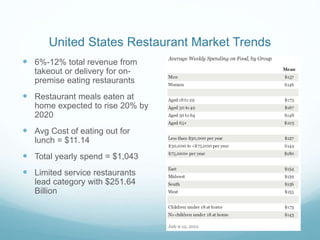
United States Restaurant Market Trends
 6%-12% total revenue from
takeout or delivery for on-
premise eating restaurants
 Restaurant meals eaten at
home expected to rise 20% by
2020
 Avg Cost of eating out for
lunch = $11.14
 Total yearly spend = $1,043
 Limited service restaurants
lead category with $251.64
Billion
Juices and Smoothie Market
Trends
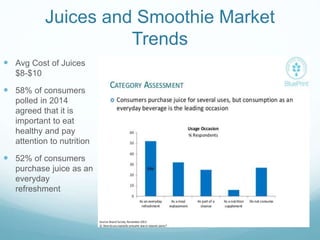
 Avg Cost of Juices
$8-$10
 58% of consumers
polled in 2014
agreed that it is
important to eat
healthy and pay
attention to nutrition
 52% of consumers
purchase juice as an
everyday
refreshment
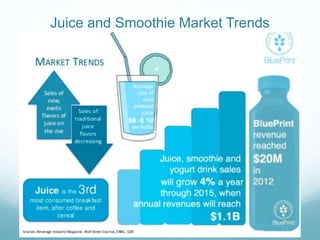
Juice and Smoothie Market Trends
Juice and Smoothie Continued
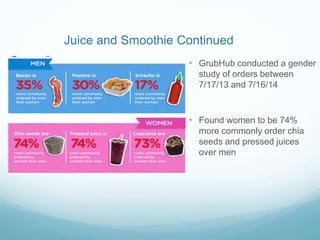
• GrubHub conducted a gender
study of orders between
7/17/13 and 7/16/14
• Found women to be 74%
more commonly order chia
seeds and pressed juices
over men
Home Delivery Trends
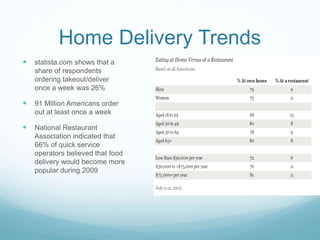
 statista.com shows that a
share of respondents
ordering takeout/deliver
once a week was 26%
 91 Million Americans order
out at least once a week
 National Restaurant
Association indicated that
66% of quick service
operators believed that food
delivery would become more
popular during 2009
Home Delivery Trends –
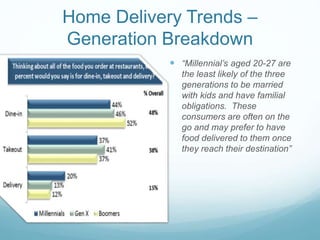
Generation Breakdown
 “Millennial’s aged 20-27 are
the least likely of the three
generations to be married
with kids and have familial
obligations. These
consumers are often on the
go and may prefer to have
food delivered to them once
they reach their destination”
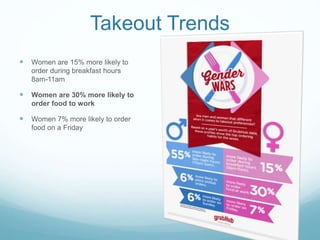
Takeout Trends
 Women are 15% more likely to
order during breakfast hours
8am-11am
 Women are 30% more likely to
order food to work
 Women 7% more likely to order
food on a Friday
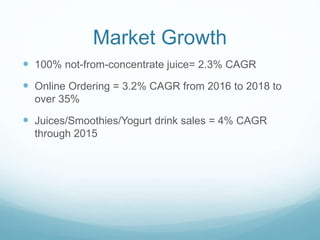
Market Growth
 100% not-from-concentrate juice= 2.3% CAGR
 Online Ordering = 3.2% CAGR from 2016 to 2018 to
over 35%
 Juices/Smoothies/Yogurt drink sales = 4% CAGR
through 2015
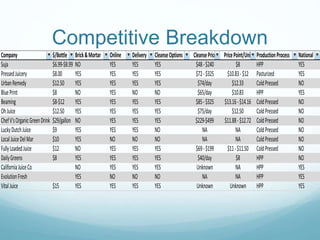
Competitive Breakdown
Company $/Bottle Brick&Mortar Online Delivery CleanseOptions CleansePrice PricePoint/Unit ProductionProcess National
Suja $6.99-$8.99 NO YES YES YES $48-$240 $8 HPP YES
PressedJuicery $8.00 YES YES YES YES $72-$325 $10.83-$12 Pasturized YES
UrbanRemedy $12.50 YES YES YES YES $74/day $12.33 ColdPressed NO
BluePrint $8 NO YES NO NO $65/day $10.83 HPP YES
Beaming $8-$12 YES YES YES YES $85-$325 $13.16-$14.16 ColdPressed NO
OhJuice $12.50 YES YES YES YES $75/day $12.50 ColdPressed NO
ChefV'sOrganicGreenDrink $29/gallon NO YES YES YES $229-$499 $11.88-$12.72 ColdPressed NO
LuckyDutchJuice $9 YES YES YES NO NA NA ColdPressed NO
LocalJuiceDelMar $10 YES NO NO NO NA NA ColdPressed NO
FullyLoadedJuice $12 NO YES YES YES $69-$199 $11-$11.50 ColdPressed NO
DailyGreens $8 YES YES YES YES $40/day $8 HPP NO
CaliforniaJuiceCo NO YES YES YES Unknown NA HPP YES
EvolutionFresh YES NO NO NO NA NA HPP YES
VitalJuice $15 YES YES YES YES Unknown Unknown HPP YES
Keys to Success
 Stable source of product ingredients at a reasonable
cost
 Well-controlled manufacturing process
 Efficient distribution system
 Marketing messages provide educational value
 Marketing spend
 Home delivery and wholesale to offset seasonality
Opportunity
 Corporate Partnerships
 Local Partnerships
 Everyday California
 Events
 Sponsorships
 Additional locations – Denver, Vancouver, Austin,
Hawaii (Google Trends:
https://www.google.com/trends/explore#q=organic%20j
uice)
Customer Base – 25-35 Young Pro’s
Brick-and-Mortar
 Attractive Ambiance
 Friendly Customer Service
 In-store special offers
 Partnership with Everyday California
 Messaging to customers about promotions and on-line
ordering and delivery
 Year One
Home Delivery
 Prompt service delivered to the doorstep
 Logistical Routes for time and costs
 Ability to order online for convenience
 Mobile Application
 Year One
Wholesale
 HPP Process or Pasteurization
 Distribution Channel
 Legal Contracts
 Relationship Management
 Online
 Shipment Schedules
 Investment
 Year Two
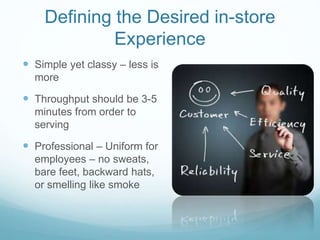
Defining the Desired in-store
Experience
 Simple yet classy – less is
more
 Throughput should be 3-5
minutes from order to
serving
 Professional – Uniform for
employees – no sweats,
bare feet, backward hats,
or smelling like smoke
How do we Access Customer Base
 Social Media
 Blog Marketing
 Affiliate Marketing
 Email campaigns
 Sponsorships
 Farmers Markets and
giveaways
 Education
 Application promotion push
notifications
Product Positioning
Woholle Juice Bar will position itself as a company that promotes
healthy living with locally sourced, 100% organic, not-from-concentrate, non-
GMO products. It will be a full service juice bar that offers customer unique
experiences in an area widely considered to be the most beautiful place in
the United States.
In order to accomplish this products, services, and staff will be
tasked with providing customers the highest level of customer service,
premium products, and atmosphere that they can enjoy while creating a
comfortable culture that entices people to stay at the storefront and enjoy
delicious beverages and food.
In order to capture market share in La Jolla and San Diego County,
Woholle Juicebox will need to market heavily as a local product. It will be
important to convey the message to our target market that the business is
inspired by the local San Diego lifestyle, sourced locally, and delivered
locally, to help improve local health.
It will be important to position Woholle Juice Bar as a support
system for the local community that offers education and healthy products
and services. When customers understand the value of your brand to their
family, friends, and community they will support your products and refer
your products to new customers.
Risks to Achieving Success
 Product acceptance (Low Risk)
 Product consistency with seasonal sourcing (Medium Risk)
 short shelf life (High Risk)
 High Initial Investment (Medium Risk)
 Competition is driving down industry pricing with economies of
scale (High Risk)
 Offseason Foot Traffic (Low Risk)
 Pricing Fluctuation for Goods and Seasonality (High)
 Production (Low Risk)
Risks Mitigation Plan
 Risk Impact Assessment to Woholle
 Longer Time to Profitability
 Decrease in Sales Causing Increased Debt
 Decreased Margins Threaten Business Longevity
 Inability to Supply Demand
Risk Mitigation Planning, Implementation,
and Progress Monitoring
 Hedging against inflation and increased pricing of ingredients
 Ingredients based on seasonality and ensuring we can continue to
source locally
 Manufacturing process that is well controlled
 Subscription offering to help forecast demand
 HPP process to increase shelf life and decreased return of expired
products for wholesale distribution
 Home delivery to offset offseason foot traffic
Initial Investment Plan
 To be completed with Managing Partners
Recommendations
 Begin and encourage home delivery to customers
 Begin wholesale in year one and two locally (Red Bull case study)
 Begin larger wholesale distribution in Q3 of Year Two
 Decrease costs by encouraging online ordering and delivery
 Marketing heavily on Social Media and Digitally in La Jolla, Del
Mar, and UTC first
 Expansion from Kiosks to additional areas (Fashion Valley,
Mission Valley, Downtown)
 Future Expansion – Denver

Woholle Presentation

  • 1.
    Agenda Industry  Industry Analysis US Market Trends  Juice & Smoothie Trends  Home Delivery Trends  Takeout Trends  Market Growth  Competitive Breakdown  Opportunity  Target Market Woholle Juice  Brick and Mortar  Home Delivery  Wholesale  Keys to Success  How do we access the Customer Base  Product Positioning  Risks to achieving Success  Risk Mitigation Plan  Initial Investment Plan  Recommendations
  • 2.
    Industry Analysis  JuiceIndustry $5 Billion in revenue per year  Juice industry as a whole declined 1.8% yoy  100% not-from-concentrate (NFC) juice is only segment to see growth  207 companies producing 100% NFC Juice
  • 3.
    Industry Analysis Continued •Consumer behavior shift: less time for chores • 21st Century Key currency: Buying back time • Smartphone, Tablet, and personal PC boom gives customers greater access to data and services • Americans spend estimated $70 Billion/year on food takeout and delivery • $9 Billion is ordered online and expected to break 30% in 2016
  • 4.
    United States RestaurantMarket Trends  6%-12% total revenue from takeout or delivery for on- premise eating restaurants  Restaurant meals eaten at home expected to rise 20% by 2020  Avg Cost of eating out for lunch = $11.14  Total yearly spend = $1,043  Limited service restaurants lead category with $251.64 Billion
  • 5.
    Juices and SmoothieMarket Trends  Avg Cost of Juices $8-$10  58% of consumers polled in 2014 agreed that it is important to eat healthy and pay attention to nutrition  52% of consumers purchase juice as an everyday refreshment
  • 6.
    Juice and SmoothieMarket Trends
  • 7.
    Juice and SmoothieContinued • GrubHub conducted a gender study of orders between 7/17/13 and 7/16/14 • Found women to be 74% more commonly order chia seeds and pressed juices over men
  • 8.
    Home Delivery Trends statista.com shows that a share of respondents ordering takeout/deliver once a week was 26%  91 Million Americans order out at least once a week  National Restaurant Association indicated that 66% of quick service operators believed that food delivery would become more popular during 2009
  • 9.
    Home Delivery Trends– Generation Breakdown  “Millennial’s aged 20-27 are the least likely of the three generations to be married with kids and have familial obligations. These consumers are often on the go and may prefer to have food delivered to them once they reach their destination”
  • 10.
    Takeout Trends  Womenare 15% more likely to order during breakfast hours 8am-11am  Women are 30% more likely to order food to work  Women 7% more likely to order food on a Friday
  • 11.
    Market Growth  100%not-from-concentrate juice= 2.3% CAGR  Online Ordering = 3.2% CAGR from 2016 to 2018 to over 35%  Juices/Smoothies/Yogurt drink sales = 4% CAGR through 2015
  • 12.
    Competitive Breakdown Company $/BottleBrick&Mortar Online Delivery CleanseOptions CleansePrice PricePoint/Unit ProductionProcess National Suja $6.99-$8.99 NO YES YES YES $48-$240 $8 HPP YES PressedJuicery $8.00 YES YES YES YES $72-$325 $10.83-$12 Pasturized YES UrbanRemedy $12.50 YES YES YES YES $74/day $12.33 ColdPressed NO BluePrint $8 NO YES NO NO $65/day $10.83 HPP YES Beaming $8-$12 YES YES YES YES $85-$325 $13.16-$14.16 ColdPressed NO OhJuice $12.50 YES YES YES YES $75/day $12.50 ColdPressed NO ChefV'sOrganicGreenDrink $29/gallon NO YES YES YES $229-$499 $11.88-$12.72 ColdPressed NO LuckyDutchJuice $9 YES YES YES NO NA NA ColdPressed NO LocalJuiceDelMar $10 YES NO NO NO NA NA ColdPressed NO FullyLoadedJuice $12 NO YES YES YES $69-$199 $11-$11.50 ColdPressed NO DailyGreens $8 YES YES YES YES $40/day $8 HPP NO CaliforniaJuiceCo NO YES YES YES Unknown NA HPP YES EvolutionFresh YES NO NO NO NA NA HPP YES VitalJuice $15 YES YES YES YES Unknown Unknown HPP YES
  • 13.
    Keys to Success Stable source of product ingredients at a reasonable cost  Well-controlled manufacturing process  Efficient distribution system  Marketing messages provide educational value  Marketing spend  Home delivery and wholesale to offset seasonality
  • 14.
    Opportunity  Corporate Partnerships Local Partnerships  Everyday California  Events  Sponsorships  Additional locations – Denver, Vancouver, Austin, Hawaii (Google Trends: https://www.google.com/trends/explore#q=organic%20j uice)
  • 15.
    Customer Base –25-35 Young Pro’s
  • 16.
    Brick-and-Mortar  Attractive Ambiance Friendly Customer Service  In-store special offers  Partnership with Everyday California  Messaging to customers about promotions and on-line ordering and delivery  Year One
  • 17.
    Home Delivery  Promptservice delivered to the doorstep  Logistical Routes for time and costs  Ability to order online for convenience  Mobile Application  Year One
  • 18.
    Wholesale  HPP Processor Pasteurization  Distribution Channel  Legal Contracts  Relationship Management  Online  Shipment Schedules  Investment  Year Two
  • 19.
    Defining the Desiredin-store Experience  Simple yet classy – less is more  Throughput should be 3-5 minutes from order to serving  Professional – Uniform for employees – no sweats, bare feet, backward hats, or smelling like smoke
  • 20.
    How do weAccess Customer Base  Social Media  Blog Marketing  Affiliate Marketing  Email campaigns  Sponsorships  Farmers Markets and giveaways  Education  Application promotion push notifications
  • 21.
    Product Positioning Woholle JuiceBar will position itself as a company that promotes healthy living with locally sourced, 100% organic, not-from-concentrate, non- GMO products. It will be a full service juice bar that offers customer unique experiences in an area widely considered to be the most beautiful place in the United States. In order to accomplish this products, services, and staff will be tasked with providing customers the highest level of customer service, premium products, and atmosphere that they can enjoy while creating a comfortable culture that entices people to stay at the storefront and enjoy delicious beverages and food. In order to capture market share in La Jolla and San Diego County, Woholle Juicebox will need to market heavily as a local product. It will be important to convey the message to our target market that the business is inspired by the local San Diego lifestyle, sourced locally, and delivered locally, to help improve local health. It will be important to position Woholle Juice Bar as a support system for the local community that offers education and healthy products and services. When customers understand the value of your brand to their family, friends, and community they will support your products and refer your products to new customers.
  • 22.
    Risks to AchievingSuccess  Product acceptance (Low Risk)  Product consistency with seasonal sourcing (Medium Risk)  short shelf life (High Risk)  High Initial Investment (Medium Risk)  Competition is driving down industry pricing with economies of scale (High Risk)  Offseason Foot Traffic (Low Risk)  Pricing Fluctuation for Goods and Seasonality (High)  Production (Low Risk)
  • 23.
    Risks Mitigation Plan Risk Impact Assessment to Woholle  Longer Time to Profitability  Decrease in Sales Causing Increased Debt  Decreased Margins Threaten Business Longevity  Inability to Supply Demand
  • 24.
    Risk Mitigation Planning,Implementation, and Progress Monitoring  Hedging against inflation and increased pricing of ingredients  Ingredients based on seasonality and ensuring we can continue to source locally  Manufacturing process that is well controlled  Subscription offering to help forecast demand  HPP process to increase shelf life and decreased return of expired products for wholesale distribution  Home delivery to offset offseason foot traffic
  • 25.
    Initial Investment Plan To be completed with Managing Partners
  • 26.
    Recommendations  Begin andencourage home delivery to customers  Begin wholesale in year one and two locally (Red Bull case study)  Begin larger wholesale distribution in Q3 of Year Two  Decrease costs by encouraging online ordering and delivery  Marketing heavily on Social Media and Digitally in La Jolla, Del Mar, and UTC first  Expansion from Kiosks to additional areas (Fashion Valley, Mission Valley, Downtown)  Future Expansion – Denver

Editor's Notes

  • #14 Very important to understand how and where we will be sourcing our ingredients from. In order to protect profit margins and drive down costs it will be important to understand seasonality of products and ingredients needed for final product. Hedging against ingredient costs will be important to lock in prices for future purchases of ingredients. Manufacturing process needs to be HPP or Pasteurized. Need to evaluate demand of in-store juice vs wholesale and home delivery. What are our sales projections based on our target market and realistic, manageable process that allows us to produce for desired demand. Distribution should begin with Brick-and-Mortar and continue with home delivery. Wholesale will begin once we have established partners and understand their demand for products and set price points for wholesale costs.