CONSULTATION
 consultation involves focused collaborative discussion in
which people who share concerns work together to identify
ways forward.
 Collaboration of professional school counselors with
parents, students, teachers, administrators and other
helping professionals, both within and outside the school
setting.
CONSULTATION
 Consultation is the activity engaged in by the individual
when his/her expertise is requested by another party or
organization, usually enable the latter to assist another-third
party or an organization
 Consultation is appoint to work with client
Goal to empower those involved to assist students in
the areas of personal/social, academic and/or career
development
NATURE/PURPOSE
-Gibson and Mitchell (1999)
the existing need cannot be adequately handled by the
individual or organization requesting consultation
that Consultant has the special expertise required to
assist the requesting party or consultee
the consultee has the capacity to carry out the
consultant’s recommendations.
BASIC ASSUMPTIONS
the Consultant understands and takes into
consideration the organizational and environmental context
within which his/her suggestions will be applied and their
consequences
BASIC ASSUMPTIONS
 Established a consulting relationship
 Clarify the problem situation
 Determine desired outcome
 Developing ideas and strategies
 Develop a plan
STAGES/STEPS IN CONSULTATION
PROCESS
 Specify the plan
 Confirm the consulting relationship
STAGES/STEPS IN CONSULTATION
PROCESS
 Provision
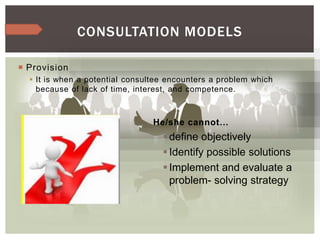
 It is when a potential consultee encounters a problem which
because of lack of time, interest, and competence.
CONSULTATION MODELS
He/she cannot…
define objectively
Identify possible solutions
Implement and evaluate a
problem- solving strategy
 Provision
 The Consultant . . .
 - provide direct service to a third party that calls for no
further intervention from the consultee
 - plan strategies for helping the child cope with his/her
situation and ensure that those plans are followed
 - possible to deal directly with the people supervising the
child or to teach these supervisors to handle the child more
effectively
CONSULTATION MODELS
 Prescription
 1. The information needed to define and solve the problem is
accurate and discussed sufficiently.
 2. The Consultants’ prescribed plan is accepted for
implementation by the consultee as designed
 3. A decision is arrived at as to whether the Consultant,
consultee, or both will evaluate the process and outcomes of
the prescribed plan
 4. The consultee makes known any desire for modifications in
the prescription.
CONSULTATION MODELS
 Collaboration
The goal is to facilitate the consultee’s self- direction
and innate capacity to solve problems.
The Consultant . . .
- helps consultees to share observations, concepts, and
proven practices and examine facilitating forces in both the
immediate and larger environments
- may propose enhancement programs to help consultees
hone their problem-solving skills
- may observe certain facets of the concern that are not yet
appropriately or sufficiently attended to
CONSULTATION MODELS
 Mediation
“The Consultant who recognizes a persisting problem
decides on the most appropriate intervention. Calls together
the persons who have direct contact with the problem and
have the greatest potential to influence desired change.”
The Consultant . . .
 - embark on a study of the situation (what is happening, how it is
happening, among whom it is happening)
 - make strategies for handling the situation
 - presents the matter and the proposal to the administrator or
management
CONSULTATION MODELS
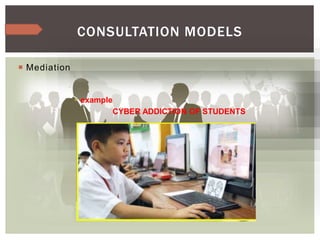
 Mediation
 example
CYBER ADDICTION OF STUDENTS
CONSULTATION MODELS
Consultation service

Consultation service

  • 1.
  • 2.
     consultation involvesfocused collaborative discussion in which people who share concerns work together to identify ways forward.  Collaboration of professional school counselors with parents, students, teachers, administrators and other helping professionals, both within and outside the school setting. CONSULTATION
  • 3.
     Consultation isthe activity engaged in by the individual when his/her expertise is requested by another party or organization, usually enable the latter to assist another-third party or an organization  Consultation is appoint to work with client Goal to empower those involved to assist students in the areas of personal/social, academic and/or career development NATURE/PURPOSE
  • 4.
    -Gibson and Mitchell(1999) the existing need cannot be adequately handled by the individual or organization requesting consultation that Consultant has the special expertise required to assist the requesting party or consultee the consultee has the capacity to carry out the consultant’s recommendations. BASIC ASSUMPTIONS
  • 5.
    the Consultant understandsand takes into consideration the organizational and environmental context within which his/her suggestions will be applied and their consequences BASIC ASSUMPTIONS
  • 6.
     Established aconsulting relationship  Clarify the problem situation  Determine desired outcome  Developing ideas and strategies  Develop a plan STAGES/STEPS IN CONSULTATION PROCESS
  • 7.
     Specify theplan  Confirm the consulting relationship STAGES/STEPS IN CONSULTATION PROCESS
  • 8.
     Provision  Itis when a potential consultee encounters a problem which because of lack of time, interest, and competence. CONSULTATION MODELS He/she cannot… define objectively Identify possible solutions Implement and evaluate a problem- solving strategy
  • 9.
     Provision  TheConsultant . . .  - provide direct service to a third party that calls for no further intervention from the consultee  - plan strategies for helping the child cope with his/her situation and ensure that those plans are followed  - possible to deal directly with the people supervising the child or to teach these supervisors to handle the child more effectively CONSULTATION MODELS
  • 10.
     Prescription  1.The information needed to define and solve the problem is accurate and discussed sufficiently.  2. The Consultants’ prescribed plan is accepted for implementation by the consultee as designed  3. A decision is arrived at as to whether the Consultant, consultee, or both will evaluate the process and outcomes of the prescribed plan  4. The consultee makes known any desire for modifications in the prescription. CONSULTATION MODELS
  • 11.
     Collaboration The goalis to facilitate the consultee’s self- direction and innate capacity to solve problems. The Consultant . . . - helps consultees to share observations, concepts, and proven practices and examine facilitating forces in both the immediate and larger environments - may propose enhancement programs to help consultees hone their problem-solving skills - may observe certain facets of the concern that are not yet appropriately or sufficiently attended to CONSULTATION MODELS
  • 12.
     Mediation “The Consultantwho recognizes a persisting problem decides on the most appropriate intervention. Calls together the persons who have direct contact with the problem and have the greatest potential to influence desired change.” The Consultant . . .  - embark on a study of the situation (what is happening, how it is happening, among whom it is happening)  - make strategies for handling the situation  - presents the matter and the proposal to the administrator or management CONSULTATION MODELS
  • 13.
     Mediation  example CYBERADDICTION OF STUDENTS CONSULTATION MODELS