Emmanual Ahoulou
  Mehak Narula
  Amit Chougule
   Xingtong Li
What is ERP ?
In 1990 ERP CONCEPT was described as an
 innovative business software which can be developed
 to create a shared database acrross multiple business
 units.
ERP is an enterprise –wide information system that
 facilitates the flow of information and coordinates all
 ressources and activities within the organization.
ERP System in SME
 SME uses ERP to reduce costs to improve the profit margins.
 Need of proven methods to streamline operations and improve thheir customer’s
  experience.
 To synchronize changes between systems.
 Consolidates applications could bring more control to cross-functional processes for
  manufacturing, finance, human ressources, marketing and sales.
 Provides a real time enterprise-wide view of the business for faster and more
    effective decision making.
   Shortens production lead times and delivery times.
   Helps build a common vision throughout the enterprise.
   Cross-departmental coordination and execution workflows quite challenging without
    erp solution.
   Consolidates multiple permissions and security procedures into a single framework
    which reduces the risk of losing or exposing sensitive data.
   ERP boost productivity and worker output, it can dramatically reduce operating and
    overhead expenses.
ERP System in SME
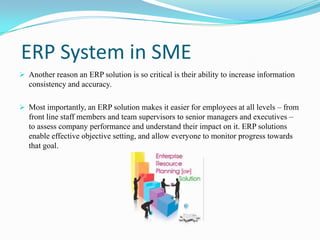
 Another reason an ERP solution is so critical is their ability to increase information
   consistency and accuracy.

 Most importantly, an ERP solution makes it easier for employees at all levels – from
  front line staff members and team supervisors to senior managers and executives –
  to assess company performance and understand their impact on it. ERP solutions
   enable effective objective setting, and allow everyone to monitor progress towards
   that goal.
NEED OF ERP System
 Companies require immediate informations business
  processes( stock, order, profits).ERP gathers all the
  information into a single framework to improve their
  effectiveness.
 ERP system is customizable, standard application
  software includes integrated business solutions for the
  core processes and the main administrative functions.
 SME need to implement an integrated information system
  in order to stay competitive and customer-orient
 Some need to reduce costs constantly to stay competitive
  and increase the profits margins.
BUSINESS PROCESS
REENGINEERING
Processes, organization, structure and information
 technologies are the key components of BPR which
 automates business processes accross the enterprise
 and provide a well designed information system.
Organisation has two options to consider while
 implementing ERP.
ERP implementing strategies.

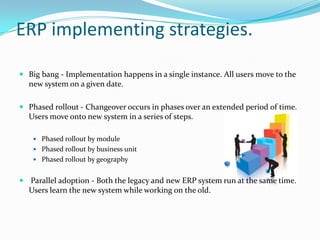
 Big bang - Implementation happens in a single instance. All users move to the
  new system on a given date.

 Phased rollout - Changeover occurs in phases over an extended period of time.
  Users move onto new system in a series of steps.

    Phased rollout by module
    Phased rollout by business unit
    Phased rollout by geography


 Parallel adoption - Both the legacy and new ERP system run at the same time.
  Users learn the new system while working on the old.
Factors affecting ERP
implementation
 Data Provided
 Parrallel Systems
 Training & Testing
 Expectations from ERP systems
 Employee Retention
 Design & Testing
 Stakeholders should be identified in initial phases.
Issues & Challenges
 Awareness
 Perception
 Earlier Implementation
 Approach to Implementation
 Cost
 Change Management
Case Study - Custom Engineering
Solutions
 Two major divisions
   Electromechanical Motors & Equipment
   Electronic Control Systems
 ERP SYSTEM JUSTIFICATION
    The Need for New Systems
    Justifications for a New ERP System
    Support niche market strategy
    Provide better cost data
    Improve the accuracy of financial reporting
An Enterprise Resource
Planning Consultant
 Represents a contractor, firm or team of consultants
  that include project management, technical and
  functional resources or most likely a combination of
  all of these in one.
The Functions of an ERP Consultant
 Knowledge brought by a consultant is the most important asset.

 "Change management," which is part communications, part training,
  part strategy and part hand-holding is another important function. If
  your organization does not change with the system, you get less
  value for your efforts.

 Can act as an advisor - He has been there and done that and can give
  options along with consequences of taking those options.
Benefits
While ERP consultants can be expensive, if used
 properly they can save time and money while
 implementing a more trouble-free system.

One of the key benefits is "knowledge transfer" from
 consultants to your staff, which, if done properly, will
 enable you to become self-sufficient and get rid of
 consultants sooner.
Expert Insight
 Many organizations keep implementation consultants on staff long
  after they have deployed the system. They do this for support and as
  a safety net in case changes are needed to the system configuration
  for business or regulatory reasons.

 Implementation consultants are generally expensive and may not be
  the best suited to application support. Consider instead hiring a
  service geared specifically for system support; these services tend to
  be cheaper and better at system maintenance and troubleshooting
  problems.
Roles
 The various tasks that are performed by ERP consultants are as
  follows:
 Selection of the ERP package.
 Creating equilibrium between system capabilities and
  organizational objectives.
 Present and prospective system analysis and documentation.
 Development, management, implementation and regular
  assessment of the ERP system.
 Imparting education and training to existing and prospective
  users.
Role
   Ensuring steps for effective implementation of ERP.
   Assisting in installation and configuration of the
    ERP system.
   Making sure that the ERP system can be updated to
    satisfy changing business needs.
   They analyze the requirements of the business and
    provide an ERP consulting strategy to satisfy
    business requirements.
   He assists by providing their expertise on
    specialized software modules.
Thank You
 Amit Chougule
    Lille, France.
    amitchougule4433@gmail.com

Consultants role in ERP implementations in SME

  • 1.
    Emmanual Ahoulou Mehak Narula Amit Chougule Xingtong Li
  • 2.
    What is ERP? In 1990 ERP CONCEPT was described as an innovative business software which can be developed to create a shared database acrross multiple business units. ERP is an enterprise –wide information system that facilitates the flow of information and coordinates all ressources and activities within the organization.
  • 3.
    ERP System inSME  SME uses ERP to reduce costs to improve the profit margins.  Need of proven methods to streamline operations and improve thheir customer’s experience.  To synchronize changes between systems.  Consolidates applications could bring more control to cross-functional processes for manufacturing, finance, human ressources, marketing and sales.  Provides a real time enterprise-wide view of the business for faster and more effective decision making.  Shortens production lead times and delivery times.  Helps build a common vision throughout the enterprise.  Cross-departmental coordination and execution workflows quite challenging without erp solution.  Consolidates multiple permissions and security procedures into a single framework which reduces the risk of losing or exposing sensitive data.  ERP boost productivity and worker output, it can dramatically reduce operating and overhead expenses.
  • 4.
    ERP System inSME  Another reason an ERP solution is so critical is their ability to increase information consistency and accuracy.  Most importantly, an ERP solution makes it easier for employees at all levels – from front line staff members and team supervisors to senior managers and executives – to assess company performance and understand their impact on it. ERP solutions enable effective objective setting, and allow everyone to monitor progress towards that goal.
  • 5.
    NEED OF ERPSystem  Companies require immediate informations business processes( stock, order, profits).ERP gathers all the information into a single framework to improve their effectiveness.  ERP system is customizable, standard application software includes integrated business solutions for the core processes and the main administrative functions.  SME need to implement an integrated information system in order to stay competitive and customer-orient  Some need to reduce costs constantly to stay competitive and increase the profits margins.
  • 6.
    BUSINESS PROCESS REENGINEERING Processes, organization,structure and information technologies are the key components of BPR which automates business processes accross the enterprise and provide a well designed information system. Organisation has two options to consider while implementing ERP.
  • 7.
    ERP implementing strategies. Big bang - Implementation happens in a single instance. All users move to the new system on a given date.  Phased rollout - Changeover occurs in phases over an extended period of time. Users move onto new system in a series of steps.  Phased rollout by module  Phased rollout by business unit  Phased rollout by geography  Parallel adoption - Both the legacy and new ERP system run at the same time. Users learn the new system while working on the old.
  • 8.
    Factors affecting ERP implementation Data Provided  Parrallel Systems  Training & Testing  Expectations from ERP systems  Employee Retention  Design & Testing  Stakeholders should be identified in initial phases.
  • 9.
    Issues & Challenges Awareness  Perception  Earlier Implementation  Approach to Implementation  Cost  Change Management
  • 10.
    Case Study -Custom Engineering Solutions  Two major divisions  Electromechanical Motors & Equipment  Electronic Control Systems  ERP SYSTEM JUSTIFICATION  The Need for New Systems  Justifications for a New ERP System  Support niche market strategy  Provide better cost data  Improve the accuracy of financial reporting
  • 11.
    An Enterprise Resource PlanningConsultant  Represents a contractor, firm or team of consultants that include project management, technical and functional resources or most likely a combination of all of these in one.
  • 12.
    The Functions ofan ERP Consultant  Knowledge brought by a consultant is the most important asset.  "Change management," which is part communications, part training, part strategy and part hand-holding is another important function. If your organization does not change with the system, you get less value for your efforts.  Can act as an advisor - He has been there and done that and can give options along with consequences of taking those options.
  • 13.
    Benefits While ERP consultantscan be expensive, if used properly they can save time and money while implementing a more trouble-free system. One of the key benefits is "knowledge transfer" from consultants to your staff, which, if done properly, will enable you to become self-sufficient and get rid of consultants sooner.
  • 14.
    Expert Insight  Manyorganizations keep implementation consultants on staff long after they have deployed the system. They do this for support and as a safety net in case changes are needed to the system configuration for business or regulatory reasons.  Implementation consultants are generally expensive and may not be the best suited to application support. Consider instead hiring a service geared specifically for system support; these services tend to be cheaper and better at system maintenance and troubleshooting problems.
  • 15.
    Roles  The varioustasks that are performed by ERP consultants are as follows:  Selection of the ERP package.  Creating equilibrium between system capabilities and organizational objectives.  Present and prospective system analysis and documentation.  Development, management, implementation and regular assessment of the ERP system.  Imparting education and training to existing and prospective users.
  • 16.
    Role  Ensuring steps for effective implementation of ERP.  Assisting in installation and configuration of the ERP system.  Making sure that the ERP system can be updated to satisfy changing business needs.  They analyze the requirements of the business and provide an ERP consulting strategy to satisfy business requirements.  He assists by providing their expertise on specialized software modules.
  • 17.
    Thank You  AmitChougule  Lille, France.  amitchougule4433@gmail.com