








Page 1 of 38
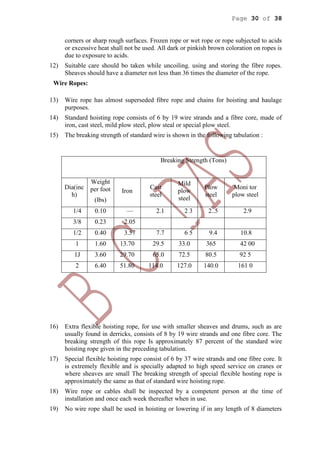
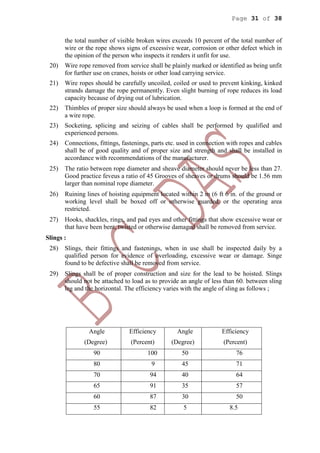
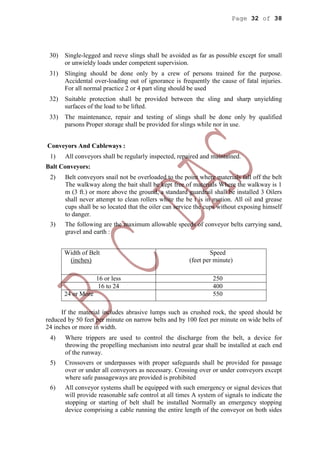
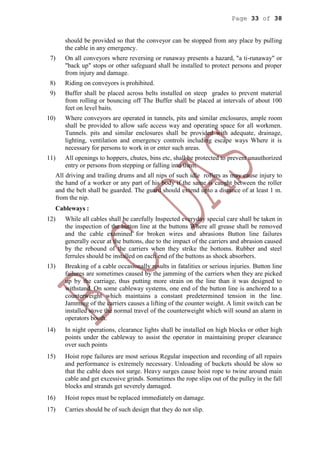
There are many complex situation during work in excavation, fabrication, erection and
testing are undertaken. The job hazards involves are present here.
This was in the book form circulated among the employees who works under project
areas..
At present this book is not available. So it is given here for those working in SAL/ Bokaro
Steel Plant for reference.
CONTENTS
CHAPTER • 1 EXCAVATIONS :
1) Open Excavations - Earth & Rock.
2) Tunnel and shaft Excavation.
3) Coffer Dams-Construction & Maintenance.
4) Demolition.
CHAPTER - 2 EXPLOSIVES AND BLASI ING :
1) General.
2) Supervision & short Firing.
3) Transport & Handling.
4) Storage.
5) Rock Blasting.
CHAPTER - 3 CONSTRUCTION :
1) Scaffolds.
2) Platforms, Gangways and Runs.
3) Ladders.
4) Openings, Dangerous corners, Breaks or Edgos and Stoping Surfaces,
5) Form construction & concrete placement.
6) Grouting and Guniting.
7) Structural Stool Erection.
8) Welding & Cutting.
9) Painting.
CHAPTER • 4 PLANT & MACHINERY ;
1) Tools & Hand Tools.
2) Drills.
3) Ropes, Chains & Slings.
4) Conveyors & cableways.
5) Light Equipment.
6) Lifting appliances.
Page 2 of 38
CHAPTER : I
EXCAVATIONS
Open Excavations earth And Rock :
1) Sides of every excavation, where there is danger of fall or dislodgement of earth, rock
or other material forming the side of or adjacent to any excavation shall be securely
supported by adequately braced timber of suitable quality or other material unless the
sides of the excavation are sloped to a safe angle.
Safe-angle moans angle greater than angle of repose of the material when saturated.
2) No excavation or earth work below the level of any foundation of a building or
structure shall be commenced or continued unless adequate steps are taken to prevent
danger to any person from collapse of the structure or fall of any part thereof.
3) In every excavation work along sloping ground, sides and slopes of excavation shall
be maintained in a safe condition by scaling, benching or barricading. Loose eatth-and
loose rock shall be continually scaled down. Each worker shall be provided with a
safety helmet and a safety belt attached to a safety line. On steep slope, workers shall
not be permitted to work on the above the other. All Scaling work shall be done under
the immediate supervision of an experienced foreman.
4) Trenches : Excavation, if over 1.2 m in depth, unless in solid rock or hard Shale, shall
be either shored, sheeted and braced or sloped to an angle greater than the angle of
repose of the material when saturated. All shoring and bracing shall extend to the
bottom of excavation where necessary.
5) To hold banks of loose and unstable materials from sliding, adequate shoring shall be
used and under-cutting of bonks shall not be permitted. The bracing and shoring of
trenches shall be carried out along with the excavation.
6) Additional precautions by way of shoring and bracing shall be taken to prevent slides,
slips or cave ins when excavations or trenches are made in locations subject to vib-
rations from railroad or highway traffic, or the operation of machinery or any other
source of vibration.
7) Materials used for bracing, shoring, etc. shall be in good serviceable condition and
timbers shall be sound and free from large or loose knots.
8) Excavated or other material shall not be stored nearer than 1 m. from the edge of any
excavation and shall be so stored and retained as to prevent its falling or sliding back
into the excavation and to prevent excessive pressure upon the sides of the excavation.
9) In all trenches 1.5 m or more in dopth, ladders extending from the floor of trench to at
least 1 m. above the top shall be provided and so located as to provide means of exit
intervals of not more than 15 2m.
10) Excavation areas shall be adequately lighted for night work.
11) During the hours of darkness all public side walks and walkways shall be adequately
illuminated and warning lights about the excavation shall be placed to ensure safety of
pedestrians and the vehicular traffic.
Page 3 of 38
12) At all approaches and exits of the sites of excavations danger and warning signals
shall be placed. To emphasize the danger a flagman with a red flag shall also be
posted to warn the public of approaching trucks and to direct trucks in and out of the
site of excavation.
12. At very accessible part of an excavation pit or opening in the ground deeper than 2
m, a suitable barrier to a height of 1 m shall be provided.
Inspections and Examinations :
13) No person shall work in any excavation, shaft, earthwork or tunnel unless all
limbering and plant used therein are inspected by a competent person before work is
started and also after explosives have been used in or near the excavation, shaft,
earthwork or tunnel.
14) After every blasting operation, side slopes of excavations shall be carefully examined
by a competent person to prevent rock falls; work inside excavations shall not comm-
ence until all loose rock on the sides is removed. All workers engaged in such
excavations shall use safety helmets.
15) No material or load shall be placed or stacked or removed near the edge of any
excavation, shaft, pit or opening in the ground so as to endanger persons employed
below.
16) Adequate measures shall be taken to prevent workers and operators from approaching
dangerous areas. Visitors shall not be allowed on the scene of excavations unless they
are accompanied by a supervisor.
Tunnel And Shaft Excavation :
1) All tunnel walls and roofs shall be carefully inspected frequently and thorough scaling
end removal of loose rock should be carried out to prevent rock-falls Every part of the
area where tunneling is done shall be adequately illuminated. There shall be good
house keeping and safe walkways shall, be provided. All tunnel workers shall wear
safety helmets and hard-too safely shoes.
2) In every excavation of sh3ft and tunnel, sufficient safe means of access shall, so far as
is reasonably practicable, be provided to every place at which any person has at any
time to work.
3) In tunneling, the drilling rigs shall be carefully designed, built and maintained. High
drill rigs shall be provided with suitable railings around the top decks. All drilling shall
be done wet. All the safety precautions for drilling or for the use of drills shall be
taken.
4) Care shall be taken in handling and use of explosives. The loading of a round shall be
completed preferably by the crew starting the work. Firing of round shall be the
responsibility of one man.
5) After blasting inside a tunnel or shaft, scaling and removal of rock or loose material
shall not commence unless the roof and walls of the tunnel and sides of the shaft are
carefully inspected by a competent person and loose rock from the roof and sides is
removed or unstable material is properly supported by shoring to prevent rock falls.
6) Dump cars shall be kept in good repair and shall be equipped with safety couplers. The
use of rolling equipment with link couplers shall not be permitted. Rocker or cradle
type dump cars shall be provided with a positive type lock to prevent accidental
dumping. Dump cars shall not be overloaded.
Page 4 of 38
7) A) Motive power, other than electric, shall not be used without prior authorisation
from the project head. No petrol engines shall be used underground. Diesel
locomotives shall not be used underground unless equipped with a filter that will
remove all carbon monoxide and oxides of nitrogen. Such filters shall be inspected in
each shift by the master mechanic and more frequently by the locomotive operator
B) Every locomotive shall have headlights on each end. It shall be equipped with
whistles or horn with a tone of sufficient volume to be heard by men along the track
when the air drills are working.
8) The tracks shall be properly laid using rails of sufficient weight and shall be kept in
safe operating condition.
9) The ventilation system shall be adequate to maintain pure air in all parts of tunnel and
shafts.
A. Air shall be considered unfit for workmen to breathe if it contains any of the
following :—
 loss than 19 percent oxygen by volume.
 More than 1 percent carbon dioxide by volume
 More than 0.02 percent carbon monoxide by volume.
 More thane 0.005 percent hydrogen sulphide by volume.
 More than 0.002 percent oxides of nitrogen.
 Any other poisonous gas in harmful amounts.
Air containing more than 1.5 percent by volume of flammable gas shall be considered
dangerous.
B. In addition to the requirement given above, there shall be furnished 2.2M/3 of air
per minute for each bracke horse power of diesel locomotive used in the tunnel.
10) Sufficient general lighting shall be provided in the tunnels and shafts so that tho
pedestrians shall have no need to use hand torches for walking safety.
11) All electric wiring shall be extra-heavy insulated and of sufficient capacity
supported on insulators of approved type and not looped on or tied to spikes,
ventilating pipe, or other makeshift supports. All switches shall be of the enclosed
safety type. Lines shall be located so as not to create an electrical or tripping hazard
to workers.
12) No inflammable material or oil and grease shall be stored inside or near the tunnels
or shafts and all combustible rubbish from the tunnel or shaft shall be promptly
removed.
Shaft Excavation :
13) Head frames for shafts shall bo of open framework design and constructed of
sound fire resisting materials. All sheaves should be of the proper diameter for the
cable or hoist rope used, be amply strong, properly mounted and frequently
inspected.
14) A) Covered stairways at least (76 CM) wide shall be erected in all shafts except
during the sinking period. A recommended method is to sink a separate shaft
alongside o f t h e main shaft in which a spiral stair shall be erected. The surface
opening of this main shaft shall be housed with a fire-proof structure. If it is not
possible to construct such a stairway, a isddor shall be installed with landings at
Page 5 of 38
every 2o feet of sufficient width to permit men to pass. Where one or more drifts
are to be driven from the shaft, landings shall also be provided at each drift in the
manshaft. The rungs of a ladder shall in no case be less than 15 CM from the wall
or from any obstruction in the shaft or opening. Under no circumstances shall a
ladder be installed inclining backwards from the vertical. Should it become
necessary to offset a section of ladder way. the top of a section shall extend not less
than (92 CM) above the bottom of the section above or hand hold shall be provided.
The side rails of the topmost section shall extend at least 92 CM above the ground.
B) Fixed ladders of standard construction shall be provided for access to cable sheaves on
hoad frames located over tunnel shafts. A runway or platform equipped with guard
rails and tee boards shall also be provided next to cable sheaves
C) Timbers and projections on which debris may lodge in other ways and stairways in
daily use shall be regularly cleaned of all loose rock and other debris.
15) All hoisting equipment, including ropes and cables shall be thoroughly inspected at
least once a week and maintained in good condition. Hoists shall never be loaded in
excess of the maximum safe load. Muck buckets shall not be heaped up and no one
shall remain under a bucket while it is being hoisted Like tunnel workers, hard hats
and hard-toed shoes shall be worn by everyone engaged in shaft excavation. When
hauling tools that project above the rim of the bucket, the tools should be loaded in
such a manner that neither the bucket nor the tools shall come in cc mract with the
side walls of the shaft.
16) Where tunnels are driven from shafts and a communication system is required, a
telephones system shall be established. Ready communication must be maintained
between the surface, shaft and underground stations.
17) The shaft shall be protected with a two rail guard rail at least (92 CM) high, with n
toe boards to proven* material from falling into the shaft. The gate opening into the
shaft shall be closed at all times except when necessary to enter or leave the shafts
or to empty the bucket or send materials down the shaft, preferably the gates should
be automatic in operation.
Coffer Dams - Construction And Maintenance.
General:
1. Every coffer dam or caisson and every pa t thereof shall he of goods construction,
suitable and sound material and adequate strength. It shall be properly maintained. Its
construction, additions, or alterations end dismantling including all work connected
therewith shall be supervised by a competent person.
2. A coffer dam or caisson shall, where necessary. be specially secured in position so as
to prevent movement in a manner dangerous to persons employed.
3. In any coffer dam or caisson there shall, so far as is reasonably practicable, be
adequate means for persons to reach places of safety in the event of an Inrush of water.
Inspection and Examination :
4. No person-shall be employed in a cof.er dam or caisson unless it has been inspected
once a day by a competent person and also after explosives have been used in or near
the coffer dam or caisson in a manner likely to effect its strength and stability.
Necessary entry to the effect that the coffer dam or the caisson has been inspected shall
be mode in the register prescribed for the purpose.
Attendance and Equipment:
Page 6 of 38
5. No person shall be employed under water as a diver.
except for shallow depth where skill divers are employed. unless :
a) A sufficient number of competent persons are employed in attendance upon him as to
ensure his a safety, and
b) There are provided and readily available, in good working order, sufficient and
suitable diving plant and equipment, including air pumps, pressure gauges and means
of access to and from water and including at least one diving dress one complete set of
woolen clothing in excess of the number of divers under water at any one time, and
c) Another diver above water provided with suitable equipment and plant is immediately
available to the assistance of any diver under water in emergency.
Test and Examinations ot Equipment :
6. All diving equipment shall be initially tested and thoroughly examined by a competent
person and thereafter thoroughly examined by him in every period of three months and
record of such tests and examinations entered in a register maintained for the purpose.
7. Air pump, air lines and diving helmet shall be thoroughly examined for any defect
every time before they are put to use.
Signalling :
8. In all diving operations, efficient signaling system to enable the d ver to be in
communication with his attendant shall be maintained.
Medical Examinations :
9. No person shall be employed under water as a diver unless he has with in the previous
four days been examined by A registered medical practitioner appointed by the depart-
ment. or by the principal employer or appointed under any law in force and certified
him to be fit to dive
DEMOLITION :
1. All demolition work shall be placed under the supervision of a competent person
experienced in demolition work.
2. During demolition work all electric cables and water, gas or steam pipes shall be
disconnected except which are used for the operations.
3. All practical steps shall be taken to prevent danger to persons employed from risk of
fire or explosion due to gas, vapour or following due to water from water mains,
sewers and culverts
4. All practical steps shall be taken to avoid danger from collapse of the structure when
any part of the framing is removed from a framed or party framed structure which
may endanger life of any person employed.
5. Before demolition is commenced and also during the progress of the work,
precautions shall where necessary, be taken by adequate shoring or otherwise to
prevent, as far as practicable, the accidental collapse of any part of the structure or of
any adjoining structure the collapse of which may endanger any person employed.
6. Warning signs and red lights should be placed wherever there is danger to public, and
the structure under demo- lit on should be adequately barricated so that public are kept
away from the hazardous area.
CHAPTER : 2
Page 7 of 38
Explosives And Blasting
General :
All operations involved in transportation, handling, storage and use of explosives shall
be as per Indian explosives Act and shall also conform with the provisions made here-
under.
Supervision And Shot Firing :
1. Explosives shall be handled by or under the supervision of competent persons who are
fully experienced in the work and who received adequate instructions as to the
dangers connected therewith and the precautions to be observed.
2. No shot shall be fired except by a competent person authorised by the employer.
3. Blasting shall be done at regular hours which should be conspicuously posted in the
blasting area.
Transport And Handling :
1. Explosives shall not be transported on the site of operation except in a suitable case or
canister which is so made as to prevent any escape of explosives and any danger of
spark or other source of ignition during conveyance. No explosive shall be removed
from such case or canister except when it is to be used fourthwith for the purpose of
the work.
2. No explosive shall be transported in a mechanically propelled vehicle unless such
vehicle is locked and is of a type approved in writing by the Chief Inspecter of Explo-
sives. The following rules should also be observed.
a) Vehicles must have springs under the body.
b) Detonators and ignitors must not be carried in the same vehicle with
explosives.
c) The speed of vehicle must not exceed 24 Km. per hour.
d) Besides the driver only one more helper shell be accommodated in the vehicle.
The vehicle carrying the explosives trust not be used to transport workmen or
other materials to workspot6 although there trey be enough space for men or
materials.
e) Drivers must not leave the vehicle unattended while transporting explosives.
f) All vehicles transporting explosive shall be marked or placarded on both sides
and ends with the word "EXELPOSlVES" in white letters not less than 8 cm.
high on a rad background.
g) A motor vehicle carrying explosives should not be re- fuelled except in
emergencies and then only when motor is stopped and other precaution taken to
prevent accidents Such vehicles should invariably have to least two fire
extinguishers placed at convenient points.
h) All vehicles transporting explosives shall never be taken into a garage, or
repair shop, or parked in congested areas, or stored overnight or at any other
time in a public garage or similar building.
i) Explosive shall not be transported on a public highway during hours of
darkness except in extreme emergency and only with the written approval of the
project official.
j) Explosive shall not be transported in any form of trailer, no shall any trailer be
attached to a motor truck or vehicle hauling explosives.
k) No transfer of explosives from one vehicle to another shall be made on any
highway except in case of emergency.
Page 8 of 38
l) Persons employed in the transport or handling of explosives should not carry
with them or in the vehicle, matches fire arms or any flame-producing devices.
m) All explosives should be adequately protected against theft.
n) Smoking shall be prohibited during handling and transport of explosives.
3. Motor vehicles used for transporting explosives shall be carefully inspected daily to
determine that:
a) Fire extinguishers are filled and in place :
b) The electric wiring is well insulated and firmly secured :
c) Chasis, engine and body are clean and free from surplus oil and grease :
d) Fuel tank and feed lines are not leaking.
e) Lights, brakes and steering mechanism are in good working order; and
f) Vehicle is in proper condition in all respects for the safe transportation of
explosives.
4. Boxes of explosives should not be handled roughly or allowed to fall.
5. Containers of explosives shall be opened only by means of non-sparking tools or
instruments.
6. After the loading of a blast is completed, all excess explosives and detonators shall be
removed to a safe location or returned at once to the storage magazine,
observing the same rules as when being conveyed to the blasting area.
7. Containers for detonators shall always be used only for storing detonators.
Storage :
1) The magazine should, at all times be kept scrupulously clean. High explosives like
dynamite should be stored in dry, clean, well ventilated, bullet-proof and fire-proof
building, on an isolated site The area around the magazine for a distance of 7.7M.
shall be kept clear of all vegetation and Combustible matter.
2) No unauthorised person is at any time to be admitted into the magazine.
3) The person in charge of the magazine is to take care that the magazine is well and
securely locked.
4) The magazine is on no account to be opened during, or on the approach of a
thunderstorm, end no person should remain in the vicinity of The magazine during
such storm
5) Magazine shoes without nails should be kept at all times in the magazine, and a
wood tub or cement trough about one foot high and eighteen inches in diameter,
filled with water should be fixed rear the door of the magazine.
6) Persons entering the magazine must put on the magazine shoes provided for the
purpose, and be careful not to allow the magazine shoes to touch the ground outside
the clean floor.
7) Persons with bare feet shall, before entering the magazine, dip their feet in water,
and then step direct from the tub over the barrier (if there is one), on to the clean
floor.
8) A brush or broom should be kept in the lobby of the magazine for cleaning the
magazine on each occasion it is opened for the receipt, delivery or inspection of
explosives.
9) Light should be obtained from an electric storage battery lantern. Electric lights
from the supplying maim taken through conduit wiring and properly earthed may be
obtained with the approval of Chief Inspector of Explosives.
10) No matches should be allowed in a magazine.
11) No person having articles of steel or iron on him is to be allowed to enter a
magazine.
Page 9 of 38
12) Only cotton rags, waste and articles liable to spontaneous ignition, should not be
taken into a magazine
13) Workmen, sweepers, etc. should be examined before they enter the magazine to see
that they have none of the articles mentioned in rules 10, 11 and 12 on their person.
All other men entering a magazine shcu o net also have such articles on their person.
14) No tools or implements other than those of copper. brass, gun mital or weed should
be allowed inside the magazine. Tools should only be used with great gentleness and
care.
15) Boxes of explosives should not be thrown down or dragged along the floor and
should be stacked on wooden trestles. Where there are white ants, the legs of the
trestles should rest in shallow copper, lead or brass bowls containing water.
16) Packages containing explosives should not be allowed to remain in the sun.
17) The order of storing should be such as to allow the oldest explosives to be used first.
18) Empty boxes should not be kept in the magazine nor any loose packing material.
19) Blasting caps and electric blasting caps should never be stored in the same box,
magazine or building with other explosives.
20) The following should be hung up in the lobby of the magazine :
a) A copy of these rules;
b) A statement showing the stock in the magazine and
c) Certificate showing the last date of testing of the lighting conductor.
21) All magazines which contain more than 250 lbs. of high explosives should be
inspected at least twice a year by the office in direct charge thereof and other
magazines at least once a year. High explosives are those which are habitually fired
by detonation and used where a destruction rather than a propellant effect is aimed
at, and include such explosives as Blasting Gelatin-, Carbonite. Dynamite. Glignite,
Phoenix Powder, Roburite. tonite and Ammonal.
Rock Blasting :
1) Drilling
a) The position of ail holes to be drilled must be marked out with white paint thus
'O’.
b) All holes shall be of greater diameter than the diameter of the cartridges of
explosives used.
c) Loading and drilling shall not be carried out at the same time in the same area.
d) A drill, pick, or bore shall not be inserted in butts of old holes oven if examination
fails to disclose explosives.
e) Drilling shall not be resumed after blasts have been fired until a thorough
examination has been made to make sure that there are no unexploded charges
which the drills may strike.
f) Drilling shall not be started until all remaining butts of old holes are examined for
unexploded charges.
g) Rock drillers should be provided with approved, respirators in siliceous, dusty
atmosphere, arising cut of crilling operations.
Loading :
a) Bore holes must be cleared of all debris before a cartridge is inserted.
b) In loading bore holes, temping shall be done with a wooden stick having no
exposed metal parts.
c) Primed cartridges shall be seated by even steady pressure only.
Page 10 of 38
d) All loaded holes or charges shall be checked and definitely located before firing.
e) When holes are sprung, ample time shall be left between spring shots for the holes
to cool, and also between the last springing shot and the loading of the main
charge.
f) When practicable no more cartridges shall be primed than are required for a round
of blasting.
g) Detonators shell be inserted only in a hole in the end of a cartridge prepared
specially for that purpose.
h) Holes in cartridges shall be made with a sharpened wooden stick,
i) All charges, before being fired, shall be covered with blasting mils where blasting
is done in the vicinity of structures likely to be injured by flying debris.
j) Detonating cord shall be cut from supply reel before attaching to explosives or
tamping in hole. Use of short pieces of fuse shall be prohibited for detonation
purposes.
Wiring :
a) All electric caps in a bla9t shall be of the same manufacture
b) Each electric blasting cap shall be tested with an approved galvanometer before and
after temping in a hole to determine whether it will carry the current
c) After testing the leg wires of electric blasting caps they shall be short circuited by
twisting the bare ends together a id shall remain so. Twisted untill ready to be con-
nected into the circuit preparatory to connecting to the firing line
d) Unless the power supply is heavy, it is recommended that ail electric blasting caps
shall be wired in series and the firing the shall not be smaller than No. 14B and S
gauge copper wire
e) The number of electric blasting caps used in a circuit shell not exceed the tested
capacity of the blasting machine, or power source.
f) The circuit, including all caps, shall be tested with a circuit tester or galvanometer,
operating accurately, before being connected to firing line.
g) The complete blasting circuit shall be checked with a circuit tester or
galvanometer, operating accurately, before being conacted to the source of power.
h) Cartridge shall not be primed nor holes loaded during the approach of a
thunderstorm or while it is in progress If a charg9 has been primed or holes loaded,
person should be ordered to a safe distance until the storm is over.
i) Blasting circuit wires shall never touch on other wires carrying electric current.
Blasting operation control shall consist of two switches. a safety switch and a firing
switch located at least 6 feet a Part, the connection between the switched to be
made by a ' Plug in*' jumper which may be permanently attached to the safety
switch The Plug in is so made that it cannot be plugged into or connected to the
firing switch until the firing switch is unlocked, and the jumper must be
disconnected from the firing switch before the firing switch c in be locked
j) K) Both the safety switch and the firing switch shall be of the locking, double pole,
double throw type which when opened and locked in downward position short
circuit and ground the leading wires.
k) Both the switches shall be locked immediately after tiring »he shot and before any
person is allowed to the area Keys to the switches shall remain in th8 possession of
the starter at all times.
Fuse Blasting:
l) The length of fuse to be used in blasting shall, in no case, be less than 75 cm but
should not be less than that required by State law if any.
Page 11 of 38
m) Blasters or shot firers should be cautioned always to use sufficient lengths of fuse
to permit them to reach a safe place before the first hole is fired Th8 fuse lengths
given in the following table are suggested for normal conditions :
( 18 ) Fuse Lengths
Number of
holes
Burning Rate 40 Seconds per
foot
Burning time
4 10 6* 0" 4 min
11 12 7* 0" 4 Min. 40 sec.
n) Not more then 12 holes shell be loaded and that at one time if cap and fuse
are used to detonate the charge.
Mudcap Blasting:
o) Mudcap blasting is inefficient and dangerous ard should be avoided Two or
more mudcaps shall not be placed on one rock except when electrically
detonated
Firing :
a) Shots shall, so far as practicable, be fired electrically and apparatus
especially designed for the purpose only shall be used.
b) The charge should be fired, as far as practicable successively and net
simultaneously.
c) Prior To the firing of a shot, all persons in the blasting area shall he
warned and ordered to a safe distane from the area.
d) Competent flagmen, equipped with red flags. shall be assigned to stop
traffic at access points, on each possible route of travel, at a safe distance
from blasting area
e) Blasts shall not be fired until it is absolutely certain that every person has
retreated to a safe distance.
f) The person in charge of blasting shall be the last one to leave the area to be
blasted.
g) The signal to fire shall be given only by the person in charge of the
blasting.
h) A loud prearranged warning sir.gel shell le given at a proper tire before
firing a blast.
i) Definite places of shelter, natural or artificially constructed, shall be assigned to
the crew. Men should be made to go to these shelters rather than depend upon each
man's judgement as to a safe place.
Inspection after Blasting :
a) Immediately after a blast has been fired, the firing line shall be disconnected from
the blasting machine or other source of power.
b) After a blast has been fired, a careful inspection should be made by the blaster to
determine if all charges has exploded. The blaster shall count the number of the
exploding shots in blasting Misfires in fuse blasting shall not be examined for at
Page 12 of 38
least 10 hours after its failure to explode. Electric blasting misfires shall not be
examined for at least 15 min. after failure to explode. Other person shall not be
allowed to return to the area of blast until an ‘All Clear' signal is given.
c) All wires shall be carefully traced and search made for any unexploded cartridges
by the man In-charge of no blasting operation.
d) Loose pieces of rock and other debris shall be scaled down from the sides of the
face of excavation and me aria made safe before proceeding with the work.
Misfires:
a) Misfired holes should be placed in-charge of a competent person.
b) If broken wires, faulty connections or short circuits are likely or found to be the
cause of the misfire, proper repairs shall be made, the firing line reconnected, and the
charge fired. This shall be done, however, only after a careful inspection has been
made of burdens remaining in such holes and no hole shall be so fired when the
burden has been dangerously weakened by other shots.
c) The charge of explosives from a misfired hole shall not be drilled, bored or picked
out.
d) Misfired charges temped with solid material shall be detonated by the following
method where practicable; float out the stemming by use of e water or air jet from a
hose until the hole has been opened to within 61 Cm of charge, then siphon off or
pump out water, place new charge and detonate. Whenever this method is not
practicable, then drill a new hole not nearer than 61 cm load and detonate. A careful
search shall be made of unexploded material in the debris of the second charge.
Tunnel and Shaft Blasting :
a) Only electrical blasting shall be adopted for shaft and tunnel work.
b) A separate circuit independent of power and light circuits shall be used for blasting.
c) No electrically energized circuit shall be installed on the same side of the shaft or
tunnel with the blast eg circuits.
d) Stray currents have caused many fatalities while loading, and utmost care is necessary
in removing all faults from electrical circuits. All electric lights, or other energised
circuits shall be disconnected for at least 61 M from the point of loading.
e) All tracks, airlines, and vent pipes shall be kept properly grounded
f) For loading purposes the employees shall be equipped with permissible battery lamps.
g) The safety switch and the firing switch shall be placed on opposite sides of the tunnel.
h) Only explosive which produce less than 4700 Cu cm poisonous gas (carbon monoxide
and hydrogen sulphide) per 3.2cm x 20 cm cartridge shall be used for shaft and tunnel
work.
Open Lights:
No fire, flame, smoking or open lights shall be allowed within 6.6m from any
explosive except for the purpose of firing a charge.
Warning Notice :
Adequate warning notices shell be given to all persons employed indicating the
period of dancer at the time of firing end it shall be the duty of every employer to
provide adequate shelters or screens for protection of workers exposed to risk of
injury from the explosion or from flying material.
Explosives Register :
There shall be kept by the employer or his agent a register of explosives in which
Page 13 of 38
particulars cf all issues end returns, particulars of explosives used in each blasting
operation and particulars of misfired shots shall be entered
CHAPTER - 3
Construction
Scaffolds:
1. Scaffolds of adequate type shall be provided for all work that cannot be
done from the ground or from part of a permanent structure or from a ladder
or ether available means of support and safe means of access shall be
provided to every place at which workers may be required to work.
2. Every scaffold and every part thereof including supports shall be of good
construction of suitable and sound material and of adequate strength for the
purpose for which it is used and it shall be properly maintained.
Construction and dismantling of every scaffold shall be under the
supervision of a competent person. Boards and planks used for the floors
shall be of uniform thickness, butt jointed, closely laid end securely
fastened in place
3. Every scaffold shall be securely supported or suspended and shall, where necessary
be sufficiently and properly strutted or braced to ensure stability The use of braces
or framework as means of access to the working surface shall not be permitted.
4. All scaffolds or working platforms of any nature shall be securely fastened to the
building or structure, or if independent of the building or structure, or if
independent of the building shall be braced or guyed to prevent swaying.
5. In the construction of dams sufficient anchorage shall be provided in the dam itself
at the time of construction. The projecting anchorage shall be cut off only on
completion. It is safer to avoid support on the sloping runners The joints should be
provided with bolts and nuts and not bent rods.
6. Life boats shall be provided for rescuing workmen who might fall into reservoir
impounding river water while construction is in progress.
Suspended Scaffolds :
1) Outriggars or other means of supports of suspended scaffolds shall be of adequate
length and strength, properly constructed, installed and securely fixed by anchor
bolts or other equivalent means
2) Ropes, chains, or other means of suspension shall be of good construction, sound,
material, adequate strength and free from patent defects and properly secured. The
ropes and chains shall have a factor of a safety of 8
3) The platform shall not be less than 45 Cm. (17 inches) wide and points of
suspension not more than 3 m (10 ft.) apart and so arranged or secured that at the
working position the edge is as close as practicable to the working face when
persons have to work in a sitting position.
4) All rolling scaffolds shall be equipped with a positive locking device to prevent
accidental movement of the scaffolds These shall be periodically tested.
5) Suspended scaffolds shall be tested as frequently as may be necessary to ensure that
minimum safety factors are maintained The test will be made by raising the
working surface one ft above the ground and loading it with at least two times the
maximum weight likely to be imposed upon it.
Page 14 of 38
6) Skips, buckets, and similar equipment shall only be used for work of short duration
when use of suspendcd scaffold is unreasonable and shall be used under the
supervision of a responsible person. The skip, bucket or basket shall be at least 75
cm inches deep.
7) Trestle scaffolds shah not be of more than three tiers and the working platform
shall not be more than 4.5M above the ground or floor or other surface upon which
the scaffold is erected, and no trestle scaffold shall be erected on a suspended
scaffold.
8) Men shall not be allowed to work from scaffolds during storms or high winds.
9) It scaffolds are to be used to a great extent or for a long period of time, a regular
plank stairway, wide enough to allow two people to pass, shall be erected. Such
stairways shall have hand rails on both sides.
10) When work is being performed above a scaffold platform a protective overhead
covering shall be provided for the men working on the scaffold.
11) Whenever workmen have to work or constantly pass under a scaffold on which
men are working a screen or other protection shall be provided to catch any
falling material. Such protection shall extend outside the scaffold proper, in
order to catch any material falling off the edges of scaffold platforms. 1.25 cm
wire mesh netting of No 18 guage or better may be used for this purpose.
12) Side screens shall be provided on scaffolds erected along passageways or other
thoroughfares.
13) On high scaffolds a netting or equivalent guard s tall be provided for the space
between toe boards and railings.
14) During dismantling of scaffolds necessary precautions shall be taken to prevent
injury to persons due to fall of loose materials, bracings and other members of
the scaffolds shall not be removed prematurely, while dismantling the entire
scaffold shall be maintained stable and rigid so as to avoid the danger of
collapse. Nails from the planking and various members of the scaffold shall be
carefully removed and all material carefully piled.
Bali Stagings:
Bali staging are commonly used for staging upto a height of 12.2 m. These
stagings shall be designed and erected with adequate bracings securely fastened
under the supervision of an experienced and competent person regularly inspected
and properly maintained.
Platforms Gangways And Runs :
1) All working platforms gangways and runs from which workers are liable to fall
more than 2m shall be.
a) Of adequate width depending upon the type of work done and closely boarded
planked or plated. For platforms the width shall not b^ less than 63 Cm For
gangways and runs the minimum width shall be 43 Cm. but when such
gangways or runs are used for passage of materials the width shall not be less
than 63 Cm.
b) Provided with suitable guards rails of adequate strength to a height of 1 m
above the working surface and toe boards of at least 20 Cm. in height to prevent
fall of persons, materials or tools.
2) Every platform gangways run or stairs shall be kept free from any unnecessary
obstruction, material or rubbish and from any projecting rails, and when they
become slippery appropriate steps shall be taken by way of sanding, cleaning or
otherwise to remedy the defect.
Page 15 of 38
3) Each supporting members used in the construction of runways, platforms, ramps
and scaffolds shall be securely fastened braced. The supporting member shall be
placed on a firm, rigid smooth foundation of a nature that will prevent lateral
displacement. The thrust-out members from which a scaffold is suspended shall, ba
sufficiently strong and shall extend at least one foot outside the platform being
suspended and have a stop block or bolt at the other end
4) Each supporting members used in the construction of runways, platforms, ramps
and scaffolds shall be securely fastened braced. The supporting member shall be
placed on a firm, rigid smooth foundation of a nature that will prevent lateral
displacement. The thrust-out members from which a scaffold is suspended shall, be
sufficiently strong and shall extend at least one foot outside the platform being
suspended and have a stop block or bolt at the other end
Platforms :
6. The minimum uniformly distributed design load per sq. cm of platforms shall be 26.5
gm. In case of stone masons it shall be 75 lbs. per so. ft. (38 gm./sq. cm.) Any concen-
trated load e» any point in the span shall not exceed the designed uniformly distributed
load. A factor of safety of Planking shall not be less than 5 cm. thick shall be adopted
7. A scaffold platform plank shall not project beyond its end supports to a distance
exceeding four times the thickness of the plank unless it is effectively secured to
prevent tipping.
8. Cantilever of scaffolds planks shall be avoided. Ledgers or putlogs shall be erected to
support the ends of such planks.
9. Where planks are butt jointed, two paralleled putlongs must be used, not mar? than 20
cm apart, giving each plank sufficient support.
10. The following minimum widths of platforms for various types of scaffolds are
recommended :
a) Where platform is not more than 1.8 m above the ground or solid floor.
b) For painters, decorators and similar workman ... . 30 cm
c) For other types ( Men and Tools only ) .... 50 cm.
11. Where platform is more than 1.8 m above the ground or solid floor.
a) For men tools, and materials … 120 cm
b) For men, tools materials and vehicles …150 cm
Gangways and Runs :
1) All planks forming a gangway or run shall be so fixed and supported as to prevent
under or unequal sagging.
2) No gangway or run the slope of which exceeds I vertical to horizontal shall be used.
3) Where the slope of a gangway or run renders additional foothold necessary, and in
every case where the slope is more than I vertical to 1.5 horizontal, there shall be provi-
ded proper stepping laths which shall:
a) be placed at suitable intervals, and.
b) be of the full width of the gangway or run except that they may be interrupted
over a width of not more than 10 cm. to facilitate the movement of barrows.
Note :
When any worker is working at a high place more than 2 m from the ground, and if an
adequate scaffolding as per the specifications given in these regulations has not been or not
practicable, he must wear a safety belts the life line of which is securely fixed or hooked to
Page 16 of 38
any fixed structure, failing which a net properly and securing anchored and fixed below
has been provided to prevent the worker from falling on the ground and receiving injury.
The safety belt should confirm to the i.e. specifications. should be light and fitting
conveniently and should be carefully examined every day before use.
A life belt is no substitute for a standard scaffolding or working platform and should be
used only when an alternative is not practicable and the job is of a short duration.
A life belt is no substitute for a srandard scaffolding or working platform and should be
used only when an alternative is not practicable and the job is of a short duration.
Ladders :
1) Every ladder and step-ladder shall be of good construction, sound material and
adequate strength.
a) No ladder with defective or missing rung or with any rung which depends for its
support solely on nails, spikes or other similar fixing shall be used.
b) Wooden ladders should not be painted as paint covers up defects but linseed oil or
clear varnish should be used.
2) The use of ladders for other than a means of access should be eliminated as far as
possible.
3) Whenever a platform is 150cm or more above the ground, a ladder or stairway shall
be provided, one for each successive platform. Safe access from and to ladders or
stairs must be provided at all platforms.
4) Every ladder used for a vertical height of more than 9 2m shall be provided with an
intermediate landing and vertical distance between two successive landing places
shall not exceed 92.m. All intermediate landings shall be provided with suitable
guard rails to a height of at least 1m above the landing place.
5) Where a ladder is used as a means of communication or as a working place the
ladder shall rise, or adequate hand hold shall be provided, to a height of at least 1m
(3 feet 6 inches) above the place of landing or the highest rung to be reached by the
feet of any person working on the ladder, as the case may be, or if that is
impracticable to the greatest practicable height.
6) When using a ladder or a step ladder, the user should always face the ladder. The
transportation of materials by ladders should be reduced to a minimum. Tools and
materials should whenever practicable, be pulled up with a rope.
7) Ladders should not be placed in front of doors opening towards the ladders or
against window sashes. Step- ladders should be opened out fully before use. Two
ladders should not be spliced together to provide access to a greater height than when
a single ladder is used.
8) When permanent or portable ladders are used, the upper ends shall extend 105 cm
above the platform Portable ladders shall be securely fastened at the bottom and top.
9) All ladders shall be periodically inspected. The stability of ladders should be tested
before using it.
10) A ladder should not be placed upon a box. barrel or other movable insecure object.
11) Portable ladders should be in a safe position before being climbed. The slipping of a
ladder at either end should be carefully guarded against, especial-/ where the
supporting surfaced are smooth or vibrating. If necessary a person shall be stationed
at the base of the ladder to prevent slipping.
Openings. Dangerous Corners. Breaks Or Edges, And Sloping Surfaces
1) Every accessible opening through which any person is liable to fall a distance of
more than 2m or to fail into any liquid or material so as to involve risk of
Page 17 of 38
drowning or of serious injury shall be provided with guard rails 1m above the edge
and the boards at least 20 cm high or a covering to prevent fall of persons, tools or
materials through the opening.
2) Every dangerous corner, break or edge or any structure which is accessible to any
person shall be provided with guard rail !s of adequate strength and if necessary,
with the toe boards,
3) Any person employed on a sloping surface of a vertical fall of rr.ore than 2m shall
be provided with suitable ladders or craw ling boards properly secured and a
suitable working platform fitted with suitable guard rails and in case it is
impracticable or inappropriate to provide such ladders, crawling boards or working
platforms, suitable safety belt of sound material and in good condition with a rope
of adequate strength and length enabling the wearer to attach himself to a secure
anchorage shall be supplied, or where the wearer cannot so attach himself, a
second person shall 2ticch or hold the rope in a secure manner.
Form Construction And Concrete Placement
From Constructions :
1) Each concrete structure presents its own problems in form building, and various
types of forms can be designed for the same structure. Certain hazards, however,
such as those due to poor housekeeping, leaving materials and tools where they
may fall and cause injuries, the tops of forms used as walkways not equipped with
standard guardrails and toe boards on the open side, and failure to properly secure
forms of scaffolds, are common to all form- work. Most of these hazards can be
reduced, if no; eliminated, by careful planning.
Handling Forms :
2) All forms or form panels that are to be reused should have U-bolts, sufficient in
number and size to carry the weight of form or form panels. All temporary bracing
shall be securely fastened to prevent members from falling when panels are being
moved.
Raising :
3) All form-raising operation should be conducted in a safe 3nd orderly manner and
only experienced workmen should be allowed in this type of work. All form
raisers shall use safety belts when required to go over the side unless scaffolds are
in place on the form.
4) ‘A' frames shall be designed and maintained to withstand all loads imposed upon
them. All head and tail jacks shall be maintained in good working order. Tail jack
fasteners of sufficient length and size shall be securely anchored in the concrete.
Stripping:
5) All forms stripping shall be conducted in a safe and orderly manner and in
accordance with the rules for good housekeeping. All stripped lumber shall be
placed in piles or removed immediately from the work area. All protruding nails or
superfluous bolts or studs used to fasten the shuttering shall be cut or bent down
soon after the stripping.
6) Boatswain's chairs, safety bolts, and ropes shall be used where workmen are likely
to fall and shall be protected from falling objects.
Concrete : Placement:
Page 18 of 38
7) All employees placing concrete should wear safety helmets and rubber boots with
trouser legs outside. Shirt sleeves should be rolled down, gloves should be worn,
and every reasonable precaution taken to prevent contract of skin with cement and
concrete. Provision should be made for concrete workers to take a shower before
leaving the jobs at the end of their shift.
8) Men in good physical condition should be employed for vibrators. Lowering of
vibrators, from one level to another by use of air hose or electric cable shall not be
permitted.
9) When concrete is transported by means of chutes; the towers shall be substantial
construction, sound material and ample strength to carry the greatest load that
could possibly occur The shall be properly guyed and provided with safe access At
each level of the chute where men work, landing platforms shall be provided and
the chute shall be properly guyed and the area below the spout shall be be
barricated to keep people out of the areas where they might be injured by falling
concrete.
Concrete Buckets : •
10) Concrete buckets for use with crane and cable ways shall be constructed without
flanges or other projections that may collect concrete which might be dislodged
and fall on workmen. Buckets shall have on air connection to operate the dumping
mechanism. All concrete buckets that are dumped by control of a cableway
operator shall be equipped with safety catches that must be manually released
before the concrete can be dumped. No. man shall ride a bucket for any purpose.
11) When it is necessary to drift a bucket to a place not accessible by the crane, the
drifting shall be done by some mechanical means and not by men pushing or
pulling the bucket, drifting the bucket by swinging the crane shall be prohibited.
12) Only those workmen who are known to be careful and reliable should be
employed as signalmen to direct the spotting of buckets. Signalmen should be so
stationed. in a safe place, that they can see the entire area where concrete is being
placed. A man should be specially designated to watch the movement of the
bucket and warn the crew and vibrator operators of the approaching bucket so that
all workers may clear out of the area affected by the bucket.
Mixer :
13) All mixer gears, chains, and rollers shall be guarded. If the mixer has a charging
skip, it shall be guarded by bars on the sides to prevent any one walking under the
skip. The cable and sheaves should be inspected daily when the mixer is in
continuous daily operation.
Mixing Plant :
14) Mixing plants shall be adequately designed and precautions taken to protect
workmen from failing objects. Walkways, platforms, stairways and ramps shall be
well built and protected. The operation of the plant shall be coordinated by signals
or inter-locking devices as may be necessary to ensure the safety of all workmen.
An air exhaust system shall be installed to remove cement and other duals from the
inside of the plant. Dust masks should be worn when necessary.
Pumpcrete :
15) The pumpcrete method of placing concrete presents its own particular hazards :
a) The scaffolding supporting the pipe shall be designed to carry the pipe when
filled with concrete plus 100 percent overload, plus the estimated weight of the
Page 19 of 38
maximum number of workmen that may use the scaffold at one time while the
pump is operating. A factor of safety of four shall then be used.
b) The pipe line shall be anchored at all curves and near the end The toggle and
flange connections shall be inspected before each placement to ensure tight
joints. Air release valves shall be installed at high points to release entrapped,
air. The use of these valves will assist in preventing line plugging and in turn
reduce accident possibilities.
c) The work of cleaning a pipe line must be carefully done. Experienced
workmen should be employed. There is danger of injury to workmen and also
possibility of wrecking the scaffold. If and when necessary to open a pipe to
clear it of an obstruction, the work must b • carefully done in order that
workmen may not be injured by concrete blown out by air pressure in the pipe.
d) All workmen, when working in the vicinity of a pumpcrete machine should b3
provided with goggles and be required to wear them.
Sand Blasting :
16) If sand and air blast are used, the sand blast shall wear the regulation sand blaster's
hood. If sand and water blast are used, operators of the blast shall were goggles
and protective clothings. Operators of sand machines shall use care in directing the
blast so that no one is caught in the blast or the rebound. All employees whose
work requires that they be in the vicinity of the sand blasting operations shall were
goggles and dust masks it a dry sand blast be used.
Reinforcement :
17) Reinforcing steel shall be piled on wood sills, and segregated as to sizes and
lengths. Wood stakes shall be used to separate the various piles. Lanes and
driveways shall be kept clear.
18) The Chief accident hazards m bending reinforcing steel are due to sharp burrs in
cutting and the whipping of long flexible rods. Tripping hazards will be present
unless the rules of good housekeeping are observed Employees on this work
should wear heavy gloves or hand pads. A leather or heavy denim apron is
desirable. The area about the bender shall be kept clear for a distance equal to the
length of the longest bar.
19) All persons placing reinforcement steel where a falling hazard is present shall use
safety belts. The tie-off rope may be short with a hook on the end to engage the
steel. The common practice of carrying wire for ties in a toil over one shoulder and
under the opposite arm is hazardous. Carry the wire on a reel worn on the belt.
Cement Handling :
20) Workmen engaged in handling bulk cement in confined places should were
tight-fitting goggles, approved dust-masks, and protective clothing that fits
snugly around the neck. wrists and ankles.
Adequate washing facilities should be provided for the workmen.
Grouting Guniting :
Some of the principal hazards particularly incident to grouting and guniting are as given
below :
Machinery Hazards:
All openings of grout mixers shall be adequately guarded. All flywheels, and all other
Page 20 of 38
moving parts including compressor drive belts shell like wise be fully guarded.
Grout pipe and Hozes : All pipes or hoses used to convey the grout shall be of sufficient
strength to withstand the maximum pressure that may be reached during the operation.
Pumps shall not be operated at pressures in excess of their rated capacities, or the safe
working strength of the conveying system. All hose couplings shall be of standard type,
and makeshift wire connections shall not be used, pipes or hose laid along ladder ways. Cat
walks or ramps, shell be located at one side in order to prevent tripping.
Tools : Proper tools for the work to be done shall always be provided and maintained in
good condition. Only wrench with jaws in proper condition shall be used In u mg a wrench
it should always be so placed that the pull tends to force the jaws further on the nut. and the
user should make sure that the footing Is secure before applying force to the wrench.
Safety Belts : Men working in elevated positions shall use suitable safety belts,
boatswain's chairs, or lines to guard against falling unless standard scaffolding has been
provided.
Gallery Lighting and Ventilation : All galleries or shafts, where foundation grouting is
in progress shall be adequately lighted and ventilated and reasonable free from water.
Workmen should be provided with pocket flashlights or use in Case the light circuit fails.
All unused shafts, vertical stairwells, or other openings in galleries shall be barricated.
Telephone System : Wherever feasible, a telephone system should be used to provide a
positive and quick method of communication between all control locations on grout
operations.
Guniting : Only exprianced man should be employed for guniting which is a special type
of concrete work. The nozzle- man and helper shall be provided with cup type safety
goggles and shall use them as protection against rebound material. The nozzle man should
so operate the nozzle as to keep the rebounds at a minimum, and care must be taken not to
trap the rebound cleanup men in the blast.
a) All scaffolds or platforms used in placing gunite shall be substantially built. No
makeshift type of construction shall be permitted.
b) AH hose and mixers shall be inspected daily and maintained in a safe working
condition.
c) All other workmen shall be excluded from the immediate working area.
Structural Steel Erection :
1) The erection of structures requires special skill and involves special risks Heavy
members have to be manoeuvred into places, but the short time required to make
the erection joint at any connection may not always justify the erection of a
standard scaffold. When scaffolds and ladders for use of the welders, rivetters or
erectors are necessary, they must confirm to the rules and regulations laid down in
this manual.
2) All employees working in places from where they are likely to fall must use safety
belts unless standard scaffolding has been provided.
3) Wherever workmen are exposed to unusual falling hazards from which it is
impracticable to protect them by temporary floors or scaffolds nor It is practicable
to use safety belts, a safety net or nets should, be suspended below the place where
men are working. Such nets shall be of 4 inch (10 cm) mesh and shall be made of
Manila rope of at least 1.25 cm diameter, with an outside or border rope of 2 cm
Page 21 of 38
(3/4 inch) diameter. The borders shall be provided with loops so that the nets can
be attached to any structure or to each other.
4) Safety helmets should be worn by employees working on or around erection
operations and should be worn with chinstrap fastened.
5) Gloves of a suitable type should be worn by all employees when handling steel
cables or other or sharp edged material.
6) Goggles should be worn when grinding, chipping, scraping, caulking cutting and
heating revets.
7) Safety shoes or boots should be worn by all employess and the soles should be
kept free from mud and grease.
8) Workmen should stand in clear when derrick is sorting for shifting steel beams.
The signal man and the operator should check to see that all men have cleared out
before lifts are made
9) Workmen should not stand, walk or work beneath suspended loads
10) When guiding a beam. It should be so that the hands do not get jammed against
other objects.
11) When lifting an object in a group, ore person should be designated to give the
signal for all to lift or set the object down In unison.
12) When lifting; legs should be bent, body kept straight and leg muscles used for the
lift.
13) There shall be no riding on steel that is being hoisted. no riding on the overhauling
Weight, hocks cables or slings, nor sliding down on ropes or cables.
14) Public or workers in other trades operating close to steel erection should be
safeguarded and cautioned against accidents.
a) They should be cautioned and instructed regarding any hazardous condition
existing or that may arise and result in accident.
b) They should be advised to wear safety helmets when required to work close
by.
c) They should be Instructed not to work and go directly undernearth scaffolds
that are being used
d) Red flags, or warning signs should be strategically posted to assist in
cautioning and instructing others.
15) When receiving or unloading steel on job site, adequate protection such as
barricades, sign flags and watchman should be provided to protect the public.
Welding And Cutting :
1. All welding and cutting shall be done by workmen who are thoroughly trained in the
work or by trainees under competent supervision. Screens shall be placed around the
work to protect persons from glare.
2. Welding and cutting shall not be done in the proximity of flammable materials.
3. Welders and helpers shall wear non-combustible helmets and gloves during welding
operations, they should be careful to keep out of the line cf sparks and hot metal, and
they should wear clothing free from grease, gasoline, oil 8nd other flammable
materials. Electric welders must use shields for protection of their eyes.
4. Oxygen and acetylene cylinders or containers shall never be permitted In small space
on compartments where welding operations are In progress
5. A helper shall always be at hand to shut off the gas in case of an accident when the
welder is working in a space from where escape is difficult.
6. All welding operations should be carried out in a wall-ventilated space Where any
consider.bla amount of welding is to be done, an exhaust system for carrying away
Page 22 of 38
the fumes should be installed If brass, bronze or zinc is to be welded, a suitable
respirators should be worn if exhaust system is not installed
7. All torches, regulators, cylinders and other such equipment shall be of an approved
design. Regularly inspected and kept in good condition. Defective apparatus and
equipment shall be removed from service, replaced or repaired and re inspected
before again being placed in service. Repairs shall be made only by persons
thoroughly familiar with such apparatus.
8. Welders and helpers shall wear suitable eye protective devices during welding and
cutting operations. Rose water washing is beneficial of smarting eyes due to exposure
to arc flashes.
Fire Protection :
To avoid fire hazards the following additional precautions should be observed on all oxy-
acetylene cutting and welding:
a) Keep hose and cylinder valves free from grease, oil dust and dirt.
b) Keep cylinders away from stoves, furnaces and other sources of heat
c) Only 'gas lighter shall be used to light the torch.
d) Avoid use of oxy-acetylene flame in confined spaces.
e) Clean thoroughly with steam all containers that have been used for storage of
flammable liquids, or wash with hot water and soda, and ventilate thoroughly
before welding and cutting.
f) When testing for leaks use only soap water and watch for bubbles.
g) Valve protection caps shall be in i ace when cylinders are not in use.
h) All employees shall be rr.ade familiar with the location and proper use of fire
extinguishers in their area of work.
Gas Cylinders
1. Gas cylinders shall be kept up right in approved safe places where they cannot be
knocked over, and well separated from radiators. furnaces and combustible materials.
These safe places shall be painted with appropriate warning signs. Empty cylinders
should be marked “EMPTY" and the valves closed. Loaded and empty cylinders
should be k6pt in separate places.
2. Oxygen cylinders shall not be stored in close proximity to acetylene cylinders or ether
fuel gas inside the building and in no circumstances either oxygen or acetylene
cylinders shall be stored under direct rays of sun or in places where excessive rise of
temperature is likely to occur.
3. Tampering with or attempting to repair safety devices or valves of gas cylinders shall
be prohibited and if trouble is experienced in any cylinder, a report shall be sent to the
supplier forthwith describing the character of the trouble end particulars of the
cylinder.
4. When acetylene cylinders are coupled, approved flash arrestors shall be inserted
between each cylinder and the coupler block or between the coupler block and the
regulator and only cylinders of approximately equal capacity shall be coupled.
5. Cylinder found to have leaky valves or fittings which dosing of the valve will rot step
shall be taken into the open away from any source of ignition and slowly drained of gas
6. Electric magnets or direct slings shall not be used for handling cylinders. Special
cradles shall be used.
Hoses and Torches:
Page 23 of 38
7. The hose shall be specially designed for use on cutting and welding operations. Special
care shall be used to avoid interchange of oxygen and acetylene hoses as the mixture of
these gases is highly explosive. Some colored hose should always be used on each gas
red for fuel gas and black for oxygen Glycerin shall be used for lubricating valves.
8. Some manufacturers dust the inside of the hoses with fins tile, new hose3 shall,
therefore, be thoroughly cleaned on the interior before attaching to the torch.
Compressed air shall never be used to clean hoses as it may contain oil from the
compressor Oxygen shall be used to clean oxygen hoses and acetylene shall be used to
clean acetylene hoses.
9. Torches that leak at any connections get hot. or flash back shall not be used Only
copper or brass wire shall be used to clean the tips.
Gas Wilding and Cutting Operations :
10. The gas cylinders shall not be used unless fitted with the foil owing high pressure
gauge on cylinder, reducing valve with pressure regulator and safety relief device, low
pressure gauge for indicating pressure on the torch. The fuel gas and oxygen cylinder
shall have left hand and right hand threads respectively, so that they cannot be inter-
changed.
11. Cylinder valves shall be opened only with hand wheels or tools, specially designed for
that purpose, and left in place while cylinders are in use. Cylinder valves shall be
closed when not in use.
12. Oil or grease in the presence of oxygen under pressure will violently ignite. Oxygen
cylinders and fitting shall be kept away from oily or greasy substance and shall not be
handled with oil hands or gloves. A jet of oxygen shall not be directed at oil surfaces,
greasy clothes, or within a fuel oil or other storage tank or vessel
13. Under no circumstances shall acetylene be used at a pressure exceeding 15ibspersq
inch. Oxygen pressure should always be such that acetylene does not flow back into the
oxygen cylinder as oxy-acetylene mixture is highly explosive.
14. After attaching the regulator and before opening the cylinder valve, the operator should
see that the adjusting screw of the regulator is released. Oxygen should not be
permitted to entry the regulator suddenly. They cylinder valve should be opened
slowly.
15. Oxygen and acetylene hoses shall be taped or clamped together at 1 m intervals. Tape
shall never be used to make repairs to hoses.
16. Oxygen or acetylene cylinders shall never be placed where they can be contacted by
electric wires or with ground wires of electrical equipment. If electric-arc welding is
being done in the same vicinity, such precautions as necessary must be observed to
make sure that the oxygen acetylene gas equipment does not come in contact with elec-
tric are-welding equipment
17. Closed tanks or containers shall never be welded until they are thoroughly cleaned,
dried out, and ventilated, and it has been determined that they contained no explosive
or harmful fumes.
18. No smoking shall be permitted by workmen or welders, while handling gas cylinders.
Electric Arc Welding and Cutting :
19. Electric welding introduces the hazards of electric shock and electric flash. Since the
flash from electric-arc welding is much more severe than that oxy-acetylene welding,
the welder shall have adequate eye protection and all persons working in the Immediate
vicinity should wear suitable colored goggles unless the work is completely shielded.
Page 24 of 38
20. Welding shall not ba done in the presence of any person not amply protected from the
flash Persons should never look at electric are with the naked eye ; to do so may cause
serious eye injury.
21. Only heavy duty electric cable with unbroken insulation shall be used, and ail
connections 6hall be water proof. All connections shall be checked before welding is
started, and frequent inspection shall be made during welding operations.
22. When it is necessary to couple several lengths of cable for use as a welding circuit and
occasional coupling or uncoupling is necessary, insulated cable connectors shall be
used on both the ground line and electrode holder line.
23. Frames of all electric welding machines operated from power circuits shall be
effectively grounded.
24. When the operator has occasion to have his work or stop work for any appreciable
time, the power supply switch in the equipment should be opened end the unit shut
down.
Painting
Storage :
Packages containing paints, varnishes, lacquers or other volatile painting materials shall be
kept tightly closed when not in actual use, and shall be placed where they will not be
exposed to excessive heat, sparks, flame cr direct rays of the sun.
Fire Hazard :
Most paint materials are highly combustible, and every precaution should be taken to
eliminate danger from fire.
a) No attempt should be made to heat paint materials except by placing containers in air
or water at moderate temperature. Dirty wiping rags, paint scrapings and paint
saturated debris, which always involve the hazard of spontaneous combustion or
ignition from other sources, should not be allowed to accumulate but should be
collected and disposed of at frequent intervals.
b) Smoking, open flame, exposed heating elements, and other sources of ignition of any
kind should not be permitted in paint stores or areas where spray painting is done
c) Fire extinguishers of appropriate capacity shall always be at hand where flammable
paint materials are being mixed, used, or stored Sand or extinguishers of the carbon
dioxide and carbon tetrachloride type are generally effective. Carbon tetra chloride is
highly toxic and consequently should never be used in a confined space. It is
advisable to use toxic substitute for CTC fire extinguishers.
Protection from Dust and Fumes :
Aside from its explosiveness, air laden with dust cr fumes may cause suffocation or other
respiratory injury and may also have toxic effects through the skin or alimentary system. In
painting, the dust comes chiefly from operations preparatory to painting such as sand
blasting, scaling, scraping and brushing Injurious fumes are given off when Volatile paint
materials are being mixed or applied specially when they are sprayed Dust and fume
nuisance is most dangerous in constricted spaces. Coal tar paint fumes are particularly
noxious.
a) Workmen must be provided with an ample supply of fresh air. If natural circulation
is not adequate, artificial, ventilation shall be provided. Ventilation shall be
sufficient to carry away harmful accumulations of dust and fumes, or workmen
shall wear approved type respirators.
b) Spray-painting operation shall be so confined as not to contaminate the air where
other men are working Spray gun operators should be required to wear clothing
which fits snugly at the ankles, neck and wrists end should wear gloves goggles and
Page 25 of 38
respirators
Handling Paint Materials :
Serious harm may result if the skin is exposed to prolonged contract with paint materials.
Injury may take the form of burns of toxic effects resulting from absorption into or through
the skin. It is well to avoid the use of paint solvents for cleaning the skin These materials
are not only injurious themselves, but they also carry poisonous ingredients of the paint
into the pores of the skin There are a number of protective creams which may be applied to
the skin before exposure to paint substances, and which wash off easily in warm soapsuds,
taking paint off with them. The use of protective creams by all painters is recommended.
Many paints contain lead compounds which sre extremely injurious to health. If any
paint containing lead is used all precautions as prescribed in the rules framed urder the
Factories Act 1948. including periodical remedial checkup must be taken. The least
remedy is to substitute such paints by non-toxic paints. Food shall never be placed where it
might be exposed to fumes or dust from paint. Painters should clean their hands before
eating.
Creosote :
Creosote is a lumber preservative ard is closely related to carbolic acid. Extreme care is
required to prevent contact with the skin or eyes, as it will cause severe burns. Protective
creams or jellies should be used on exposed skin surface when engaged in handling
creosoted materials Affected parts of the body should be washed immediately, and in most
cases the services of physician should be secured.
CHAPTER-4
Plant And Machinery
TOOLS
Hand Tools :
1) All hand tools shall be kept in good repair and used only for the purpose for which
designed
2) Tools having mushroomed heeds, split or defective handles, worn parts, or other
defects that will impair their strength or render them unsafe for use, shall be
removed from service and shall not be reissued until the necessary repairs have
been made.
3) All sharp tools be kept in sheaths, shields, tools chests, or other containers when
not in actual use, to protect the tools, the workers and other persons.
4) 4 Tools shall not be left on scaffolds, ladders, or overhead working spaces when not
in use. When work is being performed overhead on scaffolds or ladders, containers
shall be used to hold tools and prevent them failing.
5) The practice of throwing tools from one location to another from one employee to
another, or dropping them to lower levels, shall not be permitted. When it is
necessary to pass tools or materials under the above conditions, suitable containers
and/ol ropes shall be used.
6) Sharp-edged or pointed tools shall not be carried in workmen’s pockets
7) Only no sparking tools shall be used in locations where sources of ignition may
cause a fire or explosion.
Page 26 of 38
Pneumatic and Power Tools :
8) Modern hand and portable tools powered by electricity or compressed air are
almost without exception, equipped with modern safety appliances. However, there
are certain precautions that should be observed in the care and use of such tools if
accidents are to be avoided.
9) Hand tools and portable power tools should be inspected frequently worn cut parts
and connection Sudden cessation of operation or the 'kicking' or bucking' of such a
tool may elevation exposed to the danger of falling.
10) In using heavy tools, it is best to support them where possible from some detached
object or support in order to safeguard the operator's feet.
11) Loose clothing should never be worn by operators of portable electric drills,
reamers, etc. Neither should gloves be worn Smooth overalls should be worn with
the jumper tucked in.
12) All tools should be laid flat when not in use. They should never stand on the nozzel
or cutting edge.
Pneumatic Tools:
13) Pneumatic tools shall be used only by employee familiar with and properly
instructed in their use.
14) Pneumatic tools shall be kept in good operating condition, thoroughly Inspected at
regular intervals and particular attention given to control and exhaust valves, hose
connections. die clips on hammer, and the checks of reamers and drill.
15) Safety clips or retainers shall be installed or pneumatic impact tools to prevent dies
and tools from being accidentally expelled from the barrel.
16) Pressure shall be shut off and exhausted from the line before disconnecting the line
from any tool or connection.
17) Safety lashing shall be provided at connection between too| and hose.
18) Air hose shall be suitable to safety withstand the pressure for which it is intended.
Leaking or defective hose shall be removed from service.
19) The use of compressed air for blowing dirt from hands, face or clothing is
prohibited.
Power Tools :
20) Power actuated tools shall be used only by persons who have been trained and
instructed in their safe use.
21) Such supervision and safeguards as are necessary to prohibit their use by un
authorised persons shall be provided.
22) In electrically operated tools a three-conductor cord shall be used so that a ground
wire may be taken off the tool and the body of all such tools must de effectively
earthed as per electricity regulations. Even a slight electric shock may result in a
bad fall or a severe bump or fracture.
23) Failure on connecting cords may easily cause fires, burns due to electric flashes,
electric shock or even explosion of flammable vapours or dusts. Connecting cord
should have oil resistant rubber insulation. Protection against ‘KINKING* should
be provided by the use of the short coiled steel spring or rubber protecting tube
securely fastened in place at the motor end. Caro should be taken to see that strain
on the wires is not transmitted to the connection at the terminals or binding post.
a)Never oil an electric motor to excess. This oil may prove harmful to cord insulation
b)When a motor is in storage, coil the cord in a free coil, not around the motor.
Page 27 of 38
c)Inspect cord frequently.
d)Do not lay cord on oily or chemically saturated floor while the tool is use.
e)Never pull on the cord when it is kinked or pinched
f) Do not lower or lift the tools with the cord : use a small rope.
g)Do not leave the cord where a car or truck might run over it
24) Premature starting of the motor presents a major hazard. Wherever possible select
tools that are equipped with safety devices to guard against this danger.
25) The use of power actuated tools Is prohibited in explosive or flammable
atmospheres.
Jacks :
26) Maximum working load shall be permanently marked on a jack and it shall be
provided with a positive stop to prevent over travel unless this is impracticable in
which case the jack shall carry a warning that a stop has not been provided. Every
jack shall be thoroughly examined at suitable intervals depending upon service
conditions.
Storage Battery :
27) Electrical storage batteries are commonly used as a source of energy. Care must be
taken to avoid contact with the electrolyte in these batteries either on clothing, skin
or eyes. It will destroy clothing. On the skin it produces very serious burns. In the
eyes it will destroy sight unless immediately counteracted by soda solution, weak
ammonia solution, or in the absence of these, plan clear water.
28) When preparing electrolyte, the acid must be added slowly to the water until the
solution has the proper specific gravity. Never bring an open flame near or allow
sparks to shower on a storage battery as the gases produced are explosive under
certain conditions.
29) Ordinary baking soda will prevent skin and eye burns, if used with water
immediately after contact with the acid or electrolyte. If soda is not available, a
weak solution of ammonia of plain clear water can be used.
Drills:
1) All drilling equipment shall be kept in good working order. Safe handling and
lifting methods should be used.
2) Drills shall be stopped before greasing the machinery or moving parts.
3) Crown block shall be mounted securely and should ba inspected frequently for
loose connections.
4) Drillers should be required to block all finished drill holes over 10 cm ( 4 in )
diameter before moving to a new location.
5) When using compressed air drills as well as all other compressed air driven
equipment, the hose connections should be carefully and frequently inspected. All
repairs and adjustments air connections should be made only after the pressure has
been released.
6) Electrically-operated drills and all other electrically driven equipment should be
provided with specially insulated power transmission cables with water proof
connections.
Page 28 of 38
7) The use of gas-engine or petrol engine driven drills underground shall be
prohibited. It used on open air work the engine shall be kept in good operating
condition, and the operator shall be trained in the use of the tool, including
necessary precautions to avoid burns from the engine. The engine shall be stopped
while filling the fuel tank.
Ropes Chains And Slings :
1) The use of ropes, cables and chains shall be in accordance with the safe usage
recommended by the manufacturer.
2) No chain or rope shall be used unless :
a) It is of good construction, sound material, adequate strength and free from
patent defects.
b) Safe working load is plainly marked omit or an identification number is
marked on it and the safe working load corresponding to this number is
entered in a register maintained by the persons-in-charge.
Chains:
3) All chains in continuous use shall be inspected once a month. Each chain shall
be measured for length at each Inspection. If a stretch of one in 36 is found, it
shall be inspected for cracks Any link that shows evidence of a crack or cross
section reduction by wear, hicks or cuts shall be removed. A chain with any
link section reduced to less than to-thirds of the original section shall never be
used.
4) No chain shall be used which has boon broken and mended with a bolt, nor
shall the end of the chain be bolted to the chain to form a loop.
5) Chains shall never be knotted, nor shall they be shortened by twisting the chain.
6) Before any strain is put on the chain, it shall be inspected to sec that all links
are lined up so that the pull Is through the long diameter of the link.
7) All chains except those mentioned below shall be annealed once a year (6
months for 1.25 cm in bar chains and below or chains working at high temp )
when in continuous use. This work shall only be attempted by competent men
having the proper facilities for such work. The particulars of annealing or heat
treatment and test shall be entered in the register maintained for the purpose. It
is recommended that all chains be returned to the manufacturer (or the
annealing.
Chains that no ad not be annealed are :
a) Bridle chains attached to derricks or ma9ts.
b) Chains made of malleable cast iron.
c) Plate link chains,
d) Chains of steel or any non ferrous metal (including rings, hooks, sockets and
swivels).
e) Pitched chains, working on sprocket or pocketed wheels.
f) Rings, hooks shackles and swivels permanently attached to pitched chain,
pulley blocks or weighting machines.
Page 29 of 38
************
g) Hooks and swivels having screw threaded parts or ball bearing or other case
hardened parts.
h) Socket secured to wire-ropes by white metal copping
i) Board-cause connections :
Such chains & lifting tackles shall be thoroughly inspected by a competent persons at
suitable intervals, and particulars entered in the register.
Fibre Ropes :
8) Manila, sisal or hemp ropes are commonly used. For all normal use pure manila
rope which is hard but pliant should be used Sisal rope is 2/3 times as strong as
manila rope, but its fibers are hard stiff and have a tendency to splinter. Hemp ropes
are as strong as manila ropes, but they are more soft.
9) The weight, breaking strength and working strength with o factor of safety of 8 of
standard manila rope ( 3 strand) ore given in the table below :
Diameter
(inches )
Weight
per fool
(pounds)
Strength
Breaking
(Pounds)
working
I 0.020 600 75
0.075 2650 330
0 167 5400 676
1 0.270 9000 1125
11 0418 13500 1690
u 0 600 18510 2310
2 I.0S0 3.000 3875
4 1670 46500 5810
3 2420 64000 8000
When a table of strengths is not available, an approximation of the working
strength of rope may be obtained by squaring the numerator or the diameter, in
eights and multiplying by 13. This gives strengths somewhat lower than those
given in the table (e.g. if the dia. of rope is 3/4 in, the dia in eight will be 6.8 in. and
working load will be found to be (6)* X 13 1bs or 468 1bs).
10) Fiber ropes wear and deteriorate. These should be regularly inspected while in use
to make sure that they are in good condition.
11) Fiber ropes should be protected from abrasion by padding when drawn over square
Page 30 of 38
corners or sharp rough surfaces. Frozen rope or wet rope or rope subjected to acids
or excessive heat shall not be used. All dark or pinkish brown coloration on ropes is
due to exposure to acids.
12) Suitable care should bo taken while uncoiling. using and storing the fibre ropes.
Sheaves should have a diameter not less than 36 times the diameter of the rope.
Wire Ropes:
13) Wire rope has almost superseded fibre rope and chains for hoisting and haulage
purposes.
14) Standard hoisting rope consists of 6 by 19 wire strands and a fibre core, made of
iron, cast steel, mild plow steel, plow steal or special plow steel.
15) The breaking strength of standard wire is shown in the following tabulation :
Breaking Strength (Tons)
Dia(inc
h)
Weight
per foot
(lbs)
Iron
Cast
steel
Mild
plow
steel
Plow
steel
Moni tor
plow steel
1/4 0.10 — 2.1 2 3 2..5 2.9
3/8 0.23 2.05
1/2 0.40 3.57 7.7 6 5 9.4 10.8
1 1.60 13.70 29.5 33.0 365 42 00
1J 3.60 29.70 65.0 72.5 80.5 92 5
2 6.40 51.80 114.0 127.0 140.0 161 0
16) Extra flexible hoisting rope, for use with smaller sheaves and drums, such as are
usually found in derricks, consists of 8 by 19 wire strands and one fibre core. The
breaking strength of this rope Is approximately 87 percent of the standard wire
hoisting rope given in the preceding tabulation.
17) Special flexible hoisting rope consist of 6 by 37 wire strands and one fibre core. It
is extremely flexible and is specially adapted to high speed service on cranes or
where sheaves are small The breaking strength of special flexible hosting rope is
approximately the same as that of standard wire hoisting rope.
18) Wire rope or cables shall be inspected by a competent person at the time of
installation and once each week thereafter when in use.
19) No wire rope shall be used in hoisting or lowering if in any length of 8 diameters
Page 31 of 38
the total number of visible broken wires exceeds 10 percent of the total number of
wire or the rope shows signs of excessive wear, corrosion or other defect which in
the opinion of the person who inspects it renders it unfit for use.
20) Wire rope removed from service shall be plainly marked or identified as being unfit
for further use on cranes, hoists or other load carrying service.
21) Wire ropes should be carefully uncoiled, coiled or used to prevent kinking, kinked
strands damage the rope permanently. Even slight burning of rope reduces its load
capacity because of drying out of lubrication.
22) Thimbles of proper size should always be used when a loop is formed at the end of
a wire rope.
23) Socketing, splicing and seizing of cables shall be performed by qualified and
experienced persons.
24) Connections, fittings, fastenings, parts etc. used in connection with ropes and cables
shall be of good quality and of proper size and strength and shall be installed in
accordance with recommendations of the manufacturer.
25) The ratio between rope diameter and sheave diameter should never be less than 27.
Good practice feveus a ratio of 45 Grooves of sheaves or drums should be 1.56 mm
larger than nominal rope diameter.
26) Ruining lines of hoisting equipment located within 2 m (6 ft 6 in. of the ground or
working level shall be boxed off or otherwise guarded, or the operating area
restricted.
27) Hooks, shackles, rings, and pad eyes and other fittings that show excessive wear or
that have been bent, twisted or otherwise damaged shall be removed from service.
Slings :
28) Slings, their fittings and fastenings, when in use shall be inspected daily by a
qualified person for evidence of overloading, excessive wear or damage. Singe
found to be defective shall be removed from service.
29) Slings shall be of proper construction and size for the lead to be hoisted. Slings
should not be attached to load as to provide an angle of less than 60. between sling
leg and the horizontal. The efficiency varies with the angle of sling as follows ;
Angle
(Degree)
Efficiency
(Percent)
Angle
(Degree)
Efficiency
(Percent)
90 100 50 76
80 9 45 71
70 94 40 64
65 91 35 57
60 87 30 50
55 82 5 8.5
Page 32 of 38
30) Single-legged and reeve slings shall be avoided as far as possible except for small
or unwieldy loads under competent supervision.
31) Slinging should be done only by a crew of persons trained for the purpose.
Accidental over-loading out of ignorance is frequently the cause of fatal injuries.
For all normal practice 2 or 4 part sling should be used
32) Suitable protection shall be provided between the sling and sharp unyielding
surfaces of the load to be lifted.
33) The maintenance, repair and testing of slings shall be done only by qualified
parsons Proper storage shall be provided for slings while nor in use.
Conveyors And Cableways :
1) All conveyors shall be regularly inspected, repaired and maintained.
Balt Conveyors:
2) Belt conveyors snail not be overloaded to the point where materials fall off the belt
The walkway along the bait shall be kept free of materials Where the walkway is 1
m (3 ft.) or more above the ground, a standard guardrail shall be installed 3 Oilers
shall never attempt to clean rollers white the be t is in motion. All oil and grease
cups shall be so located that the oiler can service the cups without exposing himself
to danger.
3) The following are the maximum allowable speeds of conveyor belts carrying sand,
gravel and earth :
Width of Belt
(inches)
Speed
(feet per minute)
16 or less 250
16 to 24 400
24 or More 550
If the material includes abrasive lumps such as crushed rock, the speed should be
reduced by 50 feet per minute on narrow belts and by 100 feet per minute on wide belts of
24 inches or more in width.
4) Where trippers are used to control the discharge from the belt, a device for
throwing the propelling mechanism into neutral gear shall be installed at each end
of the runway.
5) Crossovers or underpasses with proper safeguards shall be provided for passage
over or under all conveyors as necessary. Crossing over or under conveyors except
where safe passageways are provided is prohibited
6) All conveyor systems shall be equipped with such emergency or signal devices that
will provide reasonable safe control at all times A system of signals to indicate the
stopping or starting of belt shall be installed Normally an emergency stopping
device comprising a cable running the entire length of the conveyor on both sides
Page 33 of 38
should be provided so that the conveyor can be stopped from any place by pulling
the cable in any emergency.
7) On all conveyors where reversing or runaway presents a hazard, "a ti-runaway" or
"back up" stops or other safeguard shall be installed to protect persons and proper
from injury and damage.
8) Riding on conveyors is prohibited.
9) Buffer shall be placed across belts installed on steep grades to prevent material
from rolling or bouncing off The Buffer shall be placed at intervals of about 100
feet on level baits.
10) Where conveyors are operated in tunnels, pits and similar enclosures, ample room
shall be provided to allow safe access way and operating space for all workmen.
Tunnels. pits and similar enclosures shall be provided with adequate, drainage,
lighting, ventilation and emergency controls including escape ways Where it is
necessary for persons to work in or enter such areas.
11) All openings to hoppers, chutes, bins etc, shall be protected to prevent unauthorized
entry or persons from stepping or falling into them.
All driving and trailing drums and all nips of such idle roIlers as may cause injury to
the hand of a worker or any part of his body if the same is caught between the roller
and the belt shall be guarded. The guard should extend upto a distance of at least 1 m.
from the nip.
Cableways :
12) While all cables shall be carefully Inspected everyday special care shall be taken in
the inspection of the button line at the buttons Where all grease shall be removed
and the cable examined for broken wires and abrasions Button line failures
generally occur at the buttons, due to the impact of the carriers and abrasion caused
by the rebound of the carriers when they strike the bottoms. Rubber and steel
ferrules should be installed on each end of the buttons as shock absorbers.
13) Breaking of a cable occasionally results in fatalities or serious injuries. Button line
failures are sometimes caused by the jamming of the carriers when they are picked
up by the carriage, thus putting more strain on the line than it was designed to
withstand. On some cableway systems, one end of the button line is anchored to a
counterweight which maintains a constant predetermined tension in the line.
Jamming of the carriers causes a lifting of the counter weight. A limit switch can be
installed stove the normal travel of the counterweight which will sound an alarm in
operators booth.
14) In night operations, clearance lights shall be installed on high blocks or other high
points under the cableway to assist the operator in maintaining proper clearance
over such points
15) Hoist rope failures are most serious Regular inspection and recording of all repairs
and performance is extremely necessary. Unloading of buckets should be slow so
that the cable does not surge. Heavy surges cause hoist rope to twine around main
cable and get excessive grinds. Sometimes the rope slips out of the pulley in the fall
blocks and strands get severely damaged.
16) Hoist ropes must be replaced immediately on damage.
17) Carries should be of such design that they do not slip.
Page 34 of 38
18) Where any cableway passes above any place on a site of operation where persons
employed habitually work or pass and are liable to be injured by objects falling
from such cableway, appropriate screens shall be provided or other steps shall, so
far as is reasonably practicable, be taken to protect such persons from being so
injured.
Ught Equipment
Working Machinery :
1) Safe means shall be provided for the removal of sawdust, chips and shavings on all
woodworking machinery.
2) A mechanical or electrical power control shall be provided on each machine, in a
protected position, to prevent accidental starting and to enable the operator to cut
off the power without leaving his position at the point of operation.
3) Circular ripsaws shall be provided with hood guard, splitter and anti-kick-back
device. All circular saws shall be provided with hood guards.
4) The peripheral length of circular saws and cutters beneath tables shall be guarded or
sides of table enclosed.
5) All planners and jointers shall be guarded and have cylindrical heads with throats in
the cylinder.
6) All swing cutoff and radial saws or similar machines, which area drawn across a
table shall be equipped with limit stops to prevent the cutting edge of the tool from
extending beyond the edge of table.
7) Band saw places shall be fully enclosed except at point of operation.
8) The use of crack, bent or otherwise defective parts such as saw blades, cutters and
knives is prohibited.
9) A push stick block or other safe means shall be used in all close operations on saws,
jointers and other machines having high speed cutting edges.
Grinding Wheels :
10) All grinding wheels shall be protected by a standard guard and tool rest
11) New wheels should be carefully fitted on the spindles.
12) Wheels should be tested frequently for balance and if out of round shall be "trued-
up" by a competent workman. If after being trued-up", a wheel is still out of
balance, it shall be discarded.
13) Wheels used in wet grinding shall never be left standing in water as the water-
soaked portion may throw the wheel out of balance.
14) Wheels designed for hand operation shall never be used or power operated grinders.
15) Grinding on the side of the wheel is hazardous and shall not be permitted.
16) Direct-current motors shall not be used for operating grinding wheels unless
equipped with some approved device to prevent over speeding if the shunt field
circuit should be accidentally broken.
17) When any person is wholly or mainly employed on a grinding wheel and
substantial quantities of dust are given off during grinding, such grinding shall not
be performed without a hood or other appliance so constructed, arranged, placed
Page 35 of 38
and maintained as substantially to intercept the dust thrown off and a duct of
adequate size so arranged as to be capable of carrying away the dust by means of a
fan or other efficient means.
Metal Working Machinery:
18) Lathes, punch, presses, drill, shapers, milling machines and other metal-working
tools shall be fully guarded
19) Point of operation guard shell never be made inoperative by plugging the switch
buttons or otherwise interfering with the operation of the guards
20) Chain hoists or other power lifting devices shall be provided to lift heavy objects to
the operation table of machine.
21) Cleaning the hands with cutting oil or compound is dangerous and should be
prohibited as small particles of metal in the oil may penetrate the skin.
22) Operators shall never wear gloves, loose clothing. loose sleeves or ties.
23) Articles made of celluloid or other flammable material shall not be worn.
24) Every machine shall have a brush conveniently placed for the operator to brush
shavings or bits of metal from the machine. The bare hand should never be used for
this purpose.
25) Goggles suitable for the work shall be worn and safety shoes are recommended.
Lifting Appliances
General:
1) Every lifting appliances and every part thereof including all working gear and all
plant or gear used for anchoring or fixing such appliances shall :
a) be of good mechanical construction, sound material adequate strength and
free from patent defects
b) be properly maintained, and.
c) as far as construction permits, be inspected at least once every week by a
competent person and a report of the result of inspection entered in a
register maintained for the purpose
2) Every lifting appliance or part thereof during the course of erection, working or
dismantling shall be properly supported and all the fixing and anchoring
arrangements shall be adequate and secure.
Traveling:
3) When lifting appliance with travelling and slewing motions are used, there shall be
1 8 m clear distance between any part of the appliance in its extreme position and
any guardrails of fencing or other fixtures, provided that if it is impracticable to
maintain this distance, all reasonable steps shall be taken to prevent the access of
any person to such guardrail, fencing or fixture.
4) Where minimum clearance of 1 8 m (6 ft.) from nearby structures is not possible,
suitable warning like peal or gongs should be sounded before crane 'commences to
move
5) A minimum distance of 1.8 m (6 ft) must be maintained between the boom and all
power lines or feeders during the travelling operation of a mobile crane.
6) Under no circumstances &n attempt should be trade to raise electric wires by a
person other than the employee of the Electricity Department.
Page 36 of 38
Platforms and Cabins :
7) Platforms for persons driving or operating the cranes or for signalers shall be
provided with safe means of access and the floors of such platforms shall be close
planked or plated and be of sufficient area for persons employed thereon
8) The driver of every power driven lifting appliances shall be provided with a
suitable cabin for protection from the weather and it should be so constructed as to
afford ready and safe access to parts of the lifting appliance in the cabi
n which
require periodic inspections and maintenance and it shall not be so placed that it
prevents the driver from having clear and unrestricted view of all lifting operations
outside the cabin.
Drums and Pulleys :
9) Every chain or rope which terminates at the winding drum of a lifting appliance
shall be properly secured thereto and at least two turns of such chain or rope shall
remain on the drum in every operating position of the appliance.
10) Drums or pulleys of lift ng appliances shall be of suitable diameter in relation to the
sizes of chains or wire ropes used round them.
11) Every crane, crab and winch shall be provided with an efficient brake or brakes and
dogs or pawls or other safety devices which will prevent the fall of the load when
suspended, and by which load can be effectively controlled whilst being lowered.
12) While a load is suspended from a crane, hoist the operator shall not leave his
position at the control until the load has been lowered to the ground.
13) Side pulls shall not be made with cranes or derricks. The crane or derrick boom
shall be directly over the load to be lifted.
14) Riding on loads, hooks, hammers, material hoists, or buckets shall not be permitted
Loads, booms and buckets shall not be swung over the heads of the workmen.
Stability :
15) Mobile lifting appliances shall not be used on soft or uneven surface or on a slope
in circumstances in which the stability of appliance is likely to be affected unless
adequate precautions are taken to ensure its stability.
16) to fixed crane shall be used unless it is securely anchored or adequately weighted as
to secure stability.
17) Every travelling jib crane on rails shall be provided with guards to remove any
loose material from the track, which shall be provided with effective stops at the
end.
18) When the stability of the crane is secured by means of removable weights a
diagram or notice indicating the position and amount of such Weights shall be fixed
on the crane where it can readily be seen.
Competent persons for Operation :
19) Lifting appliance shall be operated only by a person trained and competent to
operate that appliance except that for the purpose of training it shall be permissible
for any person to operate the appliance under the direct supervision of a competent
person. Operators shall have the following additional qualifications;
a) Be able to read and understand the signs, notices operating instructions
and signal code used.
b) Be not less than 21 years of age.
c) Must have had a physical examination before appointment. or if already
Page 37 of 38
employed within one year to determine that they have no deficiencies of
eyesight or hearing or they are not subject to epilepsy, heart failure, or
similar ailments that would be detrimental to safe operation of
equipment.
20) If the person operating a lifting appliance has no clear view of the load, there shall
be appointed signalers to give signals to the operator.
21) The crane operator should recognize signals from only one person designated as
signalman.
22) Every crane operator and rigger should be made familiar with the rules and
regulations for crane operation and standard crane signals for the safe operation of
the crane
Testing and Examination :
23) All lifting appliance shall be tested and thoroughly examined once in every period
of four years and thoroughly examined once every year by a competent person.
24) Any lifting appliance, to which any substantial alteration has been carried out. shall
not be taken into use unless it is tested and thoroughly examined by a competent
person.
25) Results off all tests and through examinations shall be entered in a register to be
maintained by the occupier.
Marking of Safe Working Loads :
26) The safe working load or safe working loads and a means of identification shall be
plainly marked :
a) Upon every crane, crab or winch, and.
b) Upon every pulley block, gin wheel, shear legs or derrick pole or mast used
in the raising of lowering of any load.
27) Every crane fitted with a derricking jib shall :
a) have plainly marked upon it the safe working loads at various points of the
jib and the maximum radius at which the jib may be worked, and,
b) be fitted with an accurate indicator, clearly visible to driver, showing the
radius of the jib at any time and the safe working load corresponding to the
radius.
28) No jib crane with fixed or derricking jib shall be used unless it is fitted with an
automatic load indicator which gives an efficient sound signal when the load lifted
is in excess of safe working load at that radius, provided that if tha requirements of
clauses 27 and 28 are complied with, fitting of an automatic load indicator can be
relaxed by the competent authority.
29) Lifting appliance, shear legs or derrick pole or mast or any part thereof shall not be
loaded beyond the safe working load except for the purpose of testing when it may
be loaded to such amount as may be decided by a competent person for carrying
out such tests.
Scotch Guy or Tower Derrick Cranes :
30) No scotch derrick, guy derrick or tower derrick shall be used in any work unless ;
a) It is of good construction, sound material, adequate strength and free from
any defect that will endanger life of any worker
b) All parts including anchorage have been thoroughly examined before
erection and thoroughly examined end tested 8fter erection by a competent
Page 38 of 38
person and results of such examination and test are entered in a register
maintained for the purpose by the employer/principle employer. Test load
shall be 25 percent above the maximum load to be lifted.
31) Max mum load to be lifted by the crane shall be marked on the crane in a position
where it can readily be seen by the crane driver.
32) jib of a scotch derrick crane shall be erected between the back stays of the crane.
33) No load which lies in the angle between the back stays of a scotch derrick crane
shall be moved by the crane.
34) No crane shall be used for lifting a load which is in excess of maximum load
marked on the crane.
35) In scotch and Tower Derrick cranes, appropriate measures shall be taken to prevent
foot of king post being lifted out of the socket while it is in use, and in Guy Derrick
crane, guys shall be suitably spaced to ensure stability of the crane.
36) The crane operators should test the brake for full load capacity, at least, once a
week while the crane is in use. Such testing every day, before the work is started, is
recommended.
************

Construction safety manual

  • 1.
    Page 1 of38 There are many complex situation during work in excavation, fabrication, erection and testing are undertaken. The job hazards involves are present here. This was in the book form circulated among the employees who works under project areas.. At present this book is not available. So it is given here for those working in SAL/ Bokaro Steel Plant for reference. CONTENTS CHAPTER • 1 EXCAVATIONS : 1) Open Excavations - Earth & Rock. 2) Tunnel and shaft Excavation. 3) Coffer Dams-Construction & Maintenance. 4) Demolition. CHAPTER - 2 EXPLOSIVES AND BLASI ING : 1) General. 2) Supervision & short Firing. 3) Transport & Handling. 4) Storage. 5) Rock Blasting. CHAPTER - 3 CONSTRUCTION : 1) Scaffolds. 2) Platforms, Gangways and Runs. 3) Ladders. 4) Openings, Dangerous corners, Breaks or Edgos and Stoping Surfaces, 5) Form construction & concrete placement. 6) Grouting and Guniting. 7) Structural Stool Erection. 8) Welding & Cutting. 9) Painting. CHAPTER • 4 PLANT & MACHINERY ; 1) Tools & Hand Tools. 2) Drills. 3) Ropes, Chains & Slings. 4) Conveyors & cableways. 5) Light Equipment. 6) Lifting appliances.
  • 2.
    Page 2 of38 CHAPTER : I EXCAVATIONS Open Excavations earth And Rock : 1) Sides of every excavation, where there is danger of fall or dislodgement of earth, rock or other material forming the side of or adjacent to any excavation shall be securely supported by adequately braced timber of suitable quality or other material unless the sides of the excavation are sloped to a safe angle. Safe-angle moans angle greater than angle of repose of the material when saturated. 2) No excavation or earth work below the level of any foundation of a building or structure shall be commenced or continued unless adequate steps are taken to prevent danger to any person from collapse of the structure or fall of any part thereof. 3) In every excavation work along sloping ground, sides and slopes of excavation shall be maintained in a safe condition by scaling, benching or barricading. Loose eatth-and loose rock shall be continually scaled down. Each worker shall be provided with a safety helmet and a safety belt attached to a safety line. On steep slope, workers shall not be permitted to work on the above the other. All Scaling work shall be done under the immediate supervision of an experienced foreman. 4) Trenches : Excavation, if over 1.2 m in depth, unless in solid rock or hard Shale, shall be either shored, sheeted and braced or sloped to an angle greater than the angle of repose of the material when saturated. All shoring and bracing shall extend to the bottom of excavation where necessary. 5) To hold banks of loose and unstable materials from sliding, adequate shoring shall be used and under-cutting of bonks shall not be permitted. The bracing and shoring of trenches shall be carried out along with the excavation. 6) Additional precautions by way of shoring and bracing shall be taken to prevent slides, slips or cave ins when excavations or trenches are made in locations subject to vib- rations from railroad or highway traffic, or the operation of machinery or any other source of vibration. 7) Materials used for bracing, shoring, etc. shall be in good serviceable condition and timbers shall be sound and free from large or loose knots. 8) Excavated or other material shall not be stored nearer than 1 m. from the edge of any excavation and shall be so stored and retained as to prevent its falling or sliding back into the excavation and to prevent excessive pressure upon the sides of the excavation. 9) In all trenches 1.5 m or more in dopth, ladders extending from the floor of trench to at least 1 m. above the top shall be provided and so located as to provide means of exit intervals of not more than 15 2m. 10) Excavation areas shall be adequately lighted for night work. 11) During the hours of darkness all public side walks and walkways shall be adequately illuminated and warning lights about the excavation shall be placed to ensure safety of pedestrians and the vehicular traffic.
  • 3.
    Page 3 of38 12) At all approaches and exits of the sites of excavations danger and warning signals shall be placed. To emphasize the danger a flagman with a red flag shall also be posted to warn the public of approaching trucks and to direct trucks in and out of the site of excavation. 12. At very accessible part of an excavation pit or opening in the ground deeper than 2 m, a suitable barrier to a height of 1 m shall be provided. Inspections and Examinations : 13) No person shall work in any excavation, shaft, earthwork or tunnel unless all limbering and plant used therein are inspected by a competent person before work is started and also after explosives have been used in or near the excavation, shaft, earthwork or tunnel. 14) After every blasting operation, side slopes of excavations shall be carefully examined by a competent person to prevent rock falls; work inside excavations shall not comm- ence until all loose rock on the sides is removed. All workers engaged in such excavations shall use safety helmets. 15) No material or load shall be placed or stacked or removed near the edge of any excavation, shaft, pit or opening in the ground so as to endanger persons employed below. 16) Adequate measures shall be taken to prevent workers and operators from approaching dangerous areas. Visitors shall not be allowed on the scene of excavations unless they are accompanied by a supervisor. Tunnel And Shaft Excavation : 1) All tunnel walls and roofs shall be carefully inspected frequently and thorough scaling end removal of loose rock should be carried out to prevent rock-falls Every part of the area where tunneling is done shall be adequately illuminated. There shall be good house keeping and safe walkways shall, be provided. All tunnel workers shall wear safety helmets and hard-too safely shoes. 2) In every excavation of sh3ft and tunnel, sufficient safe means of access shall, so far as is reasonably practicable, be provided to every place at which any person has at any time to work. 3) In tunneling, the drilling rigs shall be carefully designed, built and maintained. High drill rigs shall be provided with suitable railings around the top decks. All drilling shall be done wet. All the safety precautions for drilling or for the use of drills shall be taken. 4) Care shall be taken in handling and use of explosives. The loading of a round shall be completed preferably by the crew starting the work. Firing of round shall be the responsibility of one man. 5) After blasting inside a tunnel or shaft, scaling and removal of rock or loose material shall not commence unless the roof and walls of the tunnel and sides of the shaft are carefully inspected by a competent person and loose rock from the roof and sides is removed or unstable material is properly supported by shoring to prevent rock falls. 6) Dump cars shall be kept in good repair and shall be equipped with safety couplers. The use of rolling equipment with link couplers shall not be permitted. Rocker or cradle type dump cars shall be provided with a positive type lock to prevent accidental dumping. Dump cars shall not be overloaded.
  • 4.
    Page 4 of38 7) A) Motive power, other than electric, shall not be used without prior authorisation from the project head. No petrol engines shall be used underground. Diesel locomotives shall not be used underground unless equipped with a filter that will remove all carbon monoxide and oxides of nitrogen. Such filters shall be inspected in each shift by the master mechanic and more frequently by the locomotive operator B) Every locomotive shall have headlights on each end. It shall be equipped with whistles or horn with a tone of sufficient volume to be heard by men along the track when the air drills are working. 8) The tracks shall be properly laid using rails of sufficient weight and shall be kept in safe operating condition. 9) The ventilation system shall be adequate to maintain pure air in all parts of tunnel and shafts. A. Air shall be considered unfit for workmen to breathe if it contains any of the following :—  loss than 19 percent oxygen by volume.  More than 1 percent carbon dioxide by volume  More than 0.02 percent carbon monoxide by volume.  More thane 0.005 percent hydrogen sulphide by volume.  More than 0.002 percent oxides of nitrogen.  Any other poisonous gas in harmful amounts. Air containing more than 1.5 percent by volume of flammable gas shall be considered dangerous. B. In addition to the requirement given above, there shall be furnished 2.2M/3 of air per minute for each bracke horse power of diesel locomotive used in the tunnel. 10) Sufficient general lighting shall be provided in the tunnels and shafts so that tho pedestrians shall have no need to use hand torches for walking safety. 11) All electric wiring shall be extra-heavy insulated and of sufficient capacity supported on insulators of approved type and not looped on or tied to spikes, ventilating pipe, or other makeshift supports. All switches shall be of the enclosed safety type. Lines shall be located so as not to create an electrical or tripping hazard to workers. 12) No inflammable material or oil and grease shall be stored inside or near the tunnels or shafts and all combustible rubbish from the tunnel or shaft shall be promptly removed. Shaft Excavation : 13) Head frames for shafts shall bo of open framework design and constructed of sound fire resisting materials. All sheaves should be of the proper diameter for the cable or hoist rope used, be amply strong, properly mounted and frequently inspected. 14) A) Covered stairways at least (76 CM) wide shall be erected in all shafts except during the sinking period. A recommended method is to sink a separate shaft alongside o f t h e main shaft in which a spiral stair shall be erected. The surface opening of this main shaft shall be housed with a fire-proof structure. If it is not possible to construct such a stairway, a isddor shall be installed with landings at
  • 5.
    Page 5 of38 every 2o feet of sufficient width to permit men to pass. Where one or more drifts are to be driven from the shaft, landings shall also be provided at each drift in the manshaft. The rungs of a ladder shall in no case be less than 15 CM from the wall or from any obstruction in the shaft or opening. Under no circumstances shall a ladder be installed inclining backwards from the vertical. Should it become necessary to offset a section of ladder way. the top of a section shall extend not less than (92 CM) above the bottom of the section above or hand hold shall be provided. The side rails of the topmost section shall extend at least 92 CM above the ground. B) Fixed ladders of standard construction shall be provided for access to cable sheaves on hoad frames located over tunnel shafts. A runway or platform equipped with guard rails and tee boards shall also be provided next to cable sheaves C) Timbers and projections on which debris may lodge in other ways and stairways in daily use shall be regularly cleaned of all loose rock and other debris. 15) All hoisting equipment, including ropes and cables shall be thoroughly inspected at least once a week and maintained in good condition. Hoists shall never be loaded in excess of the maximum safe load. Muck buckets shall not be heaped up and no one shall remain under a bucket while it is being hoisted Like tunnel workers, hard hats and hard-toed shoes shall be worn by everyone engaged in shaft excavation. When hauling tools that project above the rim of the bucket, the tools should be loaded in such a manner that neither the bucket nor the tools shall come in cc mract with the side walls of the shaft. 16) Where tunnels are driven from shafts and a communication system is required, a telephones system shall be established. Ready communication must be maintained between the surface, shaft and underground stations. 17) The shaft shall be protected with a two rail guard rail at least (92 CM) high, with n toe boards to proven* material from falling into the shaft. The gate opening into the shaft shall be closed at all times except when necessary to enter or leave the shafts or to empty the bucket or send materials down the shaft, preferably the gates should be automatic in operation. Coffer Dams - Construction And Maintenance. General: 1. Every coffer dam or caisson and every pa t thereof shall he of goods construction, suitable and sound material and adequate strength. It shall be properly maintained. Its construction, additions, or alterations end dismantling including all work connected therewith shall be supervised by a competent person. 2. A coffer dam or caisson shall, where necessary. be specially secured in position so as to prevent movement in a manner dangerous to persons employed. 3. In any coffer dam or caisson there shall, so far as is reasonably practicable, be adequate means for persons to reach places of safety in the event of an Inrush of water. Inspection and Examination : 4. No person-shall be employed in a cof.er dam or caisson unless it has been inspected once a day by a competent person and also after explosives have been used in or near the coffer dam or caisson in a manner likely to effect its strength and stability. Necessary entry to the effect that the coffer dam or the caisson has been inspected shall be mode in the register prescribed for the purpose. Attendance and Equipment:
  • 6.
    Page 6 of38 5. No person shall be employed under water as a diver. except for shallow depth where skill divers are employed. unless : a) A sufficient number of competent persons are employed in attendance upon him as to ensure his a safety, and b) There are provided and readily available, in good working order, sufficient and suitable diving plant and equipment, including air pumps, pressure gauges and means of access to and from water and including at least one diving dress one complete set of woolen clothing in excess of the number of divers under water at any one time, and c) Another diver above water provided with suitable equipment and plant is immediately available to the assistance of any diver under water in emergency. Test and Examinations ot Equipment : 6. All diving equipment shall be initially tested and thoroughly examined by a competent person and thereafter thoroughly examined by him in every period of three months and record of such tests and examinations entered in a register maintained for the purpose. 7. Air pump, air lines and diving helmet shall be thoroughly examined for any defect every time before they are put to use. Signalling : 8. In all diving operations, efficient signaling system to enable the d ver to be in communication with his attendant shall be maintained. Medical Examinations : 9. No person shall be employed under water as a diver unless he has with in the previous four days been examined by A registered medical practitioner appointed by the depart- ment. or by the principal employer or appointed under any law in force and certified him to be fit to dive DEMOLITION : 1. All demolition work shall be placed under the supervision of a competent person experienced in demolition work. 2. During demolition work all electric cables and water, gas or steam pipes shall be disconnected except which are used for the operations. 3. All practical steps shall be taken to prevent danger to persons employed from risk of fire or explosion due to gas, vapour or following due to water from water mains, sewers and culverts 4. All practical steps shall be taken to avoid danger from collapse of the structure when any part of the framing is removed from a framed or party framed structure which may endanger life of any person employed. 5. Before demolition is commenced and also during the progress of the work, precautions shall where necessary, be taken by adequate shoring or otherwise to prevent, as far as practicable, the accidental collapse of any part of the structure or of any adjoining structure the collapse of which may endanger any person employed. 6. Warning signs and red lights should be placed wherever there is danger to public, and the structure under demo- lit on should be adequately barricated so that public are kept away from the hazardous area. CHAPTER : 2
  • 7.
    Page 7 of38 Explosives And Blasting General : All operations involved in transportation, handling, storage and use of explosives shall be as per Indian explosives Act and shall also conform with the provisions made here- under. Supervision And Shot Firing : 1. Explosives shall be handled by or under the supervision of competent persons who are fully experienced in the work and who received adequate instructions as to the dangers connected therewith and the precautions to be observed. 2. No shot shall be fired except by a competent person authorised by the employer. 3. Blasting shall be done at regular hours which should be conspicuously posted in the blasting area. Transport And Handling : 1. Explosives shall not be transported on the site of operation except in a suitable case or canister which is so made as to prevent any escape of explosives and any danger of spark or other source of ignition during conveyance. No explosive shall be removed from such case or canister except when it is to be used fourthwith for the purpose of the work. 2. No explosive shall be transported in a mechanically propelled vehicle unless such vehicle is locked and is of a type approved in writing by the Chief Inspecter of Explo- sives. The following rules should also be observed. a) Vehicles must have springs under the body. b) Detonators and ignitors must not be carried in the same vehicle with explosives. c) The speed of vehicle must not exceed 24 Km. per hour. d) Besides the driver only one more helper shell be accommodated in the vehicle. The vehicle carrying the explosives trust not be used to transport workmen or other materials to workspot6 although there trey be enough space for men or materials. e) Drivers must not leave the vehicle unattended while transporting explosives. f) All vehicles transporting explosive shall be marked or placarded on both sides and ends with the word "EXELPOSlVES" in white letters not less than 8 cm. high on a rad background. g) A motor vehicle carrying explosives should not be re- fuelled except in emergencies and then only when motor is stopped and other precaution taken to prevent accidents Such vehicles should invariably have to least two fire extinguishers placed at convenient points. h) All vehicles transporting explosives shall never be taken into a garage, or repair shop, or parked in congested areas, or stored overnight or at any other time in a public garage or similar building. i) Explosive shall not be transported on a public highway during hours of darkness except in extreme emergency and only with the written approval of the project official. j) Explosive shall not be transported in any form of trailer, no shall any trailer be attached to a motor truck or vehicle hauling explosives. k) No transfer of explosives from one vehicle to another shall be made on any highway except in case of emergency.
  • 8.
    Page 8 of38 l) Persons employed in the transport or handling of explosives should not carry with them or in the vehicle, matches fire arms or any flame-producing devices. m) All explosives should be adequately protected against theft. n) Smoking shall be prohibited during handling and transport of explosives. 3. Motor vehicles used for transporting explosives shall be carefully inspected daily to determine that: a) Fire extinguishers are filled and in place : b) The electric wiring is well insulated and firmly secured : c) Chasis, engine and body are clean and free from surplus oil and grease : d) Fuel tank and feed lines are not leaking. e) Lights, brakes and steering mechanism are in good working order; and f) Vehicle is in proper condition in all respects for the safe transportation of explosives. 4. Boxes of explosives should not be handled roughly or allowed to fall. 5. Containers of explosives shall be opened only by means of non-sparking tools or instruments. 6. After the loading of a blast is completed, all excess explosives and detonators shall be removed to a safe location or returned at once to the storage magazine, observing the same rules as when being conveyed to the blasting area. 7. Containers for detonators shall always be used only for storing detonators. Storage : 1) The magazine should, at all times be kept scrupulously clean. High explosives like dynamite should be stored in dry, clean, well ventilated, bullet-proof and fire-proof building, on an isolated site The area around the magazine for a distance of 7.7M. shall be kept clear of all vegetation and Combustible matter. 2) No unauthorised person is at any time to be admitted into the magazine. 3) The person in charge of the magazine is to take care that the magazine is well and securely locked. 4) The magazine is on no account to be opened during, or on the approach of a thunderstorm, end no person should remain in the vicinity of The magazine during such storm 5) Magazine shoes without nails should be kept at all times in the magazine, and a wood tub or cement trough about one foot high and eighteen inches in diameter, filled with water should be fixed rear the door of the magazine. 6) Persons entering the magazine must put on the magazine shoes provided for the purpose, and be careful not to allow the magazine shoes to touch the ground outside the clean floor. 7) Persons with bare feet shall, before entering the magazine, dip their feet in water, and then step direct from the tub over the barrier (if there is one), on to the clean floor. 8) A brush or broom should be kept in the lobby of the magazine for cleaning the magazine on each occasion it is opened for the receipt, delivery or inspection of explosives. 9) Light should be obtained from an electric storage battery lantern. Electric lights from the supplying maim taken through conduit wiring and properly earthed may be obtained with the approval of Chief Inspector of Explosives. 10) No matches should be allowed in a magazine. 11) No person having articles of steel or iron on him is to be allowed to enter a magazine.
  • 9.
    Page 9 of38 12) Only cotton rags, waste and articles liable to spontaneous ignition, should not be taken into a magazine 13) Workmen, sweepers, etc. should be examined before they enter the magazine to see that they have none of the articles mentioned in rules 10, 11 and 12 on their person. All other men entering a magazine shcu o net also have such articles on their person. 14) No tools or implements other than those of copper. brass, gun mital or weed should be allowed inside the magazine. Tools should only be used with great gentleness and care. 15) Boxes of explosives should not be thrown down or dragged along the floor and should be stacked on wooden trestles. Where there are white ants, the legs of the trestles should rest in shallow copper, lead or brass bowls containing water. 16) Packages containing explosives should not be allowed to remain in the sun. 17) The order of storing should be such as to allow the oldest explosives to be used first. 18) Empty boxes should not be kept in the magazine nor any loose packing material. 19) Blasting caps and electric blasting caps should never be stored in the same box, magazine or building with other explosives. 20) The following should be hung up in the lobby of the magazine : a) A copy of these rules; b) A statement showing the stock in the magazine and c) Certificate showing the last date of testing of the lighting conductor. 21) All magazines which contain more than 250 lbs. of high explosives should be inspected at least twice a year by the office in direct charge thereof and other magazines at least once a year. High explosives are those which are habitually fired by detonation and used where a destruction rather than a propellant effect is aimed at, and include such explosives as Blasting Gelatin-, Carbonite. Dynamite. Glignite, Phoenix Powder, Roburite. tonite and Ammonal. Rock Blasting : 1) Drilling a) The position of ail holes to be drilled must be marked out with white paint thus 'O’. b) All holes shall be of greater diameter than the diameter of the cartridges of explosives used. c) Loading and drilling shall not be carried out at the same time in the same area. d) A drill, pick, or bore shall not be inserted in butts of old holes oven if examination fails to disclose explosives. e) Drilling shall not be resumed after blasts have been fired until a thorough examination has been made to make sure that there are no unexploded charges which the drills may strike. f) Drilling shall not be started until all remaining butts of old holes are examined for unexploded charges. g) Rock drillers should be provided with approved, respirators in siliceous, dusty atmosphere, arising cut of crilling operations. Loading : a) Bore holes must be cleared of all debris before a cartridge is inserted. b) In loading bore holes, temping shall be done with a wooden stick having no exposed metal parts. c) Primed cartridges shall be seated by even steady pressure only.
  • 10.
    Page 10 of38 d) All loaded holes or charges shall be checked and definitely located before firing. e) When holes are sprung, ample time shall be left between spring shots for the holes to cool, and also between the last springing shot and the loading of the main charge. f) When practicable no more cartridges shall be primed than are required for a round of blasting. g) Detonators shell be inserted only in a hole in the end of a cartridge prepared specially for that purpose. h) Holes in cartridges shall be made with a sharpened wooden stick, i) All charges, before being fired, shall be covered with blasting mils where blasting is done in the vicinity of structures likely to be injured by flying debris. j) Detonating cord shall be cut from supply reel before attaching to explosives or tamping in hole. Use of short pieces of fuse shall be prohibited for detonation purposes. Wiring : a) All electric caps in a bla9t shall be of the same manufacture b) Each electric blasting cap shall be tested with an approved galvanometer before and after temping in a hole to determine whether it will carry the current c) After testing the leg wires of electric blasting caps they shall be short circuited by twisting the bare ends together a id shall remain so. Twisted untill ready to be con- nected into the circuit preparatory to connecting to the firing line d) Unless the power supply is heavy, it is recommended that ail electric blasting caps shall be wired in series and the firing the shall not be smaller than No. 14B and S gauge copper wire e) The number of electric blasting caps used in a circuit shell not exceed the tested capacity of the blasting machine, or power source. f) The circuit, including all caps, shall be tested with a circuit tester or galvanometer, operating accurately, before being connected to firing line. g) The complete blasting circuit shall be checked with a circuit tester or galvanometer, operating accurately, before being conacted to the source of power. h) Cartridge shall not be primed nor holes loaded during the approach of a thunderstorm or while it is in progress If a charg9 has been primed or holes loaded, person should be ordered to a safe distance until the storm is over. i) Blasting circuit wires shall never touch on other wires carrying electric current. Blasting operation control shall consist of two switches. a safety switch and a firing switch located at least 6 feet a Part, the connection between the switched to be made by a ' Plug in*' jumper which may be permanently attached to the safety switch The Plug in is so made that it cannot be plugged into or connected to the firing switch until the firing switch is unlocked, and the jumper must be disconnected from the firing switch before the firing switch c in be locked j) K) Both the safety switch and the firing switch shall be of the locking, double pole, double throw type which when opened and locked in downward position short circuit and ground the leading wires. k) Both the switches shall be locked immediately after tiring »he shot and before any person is allowed to the area Keys to the switches shall remain in th8 possession of the starter at all times. Fuse Blasting: l) The length of fuse to be used in blasting shall, in no case, be less than 75 cm but should not be less than that required by State law if any.
  • 11.
    Page 11 of38 m) Blasters or shot firers should be cautioned always to use sufficient lengths of fuse to permit them to reach a safe place before the first hole is fired Th8 fuse lengths given in the following table are suggested for normal conditions : ( 18 ) Fuse Lengths Number of holes Burning Rate 40 Seconds per foot Burning time 4 10 6* 0" 4 min 11 12 7* 0" 4 Min. 40 sec. n) Not more then 12 holes shell be loaded and that at one time if cap and fuse are used to detonate the charge. Mudcap Blasting: o) Mudcap blasting is inefficient and dangerous ard should be avoided Two or more mudcaps shall not be placed on one rock except when electrically detonated Firing : a) Shots shall, so far as practicable, be fired electrically and apparatus especially designed for the purpose only shall be used. b) The charge should be fired, as far as practicable successively and net simultaneously. c) Prior To the firing of a shot, all persons in the blasting area shall he warned and ordered to a safe distane from the area. d) Competent flagmen, equipped with red flags. shall be assigned to stop traffic at access points, on each possible route of travel, at a safe distance from blasting area e) Blasts shall not be fired until it is absolutely certain that every person has retreated to a safe distance. f) The person in charge of blasting shall be the last one to leave the area to be blasted. g) The signal to fire shall be given only by the person in charge of the blasting. h) A loud prearranged warning sir.gel shell le given at a proper tire before firing a blast. i) Definite places of shelter, natural or artificially constructed, shall be assigned to the crew. Men should be made to go to these shelters rather than depend upon each man's judgement as to a safe place. Inspection after Blasting : a) Immediately after a blast has been fired, the firing line shall be disconnected from the blasting machine or other source of power. b) After a blast has been fired, a careful inspection should be made by the blaster to determine if all charges has exploded. The blaster shall count the number of the exploding shots in blasting Misfires in fuse blasting shall not be examined for at
  • 12.
    Page 12 of38 least 10 hours after its failure to explode. Electric blasting misfires shall not be examined for at least 15 min. after failure to explode. Other person shall not be allowed to return to the area of blast until an ‘All Clear' signal is given. c) All wires shall be carefully traced and search made for any unexploded cartridges by the man In-charge of no blasting operation. d) Loose pieces of rock and other debris shall be scaled down from the sides of the face of excavation and me aria made safe before proceeding with the work. Misfires: a) Misfired holes should be placed in-charge of a competent person. b) If broken wires, faulty connections or short circuits are likely or found to be the cause of the misfire, proper repairs shall be made, the firing line reconnected, and the charge fired. This shall be done, however, only after a careful inspection has been made of burdens remaining in such holes and no hole shall be so fired when the burden has been dangerously weakened by other shots. c) The charge of explosives from a misfired hole shall not be drilled, bored or picked out. d) Misfired charges temped with solid material shall be detonated by the following method where practicable; float out the stemming by use of e water or air jet from a hose until the hole has been opened to within 61 Cm of charge, then siphon off or pump out water, place new charge and detonate. Whenever this method is not practicable, then drill a new hole not nearer than 61 cm load and detonate. A careful search shall be made of unexploded material in the debris of the second charge. Tunnel and Shaft Blasting : a) Only electrical blasting shall be adopted for shaft and tunnel work. b) A separate circuit independent of power and light circuits shall be used for blasting. c) No electrically energized circuit shall be installed on the same side of the shaft or tunnel with the blast eg circuits. d) Stray currents have caused many fatalities while loading, and utmost care is necessary in removing all faults from electrical circuits. All electric lights, or other energised circuits shall be disconnected for at least 61 M from the point of loading. e) All tracks, airlines, and vent pipes shall be kept properly grounded f) For loading purposes the employees shall be equipped with permissible battery lamps. g) The safety switch and the firing switch shall be placed on opposite sides of the tunnel. h) Only explosive which produce less than 4700 Cu cm poisonous gas (carbon monoxide and hydrogen sulphide) per 3.2cm x 20 cm cartridge shall be used for shaft and tunnel work. Open Lights: No fire, flame, smoking or open lights shall be allowed within 6.6m from any explosive except for the purpose of firing a charge. Warning Notice : Adequate warning notices shell be given to all persons employed indicating the period of dancer at the time of firing end it shall be the duty of every employer to provide adequate shelters or screens for protection of workers exposed to risk of injury from the explosion or from flying material. Explosives Register : There shall be kept by the employer or his agent a register of explosives in which
  • 13.
    Page 13 of38 particulars cf all issues end returns, particulars of explosives used in each blasting operation and particulars of misfired shots shall be entered CHAPTER - 3 Construction Scaffolds: 1. Scaffolds of adequate type shall be provided for all work that cannot be done from the ground or from part of a permanent structure or from a ladder or ether available means of support and safe means of access shall be provided to every place at which workers may be required to work. 2. Every scaffold and every part thereof including supports shall be of good construction of suitable and sound material and of adequate strength for the purpose for which it is used and it shall be properly maintained. Construction and dismantling of every scaffold shall be under the supervision of a competent person. Boards and planks used for the floors shall be of uniform thickness, butt jointed, closely laid end securely fastened in place 3. Every scaffold shall be securely supported or suspended and shall, where necessary be sufficiently and properly strutted or braced to ensure stability The use of braces or framework as means of access to the working surface shall not be permitted. 4. All scaffolds or working platforms of any nature shall be securely fastened to the building or structure, or if independent of the building or structure, or if independent of the building shall be braced or guyed to prevent swaying. 5. In the construction of dams sufficient anchorage shall be provided in the dam itself at the time of construction. The projecting anchorage shall be cut off only on completion. It is safer to avoid support on the sloping runners The joints should be provided with bolts and nuts and not bent rods. 6. Life boats shall be provided for rescuing workmen who might fall into reservoir impounding river water while construction is in progress. Suspended Scaffolds : 1) Outriggars or other means of supports of suspended scaffolds shall be of adequate length and strength, properly constructed, installed and securely fixed by anchor bolts or other equivalent means 2) Ropes, chains, or other means of suspension shall be of good construction, sound, material, adequate strength and free from patent defects and properly secured. The ropes and chains shall have a factor of a safety of 8 3) The platform shall not be less than 45 Cm. (17 inches) wide and points of suspension not more than 3 m (10 ft.) apart and so arranged or secured that at the working position the edge is as close as practicable to the working face when persons have to work in a sitting position. 4) All rolling scaffolds shall be equipped with a positive locking device to prevent accidental movement of the scaffolds These shall be periodically tested. 5) Suspended scaffolds shall be tested as frequently as may be necessary to ensure that minimum safety factors are maintained The test will be made by raising the working surface one ft above the ground and loading it with at least two times the maximum weight likely to be imposed upon it.
  • 14.
    Page 14 of38 6) Skips, buckets, and similar equipment shall only be used for work of short duration when use of suspendcd scaffold is unreasonable and shall be used under the supervision of a responsible person. The skip, bucket or basket shall be at least 75 cm inches deep. 7) Trestle scaffolds shah not be of more than three tiers and the working platform shall not be more than 4.5M above the ground or floor or other surface upon which the scaffold is erected, and no trestle scaffold shall be erected on a suspended scaffold. 8) Men shall not be allowed to work from scaffolds during storms or high winds. 9) It scaffolds are to be used to a great extent or for a long period of time, a regular plank stairway, wide enough to allow two people to pass, shall be erected. Such stairways shall have hand rails on both sides. 10) When work is being performed above a scaffold platform a protective overhead covering shall be provided for the men working on the scaffold. 11) Whenever workmen have to work or constantly pass under a scaffold on which men are working a screen or other protection shall be provided to catch any falling material. Such protection shall extend outside the scaffold proper, in order to catch any material falling off the edges of scaffold platforms. 1.25 cm wire mesh netting of No 18 guage or better may be used for this purpose. 12) Side screens shall be provided on scaffolds erected along passageways or other thoroughfares. 13) On high scaffolds a netting or equivalent guard s tall be provided for the space between toe boards and railings. 14) During dismantling of scaffolds necessary precautions shall be taken to prevent injury to persons due to fall of loose materials, bracings and other members of the scaffolds shall not be removed prematurely, while dismantling the entire scaffold shall be maintained stable and rigid so as to avoid the danger of collapse. Nails from the planking and various members of the scaffold shall be carefully removed and all material carefully piled. Bali Stagings: Bali staging are commonly used for staging upto a height of 12.2 m. These stagings shall be designed and erected with adequate bracings securely fastened under the supervision of an experienced and competent person regularly inspected and properly maintained. Platforms Gangways And Runs : 1) All working platforms gangways and runs from which workers are liable to fall more than 2m shall be. a) Of adequate width depending upon the type of work done and closely boarded planked or plated. For platforms the width shall not b^ less than 63 Cm For gangways and runs the minimum width shall be 43 Cm. but when such gangways or runs are used for passage of materials the width shall not be less than 63 Cm. b) Provided with suitable guards rails of adequate strength to a height of 1 m above the working surface and toe boards of at least 20 Cm. in height to prevent fall of persons, materials or tools. 2) Every platform gangways run or stairs shall be kept free from any unnecessary obstruction, material or rubbish and from any projecting rails, and when they become slippery appropriate steps shall be taken by way of sanding, cleaning or otherwise to remedy the defect.
  • 15.
    Page 15 of38 3) Each supporting members used in the construction of runways, platforms, ramps and scaffolds shall be securely fastened braced. The supporting member shall be placed on a firm, rigid smooth foundation of a nature that will prevent lateral displacement. The thrust-out members from which a scaffold is suspended shall, ba sufficiently strong and shall extend at least one foot outside the platform being suspended and have a stop block or bolt at the other end 4) Each supporting members used in the construction of runways, platforms, ramps and scaffolds shall be securely fastened braced. The supporting member shall be placed on a firm, rigid smooth foundation of a nature that will prevent lateral displacement. The thrust-out members from which a scaffold is suspended shall, be sufficiently strong and shall extend at least one foot outside the platform being suspended and have a stop block or bolt at the other end Platforms : 6. The minimum uniformly distributed design load per sq. cm of platforms shall be 26.5 gm. In case of stone masons it shall be 75 lbs. per so. ft. (38 gm./sq. cm.) Any concen- trated load e» any point in the span shall not exceed the designed uniformly distributed load. A factor of safety of Planking shall not be less than 5 cm. thick shall be adopted 7. A scaffold platform plank shall not project beyond its end supports to a distance exceeding four times the thickness of the plank unless it is effectively secured to prevent tipping. 8. Cantilever of scaffolds planks shall be avoided. Ledgers or putlogs shall be erected to support the ends of such planks. 9. Where planks are butt jointed, two paralleled putlongs must be used, not mar? than 20 cm apart, giving each plank sufficient support. 10. The following minimum widths of platforms for various types of scaffolds are recommended : a) Where platform is not more than 1.8 m above the ground or solid floor. b) For painters, decorators and similar workman ... . 30 cm c) For other types ( Men and Tools only ) .... 50 cm. 11. Where platform is more than 1.8 m above the ground or solid floor. a) For men tools, and materials … 120 cm b) For men, tools materials and vehicles …150 cm Gangways and Runs : 1) All planks forming a gangway or run shall be so fixed and supported as to prevent under or unequal sagging. 2) No gangway or run the slope of which exceeds I vertical to horizontal shall be used. 3) Where the slope of a gangway or run renders additional foothold necessary, and in every case where the slope is more than I vertical to 1.5 horizontal, there shall be provi- ded proper stepping laths which shall: a) be placed at suitable intervals, and. b) be of the full width of the gangway or run except that they may be interrupted over a width of not more than 10 cm. to facilitate the movement of barrows. Note : When any worker is working at a high place more than 2 m from the ground, and if an adequate scaffolding as per the specifications given in these regulations has not been or not practicable, he must wear a safety belts the life line of which is securely fixed or hooked to
  • 16.
    Page 16 of38 any fixed structure, failing which a net properly and securing anchored and fixed below has been provided to prevent the worker from falling on the ground and receiving injury. The safety belt should confirm to the i.e. specifications. should be light and fitting conveniently and should be carefully examined every day before use. A life belt is no substitute for a standard scaffolding or working platform and should be used only when an alternative is not practicable and the job is of a short duration. A life belt is no substitute for a srandard scaffolding or working platform and should be used only when an alternative is not practicable and the job is of a short duration. Ladders : 1) Every ladder and step-ladder shall be of good construction, sound material and adequate strength. a) No ladder with defective or missing rung or with any rung which depends for its support solely on nails, spikes or other similar fixing shall be used. b) Wooden ladders should not be painted as paint covers up defects but linseed oil or clear varnish should be used. 2) The use of ladders for other than a means of access should be eliminated as far as possible. 3) Whenever a platform is 150cm or more above the ground, a ladder or stairway shall be provided, one for each successive platform. Safe access from and to ladders or stairs must be provided at all platforms. 4) Every ladder used for a vertical height of more than 9 2m shall be provided with an intermediate landing and vertical distance between two successive landing places shall not exceed 92.m. All intermediate landings shall be provided with suitable guard rails to a height of at least 1m above the landing place. 5) Where a ladder is used as a means of communication or as a working place the ladder shall rise, or adequate hand hold shall be provided, to a height of at least 1m (3 feet 6 inches) above the place of landing or the highest rung to be reached by the feet of any person working on the ladder, as the case may be, or if that is impracticable to the greatest practicable height. 6) When using a ladder or a step ladder, the user should always face the ladder. The transportation of materials by ladders should be reduced to a minimum. Tools and materials should whenever practicable, be pulled up with a rope. 7) Ladders should not be placed in front of doors opening towards the ladders or against window sashes. Step- ladders should be opened out fully before use. Two ladders should not be spliced together to provide access to a greater height than when a single ladder is used. 8) When permanent or portable ladders are used, the upper ends shall extend 105 cm above the platform Portable ladders shall be securely fastened at the bottom and top. 9) All ladders shall be periodically inspected. The stability of ladders should be tested before using it. 10) A ladder should not be placed upon a box. barrel or other movable insecure object. 11) Portable ladders should be in a safe position before being climbed. The slipping of a ladder at either end should be carefully guarded against, especial-/ where the supporting surfaced are smooth or vibrating. If necessary a person shall be stationed at the base of the ladder to prevent slipping. Openings. Dangerous Corners. Breaks Or Edges, And Sloping Surfaces 1) Every accessible opening through which any person is liable to fall a distance of more than 2m or to fail into any liquid or material so as to involve risk of
  • 17.
    Page 17 of38 drowning or of serious injury shall be provided with guard rails 1m above the edge and the boards at least 20 cm high or a covering to prevent fall of persons, tools or materials through the opening. 2) Every dangerous corner, break or edge or any structure which is accessible to any person shall be provided with guard rail !s of adequate strength and if necessary, with the toe boards, 3) Any person employed on a sloping surface of a vertical fall of rr.ore than 2m shall be provided with suitable ladders or craw ling boards properly secured and a suitable working platform fitted with suitable guard rails and in case it is impracticable or inappropriate to provide such ladders, crawling boards or working platforms, suitable safety belt of sound material and in good condition with a rope of adequate strength and length enabling the wearer to attach himself to a secure anchorage shall be supplied, or where the wearer cannot so attach himself, a second person shall 2ticch or hold the rope in a secure manner. Form Construction And Concrete Placement From Constructions : 1) Each concrete structure presents its own problems in form building, and various types of forms can be designed for the same structure. Certain hazards, however, such as those due to poor housekeeping, leaving materials and tools where they may fall and cause injuries, the tops of forms used as walkways not equipped with standard guardrails and toe boards on the open side, and failure to properly secure forms of scaffolds, are common to all form- work. Most of these hazards can be reduced, if no; eliminated, by careful planning. Handling Forms : 2) All forms or form panels that are to be reused should have U-bolts, sufficient in number and size to carry the weight of form or form panels. All temporary bracing shall be securely fastened to prevent members from falling when panels are being moved. Raising : 3) All form-raising operation should be conducted in a safe 3nd orderly manner and only experienced workmen should be allowed in this type of work. All form raisers shall use safety belts when required to go over the side unless scaffolds are in place on the form. 4) ‘A' frames shall be designed and maintained to withstand all loads imposed upon them. All head and tail jacks shall be maintained in good working order. Tail jack fasteners of sufficient length and size shall be securely anchored in the concrete. Stripping: 5) All forms stripping shall be conducted in a safe and orderly manner and in accordance with the rules for good housekeeping. All stripped lumber shall be placed in piles or removed immediately from the work area. All protruding nails or superfluous bolts or studs used to fasten the shuttering shall be cut or bent down soon after the stripping. 6) Boatswain's chairs, safety bolts, and ropes shall be used where workmen are likely to fall and shall be protected from falling objects. Concrete : Placement:
  • 18.
    Page 18 of38 7) All employees placing concrete should wear safety helmets and rubber boots with trouser legs outside. Shirt sleeves should be rolled down, gloves should be worn, and every reasonable precaution taken to prevent contract of skin with cement and concrete. Provision should be made for concrete workers to take a shower before leaving the jobs at the end of their shift. 8) Men in good physical condition should be employed for vibrators. Lowering of vibrators, from one level to another by use of air hose or electric cable shall not be permitted. 9) When concrete is transported by means of chutes; the towers shall be substantial construction, sound material and ample strength to carry the greatest load that could possibly occur The shall be properly guyed and provided with safe access At each level of the chute where men work, landing platforms shall be provided and the chute shall be properly guyed and the area below the spout shall be be barricated to keep people out of the areas where they might be injured by falling concrete. Concrete Buckets : • 10) Concrete buckets for use with crane and cable ways shall be constructed without flanges or other projections that may collect concrete which might be dislodged and fall on workmen. Buckets shall have on air connection to operate the dumping mechanism. All concrete buckets that are dumped by control of a cableway operator shall be equipped with safety catches that must be manually released before the concrete can be dumped. No. man shall ride a bucket for any purpose. 11) When it is necessary to drift a bucket to a place not accessible by the crane, the drifting shall be done by some mechanical means and not by men pushing or pulling the bucket, drifting the bucket by swinging the crane shall be prohibited. 12) Only those workmen who are known to be careful and reliable should be employed as signalmen to direct the spotting of buckets. Signalmen should be so stationed. in a safe place, that they can see the entire area where concrete is being placed. A man should be specially designated to watch the movement of the bucket and warn the crew and vibrator operators of the approaching bucket so that all workers may clear out of the area affected by the bucket. Mixer : 13) All mixer gears, chains, and rollers shall be guarded. If the mixer has a charging skip, it shall be guarded by bars on the sides to prevent any one walking under the skip. The cable and sheaves should be inspected daily when the mixer is in continuous daily operation. Mixing Plant : 14) Mixing plants shall be adequately designed and precautions taken to protect workmen from failing objects. Walkways, platforms, stairways and ramps shall be well built and protected. The operation of the plant shall be coordinated by signals or inter-locking devices as may be necessary to ensure the safety of all workmen. An air exhaust system shall be installed to remove cement and other duals from the inside of the plant. Dust masks should be worn when necessary. Pumpcrete : 15) The pumpcrete method of placing concrete presents its own particular hazards : a) The scaffolding supporting the pipe shall be designed to carry the pipe when filled with concrete plus 100 percent overload, plus the estimated weight of the
  • 19.
    Page 19 of38 maximum number of workmen that may use the scaffold at one time while the pump is operating. A factor of safety of four shall then be used. b) The pipe line shall be anchored at all curves and near the end The toggle and flange connections shall be inspected before each placement to ensure tight joints. Air release valves shall be installed at high points to release entrapped, air. The use of these valves will assist in preventing line plugging and in turn reduce accident possibilities. c) The work of cleaning a pipe line must be carefully done. Experienced workmen should be employed. There is danger of injury to workmen and also possibility of wrecking the scaffold. If and when necessary to open a pipe to clear it of an obstruction, the work must b • carefully done in order that workmen may not be injured by concrete blown out by air pressure in the pipe. d) All workmen, when working in the vicinity of a pumpcrete machine should b3 provided with goggles and be required to wear them. Sand Blasting : 16) If sand and air blast are used, the sand blast shall wear the regulation sand blaster's hood. If sand and water blast are used, operators of the blast shall were goggles and protective clothings. Operators of sand machines shall use care in directing the blast so that no one is caught in the blast or the rebound. All employees whose work requires that they be in the vicinity of the sand blasting operations shall were goggles and dust masks it a dry sand blast be used. Reinforcement : 17) Reinforcing steel shall be piled on wood sills, and segregated as to sizes and lengths. Wood stakes shall be used to separate the various piles. Lanes and driveways shall be kept clear. 18) The Chief accident hazards m bending reinforcing steel are due to sharp burrs in cutting and the whipping of long flexible rods. Tripping hazards will be present unless the rules of good housekeeping are observed Employees on this work should wear heavy gloves or hand pads. A leather or heavy denim apron is desirable. The area about the bender shall be kept clear for a distance equal to the length of the longest bar. 19) All persons placing reinforcement steel where a falling hazard is present shall use safety belts. The tie-off rope may be short with a hook on the end to engage the steel. The common practice of carrying wire for ties in a toil over one shoulder and under the opposite arm is hazardous. Carry the wire on a reel worn on the belt. Cement Handling : 20) Workmen engaged in handling bulk cement in confined places should were tight-fitting goggles, approved dust-masks, and protective clothing that fits snugly around the neck. wrists and ankles. Adequate washing facilities should be provided for the workmen. Grouting Guniting : Some of the principal hazards particularly incident to grouting and guniting are as given below : Machinery Hazards: All openings of grout mixers shall be adequately guarded. All flywheels, and all other
  • 20.
    Page 20 of38 moving parts including compressor drive belts shell like wise be fully guarded. Grout pipe and Hozes : All pipes or hoses used to convey the grout shall be of sufficient strength to withstand the maximum pressure that may be reached during the operation. Pumps shall not be operated at pressures in excess of their rated capacities, or the safe working strength of the conveying system. All hose couplings shall be of standard type, and makeshift wire connections shall not be used, pipes or hose laid along ladder ways. Cat walks or ramps, shell be located at one side in order to prevent tripping. Tools : Proper tools for the work to be done shall always be provided and maintained in good condition. Only wrench with jaws in proper condition shall be used In u mg a wrench it should always be so placed that the pull tends to force the jaws further on the nut. and the user should make sure that the footing Is secure before applying force to the wrench. Safety Belts : Men working in elevated positions shall use suitable safety belts, boatswain's chairs, or lines to guard against falling unless standard scaffolding has been provided. Gallery Lighting and Ventilation : All galleries or shafts, where foundation grouting is in progress shall be adequately lighted and ventilated and reasonable free from water. Workmen should be provided with pocket flashlights or use in Case the light circuit fails. All unused shafts, vertical stairwells, or other openings in galleries shall be barricated. Telephone System : Wherever feasible, a telephone system should be used to provide a positive and quick method of communication between all control locations on grout operations. Guniting : Only exprianced man should be employed for guniting which is a special type of concrete work. The nozzle- man and helper shall be provided with cup type safety goggles and shall use them as protection against rebound material. The nozzle man should so operate the nozzle as to keep the rebounds at a minimum, and care must be taken not to trap the rebound cleanup men in the blast. a) All scaffolds or platforms used in placing gunite shall be substantially built. No makeshift type of construction shall be permitted. b) AH hose and mixers shall be inspected daily and maintained in a safe working condition. c) All other workmen shall be excluded from the immediate working area. Structural Steel Erection : 1) The erection of structures requires special skill and involves special risks Heavy members have to be manoeuvred into places, but the short time required to make the erection joint at any connection may not always justify the erection of a standard scaffold. When scaffolds and ladders for use of the welders, rivetters or erectors are necessary, they must confirm to the rules and regulations laid down in this manual. 2) All employees working in places from where they are likely to fall must use safety belts unless standard scaffolding has been provided. 3) Wherever workmen are exposed to unusual falling hazards from which it is impracticable to protect them by temporary floors or scaffolds nor It is practicable to use safety belts, a safety net or nets should, be suspended below the place where men are working. Such nets shall be of 4 inch (10 cm) mesh and shall be made of Manila rope of at least 1.25 cm diameter, with an outside or border rope of 2 cm
  • 21.
    Page 21 of38 (3/4 inch) diameter. The borders shall be provided with loops so that the nets can be attached to any structure or to each other. 4) Safety helmets should be worn by employees working on or around erection operations and should be worn with chinstrap fastened. 5) Gloves of a suitable type should be worn by all employees when handling steel cables or other or sharp edged material. 6) Goggles should be worn when grinding, chipping, scraping, caulking cutting and heating revets. 7) Safety shoes or boots should be worn by all employess and the soles should be kept free from mud and grease. 8) Workmen should stand in clear when derrick is sorting for shifting steel beams. The signal man and the operator should check to see that all men have cleared out before lifts are made 9) Workmen should not stand, walk or work beneath suspended loads 10) When guiding a beam. It should be so that the hands do not get jammed against other objects. 11) When lifting an object in a group, ore person should be designated to give the signal for all to lift or set the object down In unison. 12) When lifting; legs should be bent, body kept straight and leg muscles used for the lift. 13) There shall be no riding on steel that is being hoisted. no riding on the overhauling Weight, hocks cables or slings, nor sliding down on ropes or cables. 14) Public or workers in other trades operating close to steel erection should be safeguarded and cautioned against accidents. a) They should be cautioned and instructed regarding any hazardous condition existing or that may arise and result in accident. b) They should be advised to wear safety helmets when required to work close by. c) They should be Instructed not to work and go directly undernearth scaffolds that are being used d) Red flags, or warning signs should be strategically posted to assist in cautioning and instructing others. 15) When receiving or unloading steel on job site, adequate protection such as barricades, sign flags and watchman should be provided to protect the public. Welding And Cutting : 1. All welding and cutting shall be done by workmen who are thoroughly trained in the work or by trainees under competent supervision. Screens shall be placed around the work to protect persons from glare. 2. Welding and cutting shall not be done in the proximity of flammable materials. 3. Welders and helpers shall wear non-combustible helmets and gloves during welding operations, they should be careful to keep out of the line cf sparks and hot metal, and they should wear clothing free from grease, gasoline, oil 8nd other flammable materials. Electric welders must use shields for protection of their eyes. 4. Oxygen and acetylene cylinders or containers shall never be permitted In small space on compartments where welding operations are In progress 5. A helper shall always be at hand to shut off the gas in case of an accident when the welder is working in a space from where escape is difficult. 6. All welding operations should be carried out in a wall-ventilated space Where any consider.bla amount of welding is to be done, an exhaust system for carrying away
  • 22.
    Page 22 of38 the fumes should be installed If brass, bronze or zinc is to be welded, a suitable respirators should be worn if exhaust system is not installed 7. All torches, regulators, cylinders and other such equipment shall be of an approved design. Regularly inspected and kept in good condition. Defective apparatus and equipment shall be removed from service, replaced or repaired and re inspected before again being placed in service. Repairs shall be made only by persons thoroughly familiar with such apparatus. 8. Welders and helpers shall wear suitable eye protective devices during welding and cutting operations. Rose water washing is beneficial of smarting eyes due to exposure to arc flashes. Fire Protection : To avoid fire hazards the following additional precautions should be observed on all oxy- acetylene cutting and welding: a) Keep hose and cylinder valves free from grease, oil dust and dirt. b) Keep cylinders away from stoves, furnaces and other sources of heat c) Only 'gas lighter shall be used to light the torch. d) Avoid use of oxy-acetylene flame in confined spaces. e) Clean thoroughly with steam all containers that have been used for storage of flammable liquids, or wash with hot water and soda, and ventilate thoroughly before welding and cutting. f) When testing for leaks use only soap water and watch for bubbles. g) Valve protection caps shall be in i ace when cylinders are not in use. h) All employees shall be rr.ade familiar with the location and proper use of fire extinguishers in their area of work. Gas Cylinders 1. Gas cylinders shall be kept up right in approved safe places where they cannot be knocked over, and well separated from radiators. furnaces and combustible materials. These safe places shall be painted with appropriate warning signs. Empty cylinders should be marked “EMPTY" and the valves closed. Loaded and empty cylinders should be k6pt in separate places. 2. Oxygen cylinders shall not be stored in close proximity to acetylene cylinders or ether fuel gas inside the building and in no circumstances either oxygen or acetylene cylinders shall be stored under direct rays of sun or in places where excessive rise of temperature is likely to occur. 3. Tampering with or attempting to repair safety devices or valves of gas cylinders shall be prohibited and if trouble is experienced in any cylinder, a report shall be sent to the supplier forthwith describing the character of the trouble end particulars of the cylinder. 4. When acetylene cylinders are coupled, approved flash arrestors shall be inserted between each cylinder and the coupler block or between the coupler block and the regulator and only cylinders of approximately equal capacity shall be coupled. 5. Cylinder found to have leaky valves or fittings which dosing of the valve will rot step shall be taken into the open away from any source of ignition and slowly drained of gas 6. Electric magnets or direct slings shall not be used for handling cylinders. Special cradles shall be used. Hoses and Torches:
  • 23.
    Page 23 of38 7. The hose shall be specially designed for use on cutting and welding operations. Special care shall be used to avoid interchange of oxygen and acetylene hoses as the mixture of these gases is highly explosive. Some colored hose should always be used on each gas red for fuel gas and black for oxygen Glycerin shall be used for lubricating valves. 8. Some manufacturers dust the inside of the hoses with fins tile, new hose3 shall, therefore, be thoroughly cleaned on the interior before attaching to the torch. Compressed air shall never be used to clean hoses as it may contain oil from the compressor Oxygen shall be used to clean oxygen hoses and acetylene shall be used to clean acetylene hoses. 9. Torches that leak at any connections get hot. or flash back shall not be used Only copper or brass wire shall be used to clean the tips. Gas Wilding and Cutting Operations : 10. The gas cylinders shall not be used unless fitted with the foil owing high pressure gauge on cylinder, reducing valve with pressure regulator and safety relief device, low pressure gauge for indicating pressure on the torch. The fuel gas and oxygen cylinder shall have left hand and right hand threads respectively, so that they cannot be inter- changed. 11. Cylinder valves shall be opened only with hand wheels or tools, specially designed for that purpose, and left in place while cylinders are in use. Cylinder valves shall be closed when not in use. 12. Oil or grease in the presence of oxygen under pressure will violently ignite. Oxygen cylinders and fitting shall be kept away from oily or greasy substance and shall not be handled with oil hands or gloves. A jet of oxygen shall not be directed at oil surfaces, greasy clothes, or within a fuel oil or other storage tank or vessel 13. Under no circumstances shall acetylene be used at a pressure exceeding 15ibspersq inch. Oxygen pressure should always be such that acetylene does not flow back into the oxygen cylinder as oxy-acetylene mixture is highly explosive. 14. After attaching the regulator and before opening the cylinder valve, the operator should see that the adjusting screw of the regulator is released. Oxygen should not be permitted to entry the regulator suddenly. They cylinder valve should be opened slowly. 15. Oxygen and acetylene hoses shall be taped or clamped together at 1 m intervals. Tape shall never be used to make repairs to hoses. 16. Oxygen or acetylene cylinders shall never be placed where they can be contacted by electric wires or with ground wires of electrical equipment. If electric-arc welding is being done in the same vicinity, such precautions as necessary must be observed to make sure that the oxygen acetylene gas equipment does not come in contact with elec- tric are-welding equipment 17. Closed tanks or containers shall never be welded until they are thoroughly cleaned, dried out, and ventilated, and it has been determined that they contained no explosive or harmful fumes. 18. No smoking shall be permitted by workmen or welders, while handling gas cylinders. Electric Arc Welding and Cutting : 19. Electric welding introduces the hazards of electric shock and electric flash. Since the flash from electric-arc welding is much more severe than that oxy-acetylene welding, the welder shall have adequate eye protection and all persons working in the Immediate vicinity should wear suitable colored goggles unless the work is completely shielded.
  • 24.
    Page 24 of38 20. Welding shall not ba done in the presence of any person not amply protected from the flash Persons should never look at electric are with the naked eye ; to do so may cause serious eye injury. 21. Only heavy duty electric cable with unbroken insulation shall be used, and ail connections 6hall be water proof. All connections shall be checked before welding is started, and frequent inspection shall be made during welding operations. 22. When it is necessary to couple several lengths of cable for use as a welding circuit and occasional coupling or uncoupling is necessary, insulated cable connectors shall be used on both the ground line and electrode holder line. 23. Frames of all electric welding machines operated from power circuits shall be effectively grounded. 24. When the operator has occasion to have his work or stop work for any appreciable time, the power supply switch in the equipment should be opened end the unit shut down. Painting Storage : Packages containing paints, varnishes, lacquers or other volatile painting materials shall be kept tightly closed when not in actual use, and shall be placed where they will not be exposed to excessive heat, sparks, flame cr direct rays of the sun. Fire Hazard : Most paint materials are highly combustible, and every precaution should be taken to eliminate danger from fire. a) No attempt should be made to heat paint materials except by placing containers in air or water at moderate temperature. Dirty wiping rags, paint scrapings and paint saturated debris, which always involve the hazard of spontaneous combustion or ignition from other sources, should not be allowed to accumulate but should be collected and disposed of at frequent intervals. b) Smoking, open flame, exposed heating elements, and other sources of ignition of any kind should not be permitted in paint stores or areas where spray painting is done c) Fire extinguishers of appropriate capacity shall always be at hand where flammable paint materials are being mixed, used, or stored Sand or extinguishers of the carbon dioxide and carbon tetrachloride type are generally effective. Carbon tetra chloride is highly toxic and consequently should never be used in a confined space. It is advisable to use toxic substitute for CTC fire extinguishers. Protection from Dust and Fumes : Aside from its explosiveness, air laden with dust cr fumes may cause suffocation or other respiratory injury and may also have toxic effects through the skin or alimentary system. In painting, the dust comes chiefly from operations preparatory to painting such as sand blasting, scaling, scraping and brushing Injurious fumes are given off when Volatile paint materials are being mixed or applied specially when they are sprayed Dust and fume nuisance is most dangerous in constricted spaces. Coal tar paint fumes are particularly noxious. a) Workmen must be provided with an ample supply of fresh air. If natural circulation is not adequate, artificial, ventilation shall be provided. Ventilation shall be sufficient to carry away harmful accumulations of dust and fumes, or workmen shall wear approved type respirators. b) Spray-painting operation shall be so confined as not to contaminate the air where other men are working Spray gun operators should be required to wear clothing which fits snugly at the ankles, neck and wrists end should wear gloves goggles and
  • 25.
    Page 25 of38 respirators Handling Paint Materials : Serious harm may result if the skin is exposed to prolonged contract with paint materials. Injury may take the form of burns of toxic effects resulting from absorption into or through the skin. It is well to avoid the use of paint solvents for cleaning the skin These materials are not only injurious themselves, but they also carry poisonous ingredients of the paint into the pores of the skin There are a number of protective creams which may be applied to the skin before exposure to paint substances, and which wash off easily in warm soapsuds, taking paint off with them. The use of protective creams by all painters is recommended. Many paints contain lead compounds which sre extremely injurious to health. If any paint containing lead is used all precautions as prescribed in the rules framed urder the Factories Act 1948. including periodical remedial checkup must be taken. The least remedy is to substitute such paints by non-toxic paints. Food shall never be placed where it might be exposed to fumes or dust from paint. Painters should clean their hands before eating. Creosote : Creosote is a lumber preservative ard is closely related to carbolic acid. Extreme care is required to prevent contact with the skin or eyes, as it will cause severe burns. Protective creams or jellies should be used on exposed skin surface when engaged in handling creosoted materials Affected parts of the body should be washed immediately, and in most cases the services of physician should be secured. CHAPTER-4 Plant And Machinery TOOLS Hand Tools : 1) All hand tools shall be kept in good repair and used only for the purpose for which designed 2) Tools having mushroomed heeds, split or defective handles, worn parts, or other defects that will impair their strength or render them unsafe for use, shall be removed from service and shall not be reissued until the necessary repairs have been made. 3) All sharp tools be kept in sheaths, shields, tools chests, or other containers when not in actual use, to protect the tools, the workers and other persons. 4) 4 Tools shall not be left on scaffolds, ladders, or overhead working spaces when not in use. When work is being performed overhead on scaffolds or ladders, containers shall be used to hold tools and prevent them failing. 5) The practice of throwing tools from one location to another from one employee to another, or dropping them to lower levels, shall not be permitted. When it is necessary to pass tools or materials under the above conditions, suitable containers and/ol ropes shall be used. 6) Sharp-edged or pointed tools shall not be carried in workmen’s pockets 7) Only no sparking tools shall be used in locations where sources of ignition may cause a fire or explosion.
  • 26.
    Page 26 of38 Pneumatic and Power Tools : 8) Modern hand and portable tools powered by electricity or compressed air are almost without exception, equipped with modern safety appliances. However, there are certain precautions that should be observed in the care and use of such tools if accidents are to be avoided. 9) Hand tools and portable power tools should be inspected frequently worn cut parts and connection Sudden cessation of operation or the 'kicking' or bucking' of such a tool may elevation exposed to the danger of falling. 10) In using heavy tools, it is best to support them where possible from some detached object or support in order to safeguard the operator's feet. 11) Loose clothing should never be worn by operators of portable electric drills, reamers, etc. Neither should gloves be worn Smooth overalls should be worn with the jumper tucked in. 12) All tools should be laid flat when not in use. They should never stand on the nozzel or cutting edge. Pneumatic Tools: 13) Pneumatic tools shall be used only by employee familiar with and properly instructed in their use. 14) Pneumatic tools shall be kept in good operating condition, thoroughly Inspected at regular intervals and particular attention given to control and exhaust valves, hose connections. die clips on hammer, and the checks of reamers and drill. 15) Safety clips or retainers shall be installed or pneumatic impact tools to prevent dies and tools from being accidentally expelled from the barrel. 16) Pressure shall be shut off and exhausted from the line before disconnecting the line from any tool or connection. 17) Safety lashing shall be provided at connection between too| and hose. 18) Air hose shall be suitable to safety withstand the pressure for which it is intended. Leaking or defective hose shall be removed from service. 19) The use of compressed air for blowing dirt from hands, face or clothing is prohibited. Power Tools : 20) Power actuated tools shall be used only by persons who have been trained and instructed in their safe use. 21) Such supervision and safeguards as are necessary to prohibit their use by un authorised persons shall be provided. 22) In electrically operated tools a three-conductor cord shall be used so that a ground wire may be taken off the tool and the body of all such tools must de effectively earthed as per electricity regulations. Even a slight electric shock may result in a bad fall or a severe bump or fracture. 23) Failure on connecting cords may easily cause fires, burns due to electric flashes, electric shock or even explosion of flammable vapours or dusts. Connecting cord should have oil resistant rubber insulation. Protection against ‘KINKING* should be provided by the use of the short coiled steel spring or rubber protecting tube securely fastened in place at the motor end. Caro should be taken to see that strain on the wires is not transmitted to the connection at the terminals or binding post. a)Never oil an electric motor to excess. This oil may prove harmful to cord insulation b)When a motor is in storage, coil the cord in a free coil, not around the motor.
  • 27.
    Page 27 of38 c)Inspect cord frequently. d)Do not lay cord on oily or chemically saturated floor while the tool is use. e)Never pull on the cord when it is kinked or pinched f) Do not lower or lift the tools with the cord : use a small rope. g)Do not leave the cord where a car or truck might run over it 24) Premature starting of the motor presents a major hazard. Wherever possible select tools that are equipped with safety devices to guard against this danger. 25) The use of power actuated tools Is prohibited in explosive or flammable atmospheres. Jacks : 26) Maximum working load shall be permanently marked on a jack and it shall be provided with a positive stop to prevent over travel unless this is impracticable in which case the jack shall carry a warning that a stop has not been provided. Every jack shall be thoroughly examined at suitable intervals depending upon service conditions. Storage Battery : 27) Electrical storage batteries are commonly used as a source of energy. Care must be taken to avoid contact with the electrolyte in these batteries either on clothing, skin or eyes. It will destroy clothing. On the skin it produces very serious burns. In the eyes it will destroy sight unless immediately counteracted by soda solution, weak ammonia solution, or in the absence of these, plan clear water. 28) When preparing electrolyte, the acid must be added slowly to the water until the solution has the proper specific gravity. Never bring an open flame near or allow sparks to shower on a storage battery as the gases produced are explosive under certain conditions. 29) Ordinary baking soda will prevent skin and eye burns, if used with water immediately after contact with the acid or electrolyte. If soda is not available, a weak solution of ammonia of plain clear water can be used. Drills: 1) All drilling equipment shall be kept in good working order. Safe handling and lifting methods should be used. 2) Drills shall be stopped before greasing the machinery or moving parts. 3) Crown block shall be mounted securely and should ba inspected frequently for loose connections. 4) Drillers should be required to block all finished drill holes over 10 cm ( 4 in ) diameter before moving to a new location. 5) When using compressed air drills as well as all other compressed air driven equipment, the hose connections should be carefully and frequently inspected. All repairs and adjustments air connections should be made only after the pressure has been released. 6) Electrically-operated drills and all other electrically driven equipment should be provided with specially insulated power transmission cables with water proof connections.
  • 28.
    Page 28 of38 7) The use of gas-engine or petrol engine driven drills underground shall be prohibited. It used on open air work the engine shall be kept in good operating condition, and the operator shall be trained in the use of the tool, including necessary precautions to avoid burns from the engine. The engine shall be stopped while filling the fuel tank. Ropes Chains And Slings : 1) The use of ropes, cables and chains shall be in accordance with the safe usage recommended by the manufacturer. 2) No chain or rope shall be used unless : a) It is of good construction, sound material, adequate strength and free from patent defects. b) Safe working load is plainly marked omit or an identification number is marked on it and the safe working load corresponding to this number is entered in a register maintained by the persons-in-charge. Chains: 3) All chains in continuous use shall be inspected once a month. Each chain shall be measured for length at each Inspection. If a stretch of one in 36 is found, it shall be inspected for cracks Any link that shows evidence of a crack or cross section reduction by wear, hicks or cuts shall be removed. A chain with any link section reduced to less than to-thirds of the original section shall never be used. 4) No chain shall be used which has boon broken and mended with a bolt, nor shall the end of the chain be bolted to the chain to form a loop. 5) Chains shall never be knotted, nor shall they be shortened by twisting the chain. 6) Before any strain is put on the chain, it shall be inspected to sec that all links are lined up so that the pull Is through the long diameter of the link. 7) All chains except those mentioned below shall be annealed once a year (6 months for 1.25 cm in bar chains and below or chains working at high temp ) when in continuous use. This work shall only be attempted by competent men having the proper facilities for such work. The particulars of annealing or heat treatment and test shall be entered in the register maintained for the purpose. It is recommended that all chains be returned to the manufacturer (or the annealing. Chains that no ad not be annealed are : a) Bridle chains attached to derricks or ma9ts. b) Chains made of malleable cast iron. c) Plate link chains, d) Chains of steel or any non ferrous metal (including rings, hooks, sockets and swivels). e) Pitched chains, working on sprocket or pocketed wheels. f) Rings, hooks shackles and swivels permanently attached to pitched chain, pulley blocks or weighting machines.
  • 29.
    Page 29 of38 ************ g) Hooks and swivels having screw threaded parts or ball bearing or other case hardened parts. h) Socket secured to wire-ropes by white metal copping i) Board-cause connections : Such chains & lifting tackles shall be thoroughly inspected by a competent persons at suitable intervals, and particulars entered in the register. Fibre Ropes : 8) Manila, sisal or hemp ropes are commonly used. For all normal use pure manila rope which is hard but pliant should be used Sisal rope is 2/3 times as strong as manila rope, but its fibers are hard stiff and have a tendency to splinter. Hemp ropes are as strong as manila ropes, but they are more soft. 9) The weight, breaking strength and working strength with o factor of safety of 8 of standard manila rope ( 3 strand) ore given in the table below : Diameter (inches ) Weight per fool (pounds) Strength Breaking (Pounds) working I 0.020 600 75 0.075 2650 330 0 167 5400 676 1 0.270 9000 1125 11 0418 13500 1690 u 0 600 18510 2310 2 I.0S0 3.000 3875 4 1670 46500 5810 3 2420 64000 8000 When a table of strengths is not available, an approximation of the working strength of rope may be obtained by squaring the numerator or the diameter, in eights and multiplying by 13. This gives strengths somewhat lower than those given in the table (e.g. if the dia. of rope is 3/4 in, the dia in eight will be 6.8 in. and working load will be found to be (6)* X 13 1bs or 468 1bs). 10) Fiber ropes wear and deteriorate. These should be regularly inspected while in use to make sure that they are in good condition. 11) Fiber ropes should be protected from abrasion by padding when drawn over square
  • 30.
    Page 30 of38 corners or sharp rough surfaces. Frozen rope or wet rope or rope subjected to acids or excessive heat shall not be used. All dark or pinkish brown coloration on ropes is due to exposure to acids. 12) Suitable care should bo taken while uncoiling. using and storing the fibre ropes. Sheaves should have a diameter not less than 36 times the diameter of the rope. Wire Ropes: 13) Wire rope has almost superseded fibre rope and chains for hoisting and haulage purposes. 14) Standard hoisting rope consists of 6 by 19 wire strands and a fibre core, made of iron, cast steel, mild plow steel, plow steal or special plow steel. 15) The breaking strength of standard wire is shown in the following tabulation : Breaking Strength (Tons) Dia(inc h) Weight per foot (lbs) Iron Cast steel Mild plow steel Plow steel Moni tor plow steel 1/4 0.10 — 2.1 2 3 2..5 2.9 3/8 0.23 2.05 1/2 0.40 3.57 7.7 6 5 9.4 10.8 1 1.60 13.70 29.5 33.0 365 42 00 1J 3.60 29.70 65.0 72.5 80.5 92 5 2 6.40 51.80 114.0 127.0 140.0 161 0 16) Extra flexible hoisting rope, for use with smaller sheaves and drums, such as are usually found in derricks, consists of 8 by 19 wire strands and one fibre core. The breaking strength of this rope Is approximately 87 percent of the standard wire hoisting rope given in the preceding tabulation. 17) Special flexible hoisting rope consist of 6 by 37 wire strands and one fibre core. It is extremely flexible and is specially adapted to high speed service on cranes or where sheaves are small The breaking strength of special flexible hosting rope is approximately the same as that of standard wire hoisting rope. 18) Wire rope or cables shall be inspected by a competent person at the time of installation and once each week thereafter when in use. 19) No wire rope shall be used in hoisting or lowering if in any length of 8 diameters
  • 31.
    Page 31 of38 the total number of visible broken wires exceeds 10 percent of the total number of wire or the rope shows signs of excessive wear, corrosion or other defect which in the opinion of the person who inspects it renders it unfit for use. 20) Wire rope removed from service shall be plainly marked or identified as being unfit for further use on cranes, hoists or other load carrying service. 21) Wire ropes should be carefully uncoiled, coiled or used to prevent kinking, kinked strands damage the rope permanently. Even slight burning of rope reduces its load capacity because of drying out of lubrication. 22) Thimbles of proper size should always be used when a loop is formed at the end of a wire rope. 23) Socketing, splicing and seizing of cables shall be performed by qualified and experienced persons. 24) Connections, fittings, fastenings, parts etc. used in connection with ropes and cables shall be of good quality and of proper size and strength and shall be installed in accordance with recommendations of the manufacturer. 25) The ratio between rope diameter and sheave diameter should never be less than 27. Good practice feveus a ratio of 45 Grooves of sheaves or drums should be 1.56 mm larger than nominal rope diameter. 26) Ruining lines of hoisting equipment located within 2 m (6 ft 6 in. of the ground or working level shall be boxed off or otherwise guarded, or the operating area restricted. 27) Hooks, shackles, rings, and pad eyes and other fittings that show excessive wear or that have been bent, twisted or otherwise damaged shall be removed from service. Slings : 28) Slings, their fittings and fastenings, when in use shall be inspected daily by a qualified person for evidence of overloading, excessive wear or damage. Singe found to be defective shall be removed from service. 29) Slings shall be of proper construction and size for the lead to be hoisted. Slings should not be attached to load as to provide an angle of less than 60. between sling leg and the horizontal. The efficiency varies with the angle of sling as follows ; Angle (Degree) Efficiency (Percent) Angle (Degree) Efficiency (Percent) 90 100 50 76 80 9 45 71 70 94 40 64 65 91 35 57 60 87 30 50 55 82 5 8.5
  • 32.
    Page 32 of38 30) Single-legged and reeve slings shall be avoided as far as possible except for small or unwieldy loads under competent supervision. 31) Slinging should be done only by a crew of persons trained for the purpose. Accidental over-loading out of ignorance is frequently the cause of fatal injuries. For all normal practice 2 or 4 part sling should be used 32) Suitable protection shall be provided between the sling and sharp unyielding surfaces of the load to be lifted. 33) The maintenance, repair and testing of slings shall be done only by qualified parsons Proper storage shall be provided for slings while nor in use. Conveyors And Cableways : 1) All conveyors shall be regularly inspected, repaired and maintained. Balt Conveyors: 2) Belt conveyors snail not be overloaded to the point where materials fall off the belt The walkway along the bait shall be kept free of materials Where the walkway is 1 m (3 ft.) or more above the ground, a standard guardrail shall be installed 3 Oilers shall never attempt to clean rollers white the be t is in motion. All oil and grease cups shall be so located that the oiler can service the cups without exposing himself to danger. 3) The following are the maximum allowable speeds of conveyor belts carrying sand, gravel and earth : Width of Belt (inches) Speed (feet per minute) 16 or less 250 16 to 24 400 24 or More 550 If the material includes abrasive lumps such as crushed rock, the speed should be reduced by 50 feet per minute on narrow belts and by 100 feet per minute on wide belts of 24 inches or more in width. 4) Where trippers are used to control the discharge from the belt, a device for throwing the propelling mechanism into neutral gear shall be installed at each end of the runway. 5) Crossovers or underpasses with proper safeguards shall be provided for passage over or under all conveyors as necessary. Crossing over or under conveyors except where safe passageways are provided is prohibited 6) All conveyor systems shall be equipped with such emergency or signal devices that will provide reasonable safe control at all times A system of signals to indicate the stopping or starting of belt shall be installed Normally an emergency stopping device comprising a cable running the entire length of the conveyor on both sides
  • 33.
    Page 33 of38 should be provided so that the conveyor can be stopped from any place by pulling the cable in any emergency. 7) On all conveyors where reversing or runaway presents a hazard, "a ti-runaway" or "back up" stops or other safeguard shall be installed to protect persons and proper from injury and damage. 8) Riding on conveyors is prohibited. 9) Buffer shall be placed across belts installed on steep grades to prevent material from rolling or bouncing off The Buffer shall be placed at intervals of about 100 feet on level baits. 10) Where conveyors are operated in tunnels, pits and similar enclosures, ample room shall be provided to allow safe access way and operating space for all workmen. Tunnels. pits and similar enclosures shall be provided with adequate, drainage, lighting, ventilation and emergency controls including escape ways Where it is necessary for persons to work in or enter such areas. 11) All openings to hoppers, chutes, bins etc, shall be protected to prevent unauthorized entry or persons from stepping or falling into them. All driving and trailing drums and all nips of such idle roIlers as may cause injury to the hand of a worker or any part of his body if the same is caught between the roller and the belt shall be guarded. The guard should extend upto a distance of at least 1 m. from the nip. Cableways : 12) While all cables shall be carefully Inspected everyday special care shall be taken in the inspection of the button line at the buttons Where all grease shall be removed and the cable examined for broken wires and abrasions Button line failures generally occur at the buttons, due to the impact of the carriers and abrasion caused by the rebound of the carriers when they strike the bottoms. Rubber and steel ferrules should be installed on each end of the buttons as shock absorbers. 13) Breaking of a cable occasionally results in fatalities or serious injuries. Button line failures are sometimes caused by the jamming of the carriers when they are picked up by the carriage, thus putting more strain on the line than it was designed to withstand. On some cableway systems, one end of the button line is anchored to a counterweight which maintains a constant predetermined tension in the line. Jamming of the carriers causes a lifting of the counter weight. A limit switch can be installed stove the normal travel of the counterweight which will sound an alarm in operators booth. 14) In night operations, clearance lights shall be installed on high blocks or other high points under the cableway to assist the operator in maintaining proper clearance over such points 15) Hoist rope failures are most serious Regular inspection and recording of all repairs and performance is extremely necessary. Unloading of buckets should be slow so that the cable does not surge. Heavy surges cause hoist rope to twine around main cable and get excessive grinds. Sometimes the rope slips out of the pulley in the fall blocks and strands get severely damaged. 16) Hoist ropes must be replaced immediately on damage. 17) Carries should be of such design that they do not slip.
  • 34.
    Page 34 of38 18) Where any cableway passes above any place on a site of operation where persons employed habitually work or pass and are liable to be injured by objects falling from such cableway, appropriate screens shall be provided or other steps shall, so far as is reasonably practicable, be taken to protect such persons from being so injured. Ught Equipment Working Machinery : 1) Safe means shall be provided for the removal of sawdust, chips and shavings on all woodworking machinery. 2) A mechanical or electrical power control shall be provided on each machine, in a protected position, to prevent accidental starting and to enable the operator to cut off the power without leaving his position at the point of operation. 3) Circular ripsaws shall be provided with hood guard, splitter and anti-kick-back device. All circular saws shall be provided with hood guards. 4) The peripheral length of circular saws and cutters beneath tables shall be guarded or sides of table enclosed. 5) All planners and jointers shall be guarded and have cylindrical heads with throats in the cylinder. 6) All swing cutoff and radial saws or similar machines, which area drawn across a table shall be equipped with limit stops to prevent the cutting edge of the tool from extending beyond the edge of table. 7) Band saw places shall be fully enclosed except at point of operation. 8) The use of crack, bent or otherwise defective parts such as saw blades, cutters and knives is prohibited. 9) A push stick block or other safe means shall be used in all close operations on saws, jointers and other machines having high speed cutting edges. Grinding Wheels : 10) All grinding wheels shall be protected by a standard guard and tool rest 11) New wheels should be carefully fitted on the spindles. 12) Wheels should be tested frequently for balance and if out of round shall be "trued- up" by a competent workman. If after being trued-up", a wheel is still out of balance, it shall be discarded. 13) Wheels used in wet grinding shall never be left standing in water as the water- soaked portion may throw the wheel out of balance. 14) Wheels designed for hand operation shall never be used or power operated grinders. 15) Grinding on the side of the wheel is hazardous and shall not be permitted. 16) Direct-current motors shall not be used for operating grinding wheels unless equipped with some approved device to prevent over speeding if the shunt field circuit should be accidentally broken. 17) When any person is wholly or mainly employed on a grinding wheel and substantial quantities of dust are given off during grinding, such grinding shall not be performed without a hood or other appliance so constructed, arranged, placed
  • 35.
    Page 35 of38 and maintained as substantially to intercept the dust thrown off and a duct of adequate size so arranged as to be capable of carrying away the dust by means of a fan or other efficient means. Metal Working Machinery: 18) Lathes, punch, presses, drill, shapers, milling machines and other metal-working tools shall be fully guarded 19) Point of operation guard shell never be made inoperative by plugging the switch buttons or otherwise interfering with the operation of the guards 20) Chain hoists or other power lifting devices shall be provided to lift heavy objects to the operation table of machine. 21) Cleaning the hands with cutting oil or compound is dangerous and should be prohibited as small particles of metal in the oil may penetrate the skin. 22) Operators shall never wear gloves, loose clothing. loose sleeves or ties. 23) Articles made of celluloid or other flammable material shall not be worn. 24) Every machine shall have a brush conveniently placed for the operator to brush shavings or bits of metal from the machine. The bare hand should never be used for this purpose. 25) Goggles suitable for the work shall be worn and safety shoes are recommended. Lifting Appliances General: 1) Every lifting appliances and every part thereof including all working gear and all plant or gear used for anchoring or fixing such appliances shall : a) be of good mechanical construction, sound material adequate strength and free from patent defects b) be properly maintained, and. c) as far as construction permits, be inspected at least once every week by a competent person and a report of the result of inspection entered in a register maintained for the purpose 2) Every lifting appliance or part thereof during the course of erection, working or dismantling shall be properly supported and all the fixing and anchoring arrangements shall be adequate and secure. Traveling: 3) When lifting appliance with travelling and slewing motions are used, there shall be 1 8 m clear distance between any part of the appliance in its extreme position and any guardrails of fencing or other fixtures, provided that if it is impracticable to maintain this distance, all reasonable steps shall be taken to prevent the access of any person to such guardrail, fencing or fixture. 4) Where minimum clearance of 1 8 m (6 ft.) from nearby structures is not possible, suitable warning like peal or gongs should be sounded before crane 'commences to move 5) A minimum distance of 1.8 m (6 ft) must be maintained between the boom and all power lines or feeders during the travelling operation of a mobile crane. 6) Under no circumstances &n attempt should be trade to raise electric wires by a person other than the employee of the Electricity Department.
  • 36.
    Page 36 of38 Platforms and Cabins : 7) Platforms for persons driving or operating the cranes or for signalers shall be provided with safe means of access and the floors of such platforms shall be close planked or plated and be of sufficient area for persons employed thereon 8) The driver of every power driven lifting appliances shall be provided with a suitable cabin for protection from the weather and it should be so constructed as to afford ready and safe access to parts of the lifting appliance in the cabi n which require periodic inspections and maintenance and it shall not be so placed that it prevents the driver from having clear and unrestricted view of all lifting operations outside the cabin. Drums and Pulleys : 9) Every chain or rope which terminates at the winding drum of a lifting appliance shall be properly secured thereto and at least two turns of such chain or rope shall remain on the drum in every operating position of the appliance. 10) Drums or pulleys of lift ng appliances shall be of suitable diameter in relation to the sizes of chains or wire ropes used round them. 11) Every crane, crab and winch shall be provided with an efficient brake or brakes and dogs or pawls or other safety devices which will prevent the fall of the load when suspended, and by which load can be effectively controlled whilst being lowered. 12) While a load is suspended from a crane, hoist the operator shall not leave his position at the control until the load has been lowered to the ground. 13) Side pulls shall not be made with cranes or derricks. The crane or derrick boom shall be directly over the load to be lifted. 14) Riding on loads, hooks, hammers, material hoists, or buckets shall not be permitted Loads, booms and buckets shall not be swung over the heads of the workmen. Stability : 15) Mobile lifting appliances shall not be used on soft or uneven surface or on a slope in circumstances in which the stability of appliance is likely to be affected unless adequate precautions are taken to ensure its stability. 16) to fixed crane shall be used unless it is securely anchored or adequately weighted as to secure stability. 17) Every travelling jib crane on rails shall be provided with guards to remove any loose material from the track, which shall be provided with effective stops at the end. 18) When the stability of the crane is secured by means of removable weights a diagram or notice indicating the position and amount of such Weights shall be fixed on the crane where it can readily be seen. Competent persons for Operation : 19) Lifting appliance shall be operated only by a person trained and competent to operate that appliance except that for the purpose of training it shall be permissible for any person to operate the appliance under the direct supervision of a competent person. Operators shall have the following additional qualifications; a) Be able to read and understand the signs, notices operating instructions and signal code used. b) Be not less than 21 years of age. c) Must have had a physical examination before appointment. or if already
  • 37.
    Page 37 of38 employed within one year to determine that they have no deficiencies of eyesight or hearing or they are not subject to epilepsy, heart failure, or similar ailments that would be detrimental to safe operation of equipment. 20) If the person operating a lifting appliance has no clear view of the load, there shall be appointed signalers to give signals to the operator. 21) The crane operator should recognize signals from only one person designated as signalman. 22) Every crane operator and rigger should be made familiar with the rules and regulations for crane operation and standard crane signals for the safe operation of the crane Testing and Examination : 23) All lifting appliance shall be tested and thoroughly examined once in every period of four years and thoroughly examined once every year by a competent person. 24) Any lifting appliance, to which any substantial alteration has been carried out. shall not be taken into use unless it is tested and thoroughly examined by a competent person. 25) Results off all tests and through examinations shall be entered in a register to be maintained by the occupier. Marking of Safe Working Loads : 26) The safe working load or safe working loads and a means of identification shall be plainly marked : a) Upon every crane, crab or winch, and. b) Upon every pulley block, gin wheel, shear legs or derrick pole or mast used in the raising of lowering of any load. 27) Every crane fitted with a derricking jib shall : a) have plainly marked upon it the safe working loads at various points of the jib and the maximum radius at which the jib may be worked, and, b) be fitted with an accurate indicator, clearly visible to driver, showing the radius of the jib at any time and the safe working load corresponding to the radius. 28) No jib crane with fixed or derricking jib shall be used unless it is fitted with an automatic load indicator which gives an efficient sound signal when the load lifted is in excess of safe working load at that radius, provided that if tha requirements of clauses 27 and 28 are complied with, fitting of an automatic load indicator can be relaxed by the competent authority. 29) Lifting appliance, shear legs or derrick pole or mast or any part thereof shall not be loaded beyond the safe working load except for the purpose of testing when it may be loaded to such amount as may be decided by a competent person for carrying out such tests. Scotch Guy or Tower Derrick Cranes : 30) No scotch derrick, guy derrick or tower derrick shall be used in any work unless ; a) It is of good construction, sound material, adequate strength and free from any defect that will endanger life of any worker b) All parts including anchorage have been thoroughly examined before erection and thoroughly examined end tested 8fter erection by a competent
  • 38.
    Page 38 of38 person and results of such examination and test are entered in a register maintained for the purpose by the employer/principle employer. Test load shall be 25 percent above the maximum load to be lifted. 31) Max mum load to be lifted by the crane shall be marked on the crane in a position where it can readily be seen by the crane driver. 32) jib of a scotch derrick crane shall be erected between the back stays of the crane. 33) No load which lies in the angle between the back stays of a scotch derrick crane shall be moved by the crane. 34) No crane shall be used for lifting a load which is in excess of maximum load marked on the crane. 35) In scotch and Tower Derrick cranes, appropriate measures shall be taken to prevent foot of king post being lifted out of the socket while it is in use, and in Guy Derrick crane, guys shall be suitably spaced to ensure stability of the crane. 36) The crane operators should test the brake for full load capacity, at least, once a week while the crane is in use. Such testing every day, before the work is started, is recommended. ************