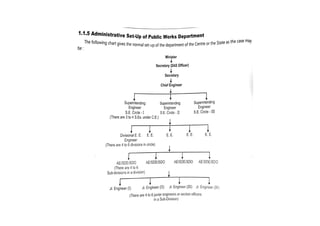
Construction Management
(Unit-1+2)
(Unit-1+2)
By- Jitesh Kumar
Organization :
• It means ‘a group of people working together to
achieve a common goal’.
• A common goal in contractors organization is to
complete the work as per tender documents as early
as possible & to achieve maximum profit.
• A common goal in a factory may be to have maximum
production.
• Organization arranges the functions which is necessary
for achievement of objectives. It indicates the
authority & responsibility given to persons, who are
responsible for execution & respective functions.
• In an organization, people work together & effectively
to reach objectives.
• The work is distributed among the people, a practical
shape is given to the objectives.
• The main problem of an organization is to select the
right people with required skills to achieve the desired
results.
There are three fundamentals of an organization :-
1. People
2. Work
3. An organizational structure
1. People :-
• People who do the activities of the organization must
be well qualified & trained.
• They must perform the work given to them.
• They must be selected on the basis of their ability &
skill.
skill.
2. Work :-
• Earlier one man was doing all the work such bas
purchasing of goods, selling etc.
• Now, the work is divided into several departments e.g.
– purchasing, production, quality control, sales etc.
3. Organization Structure :- There are four considerations
• Span of supervision
• Provision for making changes (flexibility)
• Balancing between the different departments
• Integrating work with other phase of management
The aim of forming organization/elements of
organization :-
Well organized & combined effort of people
Ordered way of working
Clear & well defined policies & procedures
Effective communication system
Characteristics of organization :-
Division of work & responsibilities
Proper division of authority & responsibility
Organization ensures achievement of established goals
Organization controls the efforts of the group
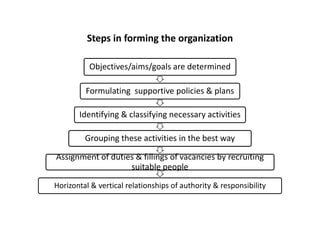
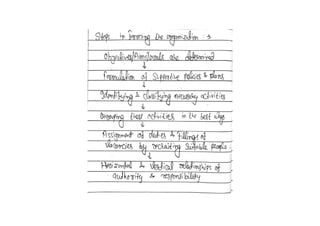
Steps in forming the organization
Objectives/aims/goals are determined
Formulating supportive policies & plans
Identifying & classifying necessary activities
Grouping these activities in the best way
Assignment of duties & fillings of vacancies by recruiting
suitable people
Horizontal & vertical relationships of authority & responsibility
Principles of Organization :-
1. Principle of Authority & responsibility :-
• A person can not be held responsible for duties if he
does not have the power to do.
• The authority flows downward in the line. Every
individual is given authority to get the work done.
Though power can be assigned but responsibility lies
with the man who has been given the work.
• The responsibility can not be assigned under any
circumstances.
2. Principle of Balance :-
• It means work should be divided in such a way that
everybody should be able to give his maximum.
• In an organization, some person is over worked & the
other is under worked, then the work will suffer in
both the situations.
3. Principle of flexibility :-
• An organization should not resist to changes those are
necessary due to technological changes, economic
changes, personal changes etc.
4. Principle of Simplicity :-
• The organizational structure should be simple so that it
is easily understood by each & every person.
• The authority , responsibility & position of every person
should be made clear so that there is no confusion
about these things.
about these things.
• A complex organizational structure will create doubts &
conflicts among persons.
5. Principle of Efficiency :-
• The organization should be able to achieve objectives
at a minimum cost.
• The standards of costs & revenue are predetermined
& performance should be according to these goals.
• The organization should also enable the attainment of
job satisfaction to employees.
6. Principle of Continuity :-
• The organization should be able to accept change
according to the changing situations.
• Everyday there are changes in methods of production &
marketing systems.
The organization should be dynamic & not static.
• The organization should be dynamic & not static.
• There should always be a possibility of making
necessary adjustments.
Types of Organization :-
• An Organization is classified into following types :-
Line Organization
Line & Staff Organization
Functional Organization
Project Organization
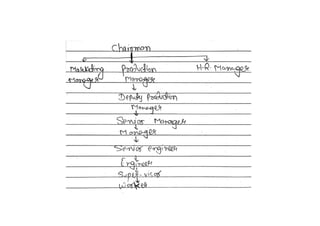
1. Line Organization :-
It is also called as scalar organization
It is the oldest & simplest form of organization
It is a vertical type of organization
It is also called as military type organization, because
military follows similar form of organizational
structure.
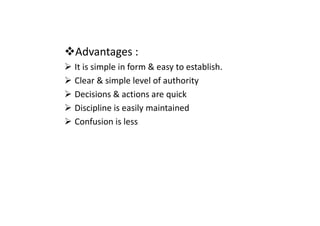
Advantages :
It is simple in form & easy to establish.
Clear & simple level of authority
Decisions & actions are quick
Discipline is easily maintained
Confusion is less
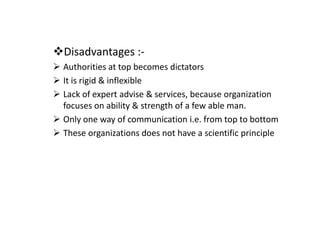
Disadvantages :-
Authorities at top becomes dictators
It is rigid & inflexible
Lack of expert advise & services, because organization
focuses on ability & strength of a few able man.
Only one way of communication i.e. from top to bottom
These organizations does not have a scientific principle
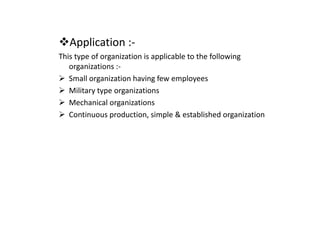
Application :-
This type of organization is applicable to the following
organizations :-
Small organization having few employees
Military type organizations
Mechanical organizations
Continuous production, simple & established organization
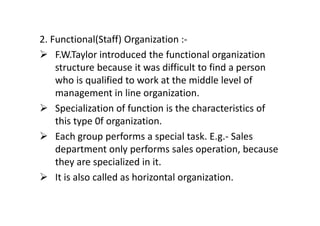
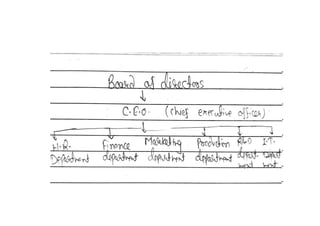
2. Functional(Staff) Organization :-
F.W.Taylor introduced the functional organization
structure because it was difficult to find a person
who is qualified to work at the middle level of
management in line organization.
Specialization of function is the characteristics of
this type 0f organization.
Each group performs a special task. E.g.- Sales
department only performs sales operation, because
they are specialized in it.
It is also called as horizontal organization.
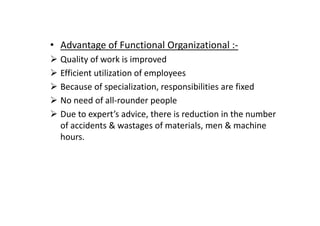
• Advantage of Functional Organizational :-
Quality of work is improved
Efficient utilization of employees
Because of specialization, responsibilities are fixed
No need of all-rounder people
Due to expert’s advice, there is reduction in the number
of accidents & wastages of materials, men & machine
hours.
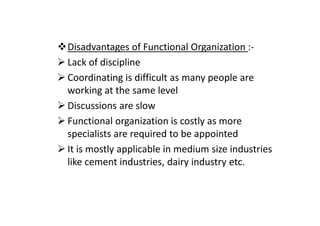
Disadvantages of Functional Organization :-
Lack of discipline
Coordinating is difficult as many people are
working at the same level
Discussions are slow
Functional organization is costly as more
specialists are required to be appointed
It is mostly applicable in medium size industries
like cement industries, dairy industry etc.
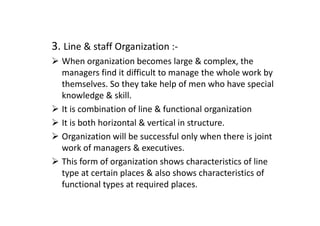
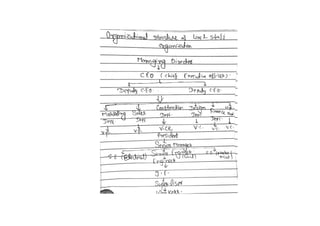
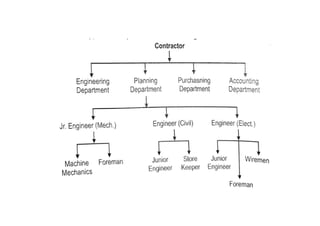
3. Line & staff Organization :-
When organization becomes large & complex, the
managers find it difficult to manage the whole work by
themselves. So they take help of men who have special
knowledge & skill.
It is combination of line & functional organization
It is both horizontal & vertical in structure.
Organization will be successful only when there is joint
work of managers & executives.
This form of organization shows characteristics of line
type at certain places & also shows characteristics of
functional types at required places.
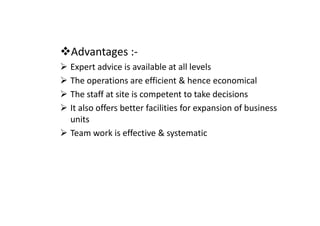
Advantages :-
Expert advice is available at all levels
The operations are efficient & hence economical
The staff at site is competent to take decisions
It also offers better facilities for expansion of business
units
Team work is effective & systematic
Disadvantages
Cost of operation increases due to good salaries to
employees
There may be confusion about the relation of staff &
line employees.
Discipline is poor
Discipline is poor
Communication may be poor if not not done properly
• Application :-
In large scale companies/industries
In large scale manufacturing & automobile industry
4. Project Organization :-
When an existing organization is unable to handle
situation due to launch of new products/projects, then
companies create a separate team or group for
individual project called project organization.
These are temporary organization formd for specific
project for a specific period of time. Once the goal is
achieved , these are dismantled.
Project manager is responsible for the coordination of
the entire team working for the project.
Advantages :-
Scope of work is limited, so more efficiency.
Team has full control over resources
Organization is highly responsive to customers
Disadvantages :-
Disadvantages :-
Temporary nature of organization
Loose bonding in groups (professional rivalry)
Difficult to meet time limit
Role of various personnel in Construction industry :-
For execution of work following persons are required at
site :-
• Site Engineer
• Supervisors
• Mistries
• Mistries
• Operators
• Labour
1. Site Engineer:-
He is the overall in charge of the execution of work at
site.
His decision is final in the execution of work.
He has to explain designs & other instructions at the
site.
He has to employ the required staff.
He has to see the purchase of materials, equipments &
machinery at the site & he also decides the use of
equipments & machinery.
He has to co-ordinates the various agencies required for
the work.
He is fully responsible for the satisfactory completion of
the work.
2.Supervisor :-
Junior engineers, overseers, mistries are the persons
appointed for the supervision of the work.
Their job requirements are :-
(i) To supervise the work done by the skilled & unskilled
labourers & to guide them whenever necessary.
(ii) To prepare the schedule of work :- daily work
programmes under the direction of site engineer &
to arrange accordingly the men, material, equipment
for the execution of work.
2. Supervisor :-
Junior engineers, overseers, Mistries are the persons
appointed for the supervision of the work.
Their job requirements are :-
(1) To supervise the work carried out by the skilled &
unskilled labourers & to guide them whenever
necessary.
(2) To prepare the schedule of work :- Daily work
programmes under the direction of the site engineer
& to arrange accordingly the men, materials ,
equipment for the execution of work.
(iii) To check & see that, work is being done as per the
drawing & specifications.
(iv) To take the measurement of work done, record it, &
prepare the payment bill.
(v) To pass the instruction to lower level, which are
received from top.
(vi)To ensure safety & security at the work site.
Labour :-
There are following types of labour are generally
found in construction industry :-
Unskilled labour
Semi-skilled labour
Skilled labour
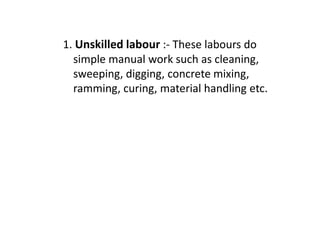
1. Unskilled labour :- These labours do
simple manual work such as cleaning,
sweeping, digging, concrete mixing,
ramming, curing, material handling etc.
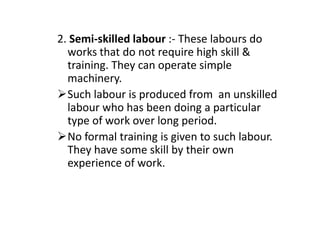
2. Semi-skilled labour :- These labours do
works that do not require high skill &
training. They can operate simple
machinery.
Such labour is produced from an unskilled
labour who has been doing a particular
type of work over long period.
labour who has been doing a particular
type of work over long period.
No formal training is given to such labour.
They have some skill by their own
experience of work.
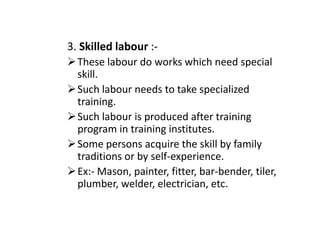
3. Skilled labour :-
These labour do works which need special
skill.
Such labour needs to take specialized
training.
Such labour is produced after training
program in training institutes.
Some persons acquire the skill by family
traditions or by self-experience.
Ex:- Mason, painter, fitter, bar-bender, tiler,
plumber, welder, electrician, etc.
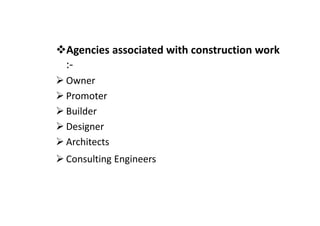
Agencies associated with construction work
:-
Owner
Promoter
Builder
Builder
Designer
Architects
Consulting Engineers
Owner :-
This is the person who decides to start the work or
any project.
Promoter :-
A person/firm, who starts civil engineering work is
called promoter.
Promoter may be a single individual, co-operative
society, private firms, public company, government or
semi-government agencies.
Promoter initiate the work, order the start of work &
get the work done through various agencies.
He hires the consulting engineer to help him
understand & handle the process of construction.
• Functions of Promoters :-
To give full details & requirements in the
beginning to the architect & consulting
engineer to complete the work in time & in
given budget.
To appoint suitable agencies for planning &
execution of work.
To arrange the required finance
To make payments to various agencies
To get the work done through various agencies
as per drawing details.
Builder :-
Contractors/builders are the persons who actually
do the construction work according to the plan,
design & specifications.
It do the work as per terms & conditions of the
contract.
They have to do the work as per the direction of
architect /consulting engineers.
• Functions of builder :-
To maintain a suitable organization required
for carrying out the work.
To arrange necessary tools, plants, equipments,
& machinery required for the work.
To arrange necessary labour required for work.
To take the full responsibility of the work till its
completion.
To arrange the schedule of the work in
consultation with the site engineer & carry out
work as per agreement.
Designer :-
These persons are specialist in designing components of a
project.
Ex- R.C.C. designers, waste disposal experts, water filter
designer etc.
• Functions :-
To provide complete design, drawings & specifications etc.
To check the work for proper implementation of design to make
sure the standard work.
To help & guide the site engineer for correct, speedy &
economical execution of works as per design.
To conduct tests after completion of the components to ensure
about implementation of the design.
Architects :-
• An Architect is a professional who turns building
design into reality.
• They develop concepts for structures and then
work with engineers to bring these designs into
reality.
reality.
• They deal with sketching, thinking, planning,
designing buildings or other structures.
Consulting Engineer :-
Consulting engineer is the mediator b/w the
promoter & the contractor.
He does advisory job in civil engineering project.
He prepares detailed drawings, estimate,
specifications & designs etc.
He supervises the work, guide the contractor &
his workers.
• Role of Consultant for various activities :-
Monitoring of progress & quality :-
Consultants play an important role in organizing
project activities from the start to the maintenance
stage.
They guide the contractor in preparing the project,
organizing and monitoring the project's progress.
They maintain a good coordination between teams in
executing the project using their vast experience.
They guide in estimating the project budget and
helps in smooth release of funds as per the schedule.
• They have the experience and resources to manage
the quality of the materials and structures during
construction
• They suggest steps and methods that ensure the
overall quality.
• They have methods to ensure the quality of various
works such as finishing, concreting, installation and
fabrication etc.
fabrication etc.
• They prepare structural elements according to
standard codes. Testing of materials in the laboratory
is done with the help of suitable processes.
• They develop strategies to eliminate defects, purchase
materials of suitable quality, and check the
dimensions of the structure after construction.
Settlement of disputes:-
Disputes are damaging, expensive, and time
consuming. They affect individuals, organizations,
government, and the economy.
Preventing disputes, and resolving disputes
earlier and more effectively, benefits everyone.
Consultants act as an arbitrator to settle the
disputes on the mutual agreement of both
parties, owner & contractor.
Consultants suggest ways & methods to settle the
dispute b/w parties.
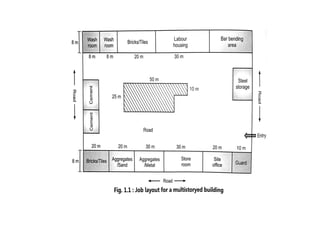
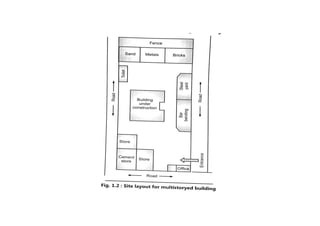
Site Layout or Job Layout at building site :-
Site layout is the plan of the construction site.
It shows the area and the exact location for
placing the resources required in the work.
It also indicates the place for offices, godowns,
workshops, accommodation etc.
Besides this, it shows the existing relationship of
the site with its surrounding in respect of
communication, approaches and existing
facilities.
A systematic and scientifically prepared site
layout is necessary to :-
1. Get a continuous supply of materials in sufficient
amount.
2. Have an easy access to material
3. Easy to check material’s wastage
4. Decrease the number of plants and reduce the
movement of heavy equipment.
5. Avoid confusion and reduce accidents.
6. Have a clean outlook to facilitate the inspection of
the materials
The site layout depends on the following
factors:-
1. Location of the site.
2. Availability of space.
3. Access to the site.
4. Material bulk.
5. Type of equipment to be used.
6. Ground conditions.
Principles Of Job Layout:
• The following are the principles of job layout. They
promote economy, efficiency, tidiness and safety.
1. The site should have preferably two openings, one for
entry and the other for exist. It promotes flow of traffic.
If there is only one gate then it is preferable to provide a
cross-over near the gate.
2. The general office should be located near the main gate.
This avoids confusion at construction site.
3. The godown should be located just behind the general
office. So that it allows a closer supervision of the stores.
4. Temporary roads may be constructed around the
operation area. It promotes the flow of material and
movement of equipment.
5. The workshops for joiner, fitter, electrician etc should be
decided and located at suitable location for easy and
short routes.
6. Staff housing should be away from noise. It should be
concentrated in one area to promote communication
and reduce the cost of facilities and services.
7. The existing services should be used to the maximum
extent.
Preparation of Plan for job Layout
Before starting the construction work, a layout plan is prepared.
The plan gives proper location for machines, proper & safe storage for
materials & workers to facilitate the work as per schedule.
Materials are required to store near the work to reduce the cost of
transportation & easy handling of material.
Machines are placed in the most advantageous position.
For administrative control, office location should be at proper place.
Proper connectivity to vehicles coming at site for various reasons.
Sufficient place for movement should be available near the work for
easy movement of labour & machinery.
The layout should be planned in such a way that it gives maximum
efficiency in minimum movement, to save time & money.
Fencing & hording at site is required for safety & identification of
project.
CM U-1+2.pdf
CM U-1+2.pdf

CM U-1+2.pdf

  • 1.
  • 2.
    Organization : • Itmeans ‘a group of people working together to achieve a common goal’. • A common goal in contractors organization is to complete the work as per tender documents as early as possible & to achieve maximum profit. as possible & to achieve maximum profit. • A common goal in a factory may be to have maximum production. • Organization arranges the functions which is necessary for achievement of objectives. It indicates the authority & responsibility given to persons, who are responsible for execution & respective functions.
  • 3.
    • In anorganization, people work together & effectively to reach objectives. • The work is distributed among the people, a practical shape is given to the objectives. • The main problem of an organization is to select the right people with required skills to achieve the desired right people with required skills to achieve the desired results. There are three fundamentals of an organization :- 1. People 2. Work 3. An organizational structure
  • 4.
    1. People :- •People who do the activities of the organization must be well qualified & trained. • They must perform the work given to them. • They must be selected on the basis of their ability & skill. skill. 2. Work :- • Earlier one man was doing all the work such bas purchasing of goods, selling etc. • Now, the work is divided into several departments e.g. – purchasing, production, quality control, sales etc.
  • 5.
    3. Organization Structure:- There are four considerations • Span of supervision • Provision for making changes (flexibility) • Balancing between the different departments • Integrating work with other phase of management
  • 6.
    The aim offorming organization/elements of organization :- Well organized & combined effort of people Ordered way of working Clear & well defined policies & procedures Effective communication system Effective communication system
  • 7.
    Characteristics of organization:- Division of work & responsibilities Proper division of authority & responsibility Organization ensures achievement of established goals Organization controls the efforts of the group Organization controls the efforts of the group
  • 8.
    Steps in formingthe organization Objectives/aims/goals are determined Formulating supportive policies & plans Identifying & classifying necessary activities Identifying & classifying necessary activities Grouping these activities in the best way Assignment of duties & fillings of vacancies by recruiting suitable people Horizontal & vertical relationships of authority & responsibility
  • 10.
    Principles of Organization:- 1. Principle of Authority & responsibility :- • A person can not be held responsible for duties if he does not have the power to do. • The authority flows downward in the line. Every individual is given authority to get the work done. individual is given authority to get the work done. Though power can be assigned but responsibility lies with the man who has been given the work. • The responsibility can not be assigned under any circumstances.
  • 11.
    2. Principle ofBalance :- • It means work should be divided in such a way that everybody should be able to give his maximum. • In an organization, some person is over worked & the other is under worked, then the work will suffer in both the situations. both the situations. 3. Principle of flexibility :- • An organization should not resist to changes those are necessary due to technological changes, economic changes, personal changes etc.
  • 12.
    4. Principle ofSimplicity :- • The organizational structure should be simple so that it is easily understood by each & every person. • The authority , responsibility & position of every person should be made clear so that there is no confusion about these things. about these things. • A complex organizational structure will create doubts & conflicts among persons.
  • 13.
    5. Principle ofEfficiency :- • The organization should be able to achieve objectives at a minimum cost. • The standards of costs & revenue are predetermined & performance should be according to these goals. • The organization should also enable the attainment of job satisfaction to employees.
  • 14.
    6. Principle ofContinuity :- • The organization should be able to accept change according to the changing situations. • Everyday there are changes in methods of production & marketing systems. The organization should be dynamic & not static. • The organization should be dynamic & not static. • There should always be a possibility of making necessary adjustments.
  • 15.
    Types of Organization:- • An Organization is classified into following types :- Line Organization Line & Staff Organization Functional Organization Project Organization Project Organization
  • 16.
    1. Line Organization:- It is also called as scalar organization It is the oldest & simplest form of organization It is a vertical type of organization It is also called as military type organization, because military follows similar form of organizational military follows similar form of organizational structure.
  • 18.
    Advantages : It issimple in form & easy to establish. Clear & simple level of authority Decisions & actions are quick Discipline is easily maintained Discipline is easily maintained Confusion is less
  • 19.
    Disadvantages :- Authorities attop becomes dictators It is rigid & inflexible Lack of expert advise & services, because organization focuses on ability & strength of a few able man. Only one way of communication i.e. from top to bottom These organizations does not have a scientific principle
  • 20.
    Application :- This typeof organization is applicable to the following organizations :- Small organization having few employees Military type organizations Mechanical organizations Continuous production, simple & established organization Continuous production, simple & established organization
  • 21.
    2. Functional(Staff) Organization:- F.W.Taylor introduced the functional organization structure because it was difficult to find a person who is qualified to work at the middle level of management in line organization. Specialization of function is the characteristics of Specialization of function is the characteristics of this type 0f organization. Each group performs a special task. E.g.- Sales department only performs sales operation, because they are specialized in it. It is also called as horizontal organization.
  • 23.
    • Advantage ofFunctional Organizational :- Quality of work is improved Efficient utilization of employees Because of specialization, responsibilities are fixed No need of all-rounder people Due to expert’s advice, there is reduction in the number Due to expert’s advice, there is reduction in the number of accidents & wastages of materials, men & machine hours.
  • 24.
    Disadvantages of FunctionalOrganization :- Lack of discipline Coordinating is difficult as many people are working at the same level Discussions are slow Functional organization is costly as more specialists are required to be appointed It is mostly applicable in medium size industries like cement industries, dairy industry etc.
  • 25.
    3. Line &staff Organization :- When organization becomes large & complex, the managers find it difficult to manage the whole work by themselves. So they take help of men who have special knowledge & skill. It is combination of line & functional organization It is combination of line & functional organization It is both horizontal & vertical in structure. Organization will be successful only when there is joint work of managers & executives. This form of organization shows characteristics of line type at certain places & also shows characteristics of functional types at required places.
  • 28.
    Advantages :- Expert adviceis available at all levels The operations are efficient & hence economical The staff at site is competent to take decisions It also offers better facilities for expansion of business It also offers better facilities for expansion of business units Team work is effective & systematic
  • 29.
    Disadvantages Cost of operationincreases due to good salaries to employees There may be confusion about the relation of staff & line employees. Discipline is poor Discipline is poor Communication may be poor if not not done properly
  • 30.
    • Application :- Inlarge scale companies/industries In large scale manufacturing & automobile industry
  • 31.
    4. Project Organization:- When an existing organization is unable to handle situation due to launch of new products/projects, then companies create a separate team or group for individual project called project organization. These are temporary organization formd for specific project for a specific period of time. Once the goal is project for a specific period of time. Once the goal is achieved , these are dismantled. Project manager is responsible for the coordination of the entire team working for the project.
  • 32.
    Advantages :- Scope ofwork is limited, so more efficiency. Team has full control over resources Organization is highly responsive to customers Disadvantages :- Disadvantages :- Temporary nature of organization Loose bonding in groups (professional rivalry) Difficult to meet time limit
  • 34.
    Role of variouspersonnel in Construction industry :- For execution of work following persons are required at site :- • Site Engineer • Supervisors • Mistries • Mistries • Operators • Labour
  • 35.
    1. Site Engineer:- Heis the overall in charge of the execution of work at site. His decision is final in the execution of work. He has to explain designs & other instructions at the site. He has to employ the required staff. He has to employ the required staff. He has to see the purchase of materials, equipments & machinery at the site & he also decides the use of equipments & machinery. He has to co-ordinates the various agencies required for the work. He is fully responsible for the satisfactory completion of the work.
  • 36.
    2.Supervisor :- Junior engineers,overseers, mistries are the persons appointed for the supervision of the work. Their job requirements are :- (i) To supervise the work done by the skilled & unskilled labourers & to guide them whenever necessary. (ii) To prepare the schedule of work :- daily work (ii) To prepare the schedule of work :- daily work programmes under the direction of site engineer & to arrange accordingly the men, material, equipment for the execution of work.
  • 37.
    2. Supervisor :- Juniorengineers, overseers, Mistries are the persons appointed for the supervision of the work. Their job requirements are :- (1) To supervise the work carried out by the skilled & unskilled labourers & to guide them whenever unskilled labourers & to guide them whenever necessary. (2) To prepare the schedule of work :- Daily work programmes under the direction of the site engineer & to arrange accordingly the men, materials , equipment for the execution of work.
  • 38.
    (iii) To check& see that, work is being done as per the drawing & specifications. (iv) To take the measurement of work done, record it, & prepare the payment bill. (v) To pass the instruction to lower level, which are received from top. (vi)To ensure safety & security at the work site. (vi)To ensure safety & security at the work site.
  • 39.
    Labour :- There arefollowing types of labour are generally found in construction industry :- Unskilled labour Semi-skilled labour Skilled labour
  • 40.
    1. Unskilled labour:- These labours do simple manual work such as cleaning, sweeping, digging, concrete mixing, ramming, curing, material handling etc.
  • 41.
    2. Semi-skilled labour:- These labours do works that do not require high skill & training. They can operate simple machinery. Such labour is produced from an unskilled labour who has been doing a particular type of work over long period. labour who has been doing a particular type of work over long period. No formal training is given to such labour. They have some skill by their own experience of work.
  • 42.
    3. Skilled labour:- These labour do works which need special skill. Such labour needs to take specialized training. Such labour is produced after training Such labour is produced after training program in training institutes. Some persons acquire the skill by family traditions or by self-experience. Ex:- Mason, painter, fitter, bar-bender, tiler, plumber, welder, electrician, etc.
  • 43.
    Agencies associated withconstruction work :- Owner Promoter Builder Builder Designer Architects Consulting Engineers
  • 44.
    Owner :- This isthe person who decides to start the work or any project. Promoter :- A person/firm, who starts civil engineering work is called promoter. Promoter may be a single individual, co-operative Promoter may be a single individual, co-operative society, private firms, public company, government or semi-government agencies. Promoter initiate the work, order the start of work & get the work done through various agencies. He hires the consulting engineer to help him understand & handle the process of construction.
  • 45.
    • Functions ofPromoters :- To give full details & requirements in the beginning to the architect & consulting engineer to complete the work in time & in given budget. To appoint suitable agencies for planning & To appoint suitable agencies for planning & execution of work. To arrange the required finance To make payments to various agencies To get the work done through various agencies as per drawing details.
  • 46.
    Builder :- Contractors/builders arethe persons who actually do the construction work according to the plan, design & specifications. It do the work as per terms & conditions of the It do the work as per terms & conditions of the contract. They have to do the work as per the direction of architect /consulting engineers.
  • 47.
    • Functions ofbuilder :- To maintain a suitable organization required for carrying out the work. To arrange necessary tools, plants, equipments, & machinery required for the work. To arrange necessary labour required for work. To arrange necessary labour required for work. To take the full responsibility of the work till its completion. To arrange the schedule of the work in consultation with the site engineer & carry out work as per agreement.
  • 48.
    Designer :- These personsare specialist in designing components of a project. Ex- R.C.C. designers, waste disposal experts, water filter designer etc. • Functions :- To provide complete design, drawings & specifications etc. To provide complete design, drawings & specifications etc. To check the work for proper implementation of design to make sure the standard work. To help & guide the site engineer for correct, speedy & economical execution of works as per design. To conduct tests after completion of the components to ensure about implementation of the design.
  • 49.
    Architects :- • AnArchitect is a professional who turns building design into reality. • They develop concepts for structures and then work with engineers to bring these designs into reality. reality. • They deal with sketching, thinking, planning, designing buildings or other structures.
  • 50.
    Consulting Engineer :- Consultingengineer is the mediator b/w the promoter & the contractor. He does advisory job in civil engineering project. He prepares detailed drawings, estimate, specifications & designs etc. specifications & designs etc. He supervises the work, guide the contractor & his workers.
  • 51.
    • Role ofConsultant for various activities :- Monitoring of progress & quality :- Consultants play an important role in organizing project activities from the start to the maintenance stage. They guide the contractor in preparing the project, They guide the contractor in preparing the project, organizing and monitoring the project's progress. They maintain a good coordination between teams in executing the project using their vast experience. They guide in estimating the project budget and helps in smooth release of funds as per the schedule.
  • 52.
    • They havethe experience and resources to manage the quality of the materials and structures during construction • They suggest steps and methods that ensure the overall quality. • They have methods to ensure the quality of various works such as finishing, concreting, installation and fabrication etc. fabrication etc. • They prepare structural elements according to standard codes. Testing of materials in the laboratory is done with the help of suitable processes. • They develop strategies to eliminate defects, purchase materials of suitable quality, and check the dimensions of the structure after construction.
  • 53.
    Settlement of disputes:- Disputesare damaging, expensive, and time consuming. They affect individuals, organizations, government, and the economy. Preventing disputes, and resolving disputes earlier and more effectively, benefits everyone. Consultants act as an arbitrator to settle the Consultants act as an arbitrator to settle the disputes on the mutual agreement of both parties, owner & contractor. Consultants suggest ways & methods to settle the dispute b/w parties.
  • 54.
    Site Layout orJob Layout at building site :- Site layout is the plan of the construction site. It shows the area and the exact location for placing the resources required in the work. It also indicates the place for offices, godowns, workshops, accommodation etc. workshops, accommodation etc. Besides this, it shows the existing relationship of the site with its surrounding in respect of communication, approaches and existing facilities.
  • 55.
    A systematic andscientifically prepared site layout is necessary to :- 1. Get a continuous supply of materials in sufficient amount. 2. Have an easy access to material 3. Easy to check material’s wastage 4. Decrease the number of plants and reduce the 4. Decrease the number of plants and reduce the movement of heavy equipment. 5. Avoid confusion and reduce accidents. 6. Have a clean outlook to facilitate the inspection of the materials
  • 56.
    The site layoutdepends on the following factors:- 1. Location of the site. 2. Availability of space. 3. Access to the site. 4. Material bulk. 5. Type of equipment to be used. 6. Ground conditions.
  • 57.
    Principles Of JobLayout: • The following are the principles of job layout. They promote economy, efficiency, tidiness and safety. 1. The site should have preferably two openings, one for entry and the other for exist. It promotes flow of traffic. If there is only one gate then it is preferable to provide a cross-over near the gate. cross-over near the gate. 2. The general office should be located near the main gate. This avoids confusion at construction site. 3. The godown should be located just behind the general office. So that it allows a closer supervision of the stores.
  • 58.
    4. Temporary roadsmay be constructed around the operation area. It promotes the flow of material and movement of equipment. 5. The workshops for joiner, fitter, electrician etc should be decided and located at suitable location for easy and short routes. 6. Staff housing should be away from noise. It should be concentrated in one area to promote communication and reduce the cost of facilities and services. 7. The existing services should be used to the maximum extent.
  • 59.
    Preparation of Planfor job Layout Before starting the construction work, a layout plan is prepared. The plan gives proper location for machines, proper & safe storage for materials & workers to facilitate the work as per schedule. Materials are required to store near the work to reduce the cost of transportation & easy handling of material. Machines are placed in the most advantageous position. For administrative control, office location should be at proper place. Proper connectivity to vehicles coming at site for various reasons. Sufficient place for movement should be available near the work for Sufficient place for movement should be available near the work for easy movement of labour & machinery. The layout should be planned in such a way that it gives maximum efficiency in minimum movement, to save time & money. Fencing & hording at site is required for safety & identification of project.