STEP III
Constructing an Instrument
for
Data Collection
The Eight-Step Research Process
Phase I Deciding What To Research
 Step I Formulating A Research Problem
Phase II Planning A Research Study
 Step II Conceptualising a Research Design
 Step III Constructing an Instrument for Data Collection
 Step IV Selecting a Sample
 Step V Writing a Research Proposal
Phase III Conducting A Research Study
 Step VI Collecting Data
 Step VII Processing and Displaying Data
 Step VIII Writing a Research Report
 In this chapter, you will learn about:
 Differences in methods of data collection in
quantitative and qualitative research
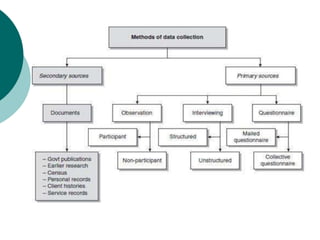
 Major approaches to information gathering
 Collecting data using primary sources
 Observation
 The interview
 The questionnaire
 Methods of data collection in qualitative research
 Collecting data using secondary sources
Methods of Data Collection in Quantitative
and Qualitative Research
 Most methods of data collection can be used in both
qualitative and quantitative research.
 Distinction is mainly due to the restrictions imposed on
flexibility, structure, sequential order, depth and freedom
that a researcher has in their use during the research
process.
 Quantitative methods favour these restrictions whereas
qualitative ones advocate against them.
 The classification of a method into quantitative or
qualitative category depends upon answering to the
following questions:
 What philosophical epistemology is underpinning your
approach to research enquiry?
 How was the information collected? Was it through a
structured or unstructured/flexible format of data
collection?
 Were the questions or issues discussed during data
collection predetermined or developed during the period?
 How was the information you gathered recorded? Was it in
a descriptive, narrative, categorical, quantitative form or
on a scale?
 How was the information analysed? Was it a descriptive,
categorical or numerical analysis?
 How do you propose to communicate the findings? Do you
want to write in a descriptive or analytical manner?
Major Approaches to Information Gathering
 There are two major approaches to gathering information
about a situation, person, problem or phenomenon.
 When you undertake a research study, in most situations, you
need to collect the required information. However, sometimes
the information required for a study may be already available
and need only be extracted.
 Based upon these broad approaches to information gathering,
data can be categorised as:
 Primary Data &
 Secondary Data.
 None of the methods ensures 100 per cent accurate
and reliable information.
 Quality of the data gathered is dependent upon a
number of other factors.
 The skill of a researcher lies in the ability to take care
of the factors that could affect the quality of data.
 One of the main differences between experienced and
amateur researchers lies in their understanding of,
and ability to control, these factors.
 It is, therefore, important for the beginners to be
aware of them.
Collecting Data Using Primary Sources
 Several methods can be used to collect primary data. The
choice of a method depends upon the purpose of the
study, the resources available and the skills of the
researcher.
 There are times when the method most appropriate
cannot be used because of constraints such as a lack of
resources and/or required skills.
 In such situations, you should be aware of the problems
that these limitations impose on the quality of the data.
 In selecting a method, the socioeconomic-demographic
characteristics of the population play an important role:
you should know as much as possible about the
characteristics such as educational level, age structure,
socioeconomic status and ethnic background.
 If possible, it is helpful to know the study population’s
interest in, and attitude towards, participation in the
study.
 Some populations, for a number of reasons, may not feel
either at ease with a particular method of data collection
(such as being interviewed) or comfortable with
expressing opinions in a questionnaire.
 Furthermore, people with little education may respond
differently to certain methods of data collection compared
to people with more education.
 Another important determinant is the way the purpose
and relevance of the study are explained to the potential
respondents.
 Whatever method of data collection is used, make sure
that respondents clearly understand the purpose and
relevance of the study.
 This is particularly important when you use a
questionnaire to collect data, because in an interview
situation you can answer a respondent’s questions but
in a questionnaire you will not have this opportunity.
Observation
 Observation is one way to collect primary data. It is a
purposeful, systematic and selective way of watching
and listening to an interaction or phenomenon as it
takes place.
 There are situations in which observation is the most
appropriate method; for example, when you want to
learn about the interaction in a group, study the dietary
patterns of a population, ascertain the functions
performed by a worker, or study the behaviour or
personality traits of an individual.
 It is also appropriate in situations where full and/or
accurate information cannot be elicited by questioning,
because respondents either are not co-operative or are
unaware of the answers because it is difficult for them
to detach themselves from the interaction.
 In summary, when you are more interested in the
behaviour than in the perceptions of individuals, or when
subjects are so involved in the interaction that they are
unable to provide objective information about it,
observation is the best approach to collect the required
information.
 Types of observation
 There are two types of observation:
1. Participant Observation;
2. Non-participant Observation.
 Participant observation is when you, as a researcher,
participate in the activities of the group being observed in
the same manner as its members, with or without their
knowing that they are being observed.
 For example, you might want to examine the reactions of
the general population towards people in wheelchairs.
 You can study their reactions by sitting in a wheelchair
yourself. Or you might want to study the life of prisoners
and pretend to be a prisoner in order to do this.
 Participant observation is when you, as a researcher,
participate in the activities of the group being observed in
the same manner as its members, with or without their
knowing that they are being observed.
 For example, you might want to examine the reactions of
the general population towards people in wheelchairs.
 You can study their reactions by sitting in a wheelchair
yourself. Or you might want to study the life of prisoners
and pretend to be a prisoner in order to do this.
 Non-participant observation, on the other hand, is when
you, as a researcher, do not get involved in the activities
of the group but remain a passive observer, watching and
listening to its activities and drawing conclusions from
this.
 For example, you might want to study the functions
carried out by nurses in a hospital.
 As an observer, you could watch, follow and record the
activities as they are performed.
 After making a number of observations, conclusions
could be drawn about the functions nurses carry out in
the hospital.
 Any occupational group in any setting can be observed
in the same manner.
Problems with Observation as a Method of
Data Collection
 Observation - as a method of data collection may suffer
from a number of problems, which is not to suggest that all
or any of these necessarily prevail in every situation.
 As a beginner, you should be aware of these potential
problems:
 When individuals or groups become aware that they are being
observed, they may change their behaviour.
 Depending upon the situation, this change could be positive or
negative – it may increase or decrease, for example- their
productivity and may occur for a number of reasons.
 Change in behaviour of the persons or groups being
observed is known as the Hawthorne effect. The use of
observation in such a situation may introduce distortion:
what is observed may not represent their normal behaviour.
 There is also a possibility of observer bias. If an observer is
not impartial, s/he can easily introduce bias and there is no
easy way to verify the observations and the inferences drawn
from them.
 The interpretations drawn from observations may vary from
observer to observer. There is a possibility of incomplete
observation and/or recording that varies with the method of
recording.
 An observer may watch keenly but at the expense of detailed
recording. The opposite problem may occur when the
observer takes detailed notes but in doing so misses some of
the important interactions.
Situations in Which Observations Can be
Made
 Observations can be made under two conditions:
1. Natural;
2. Controlled.
 Observing a group in its natural operation rather than
intervening in its activities is classified as observation
under natural conditions.
 Introducing a stimulus to the group for it to react to and
observing the reaction is called controlled observation.
Recording Observations
 There are many ways of recording observations. The
selection of a method of recording depends upon the
purpose of the observation.
 The way an observation is recorded also determines
whether it is a quantitative or qualitative study.
 Narrative and descriptive recording is mainly used in
qualitative research but if you are doing a
quantitative study, you would record an observation
in categorical form or on a numerical scale.
 Keep in mind that each method of recording has its
advantages and disadvantages:
 Narrative Recording – In this form of recording the
researcher records a description of the interaction in
his/her own words.
 Such type of recording clearly falls in the domain of
qualitative research.
 Usually, a researcher makes brief notes while observing
the interaction and then soon after completing the
observation makes detailed notes in narrative form. In
addition, some researchers may interpret the interaction
and draw conclusions from it.
 The biggest advantage of narrative recording is that it
provides a deeper insight into the interaction.
 However, a disadvantage is that an observer may be
biased in his/her observation and, therefore, the
interpretations and conclusions drawn from the observation
may also be biased.
 In addition, interpretations and conclusions drawn are
bound to be subjective reflecting the researcher’s
perspectives.
 Also, if a researcher’s attention is on observing, s/he
might forget to record an important piece of interaction
and, obviously, in the process of recording, part of the
interaction may be missed.
 Hence, there is always the possibility of incomplete
recording and/or observation.
 In addition, when there are different observers, the
comparability of narrative recording can be a problem.
 Using Scales – At times some observers may prefer to
develop a scale in order to rate various aspects of the
interaction or phenomenon.
 The recording is done on a scale developed by the
observer/researcher. A scale may be one-, two- or three-
directional, depending upon the purpose of the
observation.
 For example, in the scale in Figure 9.2 – designed to
record the nature of the interaction within a group –
there are three directions: positive, negative and neutral.
 The main advantage of using scales in recording
observation is that you do not need to spend time on
taking detailed notes and can thus concentrate on
observation.
 On the other hand, problems with using a scale are that it
does not provide specific and in-depth information about
the interaction. In addition, it may suffer from any of the
following errors:
 Unless the observer is extremely confident of his/her
ability to assess an interaction, s/he may tend to avoid
the extreme positions on the scale, using mostly the
central part. The error that this tendency creates is
called the error of central tendency.
 Some observers may prefer certain sections of the scale
in the same way that some teachers are strict markers
and others are not. When observers have a tendency to
use a particular part of the scale is known as the
elevation effect.
 Another type of error that may be introduced is when
the way an observer rates an individual on one aspect
influences the way s/he rates that individual on another
aspect of the interaction.
 Again something similar to this can happen in teaching
when a teacher’s assessment of the performance of a
student in one subject may influence his/her rating of
that student’s performance in another. This type of
effect is known as the halo effect.
 Categorical Recording – Sometimes an observer may
decide to record his/her observation using categories.
 The type and number of categories depend upon the type
of interaction and the observer’s choice about how to
classify the observation.
 For example, passive/active (two categories);
introvert/extrovert (two categories);
always/sometimes/never (three categories); strongly
agree/agree/uncertain/disagree/strongly disagree (five
categories).
 The use of categories to record an observation may
suffer from the same problems as those associated with
scales.
 Recording on Electronic Devices – Observation can also be
recorded on videotape or other electronic devices and then
analysed.
 The advantage of recording an interaction in this way is
that the observer can see it a number of times before
interpreting an interaction or drawing any conclusions from
it and can also invite other professionals to view the
interaction in order to arrive at more objective conclusions.
 However, one of the disadvantages is that some people
may feel uncomfortable or may behave differently before a
camera. Therefore the interaction may not be a true
reflection of the situation.
 The choice of a particular method is dependent upon the
purpose of the observation, the complexity of the
interaction and the type of population being observed.
The Interview
 Interviewing is a commonly used method of collecting
information from people. In many walks of life we collect
information through different forms of interaction with
others.
 There are many definitions of interviews. According to
Monette et al. (1986: 156), ‘an interview involves an
interviewer reading questions to respondents and
recording their answers’.
 According to Burns (1997: 329), ‘an interview is a verbal
interchange, often face to face, though the telephone may
be used, in which an interviewer tries to elicit information,
beliefs or opinions from another person’.
 Any person-to-person interaction, either face to face or
otherwise, between two or more individuals with a specific
purpose in mind is called an interview.
 When interviewing a respondent, you, as a researcher,
have the freedom to decide the format and content of
questions to be asked, select the wording of your
questions, decide the way you want to ask them and
choose the order in which they are to be asked.
 This process of asking questions can be either very
flexible, where you have the freedom to think about and
formulate questions as they come to your mind around
the issue being investigated, or inflexible, where you
have to keep strictly to the questions decided beforehand
– including their wording, sequence and the manner in
which they are asked.
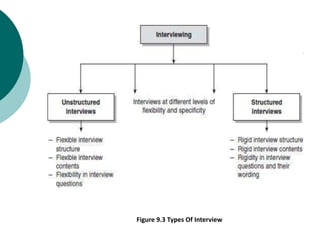
 Interviews are classified into different categories
according to this degree of flexibility as in Figure 9.3.
Figure 9.3 Types Of Interview
Thanks for Today

Constructing Instument for data collection.ppt

  • 1.
    STEP III Constructing anInstrument for Data Collection
  • 2.
    The Eight-Step ResearchProcess Phase I Deciding What To Research  Step I Formulating A Research Problem Phase II Planning A Research Study  Step II Conceptualising a Research Design  Step III Constructing an Instrument for Data Collection  Step IV Selecting a Sample  Step V Writing a Research Proposal Phase III Conducting A Research Study  Step VI Collecting Data  Step VII Processing and Displaying Data  Step VIII Writing a Research Report
  • 3.
     In thischapter, you will learn about:  Differences in methods of data collection in quantitative and qualitative research  Major approaches to information gathering  Collecting data using primary sources  Observation  The interview  The questionnaire  Methods of data collection in qualitative research  Collecting data using secondary sources
  • 4.
    Methods of DataCollection in Quantitative and Qualitative Research  Most methods of data collection can be used in both qualitative and quantitative research.  Distinction is mainly due to the restrictions imposed on flexibility, structure, sequential order, depth and freedom that a researcher has in their use during the research process.  Quantitative methods favour these restrictions whereas qualitative ones advocate against them.  The classification of a method into quantitative or qualitative category depends upon answering to the following questions:
  • 5.
     What philosophicalepistemology is underpinning your approach to research enquiry?  How was the information collected? Was it through a structured or unstructured/flexible format of data collection?  Were the questions or issues discussed during data collection predetermined or developed during the period?  How was the information you gathered recorded? Was it in a descriptive, narrative, categorical, quantitative form or on a scale?  How was the information analysed? Was it a descriptive, categorical or numerical analysis?  How do you propose to communicate the findings? Do you want to write in a descriptive or analytical manner?
  • 6.
    Major Approaches toInformation Gathering  There are two major approaches to gathering information about a situation, person, problem or phenomenon.  When you undertake a research study, in most situations, you need to collect the required information. However, sometimes the information required for a study may be already available and need only be extracted.  Based upon these broad approaches to information gathering, data can be categorised as:  Primary Data &  Secondary Data.
  • 7.
     None ofthe methods ensures 100 per cent accurate and reliable information.  Quality of the data gathered is dependent upon a number of other factors.  The skill of a researcher lies in the ability to take care of the factors that could affect the quality of data.  One of the main differences between experienced and amateur researchers lies in their understanding of, and ability to control, these factors.  It is, therefore, important for the beginners to be aware of them.
  • 8.
    Collecting Data UsingPrimary Sources  Several methods can be used to collect primary data. The choice of a method depends upon the purpose of the study, the resources available and the skills of the researcher.  There are times when the method most appropriate cannot be used because of constraints such as a lack of resources and/or required skills.  In such situations, you should be aware of the problems that these limitations impose on the quality of the data.  In selecting a method, the socioeconomic-demographic characteristics of the population play an important role: you should know as much as possible about the characteristics such as educational level, age structure, socioeconomic status and ethnic background.
  • 9.
     If possible,it is helpful to know the study population’s interest in, and attitude towards, participation in the study.  Some populations, for a number of reasons, may not feel either at ease with a particular method of data collection (such as being interviewed) or comfortable with expressing opinions in a questionnaire.  Furthermore, people with little education may respond differently to certain methods of data collection compared to people with more education.  Another important determinant is the way the purpose and relevance of the study are explained to the potential respondents.
  • 10.
     Whatever methodof data collection is used, make sure that respondents clearly understand the purpose and relevance of the study.  This is particularly important when you use a questionnaire to collect data, because in an interview situation you can answer a respondent’s questions but in a questionnaire you will not have this opportunity.
  • 12.
    Observation  Observation isone way to collect primary data. It is a purposeful, systematic and selective way of watching and listening to an interaction or phenomenon as it takes place.  There are situations in which observation is the most appropriate method; for example, when you want to learn about the interaction in a group, study the dietary patterns of a population, ascertain the functions performed by a worker, or study the behaviour or personality traits of an individual.  It is also appropriate in situations where full and/or accurate information cannot be elicited by questioning, because respondents either are not co-operative or are unaware of the answers because it is difficult for them to detach themselves from the interaction.
  • 13.
     In summary,when you are more interested in the behaviour than in the perceptions of individuals, or when subjects are so involved in the interaction that they are unable to provide objective information about it, observation is the best approach to collect the required information.  Types of observation  There are two types of observation: 1. Participant Observation; 2. Non-participant Observation.
  • 14.
     Participant observationis when you, as a researcher, participate in the activities of the group being observed in the same manner as its members, with or without their knowing that they are being observed.  For example, you might want to examine the reactions of the general population towards people in wheelchairs.  You can study their reactions by sitting in a wheelchair yourself. Or you might want to study the life of prisoners and pretend to be a prisoner in order to do this.
  • 15.
     Participant observationis when you, as a researcher, participate in the activities of the group being observed in the same manner as its members, with or without their knowing that they are being observed.  For example, you might want to examine the reactions of the general population towards people in wheelchairs.  You can study their reactions by sitting in a wheelchair yourself. Or you might want to study the life of prisoners and pretend to be a prisoner in order to do this.  Non-participant observation, on the other hand, is when you, as a researcher, do not get involved in the activities of the group but remain a passive observer, watching and listening to its activities and drawing conclusions from this.
  • 16.
     For example,you might want to study the functions carried out by nurses in a hospital.  As an observer, you could watch, follow and record the activities as they are performed.  After making a number of observations, conclusions could be drawn about the functions nurses carry out in the hospital.  Any occupational group in any setting can be observed in the same manner.
  • 17.
    Problems with Observationas a Method of Data Collection  Observation - as a method of data collection may suffer from a number of problems, which is not to suggest that all or any of these necessarily prevail in every situation.  As a beginner, you should be aware of these potential problems:  When individuals or groups become aware that they are being observed, they may change their behaviour.  Depending upon the situation, this change could be positive or negative – it may increase or decrease, for example- their productivity and may occur for a number of reasons.
  • 18.
     Change inbehaviour of the persons or groups being observed is known as the Hawthorne effect. The use of observation in such a situation may introduce distortion: what is observed may not represent their normal behaviour.  There is also a possibility of observer bias. If an observer is not impartial, s/he can easily introduce bias and there is no easy way to verify the observations and the inferences drawn from them.  The interpretations drawn from observations may vary from observer to observer. There is a possibility of incomplete observation and/or recording that varies with the method of recording.  An observer may watch keenly but at the expense of detailed recording. The opposite problem may occur when the observer takes detailed notes but in doing so misses some of the important interactions.
  • 19.
    Situations in WhichObservations Can be Made  Observations can be made under two conditions: 1. Natural; 2. Controlled.  Observing a group in its natural operation rather than intervening in its activities is classified as observation under natural conditions.  Introducing a stimulus to the group for it to react to and observing the reaction is called controlled observation.
  • 20.
    Recording Observations  Thereare many ways of recording observations. The selection of a method of recording depends upon the purpose of the observation.  The way an observation is recorded also determines whether it is a quantitative or qualitative study.  Narrative and descriptive recording is mainly used in qualitative research but if you are doing a quantitative study, you would record an observation in categorical form or on a numerical scale.  Keep in mind that each method of recording has its advantages and disadvantages:
  • 21.
     Narrative Recording– In this form of recording the researcher records a description of the interaction in his/her own words.  Such type of recording clearly falls in the domain of qualitative research.  Usually, a researcher makes brief notes while observing the interaction and then soon after completing the observation makes detailed notes in narrative form. In addition, some researchers may interpret the interaction and draw conclusions from it.  The biggest advantage of narrative recording is that it provides a deeper insight into the interaction.  However, a disadvantage is that an observer may be biased in his/her observation and, therefore, the interpretations and conclusions drawn from the observation may also be biased.
  • 22.
     In addition,interpretations and conclusions drawn are bound to be subjective reflecting the researcher’s perspectives.  Also, if a researcher’s attention is on observing, s/he might forget to record an important piece of interaction and, obviously, in the process of recording, part of the interaction may be missed.  Hence, there is always the possibility of incomplete recording and/or observation.  In addition, when there are different observers, the comparability of narrative recording can be a problem.
  • 23.
     Using Scales– At times some observers may prefer to develop a scale in order to rate various aspects of the interaction or phenomenon.  The recording is done on a scale developed by the observer/researcher. A scale may be one-, two- or three- directional, depending upon the purpose of the observation.  For example, in the scale in Figure 9.2 – designed to record the nature of the interaction within a group – there are three directions: positive, negative and neutral.  The main advantage of using scales in recording observation is that you do not need to spend time on taking detailed notes and can thus concentrate on observation.
  • 24.
     On theother hand, problems with using a scale are that it does not provide specific and in-depth information about the interaction. In addition, it may suffer from any of the following errors:  Unless the observer is extremely confident of his/her ability to assess an interaction, s/he may tend to avoid the extreme positions on the scale, using mostly the central part. The error that this tendency creates is called the error of central tendency.  Some observers may prefer certain sections of the scale in the same way that some teachers are strict markers and others are not. When observers have a tendency to use a particular part of the scale is known as the elevation effect.
  • 25.
     Another typeof error that may be introduced is when the way an observer rates an individual on one aspect influences the way s/he rates that individual on another aspect of the interaction.  Again something similar to this can happen in teaching when a teacher’s assessment of the performance of a student in one subject may influence his/her rating of that student’s performance in another. This type of effect is known as the halo effect.
  • 26.
     Categorical Recording– Sometimes an observer may decide to record his/her observation using categories.  The type and number of categories depend upon the type of interaction and the observer’s choice about how to classify the observation.  For example, passive/active (two categories); introvert/extrovert (two categories); always/sometimes/never (three categories); strongly agree/agree/uncertain/disagree/strongly disagree (five categories).  The use of categories to record an observation may suffer from the same problems as those associated with scales.
  • 27.
     Recording onElectronic Devices – Observation can also be recorded on videotape or other electronic devices and then analysed.  The advantage of recording an interaction in this way is that the observer can see it a number of times before interpreting an interaction or drawing any conclusions from it and can also invite other professionals to view the interaction in order to arrive at more objective conclusions.  However, one of the disadvantages is that some people may feel uncomfortable or may behave differently before a camera. Therefore the interaction may not be a true reflection of the situation.  The choice of a particular method is dependent upon the purpose of the observation, the complexity of the interaction and the type of population being observed.
  • 28.
    The Interview  Interviewingis a commonly used method of collecting information from people. In many walks of life we collect information through different forms of interaction with others.  There are many definitions of interviews. According to Monette et al. (1986: 156), ‘an interview involves an interviewer reading questions to respondents and recording their answers’.  According to Burns (1997: 329), ‘an interview is a verbal interchange, often face to face, though the telephone may be used, in which an interviewer tries to elicit information, beliefs or opinions from another person’.  Any person-to-person interaction, either face to face or otherwise, between two or more individuals with a specific purpose in mind is called an interview.
  • 29.
     When interviewinga respondent, you, as a researcher, have the freedom to decide the format and content of questions to be asked, select the wording of your questions, decide the way you want to ask them and choose the order in which they are to be asked.  This process of asking questions can be either very flexible, where you have the freedom to think about and formulate questions as they come to your mind around the issue being investigated, or inflexible, where you have to keep strictly to the questions decided beforehand – including their wording, sequence and the manner in which they are asked.  Interviews are classified into different categories according to this degree of flexibility as in Figure 9.3.
  • 30.
    Figure 9.3 TypesOf Interview
  • 31.