THE 6TH AMENDMENT: RIGHT TO
COUNSEL AND A FAIR TRIAL
Chapter 12
Introduction






The 6th Amendment is not that familiar to the
public
It deals with the fairness at trial and the right to
a lawyer during the time leading up to and
during prosecution
The 6th Amendment protects the individual
against the government’s unlimited resources
and ensure a fair trial
Speedy and Public Trial




The 6th Amendment require a speedy and
public trial
A delayed or prolonged trial is inherently unfair


With the assumption of a person is innocent until
proven guilty, each individual charged with a
crime has the right to have their determination
made as quickly as possible
Speedy and Public Trial




Delay that harms the accused’s defense
may cause the charges to be dismissed
Ba rke r v. Wing o (1972)


A trial is sufficiently “speedy” is determined by

1.
2.
3.
4.

The length of the delay
The reason for the delay
The defendant’s assertion of this right
The harm caused
Speedy and Public Trial


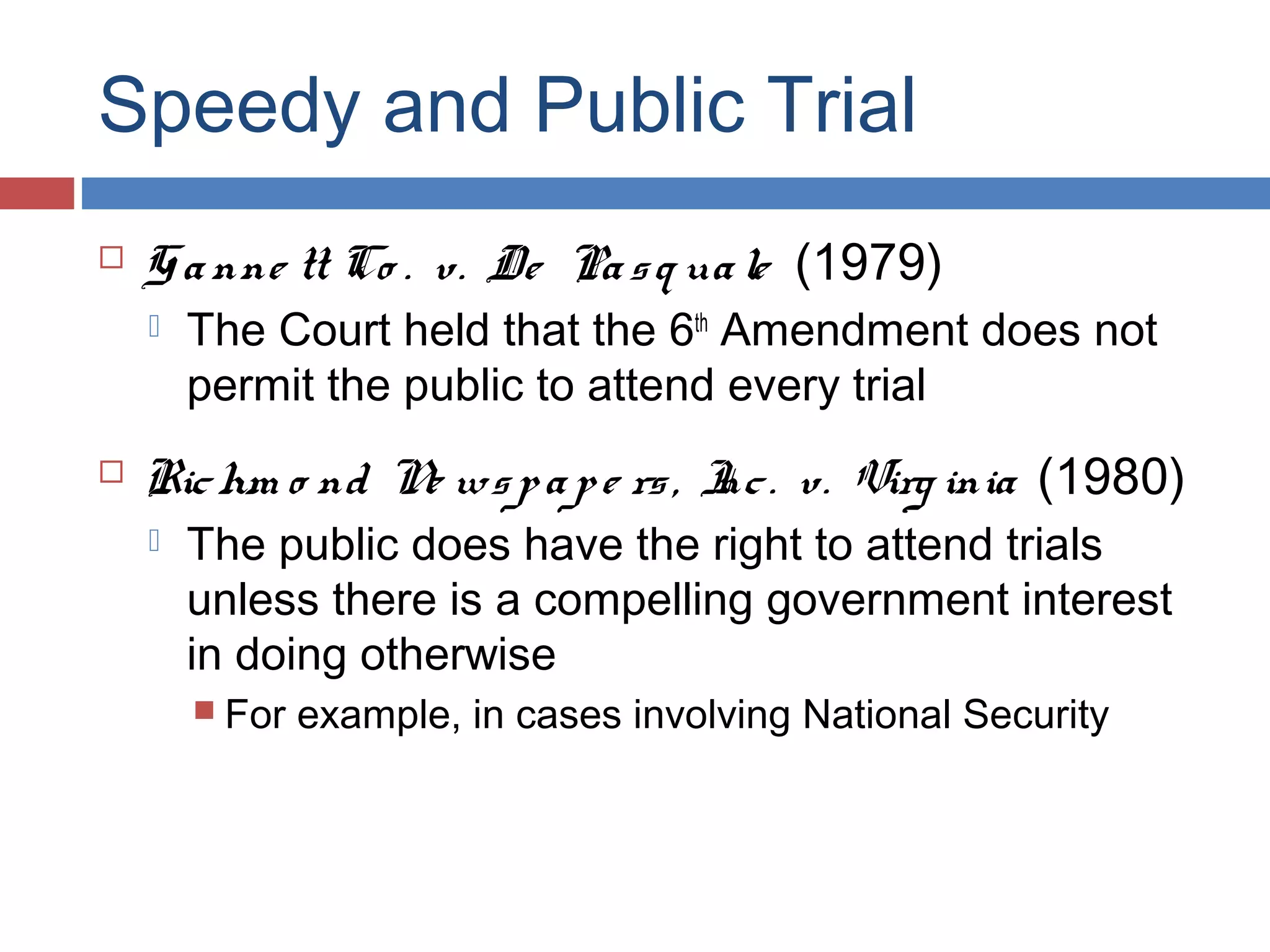
G a nne tt Co . v. De Pa s q ua le (1979)




The Court held that the 6th Amendment does not
permit the public to attend every trial

Ric hm o nd N ws p a p e rs , I . v. Virg inia (1980)
e
nc


The public does have the right to attend trials
unless there is a compelling government interest
in doing otherwise
 For

example, in cases involving National Security
Where the Trial Is Held




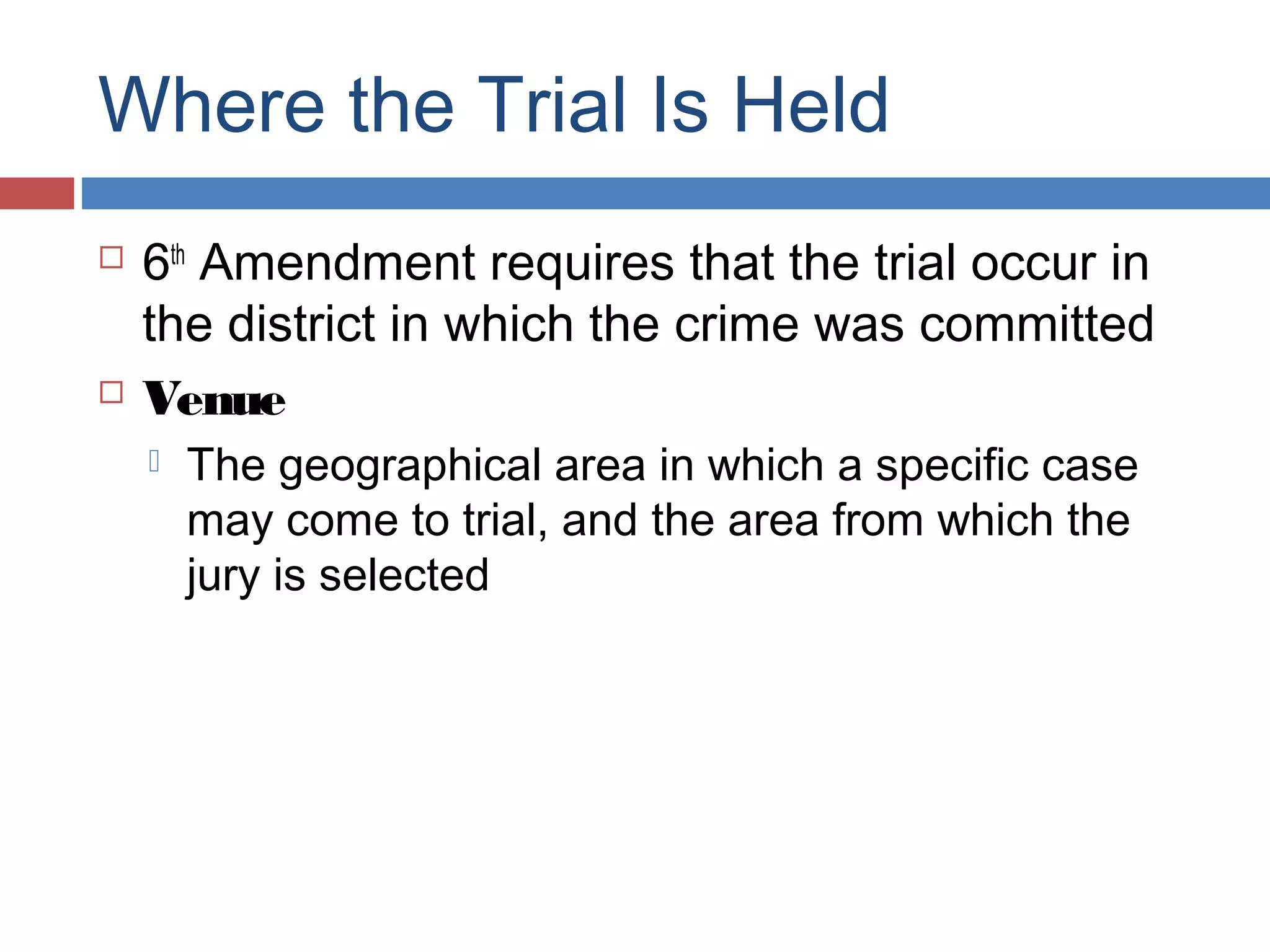
6th Amendment requires that the trial occur in
the district in which the crime was committed
Venue


The geographical area in which a specific case
may come to trial, and the area from which the
jury is selected
Where the Trial Is Held


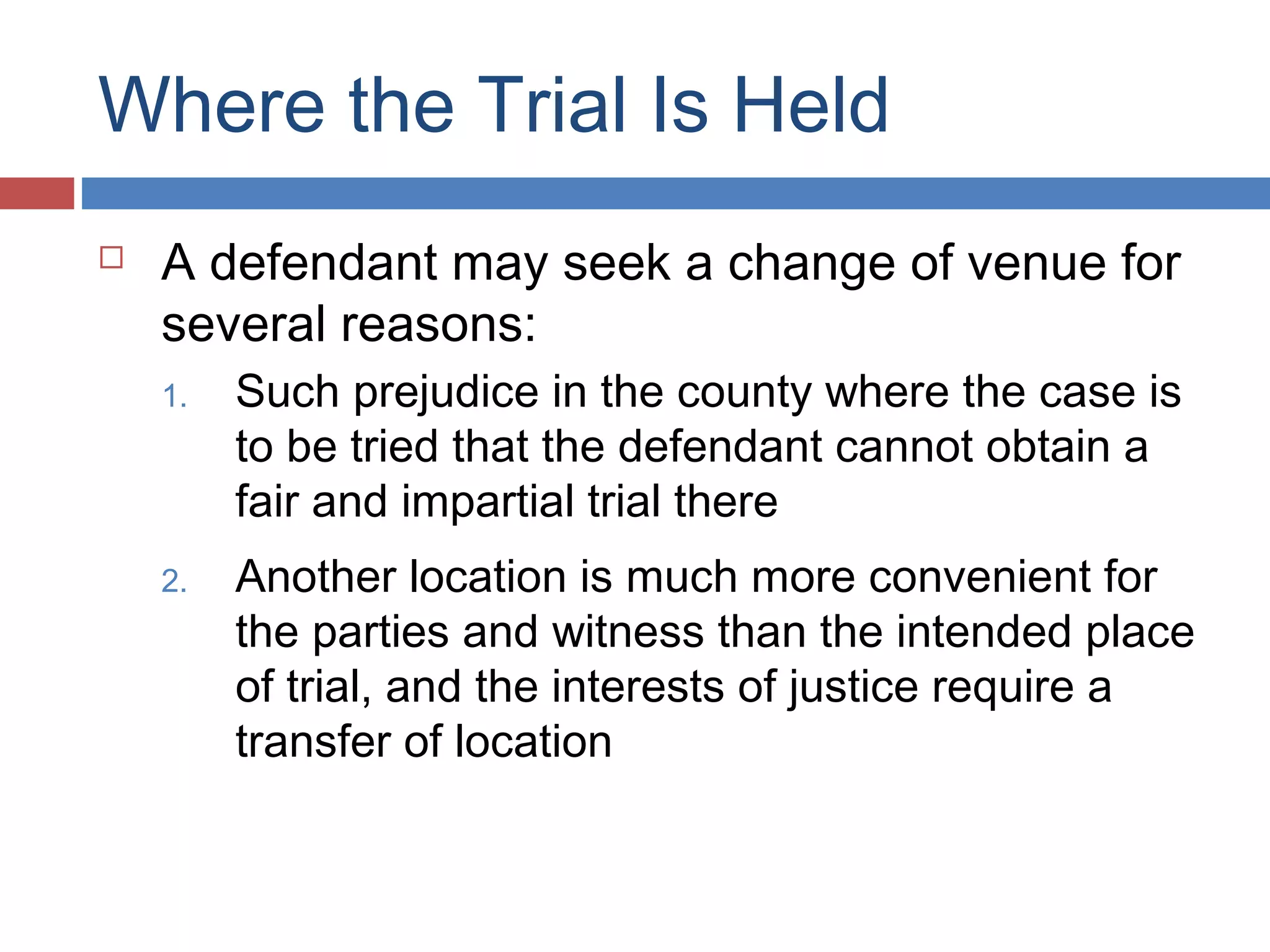
A defendant may seek a change of venue for
several reasons:
1.

Such prejudice in the county where the case is
to be tried that the defendant cannot obtain a
fair and impartial trial there

2.

Another location is much more convenient for
the parties and witness than the intended place
of trial, and the interests of justice require a
transfer of location
An Impartial Jury






The 6th Amendment requires an impartial and
representative jury
All crimes involving the potential of jail time do
not require a jury trial
“Petty crimes” do not require a jury trial




No definition of what a petty crime is

More serious offenses warrant a jury trial


Generally those who punishments could exceed
jail time of six months
An Impartial Jury
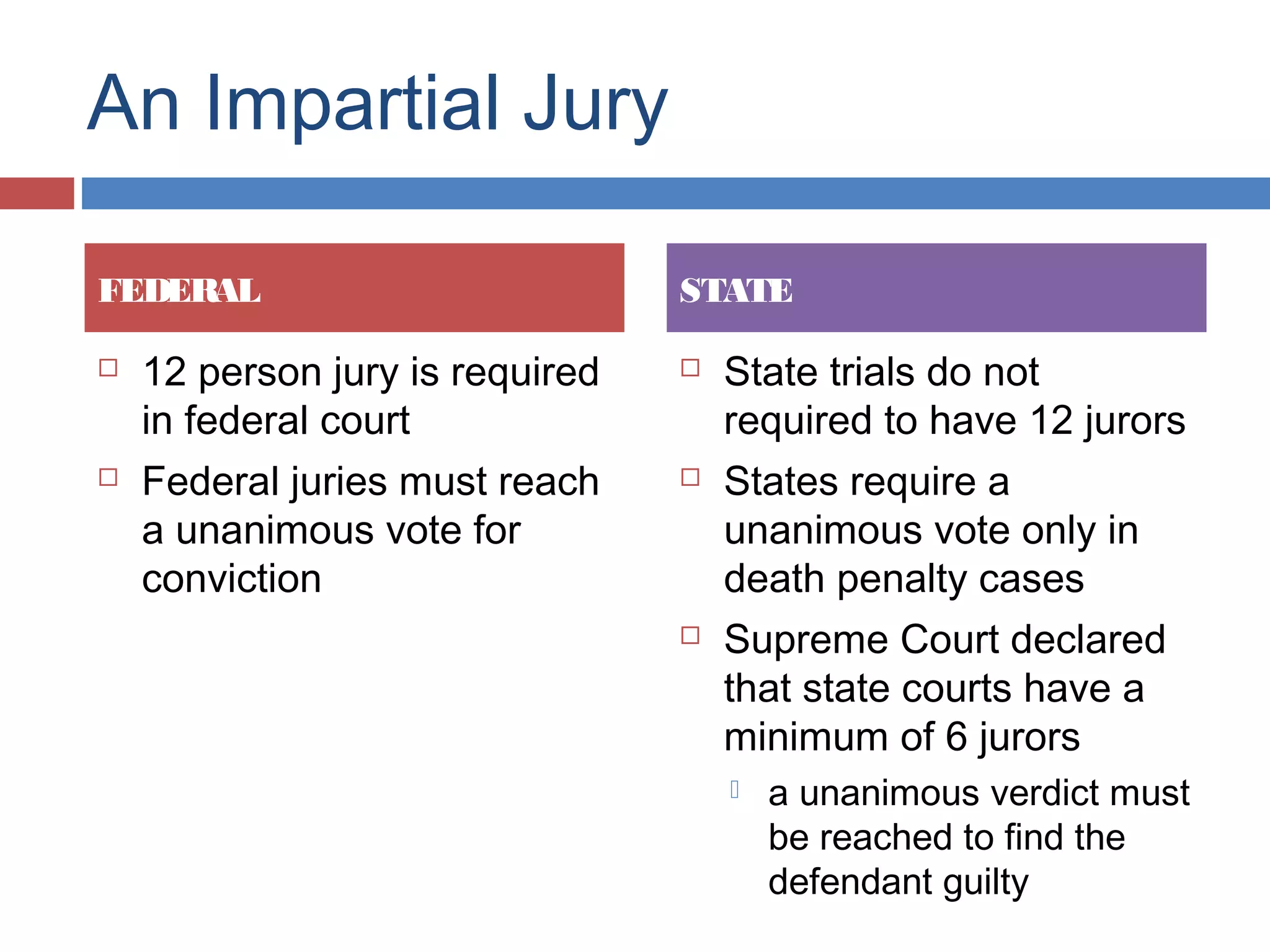
FEDERAL




12 person jury is required
in federal court
Federal juries must reach
a unanimous vote for
conviction

STATE






State trials do not
required to have 12 jurors
States require a
unanimous vote only in
death penalty cases
Supreme Court declared
that state courts have a
minimum of 6 jurors


a unanimous verdict must
be reached to find the
defendant guilty
An Impartial Jury


Voir dire




The process of questioning potential jurors to
determine their impartiality

Peremptory challenges


A specific number of allowances given to each
side in a case so that they may assert to remove
a potential juror for any reason whatsoever
An Impartial Jury


Ba ts o n v. Ke ntuc ky (1986)


Held that prosecutors’ peremptory challenges to
exclude from a jury members of the defendant’s
race based only on racial grounds violates the
equal protection rights of both the defendant and
the excluded juror
An Impartial Jury


To try defendants before juries unfairly
composed of a group likely to find against
them has been held a denial of equal
protection


Stra ud e r v. We s t Virg inia (1879)
 The

Court held that a black defendant could not be
tried before a jury from which all members of his
race were purposely excluded
An Impartial Jury




For tactical reasons, a person might waive the
right to a jury trial and select a court trial
Having the case heard before only the bench
(judge), without a jury
Jury Nullification




When a jury believes that a defendant to be
guilty but acquits that person because they do
not feel the circumstances would make a
conviction fair or they disagree with the law
Why would a jury nullify a law?



Mostly because they do not agree with it or think
it is unjust
A jury may also feel the penalty is too harsh for
the circumstances
Current Events
DOUG
DARREL
L







In September 2012 a jury
unanimously acquitted him in New
Hampshire for marijuana cultivation
charges
His attorney argued that he was
growing cannabis for his own
religious and medicinal use
He escaped prison because his
attorney convinced the jury to nullify
the charges against him
The Right to Confront Witnesses




The confrontation clause of the 6th Amendment
requires that witnesses be present in court so
that the defendant can confront them
The Supreme Court has supported state laws
that protect juvenile victims by permitting child
abuse victims to testify via one-way closed
circuit television
The Right to Confront Witnesses




The 6th Amendment also excludes hearsay
evidence
Hearsay






An out-of-court statement used to prove the truth
of the matter asserted
Can include statements made by the person
actually testifying, before taking the stand

Evidentiary law pertaining to hearsay and
exceptions is complex and voluminous
Compulsory Process




Permits a defendant to require witnesses to
appear in court, usually under the issuance by
the court of a subpoena
Subpoena




Requires an individual to appear in court to testify
or to bring documents or other physical evidence
to the court
Can be served by an officer of the court, or by
any other adult who is not a party to the action
Right to Counsel





The right to counsel is the only 6th Amendment
guarantee that extends beyond the trial
Everyone has the right to legal representation
Every lawyer has an obligation to do
everything legally permissible to see that the
client’s rights are upheld
Right to Counsel








It is to ensure that those accused are afforded their
legal right and that they understand the process in
which they are involved
Based on the adversarial justice system
 Places one party against another to resolve a
legal issue
The prosecutor must prove the accused beyond a
reasonable doubt
The defense lawyer must raise a doubt to win their
case
Development of the Right to
Counsel






England’s early legal system did not include the
assistance of counsel
Po we ll v. A ba m a (1932)
la
 Denying legal counsel for a defendant at trial is a
denial of due process
G id e o n v. Wa inwrig ht (1963)
 Held that not only was the right to counsel absolute,
but also in all serious cases, indigent defendants
accused of a felony were to be provided with legal
counsel
 Indigent defendants


Poor, unable to afford a lawyer
Development of the Right to
Counsel


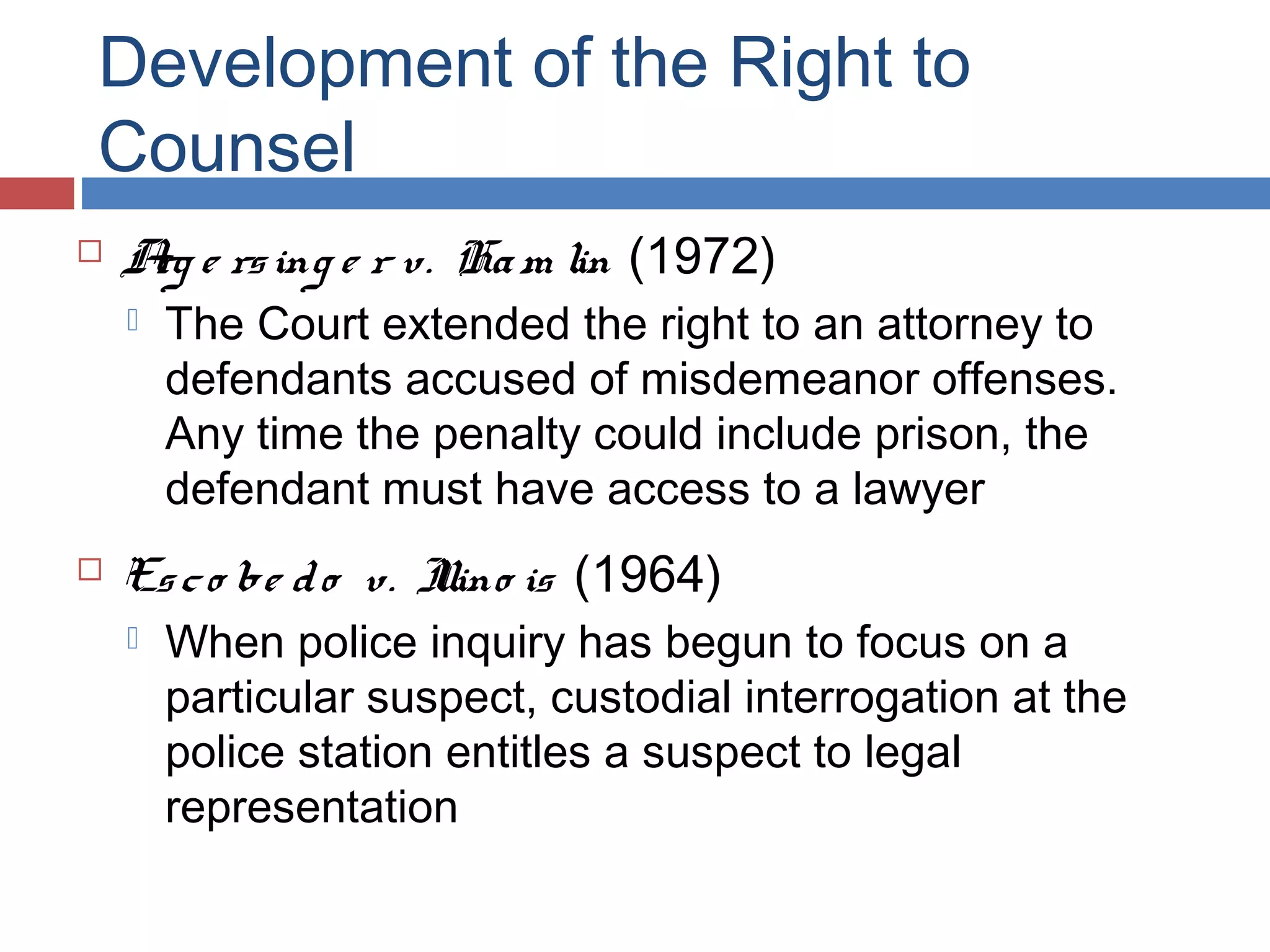
A e rs ing e r v. Ha m lin (1972)
rg




The Court extended the right to an attorney to
defendants accused of misdemeanor offenses.
Any time the penalty could include prison, the
defendant must have access to a lawyer

Es c o be d o v. I is (1964)
llino


When police inquiry has begun to focus on a
particular suspect, custodial interrogation at the
police station entitles a suspect to legal
representation
Current Events
THE
ACCESS
TO
JUSTICE
INITIATIVE







In March 2010 the U.S. Department
of Justice established this to address
the access-to-justice crisis in the
criminal justice system
The mission is to deliver outcomes
that are fair and accessible to all,
regardless of wealth or status
Many agencies will work together to
improve the services for those who
are unable to afford lawyers
Right to Counsel at Critical Stages
of Criminal Proceedings






The Supreme Court has held that no one may be
imprisoned for any level of crime without legal
representation, unless the accused has
knowingly and intelligently waived their right
6th Amendment right to legal counsel occurs at
every critical stage of a criminal proceeding,
including during the investigation, at hearings
and during the trial
A critical stage is any step during a criminal
prosecution where the accused’s rights may be
affected by the absence of legal representation
Critical Stages during the Criminal
Investigation


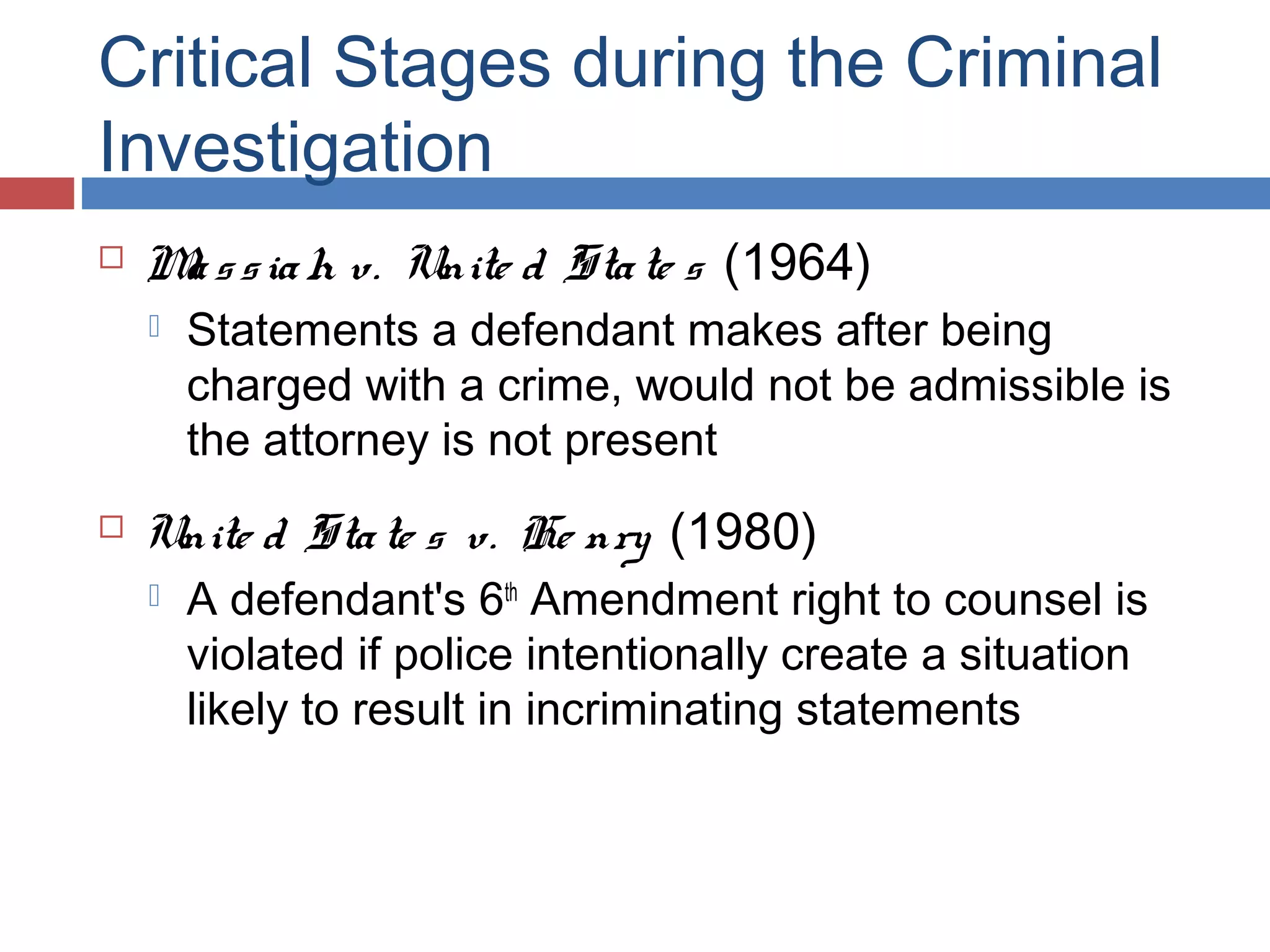
M s s ia h v. Unite d Sta te s (1964)
a




Statements a defendant makes after being
charged with a crime, would not be admissible is
the attorney is not present

Unite d Sta te s v. He nry (1980)


A defendant's 6th Amendment right to counsel is
violated if police intentionally create a situation
likely to result in incriminating statements
Critical Stages during the Criminal
Investigation




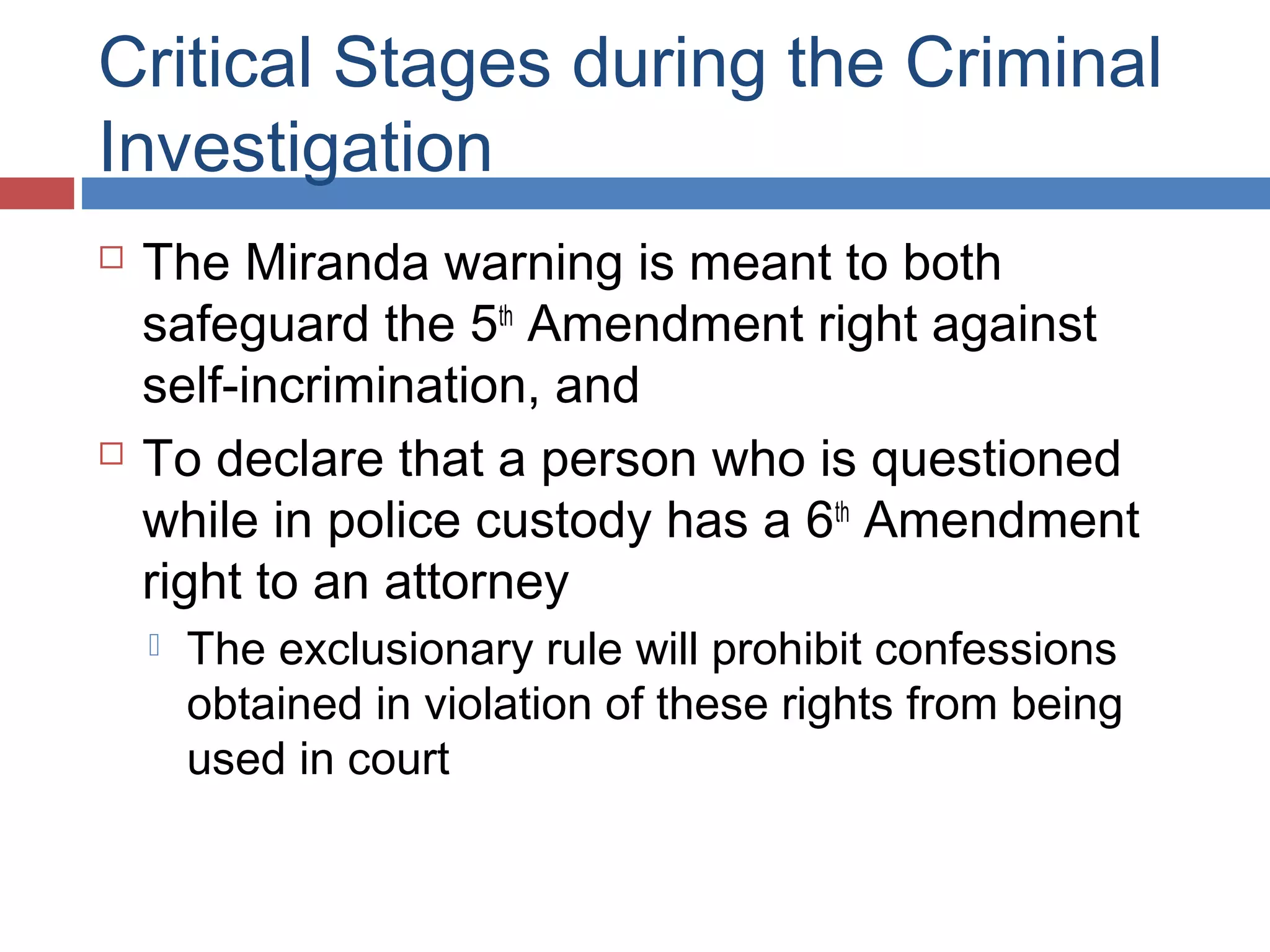
The Miranda warning is meant to both
safeguard the 5th Amendment right against
self-incrimination, and
To declare that a person who is questioned
while in police custody has a 6th Amendment
right to an attorney


The exclusionary rule will prohibit confessions
obtained in violation of these rights from being
used in court
Critical Stages during the Criminal
Investigation
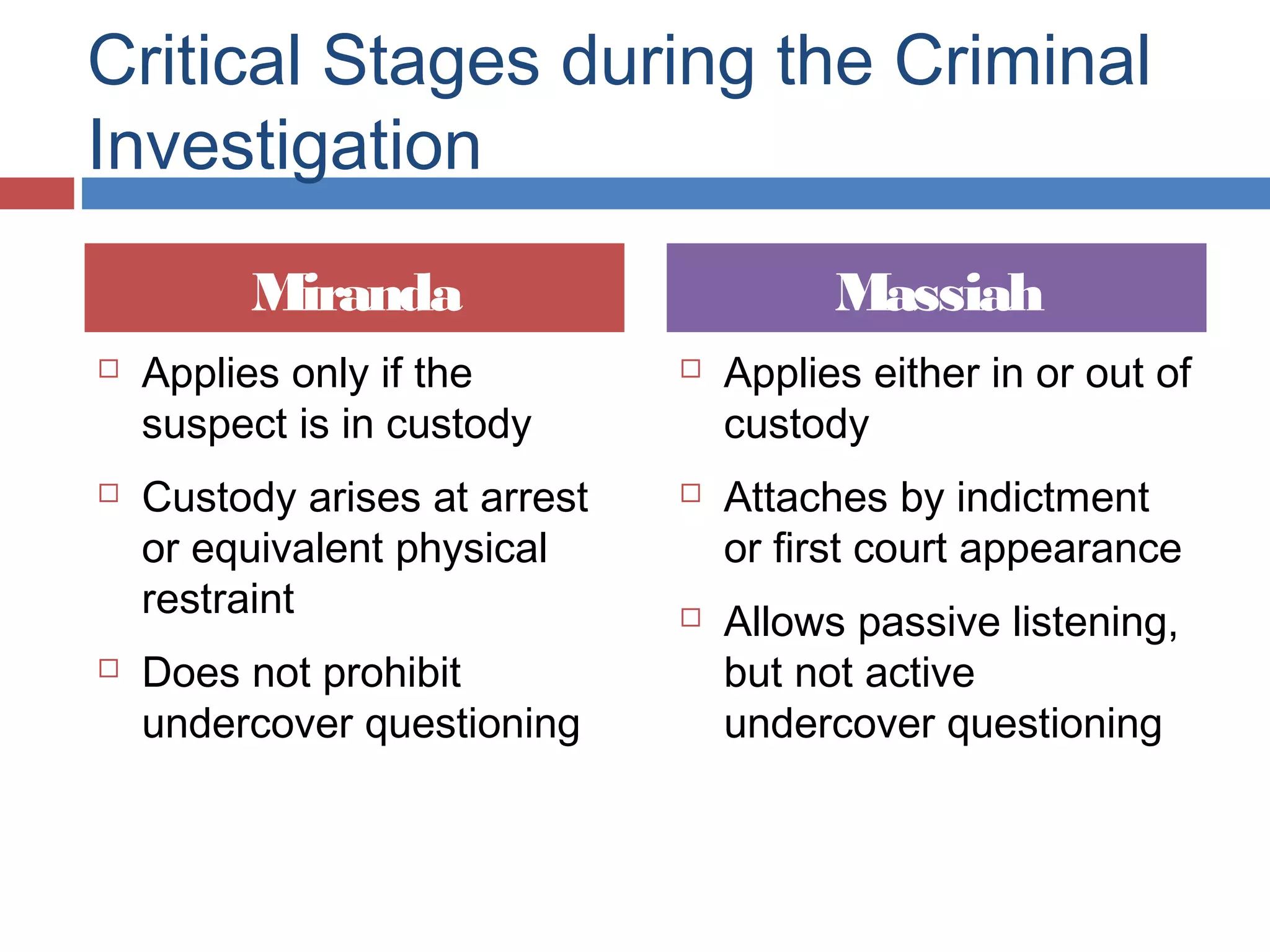
Miranda






Applies only if the
suspect is in custody
Custody arises at arrest
or equivalent physical
restraint
Does not prohibit
undercover questioning

Massiah






Applies either in or out of
custody
Attaches by indictment
or first court appearance
Allows passive listening,
but not active
undercover questioning
Critical Stages during the Criminal
Investigation


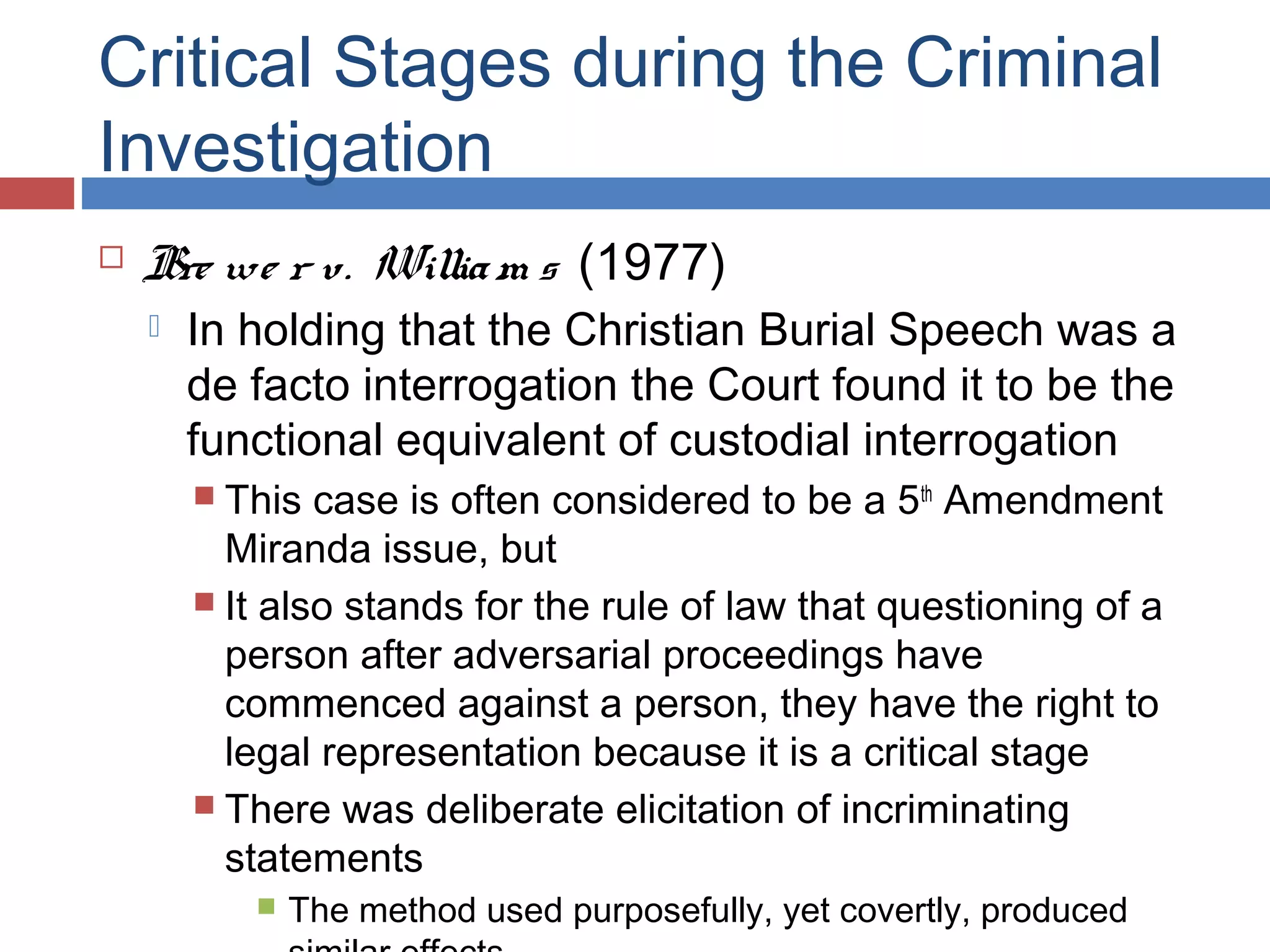
Bre we r v. Willia m s (1977)


In holding that the Christian Burial Speech was a
de facto interrogation the Court found it to be the
functional equivalent of custodial interrogation
 This

case is often considered to be a 5th Amendment
Miranda issue, but
 It also stands for the rule of law that questioning of a
person after adversarial proceedings have
commenced against a person, they have the right to
legal representation because it is a critical stage
 There was deliberate elicitation of incriminating
statements


The method used purposefully, yet covertly, produced
Rights during Identification








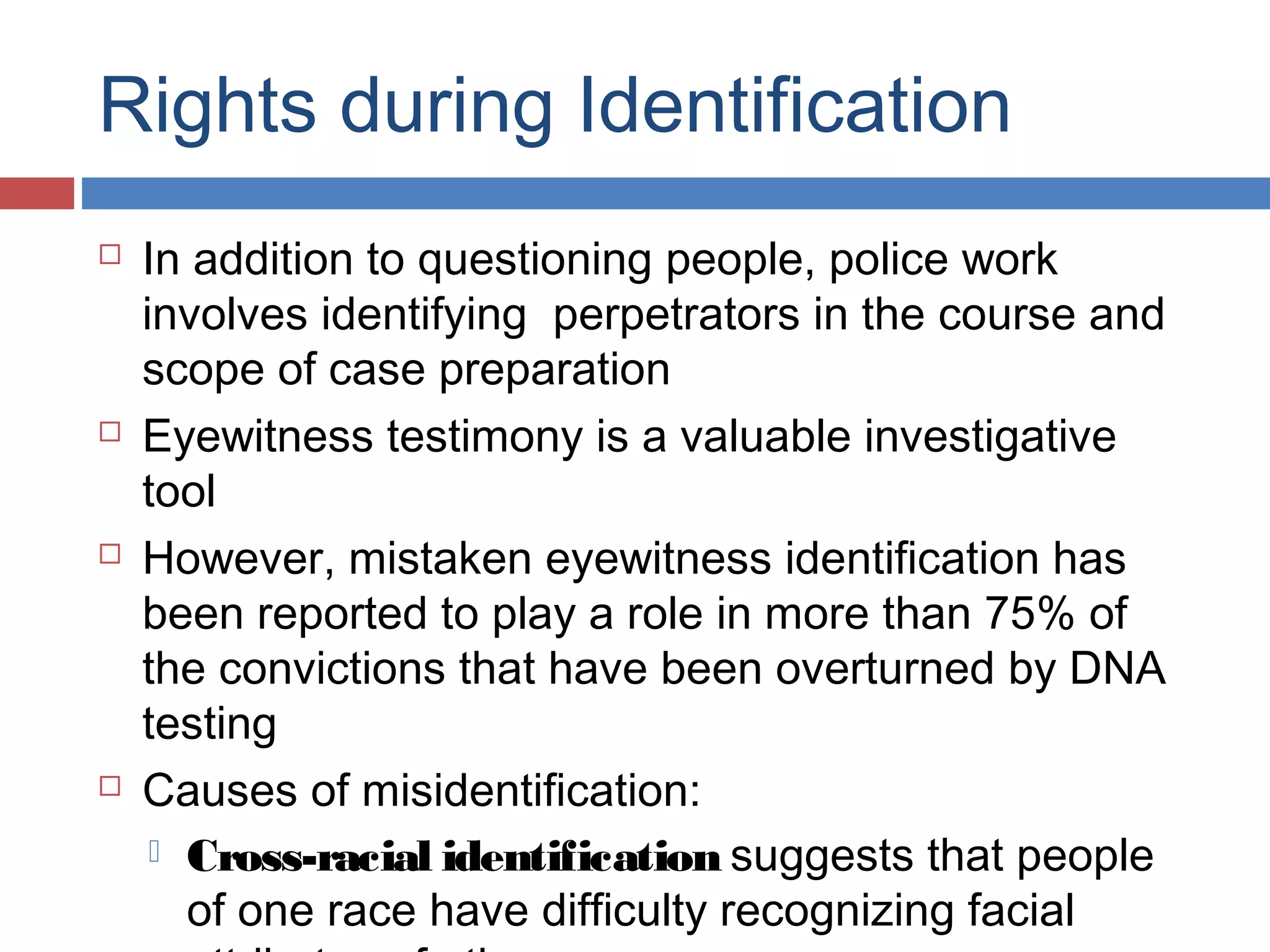
In addition to questioning people, police work
involves identifying perpetrators in the course and
scope of case preparation
Eyewitness testimony is a valuable investigative
tool
However, mistaken eyewitness identification has
been reported to play a role in more than 75% of
the convictions that have been overturned by DNA
testing
Causes of misidentification:
 Cross-racial identification suggests that people
of one race have difficulty recognizing facial
Rights during Identification




Criminal procedure defines ways police identify
suspects to victims or other witnesses
Showup




Lineup




Identification technique in which only one individual is
shown to the victim or witness
Identification technique in which the victim or witness
is shown several people, including the suspect

Blind Lineup


One conducted by someone who does not know who
the suspect is
Rights during Identification


Unite d Sta te s v. Wa d e & G ilbe rt v. Ca lifo rnia
(1967)


Established the Wade-Gilbert Rule, that the Court
held that pretrial lineups invoke the 6th
Amendment protection and require that the
suspect have a lawyer
Rights during Identification


Fo s te r v. Ca lifo rnia (1969)




Lineups may not be arranged in such a manner
as to make the defendant stand out from the
others in any unnecessarily suggestive ways

Kirby v. I is (1972)
llino


Pre-indictment identification procedures are not
critical stages of criminal proceedings, so there is
no 6th Amendment right to a lawyer
Rights during Identification


Factors to consider in determining witness
reliability:










The opportunity of the witness to view the defendant
during the crime
The level of attention the witness was paying to the
defendant
The accuracy of any descriptions of the defendant
made by the witness before the identification
procedure
The witness’s level of certainty in his or her
identification
The time between the crime and confrontation
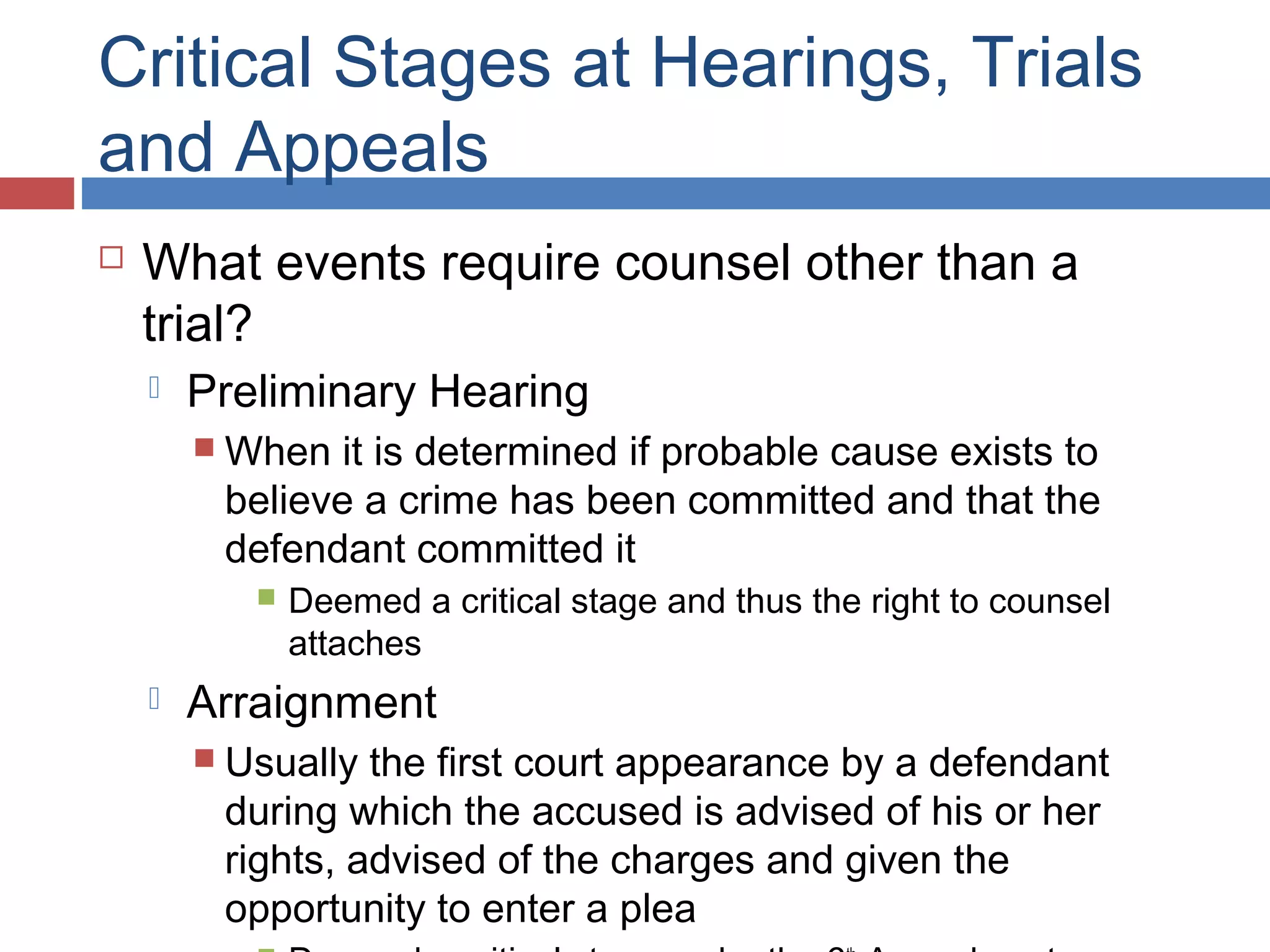
Critical Stages at Hearings, Trials
and Appeals


What events require counsel other than a
trial?


Preliminary Hearing
 When

it is determined if probable cause exists to
believe a crime has been committed and that the
defendant committed it




Deemed a critical stage and thus the right to counsel
attaches

Arraignment
 Usually

the first court appearance by a defendant
during which the accused is advised of his or her
rights, advised of the charges and given the
opportunity to enter a plea
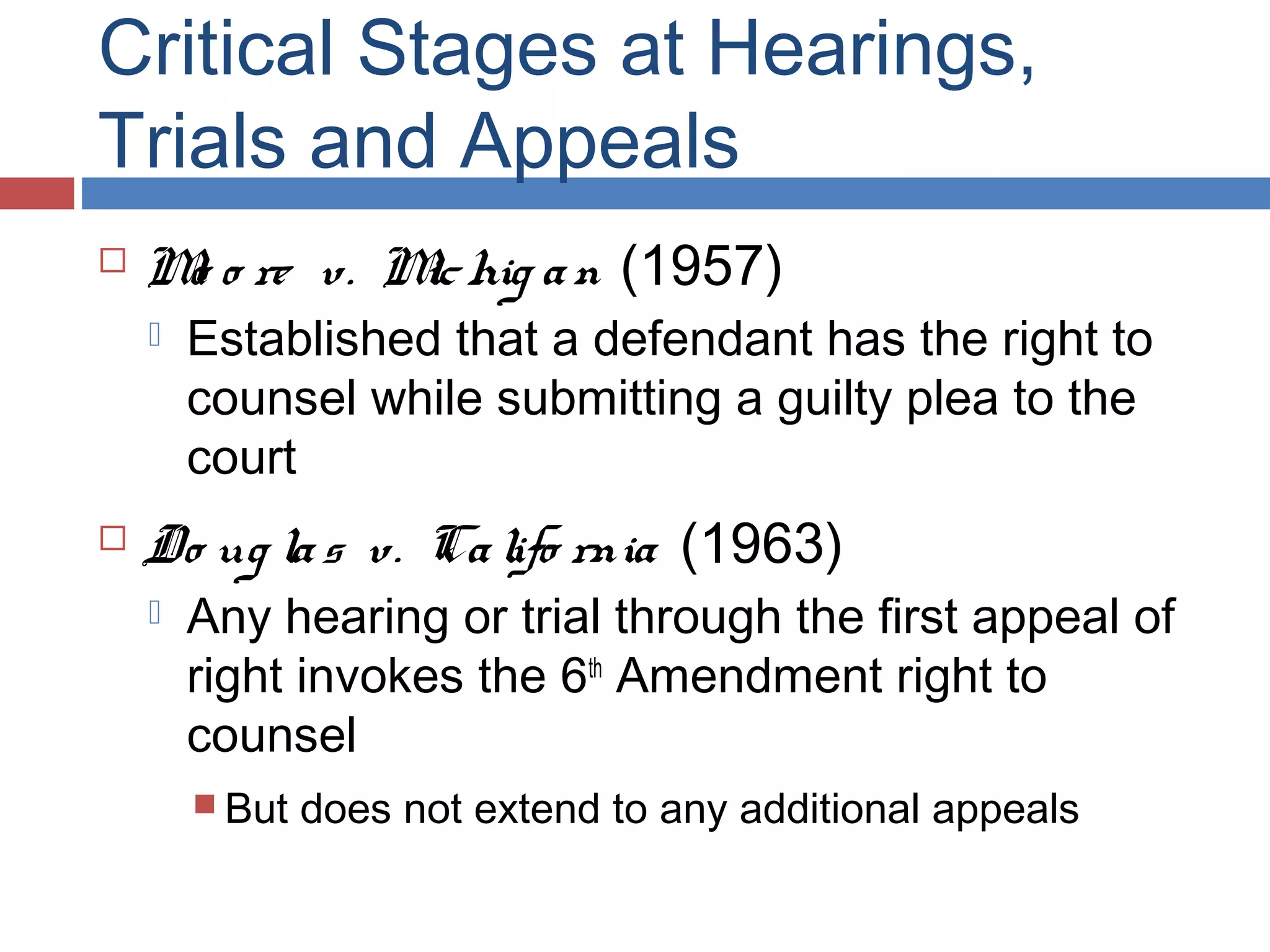
Critical Stages at Hearings,
Trials and Appeals


M o re v. M hig a n (1957)
o
ic




Established that a defendant has the right to
counsel while submitting a guilty plea to the
court

Do ug la s v. Ca lifo rnia (1963)


Any hearing or trial through the first appeal of
right invokes the 6th Amendment right to
counsel
 But

does not extend to any additional appeals
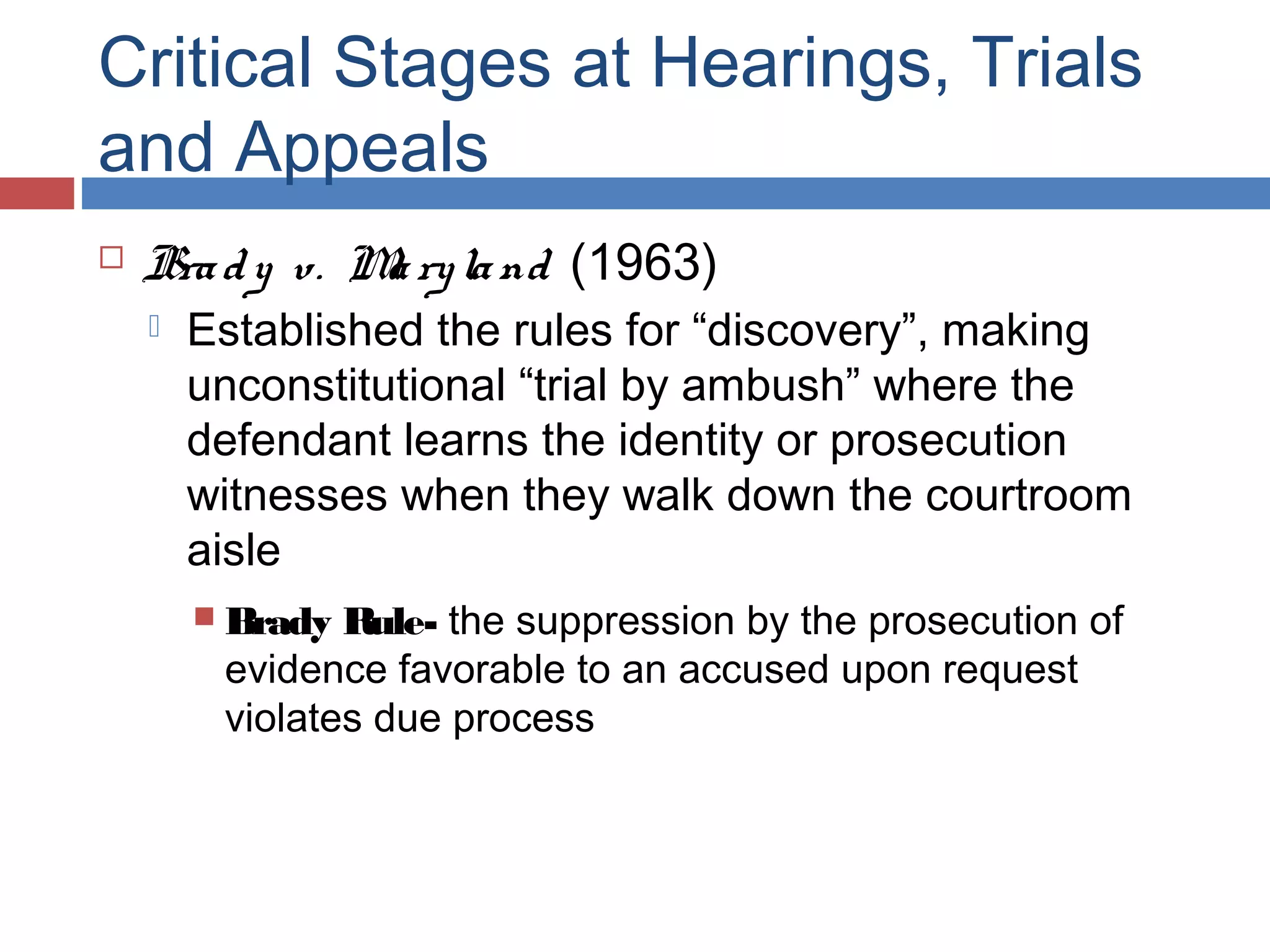
Critical Stages at Hearings, Trials
and Appeals


Bra d y v. M ry la nd (1963)
a


Established the rules for “discovery”, making
unconstitutional “trial by ambush” where the
defendant learns the identity or prosecution
witnesses when they walk down the courtroom
aisle
Rule- the suppression by the prosecution of
evidence favorable to an accused upon request
violates due process

 Brady
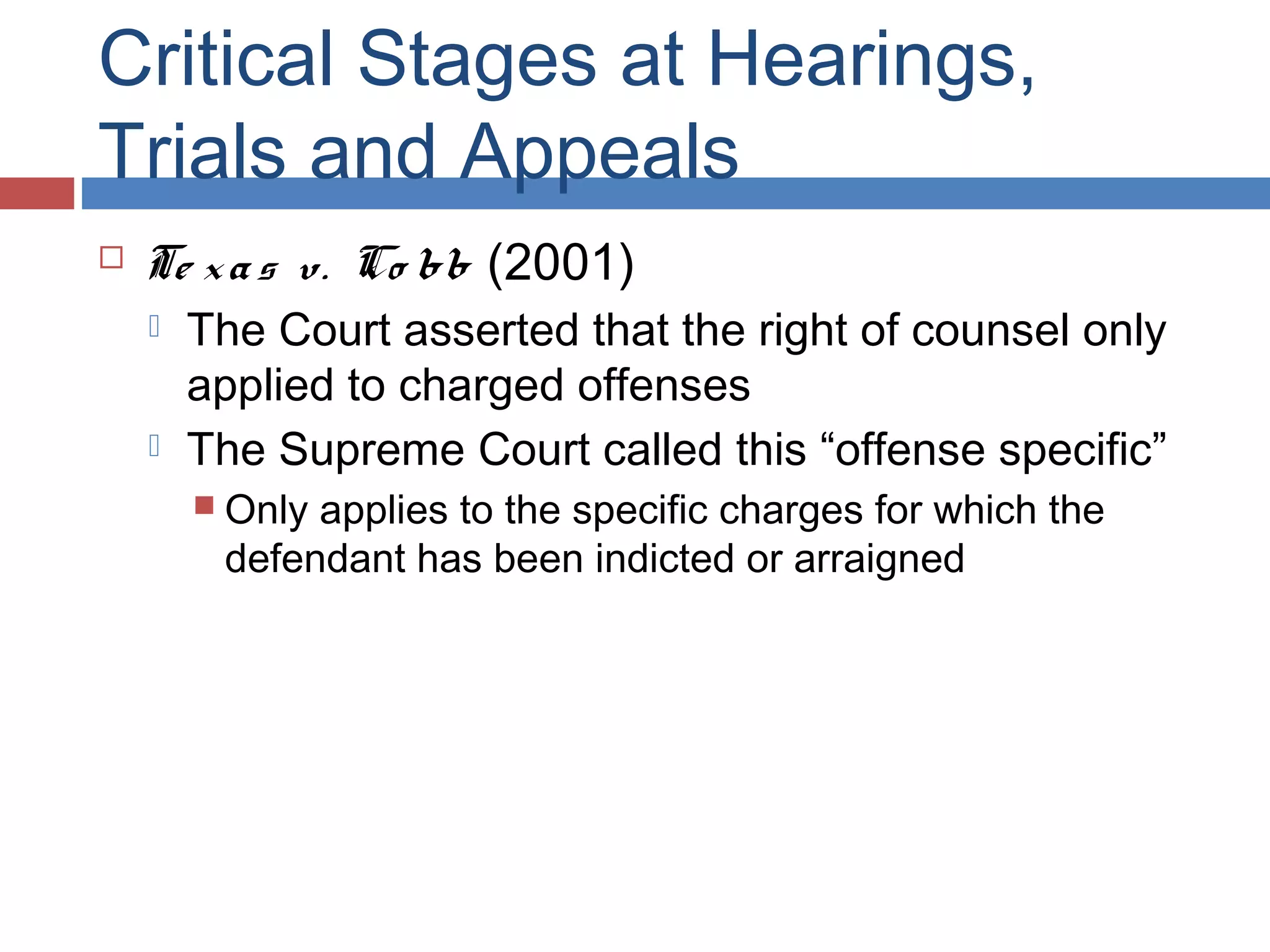
Critical Stages at Hearings,
Trials and Appeals


Te x a s v. Co bb (2001)




The Court asserted that the right of counsel only
applied to charged offenses
The Supreme Court called this “offense specific”
 Only

applies to the specific charges for which the
defendant has been indicted or arraigned
The Presumption of Effective
Counsel


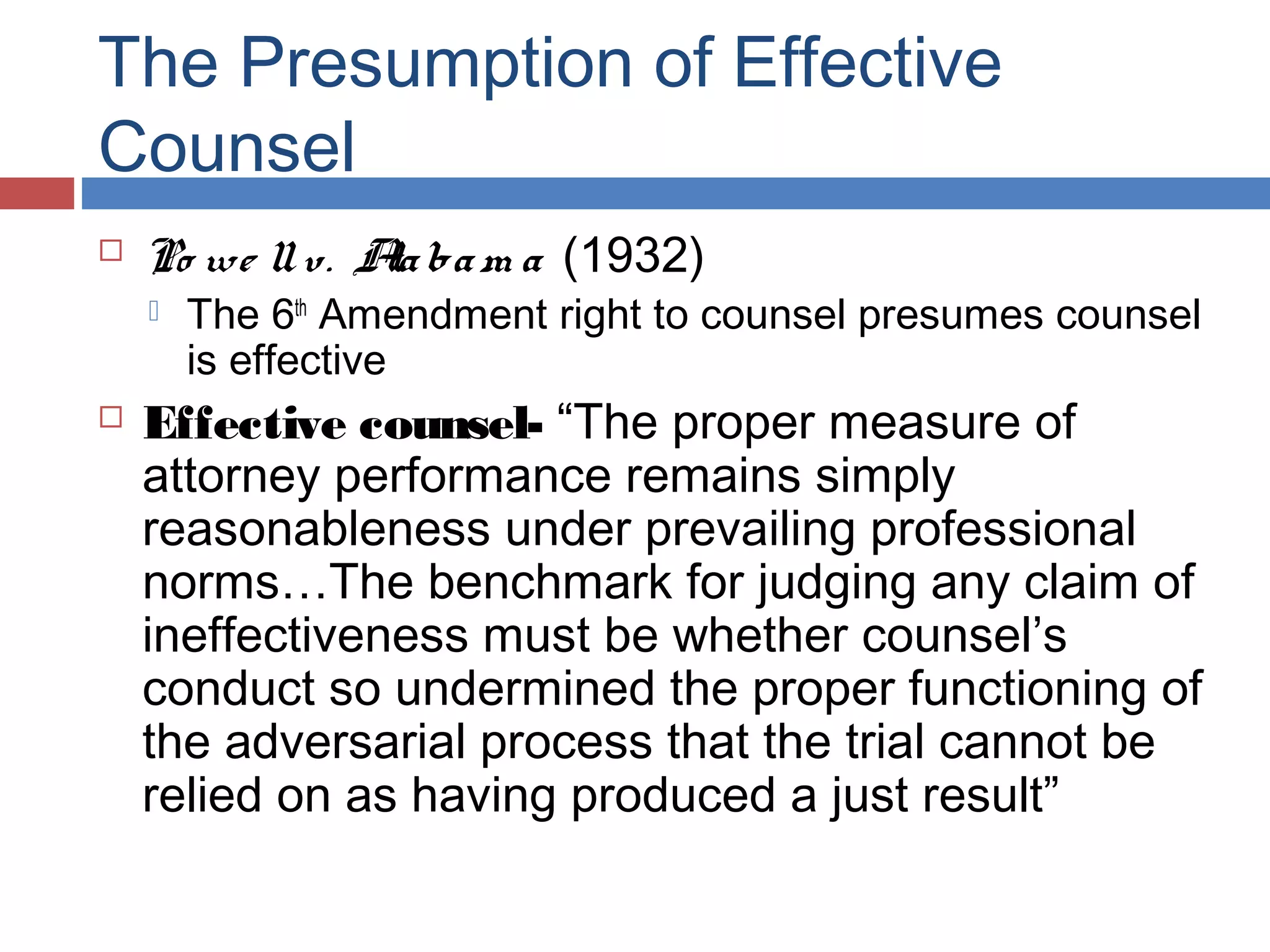
Po we ll v. A ba m a (1932)
la




The 6th Amendment right to counsel presumes counsel
is effective

Effective counsel- “The proper measure of
attorney performance remains simply
reasonableness under prevailing professional
norms…The benchmark for judging any claim of
ineffectiveness must be whether counsel’s
conduct so undermined the proper functioning of
the adversarial process that the trial cannot be
relied on as having produced a just result”
The Presumption of Effective
Counsel


Stric kla nd v. Wa s hing to n (1984)


Established a two-prong test to establish a
claim of ineffective counsel

1.
2.

The counsel’s representation fell below an
objective standard of reasonableness
There is a reasonable probability that, but for the
counsel’s unprofessional errors, the result of the
proceeding would have been different
The Presumption of Effective
Counsel


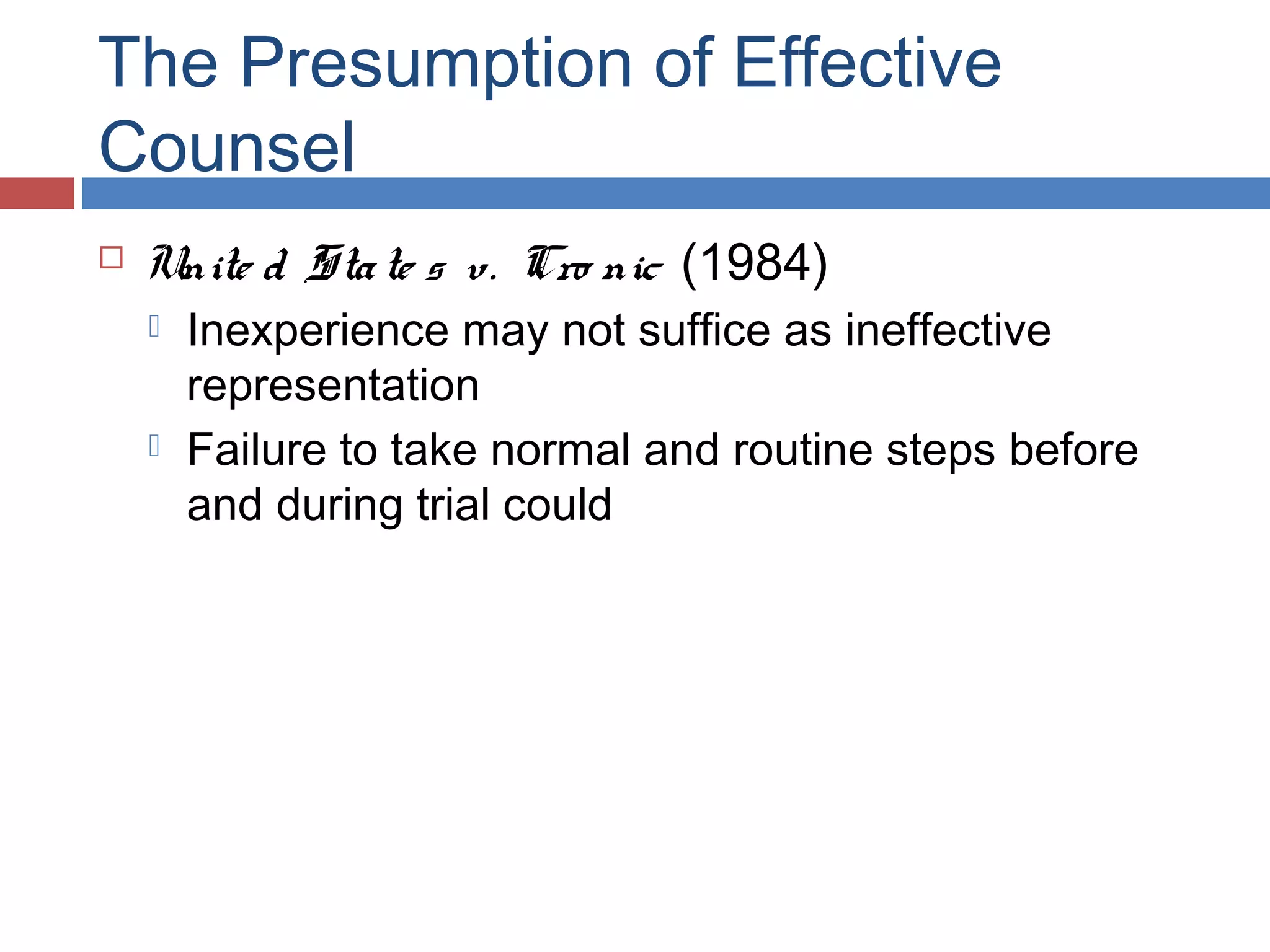
Unite d Sta te s v. Cro nic (1984)




Inexperience may not suffice as ineffective
representation
Failure to take normal and routine steps before
and during trial could
The Presumption of Effective
Counsel




If a lawyer has a conflict of interest by
representing another client who would
prejudice the other, ineffective assistance of
counsel would exist
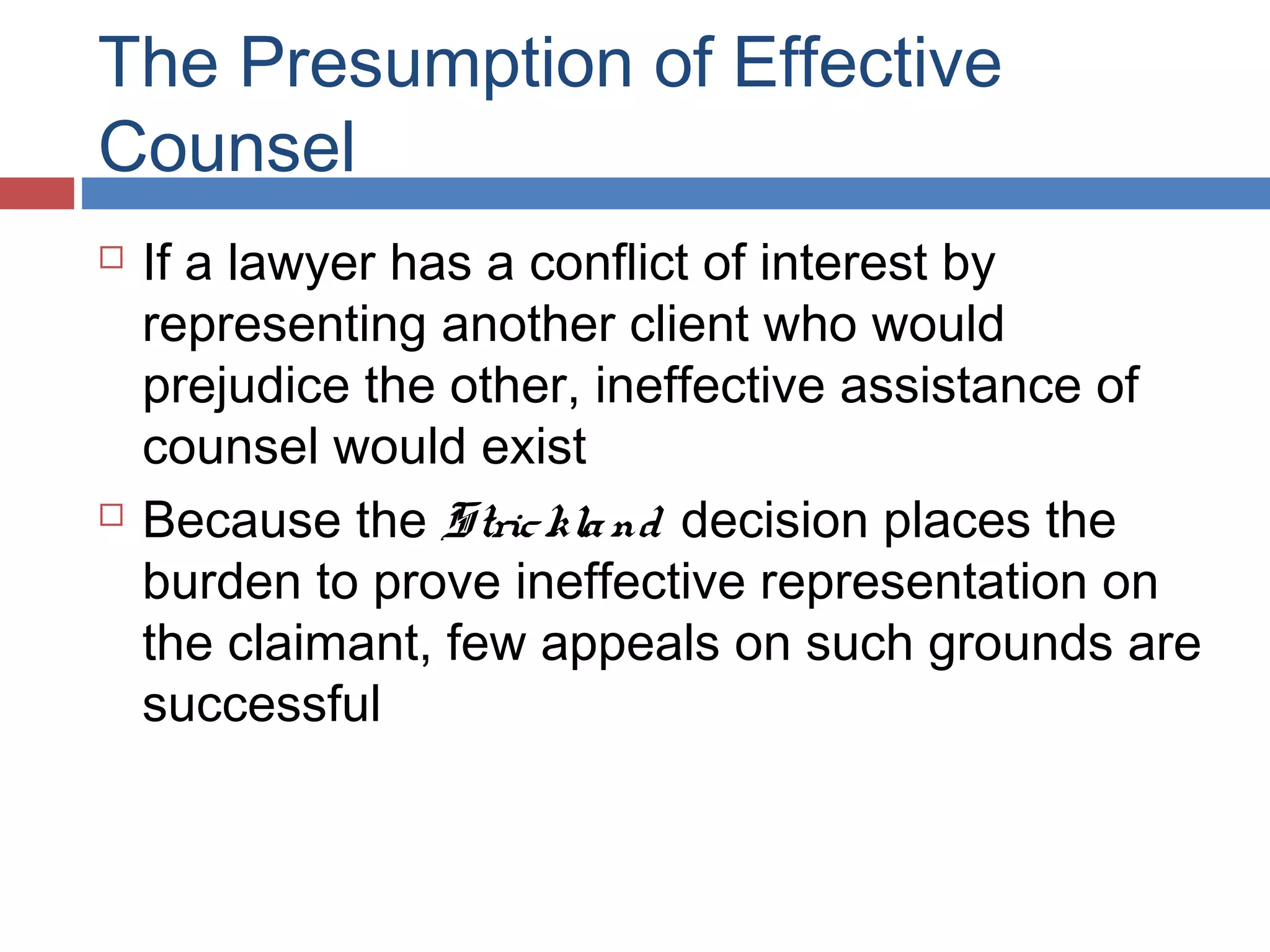
Because the Stric kla nd decision places the
burden to prove ineffective representation on
the claimant, few appeals on such grounds are
successful
Waiver of 6th Amendment Right to
Legal Counsel




A suspect cannot be forced to deal with an
attorney and so may waive this right
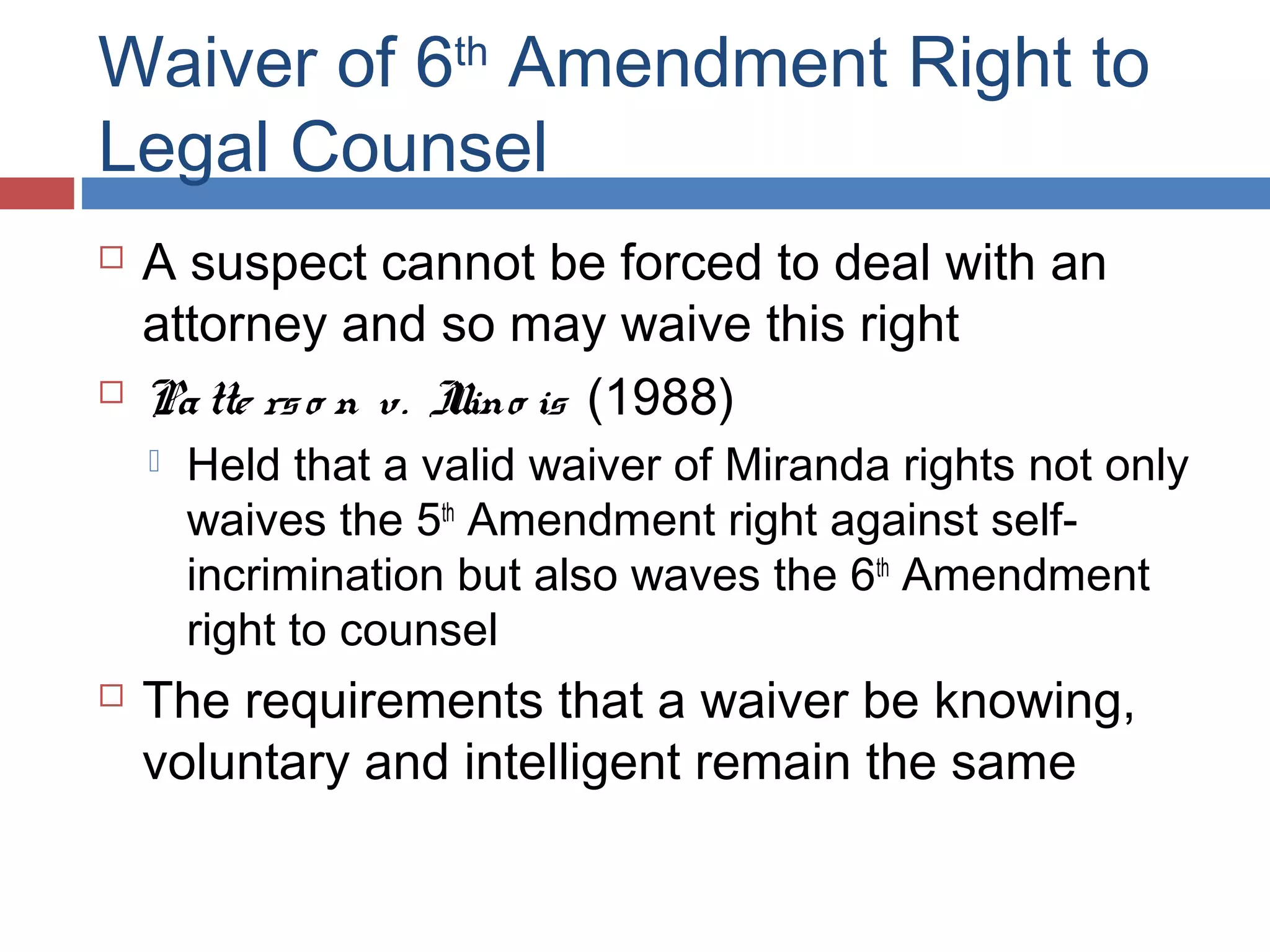
Pa tte rs o n v. I is (1988)
llino




Held that a valid waiver of Miranda rights not only
waives the 5th Amendment right against selfincrimination but also waves the 6th Amendment
right to counsel

The requirements that a waiver be knowing,
voluntary and intelligent remain the same
Waiver of 6th Amendment Right to
Legal Counsel






A court will consider the totality of
circumstances regarding how the waiver was
obtained and the competency and age of the
person
As well as issues of intelligence, health and
ability to understand the language
For a waiver to be effective, it need no be in
writing, but whatever statement is made by the
suspect must show there was, in fact:


An intentional relinquishment of the known right
The Right to Act as One’s Own
Counsel


People may elect to appear in court pro se







Appearing in court without an attorney, representing
oneself

Some defendants distrust attorneys in general
Believe they can handle their defense
adequately
The expense of hiring a lawyer or not qualifying
for legal aid compels some to defend
themselves
The Right to Act as One’s Own
Counsel


Fa re tta v. Ca lifo rnia (1975)


Set forth three conditions to be met before a
person could represent themselves:

Awareness of the right to counsel
2. A valid waiver of 6th Amendment rights
3. Competency
An accused who represents themselves,
cannot later claim ineffective counsel
1.


Juveniles and the 6th Amendment


I re G a ult (1967)
n


Established that the Constitution applied to
juveniles as well as adults



Gives rights to juveniles including the right
against self-incrimination



To receive notice of charges



To confront and cross-examine witnesses



Right to counsel
The 6th Amendment and
Corrections




Like the 5th Amendment, the 6th Amendment is
not frequently cited in prisoners’ rights lawsuits
For prisoners, cases based on the 6th
Amendment involve the right to a speedy trial
and the detainer problem


Document filed against inmates who have other
criminal charges pending against them
The 6 Amendment and
Corrections
th



M m p a v. Rha y (1967)
e




Convicted offenders have right to assistance of
counsel at probation revocation hearings in which
sentencing has been deferred

G a g no n v. Sc a rp e lli (1973)


Probationers/parolees have a constitutionally
limited right to counsel on a case-by-case basis at
revocation proceedings

Ch12

  • 1.
    THE 6TH AMENDMENT:RIGHT TO COUNSEL AND A FAIR TRIAL Chapter 12
  • 2.
    Introduction    The 6th Amendmentis not that familiar to the public It deals with the fairness at trial and the right to a lawyer during the time leading up to and during prosecution The 6th Amendment protects the individual against the government’s unlimited resources and ensure a fair trial
  • 3.
    Speedy and PublicTrial   The 6th Amendment require a speedy and public trial A delayed or prolonged trial is inherently unfair  With the assumption of a person is innocent until proven guilty, each individual charged with a crime has the right to have their determination made as quickly as possible
  • 4.
    Speedy and PublicTrial   Delay that harms the accused’s defense may cause the charges to be dismissed Ba rke r v. Wing o (1972)  A trial is sufficiently “speedy” is determined by 1. 2. 3. 4. The length of the delay The reason for the delay The defendant’s assertion of this right The harm caused
  • 5.
    Speedy and PublicTrial  G a nne tt Co . v. De Pa s q ua le (1979)   The Court held that the 6th Amendment does not permit the public to attend every trial Ric hm o nd N ws p a p e rs , I . v. Virg inia (1980) e nc  The public does have the right to attend trials unless there is a compelling government interest in doing otherwise  For example, in cases involving National Security
  • 6.
    Where the TrialIs Held   6th Amendment requires that the trial occur in the district in which the crime was committed Venue  The geographical area in which a specific case may come to trial, and the area from which the jury is selected
  • 7.
    Where the TrialIs Held  A defendant may seek a change of venue for several reasons: 1. Such prejudice in the county where the case is to be tried that the defendant cannot obtain a fair and impartial trial there 2. Another location is much more convenient for the parties and witness than the intended place of trial, and the interests of justice require a transfer of location
  • 8.
    An Impartial Jury    The6th Amendment requires an impartial and representative jury All crimes involving the potential of jail time do not require a jury trial “Petty crimes” do not require a jury trial   No definition of what a petty crime is More serious offenses warrant a jury trial  Generally those who punishments could exceed jail time of six months
  • 9.
    An Impartial Jury FEDERAL   12person jury is required in federal court Federal juries must reach a unanimous vote for conviction STATE    State trials do not required to have 12 jurors States require a unanimous vote only in death penalty cases Supreme Court declared that state courts have a minimum of 6 jurors  a unanimous verdict must be reached to find the defendant guilty
  • 10.
    An Impartial Jury  Voirdire   The process of questioning potential jurors to determine their impartiality Peremptory challenges  A specific number of allowances given to each side in a case so that they may assert to remove a potential juror for any reason whatsoever
  • 11.
    An Impartial Jury  Bats o n v. Ke ntuc ky (1986)  Held that prosecutors’ peremptory challenges to exclude from a jury members of the defendant’s race based only on racial grounds violates the equal protection rights of both the defendant and the excluded juror
  • 12.
    An Impartial Jury  Totry defendants before juries unfairly composed of a group likely to find against them has been held a denial of equal protection  Stra ud e r v. We s t Virg inia (1879)  The Court held that a black defendant could not be tried before a jury from which all members of his race were purposely excluded
  • 13.
    An Impartial Jury   Fortactical reasons, a person might waive the right to a jury trial and select a court trial Having the case heard before only the bench (judge), without a jury
  • 14.
    Jury Nullification   When ajury believes that a defendant to be guilty but acquits that person because they do not feel the circumstances would make a conviction fair or they disagree with the law Why would a jury nullify a law?   Mostly because they do not agree with it or think it is unjust A jury may also feel the penalty is too harsh for the circumstances
  • 15.
    Current Events DOUG DARREL L    In September2012 a jury unanimously acquitted him in New Hampshire for marijuana cultivation charges His attorney argued that he was growing cannabis for his own religious and medicinal use He escaped prison because his attorney convinced the jury to nullify the charges against him
  • 16.
    The Right toConfront Witnesses   The confrontation clause of the 6th Amendment requires that witnesses be present in court so that the defendant can confront them The Supreme Court has supported state laws that protect juvenile victims by permitting child abuse victims to testify via one-way closed circuit television
  • 17.
    The Right toConfront Witnesses   The 6th Amendment also excludes hearsay evidence Hearsay    An out-of-court statement used to prove the truth of the matter asserted Can include statements made by the person actually testifying, before taking the stand Evidentiary law pertaining to hearsay and exceptions is complex and voluminous
  • 18.
    Compulsory Process   Permits adefendant to require witnesses to appear in court, usually under the issuance by the court of a subpoena Subpoena   Requires an individual to appear in court to testify or to bring documents or other physical evidence to the court Can be served by an officer of the court, or by any other adult who is not a party to the action
  • 19.
    Right to Counsel    Theright to counsel is the only 6th Amendment guarantee that extends beyond the trial Everyone has the right to legal representation Every lawyer has an obligation to do everything legally permissible to see that the client’s rights are upheld
  • 20.
    Right to Counsel     Itis to ensure that those accused are afforded their legal right and that they understand the process in which they are involved Based on the adversarial justice system  Places one party against another to resolve a legal issue The prosecutor must prove the accused beyond a reasonable doubt The defense lawyer must raise a doubt to win their case
  • 21.
    Development of theRight to Counsel    England’s early legal system did not include the assistance of counsel Po we ll v. A ba m a (1932) la  Denying legal counsel for a defendant at trial is a denial of due process G id e o n v. Wa inwrig ht (1963)  Held that not only was the right to counsel absolute, but also in all serious cases, indigent defendants accused of a felony were to be provided with legal counsel  Indigent defendants  Poor, unable to afford a lawyer
  • 22.
    Development of theRight to Counsel  A e rs ing e r v. Ha m lin (1972) rg   The Court extended the right to an attorney to defendants accused of misdemeanor offenses. Any time the penalty could include prison, the defendant must have access to a lawyer Es c o be d o v. I is (1964) llino  When police inquiry has begun to focus on a particular suspect, custodial interrogation at the police station entitles a suspect to legal representation
  • 23.
    Current Events THE ACCESS TO JUSTICE INITIATIVE    In March2010 the U.S. Department of Justice established this to address the access-to-justice crisis in the criminal justice system The mission is to deliver outcomes that are fair and accessible to all, regardless of wealth or status Many agencies will work together to improve the services for those who are unable to afford lawyers
  • 24.
    Right to Counselat Critical Stages of Criminal Proceedings    The Supreme Court has held that no one may be imprisoned for any level of crime without legal representation, unless the accused has knowingly and intelligently waived their right 6th Amendment right to legal counsel occurs at every critical stage of a criminal proceeding, including during the investigation, at hearings and during the trial A critical stage is any step during a criminal prosecution where the accused’s rights may be affected by the absence of legal representation
  • 25.
    Critical Stages duringthe Criminal Investigation  M s s ia h v. Unite d Sta te s (1964) a   Statements a defendant makes after being charged with a crime, would not be admissible is the attorney is not present Unite d Sta te s v. He nry (1980)  A defendant's 6th Amendment right to counsel is violated if police intentionally create a situation likely to result in incriminating statements
  • 26.
    Critical Stages duringthe Criminal Investigation   The Miranda warning is meant to both safeguard the 5th Amendment right against self-incrimination, and To declare that a person who is questioned while in police custody has a 6th Amendment right to an attorney  The exclusionary rule will prohibit confessions obtained in violation of these rights from being used in court
  • 27.
    Critical Stages duringthe Criminal Investigation Miranda    Applies only if the suspect is in custody Custody arises at arrest or equivalent physical restraint Does not prohibit undercover questioning Massiah    Applies either in or out of custody Attaches by indictment or first court appearance Allows passive listening, but not active undercover questioning
  • 28.
    Critical Stages duringthe Criminal Investigation  Bre we r v. Willia m s (1977)  In holding that the Christian Burial Speech was a de facto interrogation the Court found it to be the functional equivalent of custodial interrogation  This case is often considered to be a 5th Amendment Miranda issue, but  It also stands for the rule of law that questioning of a person after adversarial proceedings have commenced against a person, they have the right to legal representation because it is a critical stage  There was deliberate elicitation of incriminating statements  The method used purposefully, yet covertly, produced
  • 29.
    Rights during Identification     Inaddition to questioning people, police work involves identifying perpetrators in the course and scope of case preparation Eyewitness testimony is a valuable investigative tool However, mistaken eyewitness identification has been reported to play a role in more than 75% of the convictions that have been overturned by DNA testing Causes of misidentification:  Cross-racial identification suggests that people of one race have difficulty recognizing facial
  • 30.
    Rights during Identification   Criminalprocedure defines ways police identify suspects to victims or other witnesses Showup   Lineup   Identification technique in which only one individual is shown to the victim or witness Identification technique in which the victim or witness is shown several people, including the suspect Blind Lineup  One conducted by someone who does not know who the suspect is
  • 31.
    Rights during Identification  United Sta te s v. Wa d e & G ilbe rt v. Ca lifo rnia (1967)  Established the Wade-Gilbert Rule, that the Court held that pretrial lineups invoke the 6th Amendment protection and require that the suspect have a lawyer
  • 32.
    Rights during Identification  Fos te r v. Ca lifo rnia (1969)   Lineups may not be arranged in such a manner as to make the defendant stand out from the others in any unnecessarily suggestive ways Kirby v. I is (1972) llino  Pre-indictment identification procedures are not critical stages of criminal proceedings, so there is no 6th Amendment right to a lawyer
  • 33.
    Rights during Identification  Factorsto consider in determining witness reliability:      The opportunity of the witness to view the defendant during the crime The level of attention the witness was paying to the defendant The accuracy of any descriptions of the defendant made by the witness before the identification procedure The witness’s level of certainty in his or her identification The time between the crime and confrontation
  • 34.
    Critical Stages atHearings, Trials and Appeals  What events require counsel other than a trial?  Preliminary Hearing  When it is determined if probable cause exists to believe a crime has been committed and that the defendant committed it   Deemed a critical stage and thus the right to counsel attaches Arraignment  Usually the first court appearance by a defendant during which the accused is advised of his or her rights, advised of the charges and given the opportunity to enter a plea
  • 35.
    Critical Stages atHearings, Trials and Appeals  M o re v. M hig a n (1957) o ic   Established that a defendant has the right to counsel while submitting a guilty plea to the court Do ug la s v. Ca lifo rnia (1963)  Any hearing or trial through the first appeal of right invokes the 6th Amendment right to counsel  But does not extend to any additional appeals
  • 36.
    Critical Stages atHearings, Trials and Appeals  Bra d y v. M ry la nd (1963) a  Established the rules for “discovery”, making unconstitutional “trial by ambush” where the defendant learns the identity or prosecution witnesses when they walk down the courtroom aisle Rule- the suppression by the prosecution of evidence favorable to an accused upon request violates due process  Brady
  • 37.
    Critical Stages atHearings, Trials and Appeals  Te x a s v. Co bb (2001)   The Court asserted that the right of counsel only applied to charged offenses The Supreme Court called this “offense specific”  Only applies to the specific charges for which the defendant has been indicted or arraigned
  • 38.
    The Presumption ofEffective Counsel  Po we ll v. A ba m a (1932) la   The 6th Amendment right to counsel presumes counsel is effective Effective counsel- “The proper measure of attorney performance remains simply reasonableness under prevailing professional norms…The benchmark for judging any claim of ineffectiveness must be whether counsel’s conduct so undermined the proper functioning of the adversarial process that the trial cannot be relied on as having produced a just result”
  • 39.
    The Presumption ofEffective Counsel  Stric kla nd v. Wa s hing to n (1984)  Established a two-prong test to establish a claim of ineffective counsel 1. 2. The counsel’s representation fell below an objective standard of reasonableness There is a reasonable probability that, but for the counsel’s unprofessional errors, the result of the proceeding would have been different
  • 40.
    The Presumption ofEffective Counsel  Unite d Sta te s v. Cro nic (1984)   Inexperience may not suffice as ineffective representation Failure to take normal and routine steps before and during trial could
  • 41.
    The Presumption ofEffective Counsel   If a lawyer has a conflict of interest by representing another client who would prejudice the other, ineffective assistance of counsel would exist Because the Stric kla nd decision places the burden to prove ineffective representation on the claimant, few appeals on such grounds are successful
  • 42.
    Waiver of 6thAmendment Right to Legal Counsel   A suspect cannot be forced to deal with an attorney and so may waive this right Pa tte rs o n v. I is (1988) llino   Held that a valid waiver of Miranda rights not only waives the 5th Amendment right against selfincrimination but also waves the 6th Amendment right to counsel The requirements that a waiver be knowing, voluntary and intelligent remain the same
  • 43.
    Waiver of 6thAmendment Right to Legal Counsel    A court will consider the totality of circumstances regarding how the waiver was obtained and the competency and age of the person As well as issues of intelligence, health and ability to understand the language For a waiver to be effective, it need no be in writing, but whatever statement is made by the suspect must show there was, in fact:  An intentional relinquishment of the known right
  • 44.
    The Right toAct as One’s Own Counsel  People may elect to appear in court pro se     Appearing in court without an attorney, representing oneself Some defendants distrust attorneys in general Believe they can handle their defense adequately The expense of hiring a lawyer or not qualifying for legal aid compels some to defend themselves
  • 45.
    The Right toAct as One’s Own Counsel  Fa re tta v. Ca lifo rnia (1975)  Set forth three conditions to be met before a person could represent themselves: Awareness of the right to counsel 2. A valid waiver of 6th Amendment rights 3. Competency An accused who represents themselves, cannot later claim ineffective counsel 1. 
  • 46.
    Juveniles and the6th Amendment  I re G a ult (1967) n  Established that the Constitution applied to juveniles as well as adults  Gives rights to juveniles including the right against self-incrimination  To receive notice of charges  To confront and cross-examine witnesses  Right to counsel
  • 47.
    The 6th Amendmentand Corrections   Like the 5th Amendment, the 6th Amendment is not frequently cited in prisoners’ rights lawsuits For prisoners, cases based on the 6th Amendment involve the right to a speedy trial and the detainer problem  Document filed against inmates who have other criminal charges pending against them
  • 48.
    The 6 Amendmentand Corrections th  M m p a v. Rha y (1967) e   Convicted offenders have right to assistance of counsel at probation revocation hearings in which sentencing has been deferred G a g no n v. Sc a rp e lli (1973)  Probationers/parolees have a constitutionally limited right to counsel on a case-by-case basis at revocation proceedings