constipation
•
•
•
•
•

Definition
Pathophysiology
symptoms
Causes
Treatment
• affects approximately 2% of the population in
the U.S.
• Women and the elderly are more commonly
affected.
• Though not usually serious, can be a concern
• It is a symptom not a disease
• Rome III criteria for constipation
Definition
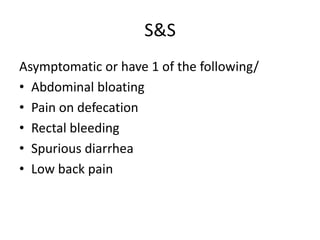
Rome III criteria for constipation
if you have 2 or > of the following for at least 3
months:
• Fewer than 3 bowel movements / week
• Straining
• Lumpy or hard stools
• Sensation of anorectal obstruction
• Sensation of incomplete defecation
• Manual maneuvering required to defecate
S&S
Asymptomatic or have 1 of the following/
• Abdominal bloating
• Pain on defecation
• Rectal bleeding
• Spurious diarrhea
• Low back pain
Severe if/
• Feeling of incomplete evacuation
• Digital extraction
• Tenesmus
• Enema retention
• Rectal bleeding
• Abdominal pain (suggestive of
possible irritable bowel syndrome [IBS] with
constipation [IBS-C])
• Inability to pass flatus
• Vomiting
• Unexplained weight loss
Hx & Ex
•
•
•
•
•
•
•

onset
bowel habit
Fluid intake
Activity exercise!
Other disease,DM,HYPOTHYRIODISM
Medication
Mental assessment
ex
• no benefit in determining etiology or deciding
on treatment
• Abdomen ,mass,distention
• Pelvis, hernia
• Anorectal ex,fissure,piles,prolapse
complication
• acute or chronic
hemorrhoidal disease
• hypotonic laxative colon
• Anal fissure
• pelvic floor damage in
women
• solitary rectal ulcers
• Fecal impaction
• Bowel obstruction

•
•
•
•
•
•
•
•

Megacolon
Volvulus
Rectal prolapse
Urinary retention
Syncope
Fistula in ano
Fecal incontinence
Stercoral
ulceration/perforation
Cauese
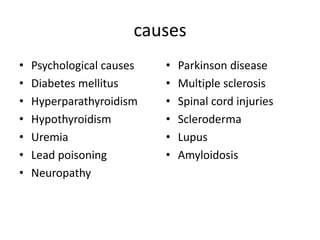
causes
•
•
•
•
•
•
•

Psychological causes
Diabetes mellitus
Hyperparathyroidism
Hypothyroidism
Uremia
Lead poisoning
Neuropathy

•
•
•
•
•
•

Parkinson disease
Multiple sclerosis
Spinal cord injuries
Scleroderma
Lupus
Amyloidosis
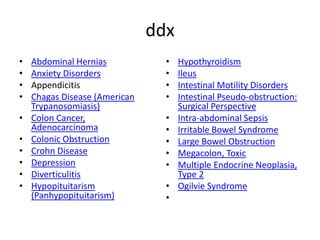
ddx
•
•
•
•
•

•
•
•
•
•

Abdominal Hernias
Anxiety Disorders
Appendicitis
Chagas Disease (American
Trypanosomiasis)
Colon Cancer,
Adenocarcinoma
Colonic Obstruction
Crohn Disease
Depression
Diverticulitis
Hypopituitarism
(Panhypopituitarism)

•
•
•
•
•
•
•
•
•
•
•

Hypothyroidism
Ileus
Intestinal Motility Disorders
Intestinal Pseudo-obstruction:
Surgical Perspective
Intra-abdominal Sepsis
Irritable Bowel Syndrome
Large Bowel Obstruction
Megacolon, Toxic
Multiple Endocrine Neoplasia,
Type 2
Ogilvie Syndrome
pathophysio
investigation
•
•
•
•
•
•

Outpatient 3-6 m
Lab ?
Image study , sepsis
endoscopy
Acute or chronic
Age? Consider sigmoidoscopy, colonoscopy, or
bariumenema for colorectal cancer
screening in patients older than 50 years.
•
•
•
•
•
•
•
•
•

X-ray
ct
Lower gastrointestinal (GI) endoscopy
Barium or Gastrografin Study
colonic transit study
defecography
anorectal manometry
surface anal electromyography (EMG)
balloonexpulsion
•
•
•
•

Cbc anaemia
Fecal occult blood
Thyroid function
Serum chemistry
•
•
•
•
•

Foods to Relieve Constipation
1. Prunes
2. Beans
3. Kiwi
4. Rye Bread
5. Pears
•
•
•
•
•
•

Foods That Can Cause Constipation
1. Chocolate
2. Dairy Products
3. Red Meat
4. Bananas
5. Caffeine
Treatment
• Medical care
• should focus on dietary change and exercise
rather than laxatives, enemas, and
suppositories
• To avoid the laxative colon
• Exercise
• stimulate bowel motility
• Once acute constipation has resolved and the
associated medical or surgical conditions have
been ruled out, additional inpatient care is
rarely indicated.
•
•
•
•
•
•
•
•
•
•
•
•

The following factors may warrant a transfer:
Uncertain diagnosis
Evidence of intra-abdominal catastrophe
Acute abdominal pain
Fever
Lower gastrointestinal (GI) bleeding
Chills
Instability of vital signs
Absence of bowel sounds
Acute recent change in bowel habits
Unsuccessful or inadequate treatment offered at the local facility
Dietary Measures
• Increased fiber intake
• Increased fluid intake
• Increased fiber intake
• Dietary fiber is available in diverse natural
sources, such as fruits, vegetables, and cereals.
Ingestion of natural fiber sources is nutritionally
superior to supplementation with purified fiber
• started at a low subtherapeutic dose
• are not laxatives
• prescribing a fiber supplement, such as wheat,
psyllium, or methylcellulose, is often useful.
• Increased fluid intake
• drink at least 8 glasses of water daily
• decrease consumption of
• coffee, tea, and alcohol ? Diuretic effect
Pharmacologic Therapy
Medications to treat constipation include
• bulk-forming agents (fibers)
• emollient stool softeners
• rapidly acting lubricants
• prokinetics
• laxatives
• osmotic agents
• prosecretory drugs.
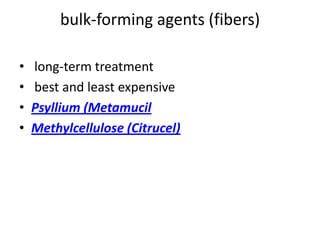
bulk-forming agents (fibers)
•
•
•
•

long-term treatment
best and least expensive
Psyllium (Metamucil
Methylcellulose (Citrucel)
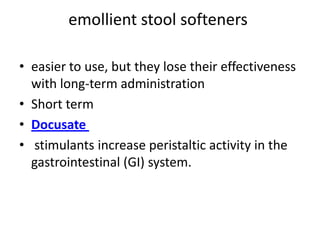
emollient stool softeners
• easier to use, but they lose their effectiveness
with long-term administration
• Short term
• Docusate
• stimulants increase peristaltic activity in the
gastrointestinal (GI) system.
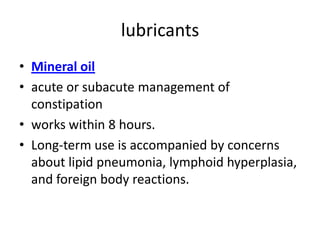
lubricants
• Mineral oil
• acute or subacute management of
constipation
• works within 8 hours.
• Long-term use is accompanied by concerns
about lipid pneumonia, lymphoid hyperplasia,
and foreign body reactions.
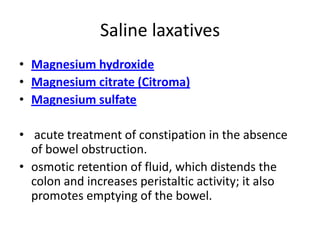
Saline laxatives
• Magnesium hydroxide
• Magnesium citrate (Citroma)
• Magnesium sulfate

• acute treatment of constipation in the absence
of bowel obstruction.
• osmotic retention of fluid, which distends the
colon and increases peristaltic activity; it also
promotes emptying of the bowel.
Osmotic agents
• useful for long-term treatment of constipated
patients with slow colonic transit who are
refractory to dietary fiber supplementation.
• Lactulose
• Sorbitol
• Polyethylene glycol solution bowel
preparation
prokinetics
• a prokinetic selective 5-hydroxytryptamine-4
(5-HT4) receptor antagonist that stimulates
colonic motility and decreases transit time.
• Tegaserod
• irritable bowel syndrome (IBS) with constipation (IBS-C) or
chronic idiopathic constipation (CIC) in women younger than
55 years
prosecretory drugs
• lubiprostone & linaclotide
• which stimulate intestinal fluid secretion by
acting on the intestinal epithelial chloride
channel and the guanylate cyclase receptor
• chronic idiopathic constipation
• Irritable bowel syndrome
• Lubiprostone is also approved for opioid-induced
constipation in patients with chronic, noncancer pain.
Stimulant laxatives
• commonly employed to treat acute constipation and
are the most common class of laxatives used over the
long term by individuals taking over the
counter products.
• Senna acting directly on the intestinal mucosa or nerve plexus, action
8-12 hours

Bisacodyl
• Cascara sagrada
•

• Castor oil
•
•
Surgical
intervention
• large bowel obstruction, volvulus, or intraabdominal infection or ischemia
• hemorrhoidal thrombosis.
• rectal outlet obstruction (eg, rectocele, rectal
prolapse, internal rectal intussusception) or in
patients with a hypomotile
(laxative) colon who are refractory to medical
treatment.
Consultations
• large bowel obstruction or colonic ileus
secondary to an acute intra-abdominal
process is suspected.
• anorectal complications of constipation or for
surgical correction of the underlying cause.
Symptomatic hemorrhoids and anal fissures
represent complications of constipation until
proven otherwise.
• Acute hemorrhoidal thrombosis
Long term monitoring
After resolves in a patient who was acutely
constipated, outpatient care requires the
following measures:
• Confirming that the patient is not chronically
constipated
• Ruling out colorectal pathology
Long term monitoring
For a patient who is chronically constipated,
outpatient care may include the following:
• Colonic imaging or endoscopic visualization
• Dietary management
• If these measures fail in a compliant patient,
further evaluation

Constipation

  • 1.
  • 2.
  • 3.
    • affects approximately2% of the population in the U.S. • Women and the elderly are more commonly affected. • Though not usually serious, can be a concern
  • 4.
    • It isa symptom not a disease
  • 5.
    • Rome IIIcriteria for constipation
  • 6.
    Definition Rome III criteriafor constipation if you have 2 or > of the following for at least 3 months: • Fewer than 3 bowel movements / week • Straining • Lumpy or hard stools • Sensation of anorectal obstruction • Sensation of incomplete defecation • Manual maneuvering required to defecate
  • 7.
    S&S Asymptomatic or have1 of the following/ • Abdominal bloating • Pain on defecation • Rectal bleeding • Spurious diarrhea • Low back pain
  • 8.
    Severe if/ • Feelingof incomplete evacuation • Digital extraction • Tenesmus • Enema retention
  • 9.
    • Rectal bleeding •Abdominal pain (suggestive of possible irritable bowel syndrome [IBS] with constipation [IBS-C]) • Inability to pass flatus • Vomiting • Unexplained weight loss
  • 10.
    Hx & Ex • • • • • • • onset bowelhabit Fluid intake Activity exercise! Other disease,DM,HYPOTHYRIODISM Medication Mental assessment
  • 11.
    ex • no benefitin determining etiology or deciding on treatment • Abdomen ,mass,distention • Pelvis, hernia • Anorectal ex,fissure,piles,prolapse
  • 12.
    complication • acute orchronic hemorrhoidal disease • hypotonic laxative colon • Anal fissure • pelvic floor damage in women • solitary rectal ulcers • Fecal impaction • Bowel obstruction • • • • • • • • Megacolon Volvulus Rectal prolapse Urinary retention Syncope Fistula in ano Fecal incontinence Stercoral ulceration/perforation
  • 13.
  • 14.
    causes • • • • • • • Psychological causes Diabetes mellitus Hyperparathyroidism Hypothyroidism Uremia Leadpoisoning Neuropathy • • • • • • Parkinson disease Multiple sclerosis Spinal cord injuries Scleroderma Lupus Amyloidosis
  • 15.
    ddx • • • • • • • • • • Abdominal Hernias Anxiety Disorders Appendicitis ChagasDisease (American Trypanosomiasis) Colon Cancer, Adenocarcinoma Colonic Obstruction Crohn Disease Depression Diverticulitis Hypopituitarism (Panhypopituitarism) • • • • • • • • • • • Hypothyroidism Ileus Intestinal Motility Disorders Intestinal Pseudo-obstruction: Surgical Perspective Intra-abdominal Sepsis Irritable Bowel Syndrome Large Bowel Obstruction Megacolon, Toxic Multiple Endocrine Neoplasia, Type 2 Ogilvie Syndrome
  • 16.
  • 17.
    investigation • • • • • • Outpatient 3-6 m Lab? Image study , sepsis endoscopy Acute or chronic Age? Consider sigmoidoscopy, colonoscopy, or bariumenema for colorectal cancer screening in patients older than 50 years.
  • 18.
    • • • • • • • • • X-ray ct Lower gastrointestinal (GI)endoscopy Barium or Gastrografin Study colonic transit study defecography anorectal manometry surface anal electromyography (EMG) balloonexpulsion
  • 19.
    • • • • Cbc anaemia Fecal occultblood Thyroid function Serum chemistry
  • 20.
    • • • • • Foods to RelieveConstipation 1. Prunes 2. Beans 3. Kiwi 4. Rye Bread 5. Pears
  • 21.
    • • • • • • Foods That CanCause Constipation 1. Chocolate 2. Dairy Products 3. Red Meat 4. Bananas 5. Caffeine
  • 22.
    Treatment • Medical care •should focus on dietary change and exercise rather than laxatives, enemas, and suppositories • To avoid the laxative colon • Exercise • stimulate bowel motility
  • 23.
    • Once acuteconstipation has resolved and the associated medical or surgical conditions have been ruled out, additional inpatient care is rarely indicated.
  • 24.
    • • • • • • • • • • • • The following factorsmay warrant a transfer: Uncertain diagnosis Evidence of intra-abdominal catastrophe Acute abdominal pain Fever Lower gastrointestinal (GI) bleeding Chills Instability of vital signs Absence of bowel sounds Acute recent change in bowel habits Unsuccessful or inadequate treatment offered at the local facility
  • 25.
    Dietary Measures • Increasedfiber intake • Increased fluid intake
  • 26.
    • Increased fiberintake • Dietary fiber is available in diverse natural sources, such as fruits, vegetables, and cereals. Ingestion of natural fiber sources is nutritionally superior to supplementation with purified fiber • started at a low subtherapeutic dose • are not laxatives • prescribing a fiber supplement, such as wheat, psyllium, or methylcellulose, is often useful.
  • 27.
    • Increased fluidintake • drink at least 8 glasses of water daily • decrease consumption of • coffee, tea, and alcohol ? Diuretic effect
  • 28.
    Pharmacologic Therapy Medications totreat constipation include • bulk-forming agents (fibers) • emollient stool softeners • rapidly acting lubricants • prokinetics • laxatives • osmotic agents • prosecretory drugs.
  • 29.
    bulk-forming agents (fibers) • • • • long-termtreatment best and least expensive Psyllium (Metamucil Methylcellulose (Citrucel)
  • 30.
    emollient stool softeners •easier to use, but they lose their effectiveness with long-term administration • Short term • Docusate • stimulants increase peristaltic activity in the gastrointestinal (GI) system.
  • 31.
    lubricants • Mineral oil •acute or subacute management of constipation • works within 8 hours. • Long-term use is accompanied by concerns about lipid pneumonia, lymphoid hyperplasia, and foreign body reactions.
  • 32.
    Saline laxatives • Magnesiumhydroxide • Magnesium citrate (Citroma) • Magnesium sulfate • acute treatment of constipation in the absence of bowel obstruction. • osmotic retention of fluid, which distends the colon and increases peristaltic activity; it also promotes emptying of the bowel.
  • 33.
    Osmotic agents • usefulfor long-term treatment of constipated patients with slow colonic transit who are refractory to dietary fiber supplementation. • Lactulose • Sorbitol • Polyethylene glycol solution bowel preparation
  • 34.
    prokinetics • a prokineticselective 5-hydroxytryptamine-4 (5-HT4) receptor antagonist that stimulates colonic motility and decreases transit time. • Tegaserod • irritable bowel syndrome (IBS) with constipation (IBS-C) or chronic idiopathic constipation (CIC) in women younger than 55 years
  • 35.
    prosecretory drugs • lubiprostone& linaclotide • which stimulate intestinal fluid secretion by acting on the intestinal epithelial chloride channel and the guanylate cyclase receptor • chronic idiopathic constipation • Irritable bowel syndrome • Lubiprostone is also approved for opioid-induced constipation in patients with chronic, noncancer pain.
  • 36.
    Stimulant laxatives • commonlyemployed to treat acute constipation and are the most common class of laxatives used over the long term by individuals taking over the counter products. • Senna acting directly on the intestinal mucosa or nerve plexus, action 8-12 hours Bisacodyl • Cascara sagrada • • Castor oil • •
  • 37.
    Surgical intervention • large bowelobstruction, volvulus, or intraabdominal infection or ischemia • hemorrhoidal thrombosis. • rectal outlet obstruction (eg, rectocele, rectal prolapse, internal rectal intussusception) or in patients with a hypomotile (laxative) colon who are refractory to medical treatment.
  • 38.
    Consultations • large bowelobstruction or colonic ileus secondary to an acute intra-abdominal process is suspected. • anorectal complications of constipation or for surgical correction of the underlying cause. Symptomatic hemorrhoids and anal fissures represent complications of constipation until proven otherwise. • Acute hemorrhoidal thrombosis
  • 39.
    Long term monitoring Afterresolves in a patient who was acutely constipated, outpatient care requires the following measures: • Confirming that the patient is not chronically constipated • Ruling out colorectal pathology
  • 40.
    Long term monitoring Fora patient who is chronically constipated, outpatient care may include the following: • Colonic imaging or endoscopic visualization • Dietary management • If these measures fail in a compliant patient, further evaluation