Principles of Conservative
Surgery in Head & Neck
Oncology
Dr Zeeshan Ahmad
M.S.(ENT,PGY2)
Department of ENT
NMCH, Patna.29-08-13
Introduction
 Surgery on Head and Neck has major impact on swallowing,
speech and aesthetic appearance.
 Organ preserving radiation techniques.
 New chemotherapeutic regimens.
 Greater understanding of tumour biology.
 Introduction of CO2 laser- transoral.
 endoscopes
Neck
Conservation surgery for Neck
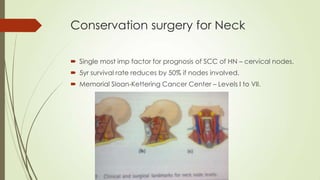
 Single most imp factor for prognosis of SCC of HN – cervical nodes.
 5yr survival rate reduces by 50% if nodes involved.
 Memorial Sloan-Kettering Cancer Center – Levels I to VII.
N0 disease – Neck dissection
 N0 – 15-20% risk of occult metastatic disease.
 Selective neck dissection
 Spares all non-lymphatic tissue including SCM, IJV and SpAN.
 Only selected nodes on involved site removed.
Types of Selective Neck Dissection
 SupraOmoHyoid Neck Dissection
 Extended SupraOmoHyoid Neck Dissection
 Anterolateral Neck Dissection
 Posterolateral Neck Dissection
 Central compartment Neck Dissection
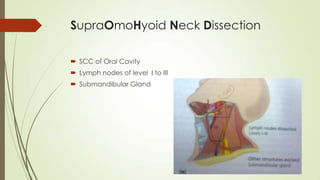
SupraOmoHyoid Neck Dissection
 SCC of Oral Cavity
 Lymph nodes of level I to III
 Submandibular Gland
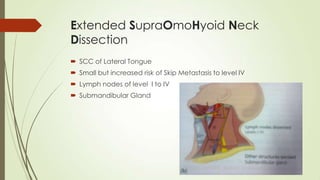
Extended SupraOmoHyoid Neck
Dissection
 SCC of Lateral Tongue
 Small but increased risk of Skip Metastasis to level IV
 Lymph nodes of level I to IV
 Submandibular Gland
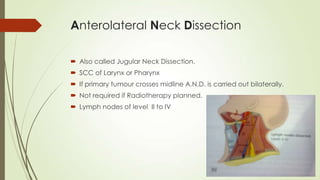
Anterolateral Neck Dissection
 Also called Jugular Neck Dissection.
 SCC of Larynx or Pharynx
 If primary tumour crosses midline A.N.D. is carried out bilaterally.
 Not required if Radiotherapy planned.
 Lymph nodes of level II to IV
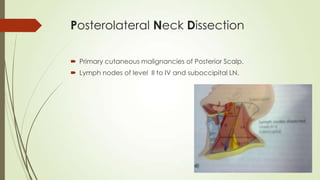
Posterolateral Neck Dissection
 Primary cutaneous malignancies of Posterior Scalp.
 Lymph nodes of level II to IV and suboccipital LN.
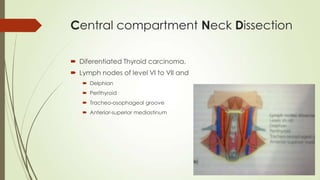
Central compartment Neck Dissection
 Diferentiated Thyroid carcinoma.
 Lymph nodes of level VI to VII and
 Delphian
 Perithyroid
 Tracheo-osophageal groove
 Anterior-superior mediastinum
N+ disease - Neck Dissection
 Comprehensive neck dissection – removal of all lymphatic tissue in
lateral neck.
 Classified into Radical and Modified Radical depending upon other
structures removed.
 Gold standard – Radical Neck Dissection.
 Modified Radical Neck Dissection three types
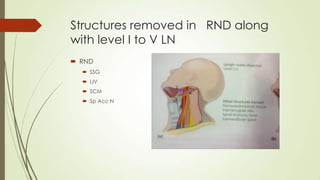
Structures removed in RND along
with level I to V LN
 RND
 SSG
 IJV
 SCM
 Sp Acc N
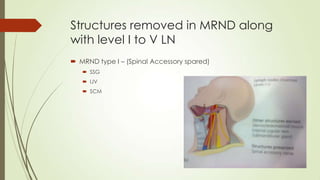
Structures removed in MRND along
with level I to V LN
 MRND type I – (Spinal Accessory spared)
 SSG
 IJV
 SCM
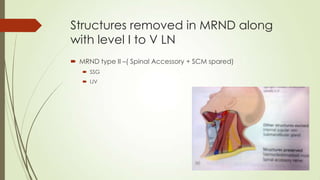
Structures removed in MRND along
with level I to V LN
 MRND type II –( Spinal Accessory + SCM spared)
 SSG
 IJV
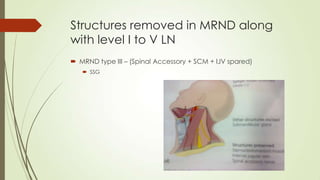
Structures removed in MRND along
with level I to V LN
 MRND type III – (Spinal Accessory + SCM + IJV spared)
 SSG
N+ Disease post Chemoradiation
 Generally acepted that N0 and N1 disease can be treated by
Chemoradiation alone.
 Insufficient data for N2 and N3
 Brizel et al – reported 4yr disease free survival rate
 75% in RT + ND
 53% in RT only
 Therefore ND is recommended for N2/N3.
Larynx
Conservation surgery for cancer of
Larynx
 Main aim is to
 Maintain speech
 Maintain swallowing
 Avoid tracheostomy
 Conservation laryngeal surgery may be
 Open
 endoscopic
 securing negative margins is crucial to success of procedure.
Crico-arytenoid unit
 It is the basic functional unit of larynx.
 Consists of
 An Arytenoid cartilage
 Cricoid cartilage
 Associated musculature
 Nerve suply
 Allows physiological speech and swallowing without the need for
tracheostomy.
Open Partial Laryngeal surgery
 General principles
 Consent for Total Laryngectomy
 Speech rehabilitation – patient and family active
 Good pulmonary function
 No medical problem
Types
 Glottic
 Vertical Partial Laryngectomy
 Lateral
 anterolateral
 Supracricoid Partial laryngectomy with Cricohyoidoepiglottopexy.
 Supraglottic
 Horizontal SPL
 Supracricoid Partial laryngectomy with Cricohyoidoepiglottopexy.
GLOTTIC
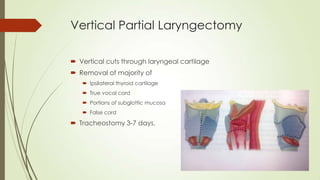
Vertical Partial Laryngectomy
 Vertical cuts through laryngeal cartilage
 Removal of majority of
 Ipsilateral thyroid cartilage
 True vocal cord
 Portions of subglottic mucosa
 False cord
 Tracheostomy 3-7 days.
Vertical Partial Laryngectomy
 Criteria for selection
 Lesion of mobile cord extending to anterior commissure
 Lesion of mobile cord involving vocal process and anterosuperior arytenoid
 Subglottic extension ≯5mm
 Fixed cord lesion not extending midline
 Anterior commissure/ VC lesion ≯ anterior 1/3 of opposite VC
Vertical Partial Laryngectomy
 Oncological results
 T1 glottic cancer
 Recurrence rates are <10%
 If ant comm not invoved 93% local control
 If ant comm invoved 75% local control( subglottic recurrence)
 T2 glottic cancer
 Failure rates of 4-26% ( cricoid and thyroid involvement)
 T3 glottic cancer
 Higher recurrence rates of 11-46%
Vertical Partial Laryngectomy
 Functional results
 Some degree of hoarseness
 Most impairment – if no reconstruction
 Least – replacement of glottis with adjacent false cord flap
Supracricoid Partial Laryngectomy with
Cricohyoidoepiglottopexy
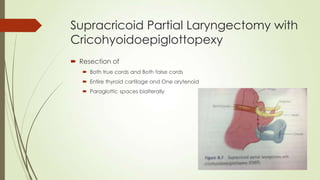
 Resection of
 Both true cords and Both false cords
 Entire thyroid cartilage and One arytenoid
 Paraglottic spaces bialterally
Supracricoid Partial Laryngectomy with
Cricohyoidoepiglottopexy
 Reconstruction is done using
 Hyoid bone, Epiglottis, Cricoid and tongue
 Temporary tracheostomy and feeding tube
 Used for T1b with ant commissure involvement and selected T2 / T3
glottic carcinoma.
Supracricoid Partial Laryngectomy with
Cricohyoidoepiglottopexy
 Local recurrence rate
 T2 4.5% (3 of 67)
 T3 10% (2 of 20)
 Temporary dysphagia and aspiration is expected
 Nasogastric feeding tube for 9 to 50 days.
 Hyoid necrosis and neolaryngeal stenosis
 Voice quality is initially poor but improves over several months
SUPRAGLOTTIC
Horizontal Supraglottic Partial
Laryngectomy
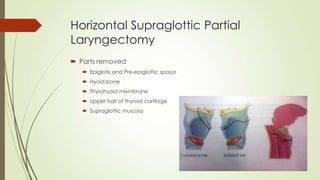
 Parts removed
 Epiglotis and Pre-epiglottic space
 Hyoid bone
 Thyrohyoid membrane
 Upper half of thyroid cartilage
 Supraglottic mucosa
Horizontal Supraglottic Partial
Laryngectomy
 Closure is by approximating base tongue to lower half of thyoid
cartilage
 Temporary tracheostomy is required.
 Bilateral selective lymph node dissection is carried out at the same
time
 It is important to identify and preserve internal and external
branches of superior laryngeal nerve
Horizontal Supraglottic Partial
Laryngectomy
 Selection criteria
 At least 5mm margin at anterior commissure
 True VC must be mobile
 Only one arytenoid may be removed
 No cartilage invasion by the tumour
 Tongue mobility should be normal
 No extension to interarytenoid or postcricoid area
 Apex of pyriform sinus should be free
 Generally lesions should be <3cm
Horizontal Supraglottic Partial
Laryngectomy
 High local control for T1 and T2
 75% for T3 and 67% for T4
Other Laryngectomies
 Subtotal Laryngectomy =
supralottic partial laryngectomy+ipsilateral vertical partial
laryngectomy
 Near Total Laryngectomy =
this is a technically complex procedure to create a physiological
voice shunt based around one mobile arytenoid.
Requires permanent stoma
Supracricoid Partial Laryngectomy with
Cricohyoidoepiglottopexy
 Supraglottic carcinomas not amenable to supraglottic
laryngectomy due to
 Glottic level involvement through anterior commissure or ventricle
 Pre-epiglottic space invasion
 Decreased cord mobility
 Limited thyroid invasion
Supracricoid Partial Laryngectomy with
Cricohyoidoepiglottopexy
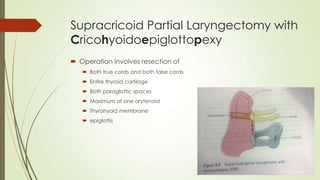
 Operation involves resection of
 Both true cords and both false cords
 Entire thyroid cartilage
 Both paraglottic spaces
 Maximum of one arytenoid
 Thyrohyoid membrane
 epiglottis
Supracricoid Partial Laryngectomy with
Cricohyoidoepiglottopexy
 Reconstruction using
 Hyoid bone
 Cricoid
 tongue
 Temporary tracheostomy tube and feeding tube is required.
Supracricoid Partial Laryngectomy with
Cricohyoidoepiglottopexy
 Indications
 T1 and supraglottic lesions with ventricle extension
 T2 infrahyoid epiglottis or posterior 1/3 of false cord
 Supraglottic lesions extending to glottis or anterior commissure
 T3 transglottic carcinoma
 Selective t4 lesions invading thyroid cartilage
Supracricoid Partial Laryngectomy with
Cricohyoidoepiglottopexy
 Contraindications
 Bulky pre-epiglottic space involvement
 Gross thyroid cartilage destruction
 Interarytenoid involvement
 Fixed arytenoids
 Subglottic extension >10mm anteriorly and >5mm posteriorly
 Inadequate pulmonary reserve
Supracricoid Partial Laryngectomy with
Cricohyoidoepiglottopexy
 No local recurrence reported by Laccourreye et al
 3.3% reported by chevalier
 Nasogastric feeding is required for 30-365 days
 Total laryngectomy may be required in 10% of cases
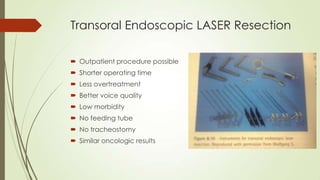
Transoral Endoscopic LASER Resection
 Outpatient procedure possible
 Shorter operating time
 Less overtreatment
 Better voice quality
 Low morbidity
 No feeding tube
 No tracheostomy
 Similar oncologic results
Transoral Endoscopic LASER Resection
 As compared to radiotherapy it has similar oncologic and
functional results, lower cost.
 Radiotherapy is possible after endocopic laser if it fails
Hypopharynx
Conservation surgery for cancer of
Hypopharynx
 Cancer of hypopharynx includes
 Cancer of pyriform sinus (70%)
 Postcricoid (15%)
 Posterior pharyngeal wall (15%)
 Of all Head and Neck sites Hypopharyngeal Cancer has poorest
prognosis – 5yr survival rate of <20%
 Patients usually present with advanced diseaseAbout 66% of
patients have nodal disease at presentation
 Thus it requires treatment of primary and also of neck
Conservation surgery for cancer of
Hypopharynx
 T1 and small volume T2 without neck metastasis
 Usually treated by radiation
 Partial pharyngectomy and bilateral selective neck dissection can also be
performed
 T1 and small volume T2 with neck metastasis
 Comprehensive neck dissection
 Radiation to the primary
Conservation surgery for cancer of
Hypopharynx
 Large volume T2 / T3 / T4
 Radical surgery
 Excision of primary tumour
 Reconstruction
 Radiotherapy
 Endoscopic laser
 Excellent functional results
 With synchronous or separate neck dissection
Oral cavity
Conservation surgery for cancer of the
Oral cavity
 Limited resection of oral cavity is to be condemned
 However it is possible to perform conservative surgery to mandible
 Careful assessment is carried out by bimanual palpation.
 CT is helpful in assessing cortical invasion
 MRI helps to find marrow invasion and inferior alveolar nerve
 Segmental mandibulectomy is carried out if
 Gross invasion by cancer
 Tumour close to mandible in irradiated patient
 Invasion of inferior alveolar nerve or canal by tumour
 Massive soft tissue disease adjacent to tumour
 Marginal mandibulectomy is done if
 Superficial aspect of cortical bone is involved
 Marginal mandibulectomy is done if
 Superficial aspect of cortical bone is involved
 Marginal mandibulectomy is contraindicated
 Gross invasion into cancellous part
 Irradiated mandible
 Edentulous patient with pipestem mandible
Oropharynx
Conservation surgery for cancer of
Oropharynx
 Transoral laser resection is an alternatve to chemoradiation and
radical surgery
 With the use of appropriate retractors and distending
pharyngoscopes adequate access is obtained
 Temporary tracheostomy may be required
 Postoperative radiotherapy is recommended
 TORS
Nose and PNS
Conservation surgery for cancer of
Nose and PNS
 Certainly, endoscopic approach for benign disease has advantage
over open surgical resection
 Better function as well as cosmesis
 Availability of
 real time image guidance,
 neuro-navigation and
 intraoperative MRI has furthur improved the safety and accuracy of endoscopic
resections
 However, malignant disease management is still questionable
Conservation surgery for cancer of
Nose and PNS
 Indications
 Midline lesions with limited lateral extension
 Benign tumours – inverted papilloma and angiofibroma
 Low grade malignant tumours
 Palliation
 Medical comorbidity limiting open approach
Conservation surgery for cancer of
Nose and PNS
 Contraindications
 Lateral extension of tumour
 Intracranial invasion
 Intraorbital invasion
 High grade malignant tumours
Parotid
Conservation surgery for Tumours of
Parotid Gland
 Warthin’s tumour excision without parotidectomy
 Preservation of facial nerve unless they are adherent to or directly
invaded by tumour
 If major branches or the main trunk are involved, then immediate
cable grafts should be done using branches of Cervical plexus or
Sural nerve
NEXT 
05.09.13 Dr Sonu Kumar Singh
M.S.(ENT,PGY2)
Benign tumours of
mouth and jaw

Conservative surgery for head and neck cancer

  • 1.
    Principles of Conservative Surgeryin Head & Neck Oncology Dr Zeeshan Ahmad M.S.(ENT,PGY2) Department of ENT NMCH, Patna.29-08-13
  • 2.
    Introduction  Surgery onHead and Neck has major impact on swallowing, speech and aesthetic appearance.  Organ preserving radiation techniques.  New chemotherapeutic regimens.  Greater understanding of tumour biology.  Introduction of CO2 laser- transoral.  endoscopes
  • 3.
  • 4.
    Conservation surgery forNeck  Single most imp factor for prognosis of SCC of HN – cervical nodes.  5yr survival rate reduces by 50% if nodes involved.  Memorial Sloan-Kettering Cancer Center – Levels I to VII.
  • 5.
    N0 disease –Neck dissection  N0 – 15-20% risk of occult metastatic disease.  Selective neck dissection  Spares all non-lymphatic tissue including SCM, IJV and SpAN.  Only selected nodes on involved site removed.
  • 6.
    Types of SelectiveNeck Dissection  SupraOmoHyoid Neck Dissection  Extended SupraOmoHyoid Neck Dissection  Anterolateral Neck Dissection  Posterolateral Neck Dissection  Central compartment Neck Dissection
  • 7.
    SupraOmoHyoid Neck Dissection SCC of Oral Cavity  Lymph nodes of level I to III  Submandibular Gland
  • 8.
    Extended SupraOmoHyoid Neck Dissection SCC of Lateral Tongue  Small but increased risk of Skip Metastasis to level IV  Lymph nodes of level I to IV  Submandibular Gland
  • 9.
    Anterolateral Neck Dissection Also called Jugular Neck Dissection.  SCC of Larynx or Pharynx  If primary tumour crosses midline A.N.D. is carried out bilaterally.  Not required if Radiotherapy planned.  Lymph nodes of level II to IV
  • 10.
    Posterolateral Neck Dissection Primary cutaneous malignancies of Posterior Scalp.  Lymph nodes of level II to IV and suboccipital LN.
  • 11.
    Central compartment NeckDissection  Diferentiated Thyroid carcinoma.  Lymph nodes of level VI to VII and  Delphian  Perithyroid  Tracheo-osophageal groove  Anterior-superior mediastinum
  • 12.
    N+ disease -Neck Dissection  Comprehensive neck dissection – removal of all lymphatic tissue in lateral neck.  Classified into Radical and Modified Radical depending upon other structures removed.  Gold standard – Radical Neck Dissection.  Modified Radical Neck Dissection three types
  • 13.
    Structures removed inRND along with level I to V LN  RND  SSG  IJV  SCM  Sp Acc N
  • 14.
    Structures removed inMRND along with level I to V LN  MRND type I – (Spinal Accessory spared)  SSG  IJV  SCM
  • 15.
    Structures removed inMRND along with level I to V LN  MRND type II –( Spinal Accessory + SCM spared)  SSG  IJV
  • 16.
    Structures removed inMRND along with level I to V LN  MRND type III – (Spinal Accessory + SCM + IJV spared)  SSG
  • 17.
    N+ Disease postChemoradiation  Generally acepted that N0 and N1 disease can be treated by Chemoradiation alone.  Insufficient data for N2 and N3  Brizel et al – reported 4yr disease free survival rate  75% in RT + ND  53% in RT only  Therefore ND is recommended for N2/N3.
  • 18.
  • 19.
    Conservation surgery forcancer of Larynx  Main aim is to  Maintain speech  Maintain swallowing  Avoid tracheostomy  Conservation laryngeal surgery may be  Open  endoscopic  securing negative margins is crucial to success of procedure.
  • 20.
    Crico-arytenoid unit  Itis the basic functional unit of larynx.  Consists of  An Arytenoid cartilage  Cricoid cartilage  Associated musculature  Nerve suply  Allows physiological speech and swallowing without the need for tracheostomy.
  • 21.
    Open Partial Laryngealsurgery  General principles  Consent for Total Laryngectomy  Speech rehabilitation – patient and family active  Good pulmonary function  No medical problem
  • 22.
    Types  Glottic  VerticalPartial Laryngectomy  Lateral  anterolateral  Supracricoid Partial laryngectomy with Cricohyoidoepiglottopexy.  Supraglottic  Horizontal SPL  Supracricoid Partial laryngectomy with Cricohyoidoepiglottopexy.
  • 23.
  • 24.
    Vertical Partial Laryngectomy Vertical cuts through laryngeal cartilage  Removal of majority of  Ipsilateral thyroid cartilage  True vocal cord  Portions of subglottic mucosa  False cord  Tracheostomy 3-7 days.
  • 25.
    Vertical Partial Laryngectomy Criteria for selection  Lesion of mobile cord extending to anterior commissure  Lesion of mobile cord involving vocal process and anterosuperior arytenoid  Subglottic extension ≯5mm  Fixed cord lesion not extending midline  Anterior commissure/ VC lesion ≯ anterior 1/3 of opposite VC
  • 26.
    Vertical Partial Laryngectomy Oncological results  T1 glottic cancer  Recurrence rates are <10%  If ant comm not invoved 93% local control  If ant comm invoved 75% local control( subglottic recurrence)  T2 glottic cancer  Failure rates of 4-26% ( cricoid and thyroid involvement)  T3 glottic cancer  Higher recurrence rates of 11-46%
  • 27.
    Vertical Partial Laryngectomy Functional results  Some degree of hoarseness  Most impairment – if no reconstruction  Least – replacement of glottis with adjacent false cord flap
  • 28.
    Supracricoid Partial Laryngectomywith Cricohyoidoepiglottopexy  Resection of  Both true cords and Both false cords  Entire thyroid cartilage and One arytenoid  Paraglottic spaces bialterally
  • 29.
    Supracricoid Partial Laryngectomywith Cricohyoidoepiglottopexy  Reconstruction is done using  Hyoid bone, Epiglottis, Cricoid and tongue  Temporary tracheostomy and feeding tube  Used for T1b with ant commissure involvement and selected T2 / T3 glottic carcinoma.
  • 30.
    Supracricoid Partial Laryngectomywith Cricohyoidoepiglottopexy  Local recurrence rate  T2 4.5% (3 of 67)  T3 10% (2 of 20)  Temporary dysphagia and aspiration is expected  Nasogastric feeding tube for 9 to 50 days.  Hyoid necrosis and neolaryngeal stenosis  Voice quality is initially poor but improves over several months
  • 31.
  • 32.
    Horizontal Supraglottic Partial Laryngectomy Parts removed  Epiglotis and Pre-epiglottic space  Hyoid bone  Thyrohyoid membrane  Upper half of thyroid cartilage  Supraglottic mucosa
  • 33.
    Horizontal Supraglottic Partial Laryngectomy Closure is by approximating base tongue to lower half of thyoid cartilage  Temporary tracheostomy is required.  Bilateral selective lymph node dissection is carried out at the same time  It is important to identify and preserve internal and external branches of superior laryngeal nerve
  • 34.
    Horizontal Supraglottic Partial Laryngectomy Selection criteria  At least 5mm margin at anterior commissure  True VC must be mobile  Only one arytenoid may be removed  No cartilage invasion by the tumour  Tongue mobility should be normal  No extension to interarytenoid or postcricoid area  Apex of pyriform sinus should be free  Generally lesions should be <3cm
  • 35.
    Horizontal Supraglottic Partial Laryngectomy High local control for T1 and T2  75% for T3 and 67% for T4
  • 36.
    Other Laryngectomies  SubtotalLaryngectomy = supralottic partial laryngectomy+ipsilateral vertical partial laryngectomy  Near Total Laryngectomy = this is a technically complex procedure to create a physiological voice shunt based around one mobile arytenoid. Requires permanent stoma
  • 37.
    Supracricoid Partial Laryngectomywith Cricohyoidoepiglottopexy  Supraglottic carcinomas not amenable to supraglottic laryngectomy due to  Glottic level involvement through anterior commissure or ventricle  Pre-epiglottic space invasion  Decreased cord mobility  Limited thyroid invasion
  • 38.
    Supracricoid Partial Laryngectomywith Cricohyoidoepiglottopexy  Operation involves resection of  Both true cords and both false cords  Entire thyroid cartilage  Both paraglottic spaces  Maximum of one arytenoid  Thyrohyoid membrane  epiglottis
  • 39.
    Supracricoid Partial Laryngectomywith Cricohyoidoepiglottopexy  Reconstruction using  Hyoid bone  Cricoid  tongue  Temporary tracheostomy tube and feeding tube is required.
  • 40.
    Supracricoid Partial Laryngectomywith Cricohyoidoepiglottopexy  Indications  T1 and supraglottic lesions with ventricle extension  T2 infrahyoid epiglottis or posterior 1/3 of false cord  Supraglottic lesions extending to glottis or anterior commissure  T3 transglottic carcinoma  Selective t4 lesions invading thyroid cartilage
  • 41.
    Supracricoid Partial Laryngectomywith Cricohyoidoepiglottopexy  Contraindications  Bulky pre-epiglottic space involvement  Gross thyroid cartilage destruction  Interarytenoid involvement  Fixed arytenoids  Subglottic extension >10mm anteriorly and >5mm posteriorly  Inadequate pulmonary reserve
  • 42.
    Supracricoid Partial Laryngectomywith Cricohyoidoepiglottopexy  No local recurrence reported by Laccourreye et al  3.3% reported by chevalier  Nasogastric feeding is required for 30-365 days  Total laryngectomy may be required in 10% of cases
  • 43.
    Transoral Endoscopic LASERResection  Outpatient procedure possible  Shorter operating time  Less overtreatment  Better voice quality  Low morbidity  No feeding tube  No tracheostomy  Similar oncologic results
  • 44.
    Transoral Endoscopic LASERResection  As compared to radiotherapy it has similar oncologic and functional results, lower cost.  Radiotherapy is possible after endocopic laser if it fails
  • 45.
  • 46.
    Conservation surgery forcancer of Hypopharynx  Cancer of hypopharynx includes  Cancer of pyriform sinus (70%)  Postcricoid (15%)  Posterior pharyngeal wall (15%)  Of all Head and Neck sites Hypopharyngeal Cancer has poorest prognosis – 5yr survival rate of <20%  Patients usually present with advanced diseaseAbout 66% of patients have nodal disease at presentation  Thus it requires treatment of primary and also of neck
  • 47.
    Conservation surgery forcancer of Hypopharynx  T1 and small volume T2 without neck metastasis  Usually treated by radiation  Partial pharyngectomy and bilateral selective neck dissection can also be performed  T1 and small volume T2 with neck metastasis  Comprehensive neck dissection  Radiation to the primary
  • 48.
    Conservation surgery forcancer of Hypopharynx  Large volume T2 / T3 / T4  Radical surgery  Excision of primary tumour  Reconstruction  Radiotherapy  Endoscopic laser  Excellent functional results  With synchronous or separate neck dissection
  • 49.
  • 50.
    Conservation surgery forcancer of the Oral cavity  Limited resection of oral cavity is to be condemned  However it is possible to perform conservative surgery to mandible  Careful assessment is carried out by bimanual palpation.  CT is helpful in assessing cortical invasion  MRI helps to find marrow invasion and inferior alveolar nerve
  • 51.
     Segmental mandibulectomyis carried out if  Gross invasion by cancer  Tumour close to mandible in irradiated patient  Invasion of inferior alveolar nerve or canal by tumour  Massive soft tissue disease adjacent to tumour  Marginal mandibulectomy is done if  Superficial aspect of cortical bone is involved
  • 52.
     Marginal mandibulectomyis done if  Superficial aspect of cortical bone is involved  Marginal mandibulectomy is contraindicated  Gross invasion into cancellous part  Irradiated mandible  Edentulous patient with pipestem mandible
  • 53.
  • 54.
    Conservation surgery forcancer of Oropharynx  Transoral laser resection is an alternatve to chemoradiation and radical surgery  With the use of appropriate retractors and distending pharyngoscopes adequate access is obtained  Temporary tracheostomy may be required  Postoperative radiotherapy is recommended  TORS
  • 55.
  • 56.
    Conservation surgery forcancer of Nose and PNS  Certainly, endoscopic approach for benign disease has advantage over open surgical resection  Better function as well as cosmesis  Availability of  real time image guidance,  neuro-navigation and  intraoperative MRI has furthur improved the safety and accuracy of endoscopic resections  However, malignant disease management is still questionable
  • 57.
    Conservation surgery forcancer of Nose and PNS  Indications  Midline lesions with limited lateral extension  Benign tumours – inverted papilloma and angiofibroma  Low grade malignant tumours  Palliation  Medical comorbidity limiting open approach
  • 58.
    Conservation surgery forcancer of Nose and PNS  Contraindications  Lateral extension of tumour  Intracranial invasion  Intraorbital invasion  High grade malignant tumours
  • 59.
  • 60.
    Conservation surgery forTumours of Parotid Gland  Warthin’s tumour excision without parotidectomy  Preservation of facial nerve unless they are adherent to or directly invaded by tumour  If major branches or the main trunk are involved, then immediate cable grafts should be done using branches of Cervical plexus or Sural nerve
  • 62.
    NEXT  05.09.13 DrSonu Kumar Singh M.S.(ENT,PGY2) Benign tumours of mouth and jaw