CASE STUDY ON 
TRIBAL ART MUSEUM
INTRODUCTION 
The Museum of Tribal Heritage at Bhopal was commissioned 
by the Government of Madhya Pradesh in 2004 since over 
30% of the population of the state is tribal. It’s architecture 
was informed by their rich culture, evolved over millennia. 
The cultural diversity seen in Madhya Pradesh is hard to find 
anywhere else. Almost oblivious of political boundaries, 
communities living in states’ peripheries, tribal communities 
continue linguistic, lifestyle, music and cultural exchanges. 
The architecture of the museum, integrates seamlessly into a 
continuum, the outside with the inside, the natural with the 
human construct, the tribal with the urban and the viewer 
with the viewed.
SITE LOCATION 
Madhya Pradesh Tribal Museum 
Shyamala Hills, Bhopal 462002, Madhya Pradesh. 
77° 23‘05.16 E 
23° 14’04.23 N 
1856 FT 
LOCATION:- 
LONGITUDE:- 
LATITUDE:- 
ALTITUDE:-
DESIGN FEATURES 
The architecture of the Museum is inspired by tribal rhythms, 
geometries, materials, forms, aesthetics and spatial consciousness, 
these very qualities are now acting as points of inspiration for the 
display materials being created by tribal artisans, supported by 
anthropologists, sociologists and social workers. 
The structure is built of steel tubes, castellated girders, and steel rods 
fabricated into intricate trusses. Steel seemed to be a natural choice in 
the land & location of ancient Iron Age & Bronze Age civilizations, and 
the contemporary truck body building industry.
SIMILAR BUILDING NEAR BY 
The State Museum of Bhopal.
SIMILAR BUILDING NEAR BY 
The State Museum of Bhopal is amongst the best-designed 
museums in India. 
The museum has 16 different theme galleries, showcasing the 
State's sculptural masterpieces, pre-historic articles and fossils, 
excavated objects, epigraphs, manuscripts, paintings, royal 
collection, textile, documents, postal stamps, autographs, miniature 
paintings, coins, arms and weapons, articles associated with India's 
freedom struggle. The museum also has reproductions of the now-destroyed 
Buddhist Bagh Cave paintings, 84 rare Jaina bronzes of 
the 8th to 11th centuries, Avalokesteshwaras of Lamaism, Saivite 
sculptures and miniature paintings showing the graceful lifestyles of 
those distant days.
LAND MARK NEAR THE SITE 
1.REGIONAL COLLEDGE OF BHOPAL 
2.SRC BHARAT SCOUT AND GUIDE M.P.
GALLERY 1 
CULTURAL DIVERSITY 
The task of establishing this specialty of Madhya Pradesh and 
better understanding and display of its multi-dimensional culture 
will be accomplished in Gallery -1. The gallery will be arranged in 
manner that will leave a deep impact on visitors about Madhya 
Pradesh’s multi-pronged cultural presence. Like shoots of banyan 
tree spread far and wide and are not confined to some definite 
limits, in the same way culture of various tribes of Madhya 
Pradesh will be put on display over there. Visitors will directly 
observe here as to how cultural offshoots of a tribal community 
crawl into other tribes beyond borders of neighboring state. 
Pattern of the gallery will be briefly as under:-
GALLERY 1 
CULTURAL DIVERSITY 
1.A glimpse of Madhya Pradesh’s map will be put up in entire 
middle part of the gallery in such a way that a visitor will have 
inkling about state’s geographical contours, hills, plateaus, forest 
and serpentine path of lifeline Narmada. Despite being map of 
Madhya Pradesh, it will give visual effect of an uneven hillock.
GALLERY 1 
CULTURAL DIVERSITY 
2. A banyan tree will be built amidst this map or hillock. Offshoots 
of the banyan tree will be spread up to sky (gallery’s high ceiling) 
and surrounding states’ tribal culture (whose glimpse will be 
shown on the gallery’s walls) whereas roots will be spread on the 
gallery’s floor. This vast tree will be made a via media for various 
mediums so that there is no excessive burden despite it being 
strong so that gigantic and majestic look of the banyan tree (which 
is also state tree and state’s emblem) is maintained.
GALLERY 1 
CULTURAL DIVERSITY 
3.Geographical presence of all the major tribes living in Madhya 
Pradesh will be symbolically shown on the map drawn in the lower 
part of the gallery with the help of their important symbols.
GALLERY 1 
CULTURAL DIVERSITY 
4.Gallery’s vastness and high ceiling motivates for making 
innovations and there is scope for it also. A staircase will rise from 
a place in the gallery and then join ramps built above around 
entire gallery. Visitors will climb up the ramps and have a bird’s eye 
view of Madhya Pradesh’s map. They will also feel themselves as a 
part of this vast cultural banyan tree. 
Down there at the places adjoining walls, there will be various 
sculptures etc. showing tribal life and culture of the state and 
bordering states, which will help visitors analyze differences and 
similarities between both the cultures.
GALLERY 1 
CULTURAL DIVERSITY 
5.Flag-like maps will be hanged from branches of banyan tree 
showing special features/similarities between various tribal 
communities. These will be displayed in the form of banners and 
scrolls.
GALLERY 2 
TRIBAL LIFE 
A mammoth container for storing food grains has been built in the 
gallery from where one enters gallery -2 from gallery -1. This food 
grains container is used in Gond tribal homes for creating a 
partition, keeping food grains safe, as a canvas for wall paining 
and keeping household things in cavities made on it while the 
vacant space in between is used for moving in and out.
GALLERY 2 
TRIBAL LIFE 
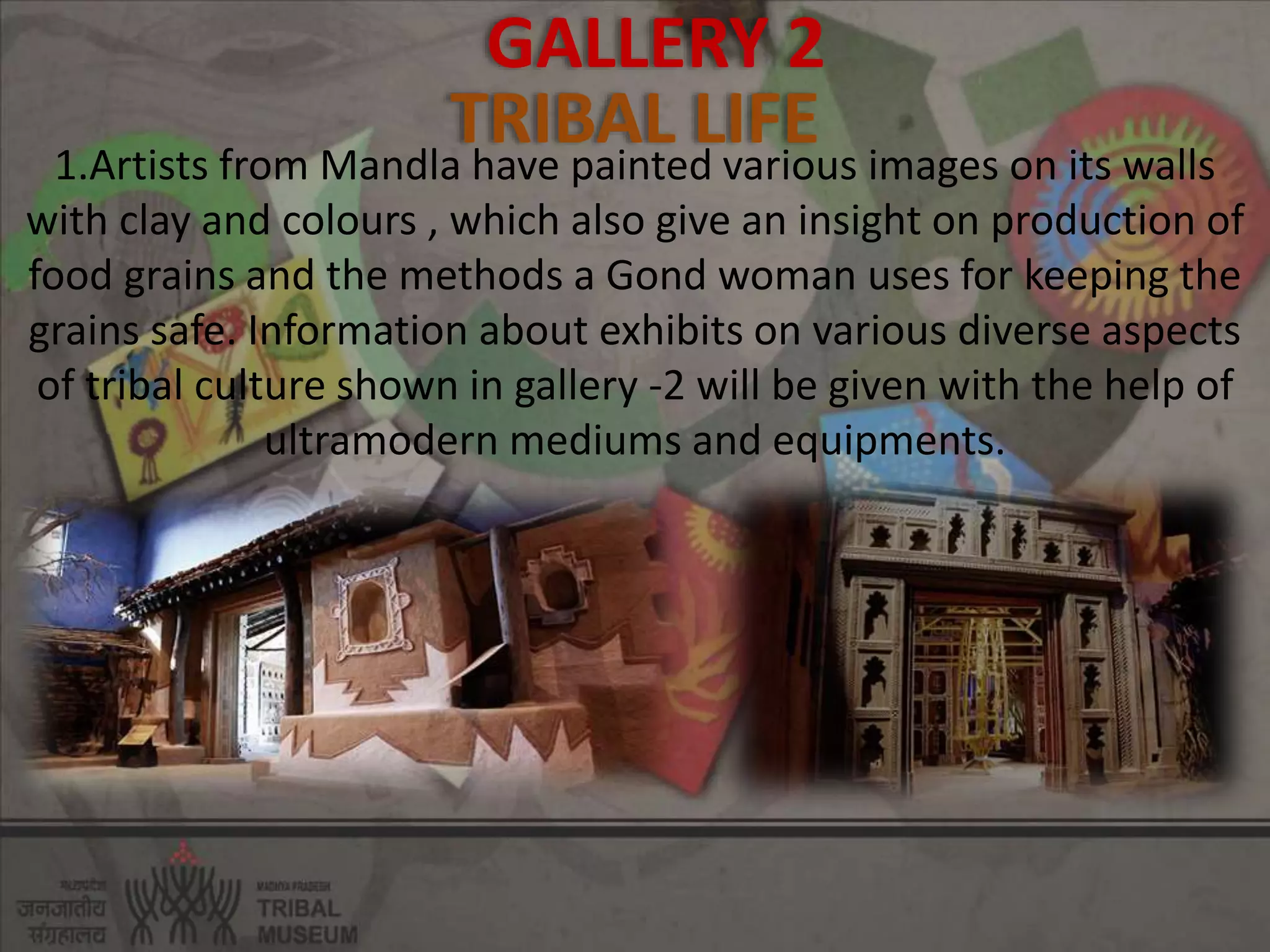
1.Artists from Mandla have painted various images on its walls 
with clay and colours , which also give an insight on production of 
food grains and the methods a Gond woman uses for keeping the 
grains safe. Information about exhibits on various diverse aspects 
of tribal culture shown in gallery -2 will be given with the help of 
ultramodern mediums and equipments.
GALLERY 2 
TRIBAL LIFE 
2.It explicit that neither can types of houses of all the tribes of Madhya 
Pradesh be shown in the limited area of gallery nor it is desirable in the 
context of this museum. Here, only hints are being given about these 
houses’ architectural, style-related, behavioral and material features. 
Changes underwent by dwellings or homes of these tribal communities 
are also being highlighted here. For examples, walls of Baiga dwellings 
were earlier made with some strong plant parts or grass. Later, they 
started making walls by applying mud on bamboo grills and finally walls 
were made of mud and then with bricks. Earlier, leaves were used to 
make a thatch followed by some specific types of grass and then with 
factory-made English tiles. Analysis of this process of change will also 
help understand changes witnessed in tribal areas.
GALLERY 2 
TRIBAL LIFE 
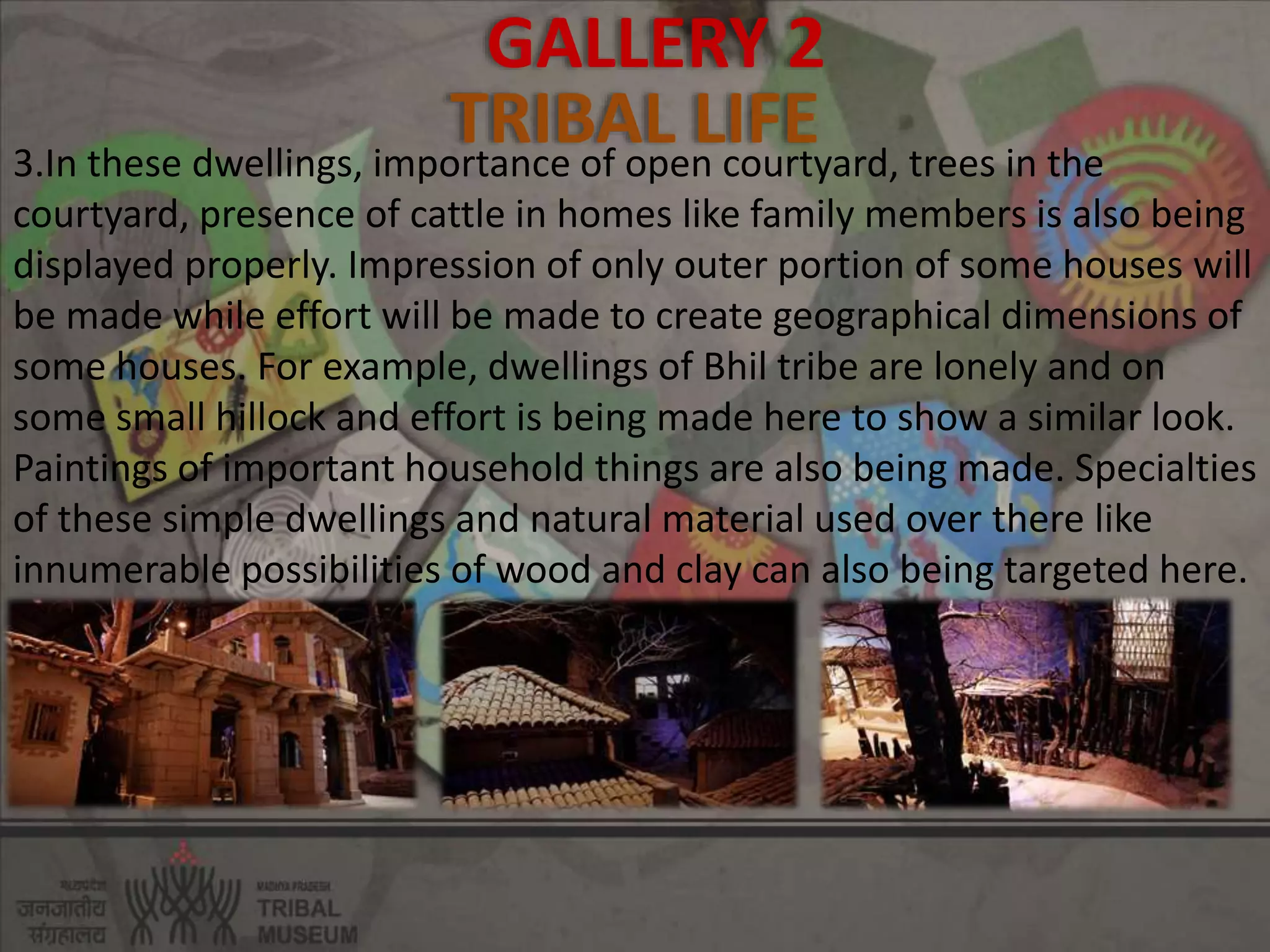
3.In these dwellings, importance of open courtyard, trees in the 
courtyard, presence of cattle in homes like family members is also being 
displayed properly. Impression of only outer portion of some houses will 
be made while effort will be made to create geographical dimensions of 
some houses. For example, dwellings of Bhil tribe are lonely and on 
some small hillock and effort is being made here to show a similar look. 
Paintings of important household things are also being made. Specialties 
of these simple dwellings and natural material used over there like 
innumerable possibilities of wood and clay can also being targeted here.
GALLERY 2 
TRIBAL LIFE 
4.This gallery serves as a courtyard where dwellings of various 
tribal communities are adjoining, peeping into each other and 
creating each other’s neighborhood. You will enter from the door 
of some tribe’s dwelling and come out into some other tribe’s 
house and sometimes into a lane of Baiga locality will assure to 
take you to a lone hillock of some Bhil dwelling.
GALLERY 3 
TRIBAL AESTHETIC 
Tribal jewellery and other make-up paraphernalia will be inlaid 
between two layers of glasses on the windows of corridors from 
where one enters this aesthetically decorated gallery. In a sense, it 
will be a lattice made from jewelry and cosmetics. The gallery will 
also have wooden or terracotta mannequins with tattoo marks. 
The first canvas for expression of art is, perhaps, the human body. 
Therefore, its use for displaying various hues of adornments on 
human body seems justified at the entry point of aesthetics.
GALLERY 3 
TRIBAL AESTHETIC 
1.As pointed out earlier, there no such thing as art separately in 
tribal life. But if look inversely, not even simplest of things like 
broom or sil-batta (grinding stone) are not untouched by 
aesthetics. Under these circumstances, it is difficult to decide what 
to include and what to leave. Therefore, we have set a target to 
collect rituals of life cycle and songs of season cycle in aesthetics 
gallery. There is a marriage canopy in the midst of gallery, which 
will be under the shades of four vast trees, each having 
identification emblem of four different tribes. It will be more 
appropriate to say that myths about origination of nature will 
bless marriage, which is symbol of completeness and continuity of 
life.
GALLERY 3 
TRIBAL AESTHETIC 
2.Efforts are being made to provide opportunities to witness all the hues and gallery 
from all angles from below or above in one way or other. Two levels are being built in 
the marriage canopy being created in the midst of the gallery so that visitor can see 
not only marriage rituals and symbols ingrained on trees, but will also have an overall 
minute view of entire gallery. At one door of the gallery, terracotta images depicting 
Bhil death rituals and concept of world of the dead. These images are dedicated to 
souls of the dead persons and in a sense this a short-term habitat for these souls. 
These terracotta images are generally installed on ground. But idea behind their 
installation here has been conceived with a view to giving opportunity to viewers to 
understand its basic concept with a different angle. It is as if we are watching this 
world of the dead from any other plain or the Earth from any other planet. There is 
also a possibility to watch this world of the dead moving in the space like a 
constellation. There is concept of a separate world for the dead in Bhil and Bhilal 
myths. Invitation is extended to these dead persons in specific language of the dead 
called “Muruwa” on special occasions. Earthen lamps are also placed on these images 
on special occasion, which will be arranged in the gallery with lighting arrangements.
GALLERY 3 
TRIBAL AESTHETIC 
3.On the occasion of marriage, new daughter-in-law is given brass 
bracelet or ring in tribal communities on which symbols of productively 
like well/stairwell/ploughing pair of bullocks/farmer/field etc are 
ingrained. This bracelet is very small and is not worn. She keep the 
bracelet in her hand at the time of preparing seeds. A large image of this 
bracelet has been made in the gallery. Besides marriage, rituals 
pertaining to birth of children and death of people will also be shown in 
totality in the gallery. Here, folklores linked to these, rituals and rites, 
and all and aspects of its process through physical things will be seen 
and understood.
GALLERY 3 
TRIBAL AESTHETIC 
4.Efforts will also be made to give concrete shape to tribal festivals and 
events related to seasons and cultivation, dances, songs and attires 
linked to them. Process is also underway to develop enlarged images of 
Bhils’ myths about making percussion instruments, Gonds’ myth about 
Badadev residing in Saja tree and making of a percussion instrument 
called “Bana” from the same tree to appease Badadev. Hollow of a dried 
tree trunk is being used to give impression of a large dried up tree. It will 
offer a better opportunity to understand natural vastness of small 
percussion instrument “Bana”, capture its rhythm and assimilate 
inherent intricacies of the instrument.
GALLERY 4 
TRIBAL SPIRITUAL WORLD 
Images of a thorny tree has been made on the wall of the corridor 
leading from Aesthetics gallery to Devlok. Thorns remind people of 
pain and strength to bear pain and remain unmoved by it is 
received from Devlok, where this ‘thorny’ corridor is leading.
GALLERY 4 
TRIBAL SPIRITUAL WORLD 
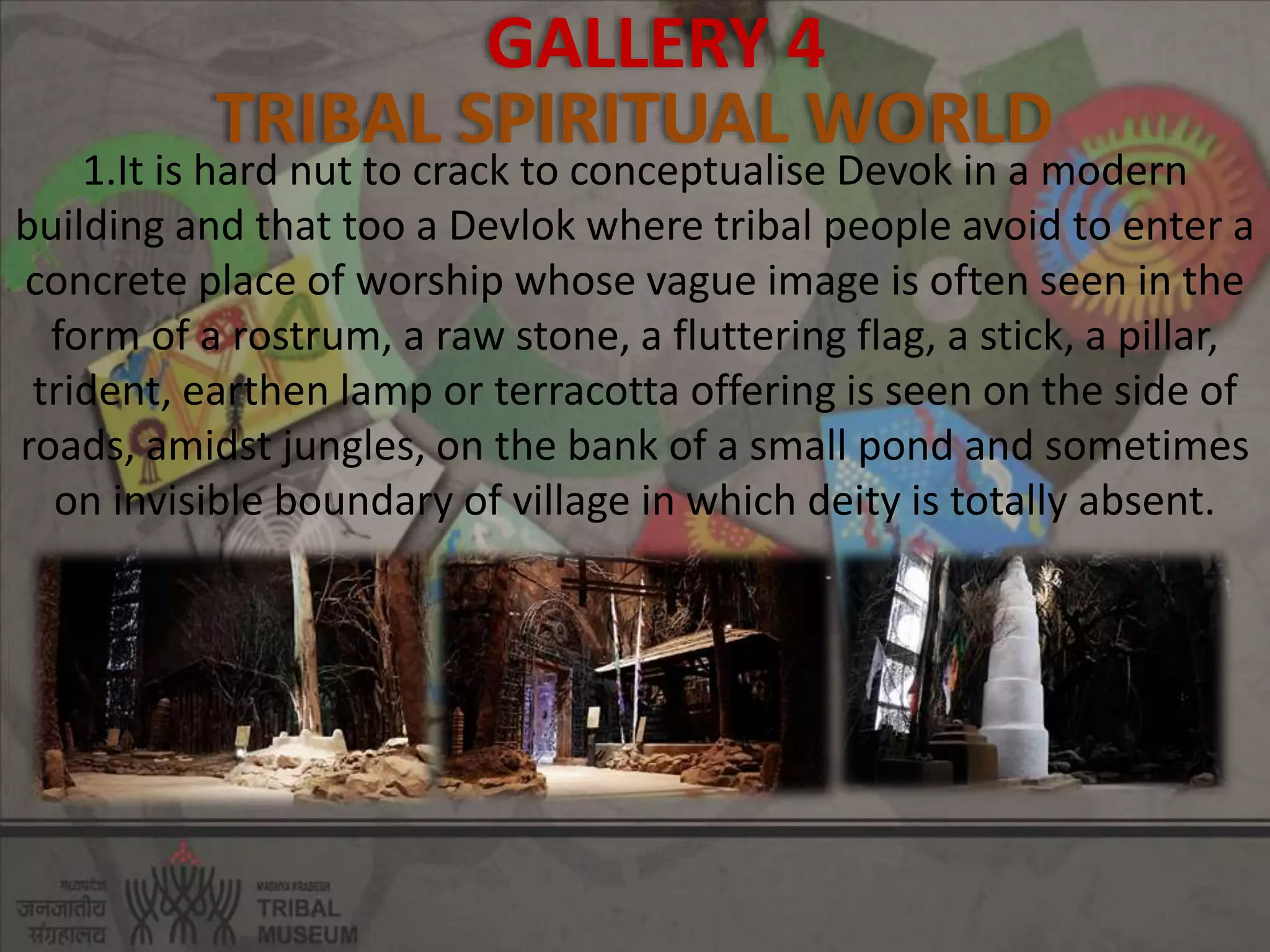
1.It is hard nut to crack to conceptualise Devok in a modern 
building and that too a Devlok where tribal people avoid to enter a 
concrete place of worship whose vague image is often seen in the 
form of a rostrum, a raw stone, a fluttering flag, a stick, a pillar, 
trident, earthen lamp or terracotta offering is seen on the side of 
roads, amidst jungles, on the bank of a small pond and sometimes 
on invisible boundary of village in which deity is totally absent.
GALLERY 4 
TRIBAL SPIRITUAL WORLD 
2.The shorthand language of symbols and signs in which these 
tribal communities have writing constitution of their Devlok 
borders on unending and unlimited possibilities of time and space. 
Possibly for this reasons they did never attempt to build any 
massive Devlok since the most massive of a building will be like a 
dust particle in the context of these unlimited vastitude.
GALLERY 4 
TRIBAL SPIRITUAL WORLD 
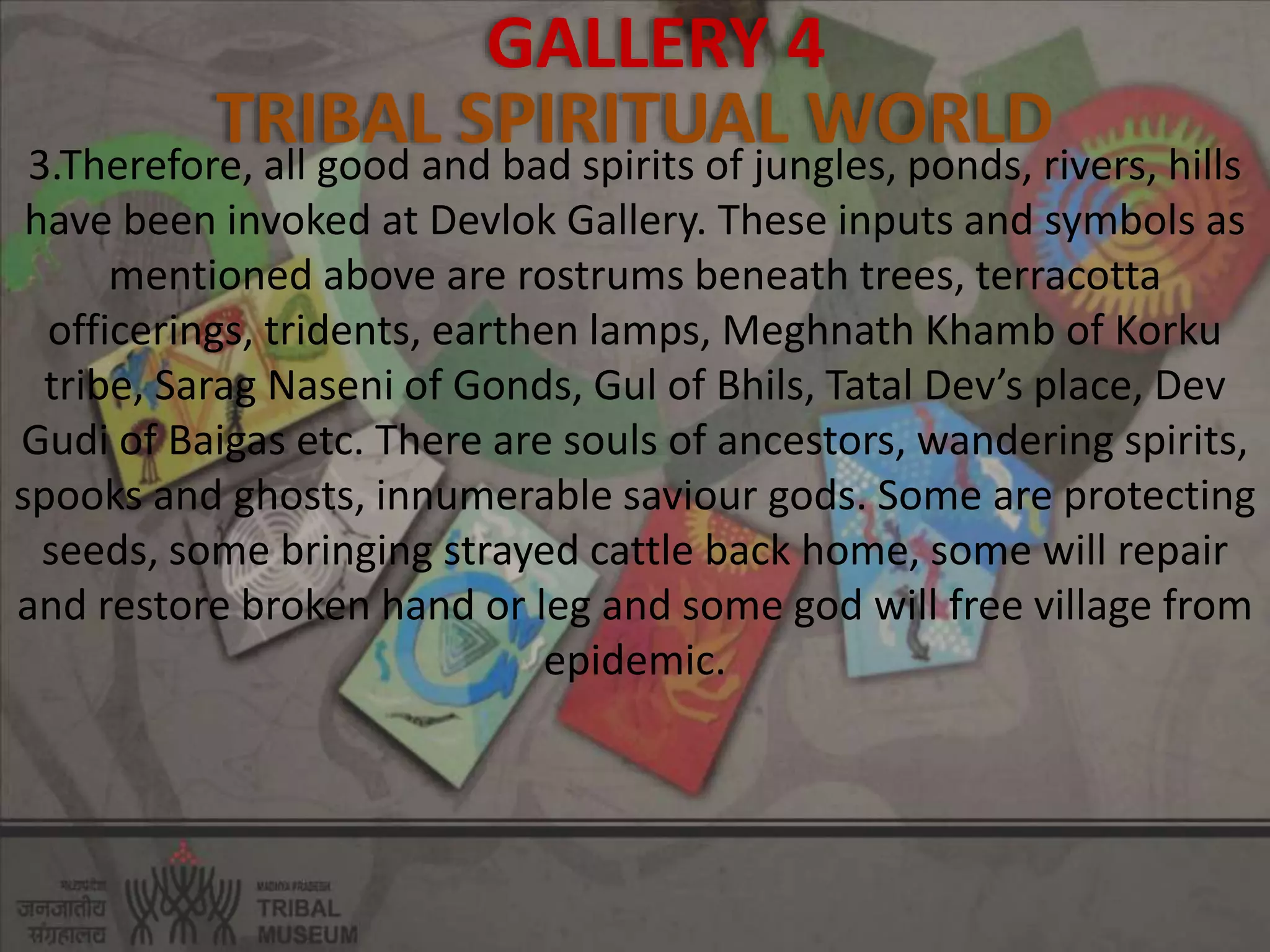
3.Therefore, all good and bad spirits of jungles, ponds, rivers, hills 
have been invoked at Devlok Gallery. These inputs and symbols as 
mentioned above are rostrums beneath trees, terracotta 
officerings, tridents, earthen lamps, Meghnath Khamb of Korku 
tribe, Sarag Naseni of Gonds, Gul of Bhils, Tatal Dev’s place, Dev 
Gudi of Baigas etc. There are souls of ancestors, wandering spirits, 
spooks and ghosts, innumerable saviour gods. Some are protecting 
seeds, some bringing strayed cattle back home, some will repair 
and restore broken hand or leg and some god will free village from 
epidemic.
GALLERY 4 
TRIBAL SPIRITUAL WORLD 
4.During visit to tribal Devlok gallery it become explicit that it is 
more a world to experience than watch. Therefore, it is more 
important to create that particular climate for making it feel or 
experience in which inanimate stone, a rostrum and offerings 
made to gods can start breathing like an animate.
GALLERY 4 
TRIBAL SPIRITUAL WORLD 
5.As said above earlier also, more than one storeys have been 
prepared in each gallery so that visitors can view it from various 
angles from below and above. Deliberate effort has been made to 
disturb the feeling if one is on the eartj and seeing everything from 
some other plane. The same is the reason behind covering iron 
grills ordinarily or partially with barbed chains so that continuity of 
this experience is not only maintained but also strengthened the 
chains which are symbols of deity’s power.
GALLERY 5 
EXHIBITION AND GUEST GALLERY 
Under the initiative of setting up a gallery for guest state, first of 
all life of tribal communities of Chhattisgarh state is being depicted 
in this gallery. That is why the corridor leading from Devlok to this 
gallery has been converted into courtyard and corridor adjoining it 
of Rajwar tribe of Sarguja in Chhattisgarh. Rajwar dwellings style 
of bamboo and clay lattices and way of coating is highly 
specialized and has the honour of becoming an identity of not only 
its community, but also entire state.
GALLERY 5 
EXHIBITION AND GUEST GALLERY 
1.Chhattisgarh is a tribal-dominated state and a large population 
of these tribes lives in Bastar area. All the tribes have a specific 
role to play in preparing Dussehra Rath over there at the time of 
Dussehra right from identifying trees in jungles for it, upto 
collection of leaves for covering it, driving nails home, preparing 
various parts of the rath, brinking Maoli Mata’s Chhatra from 
Jagdalpur, bending and pulling it on roads etc. Efforts are being 
made to grasp specialities of all the tribal communities by linking 
them with this meaningful exhibit depicting tribal affinity through 
physical objects.
GALLERY 5 
EXHIBITION AND GUEST GALLERY 
2.Besides, Maoli Mata ki Gudi, Sheetla Mata ka Sthan, Karmseni 
Vraksh and a lane with dwellings of potter, washerman, 
ironsmith/blacksmith and their tools have also been displayed. 
Gudi of Adhishthata Devi Danteashwari is inside the door of 
Rajwada of Bastar and since there is no major role of Bastar royal 
family in bringing Danteshwari Mata to Bastar, preparation of 
Dussehra Rath, celebrating the festival in this way and due to deep 
attachment of all the tribal communities with these festivals and 
rituals, consent has been reached give shape to entry door of the 
gallery on the lines of entry gate of Bastar Rajwada.
GALLERY 5 
EXHIBITION AND GUEST GALLERY 
Pictorial and written documentation of games of children of 
various tribal communities like Baiga, Gond, Saharia, Kol, Korko, 
Bharia etc has been made by visiting their areas. Since there are a 
number of games of tribal children but only a few toys, this display 
is being shaped with paintings, photographs and other means well 
besides toys.
GALLERY 5 
EXHIBITION AND GUEST GALLERY 
1.Playing images have been prepared using terracotta, hollows of 
dried gourd, hemp, papier-mâché etc. with a view to make 
understand nature of game. Images jumping, swaying on trees can 
be seen to understand games played on trees. Wrestling images 
smeared in mud can also be seen. Images of games played on 
ground like gippa, goti, chaupad etc. will be shown on the ground.
GALLERY 5 
EXHIBITION AND GUEST GALLERY 
2.Use of earthen pitchers made by potters of western Madhya 
Pradesh in improving gallery’s acoustics and lighting arrangements 
is worth noticing. Despite being a part of indigenous knowledge, 
this can open a new important and innovative vista of using the 
technique in modern context. A partition made of pieces of dry 
bamboo will be effective in maintaining gallery’s light, warmth and 
environment.
ENTERANCE GATE
ENTERANCE PLAZA
ENTERANCE TO MUSIUM
LIBERARY
SEMINAR HALL
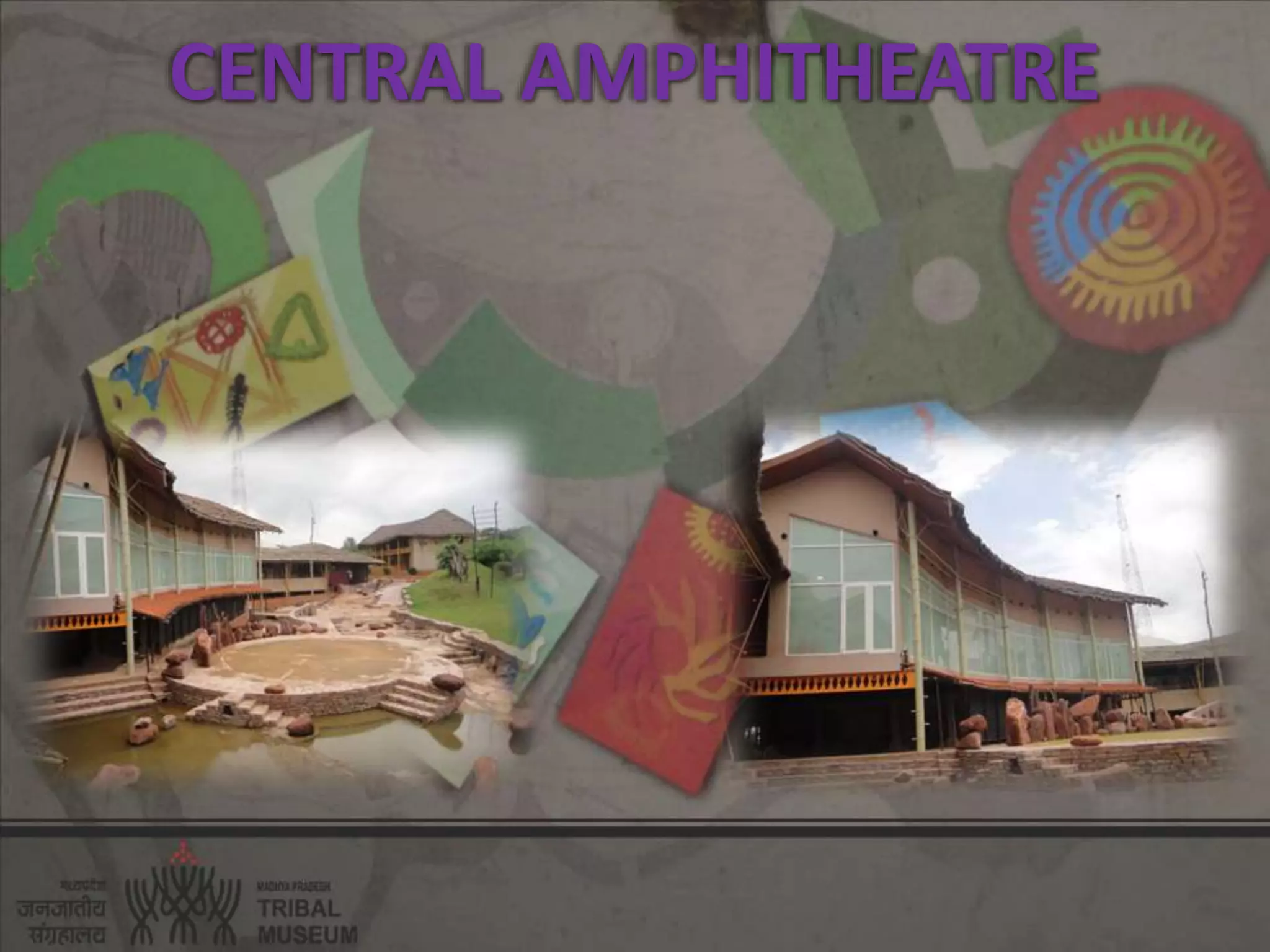
AMPHITHEATRE
CENTRAL AMPHITHEATRE
AUDITORIUM
DORMITORY
CAFETERIA
OFFICES
OFFICES
WORKSHOPS 
1.METAL WORKSHOP:- 
2.TERACOTA AND EARTH WORKSHOP:-
WORKSHOPS 
1.WOOD AND BAMBOO WORKSHOP:- 
2.PHOTOGRAPHY WORKSHOP:-
WORKSHOPS 
1.HANDMADE PAPER DISPLAY AND WORKSHOP:- 
2.DANCE AND MUSIC WORKSHOP:-
DISPLAY AREA
RESERVE COLLECTION
COURTYARDS
SHOPS AND STORES
STORAGE
PARKING

tribal art museum-bhopal

  • 1.
    CASE STUDY ON TRIBAL ART MUSEUM
  • 2.
    INTRODUCTION The Museumof Tribal Heritage at Bhopal was commissioned by the Government of Madhya Pradesh in 2004 since over 30% of the population of the state is tribal. It’s architecture was informed by their rich culture, evolved over millennia. The cultural diversity seen in Madhya Pradesh is hard to find anywhere else. Almost oblivious of political boundaries, communities living in states’ peripheries, tribal communities continue linguistic, lifestyle, music and cultural exchanges. The architecture of the museum, integrates seamlessly into a continuum, the outside with the inside, the natural with the human construct, the tribal with the urban and the viewer with the viewed.
  • 3.
    SITE LOCATION MadhyaPradesh Tribal Museum Shyamala Hills, Bhopal 462002, Madhya Pradesh. 77° 23‘05.16 E 23° 14’04.23 N 1856 FT LOCATION:- LONGITUDE:- LATITUDE:- ALTITUDE:-
  • 4.
    DESIGN FEATURES Thearchitecture of the Museum is inspired by tribal rhythms, geometries, materials, forms, aesthetics and spatial consciousness, these very qualities are now acting as points of inspiration for the display materials being created by tribal artisans, supported by anthropologists, sociologists and social workers. The structure is built of steel tubes, castellated girders, and steel rods fabricated into intricate trusses. Steel seemed to be a natural choice in the land & location of ancient Iron Age & Bronze Age civilizations, and the contemporary truck body building industry.
  • 5.
    SIMILAR BUILDING NEARBY The State Museum of Bhopal.
  • 6.
    SIMILAR BUILDING NEARBY The State Museum of Bhopal is amongst the best-designed museums in India. The museum has 16 different theme galleries, showcasing the State's sculptural masterpieces, pre-historic articles and fossils, excavated objects, epigraphs, manuscripts, paintings, royal collection, textile, documents, postal stamps, autographs, miniature paintings, coins, arms and weapons, articles associated with India's freedom struggle. The museum also has reproductions of the now-destroyed Buddhist Bagh Cave paintings, 84 rare Jaina bronzes of the 8th to 11th centuries, Avalokesteshwaras of Lamaism, Saivite sculptures and miniature paintings showing the graceful lifestyles of those distant days.
  • 7.
    LAND MARK NEARTHE SITE 1.REGIONAL COLLEDGE OF BHOPAL 2.SRC BHARAT SCOUT AND GUIDE M.P.
  • 8.
    GALLERY 1 CULTURALDIVERSITY The task of establishing this specialty of Madhya Pradesh and better understanding and display of its multi-dimensional culture will be accomplished in Gallery -1. The gallery will be arranged in manner that will leave a deep impact on visitors about Madhya Pradesh’s multi-pronged cultural presence. Like shoots of banyan tree spread far and wide and are not confined to some definite limits, in the same way culture of various tribes of Madhya Pradesh will be put on display over there. Visitors will directly observe here as to how cultural offshoots of a tribal community crawl into other tribes beyond borders of neighboring state. Pattern of the gallery will be briefly as under:-
  • 9.
    GALLERY 1 CULTURALDIVERSITY 1.A glimpse of Madhya Pradesh’s map will be put up in entire middle part of the gallery in such a way that a visitor will have inkling about state’s geographical contours, hills, plateaus, forest and serpentine path of lifeline Narmada. Despite being map of Madhya Pradesh, it will give visual effect of an uneven hillock.
  • 10.
    GALLERY 1 CULTURALDIVERSITY 2. A banyan tree will be built amidst this map or hillock. Offshoots of the banyan tree will be spread up to sky (gallery’s high ceiling) and surrounding states’ tribal culture (whose glimpse will be shown on the gallery’s walls) whereas roots will be spread on the gallery’s floor. This vast tree will be made a via media for various mediums so that there is no excessive burden despite it being strong so that gigantic and majestic look of the banyan tree (which is also state tree and state’s emblem) is maintained.
  • 11.
    GALLERY 1 CULTURALDIVERSITY 3.Geographical presence of all the major tribes living in Madhya Pradesh will be symbolically shown on the map drawn in the lower part of the gallery with the help of their important symbols.
  • 12.
    GALLERY 1 CULTURALDIVERSITY 4.Gallery’s vastness and high ceiling motivates for making innovations and there is scope for it also. A staircase will rise from a place in the gallery and then join ramps built above around entire gallery. Visitors will climb up the ramps and have a bird’s eye view of Madhya Pradesh’s map. They will also feel themselves as a part of this vast cultural banyan tree. Down there at the places adjoining walls, there will be various sculptures etc. showing tribal life and culture of the state and bordering states, which will help visitors analyze differences and similarities between both the cultures.
  • 13.
    GALLERY 1 CULTURALDIVERSITY 5.Flag-like maps will be hanged from branches of banyan tree showing special features/similarities between various tribal communities. These will be displayed in the form of banners and scrolls.
  • 14.
    GALLERY 2 TRIBALLIFE A mammoth container for storing food grains has been built in the gallery from where one enters gallery -2 from gallery -1. This food grains container is used in Gond tribal homes for creating a partition, keeping food grains safe, as a canvas for wall paining and keeping household things in cavities made on it while the vacant space in between is used for moving in and out.
  • 15.
    GALLERY 2 TRIBALLIFE 1.Artists from Mandla have painted various images on its walls with clay and colours , which also give an insight on production of food grains and the methods a Gond woman uses for keeping the grains safe. Information about exhibits on various diverse aspects of tribal culture shown in gallery -2 will be given with the help of ultramodern mediums and equipments.
  • 16.
    GALLERY 2 TRIBALLIFE 2.It explicit that neither can types of houses of all the tribes of Madhya Pradesh be shown in the limited area of gallery nor it is desirable in the context of this museum. Here, only hints are being given about these houses’ architectural, style-related, behavioral and material features. Changes underwent by dwellings or homes of these tribal communities are also being highlighted here. For examples, walls of Baiga dwellings were earlier made with some strong plant parts or grass. Later, they started making walls by applying mud on bamboo grills and finally walls were made of mud and then with bricks. Earlier, leaves were used to make a thatch followed by some specific types of grass and then with factory-made English tiles. Analysis of this process of change will also help understand changes witnessed in tribal areas.
  • 17.
    GALLERY 2 TRIBALLIFE 3.In these dwellings, importance of open courtyard, trees in the courtyard, presence of cattle in homes like family members is also being displayed properly. Impression of only outer portion of some houses will be made while effort will be made to create geographical dimensions of some houses. For example, dwellings of Bhil tribe are lonely and on some small hillock and effort is being made here to show a similar look. Paintings of important household things are also being made. Specialties of these simple dwellings and natural material used over there like innumerable possibilities of wood and clay can also being targeted here.
  • 18.
    GALLERY 2 TRIBALLIFE 4.This gallery serves as a courtyard where dwellings of various tribal communities are adjoining, peeping into each other and creating each other’s neighborhood. You will enter from the door of some tribe’s dwelling and come out into some other tribe’s house and sometimes into a lane of Baiga locality will assure to take you to a lone hillock of some Bhil dwelling.
  • 19.
    GALLERY 3 TRIBALAESTHETIC Tribal jewellery and other make-up paraphernalia will be inlaid between two layers of glasses on the windows of corridors from where one enters this aesthetically decorated gallery. In a sense, it will be a lattice made from jewelry and cosmetics. The gallery will also have wooden or terracotta mannequins with tattoo marks. The first canvas for expression of art is, perhaps, the human body. Therefore, its use for displaying various hues of adornments on human body seems justified at the entry point of aesthetics.
  • 20.
    GALLERY 3 TRIBALAESTHETIC 1.As pointed out earlier, there no such thing as art separately in tribal life. But if look inversely, not even simplest of things like broom or sil-batta (grinding stone) are not untouched by aesthetics. Under these circumstances, it is difficult to decide what to include and what to leave. Therefore, we have set a target to collect rituals of life cycle and songs of season cycle in aesthetics gallery. There is a marriage canopy in the midst of gallery, which will be under the shades of four vast trees, each having identification emblem of four different tribes. It will be more appropriate to say that myths about origination of nature will bless marriage, which is symbol of completeness and continuity of life.
  • 21.
    GALLERY 3 TRIBALAESTHETIC 2.Efforts are being made to provide opportunities to witness all the hues and gallery from all angles from below or above in one way or other. Two levels are being built in the marriage canopy being created in the midst of the gallery so that visitor can see not only marriage rituals and symbols ingrained on trees, but will also have an overall minute view of entire gallery. At one door of the gallery, terracotta images depicting Bhil death rituals and concept of world of the dead. These images are dedicated to souls of the dead persons and in a sense this a short-term habitat for these souls. These terracotta images are generally installed on ground. But idea behind their installation here has been conceived with a view to giving opportunity to viewers to understand its basic concept with a different angle. It is as if we are watching this world of the dead from any other plain or the Earth from any other planet. There is also a possibility to watch this world of the dead moving in the space like a constellation. There is concept of a separate world for the dead in Bhil and Bhilal myths. Invitation is extended to these dead persons in specific language of the dead called “Muruwa” on special occasions. Earthen lamps are also placed on these images on special occasion, which will be arranged in the gallery with lighting arrangements.
  • 22.
    GALLERY 3 TRIBALAESTHETIC 3.On the occasion of marriage, new daughter-in-law is given brass bracelet or ring in tribal communities on which symbols of productively like well/stairwell/ploughing pair of bullocks/farmer/field etc are ingrained. This bracelet is very small and is not worn. She keep the bracelet in her hand at the time of preparing seeds. A large image of this bracelet has been made in the gallery. Besides marriage, rituals pertaining to birth of children and death of people will also be shown in totality in the gallery. Here, folklores linked to these, rituals and rites, and all and aspects of its process through physical things will be seen and understood.
  • 23.
    GALLERY 3 TRIBALAESTHETIC 4.Efforts will also be made to give concrete shape to tribal festivals and events related to seasons and cultivation, dances, songs and attires linked to them. Process is also underway to develop enlarged images of Bhils’ myths about making percussion instruments, Gonds’ myth about Badadev residing in Saja tree and making of a percussion instrument called “Bana” from the same tree to appease Badadev. Hollow of a dried tree trunk is being used to give impression of a large dried up tree. It will offer a better opportunity to understand natural vastness of small percussion instrument “Bana”, capture its rhythm and assimilate inherent intricacies of the instrument.
  • 24.
    GALLERY 4 TRIBALSPIRITUAL WORLD Images of a thorny tree has been made on the wall of the corridor leading from Aesthetics gallery to Devlok. Thorns remind people of pain and strength to bear pain and remain unmoved by it is received from Devlok, where this ‘thorny’ corridor is leading.
  • 25.
    GALLERY 4 TRIBALSPIRITUAL WORLD 1.It is hard nut to crack to conceptualise Devok in a modern building and that too a Devlok where tribal people avoid to enter a concrete place of worship whose vague image is often seen in the form of a rostrum, a raw stone, a fluttering flag, a stick, a pillar, trident, earthen lamp or terracotta offering is seen on the side of roads, amidst jungles, on the bank of a small pond and sometimes on invisible boundary of village in which deity is totally absent.
  • 26.
    GALLERY 4 TRIBALSPIRITUAL WORLD 2.The shorthand language of symbols and signs in which these tribal communities have writing constitution of their Devlok borders on unending and unlimited possibilities of time and space. Possibly for this reasons they did never attempt to build any massive Devlok since the most massive of a building will be like a dust particle in the context of these unlimited vastitude.
  • 27.
    GALLERY 4 TRIBALSPIRITUAL WORLD 3.Therefore, all good and bad spirits of jungles, ponds, rivers, hills have been invoked at Devlok Gallery. These inputs and symbols as mentioned above are rostrums beneath trees, terracotta officerings, tridents, earthen lamps, Meghnath Khamb of Korku tribe, Sarag Naseni of Gonds, Gul of Bhils, Tatal Dev’s place, Dev Gudi of Baigas etc. There are souls of ancestors, wandering spirits, spooks and ghosts, innumerable saviour gods. Some are protecting seeds, some bringing strayed cattle back home, some will repair and restore broken hand or leg and some god will free village from epidemic.
  • 28.
    GALLERY 4 TRIBALSPIRITUAL WORLD 4.During visit to tribal Devlok gallery it become explicit that it is more a world to experience than watch. Therefore, it is more important to create that particular climate for making it feel or experience in which inanimate stone, a rostrum and offerings made to gods can start breathing like an animate.
  • 29.
    GALLERY 4 TRIBALSPIRITUAL WORLD 5.As said above earlier also, more than one storeys have been prepared in each gallery so that visitors can view it from various angles from below and above. Deliberate effort has been made to disturb the feeling if one is on the eartj and seeing everything from some other plane. The same is the reason behind covering iron grills ordinarily or partially with barbed chains so that continuity of this experience is not only maintained but also strengthened the chains which are symbols of deity’s power.
  • 30.
    GALLERY 5 EXHIBITIONAND GUEST GALLERY Under the initiative of setting up a gallery for guest state, first of all life of tribal communities of Chhattisgarh state is being depicted in this gallery. That is why the corridor leading from Devlok to this gallery has been converted into courtyard and corridor adjoining it of Rajwar tribe of Sarguja in Chhattisgarh. Rajwar dwellings style of bamboo and clay lattices and way of coating is highly specialized and has the honour of becoming an identity of not only its community, but also entire state.
  • 31.
    GALLERY 5 EXHIBITIONAND GUEST GALLERY 1.Chhattisgarh is a tribal-dominated state and a large population of these tribes lives in Bastar area. All the tribes have a specific role to play in preparing Dussehra Rath over there at the time of Dussehra right from identifying trees in jungles for it, upto collection of leaves for covering it, driving nails home, preparing various parts of the rath, brinking Maoli Mata’s Chhatra from Jagdalpur, bending and pulling it on roads etc. Efforts are being made to grasp specialities of all the tribal communities by linking them with this meaningful exhibit depicting tribal affinity through physical objects.
  • 32.
    GALLERY 5 EXHIBITIONAND GUEST GALLERY 2.Besides, Maoli Mata ki Gudi, Sheetla Mata ka Sthan, Karmseni Vraksh and a lane with dwellings of potter, washerman, ironsmith/blacksmith and their tools have also been displayed. Gudi of Adhishthata Devi Danteashwari is inside the door of Rajwada of Bastar and since there is no major role of Bastar royal family in bringing Danteshwari Mata to Bastar, preparation of Dussehra Rath, celebrating the festival in this way and due to deep attachment of all the tribal communities with these festivals and rituals, consent has been reached give shape to entry door of the gallery on the lines of entry gate of Bastar Rajwada.
  • 33.
    GALLERY 5 EXHIBITIONAND GUEST GALLERY Pictorial and written documentation of games of children of various tribal communities like Baiga, Gond, Saharia, Kol, Korko, Bharia etc has been made by visiting their areas. Since there are a number of games of tribal children but only a few toys, this display is being shaped with paintings, photographs and other means well besides toys.
  • 34.
    GALLERY 5 EXHIBITIONAND GUEST GALLERY 1.Playing images have been prepared using terracotta, hollows of dried gourd, hemp, papier-mâché etc. with a view to make understand nature of game. Images jumping, swaying on trees can be seen to understand games played on trees. Wrestling images smeared in mud can also be seen. Images of games played on ground like gippa, goti, chaupad etc. will be shown on the ground.
  • 35.
    GALLERY 5 EXHIBITIONAND GUEST GALLERY 2.Use of earthen pitchers made by potters of western Madhya Pradesh in improving gallery’s acoustics and lighting arrangements is worth noticing. Despite being a part of indigenous knowledge, this can open a new important and innovative vista of using the technique in modern context. A partition made of pieces of dry bamboo will be effective in maintaining gallery’s light, warmth and environment.
  • 36.
  • 37.
  • 38.
  • 39.
  • 40.
  • 41.
  • 42.
  • 43.
  • 44.
  • 45.
  • 46.
  • 47.
  • 48.
    WORKSHOPS 1.METAL WORKSHOP:- 2.TERACOTA AND EARTH WORKSHOP:-
  • 49.
    WORKSHOPS 1.WOOD ANDBAMBOO WORKSHOP:- 2.PHOTOGRAPHY WORKSHOP:-
  • 50.
    WORKSHOPS 1.HANDMADE PAPERDISPLAY AND WORKSHOP:- 2.DANCE AND MUSIC WORKSHOP:-
  • 51.
  • 52.
  • 53.
  • 54.
  • 55.
  • 56.