The courtyard wada of Maharashtra

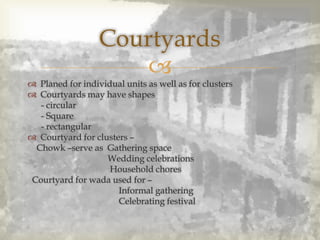
 Planed for individual units as well as for clusters
 Courtyards may have shapes
- circular
- Square
- rectangular
 Courtyard for clusters –
Chowk –serve as Gathering space
Wedding celebrations
Household chores
Courtyard for wada used for –
Informal gathering
Celebrating festival
Courtyards

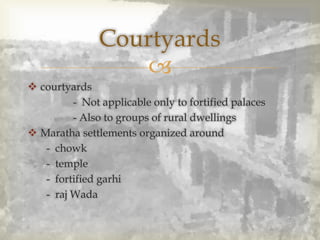
 courtyards
- Not applicable only to fortified palaces
- Also to groups of rural dwellings
 Maratha settlements organized around
- chowk
- temple
- fortified garhi
- raj Wada
Courtyards

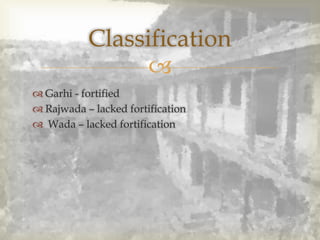
 Garhi - fortified
 Rajwada – lacked fortification
 Wada – lacked fortification
Classification

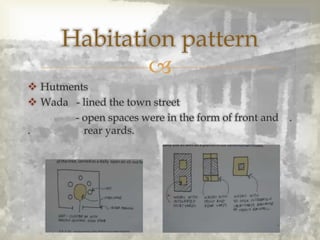
 Hutments
 Wada - lined the town street
- open spaces were in the form of front and .
. rear yards.
Habitation pattern

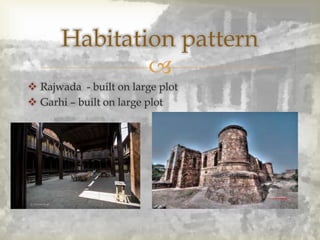
 Rajwada - built on large plot
 Garhi – built on large plot
Habitation pattern

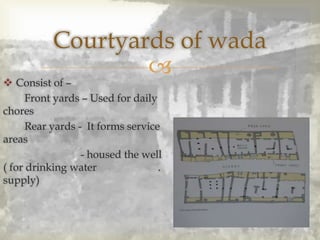
 Consist of –
Front yards – Used for daily
chores
Rear yards - It forms service
areas
- housed the well
( for drinking water .
supply)
Courtyards of wada

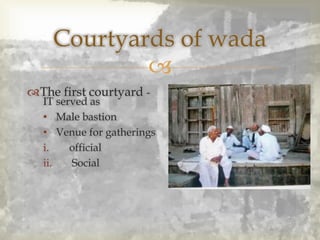
The first courtyard -
IT served as
• Male bastion
• Venue for gatherings
i. official
ii. Social
Courtyards of wada

Courtyards of wada
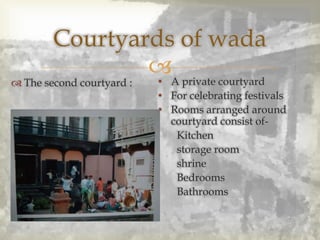
 The second courtyard : • A private courtyard
• For celebrating festivals
• Rooms arranged around
courtyard consist of-
Kitchen
storage room
shrine
Bedrooms
Bathrooms

Courtyards of wada
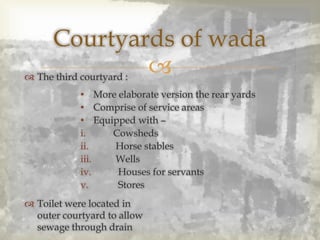
 The third courtyard :
 Toilet were located in
outer courtyard to allow
sewage through drain
• More elaborate version the rear yards
• Comprise of service areas
• Equipped with –
i. Cowsheds
ii. Horse stables
iii. Wells
iv. Houses for servants
v. Stores

THE WADA- (A Maratha house)
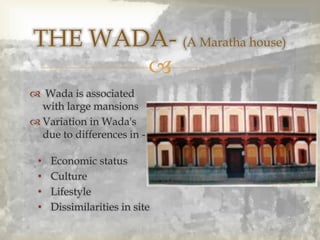
 Wada is associated
with large mansions
 Variation in Wada's
due to differences in -
• Economic status
• Culture
• Lifestyle
• Dissimilarities in site

THE WADA- (A Maratha house)
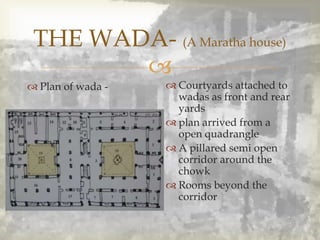
 Plan of wada -  Courtyards attached to
wadas as front and rear
yards
 plan arrived from a
open quadrangle
 A pillared semi open
corridor around the
chowk
 Rooms beyond the
corridor

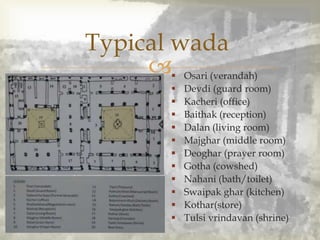
Typical wada
 Osari (verandah)
 Devdi (guard room)
 Kacheri (office)
 Baithak (reception)
 Dalan (living room)
 Majghar (middle room)
 Deoghar (prayer room)
 Gotha (cowshed)
 Nahani (bath/toilet)
 Swaipak ghar (kitchen)
 Kothar(store)
 Tulsi vrindavan (shrine)

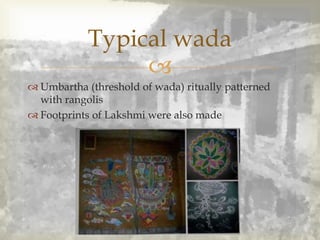
 Umbartha (threshold of wada) ritually patterned
with rangolis
 Footprints of Lakshmi were also made
Typical wada

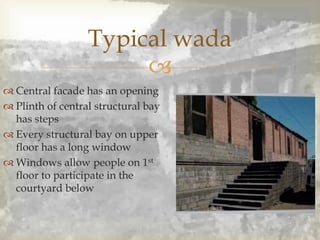
 Central facade has an opening
 Plinth of central structural bay
has steps
 Every structural bay on upper
floor has a long window
 Windows allow people on 1st
floor to participate in the
courtyard below
Typical wada

Typical wada
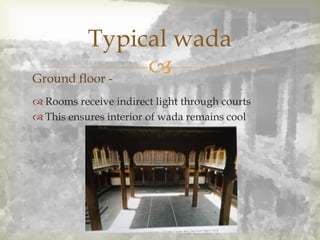
 Rooms receive indirect light through courts
 This ensures interior of wada remains cool
Ground floor -

Typical wada
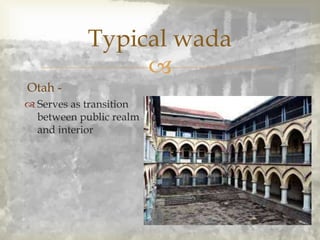
Otah -
 Serves as transition
between public realm
and interior

Typical wada
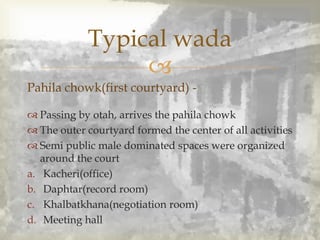
Pahila chowk(first courtyard) -
 Passing by otah, arrives the pahila chowk
 The outer courtyard formed the center of all activities
 Semi public male dominated spaces were organized
around the court
a. Kacheri(office)
b. Daphtar(record room)
c. Khalbatkhana(negotiation room)
d. Meeting hall

Typical wada
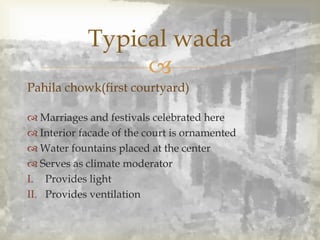
Pahila chowk(first courtyard)
 Marriages and festivals celebrated here
 Interior facade of the court is ornamented
 Water fountains placed at the center
 Serves as climate moderator
I. Provides light
II. Provides ventilation

Typical wada
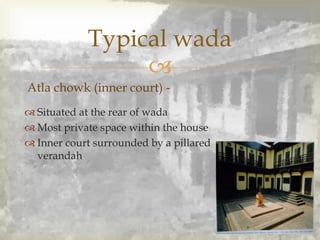
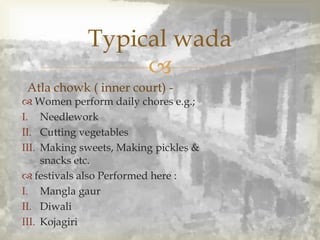
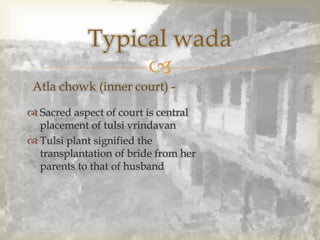
Atla chowk (inner court) -
 Situated at the rear of wada
 Most private space within the house
 Inner court surrounded by a pillared
verandah

Typical wada
Atla chowk ( inner court) -
 Women perform daily chores e.g.;
I. Needlework
II. Cutting vegetables
III. Making sweets, Making pickles &
snacks etc.
 festivals also Performed here :
I. Mangla gaur
II. Diwali
III. Kojagiri

Typical wada
 Sacred aspect of court is central
placement of tulsi vrindavan
 Tulsi plant signified the
transplantation of bride from her
parents to that of husband
Atla chowk (inner court) -

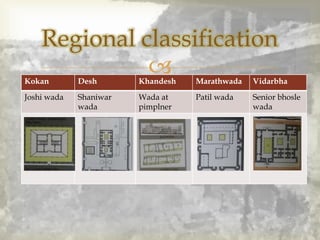
Regional classification
Kokan Desh Khandesh Marathwada Vidarbha
Joshi wada Shaniwar
wada
Wada at
pimplner
Patil wada Senior bhosle
wada

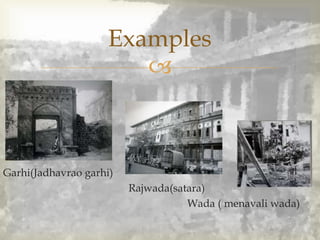
Garhi(Jadhavrao garhi)
Rajwada(satara)
Wada ( menavali wada)
Examples

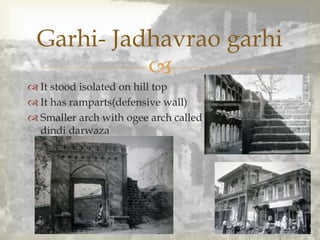
 It stood isolated on hill top
 It has ramparts(defensive wall)
 Smaller arch with ogee arch called
dindi darwaza
Garhi- Jadhavrao garhi

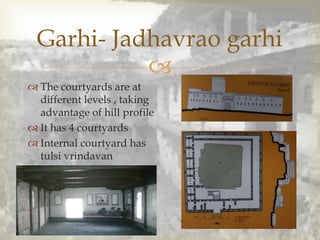
 The courtyards are at
different levels , taking
advantage of hill profile
 It has 4 courtyards
 Internal courtyard has
tulsi vrindavan
Garhi- Jadhavrao garhi

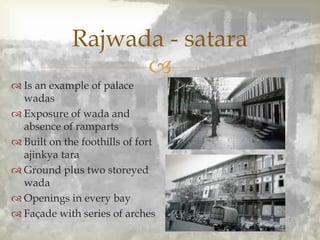
 Is an example of palace
wadas
 Exposure of wada and
absence of ramparts
 Built on the foothills of fort
ajinkya tara
 Ground plus two storeyed
wada
 Openings in every bay
 Façade with series of arches
Rajwada - satara

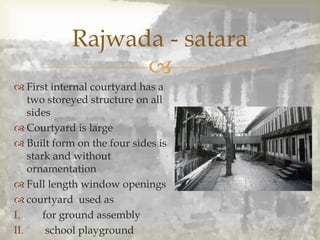
 First internal courtyard has a
two storeyed structure on all
sides
 Courtyard is large
 Built form on the four sides is
stark and without
ornamentation
 Full length window openings
 courtyard used as
I. for ground assembly
II. school playground
Rajwada - satara
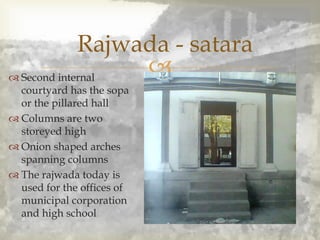
 Second internal
courtyard has the sopa
or the pillared hall
 Columns are two
storeyed high
 Onion shaped arches
spanning columns
 The rajwada today is
used for the offices of
municipal corporation
and high school
Rajwada - satara

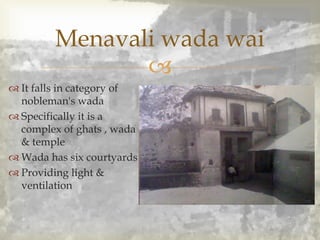
 It falls in category of
nobleman's wada
 Specifically it is a
complex of ghats , wada
& temple
 Wada has six courtyards
 Providing light &
ventilation
Menavali wada wai
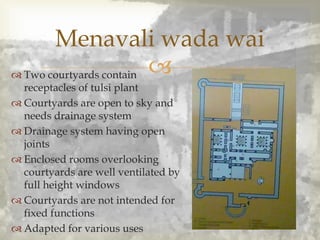
 Two courtyards contain
receptacles of tulsi plant
 Courtyards are open to sky and
needs drainage system
 Drainage system having open
joints
 Enclosed rooms overlooking
courtyards are well ventilated by
full height windows
 Courtyards are not intended for
fixed functions
 Adapted for various uses
Menavali wada wai

Presented by – Gayatri Kangarkar
THANK YOU

courtyard planning

  • 1.
    The courtyard wadaof Maharashtra
  • 2.
      Planed forindividual units as well as for clusters  Courtyards may have shapes - circular - Square - rectangular  Courtyard for clusters – Chowk –serve as Gathering space Wedding celebrations Household chores Courtyard for wada used for – Informal gathering Celebrating festival Courtyards
  • 3.
      courtyards - Notapplicable only to fortified palaces - Also to groups of rural dwellings  Maratha settlements organized around - chowk - temple - fortified garhi - raj Wada Courtyards
  • 4.
      Garhi -fortified  Rajwada – lacked fortification  Wada – lacked fortification Classification
  • 5.
      Hutments  Wada- lined the town street - open spaces were in the form of front and . . rear yards. Habitation pattern
  • 6.
      Rajwada -built on large plot  Garhi – built on large plot Habitation pattern
  • 7.
      Consist of– Front yards – Used for daily chores Rear yards - It forms service areas - housed the well ( for drinking water . supply) Courtyards of wada
  • 8.
     The first courtyard- IT served as • Male bastion • Venue for gatherings i. official ii. Social Courtyards of wada
  • 9.
     Courtyards of wada The second courtyard : • A private courtyard • For celebrating festivals • Rooms arranged around courtyard consist of- Kitchen storage room shrine Bedrooms Bathrooms
  • 10.
     Courtyards of wada The third courtyard :  Toilet were located in outer courtyard to allow sewage through drain • More elaborate version the rear yards • Comprise of service areas • Equipped with – i. Cowsheds ii. Horse stables iii. Wells iv. Houses for servants v. Stores
  • 11.
     THE WADA- (AMaratha house)  Wada is associated with large mansions  Variation in Wada's due to differences in - • Economic status • Culture • Lifestyle • Dissimilarities in site
  • 12.
     THE WADA- (AMaratha house)  Plan of wada -  Courtyards attached to wadas as front and rear yards  plan arrived from a open quadrangle  A pillared semi open corridor around the chowk  Rooms beyond the corridor
  • 13.
     Typical wada  Osari(verandah)  Devdi (guard room)  Kacheri (office)  Baithak (reception)  Dalan (living room)  Majghar (middle room)  Deoghar (prayer room)  Gotha (cowshed)  Nahani (bath/toilet)  Swaipak ghar (kitchen)  Kothar(store)  Tulsi vrindavan (shrine)
  • 14.
      Umbartha (thresholdof wada) ritually patterned with rangolis  Footprints of Lakshmi were also made Typical wada
  • 15.
      Central facadehas an opening  Plinth of central structural bay has steps  Every structural bay on upper floor has a long window  Windows allow people on 1st floor to participate in the courtyard below Typical wada
  • 16.
     Typical wada  Roomsreceive indirect light through courts  This ensures interior of wada remains cool Ground floor -
  • 17.
     Typical wada Otah - Serves as transition between public realm and interior
  • 18.
     Typical wada Pahila chowk(firstcourtyard) -  Passing by otah, arrives the pahila chowk  The outer courtyard formed the center of all activities  Semi public male dominated spaces were organized around the court a. Kacheri(office) b. Daphtar(record room) c. Khalbatkhana(negotiation room) d. Meeting hall
  • 19.
     Typical wada Pahila chowk(firstcourtyard)  Marriages and festivals celebrated here  Interior facade of the court is ornamented  Water fountains placed at the center  Serves as climate moderator I. Provides light II. Provides ventilation
  • 20.
     Typical wada Atla chowk(inner court) -  Situated at the rear of wada  Most private space within the house  Inner court surrounded by a pillared verandah
  • 21.
     Typical wada Atla chowk( inner court) -  Women perform daily chores e.g.; I. Needlework II. Cutting vegetables III. Making sweets, Making pickles & snacks etc.  festivals also Performed here : I. Mangla gaur II. Diwali III. Kojagiri
  • 22.
     Typical wada  Sacredaspect of court is central placement of tulsi vrindavan  Tulsi plant signified the transplantation of bride from her parents to that of husband Atla chowk (inner court) -
  • 23.
     Regional classification Kokan DeshKhandesh Marathwada Vidarbha Joshi wada Shaniwar wada Wada at pimplner Patil wada Senior bhosle wada
  • 24.
  • 25.
      It stoodisolated on hill top  It has ramparts(defensive wall)  Smaller arch with ogee arch called dindi darwaza Garhi- Jadhavrao garhi
  • 26.
      The courtyardsare at different levels , taking advantage of hill profile  It has 4 courtyards  Internal courtyard has tulsi vrindavan Garhi- Jadhavrao garhi
  • 27.
      Is anexample of palace wadas  Exposure of wada and absence of ramparts  Built on the foothills of fort ajinkya tara  Ground plus two storeyed wada  Openings in every bay  Façade with series of arches Rajwada - satara
  • 28.
      First internalcourtyard has a two storeyed structure on all sides  Courtyard is large  Built form on the four sides is stark and without ornamentation  Full length window openings  courtyard used as I. for ground assembly II. school playground Rajwada - satara
  • 29.
     Second internal courtyardhas the sopa or the pillared hall  Columns are two storeyed high  Onion shaped arches spanning columns  The rajwada today is used for the offices of municipal corporation and high school Rajwada - satara
  • 30.
      It fallsin category of nobleman's wada  Specifically it is a complex of ghats , wada & temple  Wada has six courtyards  Providing light & ventilation Menavali wada wai
  • 31.
     Two courtyardscontain receptacles of tulsi plant  Courtyards are open to sky and needs drainage system  Drainage system having open joints  Enclosed rooms overlooking courtyards are well ventilated by full height windows  Courtyards are not intended for fixed functions  Adapted for various uses Menavali wada wai
  • 32.
     Presented by –Gayatri Kangarkar THANK YOU