Seminar – 1
21st Nov 2017
HERITAGE CONSERVATION
ACTS & LEGISLATIONS
RICHARD MANOHARAN
M. ARCH (URBAN DESIGN)
SCHOOL OF PLANNING & ARCHITECTURE, MYSORE
 UNESCO adopted a convention on the protection of the World’s
Cultural and National Heritage on November 16, 1972.
 It is also called World Heritage Convention
GLOBAL
 States are obliged under Article 49 of
the Indian Constitution,1951 to
protect monuments and places and
objects of national importance.
 It is the duty of every citizen of India
under Article 51A(f) of Indian
Constitution, 1951 to value and
preserve the rich heritage of our
composite culture.
OBLIGATIONS
 The first ever antiquarian legislation in India is known as
Bengal Regulation XIX of 1810.
 This was soon followed by another legislation called as
Madras Regulation VII of 1817. Both these regulations vested
the Government with a power to intervene whenever the public
buildings were under threat of misuse. However, both the Acts
were silent on the buildings under the private ownership.
 The Act XX of 1863, was therefore enacted to empower the
Government to prevent injury to and preserve buildings
remarkable for their antiquity or for their historical or
architectural value.
EVOLUTION
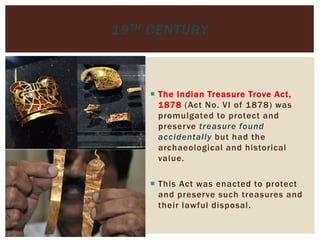
 The Indian Treasure Trove Act,
1878 (Act No. VI of 1878) was
promulgated to protect and
preserve treasure found
accidentally but had the
archaeological and historical
value.
 This Act was enacted to protect
and preserve such treasures and
their lawful disposal.
19TH CENTURY
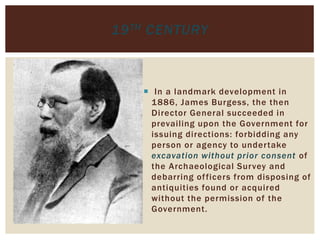
 In a landmark development in
1886, James Burgess, the then
Director General succeeded in
prevailing upon the Government for
issuing directions: forbidding any
person or agency to undertake
excavation without prior consent of
the Archaeological Survey and
debarring officers from disposing of
antiquities found or acquired
without the permission of the
Government.
19TH CENTURY
 The Ancient Monuments Preservation Act, 1904 (Act No. VII of
1904), provided effective preservation and authority over the
monument particularly those, which were under the custody of
individual or private ownership. As this Act has not been
repealed, it is deemed to be in force.
 Next Act was The Antiquities Export Control Act, 1947 (Act
No. XXXI of 1947) and Rules thereto which provided a
regulation over the export of antiquities under a licence
issued by the Director General and empowering him to decide
whether any article, object or thing is or is not an antiquity for
the purpose of the act and his decision was final.
20TH CENTURY
 In 1951, The Ancient and Historical Monuments and
Archaeological Sites and Remains (Declaration of National
Importance) Act, 1951 (No LXXI of 1951) was enacted.
 Consequently, all the ancient and historical monuments and
archaeological sites and remains protected earlier under ‘The
Ancient Monuments Preservation Act, 1904’ (Act No. VII of 1904)
were re-declared as monuments and archaeological sites of
national importance under this Act.
 Another four hundred and fifty monuments and sites of Part ‘B’
States were also added.
 Some more monuments and archaeological sites were also
declared as of national importance under Section 126 of the
States Reorganization Act, 1956.
20TH CENTURY
 In order to bring the Act on par with constitutional provisions and
providing better and effective preservation to the archaeological wealth
of the country, The Ancient Monuments and Archaeological Sites and
Remains Act 1958 ( No 24 of 1958) was enacted on 28th August 1958.
 This Act provides for the preservation of ancient and historical
monuments and archaeological sites and remains of national
importance, for the regulation of archaeological excavations and for
the protection of sculptures, carvings and other like objects.
 Subsequently, The Ancient Monuments and Archaeological Sites and
Remains Rules 1959 were framed. The Act along with Rules came into
force with effect from 15 October 1959.
 This Act repealed The Ancient and Historical Monuments and
Archaeological Sites and Remains (Declaration of National Importance)
Act, 1951.
20TH CENTURY
 The Antiquities and Art Treasures Act 1972 ( No. 52 of 1972) is the
latest Act enacted on 9th September 1972 for effective control over the
moveable cultural property consisting of antiquities and art treasures .
 The Act is to regulate the export trade in antiquities and art treasures,
to provide for the prevention of smuggling of, and fraudulent dealings
in, antiquities, to provide for the compulsory acquisition of antiquities
and art treasures for preservation in public places and to provide for
certain other matters connected therewith or incidental or ancillary
thereto.
 This Act was also supplemented with The Antiquities and Art Treasure
Rules 1973. The Act and Rules have been in force with effect from 5th
April 1976.
 This legislation repealed The Antiquities Export Control Act, 1947 (Act
No. XXXI of 1947).
20TH CENTURY
 Central Government proposed National Commission for
Heritage Sites Bill in 2009 to comply with the World Heritage
Convention.
 This commission will recommend short term, long term
policies to the state and central government, conduct
research and studies, publish periodically heritage maps,
make list of heritage sited for nominations, make periodical
reports etc.
 Present bill was withdrawn in 2015 after having
recommendations of various committees and stakeholders.
21ST CENTURY
 The Ancient Monuments and Archaeological Sites and Remains
Act, 2010
 Establishment of National Monuments Authority on 11th Nov 2011
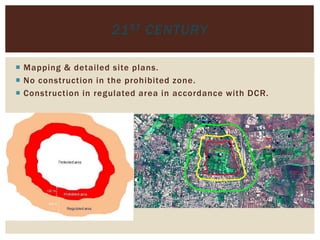
 Redefinition of 100m as prohibited zone & 100-300m as regulated
area around the monument.
 Categorization of monuments into 8 categories
 Framing of heritage bye-laws for each of the centrally protected
monument
21ST CENTURY
 Mapping & detailed site plans.
 No construction in the prohibited zone.
 Construction in regulated area in accordance with DCR.
21ST CENTURY
Various states have and proposed laws for the preservation of their
heritage
 Victoria Memorial Act, 1903
 Orissa Ancient Monuments and Preservation Act, 1956
 The Karnataka Ancient and Historical Monuments and Archaeological Sites and
Remains Act, 1961
 Salar Jung Museum Act, 1961
 Rajasthan Monuments, Archaeological Sites and Antiquities Act, 1961
 Tamil Nadu Ancient Monuments and Archaeological Sites and Remains Act, 1966
 The Madhya Pradesh Ancient Monuments and Archaeological Sites and Remains
Act, 1964
 The Hampi World Heritage Area Management Authority Act, 2002
STATE LEGISLATIONS
 http://www.livelaw.in/legal-aspects-heritage-india/
 http://asi.nic.in/asi_legislations.asp
SOURCE
THANK YOU

Conservation Acts & Legislation in India

  • 1.
    Seminar – 1 21stNov 2017 HERITAGE CONSERVATION ACTS & LEGISLATIONS RICHARD MANOHARAN M. ARCH (URBAN DESIGN) SCHOOL OF PLANNING & ARCHITECTURE, MYSORE
  • 2.
     UNESCO adopteda convention on the protection of the World’s Cultural and National Heritage on November 16, 1972.  It is also called World Heritage Convention GLOBAL
  • 3.
     States areobliged under Article 49 of the Indian Constitution,1951 to protect monuments and places and objects of national importance.  It is the duty of every citizen of India under Article 51A(f) of Indian Constitution, 1951 to value and preserve the rich heritage of our composite culture. OBLIGATIONS
  • 6.
     The firstever antiquarian legislation in India is known as Bengal Regulation XIX of 1810.  This was soon followed by another legislation called as Madras Regulation VII of 1817. Both these regulations vested the Government with a power to intervene whenever the public buildings were under threat of misuse. However, both the Acts were silent on the buildings under the private ownership.  The Act XX of 1863, was therefore enacted to empower the Government to prevent injury to and preserve buildings remarkable for their antiquity or for their historical or architectural value. EVOLUTION
  • 7.
     The IndianTreasure Trove Act, 1878 (Act No. VI of 1878) was promulgated to protect and preserve treasure found accidentally but had the archaeological and historical value.  This Act was enacted to protect and preserve such treasures and their lawful disposal. 19TH CENTURY
  • 8.
     In alandmark development in 1886, James Burgess, the then Director General succeeded in prevailing upon the Government for issuing directions: forbidding any person or agency to undertake excavation without prior consent of the Archaeological Survey and debarring officers from disposing of antiquities found or acquired without the permission of the Government. 19TH CENTURY
  • 9.
     The AncientMonuments Preservation Act, 1904 (Act No. VII of 1904), provided effective preservation and authority over the monument particularly those, which were under the custody of individual or private ownership. As this Act has not been repealed, it is deemed to be in force.  Next Act was The Antiquities Export Control Act, 1947 (Act No. XXXI of 1947) and Rules thereto which provided a regulation over the export of antiquities under a licence issued by the Director General and empowering him to decide whether any article, object or thing is or is not an antiquity for the purpose of the act and his decision was final. 20TH CENTURY
  • 10.
     In 1951,The Ancient and Historical Monuments and Archaeological Sites and Remains (Declaration of National Importance) Act, 1951 (No LXXI of 1951) was enacted.  Consequently, all the ancient and historical monuments and archaeological sites and remains protected earlier under ‘The Ancient Monuments Preservation Act, 1904’ (Act No. VII of 1904) were re-declared as monuments and archaeological sites of national importance under this Act.  Another four hundred and fifty monuments and sites of Part ‘B’ States were also added.  Some more monuments and archaeological sites were also declared as of national importance under Section 126 of the States Reorganization Act, 1956. 20TH CENTURY
  • 11.
     In orderto bring the Act on par with constitutional provisions and providing better and effective preservation to the archaeological wealth of the country, The Ancient Monuments and Archaeological Sites and Remains Act 1958 ( No 24 of 1958) was enacted on 28th August 1958.  This Act provides for the preservation of ancient and historical monuments and archaeological sites and remains of national importance, for the regulation of archaeological excavations and for the protection of sculptures, carvings and other like objects.  Subsequently, The Ancient Monuments and Archaeological Sites and Remains Rules 1959 were framed. The Act along with Rules came into force with effect from 15 October 1959.  This Act repealed The Ancient and Historical Monuments and Archaeological Sites and Remains (Declaration of National Importance) Act, 1951. 20TH CENTURY
  • 12.
     The Antiquitiesand Art Treasures Act 1972 ( No. 52 of 1972) is the latest Act enacted on 9th September 1972 for effective control over the moveable cultural property consisting of antiquities and art treasures .  The Act is to regulate the export trade in antiquities and art treasures, to provide for the prevention of smuggling of, and fraudulent dealings in, antiquities, to provide for the compulsory acquisition of antiquities and art treasures for preservation in public places and to provide for certain other matters connected therewith or incidental or ancillary thereto.  This Act was also supplemented with The Antiquities and Art Treasure Rules 1973. The Act and Rules have been in force with effect from 5th April 1976.  This legislation repealed The Antiquities Export Control Act, 1947 (Act No. XXXI of 1947). 20TH CENTURY
  • 13.
     Central Governmentproposed National Commission for Heritage Sites Bill in 2009 to comply with the World Heritage Convention.  This commission will recommend short term, long term policies to the state and central government, conduct research and studies, publish periodically heritage maps, make list of heritage sited for nominations, make periodical reports etc.  Present bill was withdrawn in 2015 after having recommendations of various committees and stakeholders. 21ST CENTURY
  • 14.
     The AncientMonuments and Archaeological Sites and Remains Act, 2010  Establishment of National Monuments Authority on 11th Nov 2011  Redefinition of 100m as prohibited zone & 100-300m as regulated area around the monument.  Categorization of monuments into 8 categories  Framing of heritage bye-laws for each of the centrally protected monument 21ST CENTURY
  • 15.
     Mapping &detailed site plans.  No construction in the prohibited zone.  Construction in regulated area in accordance with DCR. 21ST CENTURY
  • 16.
    Various states haveand proposed laws for the preservation of their heritage  Victoria Memorial Act, 1903  Orissa Ancient Monuments and Preservation Act, 1956  The Karnataka Ancient and Historical Monuments and Archaeological Sites and Remains Act, 1961  Salar Jung Museum Act, 1961  Rajasthan Monuments, Archaeological Sites and Antiquities Act, 1961  Tamil Nadu Ancient Monuments and Archaeological Sites and Remains Act, 1966  The Madhya Pradesh Ancient Monuments and Archaeological Sites and Remains Act, 1964  The Hampi World Heritage Area Management Authority Act, 2002 STATE LEGISLATIONS
  • 17.
  • 18.