Conquering Tough Challenges
for More Effective Emergency Notification

Robert C. Chandler, Ph.D.
Director, Nicholson School of Communication
About Everbridge
•   Leader in incident notification systems

•   Fast-growing global company with
    more than 1,000 clients in more
    than 100 countries

•   Serve the Global 2000, healthcare
    systems, state and local government,
    federal government, military, financial
    services firms, and universities

•   100% focused on incident notification
    solutions that merge technology
    and expertise


                                              3
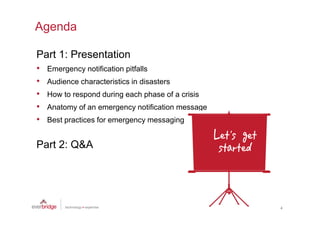
Agenda

Part 1: Presentation
•   Emergency notification pitfalls
•   Audience characteristics in disasters
•   How to respond during each phase of a crisis
•   Anatomy of an emergency notification message
•   Best practices for emergency messaging


Part 2: Q&A


                                                   4
Note:
Q&A   slides are currently
      available to everyone on
      blog.everbridge.com


         Use the
         Q&A
         function to
         submit
         your
         questions.

                            5
Conquering Tough
       Challenges for Effective
Bracing for the 2010
       Emergency Notification
Hurricane Season
       Dr. Robert Chandler
       University of Central Florida
The crux of the notification challenge


     Contacting the right people at the
     right time with the right message
     is the basic challenge for effective
     emergency notification.

                         Dr. Robert C. Chandler
                      Emergency Communication
                                   (2010) p.153
Expectations for notification

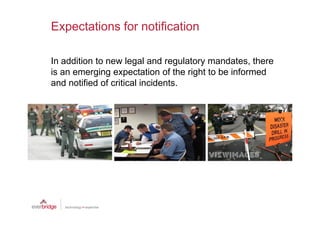
In addition to new legal and regulatory mandates, there
is an emerging expectation of the right to be informed
and notified of critical incidents.
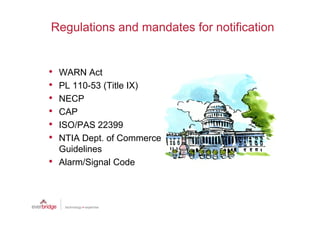
Regulations and mandates for notification


•   WARN Act
•   PL 110-53 (Title IX)
•   NECP
•   CAP
•   ISO/PAS 22399
•   NTIA Dept. of Commerce
    Guidelines
•   Alarm/Signal Code
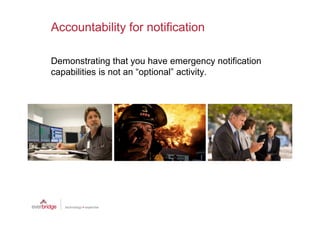
Accountability for notification

Demonstrating that you have emergency notification
capabilities is not an “optional” activity.
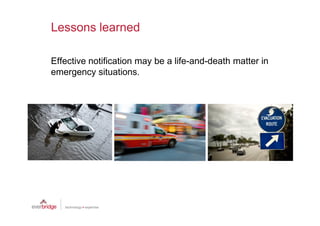
Lessons learned

Effective notification may be a life-and-death matter in
emergency situations.
New tools for notification

•   New communication technologies
•   High-mobility communication modalities
•   More connections and “channels”
•   Multi-channel and high redundancy media
•   Simple and effective dissemination vehicles
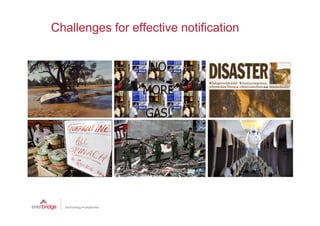
Challenges for effective notification
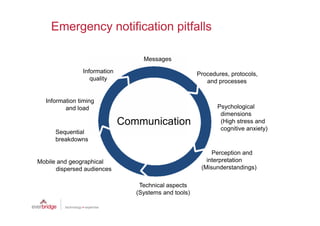
Emergency notification pitfalls

                                  Messages

               Information                            Procedures, protocols,
                  quality                                and processes


  Information timing
         and load                                            Psychological
                                                              dimensions
                             Communication                    (High stress and
                                                              cognitive anxiety)
      Sequential
      breakdowns

                                                           Perception and
Mobile and geographical                                  interpretation
      dispersed audiences                              (Misunderstandings)

                                 Technical aspects
                                (Systems and tools)
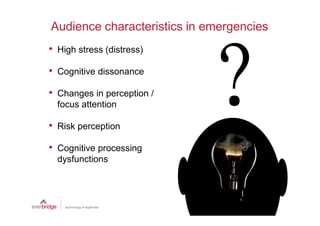
Audience characteristics in emergencies
•   High stress (distress)

•   Cognitive dissonance

•   Changes in perception /
    focus attention

•   Risk perception

•   Cognitive processing
    dysfunctions
Major implications for
incident notification planning
•   Communication goals and objectives

•   Audience analysis: Communication/information needs

•   Six Stages of the Crisis: Communication for the
    contexts of a crisis or disaster

•   Organizing communication planning into each of the six
    stages

•   Identifying target audiences/messages/timing
    sequences
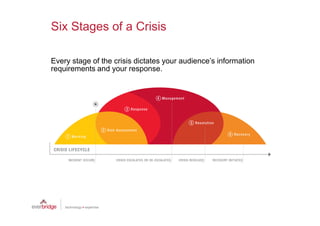
Six Stages of a Crisis

Every stage of the crisis dictates your audience’s information
requirements and your response.
Best practices for emergency messaging

• Optimal redundancy:
  Routine communication systems are usually
  inadequate for emergency communication needs.

• Procedures:
  It is necessary to establish, implement, and maintain
  procedures to swiftly and accurately disseminate
  alerts, information, and notification messages to the
  target audience.

• Dependable internal communication:
  Ensure reliable internal communication between the
  various levels and functions within your organization
  and with external partners.
Best practices for emergency messaging

• Emergency notification - messages:
  Demonstrate and validate capability to quickly and
  decisively warn those impacted by an emergency.

• Documentation:
  Document what was known when, specific steps
  taken, language and messages used, and the
  means used to notify all audiences.

• Communication center:
  Establish a central communication hub for emergency
  communication.
Best practices for emergency messaging

• Comprehensive communication plan:
  Outline basic decisions about what will be
  communicated, when, how, and to whom.

• Advance planning for emergency communication:
  Create, test, and revise a communication strategy
  and game plan well in advance of an emergency
  situation. Verify contact database. Prepare target
  audiences in advance.

• Know your audience(s):
  It is important to validate and confirm message
  effectiveness and periodically test emergency notification
  systems to demonstrate reliability.
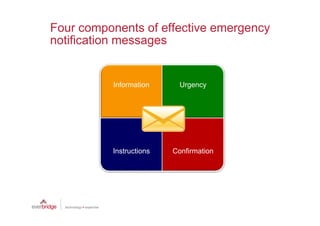
Four components of effective emergency
notification messages


          Information          Urgency


                     Message


          Instructions    Confirmation
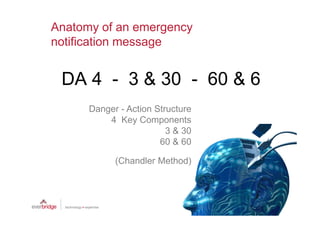
Anatomy of an emergency
notification message


 DA 4 - 3 & 30 - 60 & 6
      Danger - Action Structure
          4 Key Components
                         3 & 30
                       60 & 60

            (Chandler Method)
More effective emergency notification
messages
• Include all four message components
    1. Inform
    2. Express urgency
    3. Provide specific behavioral instructions
    4. Give the next step – confirmation/reply, etc.
•   Front-load key information into the first 30 words/30 seconds
•   Write messages at or below a 6th-grade reading level
•   Write messages using readability ease rules
•   Be sensitive to the needs of different demographic groups
    including languages, co-cultural groups, needs agenda, etc.
Incident Notification

Marc Ladin
Chief Marketing Officer, Everbridge


                                      24
Incident notification solutions address
common communication challenges

• Communicate quickly, easily, and      • Reduce miscommunications and
 efficiently with large numbers of       control rumors with accurate,
 people in minutes, not hours, making    consistent messages
 sure that the lines of communication
 are open
                                        • Satisfy regulatory requirements
• Use all contact paths to reach         with extensive and complete
 constituents wherever they are          reporting of communication attempts
                                         and two-way acknowledgements
• Ensure two-way communications          from recipients
 to get feedback from message
 receivers


                                                                            25
Key evaluation criteria for an
incident notification system

• Experience and expertise

• Ease of use

• Ease of integration


                                 26
Missed anything?
Q&A   Slides are currently
      available on
      blog.everbridge.com


        Use the
        Q&A
        function to
        submit
        your
        questions.
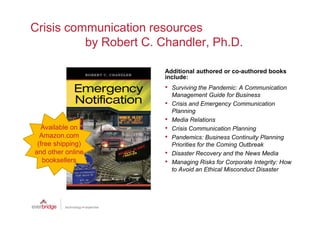
Crisis communication resources
          by Robert C. Chandler, Ph.D.

                        Additional authored or co-authored books
                        include:
                        •   Surviving the Pandemic: A Communication
                            Management Guide for Business
                        •   Crisis and Emergency Communication
                            Planning
                        •   Media Relations
   Available on         •   Crisis Communication Planning
  Amazon.com            •   Pandemics: Business Continuity Planning
 (free shipping)            Priorities for the Coming Outbreak
and other online        •   Disaster Recovery and the News Media
   booksellers          •   Managing Risks for Corporate Integrity: How
                            to Avoid an Ethical Misconduct Disaster
Communication
Contact information         resources
                            White papers, literature, case studies
                            www.everbridge.com/resources

Robert C. Chandler, Ph.D.   Upcoming webinars:
                            • System Demo (October 26)
rcchandl@mail.ucf.edu       • Message Maps (November 9)
                            www.everbridge.com/webinars
1.407.823.2681
                            Follow us:

                                 blog.everbridge.com
                                 twitter.com/everbridge
Marc Ladin                       facebook.com/everbridgeinc
                                youtube.com/user/everbridge
marc.ladin@everbridge.com
1.818.230.9700


                                  Reminder
                                  Everbridge Insights webinars
                                  qualify for Continuing Education
                                  Activity Points (CEAPs) for DRII
                                  certifications. Visit www.drii.org
                                  to register your credit.
                                  Item Number (Schedule II): 26.3
                                  Activity Group: A
                                  1 Point for each webinar

Conquering Tough Challenges for More Effective Emergency Notification

  • 1.
    Conquering Tough Challenges forMore Effective Emergency Notification Robert C. Chandler, Ph.D. Director, Nicholson School of Communication
  • 2.
    About Everbridge • Leader in incident notification systems • Fast-growing global company with more than 1,000 clients in more than 100 countries • Serve the Global 2000, healthcare systems, state and local government, federal government, military, financial services firms, and universities • 100% focused on incident notification solutions that merge technology and expertise 3
  • 3.
    Agenda Part 1: Presentation • Emergency notification pitfalls • Audience characteristics in disasters • How to respond during each phase of a crisis • Anatomy of an emergency notification message • Best practices for emergency messaging Part 2: Q&A 4
  • 4.
    Note: Q&A slides are currently available to everyone on blog.everbridge.com Use the Q&A function to submit your questions. 5
  • 5.
    Conquering Tough Challenges for Effective Bracing for the 2010 Emergency Notification Hurricane Season Dr. Robert Chandler University of Central Florida
  • 6.
    The crux ofthe notification challenge Contacting the right people at the right time with the right message is the basic challenge for effective emergency notification. Dr. Robert C. Chandler Emergency Communication (2010) p.153
  • 7.
    Expectations for notification Inaddition to new legal and regulatory mandates, there is an emerging expectation of the right to be informed and notified of critical incidents.
  • 8.
    Regulations and mandatesfor notification • WARN Act • PL 110-53 (Title IX) • NECP • CAP • ISO/PAS 22399 • NTIA Dept. of Commerce Guidelines • Alarm/Signal Code
  • 9.
    Accountability for notification Demonstratingthat you have emergency notification capabilities is not an “optional” activity.
  • 10.
    Lessons learned Effective notificationmay be a life-and-death matter in emergency situations.
  • 11.
    New tools fornotification • New communication technologies • High-mobility communication modalities • More connections and “channels” • Multi-channel and high redundancy media • Simple and effective dissemination vehicles
  • 12.
  • 13.
    Emergency notification pitfalls Messages Information Procedures, protocols, quality and processes Information timing and load Psychological dimensions Communication (High stress and cognitive anxiety) Sequential breakdowns Perception and Mobile and geographical interpretation dispersed audiences (Misunderstandings) Technical aspects (Systems and tools)
  • 14.
    Audience characteristics inemergencies • High stress (distress) • Cognitive dissonance • Changes in perception / focus attention • Risk perception • Cognitive processing dysfunctions
  • 15.
    Major implications for incidentnotification planning • Communication goals and objectives • Audience analysis: Communication/information needs • Six Stages of the Crisis: Communication for the contexts of a crisis or disaster • Organizing communication planning into each of the six stages • Identifying target audiences/messages/timing sequences
  • 16.
    Six Stages ofa Crisis Every stage of the crisis dictates your audience’s information requirements and your response.
  • 17.
    Best practices foremergency messaging • Optimal redundancy: Routine communication systems are usually inadequate for emergency communication needs. • Procedures: It is necessary to establish, implement, and maintain procedures to swiftly and accurately disseminate alerts, information, and notification messages to the target audience. • Dependable internal communication: Ensure reliable internal communication between the various levels and functions within your organization and with external partners.
  • 18.
    Best practices foremergency messaging • Emergency notification - messages: Demonstrate and validate capability to quickly and decisively warn those impacted by an emergency. • Documentation: Document what was known when, specific steps taken, language and messages used, and the means used to notify all audiences. • Communication center: Establish a central communication hub for emergency communication.
  • 19.
    Best practices foremergency messaging • Comprehensive communication plan: Outline basic decisions about what will be communicated, when, how, and to whom. • Advance planning for emergency communication: Create, test, and revise a communication strategy and game plan well in advance of an emergency situation. Verify contact database. Prepare target audiences in advance. • Know your audience(s): It is important to validate and confirm message effectiveness and periodically test emergency notification systems to demonstrate reliability.
  • 20.
    Four components ofeffective emergency notification messages Information Urgency Message Instructions Confirmation
  • 21.
    Anatomy of anemergency notification message DA 4 - 3 & 30 - 60 & 6 Danger - Action Structure 4 Key Components 3 & 30 60 & 60 (Chandler Method)
  • 22.
    More effective emergencynotification messages • Include all four message components 1. Inform 2. Express urgency 3. Provide specific behavioral instructions 4. Give the next step – confirmation/reply, etc. • Front-load key information into the first 30 words/30 seconds • Write messages at or below a 6th-grade reading level • Write messages using readability ease rules • Be sensitive to the needs of different demographic groups including languages, co-cultural groups, needs agenda, etc.
  • 23.
    Incident Notification Marc Ladin ChiefMarketing Officer, Everbridge 24
  • 24.
    Incident notification solutionsaddress common communication challenges • Communicate quickly, easily, and • Reduce miscommunications and efficiently with large numbers of control rumors with accurate, people in minutes, not hours, making consistent messages sure that the lines of communication are open • Satisfy regulatory requirements • Use all contact paths to reach with extensive and complete constituents wherever they are reporting of communication attempts and two-way acknowledgements • Ensure two-way communications from recipients to get feedback from message receivers 25
  • 25.
    Key evaluation criteriafor an incident notification system • Experience and expertise • Ease of use • Ease of integration 26
  • 26.
    Missed anything? Q&A Slides are currently available on blog.everbridge.com Use the Q&A function to submit your questions.
  • 27.
    Crisis communication resources by Robert C. Chandler, Ph.D. Additional authored or co-authored books include: • Surviving the Pandemic: A Communication Management Guide for Business • Crisis and Emergency Communication Planning • Media Relations Available on • Crisis Communication Planning Amazon.com • Pandemics: Business Continuity Planning (free shipping) Priorities for the Coming Outbreak and other online • Disaster Recovery and the News Media booksellers • Managing Risks for Corporate Integrity: How to Avoid an Ethical Misconduct Disaster
  • 28.
    Communication Contact information resources White papers, literature, case studies www.everbridge.com/resources Robert C. Chandler, Ph.D. Upcoming webinars: • System Demo (October 26) rcchandl@mail.ucf.edu • Message Maps (November 9) www.everbridge.com/webinars 1.407.823.2681 Follow us: blog.everbridge.com twitter.com/everbridge Marc Ladin facebook.com/everbridgeinc youtube.com/user/everbridge marc.ladin@everbridge.com 1.818.230.9700 Reminder Everbridge Insights webinars qualify for Continuing Education Activity Points (CEAPs) for DRII certifications. Visit www.drii.org to register your credit. Item Number (Schedule II): 26.3 Activity Group: A 1 Point for each webinar

Editor's Notes

  • #3 October 27, 2005
  • #8 October 27, 2005
  • #9 There is an emerging expectation of the right to be informed. Senior management and security personnel are being held directly accountable for sustaining effective emergency communication.
  • #11 There is an emerging expectation of the right to be informed. Senior management and security personnel are being held directly accountable for sustaining effective emergency communication.
  • #12 October 27, 2005
  • #13 October 27, 2005
  • #16 October 27, 2005
  • #17 October 27, 2005
  • #23 October 27, 2005