Crisis Management and
Effective Messaging
Dr. Robert C. Chandler
Director, Nicholson School of Communication
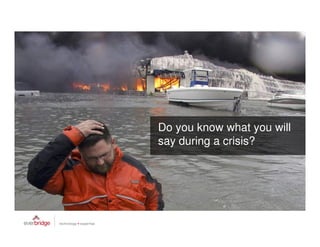
Do you know what you will
say during a crisis?
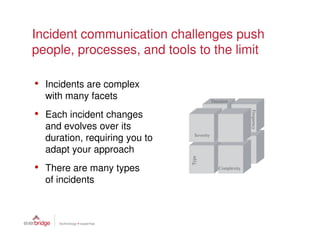
Incident communication challenges push
people, processes, and tools to the limit

• Incidents are complex
  with many facets                         Duration


• Each incident changes


                                                           Frequency
                                                           Frequency
  and evolves over its
                                Severity
  duration, requiring you to
  adapt your approach


                               Type
• There are many types                        Complexity

  of incidents
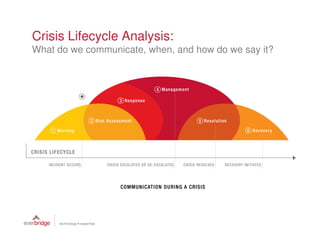
Crisis Lifecycle Analysis:
What do we communicate, when, and how do we say it?
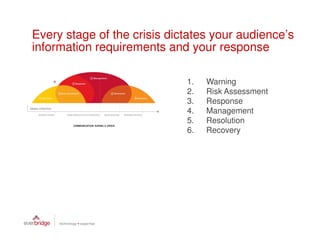
Every stage of the crisis dictates your audience’s
information requirements and your response

                             1.   Warning
                             2.   Risk Assessment
                             3.   Response
                             4.   Management
                             5.   Resolution
                             6.   Recovery
1     Warning


• Communication is often precautionary and intended to
  heighten awareness

• Certain incident types have very distinct warning
  phases
    Examples: Hurricanes, snowstorms

• Other incidents have no warning periods or very
  subtle warning signs that often go unnoticed
    Examples: Power outages, workplace violence,
    earthquakes
2      Risk Assessment


• Communication is geared toward assembling the right people
    to determine how to handle the situation

• Focus on “internal” communication – your team, your people,
    and your resources

• In the moments after an incident occurs and/or is reported,
    the crisis response team activates the organization’s
    emergency response plan

• Communications are sent only to decision-makers during
    risk assessment. “Public” communications occur during
    the response phase
2              Risk Assessment
Part 1: Six Stages of a Communication Crisis


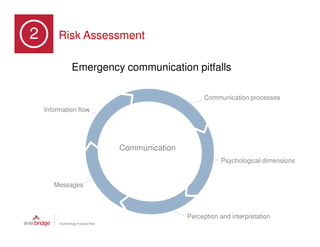
                        Emergency communication pitfalls

                                                                    Communication processes
          Information flow


                                               Communication
                                                                          Psychological dimensions


               Messages


                                                               Perception and interpretation
2              Risk Assessment
Part 1: Six Stages of a Communication Crisis


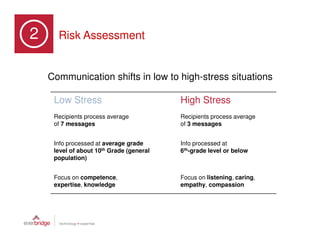
            Communication shifts in low to high-stress situations

               Low Stress                           High Stress
               Recipients process average           Recipients process average
               of 7 messages                        of 3 messages


               Info processed at average grade      Info processed at
               level of about 10th Grade (general   6th-grade level or below
               population)


               Focus on competence,                 Focus on listening, caring,
               expertise, knowledge                 empathy, compassion
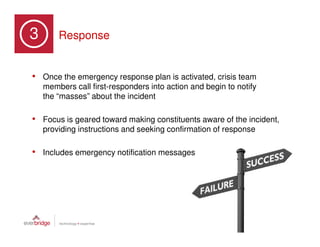
3       Response


• Once the emergency response plan is activated, crisis team
    members call first-responders into action and begin to notify
    the “masses” about the incident

• Focus is geared toward making constituents aware of the incident,
    providing instructions and seeking confirmation of response

• Includes emergency notification messages
3              Response
Part 2: Six Stages of a Communication Crisis


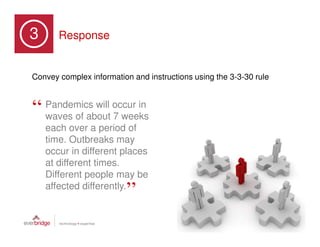
    Convey complex information and instructions using the 3-3-30 rule


    “      Pandemics will occur in
           waves of about 7 weeks
           each over a period of
           time. Outbreaks may
           occur in different places
           at different times.
           Different people may be
           affected differently.
                                               ”
4       Management

• Crisis either moves toward resolution or gets worse with
    deepening layers of complexity

• Organizations must respond differently according to
    the progression of the crisis

• Organizations must provide regular status updates to their various
    audiences, change or add to previous instructions, control rumors,
    and conference with leadership and responder teams

• Course correction may be needed to respond to changes
    in the situation
4              Management
Part 2: Six Stages of a Communication Crisis


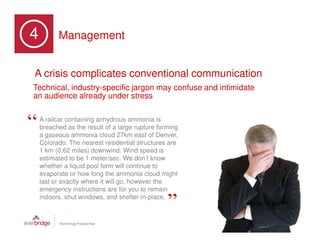
      A crisis complicates conventional communication
     Technical, industry-specific jargon may confuse and intimidate
     an audience already under stress


  “     A railcar containing anhydrous ammonia is
        breached as the result of a large rupture forming
        a gaseous ammonia cloud 27km east of Denver,
        Colorado. The nearest residential structures are
        1 km (0.62 miles) downwind. Wind speed is
        estimated to be 1 meter/sec. We don’t know
        whether a liquid pool form will continue to
        evaporate or how long the ammonia cloud might
        last or exactly where it will go, however the
        emergency instructions are for you to remain
        indoors, shut windows, and shelter-in-place.
                                                     ”
4              Management
Part 2: Six Stages of a Communication Crisis


       “     A railcar has ruptured that has
             released dangerous gas east of
             Denver, Colorado. Please remain
             indoors, shut your windows. Turn off
             your air conditioning and wait for
             further instructions.
                                               ”
5               Resolution
Part 3: Six Stages of a Crisis


      • Once the crisis has been resolved and is drawing to
            conclusion, crisis team members communicate that
            resolution to all audiences in the form of all-clear alerts
            and messages of reassurance.
      •     Indicate status return to “normalcy”
      •     Closure
      •     Indicate transition to “recovery”
      •     Recall or demobilize emergency response or
            management protocols and procedures
      • Change (transfer) of command authority or structure
5      Resolution

•   Who to communicate with: Target audiences who have been actively impacted
    by the management of the crisis; constituents and stakeholders; emergency
    responding personnel; assigned individuals, agencies, and teams that will take
    charge of the operational recovery phase

•   Critical factors to consider: Psychological and cognitive issues; lingering
    confusion and misinformation “pockets”; sequential communication delays,
    breakdowns, and “information ripples”

•   How to communicate: both PUSH and PULL measures; multiple (direct and
    indirect) channels; both PUSH and PULL measures; multiple (direct and
    indirect) channels; and source credibility (authority)

•   What to communicate: Simple declarative closure measures; change of status,
    transition; information on anticipated recovery steps; how to obtain resources or
    additional information – reassurance, confidence, and stability are all important
    meta-message aspects to communicate
6               Recovery
Part 3: Six Stages of a Crisis


       • Goal of this stage is to convert this turning point into opportunity
       • Focus on healing and getting back to normal
       • Communication revolves around post-crisis counseling,
             a return to pre-crisis policies and operations
       • Offer relief, celebration, acknowledgement for getting
             through the event
       • Instill trust and confidence with your audience
       • Acknowledge short comings and how they will be
             rectified in the future
       • Damages, losses and costs are examined and analyzed, and planned
             recovery strategies are evaluated, modified and executed
6               Recovery
Part 3: Six Stages of a Crisis


       • Who to communicate with:
               • Affected target audiences
               • Constituents and stakeholders
               • Assigned individuals, agencies, and teams in charge

       • Critical factors to consider:
               •     Coordinated communication management
               •     Prevention of rumors and misinformation
               •     Avoiding inefficiencies and breakdowns and
               •     Getting thing back to “business as usual”
6                 Recovery
Part 3: Six Stages of a Crisis


         • How to communicate:
                 • Use both PUSH and PULL measures
                 • Use multiple (direct and indirect) channels

         • What to communicate:
                 •    Focus on operational (pragmatic) information
                 •    Keep alert for changed circumstances and people
                 •    Explanation and post-event analysis
                 •    Beware of blaming or negative focus
                 •    Communicate changes in policies, procedures, and
                      facilities that are being implemented
Communication
Contact information         resources
                            White papers, literature, case studies
                            www.everbridge.com/resources


                                 blog.everbridge.com
                                 twitter.com/everbridge
                                 facebook.com/everbridgeinc
                                youtube.com/user/everbridge
Robert C. Chandler, Ph.D.
rcchandl@mail.ucf.edu
1.407.823.2681
Communication
Contact information                             resources
                                                White papers, literature, case studies
                                                www.everbridge.com/resources


Ellen Rollins                                        blog.everbridge.com
                                                     twitter.com/everbridge
Senior Account Manager                               facebook.com/everbridgeinc
ellen.rollins@everbridge.com                        youtube.com/user/everbridge
760.644.8403

Francis Willett
Director, Services Delivery
francis.willett@everbridge.com
818.230.9512

Hank Nowak                         Rory Peters
Director, Federal Services Group   Training & Education Service Manager
hank.nowak@everbridge.com          rory.peters@everbridge.com
267.222.8385                       818.230.9755

Crisis Management and Effective Messaging - Federal

  • 1.
    Crisis Management and EffectiveMessaging Dr. Robert C. Chandler Director, Nicholson School of Communication
  • 2.
    Do you knowwhat you will say during a crisis?
  • 3.
    Incident communication challengespush people, processes, and tools to the limit • Incidents are complex with many facets Duration • Each incident changes Frequency Frequency and evolves over its Severity duration, requiring you to adapt your approach Type • There are many types Complexity of incidents
  • 4.
    Crisis Lifecycle Analysis: Whatdo we communicate, when, and how do we say it?
  • 5.
    Every stage ofthe crisis dictates your audience’s information requirements and your response 1. Warning 2. Risk Assessment 3. Response 4. Management 5. Resolution 6. Recovery
  • 6.
    1 Warning • Communication is often precautionary and intended to heighten awareness • Certain incident types have very distinct warning phases Examples: Hurricanes, snowstorms • Other incidents have no warning periods or very subtle warning signs that often go unnoticed Examples: Power outages, workplace violence, earthquakes
  • 7.
    2 Risk Assessment • Communication is geared toward assembling the right people to determine how to handle the situation • Focus on “internal” communication – your team, your people, and your resources • In the moments after an incident occurs and/or is reported, the crisis response team activates the organization’s emergency response plan • Communications are sent only to decision-makers during risk assessment. “Public” communications occur during the response phase
  • 8.
    2 Risk Assessment Part 1: Six Stages of a Communication Crisis Emergency communication pitfalls Communication processes Information flow Communication Psychological dimensions Messages Perception and interpretation
  • 9.
    2 Risk Assessment Part 1: Six Stages of a Communication Crisis Communication shifts in low to high-stress situations Low Stress High Stress Recipients process average Recipients process average of 7 messages of 3 messages Info processed at average grade Info processed at level of about 10th Grade (general 6th-grade level or below population) Focus on competence, Focus on listening, caring, expertise, knowledge empathy, compassion
  • 10.
    3 Response • Once the emergency response plan is activated, crisis team members call first-responders into action and begin to notify the “masses” about the incident • Focus is geared toward making constituents aware of the incident, providing instructions and seeking confirmation of response • Includes emergency notification messages
  • 11.
    3 Response Part 2: Six Stages of a Communication Crisis Convey complex information and instructions using the 3-3-30 rule “ Pandemics will occur in waves of about 7 weeks each over a period of time. Outbreaks may occur in different places at different times. Different people may be affected differently. ”
  • 12.
    4 Management • Crisis either moves toward resolution or gets worse with deepening layers of complexity • Organizations must respond differently according to the progression of the crisis • Organizations must provide regular status updates to their various audiences, change or add to previous instructions, control rumors, and conference with leadership and responder teams • Course correction may be needed to respond to changes in the situation
  • 13.
    4 Management Part 2: Six Stages of a Communication Crisis A crisis complicates conventional communication Technical, industry-specific jargon may confuse and intimidate an audience already under stress “ A railcar containing anhydrous ammonia is breached as the result of a large rupture forming a gaseous ammonia cloud 27km east of Denver, Colorado. The nearest residential structures are 1 km (0.62 miles) downwind. Wind speed is estimated to be 1 meter/sec. We don’t know whether a liquid pool form will continue to evaporate or how long the ammonia cloud might last or exactly where it will go, however the emergency instructions are for you to remain indoors, shut windows, and shelter-in-place. ”
  • 14.
    4 Management Part 2: Six Stages of a Communication Crisis “ A railcar has ruptured that has released dangerous gas east of Denver, Colorado. Please remain indoors, shut your windows. Turn off your air conditioning and wait for further instructions. ”
  • 15.
    5 Resolution Part 3: Six Stages of a Crisis • Once the crisis has been resolved and is drawing to conclusion, crisis team members communicate that resolution to all audiences in the form of all-clear alerts and messages of reassurance. • Indicate status return to “normalcy” • Closure • Indicate transition to “recovery” • Recall or demobilize emergency response or management protocols and procedures • Change (transfer) of command authority or structure
  • 16.
    5 Resolution • Who to communicate with: Target audiences who have been actively impacted by the management of the crisis; constituents and stakeholders; emergency responding personnel; assigned individuals, agencies, and teams that will take charge of the operational recovery phase • Critical factors to consider: Psychological and cognitive issues; lingering confusion and misinformation “pockets”; sequential communication delays, breakdowns, and “information ripples” • How to communicate: both PUSH and PULL measures; multiple (direct and indirect) channels; both PUSH and PULL measures; multiple (direct and indirect) channels; and source credibility (authority) • What to communicate: Simple declarative closure measures; change of status, transition; information on anticipated recovery steps; how to obtain resources or additional information – reassurance, confidence, and stability are all important meta-message aspects to communicate
  • 17.
    6 Recovery Part 3: Six Stages of a Crisis • Goal of this stage is to convert this turning point into opportunity • Focus on healing and getting back to normal • Communication revolves around post-crisis counseling, a return to pre-crisis policies and operations • Offer relief, celebration, acknowledgement for getting through the event • Instill trust and confidence with your audience • Acknowledge short comings and how they will be rectified in the future • Damages, losses and costs are examined and analyzed, and planned recovery strategies are evaluated, modified and executed
  • 18.
    6 Recovery Part 3: Six Stages of a Crisis • Who to communicate with: • Affected target audiences • Constituents and stakeholders • Assigned individuals, agencies, and teams in charge • Critical factors to consider: • Coordinated communication management • Prevention of rumors and misinformation • Avoiding inefficiencies and breakdowns and • Getting thing back to “business as usual”
  • 19.
    6 Recovery Part 3: Six Stages of a Crisis • How to communicate: • Use both PUSH and PULL measures • Use multiple (direct and indirect) channels • What to communicate: • Focus on operational (pragmatic) information • Keep alert for changed circumstances and people • Explanation and post-event analysis • Beware of blaming or negative focus • Communicate changes in policies, procedures, and facilities that are being implemented
  • 20.
    Communication Contact information resources White papers, literature, case studies www.everbridge.com/resources blog.everbridge.com twitter.com/everbridge facebook.com/everbridgeinc youtube.com/user/everbridge Robert C. Chandler, Ph.D. rcchandl@mail.ucf.edu 1.407.823.2681
  • 21.
    Communication Contact information resources White papers, literature, case studies www.everbridge.com/resources Ellen Rollins blog.everbridge.com twitter.com/everbridge Senior Account Manager facebook.com/everbridgeinc ellen.rollins@everbridge.com youtube.com/user/everbridge 760.644.8403 Francis Willett Director, Services Delivery francis.willett@everbridge.com 818.230.9512 Hank Nowak Rory Peters Director, Federal Services Group Training & Education Service Manager hank.nowak@everbridge.com rory.peters@everbridge.com 267.222.8385 818.230.9755