Effective Messages and Message
Mapping
Dr. Robert C. Chandler
Director, Nicholson School of Communication
Agenda

• Effective Messages
• The latest rules for message mapping
• Must-have tools for creating messages
• Why formalized, planned communication
  is vital to emergency preparedness


                                          2
The challenges: Communication
(Just a few…)

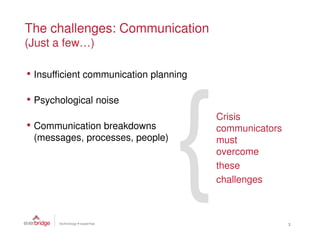
• Insufficient communication planning

• Psychological noise
                                        Crisis
• Communication breakdowns              communicators
 (messages, processes, people)          must
                                        overcome
                                        these
                                        challenges


                                                        3
The challenges: Recipient / Message

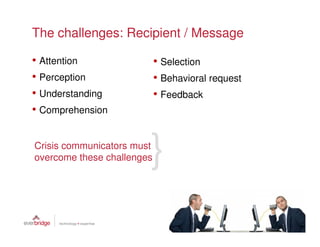
• Attention                 • Selection
• Perception                • Behavioral request
• Understanding             • Feedback
• Comprehension


                        }
Crisis communicators must
overcome these challenges
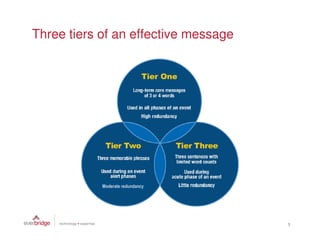
Three tiers of an effective message


            Moderate redundancy


                                      5
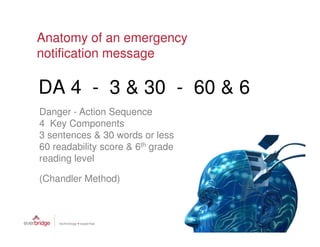
Anatomy of an emergency
notification message

DA 4 - 3 & 30 - 60 & 6
Danger - Action Sequence
4 Key Components
3 sentences & 30 words or less
60 readability score & 6th grade
reading level

(Chandler Method)
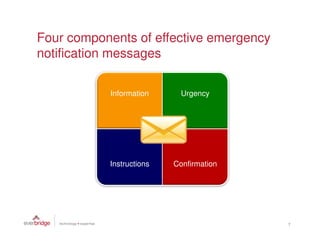
Four components of effective emergency
notification messages

           Information          Urgency


                      Message


           Instructions    Confirmation


                                          7
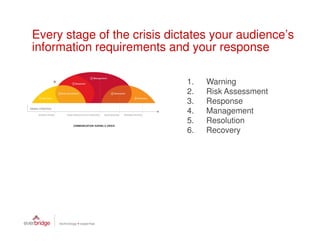
Every stage of the crisis dictates your audience’s
information requirements and your response

                             1.   Warning
                             2.   Risk Assessment
                             3.   Response
                             4.   Management
                             5.   Resolution
                             6.   Recovery
The solution: Message Maps
What are Message Maps?
  • A database of messages in predictable
    sequences (templates, sample wording, etc.)
  • Checklist of important messages, audiences,
    etc. to serve as roadmap for communicating
  • Clear, concise messages created in advance of
    an incident that simplify complex concepts and
    improve communication during chaos
  • Useful before, during, and after an incident as
    well as for routine and on-going communication


                                                      9
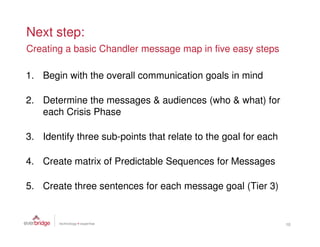
Next step:
Creating a basic Chandler message map in five easy steps

1. Begin with the overall communication goals in mind

2. Determine the messages & audiences (who & what) for
   each Crisis Phase

3. Identify three sub-points that relate to the goal for each

4. Create matrix of Predictable Sequences for Messages

5. Create three sentences for each message goal (Tier 3)


                                                                10
Basic message mapping tools

• Stock templates
• Word choices
   •   Keyword lists
   •   Lexicon
   •   Thesaurus

• Goals and strategies


                              11
Message matrices

• Who / what / how of messages

• How to build a message matrix
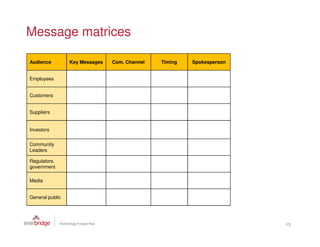
Message matrices

Audience         Key Messages   Com. Channel   Timing   Spokesperson


Employees


Customers


Suppliers


Investors


Community
Leaders

Regulators,
government

Media


General public


                                                                       13
Next step:
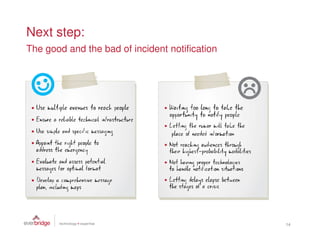
The good and the bad of incident notification


                                                14
Effective communication strategies

•   Be first, be right, be credible
•   Acknowledge with empathy
•   Explain and inform about risk
•   Describe what you know, don’t know,
    and what you’re doing about it
• Commit to continued communication
• Keep communication channels open


                                          15
Always remember

• Nothing can destroy hard-earned
 credibility more quickly than failure
 to communicate well in a crisis

• The message you send represents
 everyone in your organization from the
 governor to the on-scene responders

• Only quick, confident, actionable, and
 easily understandable communications
 will ensure your constituents’ life-safety
Communication
Contact information         resources
                            White papers, literature, case studies
                            www.everbridge.com/resources


                                 blog.everbridge.com
                                 twitter.com/everbridge
                                 facebook.com/everbridgeinc
                                youtube.com/user/everbridge
Robert C. Chandler, Ph.D.
rcchandl@mail.ucf.edu
1.407.823.2681
Communication
Contact information                             resources
                                                White papers, literature, case studies
                                                www.everbridge.com/resources


Ellen Rollins                                        blog.everbridge.com
                                                     twitter.com/everbridge
Senior Account Manager                               facebook.com/everbridgeinc
ellen.rollins@everbridge.com                        youtube.com/user/everbridge
760.644.8403

Francis Willett
Director, Services Delivery
francis.willett@everbridge.com
818.230.9512

Hank Nowak                         Rory Peters
Director, Federal Services Group   Training & Education Service Manager
hank.nowak@everbridge.com          rory.peters@everbridge.com
267.222.8385                       818.230.9755

Effective Messages and Message Mapping - Federal

  • 1.
    Effective Messages andMessage Mapping Dr. Robert C. Chandler Director, Nicholson School of Communication
  • 2.
    Agenda • Effective Messages •The latest rules for message mapping • Must-have tools for creating messages • Why formalized, planned communication is vital to emergency preparedness 2
  • 3.
    The challenges: Communication (Justa few…) • Insufficient communication planning • Psychological noise Crisis • Communication breakdowns communicators (messages, processes, people) must overcome these challenges 3
  • 4.
    The challenges: Recipient/ Message • Attention • Selection • Perception • Behavioral request • Understanding • Feedback • Comprehension } Crisis communicators must overcome these challenges
  • 5.
    Three tiers ofan effective message Moderate redundancy 5
  • 6.
    Anatomy of anemergency notification message DA 4 - 3 & 30 - 60 & 6 Danger - Action Sequence 4 Key Components 3 sentences & 30 words or less 60 readability score & 6th grade reading level (Chandler Method)
  • 7.
    Four components ofeffective emergency notification messages Information Urgency Message Instructions Confirmation 7
  • 8.
    Every stage ofthe crisis dictates your audience’s information requirements and your response 1. Warning 2. Risk Assessment 3. Response 4. Management 5. Resolution 6. Recovery
  • 9.
    The solution: MessageMaps What are Message Maps? • A database of messages in predictable sequences (templates, sample wording, etc.) • Checklist of important messages, audiences, etc. to serve as roadmap for communicating • Clear, concise messages created in advance of an incident that simplify complex concepts and improve communication during chaos • Useful before, during, and after an incident as well as for routine and on-going communication 9
  • 10.
    Next step: Creating abasic Chandler message map in five easy steps 1. Begin with the overall communication goals in mind 2. Determine the messages & audiences (who & what) for each Crisis Phase 3. Identify three sub-points that relate to the goal for each 4. Create matrix of Predictable Sequences for Messages 5. Create three sentences for each message goal (Tier 3) 10
  • 11.
    Basic message mappingtools • Stock templates • Word choices • Keyword lists • Lexicon • Thesaurus • Goals and strategies 11
  • 12.
    Message matrices • Who/ what / how of messages • How to build a message matrix
  • 13.
    Message matrices Audience Key Messages Com. Channel Timing Spokesperson Employees Customers Suppliers Investors Community Leaders Regulators, government Media General public 13
  • 14.
    Next step: The goodand the bad of incident notification 14
  • 15.
    Effective communication strategies • Be first, be right, be credible • Acknowledge with empathy • Explain and inform about risk • Describe what you know, don’t know, and what you’re doing about it • Commit to continued communication • Keep communication channels open 15
  • 16.
    Always remember • Nothingcan destroy hard-earned credibility more quickly than failure to communicate well in a crisis • The message you send represents everyone in your organization from the governor to the on-scene responders • Only quick, confident, actionable, and easily understandable communications will ensure your constituents’ life-safety
  • 17.
    Communication Contact information resources White papers, literature, case studies www.everbridge.com/resources blog.everbridge.com twitter.com/everbridge facebook.com/everbridgeinc youtube.com/user/everbridge Robert C. Chandler, Ph.D. rcchandl@mail.ucf.edu 1.407.823.2681
  • 18.
    Communication Contact information resources White papers, literature, case studies www.everbridge.com/resources Ellen Rollins blog.everbridge.com twitter.com/everbridge Senior Account Manager facebook.com/everbridgeinc ellen.rollins@everbridge.com youtube.com/user/everbridge 760.644.8403 Francis Willett Director, Services Delivery francis.willett@everbridge.com 818.230.9512 Hank Nowak Rory Peters Director, Federal Services Group Training & Education Service Manager hank.nowak@everbridge.com rory.peters@everbridge.com 267.222.8385 818.230.9755