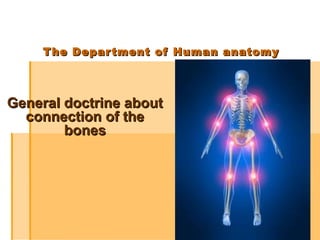

The Department of Human anatomyThe Department of Human anatomy
General doctrine aboutGeneral doctrine about
connection of theconnection of the
bonesbones
PLANPLAN
 Basic data of the bone articulationsBasic data of the bone articulations..
 The classification of the bones articulationsThe classification of the bones articulations..
 The types of continuous articulations.The types of continuous articulations.
 Intermediate articulationsIntermediate articulations..
 Synovial articulationsSynovial articulations..
 The structure of articulationThe structure of articulation..
 The analysis of movements of theThe analysis of movements of the
articulations.articulations.
Joint is a junction between two or moreJoint is a junction between two or more
bones or cartilages. It is a device tobones or cartilages. It is a device to
permit movements in a hard and rigidpermit movements in a hard and rigid
skeleton. Joints are formed in such askeleton. Joints are formed in such a
way that they keep a balance betweenway that they keep a balance between
the movement, stability and strength ofthe movement, stability and strength of
human skeleton.human skeleton.
SponsoredSponsored
Medical Lecture Notes –Medical Lecture Notes – All SubjectsAll Subjects
USMLE Exam (America) –USMLE Exam (America) – PracticePractice
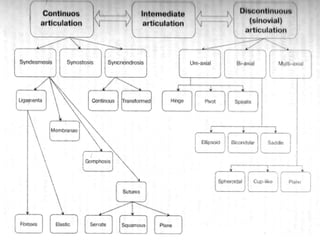
 Continuos articulation (Continuos articulation (synarthrosessynarthroses)) areare
characterizedcharacterized by the presence of an uninterruptedby the presence of an uninterrupted
articulating tissue – connective, cartilaginous, orarticulating tissue – connective, cartilaginous, or
osseous. Such articulations are either slightlyosseous. Such articulations are either slightly
movable or completely fixed.movable or completely fixed.
 Intemediate articulationIntemediate articulation forms beetweenforms beetween thethe
continuos and discontinuous articulations arecontinuos and discontinuous articulations are
symphyses (hemiarthrosis). They are representedsymphyses (hemiarthrosis). They are represented
by the cartilaginous articulations with the cleft-likeby the cartilaginous articulations with the cleft-like
cavity lacking a fibrous capsule and synovialcavity lacking a fibrous capsule and synovial
membrane.membrane.
 Disontinuous (sinovial) articulationDisontinuous (sinovial) articulation
((dyarthrosesdyarthroses)) contain a cavity lined with thecontain a cavity lined with the
synovial membrane. They posses a great mobility.synovial membrane. They posses a great mobility.
They are called joints.They are called joints.
Syndesmosys- the most common type ofSyndesmosys- the most common type of
fibrous articulations, which include :fibrous articulations, which include :
 ligamentsligaments
 membranesmembranes
 suturessutures
 gomphosisgomphosis
 fontanellefontanelle
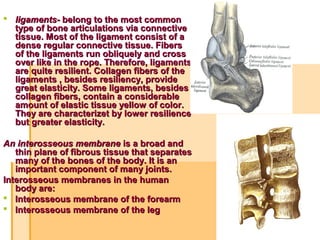
 ligamentsligaments- belong to the most common- belong to the most common
type of bone articulations via connectivetype of bone articulations via connective
tissue. Most of the ligament consist of atissue. Most of the ligament consist of a
dense regular connective tissue. Fibersdense regular connective tissue. Fibers
of the ligaments run obliquely and crossof the ligaments run obliquely and cross
over like in the rope. Therefore, ligamentsover like in the rope. Therefore, ligaments
are quite resilient. Collagen fibers of theare quite resilient. Collagen fibers of the
ligaments , besides resiliency, provideligaments , besides resiliency, provide
great elasticity. Some ligaments, besidesgreat elasticity. Some ligaments, besides
collagen fibers, contain a considerablecollagen fibers, contain a considerable
amount of elastic tissue yellow of color.amount of elastic tissue yellow of color.
They are characterizet by lower resilienceThey are characterizet by lower resilience
but greater elasticity.but greater elasticity.
An interosseous membraneAn interosseous membrane is a broad andis a broad and
thin plane of fibrous tissue that separatesthin plane of fibrous tissue that separates
many of the bones of the body. It is anmany of the bones of the body. It is an
important component of many joints.important component of many joints.
Interosseous membranes in the humanInterosseous membranes in the human
body are:body are:
 Interosseous membrane of the forearmInterosseous membrane of the forearm
 Interosseous membrane of the legInterosseous membrane of the leg
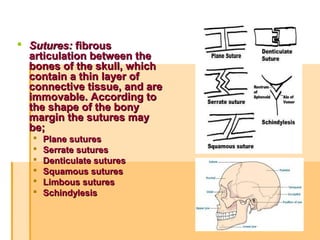
 Sutures:Sutures: fibrousfibrous
articulation between thearticulation between the
bones of the skull, whichbones of the skull, which
contain a thin layer ofcontain a thin layer of
connective tissue, and areconnective tissue, and are
immovable. According toimmovable. According to
the shape of the bonythe shape of the bony
margin the sutures maymargin the sutures may
be;be;
 Plane suturesPlane sutures
 Serrate suturesSerrate sutures
 Denticulate suturesDenticulate sutures
 Squamous suturesSquamous sutures
 Limbous suturesLimbous sutures
 SchindylesisSchindylesis
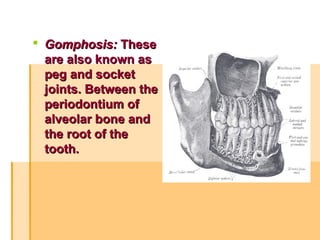
 Gomphosis:Gomphosis: These  These 
are also known as are also known as 
peg and socket peg and socket 
joints. Between the joints. Between the 
periodontium of periodontium of 
alveolar bone and alveolar bone and 
the root of the the root of the 
tooth.tooth.
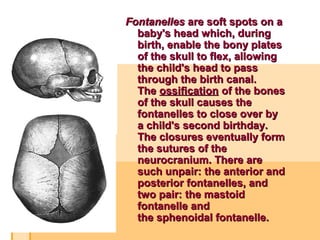
FontanellesFontanelles are soft spots on a  are soft spots on a 
baby's head which, during baby's head which, during 
birth, enable the bony plates birth, enable the bony plates 
of the skull to flex, allowing of the skull to flex, allowing 
the child's head to pass the child's head to pass 
through the birth canal. through the birth canal. 
The The ossificationossification of the bones  of the bones 
of the skull causes the of the skull causes the 
fontanelles to close over by fontanelles to close over by 
a child's second birthday. a child's second birthday. 
The closures eventually form The closures eventually form 
the sutures of the the sutures of the 
neurocranium. There are neurocranium. There are 
such unpair: the anterior and such unpair: the anterior and 
posterior fontanelles, and posterior fontanelles, and 
two pair: the mastoid two pair: the mastoid 
fontanelle and fontanelle and 
the sphenoidal fontanelle.the sphenoidal fontanelle.
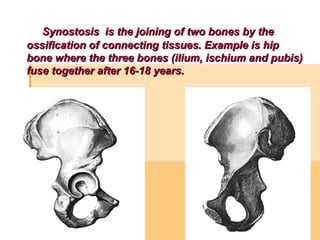
Synostosis is the joining of two bones by theSynostosis is the joining of two bones by the
ossification of connecting tissues. Example is hipossification of connecting tissues. Example is hip
bone where the three bones (ilium, ischium and pubis)bone where the three bones (ilium, ischium and pubis)
fuse together after 16-18 years.fuse together after 16-18 years.
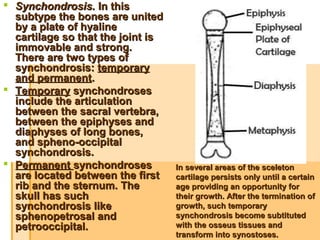
 Synchondrosis.Synchondrosis. In this  In this 
subtype the bones are united subtype the bones are united 
by a plate of hyaline by a plate of hyaline 
cartilage so that the joint is cartilage so that the joint is 
immovable and strong. immovable and strong. 
There are two types of There are two types of 
synchondrosis: synchondrosis: temporary temporary 
and permanentand permanent. . 
 TemporaryTemporary synchondroses  synchondroses 
include the articulation include the articulation 
between the sacral vertebra, between the sacral vertebra, 
between the epiphyses and between the epiphyses and 
diaphyses of long bones, diaphyses of long bones, 
and spheno-occipital and spheno-occipital 
synchondrosis.synchondrosis.
 Permanent Permanent synchondroses synchondroses 
are located between the first are located between the first 
rib and the sternum. The rib and the sternum. The 
skull has such skull has such 
synchondrosis like synchondrosis like 
sphenopetrosal and sphenopetrosal and 
petrooccipital.petrooccipital.  
In several areas of the sceleton In several areas of the sceleton 
cartilage persists only until a certain cartilage persists only until a certain 
age providing an opportunity for age providing an opportunity for 
their growth. After the termination of their growth. After the termination of 
growth, such temporary growth, such temporary 
synchondrosis become subtituted synchondrosis become subtituted 
with the osseus tissues and with the osseus tissues and 
transform into synostoses.transform into synostoses.
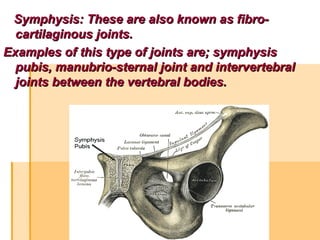
Symphysis: These are also known as fibro-Symphysis: These are also known as fibro-
cartilaginous joints.cartilaginous joints.
Examples of this type of joints are; symphysisExamples of this type of joints are; symphysis
pubis, manubrio-sternal joint and intervertebralpubis, manubrio-sternal joint and intervertebral
joints between the vertebral bodies.joints between the vertebral bodies.
Disontinuous (sinovial) articulationDisontinuous (sinovial) articulation
Synovial joints are most evolved and therefore most mobile type ofSynovial joints are most evolved and therefore most mobile type of
joints.joints. They possess the following characteristic features;They possess the following characteristic features;
 There articular surfaces are covered with hyaline cartilage. ThisThere articular surfaces are covered with hyaline cartilage. This
articular cartilage is avascular, non nervous and elastic.articular cartilage is avascular, non nervous and elastic.
Lubricated with synovial fluid, the cartilage forms slipperyLubricated with synovial fluid, the cartilage forms slippery
surfaces for free movements.surfaces for free movements.
 Between the articular surfaces there is a joint cavity filled withBetween the articular surfaces there is a joint cavity filled with
synovial fluid. The cavity may be partially or completelysynovial fluid. The cavity may be partially or completely
subdivided by an articular disc or meniscus.subdivided by an articular disc or meniscus.
 The joint is surrounded by an articular capsule which is fibrousThe joint is surrounded by an articular capsule which is fibrous
in nature and is lined by synovial membrane. Because of its richin nature and is lined by synovial membrane. Because of its rich
nerve supply the fibrous capsule is sensitive to stretchesnerve supply the fibrous capsule is sensitive to stretches
imposed by movements.imposed by movements.
 The synovial membrane lines the entire joint except the articularThe synovial membrane lines the entire joint except the articular
surfaces covered by hyaline cartilage. It is this membrane thatsurfaces covered by hyaline cartilage. It is this membrane that
secretes the slimy fluid called synovial fluid which lubricates thesecretes the slimy fluid called synovial fluid which lubricates the
joint and nourishes the articular cartilage.joint and nourishes the articular cartilage.
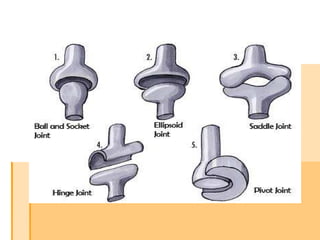
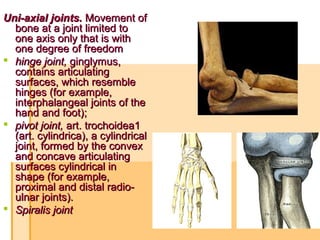
Uni-axial joints.Uni-axial joints. Movement ofMovement of
bone at a joint limited tobone at a joint limited to
one axis only that is withone axis only that is with
one degree of freedomone degree of freedom
 hinge joint,hinge joint, ginglymus,ginglymus,
contains articulatingcontains articulating
surfaces, which resemblesurfaces, which resemble
hinges (for example,hinges (for example,
interphalangeal joints of theinterphalangeal joints of the
hand and foot);hand and foot);
 pivot joint,pivot joint, art. trochoidea1art. trochoidea1
(art. cylindrica), a cylindrical(art. cylindrica), a cylindrical
joint, formed by the convexjoint, formed by the convex
and concave articulatingand concave articulating
surfaces cylindrical insurfaces cylindrical in
shape (for example,shape (for example,
proximal and distal radio-proximal and distal radio-
ulnar joints).ulnar joints).
 Spiralis jointSpiralis joint
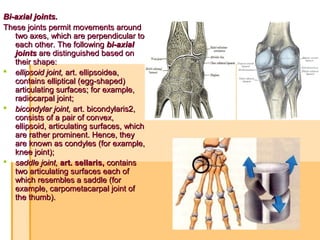
Bi-axial joints.Bi-axial joints.
These joints permit movements aroundThese joints permit movements around
two axes, which are perpendicular totwo axes, which are perpendicular to
each other. The followingeach other. The following bi-axialbi-axial
jointsjoints are distinguished based onare distinguished based on
their shape:their shape:
 ellipsoid joint,ellipsoid joint, art. ellipsoidea,art. ellipsoidea,
contains elliptical (egg-shaped)contains elliptical (egg-shaped)
articulating surfaces; for example,articulating surfaces; for example,
radiocarpal joint;radiocarpal joint;
 bicondylar joint,bicondylar joint, art. bicondylaris2,art. bicondylaris2,
consists of a pair of convex,consists of a pair of convex,
ellipsoid, articulating surfaces, whichellipsoid, articulating surfaces, which
are rather prominent. Hence, theyare rather prominent. Hence, they
are known as condyles (for example,are known as condyles (for example,
knee joint);knee joint);
 saddle joint,saddle joint, art. sellaris, art. sellaris, containscontains
two articulating surfaces each oftwo articulating surfaces each of
which resembles a saddle (forwhich resembles a saddle (for
example, carpometacarpal joint ofexample, carpometacarpal joint of
the thumb).the thumb).
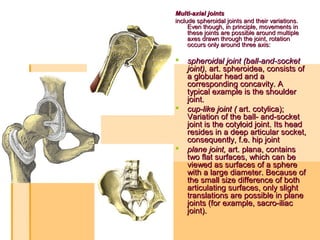
Multi-axial jointsMulti-axial joints
include spheroidal joints and their variations.include spheroidal joints and their variations.
Even though, in principle, movements inEven though, in principle, movements in
these joints are possible around multiplethese joints are possible around multiple
axes drawn through the joint, rotationaxes drawn through the joint, rotation
occurs only around three axis:occurs only around three axis:
 spheroidal joint (ball-and-socketspheroidal joint (ball-and-socket
joint),joint), art. spheroidea, consists ofart. spheroidea, consists of
a globular head and aa globular head and a
corresponding concavity. Acorresponding concavity. A
typical example is the shouldertypical example is the shoulder
joint.joint.
 cup-like joint (cup-like joint ( art. cotylica);art. cotylica);
Variation of the ball- and-socketVariation of the ball- and-socket
joint is the cotyloid joint. Its headjoint is the cotyloid joint. Its head
resides in a deep articular socket,resides in a deep articular socket,
consequently, f.e. hip jointconsequently, f.e. hip joint
 plane joint,plane joint, art. plana, containsart. plana, contains
two flat surfaces, which can betwo flat surfaces, which can be
viewed as surviewed as surffaces of a sphereaces of a sphere
with a large diameter. Because ofwith a large diameter. Because of
the small size difference of boththe small size difference of both
articulating surfaces, only slightarticulating surfaces, only slight
translations are possible in planetranslations are possible in plane
joints (for example, sacro-iliacjoints (for example, sacro-iliac
joint).joint).
Functional classification:Functional classification:
 Immovable joints: (Synarthroses) –Immovable joints: (Synarthroses) –
continuos jointscontinuos joints
 Partially moveable joints:Partially moveable joints:
(Amphiarthroses) – intermediate joints(Amphiarthroses) – intermediate joints
 Freely moveable joints: (Diarthroses) –Freely moveable joints: (Diarthroses) –
discontinous jointsdiscontinous joints
NextNext classification is based on the number ofclassification is based on the number of articulating surfaces.articulating surfaces.
AA simple jointsimple joint (articulatio simplex)(articulatio simplex) is composed ofis composed of only two articulatingonly two articulating
surfaces.surfaces.
AA compound jointcompound joint (articulatio composita)(articulatio composita) contains more than two articulatingcontains more than two articulating
surfaces. Several bones participate in the formation of a compound joint.surfaces. Several bones participate in the formation of a compound joint.
If a joint contains articular discs or menisci, which divide it into two parts, it isIf a joint contains articular discs or menisci, which divide it into two parts, it is
termed atermed a complex jointcomplex joint (articulatio complexa).(articulatio complexa).
Combined joints.Combined joints. Two isolated joints, in which movements occurTwo isolated joints, in which movements occur
simultaneously, are calledsimultaneously, are called combined jointscombined joints (articulatio combinata).(articulatio combinata). A typicalA typical
example of such joint is the temporoexample of such joint is the temporo--mandibular joint.mandibular joint.
Congruent and incongruent joints.Congruent and incongruent joints.
In those cases, when articulating surfaces entirely correspond to each other andIn those cases, when articulating surfaces entirely correspond to each other and
appear as imprints of one another, joints are called congruent (congruo -appear as imprints of one another, joints are called congruent (congruo -
correspond). In such joints, articular surfaces are tightly joined together as,correspond). In such joints, articular surfaces are tightly joined together as,
for example, in the hip joint, in which movements are largely restricted.for example, in the hip joint, in which movements are largely restricted.
Incongruent joints have a greater degree of freedom in their movements due toIncongruent joints have a greater degree of freedom in their movements due to
the incomplete correspondence of the articulating surfaces. These jointsthe incomplete correspondence of the articulating surfaces. These joints
possess accessory structures such as disks, menisci, synovial folds, whichpossess accessory structures such as disks, menisci, synovial folds, which
fill the irregularities in the articular surfaces and smooth out theirfill the irregularities in the articular surfaces and smooth out their
incongruence. The knee joint is an example of the incongruent joint.incongruence. The knee joint is an example of the incongruent joint.
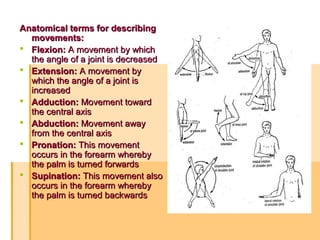
Anatomical terms for describingAnatomical terms for describing
movements:movements:
 Flexion:Flexion: A movement by whichA movement by which
the angle of a joint is decreasedthe angle of a joint is decreased
 Extension:Extension: A movement byA movement by
which the angle of a joint iswhich the angle of a joint is
increasedincreased
 Adduction:Adduction: Movement towardMovement toward
the central axisthe central axis
 Abduction:Abduction: Movement awayMovement away
from the central axisfrom the central axis
 Pronation:Pronation: This movementThis movement
occurs in the forearm wherebyoccurs in the forearm whereby
the palm is turned forwardsthe palm is turned forwards
 Supination:Supination: This movement alsoThis movement also
occurs in the forearm wherebyoccurs in the forearm whereby
the palm is turned backwardsthe palm is turned backwards
THE MOST TYPICAL FEATURES OF THETHE MOST TYPICAL FEATURES OF THE
JOINTS.JOINTS.
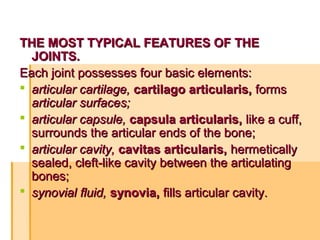
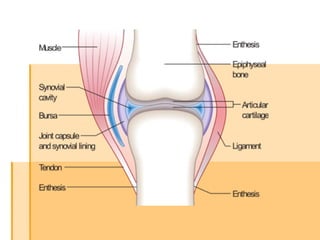
Each joint possesses four basic elements:Each joint possesses four basic elements:
 articular cartilage,articular cartilage, cartilago articularis,cartilago articularis, formsforms
articular surfaces;articular surfaces;
 articular capsule,articular capsule, capsula articularis,capsula articularis, like a cuff,like a cuff,
surrounds the articular ends of the bone;surrounds the articular ends of the bone;
 articular cavity,articular cavity, cavitas articularis,cavitas articularis, hermeticallyhermetically
sealed, cleft-like cavity between the articulatingsealed, cleft-like cavity between the articulating
bones;bones;
 synovial fluid,synovial fluid, synovia,synovia, fills articular cavity.fills articular cavity.
Articular cartilage.Articular cartilage. The articular surfaces of theThe articular surfaces of the
bones are covered with the hyaline cartilagebones are covered with the hyaline cartilage
(sometimes, fibrous), which is 2.5 mm thick on(sometimes, fibrous), which is 2.5 mm thick on
average. The thickness of the cartilage dependsaverage. The thickness of the cartilage depends
on the amount of compression experienced byon the amount of compression experienced by
the joint. The surface of the cartilage is notthe joint. The surface of the cartilage is not
covered with the perichondrium. The surface iscovered with the perichondrium. The surface is
smooth, lubricated with the synovial fluid, whichsmooth, lubricated with the synovial fluid, which
reduces friction to minimum and facilitates thereduces friction to minimum and facilitates the
movement. The articular cartilage is fairly elastic.movement. The articular cartilage is fairly elastic.
It softens strokes and absorbs shock duringIt softens strokes and absorbs shock during
movements. Since the articular cartilage doesmovements. Since the articular cartilage does
not have blood vessels, its nutrition occurs vianot have blood vessels, its nutrition occurs via
diffusion of nutrients from the synovial fluid.diffusion of nutrients from the synovial fluid.
Articular capsule.Articular capsule. The capsule of the jointThe capsule of the joint
attaches to the edges of articular surfacesattaches to the edges of articular surfaces
or somewhat over them.or somewhat over them.
The articular capsule hermetically seals theThe articular capsule hermetically seals the
articular cavity and consists of two layers -articular cavity and consists of two layers -
external fibrous layer,external fibrous layer, membrana fibrosa,membrana fibrosa,
andand internal synovial layer,internal synovial layer, membranamembrana
synovialis.synovialis.
 Synovial folds and bursae.Synovial folds and bursae. The synovialThe synovial
membrane is well developed and, in the majority ofmembrane is well developed and, in the majority of
the joints forms largethe joints forms large folds,folds, plicae synoviales,plicae synoviales,
which contain adipose tissue. They go into thewhich contain adipose tissue. They go into the
articular cavity, filling its potential spaces andarticular cavity, filling its potential spaces and
forming cushions, which absorb shock duringforming cushions, which absorb shock during
motion.motion.
 In certain regions, most frequently in the areas ofIn certain regions, most frequently in the areas of
muscular tendons, the synovial membranemuscular tendons, the synovial membrane
protrudes through the clefts in the fibrous layer andprotrudes through the clefts in the fibrous layer and
forms synovial bursae. They serve to reduceforms synovial bursae. They serve to reduce
friction during tendons' movement and can befriction during tendons' movement and can be
attributed to the accessory muscular apparatus.attributed to the accessory muscular apparatus.
 TThe synovial layer bears numerous, microscopic,he synovial layer bears numerous, microscopic,
synovial villi,synovial villi, villi synoviales,villi synoviales, which significantlywhich significantly
increase its surface area, contain capillaryincrease its surface area, contain capillary
networks, and produce the synovia] fluid.networks, and produce the synovia] fluid.
 Synovial fluidSynovial fluid.. In the articular cavity there is aIn the articular cavity there is a
small amount of pale, thick, synovial fluid. It issmall amount of pale, thick, synovial fluid. It is
produced by the synoviaproduced by the synoviall membrane. The synovialmembrane. The synovial
fluid lubricates the articular surfaces and reducesfluid lubricates the articular surfaces and reduces
friction between them.friction between them.
 The synovial fluid constitutes the internalThe synovial fluid constitutes the internal
environment of the joint. It provides nutrition to theenvironment of the joint. It provides nutrition to the
internal structures of the joint and participates ininternal structures of the joint and participates in
its metabolism.its metabolism.
 Synovial cavity.Synovial cavity. It iIt is a thin cleft, bounded by thes a thin cleft, bounded by the
synovial membrane and the articular surfaces.synovial membrane and the articular surfaces.
Between the latter, there is a thin layer of synovialBetween the latter, there is a thin layer of synovial
fluid, which separates articulating surfaces. In thefluid, which separates articulating surfaces. In the
pathological processes, the synovial cavity canpathological processes, the synovial cavity can
accumulate large amounts of inflammatory liquidaccumulate large amounts of inflammatory liquid
and greatly increases in size.and greatly increases in size.
Accessory structures of joints.Accessory structures of joints. Synovial joints maySynovial joints may
possess several accessory elements, which facilitatepossess several accessory elements, which facilitate
movement to a certain extent. Such accessory elementsmovement to a certain extent. Such accessory elements
include cartilaginous articular discs, menisci, glenoidalinclude cartilaginous articular discs, menisci, glenoidal
labralabraee, and intraarticular ligaments:, and intraarticular ligaments:
 articular- disc,articular- disc, discus articularis,discus articularis, a cartilaginous plate,a cartilaginous plate,
which completely separates the joint into two regions;which completely separates the joint into two regions;
 articular meniscus,articular meniscus, meniscus arti­cularis,meniscus arti­cularis, cartilaginouscartilaginous
semilunar plate, which partially separates the synovialsemilunar plate, which partially separates the synovial
cavity;cavity;
 glenoid labium,glenoid labium, labrum glenoidale,labrum glenoidale, a cartilaginous rim,a cartilaginous rim,
which deepens the articular socket;which deepens the articular socket;
 intraarticular ligaments,intraarticular ligaments, ligg. intraarticularia,ligg. intraarticularia, connectconnect
bones within the joint; they are covered with the synovialbones within the joint; they are covered with the synovial
membrane.membrane.
Clinical applications.Clinical applications.
 Pathological process can develop in the joints, amongPathological process can develop in the joints, among
which infectious arthritis is the most commonwhich infectious arthritis is the most common
(particularly, rheumatic or tuberculous arthritis).(particularly, rheumatic or tuberculous arthritis).
Inflammations of the synovial membrane — synovitisInflammations of the synovial membrane — synovitis
and bursitis are also fairly common. Joint deformations,and bursitis are also fairly common. Joint deformations,
contraction of the synovial cleft, and restriction ofcontraction of the synovial cleft, and restriction of
movements accompanied by pain syndrome can occurmovements accompanied by pain syndrome can occur
as a consequence of degenerative changes (arthrosis).as a consequence of degenerative changes (arthrosis).
Traumas can cause various joint dislocations withTraumas can cause various joint dislocations with
stretched and ruptured ligaments. Physician of differentstretched and ruptured ligaments. Physician of different
specialties often have to deal with the diseases ofspecialties often have to deal with the diseases of
jointsjoints
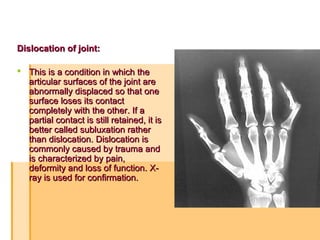
Dislocation of joint:Dislocation of joint:
 This is a condition in which theThis is a condition in which the
articular surfaces of the joint arearticular surfaces of the joint are
abnormally displaced so that oneabnormally displaced so that one
surface loses its contactsurface loses its contact
completely with the other. If acompletely with the other. If a
partial contact is still retained, it ispartial contact is still retained, it is
better called subluxation ratherbetter called subluxation rather
than dislocation. Dislocation isthan dislocation. Dislocation is
commonly caused by trauma andcommonly caused by trauma and
is characterized by pain,is characterized by pain,
deformity and loss of function.deformity and loss of function. X-X-
ray is used for confirmation.ray is used for confirmation.
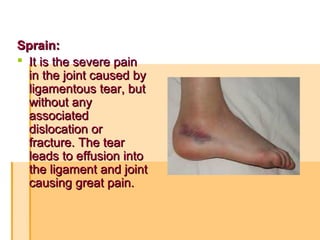
Sprain:Sprain:
 It is the severe painIt is the severe pain
in the joint caused byin the joint caused by
ligamentous tear, butligamentous tear, but
without anywithout any
associatedassociated
dislocation ordislocation or
fracture. The tearfracture. The tear
leads to effusion intoleads to effusion into
the ligament and jointthe ligament and joint
causing great pain.causing great pain.
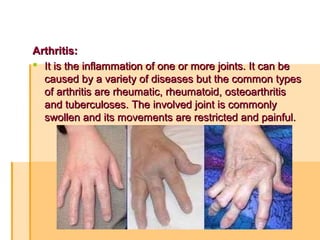
Arthritis:Arthritis:
 It is the inflammation of one or more joints. It can beIt is the inflammation of one or more joints. It can be
caused by a variety of diseases but the common typescaused by a variety of diseases but the common types
of arthritis are rheumatic, rheumatoid, osteoarthritisof arthritis are rheumatic, rheumatoid, osteoarthritis
and tuberculoses. The involved joint is commonlyand tuberculoses. The involved joint is commonly
swollen and its movements are restricted and painful.swollen and its movements are restricted and painful.
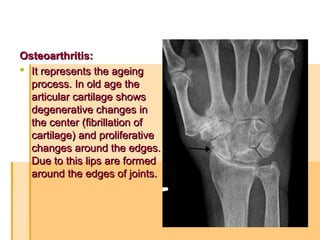
Osteoarthritis:Osteoarthritis:
 It represents the ageingIt represents the ageing
process. In old age theprocess. In old age the
articular cartilage showsarticular cartilage shows
degenerative changes indegenerative changes in
the center (fibrillation ofthe center (fibrillation of
cartilage) and proliferativecartilage) and proliferative
changes around the edges.changes around the edges.
Due to this lips are formedDue to this lips are formed
around the edges of joints.around the edges of joints.
 Stiffness of joints related to weather:Stiffness of joints related to weather:
The viscosity of synovial fluid increases with fall inThe viscosity of synovial fluid increases with fall in
temperature. This accounts for stiffness of the joints intemperature. This accounts for stiffness of the joints in
cold weather. Mobility of the joint itself is an importantcold weather. Mobility of the joint itself is an important
factor in promoting lubrication. Thus the stiffness of thefactor in promoting lubrication. Thus the stiffness of the
joints experienced in the morning gradually passes offjoints experienced in the morning gradually passes off
as the movements are resumed.as the movements are resumed.
 Neuropathic joint:Neuropathic joint:
It is the result of complete denervation of the joint so thatIt is the result of complete denervation of the joint so that
all reflexes are eliminated and the joint is leftall reflexes are eliminated and the joint is left
unprotected and liable to mechanical damage. Aunprotected and liable to mechanical damage. A
neuropathic joint shows painless swelling, excessiveneuropathic joint shows painless swelling, excessive
mobility and bony destruction. It is commonly causedmobility and bony destruction. It is commonly caused
by leprosy, tabes dorsalis and syringomyelia.by leprosy, tabes dorsalis and syringomyelia.
Thank you for attention!Thank you for attention!

Connection of bones

  • 1.
    The Department ofHuman anatomyThe Department of Human anatomy General doctrine aboutGeneral doctrine about connection of theconnection of the bonesbones
  • 2.
    PLANPLAN  Basic dataof the bone articulationsBasic data of the bone articulations..  The classification of the bones articulationsThe classification of the bones articulations..  The types of continuous articulations.The types of continuous articulations.  Intermediate articulationsIntermediate articulations..  Synovial articulationsSynovial articulations..  The structure of articulationThe structure of articulation..  The analysis of movements of theThe analysis of movements of the articulations.articulations.
  • 3.
    Joint is ajunction between two or moreJoint is a junction between two or more bones or cartilages. It is a device tobones or cartilages. It is a device to permit movements in a hard and rigidpermit movements in a hard and rigid skeleton. Joints are formed in such askeleton. Joints are formed in such a way that they keep a balance betweenway that they keep a balance between the movement, stability and strength ofthe movement, stability and strength of human skeleton.human skeleton.
  • 5.
    SponsoredSponsored Medical Lecture Notes–Medical Lecture Notes – All SubjectsAll Subjects USMLE Exam (America) –USMLE Exam (America) – PracticePractice
  • 6.
     Continuos articulation(Continuos articulation (synarthrosessynarthroses)) areare characterizedcharacterized by the presence of an uninterruptedby the presence of an uninterrupted articulating tissue – connective, cartilaginous, orarticulating tissue – connective, cartilaginous, or osseous. Such articulations are either slightlyosseous. Such articulations are either slightly movable or completely fixed.movable or completely fixed.  Intemediate articulationIntemediate articulation forms beetweenforms beetween thethe continuos and discontinuous articulations arecontinuos and discontinuous articulations are symphyses (hemiarthrosis). They are representedsymphyses (hemiarthrosis). They are represented by the cartilaginous articulations with the cleft-likeby the cartilaginous articulations with the cleft-like cavity lacking a fibrous capsule and synovialcavity lacking a fibrous capsule and synovial membrane.membrane.  Disontinuous (sinovial) articulationDisontinuous (sinovial) articulation ((dyarthrosesdyarthroses)) contain a cavity lined with thecontain a cavity lined with the synovial membrane. They posses a great mobility.synovial membrane. They posses a great mobility. They are called joints.They are called joints.
  • 7.
    Syndesmosys- the mostcommon type ofSyndesmosys- the most common type of fibrous articulations, which include :fibrous articulations, which include :  ligamentsligaments  membranesmembranes  suturessutures  gomphosisgomphosis  fontanellefontanelle
  • 8.
     ligamentsligaments- belongto the most common- belong to the most common type of bone articulations via connectivetype of bone articulations via connective tissue. Most of the ligament consist of atissue. Most of the ligament consist of a dense regular connective tissue. Fibersdense regular connective tissue. Fibers of the ligaments run obliquely and crossof the ligaments run obliquely and cross over like in the rope. Therefore, ligamentsover like in the rope. Therefore, ligaments are quite resilient. Collagen fibers of theare quite resilient. Collagen fibers of the ligaments , besides resiliency, provideligaments , besides resiliency, provide great elasticity. Some ligaments, besidesgreat elasticity. Some ligaments, besides collagen fibers, contain a considerablecollagen fibers, contain a considerable amount of elastic tissue yellow of color.amount of elastic tissue yellow of color. They are characterizet by lower resilienceThey are characterizet by lower resilience but greater elasticity.but greater elasticity. An interosseous membraneAn interosseous membrane is a broad andis a broad and thin plane of fibrous tissue that separatesthin plane of fibrous tissue that separates many of the bones of the body. It is anmany of the bones of the body. It is an important component of many joints.important component of many joints. Interosseous membranes in the humanInterosseous membranes in the human body are:body are:  Interosseous membrane of the forearmInterosseous membrane of the forearm  Interosseous membrane of the legInterosseous membrane of the leg
  • 9.
     Sutures:Sutures: fibrousfibrous articulationbetween thearticulation between the bones of the skull, whichbones of the skull, which contain a thin layer ofcontain a thin layer of connective tissue, and areconnective tissue, and are immovable. According toimmovable. According to the shape of the bonythe shape of the bony margin the sutures maymargin the sutures may be;be;  Plane suturesPlane sutures  Serrate suturesSerrate sutures  Denticulate suturesDenticulate sutures  Squamous suturesSquamous sutures  Limbous suturesLimbous sutures  SchindylesisSchindylesis
  • 10.
  • 11.
    FontanellesFontanelles are soft spots on a  are soft spots on a  baby's head which, during baby's head which, during  birth, enable the bony plates birth, enable the bony plates  of the skull to flex, allowing of the skull to flex, allowing  the child's head to pass the child's head to pass  through the birth canal. through the birth canal.  The The ossificationossification of the bones  of the bones  of the skull causes the of the skull causes the  fontanelles to close over by fontanelles to close over by  a child's second birthday. a child's second birthday.  The closures eventually form The closures eventually form  the sutures of the the sutures of the  neurocranium. There are neurocranium. There are  such unpair: the anterior and such unpair: the anterior and  posterior fontanelles, and posterior fontanelles, and  two pair: the mastoid two pair: the mastoid  fontanelle and fontanelle and  the sphenoidal fontanelle.the sphenoidal fontanelle.
  • 12.
    Synostosis is thejoining of two bones by theSynostosis is the joining of two bones by the ossification of connecting tissues. Example is hipossification of connecting tissues. Example is hip bone where the three bones (ilium, ischium and pubis)bone where the three bones (ilium, ischium and pubis) fuse together after 16-18 years.fuse together after 16-18 years.
  • 13.
     Synchondrosis.Synchondrosis. In this  In this  subtype the bones are united subtype the bones are united  by a plate of hyaline by a plate of hyaline  cartilage so that the joint is cartilage so that the joint is  immovable and strong. immovable and strong.  There are two types of There are two types of  synchondrosis: synchondrosis: temporary temporary  and permanentand permanent. .   TemporaryTemporary synchondroses  synchondroses  include the articulation include the articulation  between the sacral vertebra, between the sacral vertebra,  between the epiphyses and between the epiphyses and  diaphyses of long bones, diaphyses of long bones,  and spheno-occipital and spheno-occipital  synchondrosis.synchondrosis. Permanent Permanent synchondroses synchondroses  are located between the first are located between the first  rib and the sternum. The rib and the sternum. The  skull has such skull has such  synchondrosis like synchondrosis like  sphenopetrosal and sphenopetrosal and  petrooccipital.petrooccipital.   In several areas of the sceleton In several areas of the sceleton  cartilage persists only until a certain cartilage persists only until a certain  age providing an opportunity for age providing an opportunity for  their growth. After the termination of their growth. After the termination of  growth, such temporary growth, such temporary  synchondrosis become subtituted synchondrosis become subtituted  with the osseus tissues and with the osseus tissues and  transform into synostoses.transform into synostoses.
  • 14.
    Symphysis: These arealso known as fibro-Symphysis: These are also known as fibro- cartilaginous joints.cartilaginous joints. Examples of this type of joints are; symphysisExamples of this type of joints are; symphysis pubis, manubrio-sternal joint and intervertebralpubis, manubrio-sternal joint and intervertebral joints between the vertebral bodies.joints between the vertebral bodies.
  • 15.
    Disontinuous (sinovial) articulationDisontinuous(sinovial) articulation Synovial joints are most evolved and therefore most mobile type ofSynovial joints are most evolved and therefore most mobile type of joints.joints. They possess the following characteristic features;They possess the following characteristic features;  There articular surfaces are covered with hyaline cartilage. ThisThere articular surfaces are covered with hyaline cartilage. This articular cartilage is avascular, non nervous and elastic.articular cartilage is avascular, non nervous and elastic. Lubricated with synovial fluid, the cartilage forms slipperyLubricated with synovial fluid, the cartilage forms slippery surfaces for free movements.surfaces for free movements.  Between the articular surfaces there is a joint cavity filled withBetween the articular surfaces there is a joint cavity filled with synovial fluid. The cavity may be partially or completelysynovial fluid. The cavity may be partially or completely subdivided by an articular disc or meniscus.subdivided by an articular disc or meniscus.  The joint is surrounded by an articular capsule which is fibrousThe joint is surrounded by an articular capsule which is fibrous in nature and is lined by synovial membrane. Because of its richin nature and is lined by synovial membrane. Because of its rich nerve supply the fibrous capsule is sensitive to stretchesnerve supply the fibrous capsule is sensitive to stretches imposed by movements.imposed by movements.  The synovial membrane lines the entire joint except the articularThe synovial membrane lines the entire joint except the articular surfaces covered by hyaline cartilage. It is this membrane thatsurfaces covered by hyaline cartilage. It is this membrane that secretes the slimy fluid called synovial fluid which lubricates thesecretes the slimy fluid called synovial fluid which lubricates the joint and nourishes the articular cartilage.joint and nourishes the articular cartilage.
  • 17.
    Uni-axial joints.Uni-axial joints.Movement ofMovement of bone at a joint limited tobone at a joint limited to one axis only that is withone axis only that is with one degree of freedomone degree of freedom  hinge joint,hinge joint, ginglymus,ginglymus, contains articulatingcontains articulating surfaces, which resemblesurfaces, which resemble hinges (for example,hinges (for example, interphalangeal joints of theinterphalangeal joints of the hand and foot);hand and foot);  pivot joint,pivot joint, art. trochoidea1art. trochoidea1 (art. cylindrica), a cylindrical(art. cylindrica), a cylindrical joint, formed by the convexjoint, formed by the convex and concave articulatingand concave articulating surfaces cylindrical insurfaces cylindrical in shape (for example,shape (for example, proximal and distal radio-proximal and distal radio- ulnar joints).ulnar joints).  Spiralis jointSpiralis joint
  • 18.
    Bi-axial joints.Bi-axial joints. Thesejoints permit movements aroundThese joints permit movements around two axes, which are perpendicular totwo axes, which are perpendicular to each other. The followingeach other. The following bi-axialbi-axial jointsjoints are distinguished based onare distinguished based on their shape:their shape:  ellipsoid joint,ellipsoid joint, art. ellipsoidea,art. ellipsoidea, contains elliptical (egg-shaped)contains elliptical (egg-shaped) articulating surfaces; for example,articulating surfaces; for example, radiocarpal joint;radiocarpal joint;  bicondylar joint,bicondylar joint, art. bicondylaris2,art. bicondylaris2, consists of a pair of convex,consists of a pair of convex, ellipsoid, articulating surfaces, whichellipsoid, articulating surfaces, which are rather prominent. Hence, theyare rather prominent. Hence, they are known as condyles (for example,are known as condyles (for example, knee joint);knee joint);  saddle joint,saddle joint, art. sellaris, art. sellaris, containscontains two articulating surfaces each oftwo articulating surfaces each of which resembles a saddle (forwhich resembles a saddle (for example, carpometacarpal joint ofexample, carpometacarpal joint of the thumb).the thumb).
  • 19.
    Multi-axial jointsMulti-axial joints includespheroidal joints and their variations.include spheroidal joints and their variations. Even though, in principle, movements inEven though, in principle, movements in these joints are possible around multiplethese joints are possible around multiple axes drawn through the joint, rotationaxes drawn through the joint, rotation occurs only around three axis:occurs only around three axis:  spheroidal joint (ball-and-socketspheroidal joint (ball-and-socket joint),joint), art. spheroidea, consists ofart. spheroidea, consists of a globular head and aa globular head and a corresponding concavity. Acorresponding concavity. A typical example is the shouldertypical example is the shoulder joint.joint.  cup-like joint (cup-like joint ( art. cotylica);art. cotylica); Variation of the ball- and-socketVariation of the ball- and-socket joint is the cotyloid joint. Its headjoint is the cotyloid joint. Its head resides in a deep articular socket,resides in a deep articular socket, consequently, f.e. hip jointconsequently, f.e. hip joint  plane joint,plane joint, art. plana, containsart. plana, contains two flat surfaces, which can betwo flat surfaces, which can be viewed as surviewed as surffaces of a sphereaces of a sphere with a large diameter. Because ofwith a large diameter. Because of the small size difference of boththe small size difference of both articulating surfaces, only slightarticulating surfaces, only slight translations are possible in planetranslations are possible in plane joints (for example, sacro-iliacjoints (for example, sacro-iliac joint).joint).
  • 20.
    Functional classification:Functional classification: Immovable joints: (Synarthroses) –Immovable joints: (Synarthroses) – continuos jointscontinuos joints  Partially moveable joints:Partially moveable joints: (Amphiarthroses) – intermediate joints(Amphiarthroses) – intermediate joints  Freely moveable joints: (Diarthroses) –Freely moveable joints: (Diarthroses) – discontinous jointsdiscontinous joints
  • 21.
    NextNext classification isbased on the number ofclassification is based on the number of articulating surfaces.articulating surfaces. AA simple jointsimple joint (articulatio simplex)(articulatio simplex) is composed ofis composed of only two articulatingonly two articulating surfaces.surfaces. AA compound jointcompound joint (articulatio composita)(articulatio composita) contains more than two articulatingcontains more than two articulating surfaces. Several bones participate in the formation of a compound joint.surfaces. Several bones participate in the formation of a compound joint. If a joint contains articular discs or menisci, which divide it into two parts, it isIf a joint contains articular discs or menisci, which divide it into two parts, it is termed atermed a complex jointcomplex joint (articulatio complexa).(articulatio complexa). Combined joints.Combined joints. Two isolated joints, in which movements occurTwo isolated joints, in which movements occur simultaneously, are calledsimultaneously, are called combined jointscombined joints (articulatio combinata).(articulatio combinata). A typicalA typical example of such joint is the temporoexample of such joint is the temporo--mandibular joint.mandibular joint. Congruent and incongruent joints.Congruent and incongruent joints. In those cases, when articulating surfaces entirely correspond to each other andIn those cases, when articulating surfaces entirely correspond to each other and appear as imprints of one another, joints are called congruent (congruo -appear as imprints of one another, joints are called congruent (congruo - correspond). In such joints, articular surfaces are tightly joined together as,correspond). In such joints, articular surfaces are tightly joined together as, for example, in the hip joint, in which movements are largely restricted.for example, in the hip joint, in which movements are largely restricted. Incongruent joints have a greater degree of freedom in their movements due toIncongruent joints have a greater degree of freedom in their movements due to the incomplete correspondence of the articulating surfaces. These jointsthe incomplete correspondence of the articulating surfaces. These joints possess accessory structures such as disks, menisci, synovial folds, whichpossess accessory structures such as disks, menisci, synovial folds, which fill the irregularities in the articular surfaces and smooth out theirfill the irregularities in the articular surfaces and smooth out their incongruence. The knee joint is an example of the incongruent joint.incongruence. The knee joint is an example of the incongruent joint.
  • 22.
    Anatomical terms fordescribingAnatomical terms for describing movements:movements:  Flexion:Flexion: A movement by whichA movement by which the angle of a joint is decreasedthe angle of a joint is decreased  Extension:Extension: A movement byA movement by which the angle of a joint iswhich the angle of a joint is increasedincreased  Adduction:Adduction: Movement towardMovement toward the central axisthe central axis  Abduction:Abduction: Movement awayMovement away from the central axisfrom the central axis  Pronation:Pronation: This movementThis movement occurs in the forearm wherebyoccurs in the forearm whereby the palm is turned forwardsthe palm is turned forwards  Supination:Supination: This movement alsoThis movement also occurs in the forearm wherebyoccurs in the forearm whereby the palm is turned backwardsthe palm is turned backwards
  • 23.
    THE MOST TYPICALFEATURES OF THETHE MOST TYPICAL FEATURES OF THE JOINTS.JOINTS. Each joint possesses four basic elements:Each joint possesses four basic elements:  articular cartilage,articular cartilage, cartilago articularis,cartilago articularis, formsforms articular surfaces;articular surfaces;  articular capsule,articular capsule, capsula articularis,capsula articularis, like a cuff,like a cuff, surrounds the articular ends of the bone;surrounds the articular ends of the bone;  articular cavity,articular cavity, cavitas articularis,cavitas articularis, hermeticallyhermetically sealed, cleft-like cavity between the articulatingsealed, cleft-like cavity between the articulating bones;bones;  synovial fluid,synovial fluid, synovia,synovia, fills articular cavity.fills articular cavity.
  • 25.
    Articular cartilage.Articular cartilage.The articular surfaces of theThe articular surfaces of the bones are covered with the hyaline cartilagebones are covered with the hyaline cartilage (sometimes, fibrous), which is 2.5 mm thick on(sometimes, fibrous), which is 2.5 mm thick on average. The thickness of the cartilage dependsaverage. The thickness of the cartilage depends on the amount of compression experienced byon the amount of compression experienced by the joint. The surface of the cartilage is notthe joint. The surface of the cartilage is not covered with the perichondrium. The surface iscovered with the perichondrium. The surface is smooth, lubricated with the synovial fluid, whichsmooth, lubricated with the synovial fluid, which reduces friction to minimum and facilitates thereduces friction to minimum and facilitates the movement. The articular cartilage is fairly elastic.movement. The articular cartilage is fairly elastic. It softens strokes and absorbs shock duringIt softens strokes and absorbs shock during movements. Since the articular cartilage doesmovements. Since the articular cartilage does not have blood vessels, its nutrition occurs vianot have blood vessels, its nutrition occurs via diffusion of nutrients from the synovial fluid.diffusion of nutrients from the synovial fluid.
  • 26.
    Articular capsule.Articular capsule.The capsule of the jointThe capsule of the joint attaches to the edges of articular surfacesattaches to the edges of articular surfaces or somewhat over them.or somewhat over them. The articular capsule hermetically seals theThe articular capsule hermetically seals the articular cavity and consists of two layers -articular cavity and consists of two layers - external fibrous layer,external fibrous layer, membrana fibrosa,membrana fibrosa, andand internal synovial layer,internal synovial layer, membranamembrana synovialis.synovialis.
  • 27.
     Synovial foldsand bursae.Synovial folds and bursae. The synovialThe synovial membrane is well developed and, in the majority ofmembrane is well developed and, in the majority of the joints forms largethe joints forms large folds,folds, plicae synoviales,plicae synoviales, which contain adipose tissue. They go into thewhich contain adipose tissue. They go into the articular cavity, filling its potential spaces andarticular cavity, filling its potential spaces and forming cushions, which absorb shock duringforming cushions, which absorb shock during motion.motion.  In certain regions, most frequently in the areas ofIn certain regions, most frequently in the areas of muscular tendons, the synovial membranemuscular tendons, the synovial membrane protrudes through the clefts in the fibrous layer andprotrudes through the clefts in the fibrous layer and forms synovial bursae. They serve to reduceforms synovial bursae. They serve to reduce friction during tendons' movement and can befriction during tendons' movement and can be attributed to the accessory muscular apparatus.attributed to the accessory muscular apparatus.  TThe synovial layer bears numerous, microscopic,he synovial layer bears numerous, microscopic, synovial villi,synovial villi, villi synoviales,villi synoviales, which significantlywhich significantly increase its surface area, contain capillaryincrease its surface area, contain capillary networks, and produce the synovia] fluid.networks, and produce the synovia] fluid.
  • 28.
     Synovial fluidSynovialfluid.. In the articular cavity there is aIn the articular cavity there is a small amount of pale, thick, synovial fluid. It issmall amount of pale, thick, synovial fluid. It is produced by the synoviaproduced by the synoviall membrane. The synovialmembrane. The synovial fluid lubricates the articular surfaces and reducesfluid lubricates the articular surfaces and reduces friction between them.friction between them.  The synovial fluid constitutes the internalThe synovial fluid constitutes the internal environment of the joint. It provides nutrition to theenvironment of the joint. It provides nutrition to the internal structures of the joint and participates ininternal structures of the joint and participates in its metabolism.its metabolism.  Synovial cavity.Synovial cavity. It iIt is a thin cleft, bounded by thes a thin cleft, bounded by the synovial membrane and the articular surfaces.synovial membrane and the articular surfaces. Between the latter, there is a thin layer of synovialBetween the latter, there is a thin layer of synovial fluid, which separates articulating surfaces. In thefluid, which separates articulating surfaces. In the pathological processes, the synovial cavity canpathological processes, the synovial cavity can accumulate large amounts of inflammatory liquidaccumulate large amounts of inflammatory liquid and greatly increases in size.and greatly increases in size.
  • 29.
    Accessory structures ofjoints.Accessory structures of joints. Synovial joints maySynovial joints may possess several accessory elements, which facilitatepossess several accessory elements, which facilitate movement to a certain extent. Such accessory elementsmovement to a certain extent. Such accessory elements include cartilaginous articular discs, menisci, glenoidalinclude cartilaginous articular discs, menisci, glenoidal labralabraee, and intraarticular ligaments:, and intraarticular ligaments:  articular- disc,articular- disc, discus articularis,discus articularis, a cartilaginous plate,a cartilaginous plate, which completely separates the joint into two regions;which completely separates the joint into two regions;  articular meniscus,articular meniscus, meniscus arti­cularis,meniscus arti­cularis, cartilaginouscartilaginous semilunar plate, which partially separates the synovialsemilunar plate, which partially separates the synovial cavity;cavity;  glenoid labium,glenoid labium, labrum glenoidale,labrum glenoidale, a cartilaginous rim,a cartilaginous rim, which deepens the articular socket;which deepens the articular socket;  intraarticular ligaments,intraarticular ligaments, ligg. intraarticularia,ligg. intraarticularia, connectconnect bones within the joint; they are covered with the synovialbones within the joint; they are covered with the synovial membrane.membrane.
  • 30.
    Clinical applications.Clinical applications. Pathological process can develop in the joints, amongPathological process can develop in the joints, among which infectious arthritis is the most commonwhich infectious arthritis is the most common (particularly, rheumatic or tuberculous arthritis).(particularly, rheumatic or tuberculous arthritis). Inflammations of the synovial membrane — synovitisInflammations of the synovial membrane — synovitis and bursitis are also fairly common. Joint deformations,and bursitis are also fairly common. Joint deformations, contraction of the synovial cleft, and restriction ofcontraction of the synovial cleft, and restriction of movements accompanied by pain syndrome can occurmovements accompanied by pain syndrome can occur as a consequence of degenerative changes (arthrosis).as a consequence of degenerative changes (arthrosis). Traumas can cause various joint dislocations withTraumas can cause various joint dislocations with stretched and ruptured ligaments. Physician of differentstretched and ruptured ligaments. Physician of different specialties often have to deal with the diseases ofspecialties often have to deal with the diseases of jointsjoints
  • 31.
    Dislocation of joint:Dislocationof joint:  This is a condition in which theThis is a condition in which the articular surfaces of the joint arearticular surfaces of the joint are abnormally displaced so that oneabnormally displaced so that one surface loses its contactsurface loses its contact completely with the other. If acompletely with the other. If a partial contact is still retained, it ispartial contact is still retained, it is better called subluxation ratherbetter called subluxation rather than dislocation. Dislocation isthan dislocation. Dislocation is commonly caused by trauma andcommonly caused by trauma and is characterized by pain,is characterized by pain, deformity and loss of function.deformity and loss of function. X-X- ray is used for confirmation.ray is used for confirmation.
  • 32.
    Sprain:Sprain:  It isthe severe painIt is the severe pain in the joint caused byin the joint caused by ligamentous tear, butligamentous tear, but without anywithout any associatedassociated dislocation ordislocation or fracture. The tearfracture. The tear leads to effusion intoleads to effusion into the ligament and jointthe ligament and joint causing great pain.causing great pain.
  • 33.
    Arthritis:Arthritis:  It isthe inflammation of one or more joints. It can beIt is the inflammation of one or more joints. It can be caused by a variety of diseases but the common typescaused by a variety of diseases but the common types of arthritis are rheumatic, rheumatoid, osteoarthritisof arthritis are rheumatic, rheumatoid, osteoarthritis and tuberculoses. The involved joint is commonlyand tuberculoses. The involved joint is commonly swollen and its movements are restricted and painful.swollen and its movements are restricted and painful.
  • 34.
    Osteoarthritis:Osteoarthritis:  It representsthe ageingIt represents the ageing process. In old age theprocess. In old age the articular cartilage showsarticular cartilage shows degenerative changes indegenerative changes in the center (fibrillation ofthe center (fibrillation of cartilage) and proliferativecartilage) and proliferative changes around the edges.changes around the edges. Due to this lips are formedDue to this lips are formed around the edges of joints.around the edges of joints.
  • 35.
     Stiffness ofjoints related to weather:Stiffness of joints related to weather: The viscosity of synovial fluid increases with fall inThe viscosity of synovial fluid increases with fall in temperature. This accounts for stiffness of the joints intemperature. This accounts for stiffness of the joints in cold weather. Mobility of the joint itself is an importantcold weather. Mobility of the joint itself is an important factor in promoting lubrication. Thus the stiffness of thefactor in promoting lubrication. Thus the stiffness of the joints experienced in the morning gradually passes offjoints experienced in the morning gradually passes off as the movements are resumed.as the movements are resumed.  Neuropathic joint:Neuropathic joint: It is the result of complete denervation of the joint so thatIt is the result of complete denervation of the joint so that all reflexes are eliminated and the joint is leftall reflexes are eliminated and the joint is left unprotected and liable to mechanical damage. Aunprotected and liable to mechanical damage. A neuropathic joint shows painless swelling, excessiveneuropathic joint shows painless swelling, excessive mobility and bony destruction. It is commonly causedmobility and bony destruction. It is commonly caused by leprosy, tabes dorsalis and syringomyelia.by leprosy, tabes dorsalis and syringomyelia.
  • 36.
    Thank you forattention!Thank you for attention!