Encouraging class participation fosters active engagement, deeper understanding, and a sense of belonging. Strategies like cold calling, discussion prompts, and peer teaching can motivate students to contribute.
CLASS PARTICIPATION
In-class activitiesshould promote student participation and encourage multidirectional discussion. The
instructor should not simply ask questions and have students answer them. Discussion between students
should be facilitated so that they can respond to each other and have enriching conversations.
The instructor acts as a coach who facilitates discussion,
leaving as much time as possible for students to speak.
Learning and Teaching Innovation Center
11
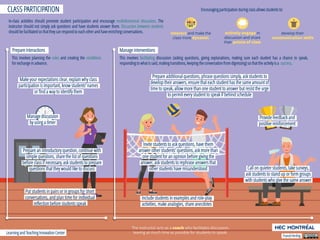
Prepare interactions
This involves planning the rules and creating the conditions
for exchange in advance.
Encouraging participation during class allows students to:
interact and make the
class more dynamic
Manage interventions
This involves facilitating discussion (asking questions, giving explanations, making sure each student has a chance to speak,
responding to what is said, making transitions, keeping the conversation from digressing) so that the activity is a success.
Franck Herling
actively engage in
discussion and share
their points of view
develop their
communication skills
Prepare an introductory question, continue with
simple questions, share the list of questions
before class if necessary, ask students to prepare
questions that they would like to discuss
Put students in pairs or in groups for short
conversations, and plan time for individual
reflection before students speak
Manage discussion
by using a timer
Include students in examples and role-play
activities, make analogies, share anecdotes
Prepare additional questions, phrase questions simply, ask students to
develop their answers, ensure that each student has the same amount of
time to speak, allow more than one student to answer but resist the urge
to permit every student to speak if behind schedule
Make your expectations clear, explain why class
participation is important, know students’ names
or find a way to identify them
Provide feedback and
positive reinforcement
Call on quieter students, take surveys,
ask students to stand up or form groups
with students who give the same answer
Invite students to ask questions, have them
answer other students’ questions, ask more than
one student for an opinion before giving the
answer, ask students to rephrase answers that
other students have misunderstood