PRACTICES FOR ENGAGING STUDENTS IN LEARNING
Teaching is not a spectator sport, neither is learning. That is why most of
the teachers cannot keep their students engaged in their course or the
classroom. Accordingly, students can never learn anything just by sitting
in the classroom and listening to their teachers, as well as spitting out
prepared answers or memorizing pre-defined assignments. One of the
key factors of a learning project success is Engagement. There are some
common effective techniques for boosting the engagement. Check
yourself if you leverage all of them.
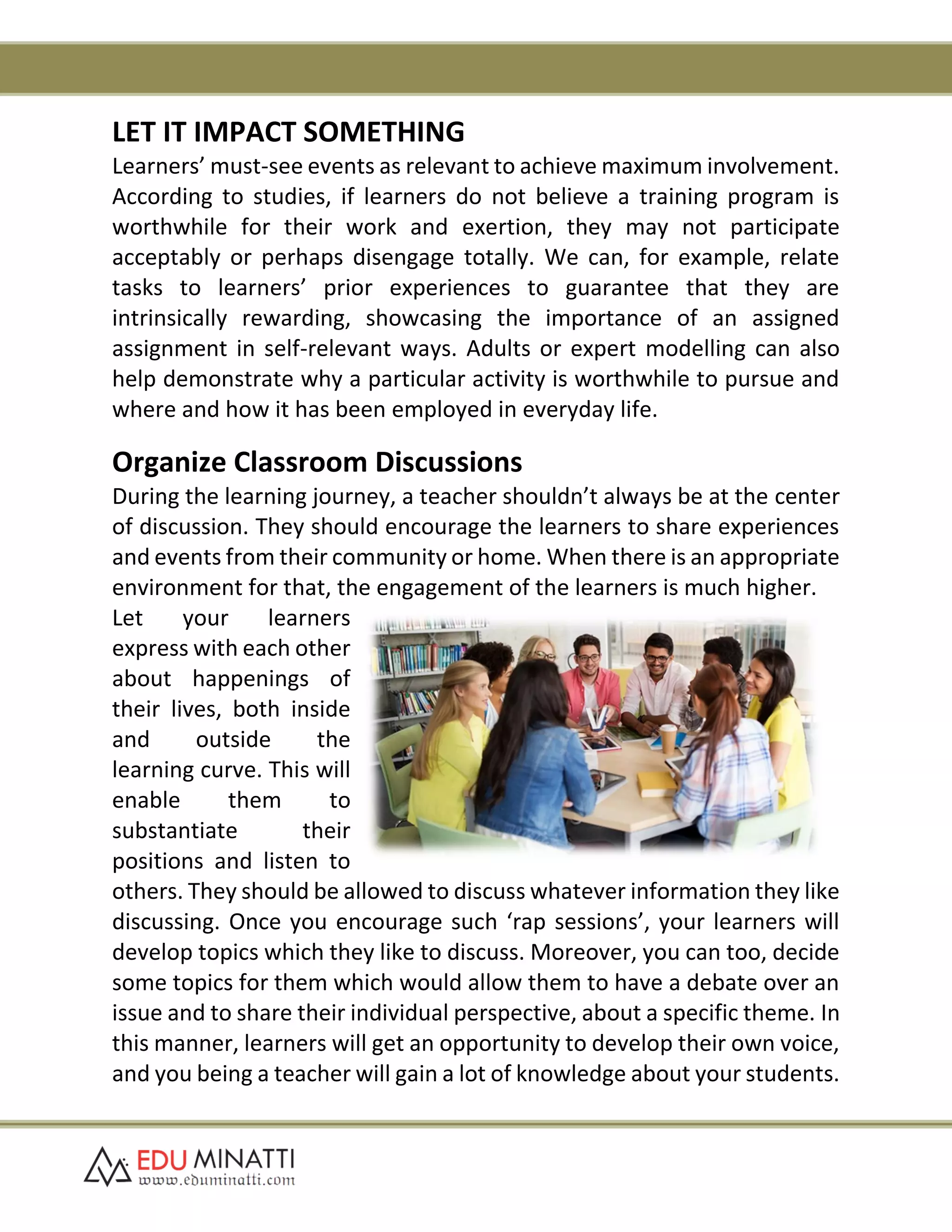
Whenever we speak of students’ engagement in learning experiences,
we generally think of it as being reflected by good behavior (i.e.,
Behavioral Engagement), happy emotions (Emotional Exhaustion
Involvement), and, most importantly, individual thought (i.e., Cognitive
Attention). This is because children may be interpersonally and
emotionally committed to a particular activity without really putting
forth the brain power required to comprehend and perfect the
information, talent, or art that the engagement encourages.
If you’ve ever taught online, odds are you won’t appreciate it nearly as
much as you enjoyed speaking in person. Teachers / Instructors from
across the world have voiced their dissatisfaction about delivering
exceptional education online. Creating exciting classroom opportunities
is one of the problems for teachers. Instructors that appreciate
relationships with their pupils have valid requests for assistance, ranging
from technical difficulties to zoom fatigue.
But on the other hand, learners are becoming increasingly frustrated
with the two-hour online courses and the lack of casual connections with
classmates after class. As educational moderators, we must reimagine
how we arrange and provide online learning that both excites our
learners and keeps our passion for teaching alive.
Given this, different studies have indicated that considering the principal
fundamental causes when designing and executing educational activities
may assist in boosting students’ motivation on behavioral, social, and
achievement and personal, hence favourably improving teaching and
learning and accomplishment. Check yourself if you can leverage all of
them.
LET IT IMPACT SOMETHING
Learners’ must-see events as relevant to achieve maximum involvement.
According to studies, if learners do not believe a training program is
worthwhile for their work and exertion, they may not participate
acceptably or perhaps disengage totally. We can, for example, relate
tasks to learners’ prior experiences to guarantee that they are
intrinsically rewarding, showcasing the importance of an assigned
assignment in self-relevant ways. Adults or expert modelling can also
help demonstrate why a particular activity is worthwhile to pursue and
where and how it has been employed in everyday life.
Organize Classroom Discussions
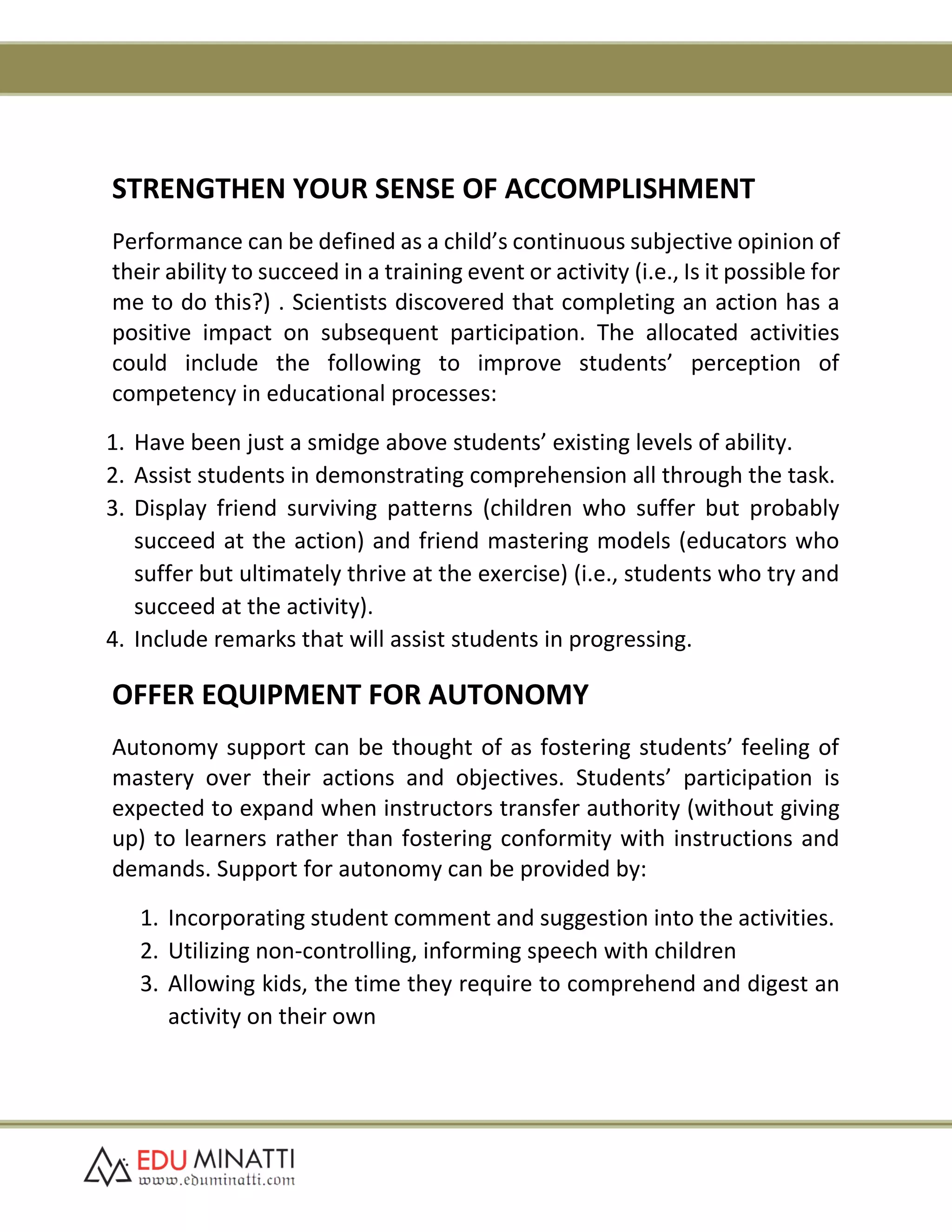
During the learning journey, a teacher shouldn’t always be at the center
of discussion. They should encourage the learners to share experiences
and events from their community or home. When there is an appropriate
environment for that, the engagement of the learners is much higher.
Let your learners
express with each other
about happenings of
their lives, both inside
and outside the
learning curve. This will
enable them to
substantiate their
positions and listen to
others. They should be allowed to discuss whatever information they like
discussing. Once you encourage such ‘rap sessions’, your learners will
develop topics which they like to discuss. Moreover, you can too, decide
some topics for them which would allow them to have a debate over an
issue and to share their individual perspective, about a specific theme. In
this manner, learners will get an opportunity to develop their own voice,
and you being a teacher will gain a lot of knowledge about your students.
STRENGTHEN YOUR SENSE OF ACCOMPLISHMENT
Performance can be defined as a child’s continuous subjective opinion of
their ability to succeed in a training event or activity (i.e., Is it possible for
me to do this?) . Scientists discovered that completing an action has a
positive impact on subsequent participation. The allocated activities
could include the following to improve students’ perception of
competency in educational processes:
1. Have been just a smidge above students’ existing levels of ability.
2. Assist students in demonstrating comprehension all through the task.
3. Display friend surviving patterns (children who suffer but probably
succeed at the action) and friend mastering models (educators who
suffer but ultimately thrive at the exercise) (i.e., students who try and
succeed at the activity).
4. Include remarks that will assist students in progressing.
OFFER EQUIPMENT FOR AUTONOMY
Autonomy support can be thought of as fostering students’ feeling of
mastery over their actions and objectives. Students’ participation is
expected to expand when instructors transfer authority (without giving
up) to learners rather than fostering conformity with instructions and
demands. Support for autonomy can be provided by:
1. Incorporating student comment and suggestion into the activities.
2. Utilizing non-controlling, informing speech with children
3. Allowing kids, the time they require to comprehend and digest an
activity on their own
APPRECIATE AND APPRECIATE INTERACTION AND
COLLABORATION
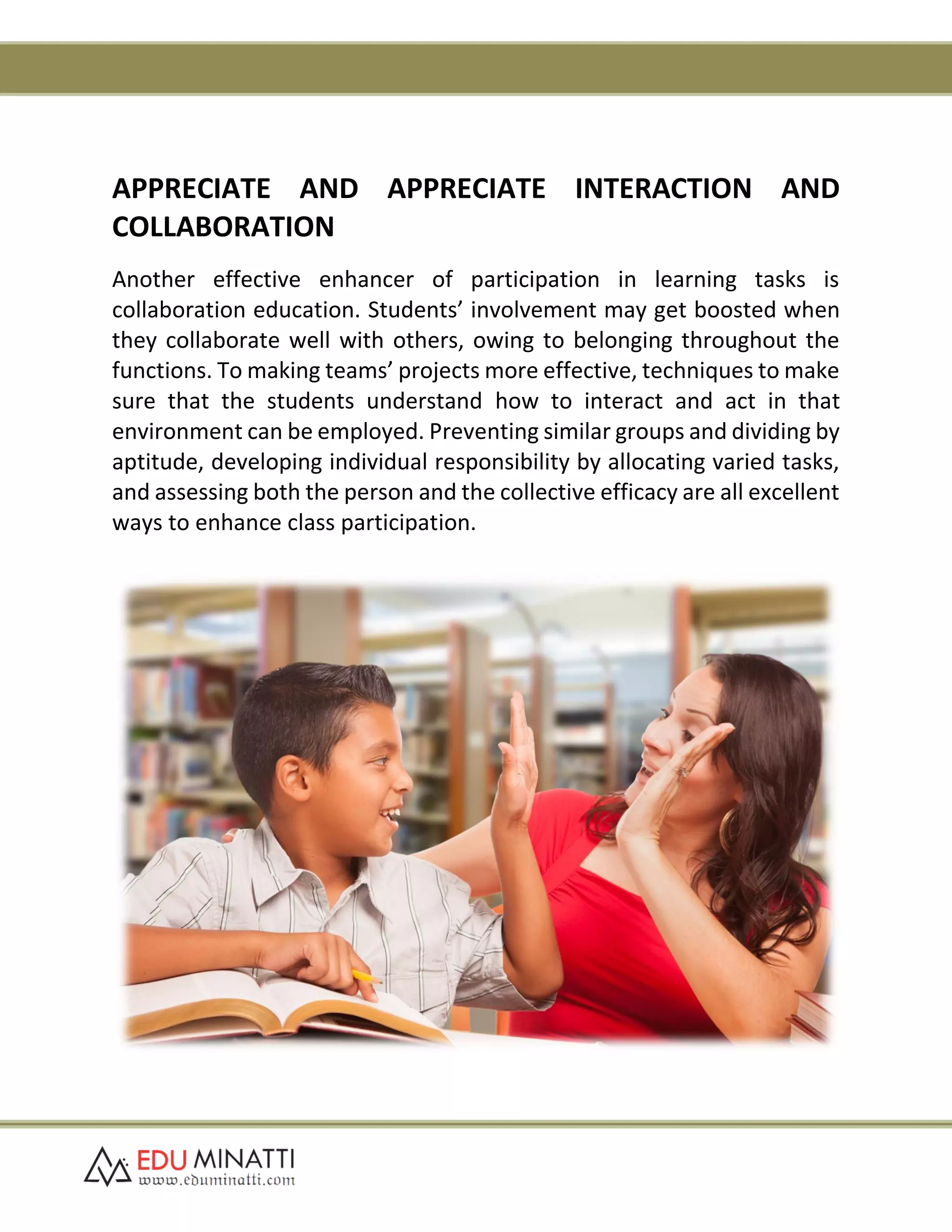
Another effective enhancer of participation in learning tasks is
collaboration education. Students’ involvement may get boosted when
they collaborate well with others, owing to belonging throughout the
functions. To making teams’ projects more effective, techniques to make
sure that the students understand how to interact and act in that
environment can be employed. Preventing similar groups and dividing by
aptitude, developing individual responsibility by allocating varied tasks,
and assessing both the person and the collective efficacy are all excellent
ways to enhance class participation.
BUILD PROFESSIONAL CONNECTIONS BETWEEN
TEACHER AND STUDENT
One important aspect in influencing student participation is the strength
of teacher-student connections, specifically for students who may be
struggling as well as those from poorer backgrounds. Children satisfy
their natural desire for a new connectedness with one another and a
sense of community in community when they create strong and loving
connections with their instructors.
EXCELLENCE ORIENTATIONS SHOULD BE PROMOTED
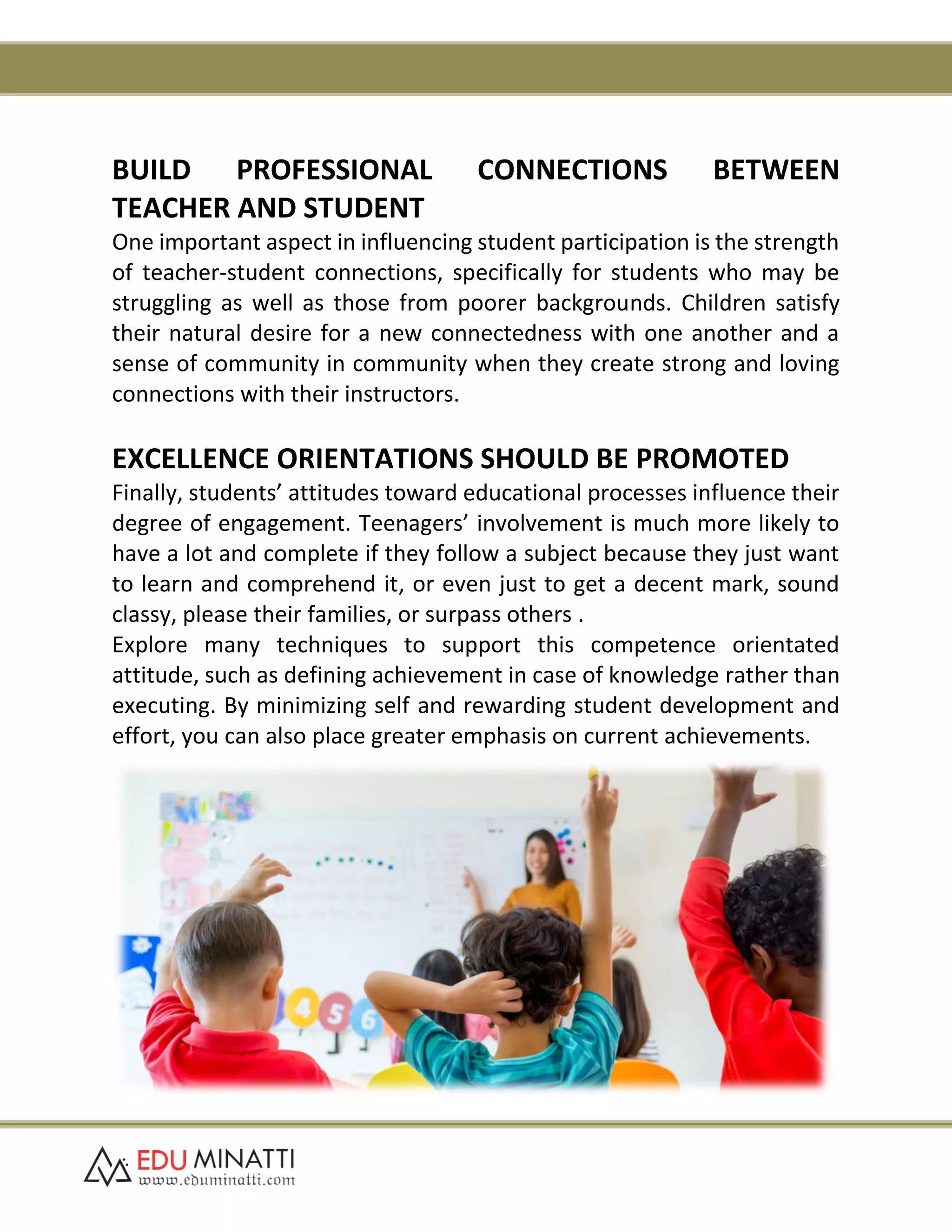
Finally, students’ attitudes toward educational processes influence their
degree of engagement. Teenagers’ involvement is much more likely to
have a lot and complete if they follow a subject because they just want
to learn and comprehend it, or even just to get a decent mark, sound
classy, please their families, or surpass others .
Explore many techniques to support this competence orientated
attitude, such as defining achievement in case of knowledge rather than
executing. By minimizing self and rewarding student development and
effort, you can also place greater emphasis on current achievements.
Rules to engage student in learning

Rules to engage student in learning

  • 2.
    PRACTICES FOR ENGAGINGSTUDENTS IN LEARNING Teaching is not a spectator sport, neither is learning. That is why most of the teachers cannot keep their students engaged in their course or the classroom. Accordingly, students can never learn anything just by sitting in the classroom and listening to their teachers, as well as spitting out prepared answers or memorizing pre-defined assignments. One of the key factors of a learning project success is Engagement. There are some common effective techniques for boosting the engagement. Check yourself if you leverage all of them. Whenever we speak of students’ engagement in learning experiences, we generally think of it as being reflected by good behavior (i.e., Behavioral Engagement), happy emotions (Emotional Exhaustion Involvement), and, most importantly, individual thought (i.e., Cognitive Attention). This is because children may be interpersonally and emotionally committed to a particular activity without really putting forth the brain power required to comprehend and perfect the information, talent, or art that the engagement encourages.
  • 3.
    If you’ve evertaught online, odds are you won’t appreciate it nearly as much as you enjoyed speaking in person. Teachers / Instructors from across the world have voiced their dissatisfaction about delivering exceptional education online. Creating exciting classroom opportunities is one of the problems for teachers. Instructors that appreciate relationships with their pupils have valid requests for assistance, ranging from technical difficulties to zoom fatigue. But on the other hand, learners are becoming increasingly frustrated with the two-hour online courses and the lack of casual connections with classmates after class. As educational moderators, we must reimagine how we arrange and provide online learning that both excites our learners and keeps our passion for teaching alive. Given this, different studies have indicated that considering the principal fundamental causes when designing and executing educational activities may assist in boosting students’ motivation on behavioral, social, and achievement and personal, hence favourably improving teaching and learning and accomplishment. Check yourself if you can leverage all of them.
  • 4.
    LET IT IMPACTSOMETHING Learners’ must-see events as relevant to achieve maximum involvement. According to studies, if learners do not believe a training program is worthwhile for their work and exertion, they may not participate acceptably or perhaps disengage totally. We can, for example, relate tasks to learners’ prior experiences to guarantee that they are intrinsically rewarding, showcasing the importance of an assigned assignment in self-relevant ways. Adults or expert modelling can also help demonstrate why a particular activity is worthwhile to pursue and where and how it has been employed in everyday life. Organize Classroom Discussions During the learning journey, a teacher shouldn’t always be at the center of discussion. They should encourage the learners to share experiences and events from their community or home. When there is an appropriate environment for that, the engagement of the learners is much higher. Let your learners express with each other about happenings of their lives, both inside and outside the learning curve. This will enable them to substantiate their positions and listen to others. They should be allowed to discuss whatever information they like discussing. Once you encourage such ‘rap sessions’, your learners will develop topics which they like to discuss. Moreover, you can too, decide some topics for them which would allow them to have a debate over an issue and to share their individual perspective, about a specific theme. In this manner, learners will get an opportunity to develop their own voice, and you being a teacher will gain a lot of knowledge about your students.
  • 5.
    STRENGTHEN YOUR SENSEOF ACCOMPLISHMENT Performance can be defined as a child’s continuous subjective opinion of their ability to succeed in a training event or activity (i.e., Is it possible for me to do this?) . Scientists discovered that completing an action has a positive impact on subsequent participation. The allocated activities could include the following to improve students’ perception of competency in educational processes: 1. Have been just a smidge above students’ existing levels of ability. 2. Assist students in demonstrating comprehension all through the task. 3. Display friend surviving patterns (children who suffer but probably succeed at the action) and friend mastering models (educators who suffer but ultimately thrive at the exercise) (i.e., students who try and succeed at the activity). 4. Include remarks that will assist students in progressing. OFFER EQUIPMENT FOR AUTONOMY Autonomy support can be thought of as fostering students’ feeling of mastery over their actions and objectives. Students’ participation is expected to expand when instructors transfer authority (without giving up) to learners rather than fostering conformity with instructions and demands. Support for autonomy can be provided by: 1. Incorporating student comment and suggestion into the activities. 2. Utilizing non-controlling, informing speech with children 3. Allowing kids, the time they require to comprehend and digest an activity on their own
  • 6.
    APPRECIATE AND APPRECIATEINTERACTION AND COLLABORATION Another effective enhancer of participation in learning tasks is collaboration education. Students’ involvement may get boosted when they collaborate well with others, owing to belonging throughout the functions. To making teams’ projects more effective, techniques to make sure that the students understand how to interact and act in that environment can be employed. Preventing similar groups and dividing by aptitude, developing individual responsibility by allocating varied tasks, and assessing both the person and the collective efficacy are all excellent ways to enhance class participation.
  • 7.
    BUILD PROFESSIONAL CONNECTIONSBETWEEN TEACHER AND STUDENT One important aspect in influencing student participation is the strength of teacher-student connections, specifically for students who may be struggling as well as those from poorer backgrounds. Children satisfy their natural desire for a new connectedness with one another and a sense of community in community when they create strong and loving connections with their instructors. EXCELLENCE ORIENTATIONS SHOULD BE PROMOTED Finally, students’ attitudes toward educational processes influence their degree of engagement. Teenagers’ involvement is much more likely to have a lot and complete if they follow a subject because they just want to learn and comprehend it, or even just to get a decent mark, sound classy, please their families, or surpass others . Explore many techniques to support this competence orientated attitude, such as defining achievement in case of knowledge rather than executing. By minimizing self and rewarding student development and effort, you can also place greater emphasis on current achievements.