Connect: Supporting Children Exposed to Domestic Violence
Agenda Slide #  Welcome and Introductions Family Dynamics and Domestic Violence What Children Experience Parenting and Supporting Children Affected by DV
Introductions Slide #  Tell us your name And share a  nickname  you’ve been  called (or wouldn’t  mind being called!)
Getting Started Slide #  Read the question on the card and share it with  your group Discuss the question Develop a two sentence response in 5 minutes Share your question and response with the  large group
Slide #  #1 Why is it important for  resource families to know  about domestic violence? #2  How would you feel about a child if you  learned that s/he lived in a home where  domestic violence occurred? What do you think?
What do you think? Slide #  #3  How would you feel about a child’s birth parents if you  learned that the child came from a home where  domestic violence took place? Would you feel  differently about the victim parent versus the abusive parent?
Slide #  #4  How might you support  children who have experienced domestic  violence differently than  other children? #5  In what ways are domestic violence and  child maltreatment connected? What do you think?
Slide #  Family Violence   refers to violence  between any family members such as: intimate partner violence  (also known as domestic violence) abuse of a parent by a child elder abuse  sibling abuse child maltreatment
Slide #  Domestic and  Dating Violence: Domestic and dating violence are  NOT   just physical or sexual assault! Patterns of coercive and controlling behaviors perpetrated by an adult or teen against an intimate partner.
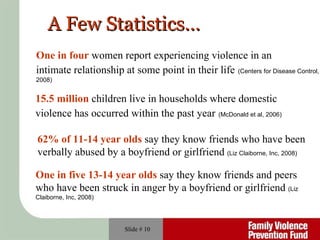
A Few Statistics… Slide #  One in four   women report experiencing violence in an  intimate relationship at some point in their life   (Centers for Disease Control, 2008) 15.5 million   children live in households where domestic  violence has occurred within the past year   (McDonald et al, 2006) 62% of 11-14 year olds   say they know friends who have been  verbally abused by a boyfriend or girlfriend   (Liz Claiborne, Inc, 2008) One in five 13-14 year olds  say they know friends and peers who have been struck in anger by a boyfriend or girlfriend   (Liz Claiborne, Inc, 2008)
Why do Men use Violence In Intimate Partner Relationships? Slide #  Some ideas people have: • to establish control • acting out culturally designated roles • mirroring violence in society • because they can get away with it it is learned behavior Remember:  Not every act of violence between  two intimate partners is domestic violence.  DV is not an isolated incident, but a  pattern   of coercive  and controlling behavior.
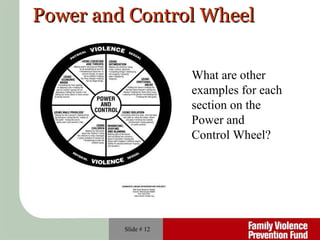
Power and Control Wheel Slide #  What are other  examples for each  section on the  Power and  Control Wheel?
Slide #  Why do Women Stay???
Slide #  Why might it be difficult to work with parents who are victims or perpetrators of domestic violence?
Remember:  DV situations can be hard for  anyone  to manage. It’s good to seek help and emotional support. Where can you find help in your community? Slide #
Slide #  Not all children are affected by domestic violence in the same way.  Exposure to Domestic Violence:
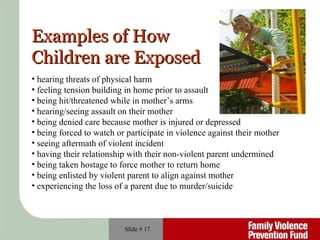
Slide #  hearing threats of physical harm  feeling tension building in home prior to assault being hit/threatened while in mother’s arms hearing/seeing assault on their mother being denied care because mother is injured or depressed  being forced to watch or participate in violence against their mother seeing aftermath of violent incident having their relationship with their non-violent parent undermined being taken hostage to force mother to return home being enlisted by violent parent to align against mother experiencing the loss of a parent due to murder/suicide Examples of How Children are Exposed
Slide #  Factor: The Child’s Age The younger the child, the more harmful the impact may be.
Slide #  Factor: The Child’s  Developmental Stage Exposure to domestic violence can affect the  tasks or milestones of the particular child’s  stage of development.
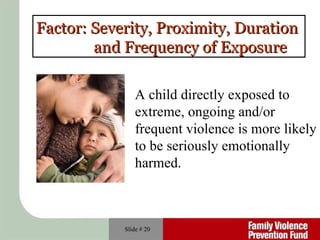
Slide #  Factor: Severity, Proximity, Duration  and Frequency of Exposure A child directly exposed to extreme, ongoing and/or frequent violence is more likely to be seriously emotionally harmed.
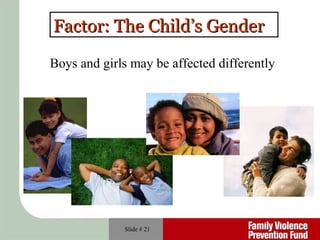
Slide #  Factor: The Child’s Gender Boys and girls may be affected differently
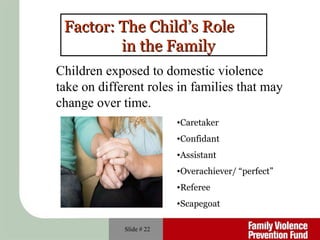
Slide #  Factor: The Child’s Role  in the Family Children exposed to domestic violence  take on different roles in families that may change over time.   Caretaker Confidant Assistant Overachiever/ “perfect” Referee Scapegoat
Slide #  Factor:  Personal Characteristics  of the Child   Some children have a strong sense of self and are able to weather their exposure to violence by drawing on internal strength.
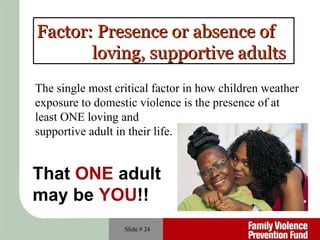
Slide #  Factor: Presence or absence of  loving, supportive adults The single most critical factor in how children weather exposure to domestic violence is the presence of at least ONE loving and  supportive adult in their life. That  ONE  adult  may be  YOU !!
Slide #  Factor: Responsiveness of systems   Knowledgeable and skilled professionals who understand and respond effectively to families can play a significant role in how children are impacted.
Slide #  What are some of the FEELINGS and BEHAVIORS that children in your care have displayed?
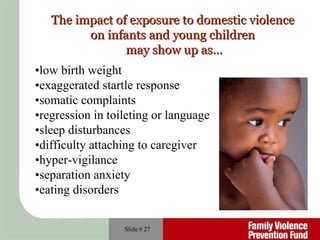
Slide #  The impact of exposure to domestic violence   on infants and young children  may show up as… • low birth weight • exaggerated startle response • somatic complaints • regression in toileting or language • sleep disturbances • difficulty attaching to caregiver • hyper-vigilance • separation anxiety • eating disorders
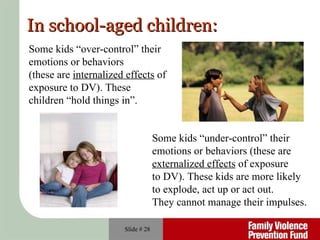
Slide #  In school-aged children: Some kids “over-control” their  emotions or behaviors  (these are  internalized effects  of  exposure to DV). These  children “hold things in”. Some kids “under-control” their  emotions or behaviors (these are  externalized effects  of exposure  to DV). These kids are more likely  to explode, act up or act out.  They cannot manage their impulses.
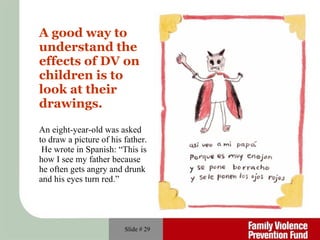
A good way to understand the effects of DV on children is to look at their  drawings.   An eight-year-old was asked to draw a picture of his father.  He wrote in Spanish: “This is how I see my father because he often gets angry and drunk and his eyes turn red.” Slide #
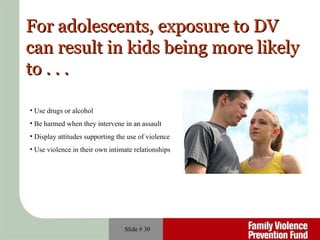
Slide #  For adolescents, exposure to DV  can result in kids being more likely to . . . Use drugs or alcohol  Be harmed when they intervene in an assault Display attitudes supporting the use of violence Use violence in their own intimate relationships
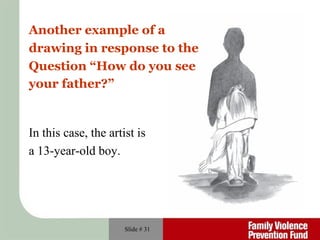
Slide #  Another example of a  drawing in response to the  Question “How do you see your father?”   In this case, the artist is a 13-year-old boy.
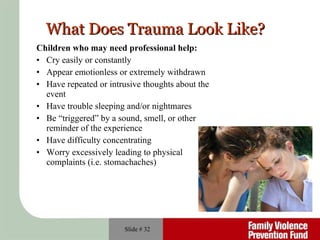
What Does Trauma Look Like? Children who may need professional help: Cry easily or constantly Appear emotionless or extremely withdrawn Have repeated or intrusive thoughts about the event Have trouble sleeping and/or nightmares Be “triggered” by a sound, smell, or other reminder of the experience Have difficulty concentrating Worry excessively leading to physical complaints (i.e. stomachaches) Slide #
Slide #  Which of these effects in children are  easier for you to handle as a parent?  Why? Which of these effects “drive you crazy”  or makes it hard for you to parent?  Why? Questions:
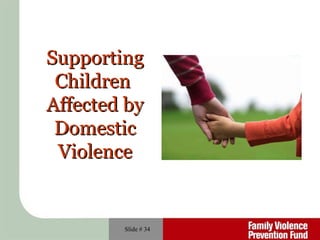
Slide #  Supporting Children  Affected by Domestic Violence
Slide #  Resource Parents Need to Know Many children will worry about their mothers safety  and will miss their family Tender loving care (TLC) is important but may not  always be enough Children need to move from unpredictable danger to reliable safety Relationships may be too close for comfort There is no quick, easy fix
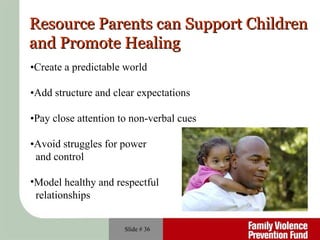
Slide #  Resource Parents can Support Children  and Promote Healing • Create a predictable world • Add structure and clear expectations • Pay close attention to non-verbal cues • Avoid struggles for power  and control Model healthy and respectful  relationships
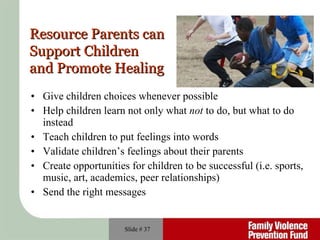
Give children choices whenever possible Help children learn not only what  not  to do, but what to do instead Teach children to put feelings into words Validate children’s feelings about their parents Create opportunities for children to be successful (i.e. sports, music, art, academics, peer relationships) Send the right messages Slide #  Resource Parents can Support Children  and Promote Healing
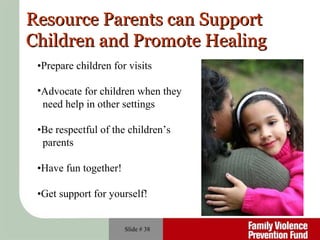
Slide #  Resource Parents can Support Children and Promote Healing • Prepare children for visits Advocate for children when they  need help in other settings • Be respectful of the children’s  parents • Have fun together!  • Get support for yourself!
Slide #  Group Activity Read the case study Discuss the questions at the end of the case study as a group Pick a spokesperson to share with the  large group
Slide #  You have the power to help children heal Final Questions?
Slide #  Thank you for your  participation today! Please  visit the Family Violence  Prevention Fund at   www.endabuse.org

Connect power point presentation(1)

  • 1.
    Connect: Supporting ChildrenExposed to Domestic Violence
  • 2.
    Agenda Slide # Welcome and Introductions Family Dynamics and Domestic Violence What Children Experience Parenting and Supporting Children Affected by DV
  • 3.
    Introductions Slide # Tell us your name And share a nickname you’ve been called (or wouldn’t mind being called!)
  • 4.
    Getting Started Slide# Read the question on the card and share it with your group Discuss the question Develop a two sentence response in 5 minutes Share your question and response with the large group
  • 5.
    Slide # #1 Why is it important for resource families to know about domestic violence? #2 How would you feel about a child if you learned that s/he lived in a home where domestic violence occurred? What do you think?
  • 6.
    What do youthink? Slide # #3 How would you feel about a child’s birth parents if you learned that the child came from a home where domestic violence took place? Would you feel differently about the victim parent versus the abusive parent?
  • 7.
    Slide # #4 How might you support children who have experienced domestic violence differently than other children? #5 In what ways are domestic violence and child maltreatment connected? What do you think?
  • 8.
    Slide # Family Violence refers to violence between any family members such as: intimate partner violence (also known as domestic violence) abuse of a parent by a child elder abuse sibling abuse child maltreatment
  • 9.
    Slide # Domestic and Dating Violence: Domestic and dating violence are NOT just physical or sexual assault! Patterns of coercive and controlling behaviors perpetrated by an adult or teen against an intimate partner.
  • 10.
    A Few Statistics…Slide # One in four women report experiencing violence in an intimate relationship at some point in their life (Centers for Disease Control, 2008) 15.5 million children live in households where domestic violence has occurred within the past year (McDonald et al, 2006) 62% of 11-14 year olds say they know friends who have been verbally abused by a boyfriend or girlfriend (Liz Claiborne, Inc, 2008) One in five 13-14 year olds say they know friends and peers who have been struck in anger by a boyfriend or girlfriend (Liz Claiborne, Inc, 2008)
  • 11.
    Why do Menuse Violence In Intimate Partner Relationships? Slide # Some ideas people have: • to establish control • acting out culturally designated roles • mirroring violence in society • because they can get away with it it is learned behavior Remember: Not every act of violence between two intimate partners is domestic violence. DV is not an isolated incident, but a pattern of coercive and controlling behavior.
  • 12.
    Power and ControlWheel Slide # What are other examples for each section on the Power and Control Wheel?
  • 13.
    Slide # Why do Women Stay???
  • 14.
    Slide # Why might it be difficult to work with parents who are victims or perpetrators of domestic violence?
  • 15.
    Remember: DVsituations can be hard for anyone to manage. It’s good to seek help and emotional support. Where can you find help in your community? Slide #
  • 16.
    Slide # Not all children are affected by domestic violence in the same way. Exposure to Domestic Violence:
  • 17.
    Slide # hearing threats of physical harm feeling tension building in home prior to assault being hit/threatened while in mother’s arms hearing/seeing assault on their mother being denied care because mother is injured or depressed being forced to watch or participate in violence against their mother seeing aftermath of violent incident having their relationship with their non-violent parent undermined being taken hostage to force mother to return home being enlisted by violent parent to align against mother experiencing the loss of a parent due to murder/suicide Examples of How Children are Exposed
  • 18.
    Slide # Factor: The Child’s Age The younger the child, the more harmful the impact may be.
  • 19.
    Slide # Factor: The Child’s Developmental Stage Exposure to domestic violence can affect the tasks or milestones of the particular child’s stage of development.
  • 20.
    Slide # Factor: Severity, Proximity, Duration and Frequency of Exposure A child directly exposed to extreme, ongoing and/or frequent violence is more likely to be seriously emotionally harmed.
  • 21.
    Slide # Factor: The Child’s Gender Boys and girls may be affected differently
  • 22.
    Slide # Factor: The Child’s Role in the Family Children exposed to domestic violence take on different roles in families that may change over time. Caretaker Confidant Assistant Overachiever/ “perfect” Referee Scapegoat
  • 23.
    Slide # Factor: Personal Characteristics of the Child Some children have a strong sense of self and are able to weather their exposure to violence by drawing on internal strength.
  • 24.
    Slide # Factor: Presence or absence of loving, supportive adults The single most critical factor in how children weather exposure to domestic violence is the presence of at least ONE loving and supportive adult in their life. That ONE adult may be YOU !!
  • 25.
    Slide # Factor: Responsiveness of systems Knowledgeable and skilled professionals who understand and respond effectively to families can play a significant role in how children are impacted.
  • 26.
    Slide # What are some of the FEELINGS and BEHAVIORS that children in your care have displayed?
  • 27.
    Slide # The impact of exposure to domestic violence on infants and young children may show up as… • low birth weight • exaggerated startle response • somatic complaints • regression in toileting or language • sleep disturbances • difficulty attaching to caregiver • hyper-vigilance • separation anxiety • eating disorders
  • 28.
    Slide # In school-aged children: Some kids “over-control” their emotions or behaviors (these are internalized effects of exposure to DV). These children “hold things in”. Some kids “under-control” their emotions or behaviors (these are externalized effects of exposure to DV). These kids are more likely to explode, act up or act out. They cannot manage their impulses.
  • 29.
    A good wayto understand the effects of DV on children is to look at their drawings. An eight-year-old was asked to draw a picture of his father. He wrote in Spanish: “This is how I see my father because he often gets angry and drunk and his eyes turn red.” Slide #
  • 30.
    Slide # For adolescents, exposure to DV can result in kids being more likely to . . . Use drugs or alcohol Be harmed when they intervene in an assault Display attitudes supporting the use of violence Use violence in their own intimate relationships
  • 31.
    Slide # Another example of a drawing in response to the Question “How do you see your father?” In this case, the artist is a 13-year-old boy.
  • 32.
    What Does TraumaLook Like? Children who may need professional help: Cry easily or constantly Appear emotionless or extremely withdrawn Have repeated or intrusive thoughts about the event Have trouble sleeping and/or nightmares Be “triggered” by a sound, smell, or other reminder of the experience Have difficulty concentrating Worry excessively leading to physical complaints (i.e. stomachaches) Slide #
  • 33.
    Slide # Which of these effects in children are easier for you to handle as a parent? Why? Which of these effects “drive you crazy” or makes it hard for you to parent? Why? Questions:
  • 34.
    Slide # Supporting Children Affected by Domestic Violence
  • 35.
    Slide # Resource Parents Need to Know Many children will worry about their mothers safety and will miss their family Tender loving care (TLC) is important but may not always be enough Children need to move from unpredictable danger to reliable safety Relationships may be too close for comfort There is no quick, easy fix
  • 36.
    Slide # Resource Parents can Support Children and Promote Healing • Create a predictable world • Add structure and clear expectations • Pay close attention to non-verbal cues • Avoid struggles for power and control Model healthy and respectful relationships
  • 37.
    Give children choiceswhenever possible Help children learn not only what not to do, but what to do instead Teach children to put feelings into words Validate children’s feelings about their parents Create opportunities for children to be successful (i.e. sports, music, art, academics, peer relationships) Send the right messages Slide # Resource Parents can Support Children and Promote Healing
  • 38.
    Slide # Resource Parents can Support Children and Promote Healing • Prepare children for visits Advocate for children when they need help in other settings • Be respectful of the children’s parents • Have fun together! • Get support for yourself!
  • 39.
    Slide # Group Activity Read the case study Discuss the questions at the end of the case study as a group Pick a spokesperson to share with the large group
  • 40.
    Slide # You have the power to help children heal Final Questions?
  • 41.
    Slide # Thank you for your participation today! Please visit the Family Violence Prevention Fund at www.endabuse.org