‘ Learn Without Fear’ Conference  Violence in schools from a gender perspective  Professor Fiona Leach, Centre for International Education, University of Sussex, UK  www.sussex.ac.uk/education/genderviolence  Plan International, Hamburg  12-14 November 2008
Definitions  Violence is ‘all forms of physical or mental violence, injury and abuse, neglect or negligent treatment, maltreatment or exploitation, including sexual abuse’ (article 1 of the Convention on the Rights of the Child)  Gender-based violence ‘involves a violation of human rights that results in all forms of violence based on gender relations. It includes physical harm, sexual acts, emotional/psychological abuse and economic deprivation’ (Commonwealth Secretariat, 2002)  'Learn Without Fear', Plan International, Hamburg
What counts as violence in school?  Overlapping terms:  •  Physical  •  Bullying  •  Teasing, gossip, spreading rumours  •  Verbal  •  Sexual  •  Intimidation, threats  •  Emotional  •  Assault  •  Psychological  •  Rape  •  Sexual harassment / abuse  •  Sexual corruption  •  Verbal abuse  Also:  •  Corporal punishment  •  Fear of violence  •  Ostracism, victimisation  •  Cyber-bullying  •  Vandalism, arson, theft etc  12 November 2008  'Learn Without Fear', Plan International, Hamburg
The scale of the problem  Globally, difficult to assess due to: • limited scope of many studies • methodological challenges  •  differing terminology, conceptualisation of the problem  e.g. regional concerns:  •  Sub-Saharan Africa: sexual abuse (of girls) linked to HIV/AIDS • Latin America: physical violence (by boys) linked to gangs, drugs and guns • Asia: corporal punishment, bullying (largely genderless)  •  USA: youth violence/sexual harassment (more recently … bullying) • Europe: bullying, violence (largely genderless)  12 November 2008  'Learn Without Fear', Plan International, Hamburg
The evidence: international studies  Numerous studies of  bullying  e.g. Olweus (1993) and  school violence , e.g. Akiba et al (2002) study in 37 countries; Smith (2000) in 17 European countries, UNESCO (1997) in 6 countries. Little attention to gender dimension.  UN (2006)  World Report on Violence against Children : 5 settings (home, school,  care institutions, workplace, community) with some gender analysis  Gender-based studies/focus on girls:  Amnesty International (2007)  Safe Schools, Every Girl’s Right  Panos (2003)  Beyond Victims and Villains: addressing sexual violence in the education sector  ActionAid (2004) (research-based campaign)  Stop Violence against Girls in School  USAID/Wellesley  Centers for Women (2003)  Unsafe Schools: a Literature Review of School-Related Gender-Based Violence in Developing Countries .  12 November 2008  'Learn Without Fear', Plan International, Hamburg
UN Report 2006  ‘ The Study has found that too often, violence is perpetrated by those responsible for the child’s safety and well-being—their parents, teachers, their guardians, the police. Children often have no place to go to report such violence, and no recourse when it occurs. They are betrayed not only by those who subject them to beatings, sexual violence, torture or even murder, but also by the authorities who fail to protect them or take appropriate action to hold perpetrators accountable.’  Statement from the NGO Advisory Panel at the launch of the UN report, 11 October 2006  12 November 2008  'Learn Without Fear', Plan International, Hamburg
The evidence: country studies with a gender perspective  Africa : at least 10 countries since 2000 (Benin, Botswana, Cameroon, Ghana, Kenya, Malawi, Rwanda, South Africa, Togo, Zimbabwe). Most focus on girls, are small scale and qualitative.  Asia : Nepal (1997), Pakistan (2006), India (2007); most evidence from broader studies e.g. Govt of India study of child abuse (2007)  USA : AAUW (2001)  Europe :  Scandinavia (2003), England (1999, 2006),  Russia (2002)  Related research  on masculinities and youth violence, homophobia in schools, youth and sexuality, HIV/AIDS, school health, and children in conflict also reveal gender violence  Also: regional desk surveys for the UN study (www.violencestudy.org/r57)  Frequent media reports  12 November 2008  'Learn Without Fear', Plan International, Hamburg
The importance of a gender perspective  •  Violence is largely a product of social inequities, including unequal gender relations  •  It is often associated with hyper-masculinity and socially sanctioned forms of masculine and feminine behaviour  •  Gender interacts with other social markers of identity such as race, ethnicity, class, age, sexuality  •  Females and males experience violence in very different ways • Blaming the individual e.g. the bully will not reduce violence in schools  ‘ Gender-based violence’ suggests some forms of violence are not gendered, so is ‘gender violence’ a more accurate term?  12 November 2008  'Learn Without Fear', Plan International, Hamburg
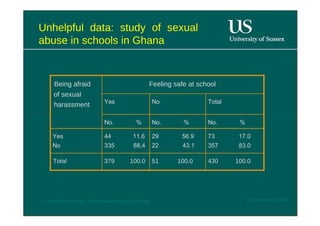
Unhelpful data: study of sexual abuse in schools in Ghana  Being afraid  Feeling safe at school  of sexual  Yes  No  Total  harassment  No.  %  No.  %  No.  %  Yes  44  11.6  29  56.9  73  17.0  No  335  88.4  22  43.1  357  83.0  Total  379  100.0  51  100.0  430  100.0  12 November 2008  'Learn Without Fear', Plan International, Hamburg
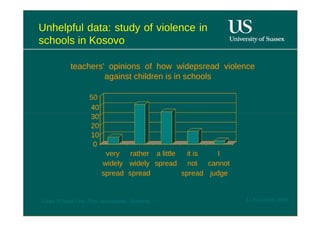
Unhelpful data: study of violence in schools in Kosovo  teachers' opinions of how widepsread violence against children is in schools  50  40 30 20 10 0  very  rather  a little  it is  I  widely  widely  spread  not  cannot  spread  spread  spread  judge  12 November 2008  'Learn Without Fear', Plan International, Hamburg
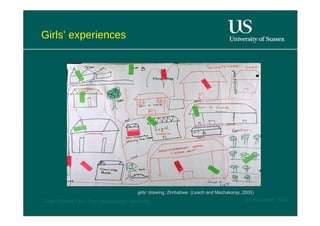
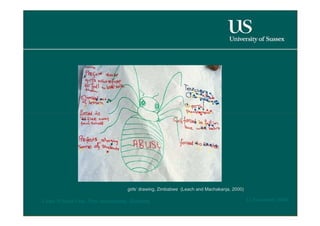
Findings from studies in Sub- Saharan Africa  Girls report :  •  Inappropriate / unsolicited sexualised touching by boys; intimidation in lessons • Beatings and threats by teachers and boys  •  Verbal abuse by teachers and peers, sexualised insults, name-calling • Propositioning for sex by teachers, male students and men in the community • Theft of food, money, pens, books ...  •  Rape, forced sex  •  Punishments by teachers, including corporal punishment • Running errands for teachers  •  Fear of violence  12 November 2008  'Learn Without Fear', Plan International, Hamburg
Girls’ experiences  girls’ drawing, Zimbabwe  (Leach and Machakanja, 2000)  12 November 2008  'Learn Without Fear', Plan International, Hamburg
girls’ drawing, Zimbabwe  (Leach and Machakanja, 2000)  12 November 2008  'Learn Without Fear', Plan International, Hamburg
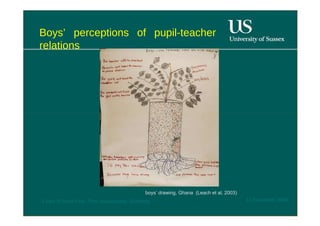
Findings from studies in Sub- Saharan Africa  Boys report :  •  Excessive corporal punishment, boys targeted unfairly • Teachers’ preferential treatment of girls, boys picked on by teachers • Verbal abuse by teachers  •  Playing truant for fear of being beaten  •  Negative attitudes/low regard for girls (seeking favours from teachers, e.g. high grades, free tuition)  Also some evidence of homophobic bullying/ girls bullying boys  12 November 2008  'Learn Without Fear', Plan International, Hamburg
Boys’ perceptions of pupil-teacher relations  boys’ drawing, Ghana  (Leach et al, 2003)  12 November 2008  'Learn Without Fear', Plan International, Hamburg
Neglected areas of research  •  Sexual abuse of boys - evidence from church-run schools (Europe & USA) and Koranic schools (Pakistan)  •  Student-on-teacher violence, including sexual harassment of (young) female teachers and verbal (sexist) abuse  •  Homophobic violence  •  Girl-on-girl violence  •  Sexual misconduct by female teachers  Also:  •  new forms of school-related violence, e.g. cyberbullying (Shariff, 2008) • context-specific forms, e.g. jackrolling (South Africa); acid attacks, eve- teasing (South Asia)  12 November 2008  'Learn Without Fear', Plan International, Hamburg
Why does gender violence exist? Factors external to the school  Economic and social conditions:  •  Poverty - school fees, uniforms etc  •  Lack of accountability, transparency and law enforcement • Gender inequalities, low status accorded women and girls • Acceptance of rigid norms of male and female behaviour; tolerance of male violence  •  Low awareness/recognition/enforcement of human rights • Civil conflict, widespread violence in society  •  Discrimination against minority groups (e.g. gay and lesbian/ ethnic and racial/ disability/ HIV)  These conditions are reflected and reinforced in school  12 November 2008  'Learn Without Fear', Plan International, Hamburg
Why?  Factors internal to the school  Schools as institutions:  •  Schools are bounded by formal rules and informal practices which regulate behaviour  •  These ‘normalise’ unequal power relations through hierarchies of gender and age/authority (gender regimes)  •  School cultures affirm and endorse heterosexual norms of masculine and feminine behaviour, e.g. through the gendering of duties, interactions and space • Contravening rules and accepted practices risks punishment or victimisation • Poor accountability and weak leadership allow violence to go unchecked • So it becomes part of school life, with males more likely to both invite and inflict violence  •  One type of violence feeds on another/is reinforced by home and society  12 November 2008  'Learn Without Fear', Plan International, Hamburg
The impact  Social:  •  Breeds more violence and the acceptance of violence in adult relationships • Impedes development of social skills, self-confidence  •  Increases social/economic burden on governments  Health:  •  Long term physical, psychological and emotional damage; depression, trauma, anxiety, suicide; low productivity  •  High risk behaviours, e.g. substance abuse, alcoholism, smoking, eating disorders  •  Early pregnancy and STIs, including HIV/AIDS  Educational:  •  Absenteeism, truancy, dropout, under-achievement  12 November 2008  'Learn Without Fear', Plan International, Hamburg
Responses  WEAK  •  Gendered violence accepted as part of school life  • ‘ Boys will be boys’; girls ‘asking for it’; beatings harden boys - rite of passage; girls need to ‘say no’ (while being compliant)  •  Prosecutions and dismissal of teachers for sexual misconduct are rare; official indifference, obfuscation and denial  •  Lack of transparency and information on complaints procedures • Slow implementation of awareness raising and training for teachers • Local, national and international initiatives inadequately resourced and supported  12 November 2008  'Learn Without Fear', Plan International, Hamburg
What is being done?  •  Legislative frameworks - international agreements/national legislation • Activities for schools, e.g. curriculum materials (life skills/HIV prevention), teachers’ manuals, participatory projects e.g. theatre, film, art, video  •  Improved information for parents and pupils, e.g. anti-bullying websites • Some tightening of teachers’ codes of conduct, disciplinary procedures • Some teacher education: pupil-centred, skills-based, gender training • NGO programmes and advocacy work  •  Media exposure  12 November 2008  'Learn Without Fear', Plan International, Hamburg
What NEEDS to be done?  •  Research: large scale cross-national studies, appropriate methodologies and common definitions  •  Legislation: enforce/tighten existing laws and policies, global commitments (e.g. on corporal punishment)  •  Intersectoral and inter-agency collaboration  •  Advocacy and awareness raising: among officials, communities, teachers, students (including gender sensitisation and legal literacy) • Involving children in designing interventions and finding solutions • Strengthening state and civic responsibilities, engagement and actions: holistic approaches, strong leadership, greater accountability, community mobilisation • Changing school cultures and perceptions of appropriate behaviour, child- friendly schools, e.g. Rights Respecting Schools (UNICEF)  •  Challenging conventional gender stereotypes and excessive authoritarianism  12 November 2008  'Learn Without Fear', Plan International, Hamburg
Reflections and challenges after a decade of research  Early research was simplistic, mostly focused on girls, portrayed girls as victims and boys as aggressors; role of agency underplayed, differences among girls and among boys ignored; interaction of gender with other social markers neglected.  Some recent research offers a more mature and complex understanding of school violence and its links with unequal gender relations.  However, there remain challenges:  •  Sensitivity of research topic; methodological challenges e.g. unreliable data (boys overplay, girls underplay sexual activity); size of sample • Culture of denial by teachers and officials  •  Complexity of gender relationships, e.g. coercion v. consent in transactional sex • How to make an impact and ensure long-term change  12 November 2008  'Learn Without Fear', Plan International, Hamburg
Web-based resources  Anti-bullying websites:  www.bullyingnoway.com.au ,  www.bullying.co.uk  Cyber-bullying/internet porn campaign (ECPAT)  www.make-IT-safe.net ,  www.becta.org.uk  Multi-media for children:  www.soulcity.org ,  www.storyworkshop.org  Activities/books for children:  Safe You, Safe Me  &  Our Right to Be Protected from Violence  www.violencestudy.org , Auntie Stella  www.auntiestella.org  Manuals for educators: Finding Our Voices  www.unicef.org , Opening Our Eyes  http://iirc.mcgill.ca/txp/index.php?id=83  Safe Schools Program  www.usaid.gov/our_work/cross-cutting_programs/wid/ , ActionAid Kenya Participatory work with children/youth (art, photo-voice, video)  www.ivmproject.ca , with male youth e.g. Program H & M  www.promundo.org  and with educators  www.theatreforachange.com  (theatre),  www.comminit.com/en/node/276417/38  (memory work)  Information and lobbying networks, e.g. Child Rights Information Network  www.crin.org , Global initiative to end all corporal punishment against children  www.endcorporalpunishment.org  12 November 2008  'Learn Without Fear', Plan International, Hamburg
References  AAUW (2001)  Hostile Hallways: bullying, teasing and sexual harassment in school  www.aauw.org/research/hostile.cfm  Burton, P. (2005)  Suffering at School.  National Statistical Office, Malawi.  Leach, F. and Humphreys, S. (2007) Gender violence in schools: taking the ‘girls as victims’ discourse forward,  Gender and Development , 15(1) 51-65.  Duncan, N. (1999)  Sexual Bullying: Gender conflict and pupil culture in secondary schools , Routledge Dunne, M. et al (2006) Gender violence in schools in the developing world,  Gender and Education,  18(1), 75-98. Human Rights Watch (2001)  Scared at School: sexual violence against girls in South African schools.  Leach, F. and Machakanja, P. (2000)  Preliminary Investigation into the Abuse of Girls in Zimbabwean Junior Secondary Schools  & Leach, F. et al (2003)  An Investigative Study of the Abuse of Girls in African Schools . Education Research No. 39 & 56, DfID (both at www.dfid.gov.uk).  Leach, F. and Mitchell, C. (eds.) (2006)  Combating Gender Violence in and around Schools . Trentham. Mitchell, C. and Kanyangara, P. (2006)  Violence against children in and around schools in Rwanda: through the eyes of children and young people . UNICEF, Kigali  Plan Togo (2006)  Suffering to Succeed? Violence and abuse in schools in Togo.  www.crin.org/docs/plan_ed_togo.pdf  Rossetti, S. (2001)  Children in School: a safe place ? UNESCO, Gabarone.  Shariff, S. (2008)  Cyber-bullying: issues and solutions for the school, the classroom and the home . Routledge Sunnari, V. et al. (2003)  Gendered and Sexualised Violence in Educational Environments.  University of Oulu United Nations (2006) World Report on  Violence Against Children.  www.violencestudy.org/r229  USAID/WCW (2003)  Unsafe Schools: a Literature Review ….  ..  www.usaid.gov  Wible, B. (2004)  Making Schools Safe for Girls: Combating Gender-based Violence in Benin.  AED, Washington.  12 November 2008  'Learn Without Fear', Plan International, Hamburg

Sexual Harassment Training

  • 1.
    ‘ Learn WithoutFear’ Conference Violence in schools from a gender perspective Professor Fiona Leach, Centre for International Education, University of Sussex, UK www.sussex.ac.uk/education/genderviolence Plan International, Hamburg 12-14 November 2008
  • 2.
    Definitions Violenceis ‘all forms of physical or mental violence, injury and abuse, neglect or negligent treatment, maltreatment or exploitation, including sexual abuse’ (article 1 of the Convention on the Rights of the Child) Gender-based violence ‘involves a violation of human rights that results in all forms of violence based on gender relations. It includes physical harm, sexual acts, emotional/psychological abuse and economic deprivation’ (Commonwealth Secretariat, 2002) 'Learn Without Fear', Plan International, Hamburg
  • 3.
    What counts asviolence in school? Overlapping terms: • Physical • Bullying • Teasing, gossip, spreading rumours • Verbal • Sexual • Intimidation, threats • Emotional • Assault • Psychological • Rape • Sexual harassment / abuse • Sexual corruption • Verbal abuse Also: • Corporal punishment • Fear of violence • Ostracism, victimisation • Cyber-bullying • Vandalism, arson, theft etc 12 November 2008 'Learn Without Fear', Plan International, Hamburg
  • 4.
    The scale ofthe problem Globally, difficult to assess due to: • limited scope of many studies • methodological challenges • differing terminology, conceptualisation of the problem e.g. regional concerns: • Sub-Saharan Africa: sexual abuse (of girls) linked to HIV/AIDS • Latin America: physical violence (by boys) linked to gangs, drugs and guns • Asia: corporal punishment, bullying (largely genderless) • USA: youth violence/sexual harassment (more recently … bullying) • Europe: bullying, violence (largely genderless) 12 November 2008 'Learn Without Fear', Plan International, Hamburg
  • 5.
    The evidence: internationalstudies Numerous studies of bullying e.g. Olweus (1993) and school violence , e.g. Akiba et al (2002) study in 37 countries; Smith (2000) in 17 European countries, UNESCO (1997) in 6 countries. Little attention to gender dimension. UN (2006) World Report on Violence against Children : 5 settings (home, school, care institutions, workplace, community) with some gender analysis Gender-based studies/focus on girls: Amnesty International (2007) Safe Schools, Every Girl’s Right Panos (2003) Beyond Victims and Villains: addressing sexual violence in the education sector ActionAid (2004) (research-based campaign) Stop Violence against Girls in School USAID/Wellesley Centers for Women (2003) Unsafe Schools: a Literature Review of School-Related Gender-Based Violence in Developing Countries . 12 November 2008 'Learn Without Fear', Plan International, Hamburg
  • 6.
    UN Report 2006 ‘ The Study has found that too often, violence is perpetrated by those responsible for the child’s safety and well-being—their parents, teachers, their guardians, the police. Children often have no place to go to report such violence, and no recourse when it occurs. They are betrayed not only by those who subject them to beatings, sexual violence, torture or even murder, but also by the authorities who fail to protect them or take appropriate action to hold perpetrators accountable.’ Statement from the NGO Advisory Panel at the launch of the UN report, 11 October 2006 12 November 2008 'Learn Without Fear', Plan International, Hamburg
  • 7.
    The evidence: countrystudies with a gender perspective Africa : at least 10 countries since 2000 (Benin, Botswana, Cameroon, Ghana, Kenya, Malawi, Rwanda, South Africa, Togo, Zimbabwe). Most focus on girls, are small scale and qualitative. Asia : Nepal (1997), Pakistan (2006), India (2007); most evidence from broader studies e.g. Govt of India study of child abuse (2007) USA : AAUW (2001) Europe : Scandinavia (2003), England (1999, 2006), Russia (2002) Related research on masculinities and youth violence, homophobia in schools, youth and sexuality, HIV/AIDS, school health, and children in conflict also reveal gender violence Also: regional desk surveys for the UN study (www.violencestudy.org/r57) Frequent media reports 12 November 2008 'Learn Without Fear', Plan International, Hamburg
  • 8.
    The importance ofa gender perspective • Violence is largely a product of social inequities, including unequal gender relations • It is often associated with hyper-masculinity and socially sanctioned forms of masculine and feminine behaviour • Gender interacts with other social markers of identity such as race, ethnicity, class, age, sexuality • Females and males experience violence in very different ways • Blaming the individual e.g. the bully will not reduce violence in schools ‘ Gender-based violence’ suggests some forms of violence are not gendered, so is ‘gender violence’ a more accurate term? 12 November 2008 'Learn Without Fear', Plan International, Hamburg
  • 9.
    Unhelpful data: studyof sexual abuse in schools in Ghana Being afraid Feeling safe at school of sexual Yes No Total harassment No. % No. % No. % Yes 44 11.6 29 56.9 73 17.0 No 335 88.4 22 43.1 357 83.0 Total 379 100.0 51 100.0 430 100.0 12 November 2008 'Learn Without Fear', Plan International, Hamburg
  • 10.
    Unhelpful data: studyof violence in schools in Kosovo teachers' opinions of how widepsread violence against children is in schools 50 40 30 20 10 0 very rather a little it is I widely widely spread not cannot spread spread spread judge 12 November 2008 'Learn Without Fear', Plan International, Hamburg
  • 11.
    Findings from studiesin Sub- Saharan Africa Girls report : • Inappropriate / unsolicited sexualised touching by boys; intimidation in lessons • Beatings and threats by teachers and boys • Verbal abuse by teachers and peers, sexualised insults, name-calling • Propositioning for sex by teachers, male students and men in the community • Theft of food, money, pens, books ... • Rape, forced sex • Punishments by teachers, including corporal punishment • Running errands for teachers • Fear of violence 12 November 2008 'Learn Without Fear', Plan International, Hamburg
  • 12.
    Girls’ experiences girls’ drawing, Zimbabwe (Leach and Machakanja, 2000) 12 November 2008 'Learn Without Fear', Plan International, Hamburg
  • 13.
    girls’ drawing, Zimbabwe (Leach and Machakanja, 2000) 12 November 2008 'Learn Without Fear', Plan International, Hamburg
  • 14.
    Findings from studiesin Sub- Saharan Africa Boys report : • Excessive corporal punishment, boys targeted unfairly • Teachers’ preferential treatment of girls, boys picked on by teachers • Verbal abuse by teachers • Playing truant for fear of being beaten • Negative attitudes/low regard for girls (seeking favours from teachers, e.g. high grades, free tuition) Also some evidence of homophobic bullying/ girls bullying boys 12 November 2008 'Learn Without Fear', Plan International, Hamburg
  • 15.
    Boys’ perceptions ofpupil-teacher relations boys’ drawing, Ghana (Leach et al, 2003) 12 November 2008 'Learn Without Fear', Plan International, Hamburg
  • 16.
    Neglected areas ofresearch • Sexual abuse of boys - evidence from church-run schools (Europe & USA) and Koranic schools (Pakistan) • Student-on-teacher violence, including sexual harassment of (young) female teachers and verbal (sexist) abuse • Homophobic violence • Girl-on-girl violence • Sexual misconduct by female teachers Also: • new forms of school-related violence, e.g. cyberbullying (Shariff, 2008) • context-specific forms, e.g. jackrolling (South Africa); acid attacks, eve- teasing (South Asia) 12 November 2008 'Learn Without Fear', Plan International, Hamburg
  • 17.
    Why does genderviolence exist? Factors external to the school Economic and social conditions: • Poverty - school fees, uniforms etc • Lack of accountability, transparency and law enforcement • Gender inequalities, low status accorded women and girls • Acceptance of rigid norms of male and female behaviour; tolerance of male violence • Low awareness/recognition/enforcement of human rights • Civil conflict, widespread violence in society • Discrimination against minority groups (e.g. gay and lesbian/ ethnic and racial/ disability/ HIV) These conditions are reflected and reinforced in school 12 November 2008 'Learn Without Fear', Plan International, Hamburg
  • 18.
    Why? Factorsinternal to the school Schools as institutions: • Schools are bounded by formal rules and informal practices which regulate behaviour • These ‘normalise’ unequal power relations through hierarchies of gender and age/authority (gender regimes) • School cultures affirm and endorse heterosexual norms of masculine and feminine behaviour, e.g. through the gendering of duties, interactions and space • Contravening rules and accepted practices risks punishment or victimisation • Poor accountability and weak leadership allow violence to go unchecked • So it becomes part of school life, with males more likely to both invite and inflict violence • One type of violence feeds on another/is reinforced by home and society 12 November 2008 'Learn Without Fear', Plan International, Hamburg
  • 19.
    The impact Social: • Breeds more violence and the acceptance of violence in adult relationships • Impedes development of social skills, self-confidence • Increases social/economic burden on governments Health: • Long term physical, psychological and emotional damage; depression, trauma, anxiety, suicide; low productivity • High risk behaviours, e.g. substance abuse, alcoholism, smoking, eating disorders • Early pregnancy and STIs, including HIV/AIDS Educational: • Absenteeism, truancy, dropout, under-achievement 12 November 2008 'Learn Without Fear', Plan International, Hamburg
  • 20.
    Responses WEAK • Gendered violence accepted as part of school life • ‘ Boys will be boys’; girls ‘asking for it’; beatings harden boys - rite of passage; girls need to ‘say no’ (while being compliant) • Prosecutions and dismissal of teachers for sexual misconduct are rare; official indifference, obfuscation and denial • Lack of transparency and information on complaints procedures • Slow implementation of awareness raising and training for teachers • Local, national and international initiatives inadequately resourced and supported 12 November 2008 'Learn Without Fear', Plan International, Hamburg
  • 21.
    What is beingdone? • Legislative frameworks - international agreements/national legislation • Activities for schools, e.g. curriculum materials (life skills/HIV prevention), teachers’ manuals, participatory projects e.g. theatre, film, art, video • Improved information for parents and pupils, e.g. anti-bullying websites • Some tightening of teachers’ codes of conduct, disciplinary procedures • Some teacher education: pupil-centred, skills-based, gender training • NGO programmes and advocacy work • Media exposure 12 November 2008 'Learn Without Fear', Plan International, Hamburg
  • 22.
    What NEEDS tobe done? • Research: large scale cross-national studies, appropriate methodologies and common definitions • Legislation: enforce/tighten existing laws and policies, global commitments (e.g. on corporal punishment) • Intersectoral and inter-agency collaboration • Advocacy and awareness raising: among officials, communities, teachers, students (including gender sensitisation and legal literacy) • Involving children in designing interventions and finding solutions • Strengthening state and civic responsibilities, engagement and actions: holistic approaches, strong leadership, greater accountability, community mobilisation • Changing school cultures and perceptions of appropriate behaviour, child- friendly schools, e.g. Rights Respecting Schools (UNICEF) • Challenging conventional gender stereotypes and excessive authoritarianism 12 November 2008 'Learn Without Fear', Plan International, Hamburg
  • 23.
    Reflections and challengesafter a decade of research Early research was simplistic, mostly focused on girls, portrayed girls as victims and boys as aggressors; role of agency underplayed, differences among girls and among boys ignored; interaction of gender with other social markers neglected. Some recent research offers a more mature and complex understanding of school violence and its links with unequal gender relations. However, there remain challenges: • Sensitivity of research topic; methodological challenges e.g. unreliable data (boys overplay, girls underplay sexual activity); size of sample • Culture of denial by teachers and officials • Complexity of gender relationships, e.g. coercion v. consent in transactional sex • How to make an impact and ensure long-term change 12 November 2008 'Learn Without Fear', Plan International, Hamburg
  • 24.
    Web-based resources Anti-bullying websites: www.bullyingnoway.com.au , www.bullying.co.uk Cyber-bullying/internet porn campaign (ECPAT) www.make-IT-safe.net , www.becta.org.uk Multi-media for children: www.soulcity.org , www.storyworkshop.org Activities/books for children: Safe You, Safe Me & Our Right to Be Protected from Violence www.violencestudy.org , Auntie Stella www.auntiestella.org Manuals for educators: Finding Our Voices www.unicef.org , Opening Our Eyes http://iirc.mcgill.ca/txp/index.php?id=83 Safe Schools Program www.usaid.gov/our_work/cross-cutting_programs/wid/ , ActionAid Kenya Participatory work with children/youth (art, photo-voice, video) www.ivmproject.ca , with male youth e.g. Program H & M www.promundo.org and with educators www.theatreforachange.com (theatre), www.comminit.com/en/node/276417/38 (memory work) Information and lobbying networks, e.g. Child Rights Information Network www.crin.org , Global initiative to end all corporal punishment against children www.endcorporalpunishment.org 12 November 2008 'Learn Without Fear', Plan International, Hamburg
  • 25.
    References AAUW(2001) Hostile Hallways: bullying, teasing and sexual harassment in school www.aauw.org/research/hostile.cfm Burton, P. (2005) Suffering at School. National Statistical Office, Malawi. Leach, F. and Humphreys, S. (2007) Gender violence in schools: taking the ‘girls as victims’ discourse forward, Gender and Development , 15(1) 51-65. Duncan, N. (1999) Sexual Bullying: Gender conflict and pupil culture in secondary schools , Routledge Dunne, M. et al (2006) Gender violence in schools in the developing world, Gender and Education, 18(1), 75-98. Human Rights Watch (2001) Scared at School: sexual violence against girls in South African schools. Leach, F. and Machakanja, P. (2000) Preliminary Investigation into the Abuse of Girls in Zimbabwean Junior Secondary Schools & Leach, F. et al (2003) An Investigative Study of the Abuse of Girls in African Schools . Education Research No. 39 & 56, DfID (both at www.dfid.gov.uk). Leach, F. and Mitchell, C. (eds.) (2006) Combating Gender Violence in and around Schools . Trentham. Mitchell, C. and Kanyangara, P. (2006) Violence against children in and around schools in Rwanda: through the eyes of children and young people . UNICEF, Kigali Plan Togo (2006) Suffering to Succeed? Violence and abuse in schools in Togo. www.crin.org/docs/plan_ed_togo.pdf Rossetti, S. (2001) Children in School: a safe place ? UNESCO, Gabarone. Shariff, S. (2008) Cyber-bullying: issues and solutions for the school, the classroom and the home . Routledge Sunnari, V. et al. (2003) Gendered and Sexualised Violence in Educational Environments. University of Oulu United Nations (2006) World Report on Violence Against Children. www.violencestudy.org/r229 USAID/WCW (2003) Unsafe Schools: a Literature Review …. .. www.usaid.gov Wible, B. (2004) Making Schools Safe for Girls: Combating Gender-based Violence in Benin. AED, Washington. 12 November 2008 'Learn Without Fear', Plan International, Hamburg