Chapter 12


The United States Congress
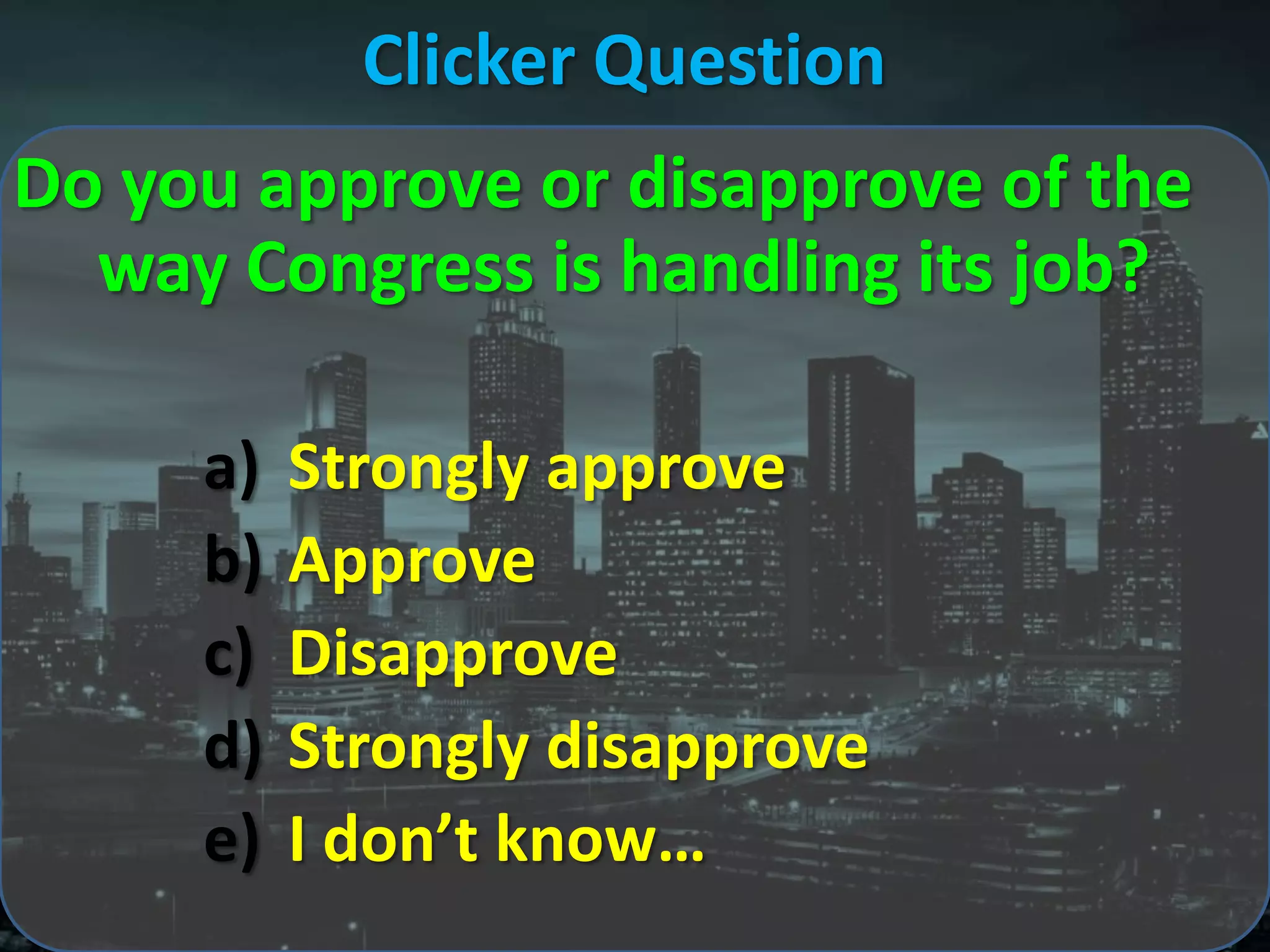
Clicker Question
Do you approve or disapprove of the
  way Congress is handling its job?

     a)   Strongly approve
     b)   Approve
     c)   Disapprove
     d)   Strongly disapprove
     e)   I don’t know…
Clicker Question
Do you approve or disapprove of the way
  your member of Congress is handling
  his or her job?
      a)   Strongly approve
      b)   Approve
      c)   Disapprove
      d)   Strongly disapprove
      e)   I don’t know…
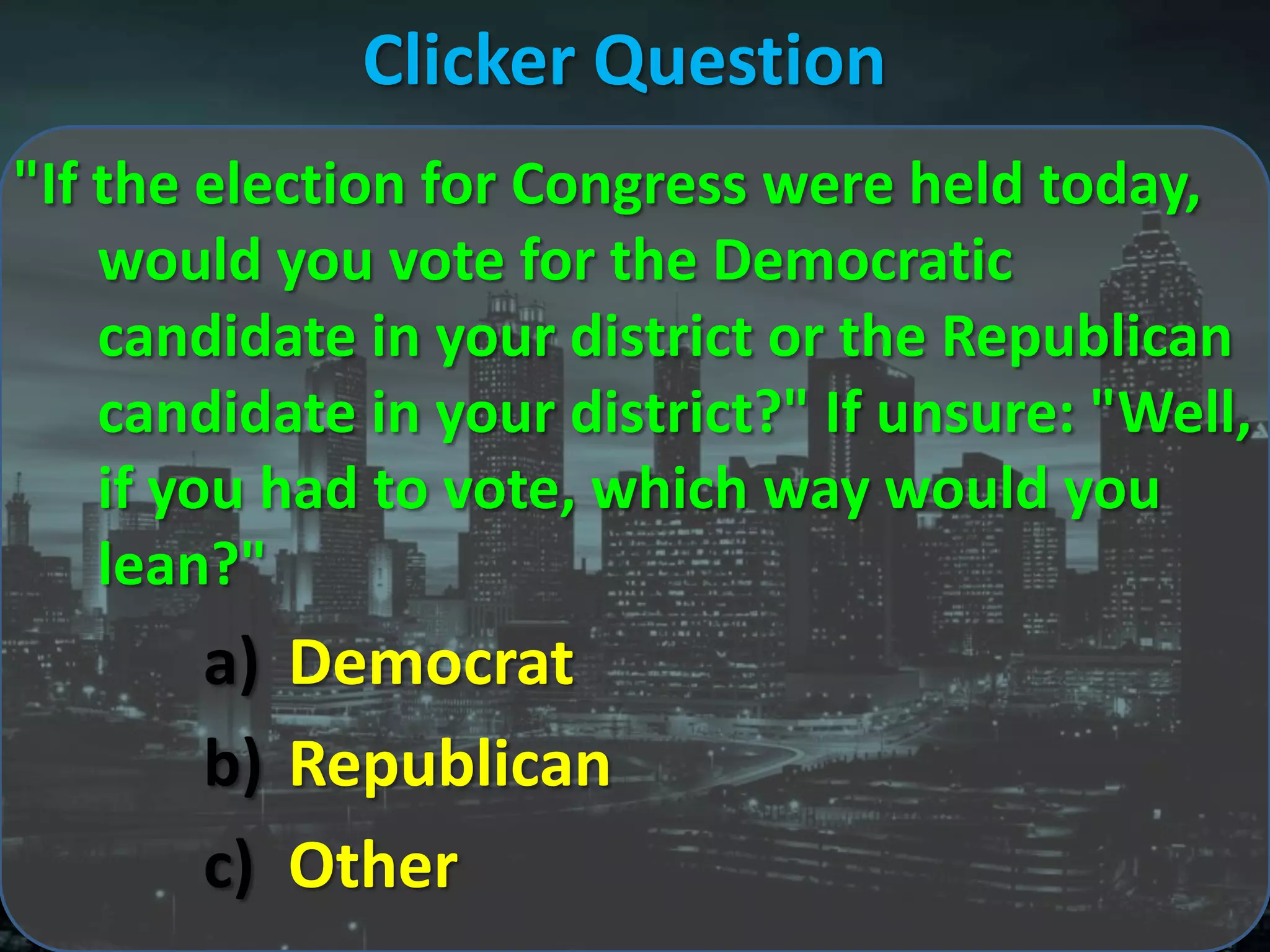
Clicker Question
"If the election for Congress were held today,
    would you vote for the Democratic
    candidate in your district or the Republican
    candidate in your district?" If unsure: "Well,
    if you had to vote, which way would you
    lean?"
       a) Democrat
       b) Republican
       c) Other
Clicker Question
"Right now, are you inclined to vote to reelect
   your representative in Congress in the next
   election or are you inclined to look around
   for someone else to vote for?"
         a) Reelect
         b) Look Around
         c) Depends
         d) Unsure
Clicker Question
Do you believe we should have
  term limits for Members of
  Congress?

      a) Yes
      b) No
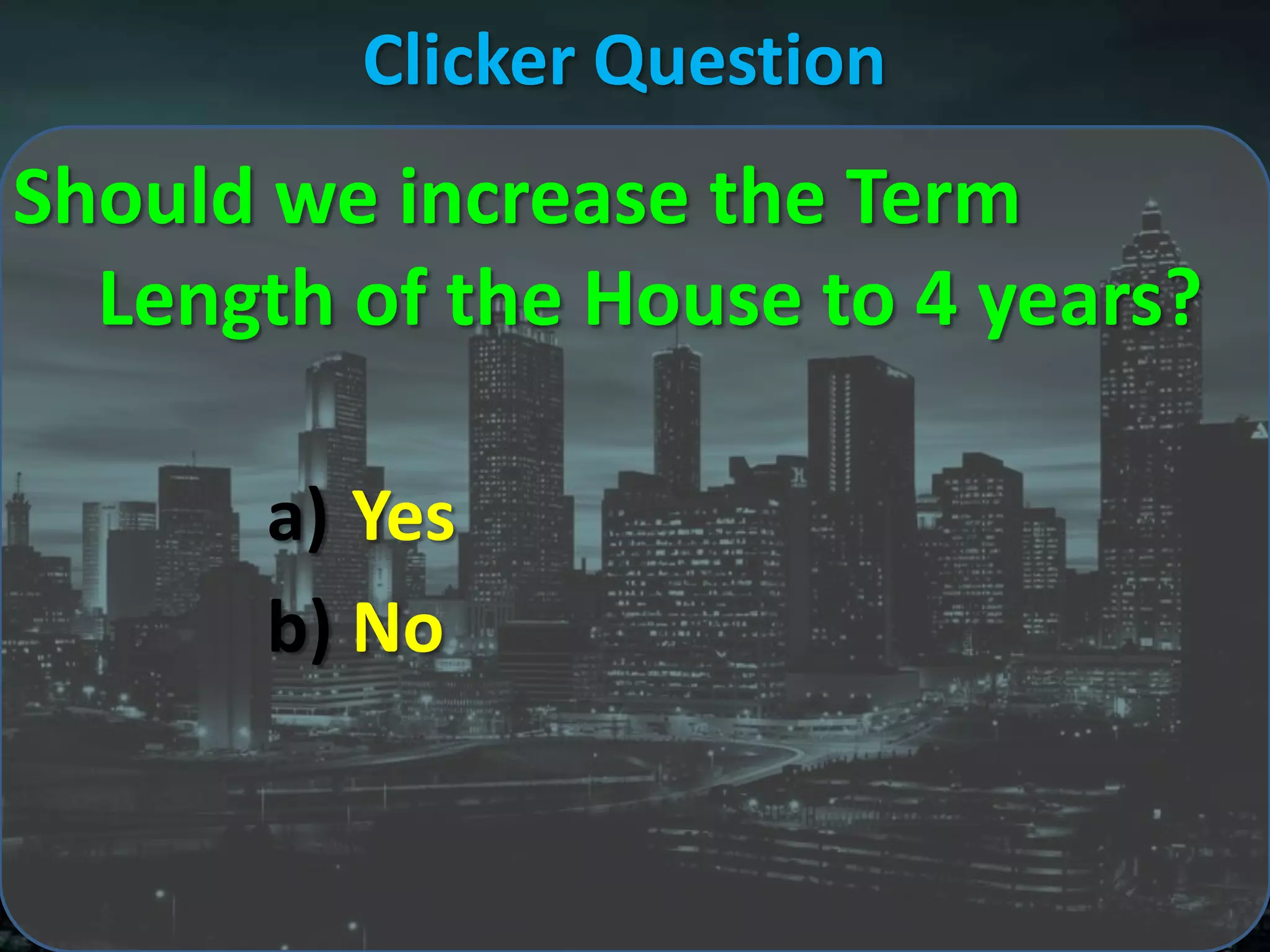
Clicker Question
Should we increase the Term
  Length of the House to 4 years?

       a) Yes
       b) No
Clicker Question
A presidential veto can be overridden
by a:
     a. two-thirds vote in both houses of Congress
     b. majority vote in both houses of Congress
     c. three-fourths vote in the Senate
     d. majority vote in the House of
Representatives
Congress: The First Branch
The U.S. Congress is the “first branch” of government
  under Article I of our Constitution and is the world’s
  most important representative body.


“All legislative Powers herein granted shall be vested
  in a Congress of the United States, which shall
  consist of a Senate and House of Representatives.”
Bicameral Legislature
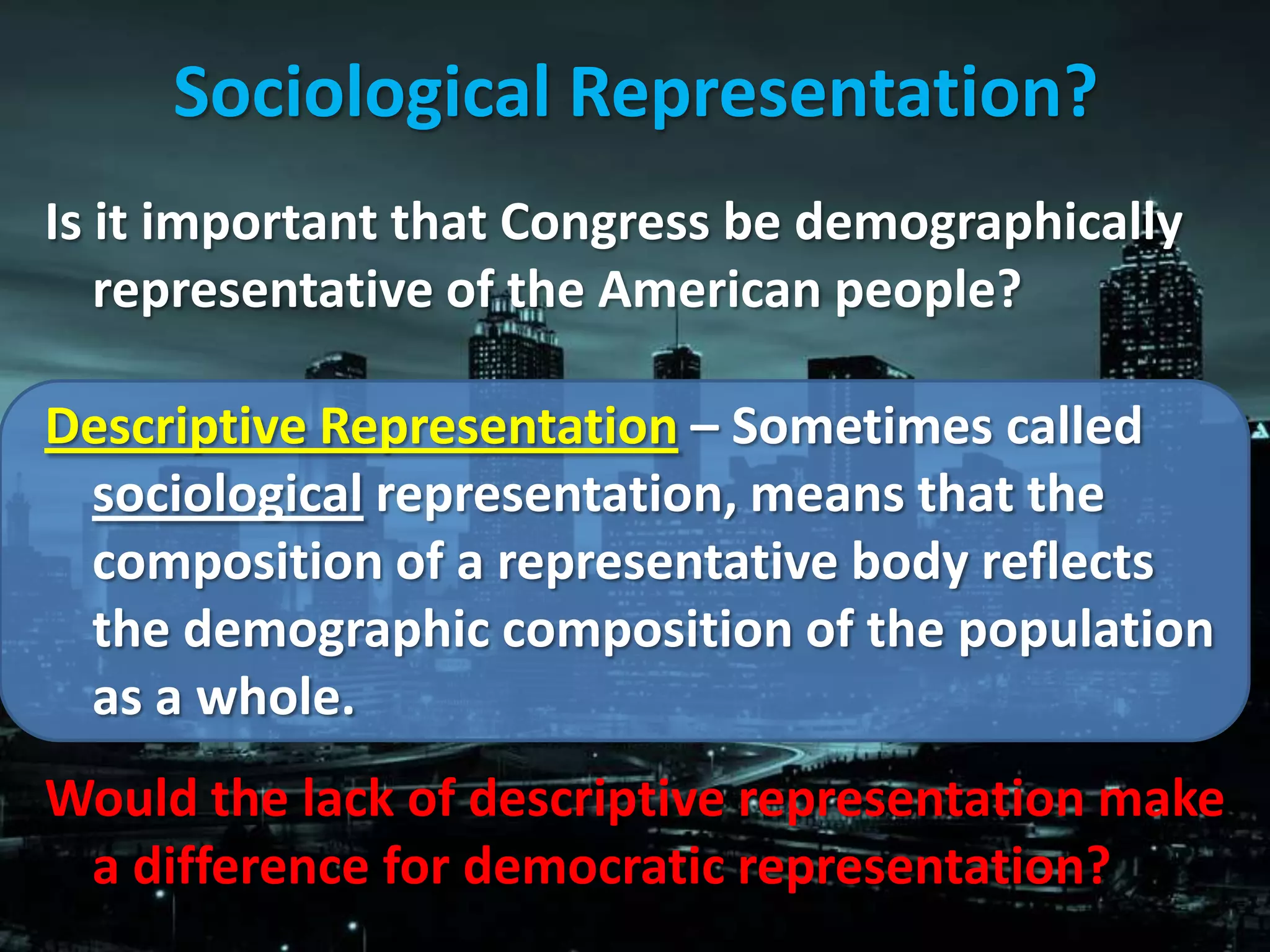
Sociological Representation?
Is it important that Congress be demographically
   representative of the American people?

Descriptive Representation – Sometimes called
 sociological representation, means that the
 composition of a representative body reflects
 the demographic composition of the population
 as a whole.
Would the lack of descriptive representation make
 a difference for democratic representation?
Clicker Question
Do you think it is important that the
  demographics of Congress represent
  the social, racial and economic
  demographics of the country?


          a) Yes
          b) No
Comparing Congress to the Public
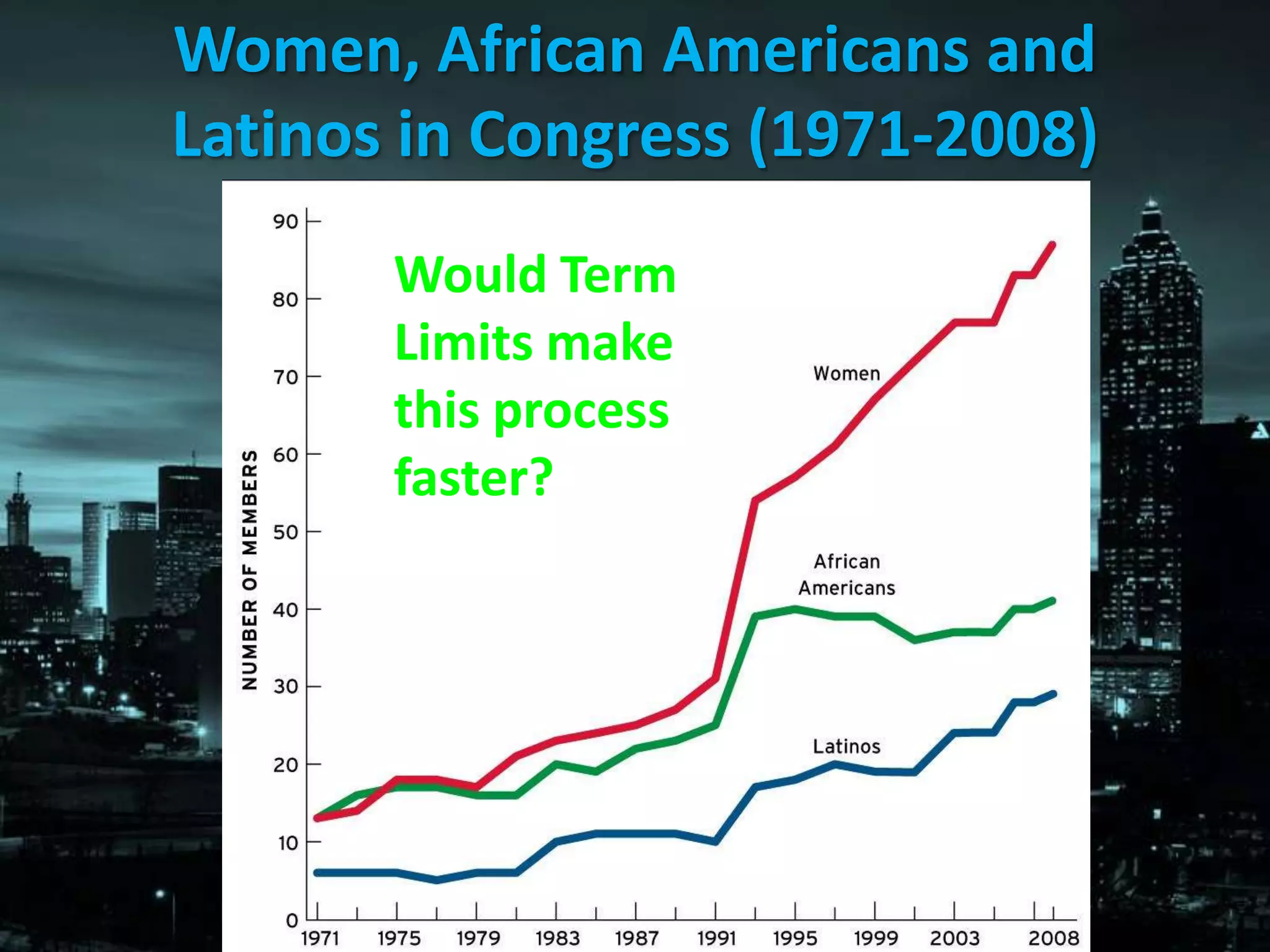
Women, African Americans and
Latinos in Congress (1971-2008)
       Would Term
       Limits make
       this process
       faster?
Representatives as “Agents”
While descriptive representation has not
 occurred, much evidence suggests that our
 representatives do work hard to represent
 the interests of their constituents…at least
 the ones who are paying attention.

As agents, representatives only need do
 their duties if they know that we are
 evaluating their performance…
Electoral Connection?
If representatives can somehow be punished or
   held to account for failing to speak properly for
   their constituents, then they have an incentive to
   provide good representation even if their own
   personal background, views, and interests differ
   from those they represent.

Elections can create a “connection” between voters
  and elected officials…a connection that demands
  that officials represent the wishes of citizens
             Punished? Do we do this?
Clicker Question
When members of Congress cast a vote,
  which of the following factors should
  typically most influence their decision?

a) The interests of the country as a whole
b) The interests of their district or state
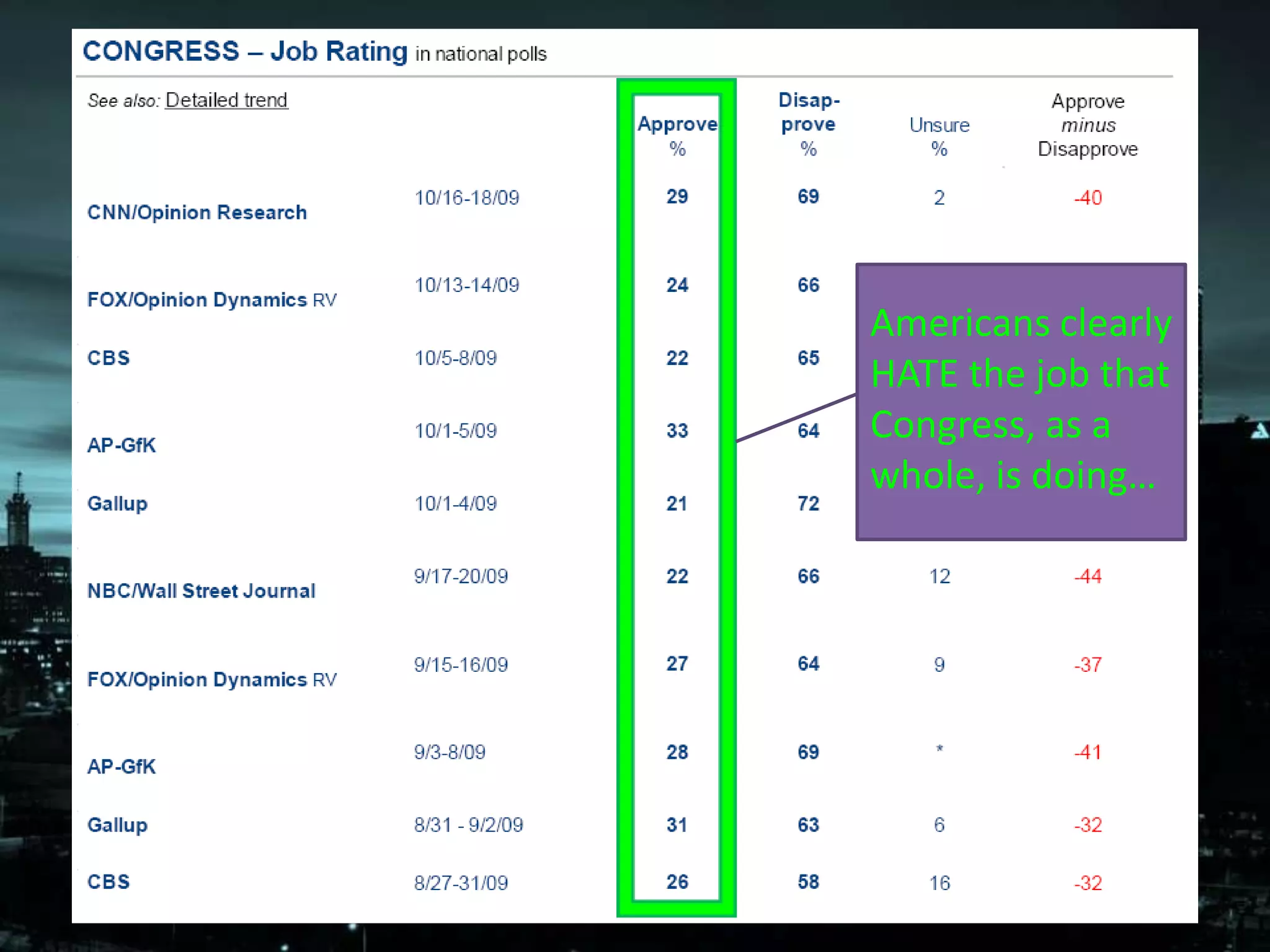
Americans clearly
HATE the job that
Congress, as a
whole, is doing…
So then, we kick them out frequently, right?...
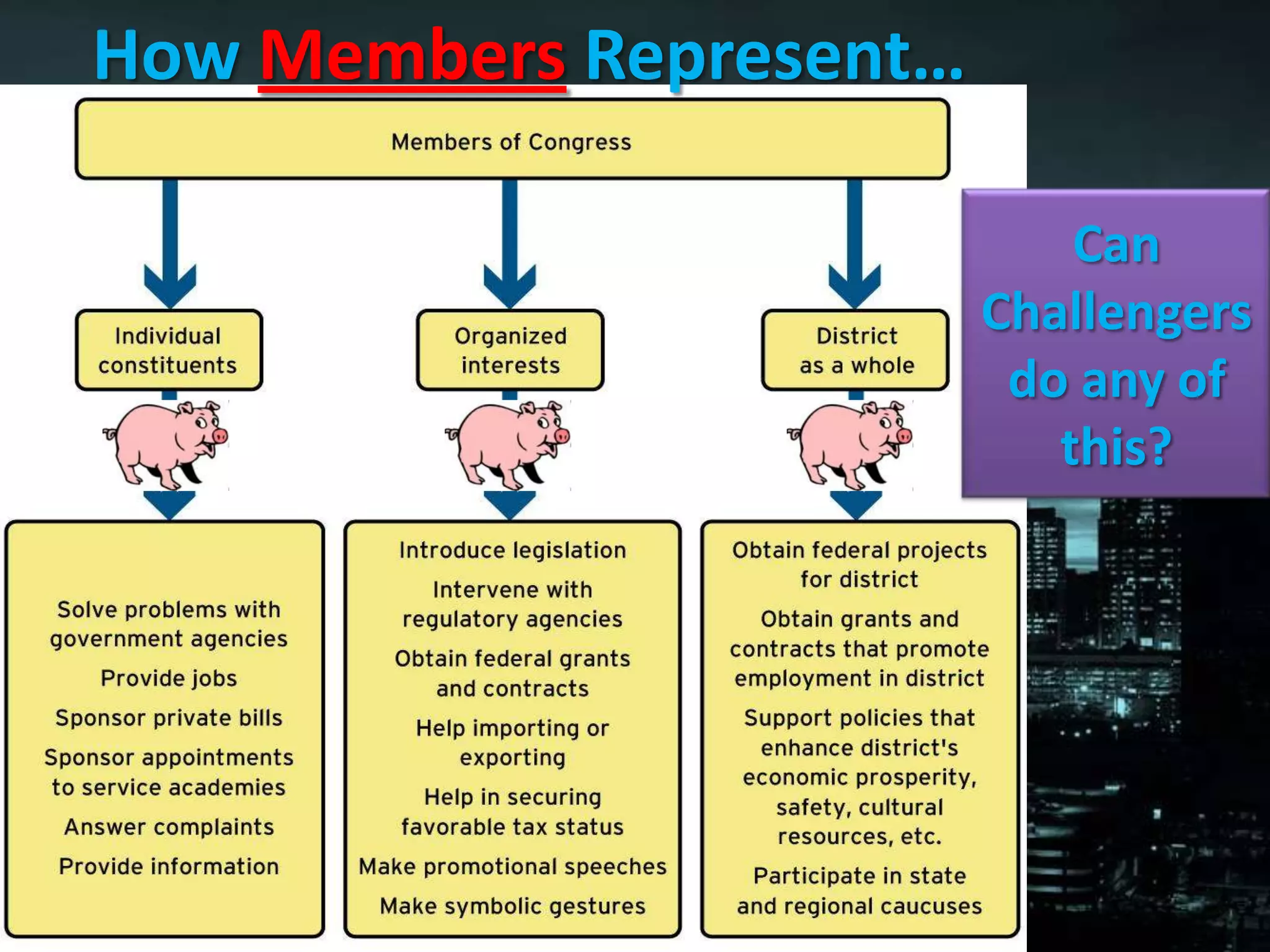
How Members Represent…

                             Can
                         Challengers
                          do any of
                            this?
Clicker Question
I think that Pork Barrel spending is a
    HUGE problem and needs to be
    stopped.

      a) I agree
      b) I disagree
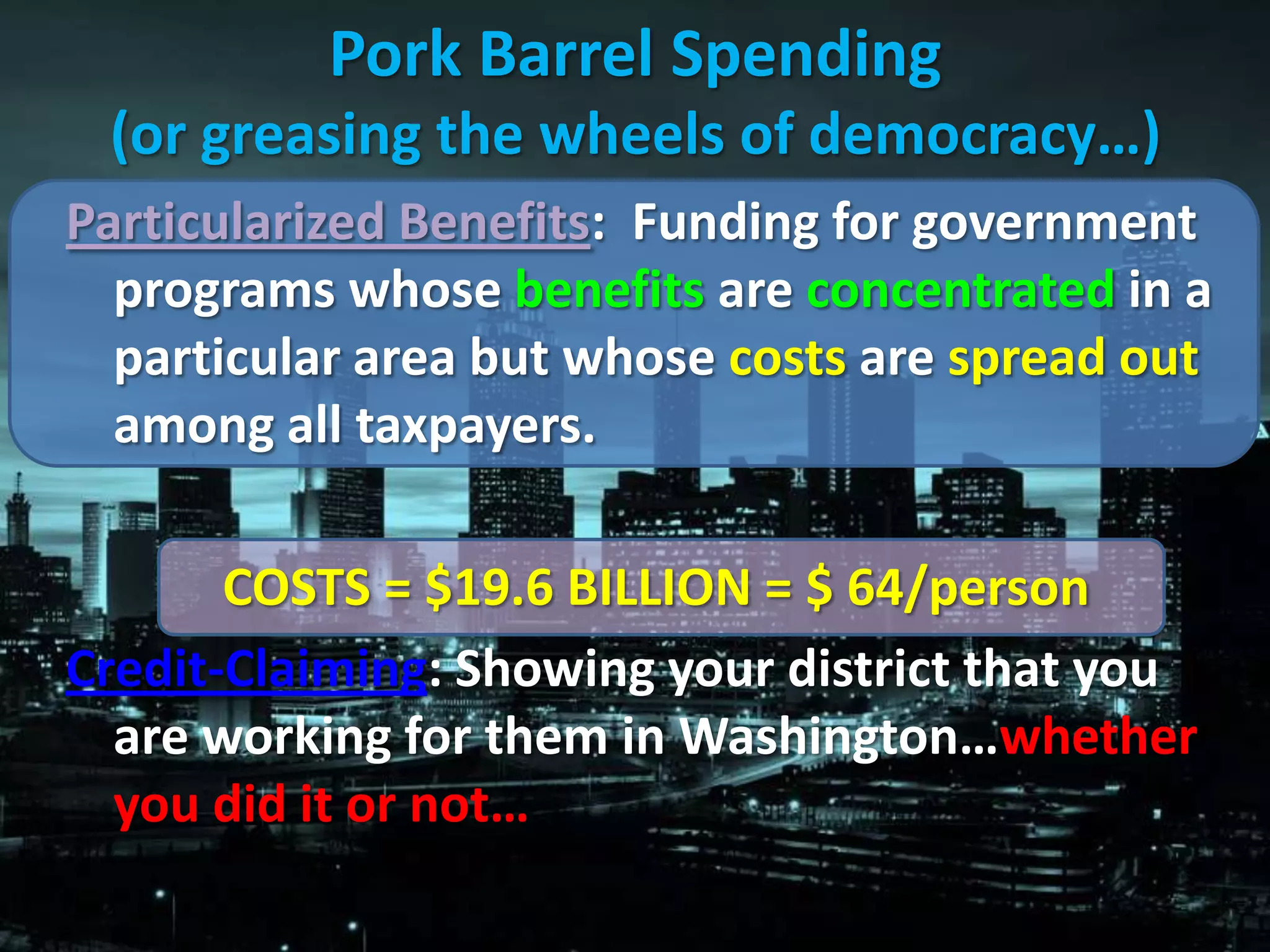
Pork Barrel Spending
 (or greasing the wheels of democracy…)
Particularized Benefits: Funding for government
  programs whose benefits are concentrated in a
  particular area but whose costs are spread out
  among all taxpayers.

       COSTS = $19.6 BILLION = $ 64/person
Credit-Claiming: Showing your district that you
  are working for them in Washington…whether
  you did it or not…
The Organization of Congress
How do 435 Representatives and 100 Senators go about the
business of legislating across broad policy areas each
consisting of highly complex issues?

How do things get done in Congress?
       1. Political Parties and Leaders
       2. Committee System
       3. Regularized Process
•The first Congress had no parties, no committees, and no real
process of getting things done…The reason these structures
developed is because each became a useful tool capable of making
the work of Congress possible.
1. Party Leadership in the House and Senate
Political parties in Congress (primarily the majority party)
are the fundamental building blocks from which policy
coalitions are fashioned to pass legislation and monitor its
implementation.

(Majorities = 218+ in House and 51+ in Senate)

Caucus or Conference
Every two years, at the beginning of each new Congress,
the members of each party gather to elect their leaders,
plan strategies and make decisions regarding other
legislative matters.
Parties in Congress
Majority Party Status = Procedural Control (Control
of the Agenda…the Rules of the Game)
•Key leadership positions – Speaker of the House, Floor
Leaders, Whips
•All committee and
subcommittee
chairmanships
•Surplus on                         committee ratios
•Supermajority on
Rules Committee
•Additional staff                          assistance to
facilitate action
Clicker Question
Which type of representation takes place
when representatives have the same
racial, ethnic, religious, or educational
backgrounds as their constituents?
          a. sociological
          b. delegate
          c. trustee
          d. agency
Clicker Question
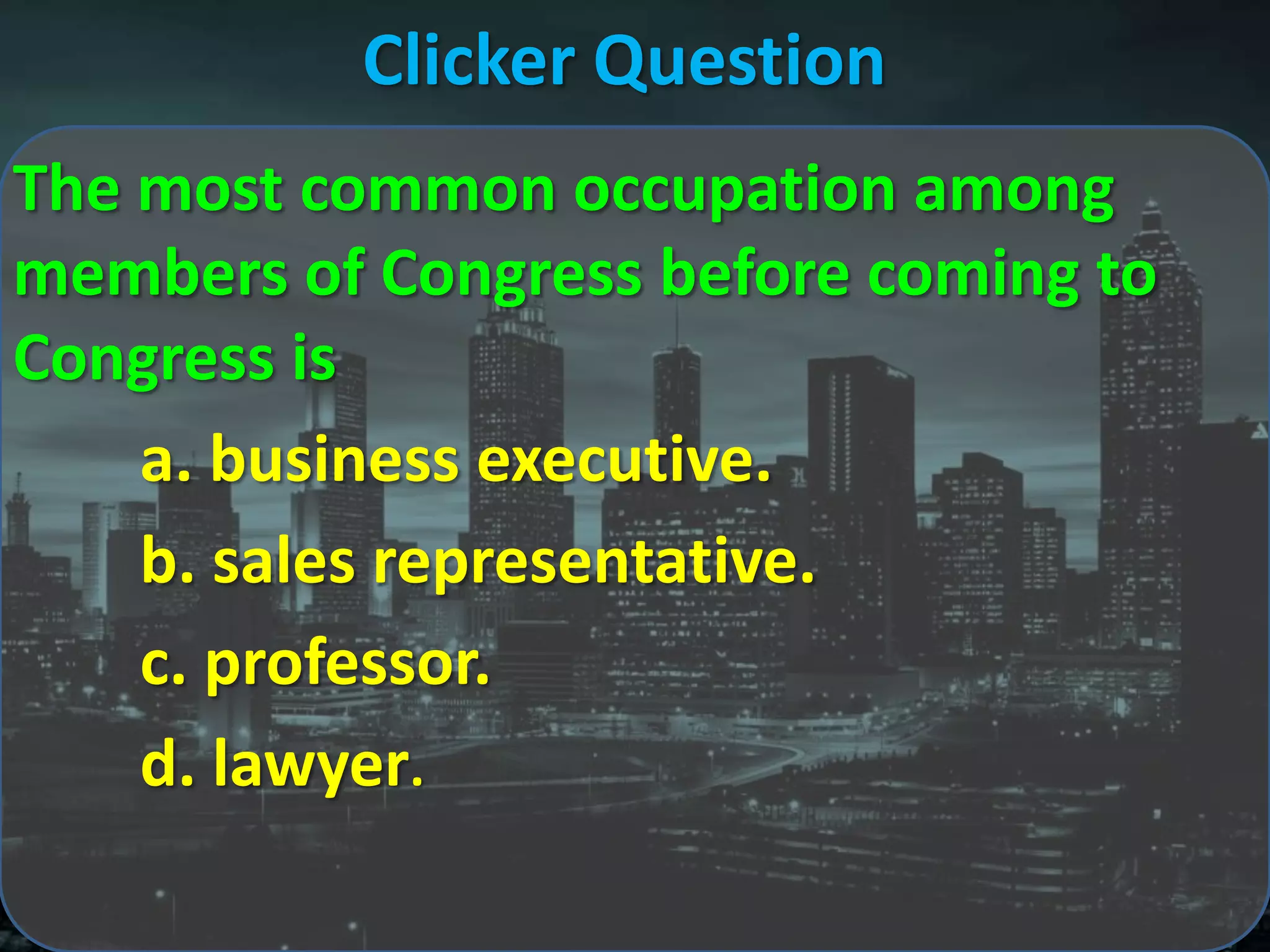
The most common occupation among
members of Congress before coming to
Congress is
    a. business executive.
    b. sales representative.
    c. professor.
    d. lawyer.
Clicker Question
Pork-barrel legislation
 a. deals with specific projects and their location
 within a particular congressional district.
 b. deals with specific agricultural subsidies.
 c. funds efforts to increase the levels of America’s
 meat exports.
 d. grants a special privilege to a person named in
 the bill.
Clicker Question
Majority Party Status equals _______
  control of the legislative process.


      a) Underhanded
      b) Procedural
      c) Committee
      d) Limited
Clicker Question
The need to divide the labor of
legislation is best exemplified in
what formal structure of Congress?
   a. the establishment of party whips
   b. the establishment of standing
   committees
   c. the strict control over floor time in
   Congress
   d. the use of conference committees
2. The Committee System
•The congressional committee system consists of a set
of standing, select, and joint committees, each with its
own jurisdiction, membership, and authority to act.
•As opposed to the hierarchy-of-power that determines
leadership arrangements, the committee system
represents a division and specialization-of-labor system.
•Most of the work of Congress takes place in its
committees and subcommittees.
•Generally, members seek assignments that will allow
them to influence decision of special importance to
their districts.
How a Bill Becomes a Law
The rules and procedures that
govern the entire policy process
(from the introduction of a bill
through its submission to the
president for signing) influence
the fate of every bill and
determines the distribution of
power (who gets to be the
decider) in the Congress.
1. Committee Deliberation
No floor action on any bill can take place until the committee with
jurisdiction over it has taken all the time it needs to deliberate.

Committees 1. Collect information through hearings and
investigations 2. Draft the actual language of bills and resolutions
and (Markup) 3. Report the legislation to their parent chambers
for consideration
Most bill are simply allowed to “die in committee” with little or no
serious consideration because they were introduced simply to
please constituency groups.

The majority party holds a majority and the chairperson on each
committee and therefore gets to decide who the “experts” are and
how to write the legislation they are considering before they
present it back to the floor.
2. Rules Committee (Protecting Party Bills)
Once a bill is approved by the relevant committee, the
whole bill or various parts of it are transmitted to a special
committee, the Rules Committee, which determines the
specific rules under which the legislation will be
considered by the full House.


Here the Speaker influences when debate will be
scheduled (controlling the calendar), for how long, what
amendments will be in order, and in what order they will be
considered.

Open Rule – A rule placing no restrictions on amendments.
Restrictive Rule – A rule restricting amendments during debate
Closed Rule – A rule prohibiting all amendments during debate
Clicker Question
“Closed rule” and “open rule” refer to
congressional provisions regarding

  a. whether deliberations are closed or
  open to the general public.
  b. assignment to powerful committees.
  c. whether lobbyists are allowed inside
  Congress.
  d. floor debate on a bill.
Congress

Rules Committee - Who’s on the Rules Committee?
           Majority (9)                    Minority (4)
•Louise M.Slaughter, NY, Chair   •David Dreier, Ranking Member, CA
•James P. McGovern, MA           •Lincoln Diaz-Balart, FL
•Alcee Hastings, FL              •Pete Sessions, TX
•Doris Matsui, CA                •Virginia Foxx, NC
•Dennis Cardoza, CA
•Michael Arcuri, NY
•Ed Perlmutter, CO
•Chellie Pingree, ME
•Jared Polis, CO
3a. House Debate
Party control of the agenda is reinforced by the
rule giving the Speaker of the House the power
of recognition during debate on a bill.

Debate is governed by the “rule” assigned to
each bill. Typically, 1 to 1.5 hours allotted.

In the House, virtually all of the time allotted by
the Rules Committee for debate on a given bill is
controlled by the bill’s sponsor and by its leading
opponent (usually the committee chair and
the ranking minority member on that
committee).
Clicker Question
“Closed rule” and “open rule” refer to
congressional provisions regarding

  a. whether deliberations are closed or
  open to the general public.
  b. assignment to powerful committees.
  c. whether lobbyists are allowed inside
  Congress.
  d. floor debate and amendments on a
  bill.
3b. Senate Debate
In the Senate, other than the power of recognition,
the leadership does not have the same level of
control over floor debate.

There is no Rules Committee – Debate is technically
unlimited.

       Filibuster – A tactic used by members of the
Minority Party in the Senate to prevent action on
legislation they oppose by continuously holding the
floor and speaking until the majority backs down.
       Cloture – A vote of 60 Senators that can end a
filibuster.
3c. Floor Voting and Party Discipline
In both the House and Senate, party leaders have a
good deal of influence over the behavior of their party
members (The Whips).

Building majority coalitions in support of party policy
positions is a central job of leaders.

Party leaders can influence legislators’ votes
through the direct impact of the party leaders’
tools of persuasion:
                 committee assignments
                 leadership positions
                 campaign money
4. Conference Committee
Bills must pass both chambers of Congress in identical
form. If the chambers cannot both agree on a single
version of a bill, a Conference Committee consisting of
members from both chambers meets to resolve
differences.

    The Conference then reports back to both
 chambers who then vote on the “compromised”
        bill – the “CONFERENCE REPORT”

Conference committees are appointed by the
Speaker and Senate Majority Leaders and are
composed of senior members of the committees
or subcommittees that initiated the original bills.
5. Presidential Action
Once adopted by the House and Senate, a bill goes to the
president, who may choose to sign the bill into law or veto
it.

The veto is the president’s constitutional power to reject a
piece of legislation. The president must return a vetoed bill
within ten days to Congress along with his objections.

Pocket Veto – If Congress adjourns during this 10 day
period and the president takes no action, the bill is
considered to be vetoed.

A presidential veto may be overridden by a two-thirds
(2/3) vote in both the House and Senate.
Congress
Presidential Vetoes and Overrides


                 Veto    Pocket     Total   Overrides

08 - Congress

  • 1.
    Chapter 12 The UnitedStates Congress
  • 2.
    Clicker Question Do youapprove or disapprove of the way Congress is handling its job? a) Strongly approve b) Approve c) Disapprove d) Strongly disapprove e) I don’t know…
  • 3.
    Clicker Question Do youapprove or disapprove of the way your member of Congress is handling his or her job? a) Strongly approve b) Approve c) Disapprove d) Strongly disapprove e) I don’t know…
  • 4.
    Clicker Question "If theelection for Congress were held today, would you vote for the Democratic candidate in your district or the Republican candidate in your district?" If unsure: "Well, if you had to vote, which way would you lean?" a) Democrat b) Republican c) Other
  • 5.
    Clicker Question "Right now,are you inclined to vote to reelect your representative in Congress in the next election or are you inclined to look around for someone else to vote for?" a) Reelect b) Look Around c) Depends d) Unsure
  • 6.
    Clicker Question Do youbelieve we should have term limits for Members of Congress? a) Yes b) No
  • 7.
    Clicker Question Should weincrease the Term Length of the House to 4 years? a) Yes b) No
  • 8.
    Clicker Question A presidentialveto can be overridden by a: a. two-thirds vote in both houses of Congress b. majority vote in both houses of Congress c. three-fourths vote in the Senate d. majority vote in the House of Representatives
  • 9.
    Congress: The FirstBranch The U.S. Congress is the “first branch” of government under Article I of our Constitution and is the world’s most important representative body. “All legislative Powers herein granted shall be vested in a Congress of the United States, which shall consist of a Senate and House of Representatives.”
  • 10.
  • 11.
    Sociological Representation? Is itimportant that Congress be demographically representative of the American people? Descriptive Representation – Sometimes called sociological representation, means that the composition of a representative body reflects the demographic composition of the population as a whole. Would the lack of descriptive representation make a difference for democratic representation?
  • 12.
    Clicker Question Do youthink it is important that the demographics of Congress represent the social, racial and economic demographics of the country? a) Yes b) No
  • 13.
  • 14.
    Women, African Americansand Latinos in Congress (1971-2008) Would Term Limits make this process faster?
  • 15.
    Representatives as “Agents” Whiledescriptive representation has not occurred, much evidence suggests that our representatives do work hard to represent the interests of their constituents…at least the ones who are paying attention. As agents, representatives only need do their duties if they know that we are evaluating their performance…
  • 16.
    Electoral Connection? If representativescan somehow be punished or held to account for failing to speak properly for their constituents, then they have an incentive to provide good representation even if their own personal background, views, and interests differ from those they represent. Elections can create a “connection” between voters and elected officials…a connection that demands that officials represent the wishes of citizens Punished? Do we do this?
  • 17.
    Clicker Question When membersof Congress cast a vote, which of the following factors should typically most influence their decision? a) The interests of the country as a whole b) The interests of their district or state
  • 18.
    Americans clearly HATE thejob that Congress, as a whole, is doing…
  • 19.
    So then, wekick them out frequently, right?...
  • 20.
    How Members Represent… Can Challengers do any of this?
  • 21.
    Clicker Question I thinkthat Pork Barrel spending is a HUGE problem and needs to be stopped. a) I agree b) I disagree
  • 22.
    Pork Barrel Spending (or greasing the wheels of democracy…) Particularized Benefits: Funding for government programs whose benefits are concentrated in a particular area but whose costs are spread out among all taxpayers. COSTS = $19.6 BILLION = $ 64/person Credit-Claiming: Showing your district that you are working for them in Washington…whether you did it or not…
  • 23.
    The Organization ofCongress How do 435 Representatives and 100 Senators go about the business of legislating across broad policy areas each consisting of highly complex issues? How do things get done in Congress? 1. Political Parties and Leaders 2. Committee System 3. Regularized Process •The first Congress had no parties, no committees, and no real process of getting things done…The reason these structures developed is because each became a useful tool capable of making the work of Congress possible.
  • 24.
    1. Party Leadershipin the House and Senate Political parties in Congress (primarily the majority party) are the fundamental building blocks from which policy coalitions are fashioned to pass legislation and monitor its implementation. (Majorities = 218+ in House and 51+ in Senate) Caucus or Conference Every two years, at the beginning of each new Congress, the members of each party gather to elect their leaders, plan strategies and make decisions regarding other legislative matters.
  • 25.
    Parties in Congress MajorityParty Status = Procedural Control (Control of the Agenda…the Rules of the Game) •Key leadership positions – Speaker of the House, Floor Leaders, Whips •All committee and subcommittee chairmanships •Surplus on committee ratios •Supermajority on Rules Committee •Additional staff assistance to facilitate action
  • 26.
    Clicker Question Which typeof representation takes place when representatives have the same racial, ethnic, religious, or educational backgrounds as their constituents? a. sociological b. delegate c. trustee d. agency
  • 27.
    Clicker Question The mostcommon occupation among members of Congress before coming to Congress is a. business executive. b. sales representative. c. professor. d. lawyer.
  • 28.
    Clicker Question Pork-barrel legislation a. deals with specific projects and their location within a particular congressional district. b. deals with specific agricultural subsidies. c. funds efforts to increase the levels of America’s meat exports. d. grants a special privilege to a person named in the bill.
  • 29.
    Clicker Question Majority PartyStatus equals _______ control of the legislative process. a) Underhanded b) Procedural c) Committee d) Limited
  • 30.
    Clicker Question The needto divide the labor of legislation is best exemplified in what formal structure of Congress? a. the establishment of party whips b. the establishment of standing committees c. the strict control over floor time in Congress d. the use of conference committees
  • 31.
    2. The CommitteeSystem •The congressional committee system consists of a set of standing, select, and joint committees, each with its own jurisdiction, membership, and authority to act. •As opposed to the hierarchy-of-power that determines leadership arrangements, the committee system represents a division and specialization-of-labor system. •Most of the work of Congress takes place in its committees and subcommittees. •Generally, members seek assignments that will allow them to influence decision of special importance to their districts.
  • 33.
    How a BillBecomes a Law The rules and procedures that govern the entire policy process (from the introduction of a bill through its submission to the president for signing) influence the fate of every bill and determines the distribution of power (who gets to be the decider) in the Congress.
  • 35.
    1. Committee Deliberation Nofloor action on any bill can take place until the committee with jurisdiction over it has taken all the time it needs to deliberate. Committees 1. Collect information through hearings and investigations 2. Draft the actual language of bills and resolutions and (Markup) 3. Report the legislation to their parent chambers for consideration Most bill are simply allowed to “die in committee” with little or no serious consideration because they were introduced simply to please constituency groups. The majority party holds a majority and the chairperson on each committee and therefore gets to decide who the “experts” are and how to write the legislation they are considering before they present it back to the floor.
  • 36.
    2. Rules Committee(Protecting Party Bills) Once a bill is approved by the relevant committee, the whole bill or various parts of it are transmitted to a special committee, the Rules Committee, which determines the specific rules under which the legislation will be considered by the full House. Here the Speaker influences when debate will be scheduled (controlling the calendar), for how long, what amendments will be in order, and in what order they will be considered. Open Rule – A rule placing no restrictions on amendments. Restrictive Rule – A rule restricting amendments during debate Closed Rule – A rule prohibiting all amendments during debate
  • 37.
    Clicker Question “Closed rule”and “open rule” refer to congressional provisions regarding a. whether deliberations are closed or open to the general public. b. assignment to powerful committees. c. whether lobbyists are allowed inside Congress. d. floor debate on a bill.
  • 38.
    Congress Rules Committee -Who’s on the Rules Committee? Majority (9) Minority (4) •Louise M.Slaughter, NY, Chair •David Dreier, Ranking Member, CA •James P. McGovern, MA •Lincoln Diaz-Balart, FL •Alcee Hastings, FL •Pete Sessions, TX •Doris Matsui, CA •Virginia Foxx, NC •Dennis Cardoza, CA •Michael Arcuri, NY •Ed Perlmutter, CO •Chellie Pingree, ME •Jared Polis, CO
  • 39.
    3a. House Debate Partycontrol of the agenda is reinforced by the rule giving the Speaker of the House the power of recognition during debate on a bill. Debate is governed by the “rule” assigned to each bill. Typically, 1 to 1.5 hours allotted. In the House, virtually all of the time allotted by the Rules Committee for debate on a given bill is controlled by the bill’s sponsor and by its leading opponent (usually the committee chair and the ranking minority member on that committee).
  • 40.
    Clicker Question “Closed rule”and “open rule” refer to congressional provisions regarding a. whether deliberations are closed or open to the general public. b. assignment to powerful committees. c. whether lobbyists are allowed inside Congress. d. floor debate and amendments on a bill.
  • 41.
    3b. Senate Debate Inthe Senate, other than the power of recognition, the leadership does not have the same level of control over floor debate. There is no Rules Committee – Debate is technically unlimited. Filibuster – A tactic used by members of the Minority Party in the Senate to prevent action on legislation they oppose by continuously holding the floor and speaking until the majority backs down. Cloture – A vote of 60 Senators that can end a filibuster.
  • 42.
    3c. Floor Votingand Party Discipline In both the House and Senate, party leaders have a good deal of influence over the behavior of their party members (The Whips). Building majority coalitions in support of party policy positions is a central job of leaders. Party leaders can influence legislators’ votes through the direct impact of the party leaders’ tools of persuasion: committee assignments leadership positions campaign money
  • 43.
    4. Conference Committee Billsmust pass both chambers of Congress in identical form. If the chambers cannot both agree on a single version of a bill, a Conference Committee consisting of members from both chambers meets to resolve differences. The Conference then reports back to both chambers who then vote on the “compromised” bill – the “CONFERENCE REPORT” Conference committees are appointed by the Speaker and Senate Majority Leaders and are composed of senior members of the committees or subcommittees that initiated the original bills.
  • 44.
    5. Presidential Action Onceadopted by the House and Senate, a bill goes to the president, who may choose to sign the bill into law or veto it. The veto is the president’s constitutional power to reject a piece of legislation. The president must return a vetoed bill within ten days to Congress along with his objections. Pocket Veto – If Congress adjourns during this 10 day period and the president takes no action, the bill is considered to be vetoed. A presidential veto may be overridden by a two-thirds (2/3) vote in both the House and Senate.
  • 45.
    Congress Presidential Vetoes andOverrides Veto Pocket Total Overrides