This document summarizes a research study that proposes a hybrid algorithm using Dijkstra and Floyd-Warshall algorithms to find conflict-free routes for multiple autonomous guided vehicles (AGVs) in a warehouse distribution system. The goal is to optimize the shortest distances and schedules for AGVs performing pickup and delivery tasks within specified time windows. A grid topology route model is used to represent the warehouse environment. The hybrid algorithm combines dynamic programming approaches to determine optimized, conflict-free routes for multiple AGVs operating simultaneously while meeting time constraints for tasks at workstations. The algorithm aims to improve efficiency of autonomous vehicle systems for goods distribution in manufacturing warehouse applications.
![International Journal of Electrical and Computer Engineering (IJECE)
Vol. 10, No. 4, August 2020, pp. 3596~3604
ISSN: 2088-8708, DOI: 10.11591/ijece.v10i4.pp3596-3604 3596
Journal homepage: http://ijece.iaescore.com/index.php/IJECE
Conflict-free dynamic route multi-agv using dijkstra
Floyd-warshall hybrid algorithm with time windows
Solichudin, Aris Triwiyatno, Munawar A. Riyadi
Department of Electrical Engineering, Faculty of Engineering, Diponegoro University, Indonesia
Article Info ABSTRACT
Article history:
Received Sep 9, 2019
Revised Dec 29, 2019
Accepted Jan 11, 2020
Autonomous Guided Vehicle is a mobile robot that can move autonomously
on a route or lane in an indoor or outdoor environment while performing
a series of tasks. Determination of the shortest route on an autonomous
guided vehicle is one of the optimization problems in handling conflict-
free routes that have an influence on the distribution of goods in
the manufacturing industry's warehouse. Pickup and delivery processes in
the distribution on AGV goods such as scheduling, shipping, and
determining the route of vehicle with short mileage characteristics, is very
possible to do simulations with three AGV units. There is a windows time
limit on workstations that limits shipping. The problem of determining
the route in this study is considered necessary as a multi-vehicle route
problem with a time window. This study aims to describe the combination of
algorithms written based on dynamic programming to overcome the problem
of conflict-free AGV routes using time windows. The combined approach of
the Dijkstra and Floyd-Warshall algorithm results in the optimization of
the closest distance in overcoming conflict-free routes.
Keywords:
Conflict-free route
Dynamic programming
Hybrid algorithm
Multi-AGV
Time windows
Copyright © 2020 Institute of Advanced Engineering and Science.
All rights reserved.
Corresponding Author:
Solichudin,
Department of Electrical Engineering,
Diponegoro University,
Prof. Soedarto, SH. Street, Tembalang, Semarang, 1269, Indonesia.
Email: sudin3007@gmail.com
1. INTRODUCTION
Vehicle transportation systems based on AGVs have been developed for decades. They are
technically advanced and complex. There are many tactical and operational issues which have to be
addressed. Decisions related to the design stage have a very large impact on future system performance [1].
This area includes issues such as:
guide-path design
estimating the number and location of parking, pick-up and delivery points,
estimating the number of required vehicles
The second area of problems relating to system management includes the following:
positioning of idle vehicles,
vehicle dispatching,
vehicle routing,
vehicle scheduling,
collision and deadlock avoidance
One such interpretation involves the following problem: if a delivery decision is made, the route and
schedule must be planned for another AGV, that the purpose of AGV scheduling is to send an AGV set and
the route mission is to find a suitable route [2]. But on another interpretation, determining the vehicle route
must be in accordance with the order of stations that must be visited by this vehicle. Scheduling also](https://image.slidesharecdn.com/v3020964ed11jan29dec199sep19y-201214022357/85/Conflict-free-dynamic-route-multi-agv-using-dijkstra-Floyd-warshall-hybrid-algorithm-with-time-windows-1-320.jpg)
![International Journal of Electrical and Computer Engineering (IJECE)
Vol. 10, No. 4, August 2020, pp. 3596~3604
ISSN: 2088-8708, DOI: 10.11591/ijece.v10i4.pp3596-3604 3596
Journal homepage: http://ijece.iaescore.com/index.php/IJECE
Conflict-free dynamic route multi-agv using dijkstra
Floyd-warshall hybrid algorithm with time windows
Solichudin, Aris Triwiyatno, Munawar A. Riyadi
Department of Electrical Engineering, Faculty of Engineering, Diponegoro University, Indonesia
Article Info ABSTRACT
Article history:
Received Sep 9, 2019
Revised Dec 29, 2019
Accepted Jan 11, 2020
Autonomous Guided Vehicle is a mobile robot that can move autonomously
on a route or lane in an indoor or outdoor environment while performing
a series of tasks. Determination of the shortest route on an autonomous
guided vehicle is one of the optimization problems in handling conflict-
free routes that have an influence on the distribution of goods in
the manufacturing industry's warehouse. Pickup and delivery processes in
the distribution on AGV goods such as scheduling, shipping, and
determining the route of vehicle with short mileage characteristics, is very
possible to do simulations with three AGV units. There is a windows time
limit on workstations that limits shipping. The problem of determining
the route in this study is considered necessary as a multi-vehicle route
problem with a time window. This study aims to describe the combination of
algorithms written based on dynamic programming to overcome the problem
of conflict-free AGV routes using time windows. The combined approach of
the Dijkstra and Floyd-Warshall algorithm results in the optimization of
the closest distance in overcoming conflict-free routes.
Keywords:
Conflict-free route
Dynamic programming
Hybrid algorithm
Multi-AGV
Time windows
Copyright © 2020 Institute of Advanced Engineering and Science.
All rights reserved.
Corresponding Author:
Solichudin,
Department of Electrical Engineering,
Diponegoro University,
Prof. Soedarto, SH. Street, Tembalang, Semarang, 1269, Indonesia.
Email: sudin3007@gmail.com
1. INTRODUCTION
Vehicle transportation systems based on AGVs have been developed for decades. They are
technically advanced and complex. There are many tactical and operational issues which have to be
addressed. Decisions related to the design stage have a very large impact on future system performance [1].
This area includes issues such as:
guide-path design
estimating the number and location of parking, pick-up and delivery points,
estimating the number of required vehicles
The second area of problems relating to system management includes the following:
positioning of idle vehicles,
vehicle dispatching,
vehicle routing,
vehicle scheduling,
collision and deadlock avoidance
One such interpretation involves the following problem: if a delivery decision is made, the route and
schedule must be planned for another AGV, that the purpose of AGV scheduling is to send an AGV set and
the route mission is to find a suitable route [2]. But on another interpretation, determining the vehicle route
must be in accordance with the order of stations that must be visited by this vehicle. Scheduling also](https://image.slidesharecdn.com/v3020964ed11jan29dec199sep19y-201214022357/75/Conflict-free-dynamic-route-multi-agv-using-dijkstra-Floyd-warshall-hybrid-algorithm-with-time-windows-1-2048.jpg)
![Int J Elec & Comp Eng ISSN: 2088-8708
Conflict-free dynamic route multi-AGV using dijkstra floyd-warshall… (Solichudin)
3597
determines the vehicle's time when it has to take and send loads [3]. Sometimes dispatching, routing and
scheduling are handled separately. However, this problem is closely related and must be considered
simultaneously. Consideration of the problem carried out depends on the form of methods and algorithms
applied. The parameters used in this study are as follows.
Vehicle dispatching
This problem is considered from two points of view. First, an available load is assigned to an idle
vehicle. Second, an idle AGV is assigned to a waiting load. Dispatching methods are based on therules by
which the idle AGVs are selected and assigned to execute the transportation tasks, e.g. nearest or shortest
vehicle travel time rule [4].
Vehicle routing and scheduling
After dispatching, a certain route should be planned and assigned to the AGV. Once the routing
decision is made, the appropri ate schedule must be set. With scheduling, all arrival and departure times of
the AGV at each significant point on the route are determined. This is necessary to ensure collision and
deadlock free routing [5].
Dynamic path topology
Optimal route search generally takes a long time. This is because the algorithm is based on global
information and calculates all routes for each AGV. The dynamic method of finding routes is based on
real-time information about traffic. For example, in the Sun and Wank research algorithm the method is
called Dynamic Time-windows for Smart Indoor (DTWS) [6].
Collision-free routes occur in many applications ranging from robot movement to scheduling of
several cranes in logistics to container transportation by automated guided vehicles (AGV) [7]. Typically,
AGV is not equipped with a smart local collision avoidance system and only relies on central control. This is
usually done with a static approach, but in this study we developed a dynamic approach. The first step is to
calculate the route in the underlying graph and then use additional methods during route execution to avoid
a collision. These rules are usually heuristic [8] which can lead to unexpected arrival times and even
deadlocks. To overcome this we developed using classical rules.
Previous research on routing algorithms can be classified into two classes, namely general path
topology and special path topology [9]. This study proposes the development of a general path topology with
a grid model using the dijkstra algorithm. The general path here means that the path network is a regular
graph. Broadbent et al. [10] was the first researcher to provide the concept of AGV routing in a short time
free of conflict and propose routing procedures based on the shortest path algorithm. While Hamzeei
et al. [11] introduced an algorithm to route AGV vehicles in two-way networks based on annealing algorithm
methods, then Nishi and Tanaka [12] discussed dynamic routes to overcome conflict-free dispatching and
AGV routes.
Research related to the AGV vehicle conflict-free route which was scrutinized by Rahnama et al [13],
Bahari [14], Antackly et.al [8], Malopolski [1], and Kumar et.al [15], when operated only 1 or 2 AGVs that
can accept assignments so that when another AGV is operated, the previous AGV must wait for an order or
command. Furthermore, when accepting the next assignment, each AGV was only able to avoid front
collisions, and deadlocks between intersections as in Jae Pil's research [16] and M. Strzelecki [17] only
avoidance of static barriers, but not discuss livelock handling [18], so that the speed of AGV decreases when
approaching obstacles as research Arutselvan [19] and Y. Wan et.al [20] resulted in the emergence of
a hysteresis effect because accuracy decreases when AGV speed increases.
The problem of AGV movement that appears in the literature review above is that researchers pay
less attention to the distance function, the problem of handling uncertainty between AGV, finding
the shortest route, the conflict-free route, and optimal scheduling, and parking efficiency. Various kinds of
deficiencies which explained in related research, so in this paper, the researcher proposes an optimization
solution to handle conflict free routes with a dynamic route approach using a hybrid algorithm dijkstra
floyd-warshall which includes scheduling parameters, shortest route search, and conflict free route.
2. RESEARCH METHOD
The research method to overcome obstacle free routes in multi-AGV used is dynamic programming
using the floyd-warshall algorithm with a grid topology route model. Dynamic routes use dynamic
programming with time windows based on problems in determining vehicle routes, with solutions to solve
problems that appear in the form of Conflict-free Vehicle Route Problems with Time Window (CVRPTW).
Dynamic routing model is proposed as a solution to overcome the problem of conflict-free routes in finding
the shortest path to the destination (workstation) in the AGV pick-up/drop-off distribution process, so that
each AGV operation runs smoothly according to the specified time. The multi-AGV autonomous navigation
system consists of three parts, namely the input part (with parameters: delivery, conflict free routes, and](https://image.slidesharecdn.com/v3020964ed11jan29dec199sep19y-201214022357/85/Conflict-free-dynamic-route-multi-agv-using-dijkstra-Floyd-warshall-hybrid-algorithm-with-time-windows-2-320.jpg)
![ ISSN: 2088-8708
Int J Elec & Comp Eng, Vol. 10, No. 4, August 2020 : 3596 - 3604
3598
scheduling), the process part (data processing) and the output part (distribution process: pickup and delivery)
on the workstation. The AGV route topology system based on the parameters above is shown in Figure 1.
Figure 1. Grid topology route
Problems associated with the design of flow paths such as displacement and buffers, fleet size
estimates, and take-up and drop-off stations have been agreed by Vimar and Selva [15], Klein and Kim [21],
Liu et al. [5], Umar et al. [22], and Correa et al. [23] Three types of bi-directional network route models are
widely used on AGV routes, such as single lane, double lane, and mixed models [24]. We use a two-way
single path design using a grid topology model with directional graphs.
The FMS system grid topology route network simulation in Figure 1 uses 24 points/nodes all of
which are calculated to find the closest distance to 12 nodes as workstations calculated in the P/D process of
distribution of goods in the manufacturing industry warehouse, assuming that node 1 (warehouse) is original
node, node 2 (DMD), node 3 (Die casting), node 4 (Machining), node 5 (Painting), node 7 (Plastic Injection),
node 18 (Welding), node 20 (Assembly), node 21 (Repair), node 22 (Final Inspection), node 24 (PPIC), and
node 15 (Parking). All nodes are calculated using the dijkstra and floyd-warshall algorithm in finding
the shortest route with dynamic programming. The route is created using a bidirectional grid topology model
to overcome the obstacle free route.
The type of collision-free routes can be classified into four types [25] with three suggested solutions,
namely (a): Schedule each AGV; (b): Select the desired route; and (c) AGV goes according to its purpose.
Each collision classification is followed by one or two cases. Based on this case, we chose the right strategy
for the different collision classifications is shown in Figure 2. Regarding the planning and scheduling of
the proposed routes for each AGV, it is expected to improve the efficiency of the Autonomous
Vehicle System.
Figure 2. Dynamic route collision type (a) head-on collision, (b) cross-collision,
(c) node-occupancy collision, (d) shelf-occupancy collision](https://image.slidesharecdn.com/v3020964ed11jan29dec199sep19y-201214022357/85/Conflict-free-dynamic-route-multi-agv-using-dijkstra-Floyd-warshall-hybrid-algorithm-with-time-windows-3-320.jpg)
![Int J Elec & Comp Eng ISSN: 2088-8708
Conflict-free dynamic route multi-AGV using dijkstra floyd-warshall… (Solichudin)
3599
The purpose of scheduling is to send a series of AGV tasks in achieving goals in pick-up/drop-off
work (or P/D for short) under certain constraints such as deadlines, priorities, route conflicts etc. Objectives
are usually related to processing time or resource utilization, such as minimizing the amount of AGV
involved while maintaining system throughput, or minimizing the total travel time of all vehicles [26].
The problem given can be stated as follows. There are three AGV vehicles with Q capacity and will
distribute good from the origin node to the warehouse which is represented by a network G = (V, A),
V {0,1,...,n, n + 1}. This representation is the set of nodes or A as the set of arcs, where A = {i, j) | i, j V}.
For i V is time windows [ai bi] and service time Si, for example V`=V-{n=1}. For arc (i, j) A has travel
time tij and cost (distance) cij. The origin node is denoted by 0 or n + 1 according to the position indicating
the origin node or destination node (end) with S0 = Sn+1 = 0, q0 = qn+1 = 0. E and L indicate the earliest
departure time from the origin node and the last arrival time when reaching the designated workstation.
The purpose of this problem is to minimize the mileage in serving the process of pick-up and drop-off
distribution of AGV goods in the manufacturing industry warehouse using grid topology by meeting the time
window constraints.
Before resolve a conflict-free route, we introducethe following equation notation:
G = the directed graph
V = initial node
V' = next node
A = side / bow
Q = AGV load capacity
Cij = the distance of origin node to destination node
D = the distance between two adjacent station
Xij = decision variable
tij = travel time
N = number of vertices
k = intermediate node
S0 = q0 = origin node
[ai bi] = time window
Si = service time
Problem formulation given:
min ∑ ∑ 𝐶𝑖𝑗 𝑋𝑖𝑗𝑛
𝑗=1
𝑛
𝑖=1 (1)
With
∑ 𝑋𝑖𝑗 = ∞
𝑖 𝑉
∀𝑗 ∈ 𝑁, (2)
∑ 𝑋𝑖𝑗 = ∞
𝑗 𝑉
∀𝑖 ∈ 𝑁, (3)
∑ 𝑋𝑜𝑗 = 1
𝑗 𝑁
, (4)
∑ 𝑋𝑖(𝑛 + 1) = 1, = 1
𝑗 𝑁
(5)
∑ 𝑋𝑖𝑗 −
𝑗 𝑁
∑ 𝑋𝑗𝑖 = 0 ∀𝑗 ∈ 𝑁,
𝑗 𝑁
(6)
qi ≤ ui ≤ Q, ui - uj + Qxij ≤ Q - qj (7)
∀𝑖, 𝑗 ∈ 𝑉 with q1 + qj ≤ Q (8)
Si + tij – k(1-xij) ≤ Sj ∀𝑖, 𝑗 ∈ 𝑁, (9)
ai ≤ Di ≤ bi , ∀𝑖 ∈ 𝑉 (10)](https://image.slidesharecdn.com/v3020964ed11jan29dec199sep19y-201214022357/85/Conflict-free-dynamic-route-multi-agv-using-dijkstra-Floyd-warshall-hybrid-algorithm-with-time-windows-4-320.jpg)
![ ISSN: 2088-8708
Int J Elec & Comp Eng, Vol. 10, No. 4, August 2020 : 3596 - 3604
3600
Xij ∈ {0,1} ∀(𝑖, 𝑗) ∈ 𝐴 (11)
In (2) and (3) are stated each workstation is approved and accepted on demand. Equations (4)
and (5) represent the arcs that lead to and leave the workstation. Equation (6) expresses the AGV flow at
a node. Equation (7) states that the demand for workstations does not exceed the AGV capacity. Equation (8)
states that the route is free of obstacles. Then (9) and (10) guarantee the process of taking and sending goods
accordance with the time windows.
Three policies were made regarding movement of AGV positions, namely scheduling, sending, and
conflict free routes in the simulation. In the first case, when the vehicle receives delivery assignments to
the pick up and drop off point, that is done immediately. The second case, the vehicle is directed to
a centralized workstation area if there is no further task request. Then in the third case, all AGVs can
carry out the process of loading and unloading of goods from the place of origin to the destination
without route conflict. Given a route network G = (V, A) which is a directed graph. A set V = {1, 2, 3, 4, 5, 6,
7, 8, 9, 10, 11, 12} V'= {2, 3, 4, 5, 6, 7, 8, 9, 10, 11, 12} with a total of 24 nodes. The set of nodes traversed is
S ⊆ V´, where node i = 2, 3, 4, 5, 6, 7, 8, 9, 10, 11, 12 are the selected nodes to be visited. Furthermore
node 1 is the node that shows the beginning and end of the trip node.
In addition, the distance cij is the tij travel time between nodes i and j for pair i, j ∈ V and the time
window [ai, bi] for each node i. Distance and travel time meet the imprecision of triangles cij ≤ cik + ckj, tij ≤ tik
+ tkj for i, j, k ∈ V. In the grid topology used as a simulation, the distance between vertices at all nodes is 40
centimeters assuming a network route of 24 nodes form a square box on each node.
2.1. Hybrid algorithm formula dijkstra-floyd warshall
2.1.1. The dijkstra algorithm for CVRPTW
Given a directional graph G = (V, E), the non-negative transit time function ce (t) from each side
with e = (v, w) E with [ai, bj] is a window of time where ai ≤ t ≤ bj, t ∈ T is service and leaves time for
node v, source node s, destination node d and departure time t0 at the source node of the shortest
time-dependent path problem with a time window such that FIFO (first-in first-out) [27] with d can be
achieved from the dijkstra algorithm. In table the optimal solution is found if G satisfies three conditions:
For all verteks v, w ∈ V, and tv ≤ tw ≤, + h (v, tv) ≤ tw + h (w, tw) is a FIFO condition.
For all edges e = (v, w) ∈ E and t ∈ T, h (v, t) ≤ ce (t) + h (w, t + ce (t)) is a square condition.
For all verteks v, w ∈ V and tv ≤ tw [av, bv] ≤ [aw, bw] is a time windows condition.
2.1.2. Pseudocode The algorithm dijkstra for the time windows
function Dijsktra(Graph, source):
for each vertex v in graph: //initializations
dist[v]:=infinity: //unknown distance function from source to v
previous[v]:=undefined; //previous node in optimal path
end for //from source
dist[source]:=0; //distance from source to source
Q :=the set of all nodes in Graph; //all nodes in the graph are unoptimized – thus are in Q
While Q is not empty: //the main loop
u :=vertex in Q with smallest distance in dist[] ; //start node in first case
remove u from Q
if dist[u] = infinity:
break; //all remaining vertices are
end if //inaccessible from source
for each neighbor v of u: //where v has not yet been
//remove from Q
alt :=dist[u] + dist_between(u,v);
if alt<dist[v]: //relax (u,v,a)
dist[v] := alt ;
previous[v] := u;
decrease-key v in Q; //reorder v in the Queue
end if
end for
end while
return distance;](https://image.slidesharecdn.com/v3020964ed11jan29dec199sep19y-201214022357/85/Conflict-free-dynamic-route-multi-agv-using-dijkstra-Floyd-warshall-hybrid-algorithm-with-time-windows-5-320.jpg)
![Int J Elec & Comp Eng ISSN: 2088-8708
Conflict-free dynamic route multi-AGV using dijkstra floyd-warshall… (Solichudin)
3601
2.1.3. Dynamic programming with floyd-warshall algorithm
The next step is to find the shortest distance with dynamic programming using the floyd-warshall
algorithm according to these two statements.
dijo = path length between points i and j
dijk = min (dijk-1, dikk-1 + dkjk-1)
Then in resolving the AGV conflict-free route problem with time windows in a dynamic program
using forward calculations by following the steps developed by Dumas [28] as in the description above can
be explained as follows.
Step 1. Initialization
State form F({1, j}, j, t) = cij if (i, j) ∈ A,
F({1, j}, j, t) = ∞ if (i, j) ∉ A,
with aj ≤ t ≤ bj, t = max{a1 + s1 + tij, aj}.
Step 2. Displacement of each k-1 state set. For each state (S, i, t) of the k-1 state set, repeat step 3.
Step 3. Build state on state k that can be achieved every state (S, i, t) on the set k-1.
F (S, i, t) = min{F(S = {j}, i, t´) + c + | t ≥ t´, a1 ≤ t´ ≤ b1}, for S ⊆ V´, j ∈ S, and aj ≤ t ≤ bj.
Obtained state (S´, j, t) = (S ∪{j}, j, max{aj, t + si + tij}) as a feasible extension of the state
(S, i, t).
Step 4. Point of view k with k + 1, if k ≤ n, then proceed to step 2.
Step 5. Calculate the optimal solution. The optimal z distance solution is given by:
z = min(i, n) ∈ A min{F{V´´, i, t) + cin | t ≤ bn – tin – S1}.
a1≤ t ≤b1
3. RESULT
The following is given Table 1 which contains the distance of 12 nodes that represent the calculated
workstation and Table 2 which contains the AGV third time window. The results of the calculation of
the algorithm applied to the grid topology path produce the value of the distance between the nodes in
Table 1 as the shortest distance on a predetermined workstation. The shortest distance between nodes on
a workstation will define the formation of a state graph (S, i, t), with the state formed as a node and the state
transition as an arc.
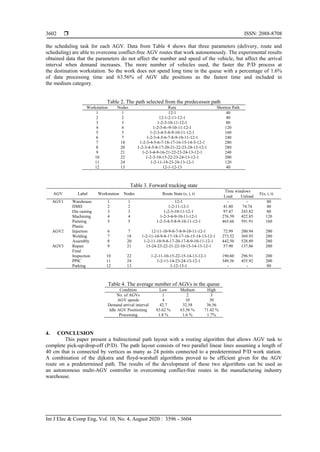
The path selected from its predecessor on the three AGVs when searching for the shortest path is
shown in Table 2, so that when the state graph is formed, the start time of the P/D process depends on
the time windows for each i is ai ≤ t ≤ bi with time windows 2 and conditions t = max {a1 + s1 + tij, aj}, j∈ S
for stage 1 and tj = max {aj, ti, + si + tij} for other stages, with the length of distribution si and the travel
time tij.
Table 1. Distance between nodes
Workstation/Node 1 2 3 4 5 6 7 8 9 10 11 12
1 0 40 80 120 160 240 80 280 280 200 1200 80
2 40 0 40 80 120 200 240 240 200 160 160 120
3 80 40 0 40 80 160 200 200 160 120 200 160
4 120 80 40 0 40 120 160 160 120 160 240 200
5 160 120 80 40 0 80 120 120 160 200 280 240
7 240 200 160 120 80 40 0 120 160 200 280 240
13 80 160 120 200 240 240 200 200 160 120 40 0
18 280 240 200 160 120 40 0 80 120 120 240 200
20 280 240 200 160 120 120 80 0 40 80 120 200
21 240 200 160 120 160 160 120 40 0 40 120 160
22 200 160 120 160 200 200 160 800 40 0 80 120
24 120 160 200 240 280 280 240 160 120 80 0 40
Information:
Workstation : 1 2 3 4 5 6 7 8 9 10 11 12
node : 1 2 3 4 5 7 18 20 21 22 24 13
After the shortest path value of the dijkstra and floyd-warshall algorithm calculations is known,
a new state (S, i, t) will be forme and the weighting of the distance between the origin node and
the destination node already known using the forward tracking system uses computational calculations,
as in Table 3. In Table 3, dynamic route calculation with a time window in P/D is given according to](https://image.slidesharecdn.com/v3020964ed11jan29dec199sep19y-201214022357/85/Conflict-free-dynamic-route-multi-agv-using-dijkstra-Floyd-warshall-hybrid-algorithm-with-time-windows-6-320.jpg)
![Int J Elec & Comp Eng ISSN: 2088-8708
Conflict-free dynamic route multi-AGV using dijkstra floyd-warshall… (Solichudin)
3603
REFERENCES
[1] W. Malopolski, “A Sustainable and Conflict-Free Operation of AGVs in a Square Topology,” Computers and
Industrial Engineering, vol. 126, pp. 472-481, 2018.
[2] I.F.A. Vis, “Survey of Research in The Design and Control of Aautomated Guided Vehicle Systems,” European
Journal Operational Research, vol. 170, no. 3, pp. 677-709, 2006.
[3] W.J. Hsu, et al., “Scheduling and Routing Algorithms for AGVs: a Survey,” International Journal Production
Research, vol. 40, no. 3, pp. 745-760, 2002.
[4] A. Langevin, D. Lauzon and D. Riopel, “Dispatching, Routing, and Scheduling of Two Automated Guided
Vehicles in a Flexible Manufacturing System,” Int. J. Flexible Manufacturing System, vol. 8, pp. 247-262, 1996.
[5] E. Gawrilow, M. Klimm, R. H. Mo, and B. Stenzel, “Conflict-Free Vehicle Routing,” Euro Journal Transpot
Logistic, vol. 1, pp. 87-111, 2012.
[6] X. Sun, et al., “Scheduling Multiple AGVs with Dynamic Time-windows for Smart Indoor Parking Lot,”
in 2018 IEEE 22nd Int. Conference on Computer Supported Cooperative Work in Design, pp. 864-868, 2018.
[7] V. Jaiganesh, D. K. Jayashankar, and J. Girijadevi, “Automated Guided Vehicle with Robotic Logistics System,”
in Procedia Engineering, vol. 97, pp. 2011-2021, 2014.
[8] D. Antakly, J-J. Loiseau, and R. Abbou, “A Temporised Conflict-Free Routing Policy for AGVs,” IFAC- Pap.,
vol. 50, no. 1, pp. 1-7, 2018.
[9] Q.I.U. Ling and H.S.U. Wen-jing, “Conflict-Free AGV Routing in a Bi-Directional Path Layout,” In Proceedings
of the 5th International Conference on Computer Integrated Manufacturing, vol. 1, pp. 392-403, 2000.
[10] S. Peyer, D. Rautenbach, and J. Vygen, “A Generalization of Dijkstra’s Shortest Path Algorithm with Applications
to VLSI Routing,” Journal of Discrete Algorithms, vol. 7, no. 4, pp. 377-390, 2009.
[11] M. Hamzeei, R. Zanjirani, and H. Rashidi-Bejgan, “An Exact and A Simulated Annealing Algorithm for
Simultaneously Determining Flow Path and The Location of P/D Stations in Bidirectional Path,” Journal of
Manufacturing System, vol. 32, no. 4, pp. 648-654, 2013.
[12] T. Nishi and Y. Tanaka, “Petri Net Decomposition Approach for Dispatching and Conflict-Free Routing of
Bidirectional Automated Guided Vehicle Systems,” in The 4th IEEE International Conference on Automation
Science and Engineering, vol. 42, no. 5, pp. 1230-1243, 2012.
[13] B. Rahnama, S. Member, K. Ebedi, and H. M. Sadeghi, “Self-Corrective Cascade Control Obstacle Avoidance and
Deviation Correction System for Robotics Systems,” In IEEE RO-MAN. IEEE, pp. 133-136, 2013.
[14] A. Bahari, “Automated Guided Vehicles Routing,” Technical Journal of Engineering and Applied Sciences,
vol. 4, no. 2, pp. 60-66, 2014.
[15] N.V. Kumar and C. S. Kumar, “Development of Collision Free Path Planning Algorithm for Warehouse Mobile
Robot,” in Procedia Computer Science, vol. 133, pp. 456-463, 2018.
[16] J.P. Ko, J.W. Jung, and J.W. Jeon, “Anti-Collision Method for AGV Using RFID and ZigBee Network,” in 13th
Interntional Conference on Control, Automation and Systems, pp. 599-604, 2013.
[17] M. Polanczyk, M. Strzelecki and K. Slot, “Obstacle Avoidance Procedure and Lee Algorithm Based Path
Replanner for Autonomous Mobile Platforms,” Int. J. of Electronics and Telecomm, vol. 59, no. 1, pp. 85-91, 2013.
[18] R. Tai, et al., “A Time-Efficient Approach to Solve Conflicts and Deadlocks for Scheduling AGVs in Warehousing
Applications,” in International Conference on Real-time Computing and Robotics, pp. 166-171, 2018.
[19] K. Arutselvan, and A. Vijayakumari, “Assistive Autonomous Ground Vehicles in Smart Grid,” in Procedia
Technology, vol. 21, pp. 232-239, 2015.
[20] Y. Wan, et al., “Controller Design for Avoiding Collisions in Automated Guided Vehicle Systems Via Labeled
Petri Nets,” IFAC-PapersOnLine Conference Paper Archive, vol. 51, no. 7, pp. 139-144, 2018.
[21] C.M. Klei and J. Kim, “AGV Dispatching,” International Journal Production Research, vol. 34, no. 1, pp. 95-110,
2007.
[22] U.A. Umar, M.K.A. Ariffin, N. Ismail, and S.H. Tang, “Conflict-Free Automated Guided Vehicles Routing Using
Multi-Objective Genetic Algorithm,” Research Journal of Applied science, Engineering and Technology, vol. 6,
no. 14, pp. 2681-2684, 2013.
[23] A.I. Corréa, A. Langevin, and L. Rousseau, “Scheduling and Routing of Automated Guided Vehicles: A Hybrid
Approach,” in Computers & Operations Research, vol. 34, no. 6, pp. 1688-1707, 2007.
[24] C. Liu, et al., “Path Planning and Intelligent Scheduling of Multi-AGV Systems in Workshop,” in Proceedings of
The 36th Chinese Control Conference, pp. 2735-2739, 2017.
[25] Z. Zhang, Q. Guo, J. Chen, and P. Yuan, “Collision-Free Route Planning for Multiple AGVs in an Automated
Warehouse Based on Collision Classification,” in IEEE Access, vol. 6, pp. 26022-26035, 2018.
[26] D. Giglio, “Task Scheduling for Multiple Forklift AGVs in Distribution Warehouses,” in Emerging Technology
and Factory Automation, pp. 1-6, 2014.
[27] N.A. El-sherbeny, “The Algorithm of The Time-Dependent Shortest Path Problem with Time Windows,”Applied
Mathematics, vol. 5, no. 17. pp. 2764-2770, 2014.
[28] N.A. El-Sherbeny, “Vehicle Routing with Time Windows: An Overview of Exact, Heuristic and Metaheuristic
Methods,” Journal of King Saud University - Science, vol. 22, no. 3, pp. 123-131, 2010.](https://image.slidesharecdn.com/v3020964ed11jan29dec199sep19y-201214022357/85/Conflict-free-dynamic-route-multi-agv-using-dijkstra-Floyd-warshall-hybrid-algorithm-with-time-windows-8-320.jpg)


