Indonesian J ElecEng & Comp Sci ISSN: 2502-4752
A review of controller approach for autonomous guided vehicle system (Faiza Gul)
553
Zheng et al. proposes waterborne AGVs, inspired by conventional automated guided vehicles
and autonomous surface vessels, for transport over water. The controller can achieve energy efficiency
and smooth tracking with arrival time awareness for transport-oriented applications. Tracking errors are also
formulated. For smooth tracking the lower level is embedded with online MPC (Model Predictive
Controller). Simulation results illustrate the effectiveness of the proposed modeling and control design for
waterborne AGVs [14].
Pedapati et al. have studied the Non-linear adaptive control of an AGV. The control strategy follows
two points: i) trajectory tracking in presence of actuator ii) free movement of the AGV in an obstacle
cluttered environment. The author presented the controller which exploit a conventional feedback controller
in conjunction with an adaptive inverse dynamic’s strategy for the actuators. Auto-Regressive Exogenous
Model (ARX) and Non-Linear Auto-Regressive Exogenous Model (NARX) have been used for identifying
the AGV actuator inverse dynamics. The simulation proofs the efficiency of proposed indirect adaptive
controllers in comparison to Inverse Dynamic Conventional Feedback Controller (IDCFB) [15].
Chen et al. proposed a predictive sliding mode control method based on multi-sensor fusion to solve
the problem of insufficient accuracy in trajectory tracking caused by actuator delay. The controller, based on
the kinematics model, uses an inner and outer two-layer structure to achieve decoupling of position control
and heading control. The experimental results depict that the new control algorithm can improve
the performance of the AGV controller by referring to the positional change rate, thereby improving
the AGV operation without derailing [16].
Wan Rahiman et al. have studied an autonomous car navigation system based on Global Positioning
System (GPS). The primary objectives of the authors were to make an auto-navigational car model that can
route through known or pre-programmed co-ordinates autonomously without any control by human.
The design uses a low-cost inertial measurement unit (IMU) to navigate between intermittent GPS fixes.
The hardware consists of a IMU, GPS receiver, compass and a data processing computer [17].
Taghavifar et al. focuses on the controller design for path-tracking problem of autonomous ground
vehicles by employing a multi-constraint nonlinear predictive control (NMPC). It is aimed to improve
the transient performance of the vehicle and to consider a rollover prevention criterion in the proposed
method. The validity of the presented control system is verified by comparing with the traditional NMPC
technique by employing a high fidelity CarSim/MATLAB framework [18].
Alireza Asvadi et al. worked on 3D lidar and presented the 3D perception system based on planes
and voxel for obstacle avoidance and modeling of a ground environment. The algorithm is divided into two
parts, first part includes estimation of ground environment using RANSAC and piecewise plane fitting
method and the second part works on determining the dynamic and static objects using voxel-grid model
and ego formation. The authors did experiments by utilizing Velodyne Lidar for point-cloud and used inertial
navigation system for localization. The obtain results were checked on urban scenes and proved
the efficiency of results [19].
In view of implementation autonomous system in industral mobile robot application, a detail
of different types of AGVs are discussed below: Fork-lifts: Fork-lift truck applications are considered
relatively new. Guided fork trucks are also common in use as they have ability to automatically pick up items
of load and drop them at destination without human intervention. They are used when any system requires
an automatic pickup and drop off loads from stand level or floor level. The vehicle can position its forks
according to desire load level with different heights.
Unit Load: Unit load application involves specific assignments for load delivery. They are popular
in integrating conveyors with storage retrieval or assembly operation system. They are famous for
transferring load from one station to the other station with remote management facility relatively used for
shorter distance but higher volume of load. They are applied in distribution and warehousing system.
Roller decks or lift decks can also be integrated with unit load train to shift load by conveyors where
the maneuverability of vehicle is difficult. In this way, it provides efficient versatility in moving
products because they operate in independent manner and can perform task by passing each other and
reaching to specific destination.
Tugger/Tow: They are also called as driver-less train and considered as earliest kind of AGV.
They are involved in transferring bulk of product in and out of warehouse area. They carry trailer cart with
themselves for dropping off products at destination that is also considered as chain movement of product.
To unload the product several stops are taken to unload product. This kind of movement is used when
the distance is very long in distributed area. This method is considered as very efficient as compared to fork
truck due to its ability to carry massive and large amount of product in short time. The dynamics of the AGV
are considered non-linear and has numerous uncertainties during their movement, therefore its a challenging
venture to explore. This has led to several control algorithms proposed in the literature. In this work, a review
of the prominent control algorithm together with controllers applied to the AGV are discussed.
3.
ISSN: 2502-4752
IndonesianJ Elec Eng & Comp Sci, Vol. 20, No. 1, October 2020 : 552 - 562
554
2. TECHNIQUES FOR AGV GUIDANCE
They are several kinds of AGV presents through which the desired task can be performed.
For making them efficient and reliable they are incorporated with other sensors to make them more efficient.
Some AGV kind are discussed below.
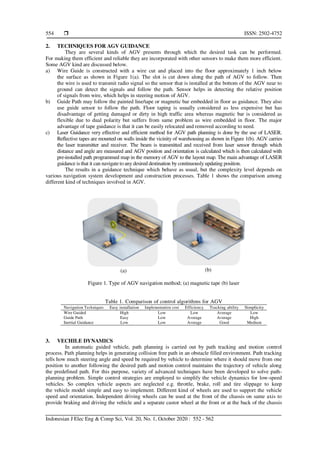
a) Wire Guide is constructed with a wire cut and placed into the floor approximately 1 inch below
the surface as shown in Figure 1(a). The slot is cut down along the path of AGV to follow. Then
the wire is used to transmit radio signal so the sensor that is installed at the bottom of the AGV near to
ground can detect the signals and follow the path. Sensor helps in detecting the relative position
of signals from wire, which helps in steering motion of AGV.
b) Guide Path may follow the painted line/tape or magnetic bar embedded in floor as guidance. They also
use guide sensor to follow the path. Floor taping is usually considered as less expensive but has
disadvantage of getting damaged or dirty in high traffic area whereas magnetic bar is considered as
flexible due to dual polarity but suffers from same problem as wire embedded in floor. The major
advantage of tape guidance is that it can be easily relocated and removed according to need.
c) Laser Guidance very effective and efficient method for AGV path planning is done by the use of LASER.
Reflective tapes are mounted on walls inside the vicinity of warehousing as shown in Figure 1(b). AGV carries
the laser transmitter and receiver. The beam is transmitted and received from laser sensor through which
distance and angle are measured and AGV position and orientation is calculated which is then calculated with
pre-installed path programmed map in the memory of AGV to the layout map. The main advantage of LASER
guidance is that it can navigate to any desired destination by continuously updating position.
The results in a guidance technique which behave as usual, but the complexity level depends on
various navigation system development and construction processes. Table 1 shows the comparison among
different kind of techniques involved in AGV.
(a) (b)
Figure 1. Type of AGV navigation method; (a) magnetic tape (b) laser
Table 1. Comparison of control algorithms for AGV
Navigation Techniques Easy installation Implementation cost Efficiency Tracking ability Simplicity
Wire Guided High Low Low Average Low
Guide Path Easy Low Average Average High
Inertial Guidance Low Low Average Good Medium
3. VECHILE DYNAMICS
In automatic guided vehicle, path planning is carried out by path tracking and motion control
process. Path planning helps in generating collision free path in an obstacle filled environment. Path tracking
tells how much steering angle and speed be required by vehicle to determine where it should move from one
position to another following the desired path and motion control maintains the trajectory of vehicle along
the predefined path. For this purpose, variety of advanced techniques have been developed to solve path-
planning problem. Simple control strategies are employed to simplify the vehicle dynamics for low-speed
vehicles. So complex vehicle aspects are neglected e.g. throttle, brake, roll and tire slippage to keep
the vehicle model simple and easy to implement. Different kind of wheels are used to support the vehicle
speed and orientation. Independent driving wheels can be used at the front of the chassis on same axis to
provide braking and driving the vehicle and a separate castor wheel at the front or at the back of the chassis
4.
Indonesian J ElecEng & Comp Sci ISSN: 2502-4752
A review of controller approach for autonomous guided vehicle system (Faiza Gul)
555
can also be used to give balance to vehicle. Also, four separate differential wheels are used to give stability to
vehicle. Front wheels support vehicle in forward and backward motion as well as also helps in avoiding
cornering. Back wheels are used to support in braking system. Figure 2 shows the geometric description
of 4-wheel differential mobile robot. Where θ represents the orientation angle of robot w.r.t world coordinate
system [ ] together vehicle pose . Figure 3 shows the 4-wheel differential driven robot.
Two differentially driving wheels are mounted on the same axis together with rear/castor wheel to
stabilize the vehicle. For navigation method, the orientation and motion are acquired by independent
actuators of both wheels and DC motor provides required torque to front wheel. The drive module
coordinates the operation of the two-wheel drive motors through the motor controller to realize the forward,
reverse and steering of the AGV. A strategic design in this platform is to allow for smooth movement in
a confined space compare to 4-wheel AGV. Figure 2 shows the 2 differentially driven vehicle. Where r is
the radius and vr and vl are the right and left wheel velocities. XY are the global co-ordinate system and
are the local coordinate system frame and are the distance from the centre of the wheel. The position
of AGV can be determined from coordinate vector where and are the coordinates points in
global system and is the orientation angle. Where and are angular and linear velocities
of right and left wheels. Assuming wheels has no slip and roll.
Figure 2. 4-wheel differentially driven robot
Figure 3. Representation of robot in coordinate system
The kinematic motion equation of vehicle that describe the mathematical relationship between the parameters
of the AGV’s motion can be written as following:
(1)
(2)
(3)
(4)
5.
ISSN: 2502-4752
IndonesianJ Elec Eng & Comp Sci, Vol. 20, No. 1, October 2020 : 552 - 562
556
The control problem for AGV has widely been researched. Faisal et al. [20] the authors steered
the mobile robot to final destination point and implemented the fuzzy logic for avoiding obstacles. Abdallah
K. et al. [21] the authors have designed a fuzzy logic controller for path planning and target search with
obstacle avoidance. Hajer Omrane et al. [22] implemented the path tracking control robot in a environment
by using the DC motor and infrared sensor for measuring distance to & from obstacles and encoders to
adjusting the speed. A bumper event approach was employed to develop an algorithm for obstacle avoidance
of Turtlebot in [23]. The approach however did not provide free collision navigation.
4. AGV NAVIGATION
The navigation architecture of AGV includes path planning, exploration, obstacle avoidance
and localization. Path planning is considered as a cognitive level for AGV. It involves integration
and aggregation of ambient information so that AGV manoeuvrability can be enhanced. For successful path
planning, path information must be updated continuously, and unanticipated events should be handled in
a constructive manner. Figure 4 shows the architectural diagram of autonomous guided vehicle.
Figure 4. Block diagram of autonomous guided vehicle
4.1. Survey of control algorithms
The dynamic nature of AGV has led to develop several control algorithms. The control system can
broadly be classified as a Linear and Non-Linear control system. Each control algorithm has its pros
and cons. Some of the controller designed for AGV system has been discussed below.
4.2. Proportional integral derivative (PID)
The PID controller considered as the widely applied controller and applied for broad range
of controller in control system applications. It is considered as a simplest controller to design and implement
since the gain parameters are easy to adjust. However, some major challenges involve the non-linearity,
imprecise and inaccurate parameters of the model. Therefore, PID controller limits the implementation
design of system and its performance. Li et al. used PID with fuzzy logic controller to enhance the static
and dynamic performance of AGV as well as improve the performance of PID controller [24]. They use
Kalman filter to determine the pose of AGV. Gomes et al. developed a control algorithm for AGV model to
follow the predefined path by line avoiding oscillation on its movement. Cameras were used inside PID
control loop to track path [25]. Kim et al. [26] have designed the obstacle avoidance system for AGV by
using fuzzy logic control with PID control. They controlled the rotation angle and moving velocity by fuzzy-
PID controller. Al Zaher et al. developed the AGV for lane tracking, detection and obstacle avoidance.
The system employs camera for collecting data in real time and images captured by camera were used to
recognize the lanes lines and obstacle dimension. A PID controller used to predict the vehicle-heading
angle [27]. Wan Rahiman designed PI controller for velocity control of a mobile robot. A loop of PI
controller is designed to provide a stable velocity to the mobile robot system [28]. Pan Zhao et al. presents
the control system architecture by developing the new adaptive PID controller called” Intelligent Pioneer” for
navigation of mobile robot in an unknown environment. Two-degree freedom model is presented for
the formulation of state space [29]. The results were presented in Future Challenge of China and stood out as
number one. Figure 5 shows the general block diagram of a PID controller for autonomous guided vehicle.
6.
Indonesian J ElecEng & Comp Sci ISSN: 2502-4752
A review of controller approach for autonomous guided vehicle system (Faiza Gul)
557
Figure 5. Block diagram of PID controller for autonomous guided vehicle
4.3. Fuzzy logic and neural network
Intelligent control algorithms have several artificial intelligence techniques, and some are
biologically inspired for controlling a system. This includes fuzzy logic, neural network, genetic algorithm
and machine learning. They are considered an efficient way to deal with the intelligent system but involves
mathematical complexity and uncertainty. This also increases computational complexity for usage
of intelligent system. There are many intelligent control systems, but fuzzy logic and neural network are
considered as most widely used and applied control system. Fuzzy Logic strategy was implemented for
control and trajectory tracking for an autonomous unicycle robot. A back-stepping approach implemented in
Fuzzy Logic Controller to acquire the asymptotic stabilization of the robots pose around the desired
trajectory [30]. The Mamdani Fuzzy Inference system with IF-THEN rules has been implemented to
construct the controller. Input velocities and torques were given the linguistic variables and centroid method
area was used for defuzzification process. Simulation results were also carried out to illustrate
the performance of Fuzzy logic controller. The kinematics and dynamics of vehicle were also studied.
Tso et al. have highlighted that the performance of AGV can be measured and calculated by errors in their
position and orientation [31]. They presented the fact that sometimes errors in robot pose are not measured
and feedback system is essential to employ to obtain position error. A linear controller is implemented which
was further improved by the implementation of Fuzzy logic. Two fuzzy logics were created. Opto-sensors are
present in a linear array. The Popov criterion, the phase-plane method, and the Hurwitz criterion demonstrate
the stability of the system. Similarly, for neural network approach many authors have worked, and solved
problems related to AGV. Singh et al. designed a multilayer feed forward neural network to control
the steering angle of robot in static and dynamic environment. The obstacle distances are feed as input
and the steering angle of AGV is the output [32]. Zhan et al. presented the intelligent coordination control
scheme for AGV steering system by the help of fuzzy control, bang-bang control and neural network. Least
square method used for the AGV system identification. The dynamic model for AGV steering system is
expressed using orientation angle error and distance error [33]. Motlagh et al. propose the obstacle avoidance
and target seeking behaviour of AGV using neural network [34]. Medina-Satiago et al. considered path
planning of pattern classification [35]. They developed a path planning algorithm using multilayer perceptron
and back propagation of ANN which was experimented on a differential drive mobile robot. Figure 6 shows
the block diagram of a Fuzzy logic controller.
Figure 6. Block diagram of fuzzy logic controller for autonomous guided vehicle
7.
ISSN: 2502-4752
IndonesianJ Elec Eng & Comp Sci, Vol. 20, No. 1, October 2020 : 552 - 562
558
4.4. Backstepping controller
Backstepping controller, considered as the most important technique for stabilizing a nonholonomic
system. It is a recursive procedure, which breaks the design problem of controller into sub design problems
and progressively stabilizes sub design system. It requires less computational time and converges fast with
less disturbance in nonlinear system, but the algorithm robustness is not efficient [25]. While, Partama et al.
have proposed a trajectory tracking algorithm for AGV system using backstepping controller unknown wheel
radii. A lyapunov function helped in kinematic modelling and achieving system stability [36]. Another
backstepping controller for Wheeled Mobile Robot has been developed by Dumitrascu et al. [37] based on
robot’s kinematics. The controller performance is evaluated in real time and through simulations.
The backstepping controller is also used to keep the vehicle on track. Fan et al. developed 4-wheeled steering
automatic guided vehicle (4WISAGV) and control the steering of each wheel independently by
demonstrating the vehicle track and reducing the 4-wheeled vehicle to 2-wheeled vehicle by aligning wheels
in center of vehicle [38]. Backstepping controller used to keep track of vehicle path and at last simulation
results proved the successful trajectory.
4.5. Sliding mode control
SMC is a non-linear control algorithm, considered as effective approach and solution due to its easy
implementation, robustness in parameters variation, fast dynamic response, and good tracking ability. In
a different development, SMC was considered by some researchers [39, 40]. The algorithm works when
a discontinuous signal applied to a control signal of system to command it and slide it to prescribed path.
Wang et al. developed trajectory tracking control system for AGV by incorporating VDC, vehicle dynamic
control with it. The control system depends on two levels: a desired yaw rate generator based on kinematics
and yaw rate controller based on tire dynamics of AGV [41]. Ertugrul et al. modelled AGV system using
kinematics and dynamics response and using variable structure system technique [42]. They developed
a sliding mode controller using Lyapunov method to eliminate chattering. The simulation proved the results.
Thanhphuong et al. designed a non-linear controller for AGV system. The controller helps AGV to follow
the desired path with constant velocity and encoders help to estimates the position of AGV. Lyapunov
method helps in improving the system stability [43]. Soysal et al. proposed the tracking control method for
AGV, using sliding mode controller. The SMC used to control direction angle and velocity of vehicle to keep
it on desired path. The controller applied a continuous signal instead of a discrete signal. It occurs due to
discontinuity of control signal [44]. Figure 7 shows the general block diagram of a sliding mode controller
for autonomous guided vehicle.
Figure 7. Block diagram of sliding mode controller for autonomous guided vehicle
4.6. Adaptive control
Adaptive control algorithms are prone to adapting parameters in system. These parameters are either
varying or uncertain with time. Non-linear adaptive controller was presented for autonomous guided
twowheel vehicle for automatic overtaking manoeuvre in [45]. Using robotic nomenclature for translational
and rotational velocities and kinematics model of robot used in developing relative inter-vehicle kinematics.
Hidaka et al. proposed a path control AGV that can steer in all directions [46]. They developed an adaptive
path control for omni directional and holonomic AGV by assuming that design parameters cannot be decided
in control system. Numerical simulations proved the validity of result. Figure 8 shows the general block
diagram of an adaptive controller for autonomous guided vehicle.
8.
Indonesian J ElecEng & Comp Sci ISSN: 2502-4752
A review of controller approach for autonomous guided vehicle system (Faiza Gul)
559
Figure 8. Block diagram of adaptive controller for autonomous guided vehicle
4.7. Linear quadratic regulator
The LQR control algorithm runs a dynamic system by optimizing the cost function. It is considered
as powerful technique for both linear and nonlinear system. Li et al. proposed the trajectory tracking control
for AGV system. Newton second law used for vehicle lateral motion and lateral tire forces. The linear
quadratic regulator then used for path tracking control [47]. MATLAB and CarSim used for simulation
purpose. System performance is also countable parameter when designing a control system for any vehicle.
For small system, lesser state space variables are required and the conversion of the performance index from
scalar form to matrix form is considered simple and easy for implementation whereas for larger system more
appropriate design, controller and state variables are required. Tchamna et al. used linear quadratic regulator
to design a technique for large system, which do not require the redesigning from beginning and make it easy
for implementation for any new implemented system [48]. The method was used to control the attitude
of vehicle in cornering. Figure 9 shows the block diagram of linear quadratic regulator.
Figure 9. Block diagram of linear quadratic regulator for autonomous guided vehicle.
4.8. Hybrid control algorithm
It has been observed that linear or non-linear algorithms had their own limitations and cannot provide
desired output and no single controller provide give required performance. So many researchers have integrated
different controllers together to enhance system performance. The scheduling and routing is considered as important
problem for AGV [49]. A hybrid simulated annealing and Dijkstara algorithms have used to solve routing problem.
Then hybrid algorithm and simulated annealing algorithm were compared to check the performance. Mousavi et al.
presented fuzzy hybrid Genetic algorithm and particle swarm optimization algorithm to solve the scheduling problem
of AGV. The obtained results showed that hybrid system take less computational time when compared with GA and
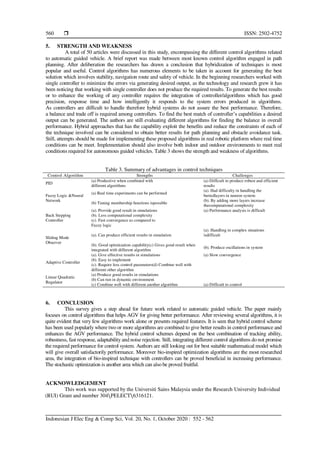
PSO algorithms itself [50]. Table 2 shows the comparisons of different algorithms based on their performances.
Table 2. Comparison of control algorithms for AGV
Algorithms Robustness Optimal Intelligent Tracking ability Simplicity Precision
PID Low Low Low Satisfactory High Low
Fuzzy logic Low Low High Low Low Low
Neural Network Low High High Low Low Low
Backstepping Satisfactory Average Average High Average Satisfactory
Sliding Mode Controller Average Average Satisfactory High Average High
Adaptive Control Satisfactory Average Average Average Low Satisfactory
Linear Quadratic Regulator Low Average Low Average Average Low
9.
ISSN: 2502-4752
IndonesianJ Elec Eng & Comp Sci, Vol. 20, No. 1, October 2020 : 552 - 562
560
5. STRENGTH AND WEAKNESS
A total of 50 articles were discussed in this study, encompassing the different control algorithms related
to automatic guided vehicle. A brief report was made between most known control algorithm engaged in path
planning. After deliberation the researchers has drawn a conclusion that hybridization of techniques is most
popular and useful. Control algorithms has numerous elements to be taken in account for generating the best
solution which involves stability, navigation route and safety of vehicle. In the beginning researchers worked with
single controller to minimize the errors via generating desired output, as the technology and research grew it has
been noticing that working with single controller does not produce the required results. To generate the best results
or to enhance the working of any controller requires the integration of controller/algorithms which has good
precision, response time and how intelligently it responds to the system errors produced in algorithms.
As controllers are difficult to handle therefore hybrid systems do not assure the best performance. Therefore,
a balance and trade off is required among controllers. To find the best match of controller’s capabilities a desired
output can be generated. The authors are still evaluating different algorithms for finding the balance in overall
performance. Hybrid approaches that has the capability exploit the benefits and reduce the constraints of each of
the technique involved can be considered to obtain better results for path planning and obstacle avoidance task.
Still, attempts should be made for implementing these proposed algorithms in real robotic platform where real time
conditions can be meet. Implementation should also involve both indoor and outdoor environments to meet real
conditions required for autonomous guided vehicles. Table 3 shows the strength and weakness of algorithms.
Table 3. Summary of advantages in control techniques
Control Algorithm Strengths Challenges
PID
(a) Productive when combined with
different algorithms
(a) Difficult to produce robust and efficient
results
Fuzzy Logic &Neural
Network
(a) Real time experiments can be performed
(a). Had difficulty in handling the
buriedlayers in neuron system
(b) Tuning membership functions ispossible
(b). By adding more layers increase
thecomputational complexity
Back Stepping
Controller
(a). Provide good result in simulations (a) Performance analysis is difficult
(b). Less computational complexity
(c). Fast convergence as compared to
Fuzzy logic
Sliding Mode
Observer
(a). Can produce efficient results in simulation
(a). Handling in complex situations
isdifficult
(b). Good optimization capability(c) Gives good result when
integrated with different algorithm
(b). Produce oscillations in system
Adaptive Controller
(a). Give effective results in simulations (a) Slow convergence
(b). Easy to implement
(c). Require less control parameters(d) Combine well with
different other algorithm
Linear Quadratic
Regulator
(a) Produce good results in simulations
(b) Can run in dynamic environment
(c) Combine well with different another algorithm (a) Difficult to control
6. CONCLUSION
This survey gives a step ahead for future work related to automatic guided vehicle. The paper mainly
focuses on control algorithms that helps AGV for giving better performance. After reviewing several algorithms, it is
quite evident that very few algorithms work alone or presents required features. It is seen that hybrid control scheme
has been used popularly where two or more algorithms are combined to give better results in control performance and
enhances the AGV performance. The hybrid control schemes depend on the best combination of tracking ability,
robustness, fast response, adaptability and noise rejection. Still, integrating different control algorithms do not promise
the required performance for control system. Authors are still looking out for best suitable mathematical model which
will give overall satisfactorily performance. Moreover bio-inspired optimization algorithms are the most researched
area, the integration of bio-inspired technique with controllers can be proved beneficial in increasing performance.
The stochastic optimization is another area which can also be proved fruitful.
ACKNOWLEDGEMENT
This work was supported by the Universiti Sains Malaysia under the Research University Individual
(RUI) Grant and number 304PELECT6316121.
10.
Indonesian J ElecEng & Comp Sci ISSN: 2502-4752
A review of controller approach for autonomous guided vehicle system (Faiza Gul)
561
REFERENCES
[1] F. Gul, W. Rahiman, and S. S. Nazli Alhady, “A comprehensive study for robot navigation techniques,” Cogent
Engineering, vol. 6, no. 1, pp. 1-25, 2019.
[2] A. Ayari and S. Bouamama, “A new multiple robot path planning algorithm: dynamic distributed particle swarm
optimization,” Robotics and biomimetics, vol. 4, no. 8, pp. 1-15, 2017.
[3] M. Saffari and M. Mahjoob, “Bee colony algorithm for real-time optimal path planning of mobile robots,” 2009
Fifth International Conference on Soft Computing, Computing with Words and Perceptions in System Analysis,
Decision and Control, pp. 1–4, 2009.
[4] H.-J. Wang, Y. Fu, Z.-Q. Zhao, and Y.-J. Yue, “An improved ant colony algorithm of robot path planning for
obstacle avoidance,” Journal of Robotics, vol. 2019, pp. 1-8, 2019.
[5] T.-K. Dao, et al, “A multi-objective optimal mobile robot path planning based on whale optimization algorithm,”
2016 IEEE 13th International Conference on Signal Processing (ICSP), pp. 337–342, 2016.
[6] J. Guo, Y. Gao, and G. Cui, “The path planning for mobile robot based on bat algorithm,” International Journal
of Automation and Control, vol. 9, no. 1, pp. 50–60, 2015.
[7] Y. Zhang, G. Guan, and X. Pu, “The robot path planning based on improved artificial fish swarm algorithm,”
Mathematical Problems in Engineering, vol. 2016, pp. 1-11, 2016.
[8] A. Kamalova, S. Navruzov, D. Qian, and S. G. Lee, “Multi-robot exploration based on multi-objective grey wolf
optimizer,” Applied Sciences, vol. 9, no. 14, pp. 1-16, 2019.
[9] F. Gul and W. Rahiman, “An integrated approach for path planning for mobile robot using bi-rrt,” IOP Conference
Series: Materials Science and Engineering, vol. 697, no. 1, pp. 1-8, 2019.
[10] A. S. Handayani, S. Nurmaini, I. Yani, and N. L. Husni, “Analysis on swarm robot coordination using fuzzy logic,”
Indonesian Journal of Electrical Engineering and Computer Science, vol. 13, no. 1, pp. 48–57, 2019.
[11] C. Rusu and I. Birou, “Obstacle avoidance fuzzy system for mobile robot with ir sensors,” 10th International
Conference on DEVELOPMENT AND APPLICATION SYSTEMS, pp. 25-29, 2010.
[12] M. Wang, J. Luo, and U. Walter, “A non-linear model predictive controller with obstacle avoidance for a space
robot,” Advances in Space Research, vol. 57, no. 8, pp. 1737–1746, 2016.
[13] T.-S. Jin, “Obstacle avoidance of mobile robot based on behavior hierarchy by fuzzy logic,” International Journal
of Fuzzy Logic and Intelligent Systems, vol. 12, no. 3, pp. 245–249, 2012.
[14] H. Zheng, R. R. Negenborn, and G. Lodewijks, “Predictive path following with arrival time awareness for
waterborne agvs,” Transportation research part C: emerging technologies, vol. 70, pp. 214–237, 2016.
[15] P. K. Pedapati, et al, “Nonlinear adaptive control of an autonomous ground vehicle in obstacle rich environment:
Some experimental results,” in TENCON 2019-2019 IEEE Region 10 Conference (TENCON), pp. 614–619, 2019.
[16] Z. Chen, J. Fu, X.-W. Tu, A.-L. Yang, and M.-R. Fei, “Real-time predictive sliding mode control method for agv
with actuator delay,” Advances in Manufacturing, vol. 7, no. 4, pp. 448–459, 2019.
[17] W. Rahiman and Z. Zainal, “An overview of development gps navigation for autonomous car,” in 2013 IEEE 8th
Conference on Industrial Electronics and Applications (ICIEA), pp. 1112–1118, 2013.
[18] H. Taghavifar, “Neural network autoregressive with exogenous input assisted multi-constraint nonlinear predictive
control of autonomous vehicles,” IEEE Transactions on Vehicular Technology, vol. 68, no. 7, pp. 6293–6304, 2019.
[19] A. Asvadi, C. Premebida, P. Peixoto, and U. Nunes, “3D lidar-based static and moving obstacle detection in driving
environments: An approach based on voxels and multi-region ground planes,” Robotics and Autonomous Systems, 2016.
[20] M. Faisal, et al, “Fuzzy logic navigation and obstacle avoidance by a mobile robot in an unknown dynamic
environment,” International Journal of Advanced Robotic Systems, vol. 10, no. 1, pp. 1-7, 2013.
[21] K. Benbouabdallah and Z. Qi-dan, “A fuzzy logic behavior architecture controller for a mobile robot path planning in multi-
obstacles environment research,” Journal of Applied Sciences, Engineering and Technology, vol. 5, pp. 3835-3842, 2013.
[22] H. Omrane, M. S. Masmoudi, and M. Masmoudi, “Fuzzy logic based control for autonomous mobile robot
navigation,” Computational intelligence and neuroscience, vol. 2016, pp. 1-10, 2016.
[23] N. Kumar, Z. Vamossy, and Z. M. Szab´ o-Resch, “Robot obstacle avoidance using bumper event,” in 2016 IEEE
11th International Symposium on Applied Computational Intelligence and Informatics (SACI), pp. 485–490, 2016.
[24] X. Li, C. Luo, Y. Xu, and P. Li, “A fuzzy pid controller applied in agv control system,” in 2016 International
Conference on Advanced Robotics and Mechatronics (ICARM), pp. 555–560, 2016.
[25] M. Gomes, et al, “Pid control applied on a line-follower agv´ using a rgb camera,” in 2016 IEEE 19th International
Conference on Intelligent Transportation Systems (ITSC), pp. 194–198, 2016.
[26] D. H. Kim, et al, “Control system design of four wheeled independent steering automatic guided vehicles (agv),” in
International Conference on Advanced Engineering Theory and Applications. Springer, pp. 580–586, 2017.
[27] T. S. A. Al-Zaher, A. M. Bayoumy, A.-H. M. Sharaf, and Y. H. H. El-din, “Lane tracking and obstacle avoidance
for autonomous ground vehicles,” in 2012 9th France-Japan & 7th Europe-Asia Congress on Mechatronics
(MECATRONICS)/13th Int’l Workshop on Research and Education in Mechatronics (REM), pp. 264–271, 2012.
[28] T. Sokunphal, W. Othman, S. Alhady, and W. Rahiman, “Pi controller design for velocity control of a mobile
robot,” Journal of Fundamental and Applied Sciences, vol. 10, no. 3S, pp. 890–902, 2018.
[29] P. Zhao, J. Chen, Y. Song, X. Tao, T. Xu, and T. Mei, “Design of a control system for an autonomous vehicle
based on adaptive-pid,” International Journal of Advanced Robotic Systems, vol. 9, no. 2, pp. 1-11, 2012.
[30] O. Castillo, L. T. Aguilar, and S. Cardenas, “Fuzzy logic tracking control for unicycle mobile robots,” Engineering
Letters, vol. 13, no. 3, 2006.
[31] S. K. Tso, et al, “Fuzzy-logic control for differential-wheel-drive agvs using linear opto-sensor arrays,” in
Proceedings of IEEE International Conference on Robotics and Automation, vol. 3, pp. 2816–2821, 1996.
11.
ISSN: 2502-4752
IndonesianJ Elec Eng & Comp Sci, Vol. 20, No. 1, October 2020 : 552 - 562
562
[32] M. K. Singh and D. R. Parhi, “Path optimisation of a mobile robot using an artificial neural network controller,”
International Journal of Systems Science, vol. 42, no. 1, pp. 107–120, 2011.
[33] Y. D. Zhan, Y. G. Guo, and J. G. Zhu, “Intelligent coordination steering control of automated guided vehicle,” in
2011 International Conference on Applied Superconductivity and Electromagnetic Devices, pp. 204–207, 2011.
[34] O. Motlagh, D. Nakhaeinia, S. H. Tang, B. Karasfi, and W. Khaksar, “Automatic navigation of mobile robots in
unknown environments,” Neural Computing and Applications, vol. 24, no. 7-8, pp. 1569–1581, 2014.
[35] A. Medina-Santiago, et al, “Neural control system in obstacle avoidance in mobile robots using ultrasonic sensors,”
Journal of applied research and technology, vol. 12, no. 1, pp. 104–110, 2014.
[36] P. S. Pratama, et al, “Positioning and obstacle avoidance of automatic guided vehicle in partially known
environment,” International Journal of Control, Automation and Systems, vol. 14, no. 6, pp. 1572–1581, 2016.
[37] B. Dumitrascu, A. Filipescu, and V. Minzu, “Backstepping control of wheeled mobile robots,” in 15th
International Conference on System Theory, Control and Computing, pp. 1–6, 2011.
[38] K. Fan, Q. Yang, P. Li, and W. Yan, “On the design of agv obstacle avoidance system based on fuzzy-pid dual-
mode controller,” in 2012 IEEE Conference on Control, Systems & Industrial Informatics, pp. 54–58, 2012.
[39] A. S. Matveev, C. Wang, and A. V. Savkin, “Real-time navigation of mobile robots in problems of border
patrolling and avoiding collisions with moving and deforming obstacles,” Robotics and Autonomous systems,
vol. 60, no. 6, pp. 769–788, 2012.
[40] R. Solea and D. C. Cernega, “Obstacle avoidance for trajectory tracking control of wheeled mobile robots,” IFAC
Proceedings Volumes, vol. 45, no. 6, pp. 906–911, 2012.
[41] J. Wang, J. Steiber, and B. Surampudi, “Autonomous ground vehicle control system for high-speed and safe
operation,” in 2008 American Control Conference, pp. 218–223, 2008.
[42] M. Ertugrul, et al, “A comparison of various vss techniques on the control of automated guided vehicles,” in 1995
Proceedings of the IEEE International Symposium on Industrial Electronics, vol. 2, pp. 837–842, 1995.
[43] N. ThanhPhuong, P. QuocThien, and N. C. Cuong, “Designed of nonlinear controller for automated guided
vehicle.” American Journal of Engineering Research, vol. 2, no. 12, pp. 382–387, 2013.
[44] B. Soysal, “Real-time control of an automated guided vehicle using a continuous mode of sliding mode control,”
Turkish Journal of Electrical Engineering & Computer Sciences, vol. 22, no. 5, pp. 1298–1306, 2014.
[45] P. Petrov and F. Nashashibi, “Modeling and nonlinear adaptive control for autonomous vehicle overtaking,” IEEE
Transactions on Intelligent Transportation Systems, vol. 15, no. 4, pp. 1643–1656, 2014.
[46] K. Hidaka, “Adaptive path control for holonomic automated guided vehicles (agv),” in International Symposium on
Nonlinear Theory and its Applications, pp. 13-16, 2008.
[47] Y. Li, X. N. Wang, S. J. Li, and J. Zhu, “Lqr based trajectory tracking control for forked agv,” in Applied
Mechanics and Materials, vol. 577, pp. 447–451, 2014.
[48] R. Tchamna, et al, “Management of linear quadratic´ regulator optimal control with full-vehicle control case
study,” International Journal of Advanced Robotic Systems, vol. 13, no. 5, pp. 1-7, 2016.
[49] C. Soyleyici and S. B. Keser, “A hybrid algorithm for automated guided vehicle routing problem,” International
Journal of Intelligent Systems and Applications in Engineering, pp. 158–161, 2016.
[50] M. Mousavi, H. Yap, S. Musa, and S. Dawal, “A fuzzy hybrid ga-pso algorithm for multi-objective agv scheduling
in fms,” International Journal of Simulation Modelling, vol. 16, no. 1, pp. 58-71, 2017.
BIOGRAPHIES OF AUTHORS
Faiza Gul is a postgraduate student at School of Electrical and Electronic Engineering,
Universiti Sains Malaysia (USM), Engineering Campus, Penang, Malaysia. She has worked on
the development of LIDAR systems, autonomous guided vehicle and non-linear system.
Syed Sahal Nazli Alhady Syed Hassan is currently a senior lecturer at School of Electrical
and Electronic Engineering Universiti Sains Malaysia. He obtained his Bachelor of Engineering
at Universiti Teknologi Mara and completed his M. Sc and Ph. D at Universiti Sains Malaysia.
His specializations are in neural networks, biomedical, embedded systems, and intelligent system
Wan Rahiman gained BEng degree from Cardiff University, UK specialising in Manufacturing
Engineering and completed PhD in control-engineering study from University of Manchester, UK.
Dr Wan Rahiman joined as a senior lecturer in School of Electrical and Electronic Engineering,
Universiti Sains Malaysia in 2009. He is currently Head of Cluster of Smart Port and Logistics
Technology (COSPALT). His research interests lie in the area of modelling nonlinear systems and
their controller algorithm on a wide range of development industrial projects, particularly, in drone
and autonomous vehicle technologies. He endeavours to develop smart electronics with Internet of
Things (IoT) solution that could widely applied in the medical industry.
![Indonesian Journal of Electrical Engineering and Computer Science
Vol. 20, No. 1, October 2020, pp. 552~562
ISSN: 2502-4752, DOI: 10.11591/ijeecs.v20.i1.pp552-562 552
Journal homepage: http://ijeecs.iaescore.com
A review of controller approach for autonomous
guided vehicle system
Faiza Gul1
, Syed Sahal Nazli Alhady2
, Wan Rahiman3
1,2,3
School of Electrical and Electronic Engineering, Universiti Sains Malaysia (USM), Malaysia
3
Cluster of Smart Port and Logistics Technology (COSPALT), Universiti Sains Malaysia, Malaysia
Article Info ABSTRACT
Article history:
Received Feb 4, 2020
Revised Apr 6, 2020
Accepted Apr 20, 2020
The autonomous guided vehicle is a great and important platform for control
systems. Their non-linear nature helps in analysing the control algorithms
more efficiently and effectively. The main purpose of path planning is to find
the optimal path avoiding the time complexity so environment can be
modeled completely. For path planning numerous algorithms have been
proposed to solve their non-linear nature. The paper contains brief
explanation on AGV application, and its controller design architecture have
been discussed with advantages and disadvantages, e.g. Fuzzy control,
Neural Control, Back-stepping control, Adaptive control, Sliding mode
control and PID control and linear quadratic regulator. At last a brief
conclusion has been drawn on the bases of strength and weakness of all
algorithms. The research will help the readers to understand mobile robotic
path planning with different controllers.
Keywords:
Autonomous guided vehicle
Control system techniques
Copyright © 2020 Institute of Advanced Engineering and Science.
All rights reserved.
Corresponding Author:
Wan Rahiman,
School of Electrical and Electronic Engineering,
Universiti Sains Malaysia,
Nibong Tebal, 14300, Penang Malaysia.
Email: wanrahiman@usm.my
1. INTRODUCTION
The automated guided vehicle can be upgraded into autonomously controlled, famously known as
autonomous guided vehicle (AGV), is used in industrial applications to transfer materials from pickup place to
drop off place. It is the only kind of transportation, which follows guidance to reach destination. Material handling
systems uses AGV, which are used in facilities such as distribution centers, manufacturing plants, terminals and
warehouses. Their performance effects the whole delivery system. Wheel based or computer based are their
controlling parameters. Their motion is dependent on the combination of sensor-based guidance and software-
based guidance systems. They have a predictable path for their movement which also includes obstacle avoidance
and detection. They include transportation of goods and raw material inside the vicinity of industry or warehouses
avoiding the obstacle and ensuring the safe delivery at destination point. Material handling by the help of AGV has
also gained importance in facilities such has warehouse, manufacturing plant, distribution terminals and centers.
In terms of algorithm design, autonomous navigation is using control structure architecture based on automated
guided system. Then the issues related to these facilities using AGV can be divided into; estimated number of
vehicles, guide path, idle-positioning, and vehicle scheduling and battery management. Bio-inspired techniques are
most popular, and researchers are implementing them solving path planning problem for AGV or mobile robots
[1]. The popular bio-inspired algorithms are based on the living creature behavior which include birds, bees, ants,
whale, bat, fish, wolf [2-8]. Randomly exploring tree algorithm with pure pursuit controller can be found in [9].
Examples can be found in, robotics, physics, and control engineering and rehabilitation science [10]. The paper
describes the review related to AGV. There are records of considerable number of researches that describe
addressing path planning and obstacle avoidance problem using algorithms [11-13].](https://image.slidesharecdn.com/areviewofcontrolalgorithmforautono-250522214850-3eb2986b/85/A_Review_of_Control_Algorithm_for_Autono-pdf-1-320.jpg)
![Indonesian J Elec Eng & Comp Sci ISSN: 2502-4752
A review of controller approach for autonomous guided vehicle system (Faiza Gul)
553
Zheng et al. proposes waterborne AGVs, inspired by conventional automated guided vehicles
and autonomous surface vessels, for transport over water. The controller can achieve energy efficiency
and smooth tracking with arrival time awareness for transport-oriented applications. Tracking errors are also
formulated. For smooth tracking the lower level is embedded with online MPC (Model Predictive
Controller). Simulation results illustrate the effectiveness of the proposed modeling and control design for
waterborne AGVs [14].
Pedapati et al. have studied the Non-linear adaptive control of an AGV. The control strategy follows
two points: i) trajectory tracking in presence of actuator ii) free movement of the AGV in an obstacle
cluttered environment. The author presented the controller which exploit a conventional feedback controller
in conjunction with an adaptive inverse dynamic’s strategy for the actuators. Auto-Regressive Exogenous
Model (ARX) and Non-Linear Auto-Regressive Exogenous Model (NARX) have been used for identifying
the AGV actuator inverse dynamics. The simulation proofs the efficiency of proposed indirect adaptive
controllers in comparison to Inverse Dynamic Conventional Feedback Controller (IDCFB) [15].
Chen et al. proposed a predictive sliding mode control method based on multi-sensor fusion to solve
the problem of insufficient accuracy in trajectory tracking caused by actuator delay. The controller, based on
the kinematics model, uses an inner and outer two-layer structure to achieve decoupling of position control
and heading control. The experimental results depict that the new control algorithm can improve
the performance of the AGV controller by referring to the positional change rate, thereby improving
the AGV operation without derailing [16].
Wan Rahiman et al. have studied an autonomous car navigation system based on Global Positioning
System (GPS). The primary objectives of the authors were to make an auto-navigational car model that can
route through known or pre-programmed co-ordinates autonomously without any control by human.
The design uses a low-cost inertial measurement unit (IMU) to navigate between intermittent GPS fixes.
The hardware consists of a IMU, GPS receiver, compass and a data processing computer [17].
Taghavifar et al. focuses on the controller design for path-tracking problem of autonomous ground
vehicles by employing a multi-constraint nonlinear predictive control (NMPC). It is aimed to improve
the transient performance of the vehicle and to consider a rollover prevention criterion in the proposed
method. The validity of the presented control system is verified by comparing with the traditional NMPC
technique by employing a high fidelity CarSim/MATLAB framework [18].
Alireza Asvadi et al. worked on 3D lidar and presented the 3D perception system based on planes
and voxel for obstacle avoidance and modeling of a ground environment. The algorithm is divided into two
parts, first part includes estimation of ground environment using RANSAC and piecewise plane fitting
method and the second part works on determining the dynamic and static objects using voxel-grid model
and ego formation. The authors did experiments by utilizing Velodyne Lidar for point-cloud and used inertial
navigation system for localization. The obtain results were checked on urban scenes and proved
the efficiency of results [19].
In view of implementation autonomous system in industral mobile robot application, a detail
of different types of AGVs are discussed below: Fork-lifts: Fork-lift truck applications are considered
relatively new. Guided fork trucks are also common in use as they have ability to automatically pick up items
of load and drop them at destination without human intervention. They are used when any system requires
an automatic pickup and drop off loads from stand level or floor level. The vehicle can position its forks
according to desire load level with different heights.
Unit Load: Unit load application involves specific assignments for load delivery. They are popular
in integrating conveyors with storage retrieval or assembly operation system. They are famous for
transferring load from one station to the other station with remote management facility relatively used for
shorter distance but higher volume of load. They are applied in distribution and warehousing system.
Roller decks or lift decks can also be integrated with unit load train to shift load by conveyors where
the maneuverability of vehicle is difficult. In this way, it provides efficient versatility in moving
products because they operate in independent manner and can perform task by passing each other and
reaching to specific destination.
Tugger/Tow: They are also called as driver-less train and considered as earliest kind of AGV.
They are involved in transferring bulk of product in and out of warehouse area. They carry trailer cart with
themselves for dropping off products at destination that is also considered as chain movement of product.
To unload the product several stops are taken to unload product. This kind of movement is used when
the distance is very long in distributed area. This method is considered as very efficient as compared to fork
truck due to its ability to carry massive and large amount of product in short time. The dynamics of the AGV
are considered non-linear and has numerous uncertainties during their movement, therefore its a challenging
venture to explore. This has led to several control algorithms proposed in the literature. In this work, a review
of the prominent control algorithm together with controllers applied to the AGV are discussed.](https://image.slidesharecdn.com/areviewofcontrolalgorithmforautono-250522214850-3eb2986b/85/A_Review_of_Control_Algorithm_for_Autono-pdf-2-320.jpg)
![Indonesian J Elec Eng & Comp Sci ISSN: 2502-4752
A review of controller approach for autonomous guided vehicle system (Faiza Gul)
555
can also be used to give balance to vehicle. Also, four separate differential wheels are used to give stability to
vehicle. Front wheels support vehicle in forward and backward motion as well as also helps in avoiding
cornering. Back wheels are used to support in braking system. Figure 2 shows the geometric description
of 4-wheel differential mobile robot. Where θ represents the orientation angle of robot w.r.t world coordinate
system [ ] together vehicle pose . Figure 3 shows the 4-wheel differential driven robot.
Two differentially driving wheels are mounted on the same axis together with rear/castor wheel to
stabilize the vehicle. For navigation method, the orientation and motion are acquired by independent
actuators of both wheels and DC motor provides required torque to front wheel. The drive module
coordinates the operation of the two-wheel drive motors through the motor controller to realize the forward,
reverse and steering of the AGV. A strategic design in this platform is to allow for smooth movement in
a confined space compare to 4-wheel AGV. Figure 2 shows the 2 differentially driven vehicle. Where r is
the radius and vr and vl are the right and left wheel velocities. XY are the global co-ordinate system and
are the local coordinate system frame and are the distance from the centre of the wheel. The position
of AGV can be determined from coordinate vector where and are the coordinates points in
global system and is the orientation angle. Where and are angular and linear velocities
of right and left wheels. Assuming wheels has no slip and roll.
Figure 2. 4-wheel differentially driven robot
Figure 3. Representation of robot in coordinate system
The kinematic motion equation of vehicle that describe the mathematical relationship between the parameters
of the AGV’s motion can be written as following:
(1)
(2)
(3)
(4)](https://image.slidesharecdn.com/areviewofcontrolalgorithmforautono-250522214850-3eb2986b/85/A_Review_of_Control_Algorithm_for_Autono-pdf-4-320.jpg)
![ ISSN: 2502-4752
Indonesian J Elec Eng & Comp Sci, Vol. 20, No. 1, October 2020 : 552 - 562
556
The control problem for AGV has widely been researched. Faisal et al. [20] the authors steered
the mobile robot to final destination point and implemented the fuzzy logic for avoiding obstacles. Abdallah
K. et al. [21] the authors have designed a fuzzy logic controller for path planning and target search with
obstacle avoidance. Hajer Omrane et al. [22] implemented the path tracking control robot in a environment
by using the DC motor and infrared sensor for measuring distance to & from obstacles and encoders to
adjusting the speed. A bumper event approach was employed to develop an algorithm for obstacle avoidance
of Turtlebot in [23]. The approach however did not provide free collision navigation.
4. AGV NAVIGATION
The navigation architecture of AGV includes path planning, exploration, obstacle avoidance
and localization. Path planning is considered as a cognitive level for AGV. It involves integration
and aggregation of ambient information so that AGV manoeuvrability can be enhanced. For successful path
planning, path information must be updated continuously, and unanticipated events should be handled in
a constructive manner. Figure 4 shows the architectural diagram of autonomous guided vehicle.
Figure 4. Block diagram of autonomous guided vehicle
4.1. Survey of control algorithms
The dynamic nature of AGV has led to develop several control algorithms. The control system can
broadly be classified as a Linear and Non-Linear control system. Each control algorithm has its pros
and cons. Some of the controller designed for AGV system has been discussed below.
4.2. Proportional integral derivative (PID)
The PID controller considered as the widely applied controller and applied for broad range
of controller in control system applications. It is considered as a simplest controller to design and implement
since the gain parameters are easy to adjust. However, some major challenges involve the non-linearity,
imprecise and inaccurate parameters of the model. Therefore, PID controller limits the implementation
design of system and its performance. Li et al. used PID with fuzzy logic controller to enhance the static
and dynamic performance of AGV as well as improve the performance of PID controller [24]. They use
Kalman filter to determine the pose of AGV. Gomes et al. developed a control algorithm for AGV model to
follow the predefined path by line avoiding oscillation on its movement. Cameras were used inside PID
control loop to track path [25]. Kim et al. [26] have designed the obstacle avoidance system for AGV by
using fuzzy logic control with PID control. They controlled the rotation angle and moving velocity by fuzzy-
PID controller. Al Zaher et al. developed the AGV for lane tracking, detection and obstacle avoidance.
The system employs camera for collecting data in real time and images captured by camera were used to
recognize the lanes lines and obstacle dimension. A PID controller used to predict the vehicle-heading
angle [27]. Wan Rahiman designed PI controller for velocity control of a mobile robot. A loop of PI
controller is designed to provide a stable velocity to the mobile robot system [28]. Pan Zhao et al. presents
the control system architecture by developing the new adaptive PID controller called” Intelligent Pioneer” for
navigation of mobile robot in an unknown environment. Two-degree freedom model is presented for
the formulation of state space [29]. The results were presented in Future Challenge of China and stood out as
number one. Figure 5 shows the general block diagram of a PID controller for autonomous guided vehicle.](https://image.slidesharecdn.com/areviewofcontrolalgorithmforautono-250522214850-3eb2986b/85/A_Review_of_Control_Algorithm_for_Autono-pdf-5-320.jpg)
![Indonesian J Elec Eng & Comp Sci ISSN: 2502-4752
A review of controller approach for autonomous guided vehicle system (Faiza Gul)
557
Figure 5. Block diagram of PID controller for autonomous guided vehicle
4.3. Fuzzy logic and neural network
Intelligent control algorithms have several artificial intelligence techniques, and some are
biologically inspired for controlling a system. This includes fuzzy logic, neural network, genetic algorithm
and machine learning. They are considered an efficient way to deal with the intelligent system but involves
mathematical complexity and uncertainty. This also increases computational complexity for usage
of intelligent system. There are many intelligent control systems, but fuzzy logic and neural network are
considered as most widely used and applied control system. Fuzzy Logic strategy was implemented for
control and trajectory tracking for an autonomous unicycle robot. A back-stepping approach implemented in
Fuzzy Logic Controller to acquire the asymptotic stabilization of the robots pose around the desired
trajectory [30]. The Mamdani Fuzzy Inference system with IF-THEN rules has been implemented to
construct the controller. Input velocities and torques were given the linguistic variables and centroid method
area was used for defuzzification process. Simulation results were also carried out to illustrate
the performance of Fuzzy logic controller. The kinematics and dynamics of vehicle were also studied.
Tso et al. have highlighted that the performance of AGV can be measured and calculated by errors in their
position and orientation [31]. They presented the fact that sometimes errors in robot pose are not measured
and feedback system is essential to employ to obtain position error. A linear controller is implemented which
was further improved by the implementation of Fuzzy logic. Two fuzzy logics were created. Opto-sensors are
present in a linear array. The Popov criterion, the phase-plane method, and the Hurwitz criterion demonstrate
the stability of the system. Similarly, for neural network approach many authors have worked, and solved
problems related to AGV. Singh et al. designed a multilayer feed forward neural network to control
the steering angle of robot in static and dynamic environment. The obstacle distances are feed as input
and the steering angle of AGV is the output [32]. Zhan et al. presented the intelligent coordination control
scheme for AGV steering system by the help of fuzzy control, bang-bang control and neural network. Least
square method used for the AGV system identification. The dynamic model for AGV steering system is
expressed using orientation angle error and distance error [33]. Motlagh et al. propose the obstacle avoidance
and target seeking behaviour of AGV using neural network [34]. Medina-Satiago et al. considered path
planning of pattern classification [35]. They developed a path planning algorithm using multilayer perceptron
and back propagation of ANN which was experimented on a differential drive mobile robot. Figure 6 shows
the block diagram of a Fuzzy logic controller.
Figure 6. Block diagram of fuzzy logic controller for autonomous guided vehicle](https://image.slidesharecdn.com/areviewofcontrolalgorithmforautono-250522214850-3eb2986b/85/A_Review_of_Control_Algorithm_for_Autono-pdf-6-320.jpg)
![ ISSN: 2502-4752
Indonesian J Elec Eng & Comp Sci, Vol. 20, No. 1, October 2020 : 552 - 562
558
4.4. Backstepping controller
Backstepping controller, considered as the most important technique for stabilizing a nonholonomic
system. It is a recursive procedure, which breaks the design problem of controller into sub design problems
and progressively stabilizes sub design system. It requires less computational time and converges fast with
less disturbance in nonlinear system, but the algorithm robustness is not efficient [25]. While, Partama et al.
have proposed a trajectory tracking algorithm for AGV system using backstepping controller unknown wheel
radii. A lyapunov function helped in kinematic modelling and achieving system stability [36]. Another
backstepping controller for Wheeled Mobile Robot has been developed by Dumitrascu et al. [37] based on
robot’s kinematics. The controller performance is evaluated in real time and through simulations.
The backstepping controller is also used to keep the vehicle on track. Fan et al. developed 4-wheeled steering
automatic guided vehicle (4WISAGV) and control the steering of each wheel independently by
demonstrating the vehicle track and reducing the 4-wheeled vehicle to 2-wheeled vehicle by aligning wheels
in center of vehicle [38]. Backstepping controller used to keep track of vehicle path and at last simulation
results proved the successful trajectory.
4.5. Sliding mode control
SMC is a non-linear control algorithm, considered as effective approach and solution due to its easy
implementation, robustness in parameters variation, fast dynamic response, and good tracking ability. In
a different development, SMC was considered by some researchers [39, 40]. The algorithm works when
a discontinuous signal applied to a control signal of system to command it and slide it to prescribed path.
Wang et al. developed trajectory tracking control system for AGV by incorporating VDC, vehicle dynamic
control with it. The control system depends on two levels: a desired yaw rate generator based on kinematics
and yaw rate controller based on tire dynamics of AGV [41]. Ertugrul et al. modelled AGV system using
kinematics and dynamics response and using variable structure system technique [42]. They developed
a sliding mode controller using Lyapunov method to eliminate chattering. The simulation proved the results.
Thanhphuong et al. designed a non-linear controller for AGV system. The controller helps AGV to follow
the desired path with constant velocity and encoders help to estimates the position of AGV. Lyapunov
method helps in improving the system stability [43]. Soysal et al. proposed the tracking control method for
AGV, using sliding mode controller. The SMC used to control direction angle and velocity of vehicle to keep
it on desired path. The controller applied a continuous signal instead of a discrete signal. It occurs due to
discontinuity of control signal [44]. Figure 7 shows the general block diagram of a sliding mode controller
for autonomous guided vehicle.
Figure 7. Block diagram of sliding mode controller for autonomous guided vehicle
4.6. Adaptive control
Adaptive control algorithms are prone to adapting parameters in system. These parameters are either
varying or uncertain with time. Non-linear adaptive controller was presented for autonomous guided
twowheel vehicle for automatic overtaking manoeuvre in [45]. Using robotic nomenclature for translational
and rotational velocities and kinematics model of robot used in developing relative inter-vehicle kinematics.
Hidaka et al. proposed a path control AGV that can steer in all directions [46]. They developed an adaptive
path control for omni directional and holonomic AGV by assuming that design parameters cannot be decided
in control system. Numerical simulations proved the validity of result. Figure 8 shows the general block
diagram of an adaptive controller for autonomous guided vehicle.](https://image.slidesharecdn.com/areviewofcontrolalgorithmforautono-250522214850-3eb2986b/85/A_Review_of_Control_Algorithm_for_Autono-pdf-7-320.jpg)
![Indonesian J Elec Eng & Comp Sci ISSN: 2502-4752
A review of controller approach for autonomous guided vehicle system (Faiza Gul)
559
Figure 8. Block diagram of adaptive controller for autonomous guided vehicle
4.7. Linear quadratic regulator
The LQR control algorithm runs a dynamic system by optimizing the cost function. It is considered
as powerful technique for both linear and nonlinear system. Li et al. proposed the trajectory tracking control
for AGV system. Newton second law used for vehicle lateral motion and lateral tire forces. The linear
quadratic regulator then used for path tracking control [47]. MATLAB and CarSim used for simulation
purpose. System performance is also countable parameter when designing a control system for any vehicle.
For small system, lesser state space variables are required and the conversion of the performance index from
scalar form to matrix form is considered simple and easy for implementation whereas for larger system more
appropriate design, controller and state variables are required. Tchamna et al. used linear quadratic regulator
to design a technique for large system, which do not require the redesigning from beginning and make it easy
for implementation for any new implemented system [48]. The method was used to control the attitude
of vehicle in cornering. Figure 9 shows the block diagram of linear quadratic regulator.
Figure 9. Block diagram of linear quadratic regulator for autonomous guided vehicle.
4.8. Hybrid control algorithm
It has been observed that linear or non-linear algorithms had their own limitations and cannot provide
desired output and no single controller provide give required performance. So many researchers have integrated
different controllers together to enhance system performance. The scheduling and routing is considered as important
problem for AGV [49]. A hybrid simulated annealing and Dijkstara algorithms have used to solve routing problem.
Then hybrid algorithm and simulated annealing algorithm were compared to check the performance. Mousavi et al.
presented fuzzy hybrid Genetic algorithm and particle swarm optimization algorithm to solve the scheduling problem
of AGV. The obtained results showed that hybrid system take less computational time when compared with GA and
PSO algorithms itself [50]. Table 2 shows the comparisons of different algorithms based on their performances.
Table 2. Comparison of control algorithms for AGV
Algorithms Robustness Optimal Intelligent Tracking ability Simplicity Precision
PID Low Low Low Satisfactory High Low
Fuzzy logic Low Low High Low Low Low
Neural Network Low High High Low Low Low
Backstepping Satisfactory Average Average High Average Satisfactory
Sliding Mode Controller Average Average Satisfactory High Average High
Adaptive Control Satisfactory Average Average Average Low Satisfactory
Linear Quadratic Regulator Low Average Low Average Average Low](https://image.slidesharecdn.com/areviewofcontrolalgorithmforautono-250522214850-3eb2986b/85/A_Review_of_Control_Algorithm_for_Autono-pdf-8-320.jpg)
![Indonesian J Elec Eng & Comp Sci ISSN: 2502-4752
A review of controller approach for autonomous guided vehicle system (Faiza Gul)
561
REFERENCES
[1] F. Gul, W. Rahiman, and S. S. Nazli Alhady, “A comprehensive study for robot navigation techniques,” Cogent
Engineering, vol. 6, no. 1, pp. 1-25, 2019.
[2] A. Ayari and S. Bouamama, “A new multiple robot path planning algorithm: dynamic distributed particle swarm
optimization,” Robotics and biomimetics, vol. 4, no. 8, pp. 1-15, 2017.
[3] M. Saffari and M. Mahjoob, “Bee colony algorithm for real-time optimal path planning of mobile robots,” 2009
Fifth International Conference on Soft Computing, Computing with Words and Perceptions in System Analysis,
Decision and Control, pp. 1–4, 2009.
[4] H.-J. Wang, Y. Fu, Z.-Q. Zhao, and Y.-J. Yue, “An improved ant colony algorithm of robot path planning for
obstacle avoidance,” Journal of Robotics, vol. 2019, pp. 1-8, 2019.
[5] T.-K. Dao, et al, “A multi-objective optimal mobile robot path planning based on whale optimization algorithm,”
2016 IEEE 13th International Conference on Signal Processing (ICSP), pp. 337–342, 2016.
[6] J. Guo, Y. Gao, and G. Cui, “The path planning for mobile robot based on bat algorithm,” International Journal
of Automation and Control, vol. 9, no. 1, pp. 50–60, 2015.
[7] Y. Zhang, G. Guan, and X. Pu, “The robot path planning based on improved artificial fish swarm algorithm,”
Mathematical Problems in Engineering, vol. 2016, pp. 1-11, 2016.
[8] A. Kamalova, S. Navruzov, D. Qian, and S. G. Lee, “Multi-robot exploration based on multi-objective grey wolf
optimizer,” Applied Sciences, vol. 9, no. 14, pp. 1-16, 2019.
[9] F. Gul and W. Rahiman, “An integrated approach for path planning for mobile robot using bi-rrt,” IOP Conference
Series: Materials Science and Engineering, vol. 697, no. 1, pp. 1-8, 2019.
[10] A. S. Handayani, S. Nurmaini, I. Yani, and N. L. Husni, “Analysis on swarm robot coordination using fuzzy logic,”
Indonesian Journal of Electrical Engineering and Computer Science, vol. 13, no. 1, pp. 48–57, 2019.
[11] C. Rusu and I. Birou, “Obstacle avoidance fuzzy system for mobile robot with ir sensors,” 10th International
Conference on DEVELOPMENT AND APPLICATION SYSTEMS, pp. 25-29, 2010.
[12] M. Wang, J. Luo, and U. Walter, “A non-linear model predictive controller with obstacle avoidance for a space
robot,” Advances in Space Research, vol. 57, no. 8, pp. 1737–1746, 2016.
[13] T.-S. Jin, “Obstacle avoidance of mobile robot based on behavior hierarchy by fuzzy logic,” International Journal
of Fuzzy Logic and Intelligent Systems, vol. 12, no. 3, pp. 245–249, 2012.
[14] H. Zheng, R. R. Negenborn, and G. Lodewijks, “Predictive path following with arrival time awareness for
waterborne agvs,” Transportation research part C: emerging technologies, vol. 70, pp. 214–237, 2016.
[15] P. K. Pedapati, et al, “Nonlinear adaptive control of an autonomous ground vehicle in obstacle rich environment:
Some experimental results,” in TENCON 2019-2019 IEEE Region 10 Conference (TENCON), pp. 614–619, 2019.
[16] Z. Chen, J. Fu, X.-W. Tu, A.-L. Yang, and M.-R. Fei, “Real-time predictive sliding mode control method for agv
with actuator delay,” Advances in Manufacturing, vol. 7, no. 4, pp. 448–459, 2019.
[17] W. Rahiman and Z. Zainal, “An overview of development gps navigation for autonomous car,” in 2013 IEEE 8th
Conference on Industrial Electronics and Applications (ICIEA), pp. 1112–1118, 2013.
[18] H. Taghavifar, “Neural network autoregressive with exogenous input assisted multi-constraint nonlinear predictive
control of autonomous vehicles,” IEEE Transactions on Vehicular Technology, vol. 68, no. 7, pp. 6293–6304, 2019.
[19] A. Asvadi, C. Premebida, P. Peixoto, and U. Nunes, “3D lidar-based static and moving obstacle detection in driving
environments: An approach based on voxels and multi-region ground planes,” Robotics and Autonomous Systems, 2016.
[20] M. Faisal, et al, “Fuzzy logic navigation and obstacle avoidance by a mobile robot in an unknown dynamic
environment,” International Journal of Advanced Robotic Systems, vol. 10, no. 1, pp. 1-7, 2013.
[21] K. Benbouabdallah and Z. Qi-dan, “A fuzzy logic behavior architecture controller for a mobile robot path planning in multi-
obstacles environment research,” Journal of Applied Sciences, Engineering and Technology, vol. 5, pp. 3835-3842, 2013.
[22] H. Omrane, M. S. Masmoudi, and M. Masmoudi, “Fuzzy logic based control for autonomous mobile robot
navigation,” Computational intelligence and neuroscience, vol. 2016, pp. 1-10, 2016.
[23] N. Kumar, Z. Vamossy, and Z. M. Szab´ o-Resch, “Robot obstacle avoidance using bumper event,” in 2016 IEEE
11th International Symposium on Applied Computational Intelligence and Informatics (SACI), pp. 485–490, 2016.
[24] X. Li, C. Luo, Y. Xu, and P. Li, “A fuzzy pid controller applied in agv control system,” in 2016 International
Conference on Advanced Robotics and Mechatronics (ICARM), pp. 555–560, 2016.
[25] M. Gomes, et al, “Pid control applied on a line-follower agv´ using a rgb camera,” in 2016 IEEE 19th International
Conference on Intelligent Transportation Systems (ITSC), pp. 194–198, 2016.
[26] D. H. Kim, et al, “Control system design of four wheeled independent steering automatic guided vehicles (agv),” in
International Conference on Advanced Engineering Theory and Applications. Springer, pp. 580–586, 2017.
[27] T. S. A. Al-Zaher, A. M. Bayoumy, A.-H. M. Sharaf, and Y. H. H. El-din, “Lane tracking and obstacle avoidance
for autonomous ground vehicles,” in 2012 9th France-Japan & 7th Europe-Asia Congress on Mechatronics
(MECATRONICS)/13th Int’l Workshop on Research and Education in Mechatronics (REM), pp. 264–271, 2012.
[28] T. Sokunphal, W. Othman, S. Alhady, and W. Rahiman, “Pi controller design for velocity control of a mobile
robot,” Journal of Fundamental and Applied Sciences, vol. 10, no. 3S, pp. 890–902, 2018.
[29] P. Zhao, J. Chen, Y. Song, X. Tao, T. Xu, and T. Mei, “Design of a control system for an autonomous vehicle
based on adaptive-pid,” International Journal of Advanced Robotic Systems, vol. 9, no. 2, pp. 1-11, 2012.
[30] O. Castillo, L. T. Aguilar, and S. Cardenas, “Fuzzy logic tracking control for unicycle mobile robots,” Engineering
Letters, vol. 13, no. 3, 2006.
[31] S. K. Tso, et al, “Fuzzy-logic control for differential-wheel-drive agvs using linear opto-sensor arrays,” in
Proceedings of IEEE International Conference on Robotics and Automation, vol. 3, pp. 2816–2821, 1996.](https://image.slidesharecdn.com/areviewofcontrolalgorithmforautono-250522214850-3eb2986b/85/A_Review_of_Control_Algorithm_for_Autono-pdf-10-320.jpg)
![ ISSN: 2502-4752
Indonesian J Elec Eng & Comp Sci, Vol. 20, No. 1, October 2020 : 552 - 562
562
[32] M. K. Singh and D. R. Parhi, “Path optimisation of a mobile robot using an artificial neural network controller,”
International Journal of Systems Science, vol. 42, no. 1, pp. 107–120, 2011.
[33] Y. D. Zhan, Y. G. Guo, and J. G. Zhu, “Intelligent coordination steering control of automated guided vehicle,” in
2011 International Conference on Applied Superconductivity and Electromagnetic Devices, pp. 204–207, 2011.
[34] O. Motlagh, D. Nakhaeinia, S. H. Tang, B. Karasfi, and W. Khaksar, “Automatic navigation of mobile robots in
unknown environments,” Neural Computing and Applications, vol. 24, no. 7-8, pp. 1569–1581, 2014.
[35] A. Medina-Santiago, et al, “Neural control system in obstacle avoidance in mobile robots using ultrasonic sensors,”
Journal of applied research and technology, vol. 12, no. 1, pp. 104–110, 2014.
[36] P. S. Pratama, et al, “Positioning and obstacle avoidance of automatic guided vehicle in partially known
environment,” International Journal of Control, Automation and Systems, vol. 14, no. 6, pp. 1572–1581, 2016.
[37] B. Dumitrascu, A. Filipescu, and V. Minzu, “Backstepping control of wheeled mobile robots,” in 15th
International Conference on System Theory, Control and Computing, pp. 1–6, 2011.
[38] K. Fan, Q. Yang, P. Li, and W. Yan, “On the design of agv obstacle avoidance system based on fuzzy-pid dual-
mode controller,” in 2012 IEEE Conference on Control, Systems & Industrial Informatics, pp. 54–58, 2012.
[39] A. S. Matveev, C. Wang, and A. V. Savkin, “Real-time navigation of mobile robots in problems of border
patrolling and avoiding collisions with moving and deforming obstacles,” Robotics and Autonomous systems,
vol. 60, no. 6, pp. 769–788, 2012.
[40] R. Solea and D. C. Cernega, “Obstacle avoidance for trajectory tracking control of wheeled mobile robots,” IFAC
Proceedings Volumes, vol. 45, no. 6, pp. 906–911, 2012.
[41] J. Wang, J. Steiber, and B. Surampudi, “Autonomous ground vehicle control system for high-speed and safe
operation,” in 2008 American Control Conference, pp. 218–223, 2008.
[42] M. Ertugrul, et al, “A comparison of various vss techniques on the control of automated guided vehicles,” in 1995
Proceedings of the IEEE International Symposium on Industrial Electronics, vol. 2, pp. 837–842, 1995.
[43] N. ThanhPhuong, P. QuocThien, and N. C. Cuong, “Designed of nonlinear controller for automated guided
vehicle.” American Journal of Engineering Research, vol. 2, no. 12, pp. 382–387, 2013.
[44] B. Soysal, “Real-time control of an automated guided vehicle using a continuous mode of sliding mode control,”
Turkish Journal of Electrical Engineering & Computer Sciences, vol. 22, no. 5, pp. 1298–1306, 2014.
[45] P. Petrov and F. Nashashibi, “Modeling and nonlinear adaptive control for autonomous vehicle overtaking,” IEEE
Transactions on Intelligent Transportation Systems, vol. 15, no. 4, pp. 1643–1656, 2014.
[46] K. Hidaka, “Adaptive path control for holonomic automated guided vehicles (agv),” in International Symposium on
Nonlinear Theory and its Applications, pp. 13-16, 2008.
[47] Y. Li, X. N. Wang, S. J. Li, and J. Zhu, “Lqr based trajectory tracking control for forked agv,” in Applied
Mechanics and Materials, vol. 577, pp. 447–451, 2014.
[48] R. Tchamna, et al, “Management of linear quadratic´ regulator optimal control with full-vehicle control case
study,” International Journal of Advanced Robotic Systems, vol. 13, no. 5, pp. 1-7, 2016.
[49] C. Soyleyici and S. B. Keser, “A hybrid algorithm for automated guided vehicle routing problem,” International
Journal of Intelligent Systems and Applications in Engineering, pp. 158–161, 2016.
[50] M. Mousavi, H. Yap, S. Musa, and S. Dawal, “A fuzzy hybrid ga-pso algorithm for multi-objective agv scheduling
in fms,” International Journal of Simulation Modelling, vol. 16, no. 1, pp. 58-71, 2017.
BIOGRAPHIES OF AUTHORS
Faiza Gul is a postgraduate student at School of Electrical and Electronic Engineering,
Universiti Sains Malaysia (USM), Engineering Campus, Penang, Malaysia. She has worked on
the development of LIDAR systems, autonomous guided vehicle and non-linear system.
Syed Sahal Nazli Alhady Syed Hassan is currently a senior lecturer at School of Electrical
and Electronic Engineering Universiti Sains Malaysia. He obtained his Bachelor of Engineering
at Universiti Teknologi Mara and completed his M. Sc and Ph. D at Universiti Sains Malaysia.
His specializations are in neural networks, biomedical, embedded systems, and intelligent system
Wan Rahiman gained BEng degree from Cardiff University, UK specialising in Manufacturing
Engineering and completed PhD in control-engineering study from University of Manchester, UK.
Dr Wan Rahiman joined as a senior lecturer in School of Electrical and Electronic Engineering,
Universiti Sains Malaysia in 2009. He is currently Head of Cluster of Smart Port and Logistics
Technology (COSPALT). His research interests lie in the area of modelling nonlinear systems and
their controller algorithm on a wide range of development industrial projects, particularly, in drone
and autonomous vehicle technologies. He endeavours to develop smart electronics with Internet of
Things (IoT) solution that could widely applied in the medical industry.](https://image.slidesharecdn.com/areviewofcontrolalgorithmforautono-250522214850-3eb2986b/85/A_Review_of_Control_Algorithm_for_Autono-pdf-11-320.jpg)


