CONFLICT RESOLUTION
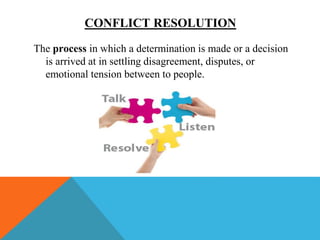
The process in which a determination is made or a decision
is arrived at in settling disagreement, disputes, or
emotional tension between to people.
GUIDELINES FOR ADDRESSING A CONFLICT
RESOLUTION
 Ground Rules
 Listen
 Don’t Take Sides
 Don’t Ask “Why...” Do Ask
What,” “How,” and “Tell me
more about...”
 Don’t Rush
 Don’t Dwell on the Past
 “I” Statements
 Don’t Do Their Work
 Know when to Tap Out
 Follow Up
 Be comfortable with being
uncomfortable
5 ELEMENTS OF ACTIVE LISTENING
 Pay attention and stay engaged.
 Show that you are listening.
 Provide feedback.
 Defer judgment.
 Respond Appropriately.
 Watch nonverbals.
5 STAGES IN THE MEDIATION PROCESS…
1. Introduction and Ground Rules
2. Storytelling- each participant shares his or her
side of the story without interruption
3. Exchange of dialogue between participants
4. Finding solutions- participants create their own
solutions to resolve the conflict
5. Final agreement- mediators write the solutions
into an agreement and all sign it.
COMMUNICATION PITFALLS…
• Closed questions or answers
• Can be answered with “yes” or “no”
• Interrupting
• Judging
• Laughing or ridiculing
• Criticizing
• Bringing up your own experience
YOUR EXPERIENCES…
• When have you experienced conflict?
• What worked to resolve it? What didn’t
work?
• Practice makes perfect 

Conflict resolution

  • 2.
    CONFLICT RESOLUTION The processin which a determination is made or a decision is arrived at in settling disagreement, disputes, or emotional tension between to people.
  • 3.
    GUIDELINES FOR ADDRESSINGA CONFLICT RESOLUTION  Ground Rules  Listen  Don’t Take Sides  Don’t Ask “Why...” Do Ask What,” “How,” and “Tell me more about...”  Don’t Rush  Don’t Dwell on the Past  “I” Statements  Don’t Do Their Work  Know when to Tap Out  Follow Up  Be comfortable with being uncomfortable
  • 4.
    5 ELEMENTS OFACTIVE LISTENING  Pay attention and stay engaged.  Show that you are listening.  Provide feedback.  Defer judgment.  Respond Appropriately.  Watch nonverbals.
  • 5.
    5 STAGES INTHE MEDIATION PROCESS… 1. Introduction and Ground Rules 2. Storytelling- each participant shares his or her side of the story without interruption 3. Exchange of dialogue between participants 4. Finding solutions- participants create their own solutions to resolve the conflict 5. Final agreement- mediators write the solutions into an agreement and all sign it.
  • 6.
    COMMUNICATION PITFALLS… • Closedquestions or answers • Can be answered with “yes” or “no” • Interrupting • Judging • Laughing or ridiculing • Criticizing • Bringing up your own experience
  • 7.
    YOUR EXPERIENCES… • Whenhave you experienced conflict? • What worked to resolve it? What didn’t work? • Practice makes perfect 

Editor's Notes

  • #4 Set and maintain mediation rules without distracting from the point of the conversation   Spend as little time as possible talking - you are simply helping/focusing the conversation between the roommates.   Avoid agreeing with/denying what the parties say - this changes your role into one of judge rather than facilitator   Be cautious of beginning questions with “Why...” to avoid connoting disapproval and opening doors for students to offer excuses for their feelings/actions. Questions beginning with “What,” “How,” and “Tell me more about...” are better for generating discussion.   Avoid coming to solutions too quickly - getting the parties to talk about what’s really happening between them is equally important.   By the same token, don’t let the parties continue rehashing the same concerns once it has stopped being productive. An important part of your role is recognizing when to bring mediations to closure.   Guide parties to use “I” statements and take responsibility for their needs and actions.   It is never your responsibility to come up with the solutions to their problems. Again, this shifts the focus from them to you.   Balance mediating in a timely fashion with knowing when to call a time-out. Often you don’t have to come to a long-term solution in one setting. Help the residents figure out how they can make things work until you can enlist the help of your AC.   Expect to continue your involvement in their conflict management. Follow up with your residents on a regular basis to track their success in solving their conflict.
  • #5 Pay attention. Give the speaker your undivided attention and acknowledge the message. Recognize that what is not said also speaks loudly. Look at the speaker directly. Put aside distracting thoughts. Don’t mentally prepare a rebuttal! Avoid being distracted by environmental factors. “Listen” to the speaker’s body language. Refrain from side conversations when listening in a group setting. Show that you are listening. Use your own body language and gestures to convey your attention. Nod occasionally. Smile and use other facial expressions. Note your posture and make sure it is open and inviting. Encourage the speaker to continue with small verbal comments like yes, and uh huh. Provide feedback. Our personal filters, assumptions, judgments, and beliefs can distort what we hear. As a listener, your role is to understand what is being said. This may require you to reflect what is being said and ask questions. Reflect what has been said by paraphrasing. “What I’m hearing is…” and “Sounds like you are saying…” are great ways to reflect back. Ask questions to clarify certain points. “What do you mean when you say…” “Is this what you mean?” Summarize the speaker’s comments periodically. Defer judgment. Interrupting is a waste of time. It frustrates the speaker and limits full understanding of the message. Allow the speaker to finish. Don’t interrupt with counter-arguments. Respond Appropriately. Active listening is a model for respect and understanding. You are gaining information and perspective. You add nothing by attacking the speaker or otherwise putting him or her down. Be candid, open, and honest in your response. Assert your opinions respectfully. Treat the other person as he or she would want to be treated. Tip: If you find yourself responding emotionally to what someone said, say so, and ask for more information: "I may not be understanding you correctly, and I find myself taking what you said personally. What I thought you just said is XXX; is that what you meant?"