Indian Health Care System
And Inequality In Access
MODULE TEACHERS:
Dr. Archana Diwate and Dr. Smitha Nair
Class Schedule: 6th
September and 11th
September 2024
Learner Objectives
• To situate health care systems within the broader social
context.
• To trace the evolution and challenges of Indian health
care systems both in the pre and post reforms period.
• To familiarize the extent of inequalities in population
health and its linkage with access to health care systems.
Content

Why Health becomes a right?

Health care as Public good

Constitutional Provisions on health

Evolution of Health services:

1940s-2017

Access to HSS

By class, caste, region and gender

Factors influencing Access
Concepts
• Health: WHO in 1946 for the first time tried to define health in a holistic
way by adopting the definition of “A state of complete physical, mental
and social wellbeing and not merely the absence of disease or infirmity”.
The concept of health is thus influenced by the interplay of macro, meso
and micro level socio economic, political and other factors or determinants
of health.
• Health care: Health care is the maintenance or improvement
of health via the diagnosis, treatment, and prevention
of disease, illness, injury, and other physical and mental impairments in
human beings.
• System: Derived from latin word ‘systema’ and ancient greek ‘sustema’
which means organized whole body (eg:respiratory system)
• Health Care System: The organized system of health care that is
responsible for providing primary, secondary and tertiary care to the
larger population which include preventive, promotive, curative and
rehabilitative services.
• The health care system is intended to deliver the health care services. It
constitutes the management sector and involves the organizational
matters. For the proper provisioning of health services community
participation is important
• Why Health is A Right?
• ➢ Constitutional Obligations:
• Articles 14, 15 and 21 (rights to life,
equality and non discrimination,
• Article 17 (abolition of
untouchability);
• Article 23 (prohibition of traffic in
human beings and forced labour);
• Article 24 (prohibition of employment
of children in factories, etc.)
International treaties India has signed:
• Eg. International covenant on SEC
rights; International HR legislations
Principle of Bhore Committee: blue print in
creating India’s health service,
“No Individual should fail to secure adequate
medical care because of inability to pay for
it”
Supreme court rulings have linked the right
to health and health care to the right to life
under Article 21
• Bandua Mukthi Morcha vs Union of India
(case)
Characteristics of Health Care
As Health becomes right of a citizen, health care services being the
major determinant of health of a population, its provisioning has to
follow the principle of a Public Good.
Two characteristics of Public Good:
❖ Non-excludability:
❖ Non Rivalry:
Health care as a means to an end (achieve health)
Organizing health care: Mixed system (Public and Private);
Welfarist; The Role of the state has to be central.
Evolution Of Indian Health Services
1st phase: Bhore committee and NHP(1940-78); FP
2nd
Phase: 1978-91; MCH; CSSM; Unicef role;
3rd
Phase: 1991-2005 HSR; reforms and privatisation
4th
Phase: 2005-2015 NHM and UHC
Current phase: Ayushman Bharat
1st
Phase: Health Planning Till 1980s
 Bhore committee
 Disease control programmes predominantly family planning
programme
 Vertical disease control hampering the structure and
funcitioning of health services
 Water supply removed from health sector in 5th
plan period
 ICDS became an independent entity with minimum
intersectoral linkage with health
Levels of Health Care
• Health care can be described at three levels: Primary, Secondary and Tertiary
• Primary Care level: first level of contact of individuals, the
family and the community with the national health system
where ‘essential health care’ is provided. It is at this level
that the health care will be most effective.
Primary
Care
• Intermediate health care level. At this level more complex
problems are dealt with.
Secondar
y Care
• Specialized level than secondary care level and requires
specific facilities and attention of highly specialized health
workers . The care is provided by medical institutions and
other hospitals
Tertiary
Care
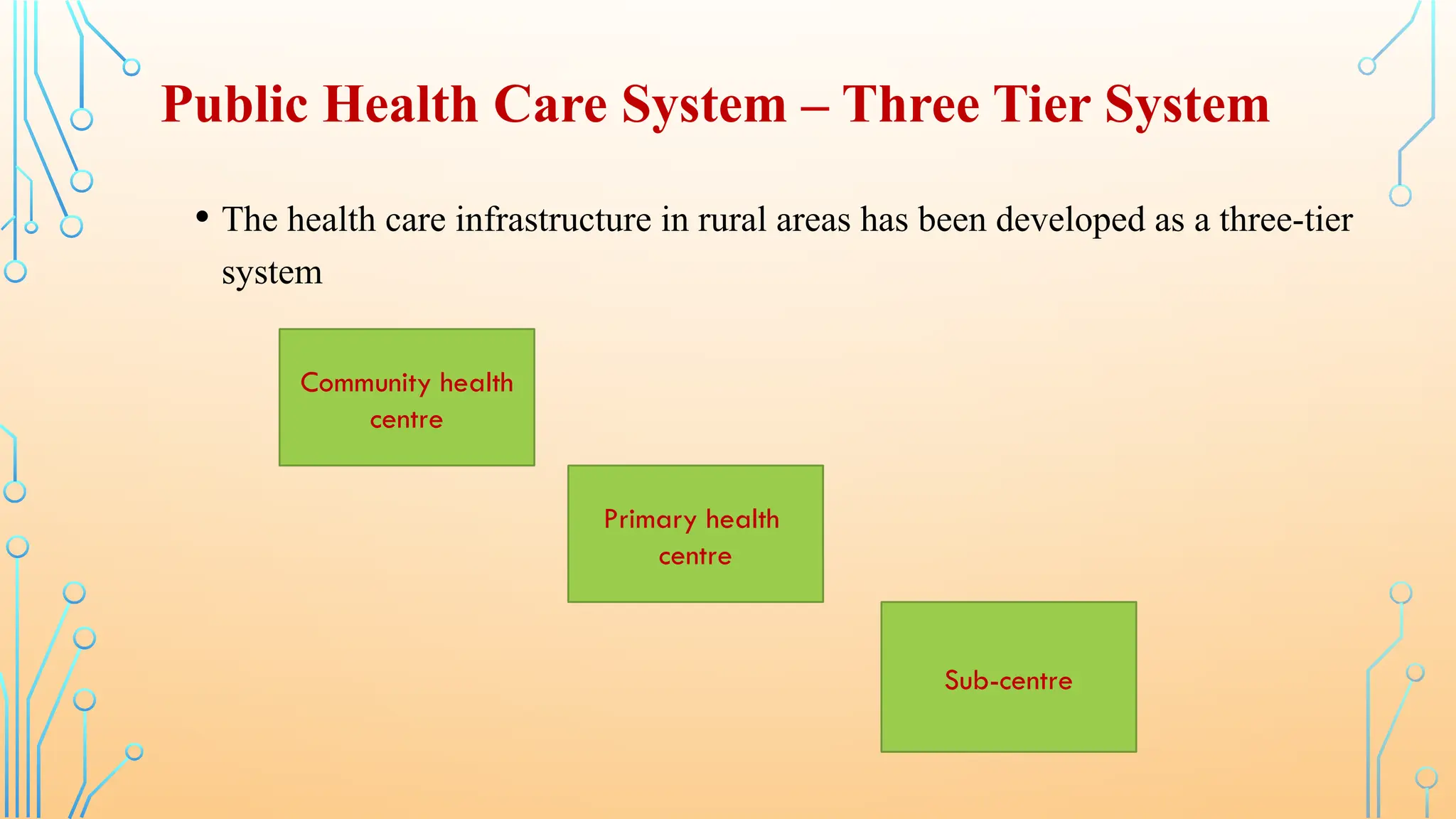
Public Health Care System – Three Tier System
• The health care infrastructure in rural areas has been developed as a three-tier
system
Community health
centre
Sub-centre
Primary health
centre
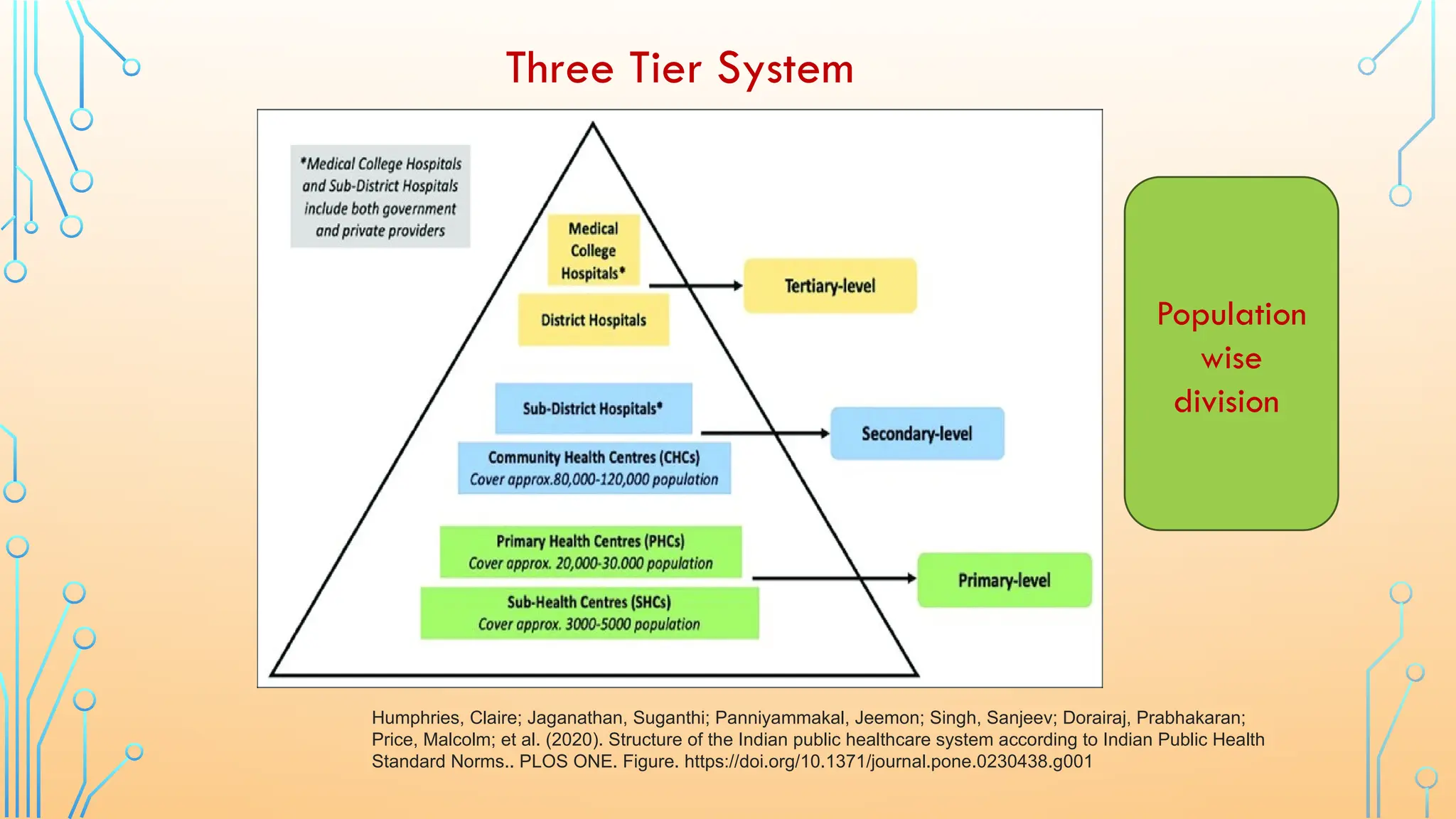
Three Tier System
Humphries, Claire; Jaganathan, Suganthi; Panniyammakal, Jeemon; Singh, Sanjeev; Dorairaj, Prabhakaran;
Price, Malcolm; et al. (2020). Structure of the Indian public healthcare system according to Indian Public Health
Standard Norms.. PLOS ONE. Figure. https://doi.org/10.1371/journal.pone.0230438.g001
Population
wise
division
2ND
PHASE
PHC and Alma Ata
Principles of PHC
1983 National Health policy
Diverted focus by UNICEF to Selective PHC approach:
Technocentric fix
3RD
PHASE
WDR 93: Investing in Health
Neoliberal policies of government
Structural Adjustment Policies in Health: HSR
• Reduction in public funding
• Increased privatisation
• PPP in health in the name of efficiency
Culmination in NHP 2002: open call for privatization
Health became Medical care: Curative care driven model
Lost focus of SDH and PHC
4th
Phase
UPA govt and CMP in health : NRHM
Attempt to strengthen the then eroding Public sector
Mix of new public management and partnership with NGOs
Universal health Coverage/ Care: Politics of Insurance model
Niti Ayog- Report on investment opportunities in India’s health care sector
2021
Health care as an Industry – ripe for investment, encouragement of FDI and
push for greater privatisation
COVID scenario-???
Poor Provisioning Leads To Poor Access
• Source: Baru et al. (2010) Inequities in Access to Health
Services in India: Caste, Class and Region, EPW, 45, 38, 49-58.
Inequity In U 5 MR
• Source: Baru et al. (2010) Inequities in Access to Health Services in
India: Caste, Class and Region, EPW, 45, 38, 49-58.
A Case Of M Ward In Mumbai
• The M East ward in Mumbai has the lowest human
development index and nearly 80% of the population lives in
slums.M-East is the poorest and most deficient in civic services
of Mumbai’s 24 administrative wards. The differences
between the civic amenities available to middle-class
apartment blocks and the slums are stark and has recorded
one of the highest fatality rates due to COVID-19.
• Most of the people were daily wage laborers or contractual
laborers. 56% of M east ward survived on borrowed money.
49% of the people in the area were earning below Rs 6000
a month and 46.7% of the people had no income.
• Infrastructure- Poor and congested housing conditions,
community water was available for one hour a day.
Sanitation facilities- (1 toilet for 190 households)
Access To Health Care For M Ward Residents
• Patients with chronic diseases - Discontinued medicine. People with urgent health-care
needs- e.g. dialysis patients , cancer patients- No access to health care services
• Government hospitals were overburdened with COVID positive cases. Non -COVID patients
had no access to health care services. Even in case of non-covid hospitals many of them
were turned away because of the facilities were full. Pregnant women, children with severe
acute malnutrition, elderly patients were among worse affected .
• Private health care facilities- not affordable/not available - Quacks with questionable
degrees were the first to open up after the unlock began
• Diagnostic facilities in government facilities were not accessible. Private diagnostic
facilities were expensive. In many cases these services were not nearby and transport
became a major barrier. Private transportation was very expensive. In many cases pregnant
women were not able to get a scan done.
Factors Influencing Access
Insufficient investments in Public sector
Failure to recognize public health as a public good
Unregulated commercialisation and rising costs
Health sector reforms that weaken public sector
Variable quality and lack of accountability in public and private sectors
Underserved areas, marginalised and vulnerable communities
References
• Baru, R., Acharya, A., Acharya, S., Kumar, A. S., & Nagaraj, K. (2010).
Inequities in access to health services in India: caste, class and region. Economic
and political Weekly, 49-58.
• Ghosh, SM and Qadeer, I (2020) Public Good Perspective of Public health,
Evaluation health system response to covid 19, EPW, vol.55, 36, 40-48.
• Should health care be a fundamental right? A conversation with Dr T.
Sundararaman and Dr Abhay Shukla by Ramya Kannan, access at:
https://www.thehindu.com/opinion/op-ed/should-healthcare-be-a-fundamental-ri
ght/article31528818.ece
,
• Podcast: https://www.youtube.com/watch?v=yWkbepumqiQ

Indian Health care system presentation.pptx

  • 1.
    Indian Health CareSystem And Inequality In Access MODULE TEACHERS: Dr. Archana Diwate and Dr. Smitha Nair Class Schedule: 6th September and 11th September 2024
  • 2.
    Learner Objectives • Tosituate health care systems within the broader social context. • To trace the evolution and challenges of Indian health care systems both in the pre and post reforms period. • To familiarize the extent of inequalities in population health and its linkage with access to health care systems.
  • 3.
    Content  Why Health becomesa right?  Health care as Public good  Constitutional Provisions on health  Evolution of Health services:  1940s-2017  Access to HSS  By class, caste, region and gender  Factors influencing Access
  • 4.
    Concepts • Health: WHOin 1946 for the first time tried to define health in a holistic way by adopting the definition of “A state of complete physical, mental and social wellbeing and not merely the absence of disease or infirmity”. The concept of health is thus influenced by the interplay of macro, meso and micro level socio economic, political and other factors or determinants of health. • Health care: Health care is the maintenance or improvement of health via the diagnosis, treatment, and prevention of disease, illness, injury, and other physical and mental impairments in human beings.
  • 5.
    • System: Derivedfrom latin word ‘systema’ and ancient greek ‘sustema’ which means organized whole body (eg:respiratory system) • Health Care System: The organized system of health care that is responsible for providing primary, secondary and tertiary care to the larger population which include preventive, promotive, curative and rehabilitative services. • The health care system is intended to deliver the health care services. It constitutes the management sector and involves the organizational matters. For the proper provisioning of health services community participation is important
  • 6.
    • Why Healthis A Right? • ➢ Constitutional Obligations: • Articles 14, 15 and 21 (rights to life, equality and non discrimination, • Article 17 (abolition of untouchability); • Article 23 (prohibition of traffic in human beings and forced labour); • Article 24 (prohibition of employment of children in factories, etc.) International treaties India has signed: • Eg. International covenant on SEC rights; International HR legislations Principle of Bhore Committee: blue print in creating India’s health service, “No Individual should fail to secure adequate medical care because of inability to pay for it” Supreme court rulings have linked the right to health and health care to the right to life under Article 21 • Bandua Mukthi Morcha vs Union of India (case)
  • 7.
    Characteristics of HealthCare As Health becomes right of a citizen, health care services being the major determinant of health of a population, its provisioning has to follow the principle of a Public Good. Two characteristics of Public Good: ❖ Non-excludability: ❖ Non Rivalry: Health care as a means to an end (achieve health) Organizing health care: Mixed system (Public and Private); Welfarist; The Role of the state has to be central.
  • 8.
    Evolution Of IndianHealth Services 1st phase: Bhore committee and NHP(1940-78); FP 2nd Phase: 1978-91; MCH; CSSM; Unicef role; 3rd Phase: 1991-2005 HSR; reforms and privatisation 4th Phase: 2005-2015 NHM and UHC Current phase: Ayushman Bharat
  • 9.
    1st Phase: Health PlanningTill 1980s  Bhore committee  Disease control programmes predominantly family planning programme  Vertical disease control hampering the structure and funcitioning of health services  Water supply removed from health sector in 5th plan period  ICDS became an independent entity with minimum intersectoral linkage with health
  • 10.
    Levels of HealthCare • Health care can be described at three levels: Primary, Secondary and Tertiary • Primary Care level: first level of contact of individuals, the family and the community with the national health system where ‘essential health care’ is provided. It is at this level that the health care will be most effective. Primary Care • Intermediate health care level. At this level more complex problems are dealt with. Secondar y Care • Specialized level than secondary care level and requires specific facilities and attention of highly specialized health workers . The care is provided by medical institutions and other hospitals Tertiary Care
  • 11.
    Public Health CareSystem – Three Tier System • The health care infrastructure in rural areas has been developed as a three-tier system Community health centre Sub-centre Primary health centre
  • 12.
    Three Tier System Humphries,Claire; Jaganathan, Suganthi; Panniyammakal, Jeemon; Singh, Sanjeev; Dorairaj, Prabhakaran; Price, Malcolm; et al. (2020). Structure of the Indian public healthcare system according to Indian Public Health Standard Norms.. PLOS ONE. Figure. https://doi.org/10.1371/journal.pone.0230438.g001 Population wise division
  • 13.
    2ND PHASE PHC and AlmaAta Principles of PHC 1983 National Health policy Diverted focus by UNICEF to Selective PHC approach: Technocentric fix
  • 14.
    3RD PHASE WDR 93: Investingin Health Neoliberal policies of government Structural Adjustment Policies in Health: HSR • Reduction in public funding • Increased privatisation • PPP in health in the name of efficiency Culmination in NHP 2002: open call for privatization Health became Medical care: Curative care driven model Lost focus of SDH and PHC
  • 15.
    4th Phase UPA govt andCMP in health : NRHM Attempt to strengthen the then eroding Public sector Mix of new public management and partnership with NGOs Universal health Coverage/ Care: Politics of Insurance model Niti Ayog- Report on investment opportunities in India’s health care sector 2021 Health care as an Industry – ripe for investment, encouragement of FDI and push for greater privatisation COVID scenario-???
  • 16.
    Poor Provisioning LeadsTo Poor Access • Source: Baru et al. (2010) Inequities in Access to Health Services in India: Caste, Class and Region, EPW, 45, 38, 49-58.
  • 17.
    Inequity In U5 MR • Source: Baru et al. (2010) Inequities in Access to Health Services in India: Caste, Class and Region, EPW, 45, 38, 49-58.
  • 18.
    A Case OfM Ward In Mumbai • The M East ward in Mumbai has the lowest human development index and nearly 80% of the population lives in slums.M-East is the poorest and most deficient in civic services of Mumbai’s 24 administrative wards. The differences between the civic amenities available to middle-class apartment blocks and the slums are stark and has recorded one of the highest fatality rates due to COVID-19. • Most of the people were daily wage laborers or contractual laborers. 56% of M east ward survived on borrowed money. 49% of the people in the area were earning below Rs 6000 a month and 46.7% of the people had no income. • Infrastructure- Poor and congested housing conditions, community water was available for one hour a day. Sanitation facilities- (1 toilet for 190 households)
  • 19.
    Access To HealthCare For M Ward Residents • Patients with chronic diseases - Discontinued medicine. People with urgent health-care needs- e.g. dialysis patients , cancer patients- No access to health care services • Government hospitals were overburdened with COVID positive cases. Non -COVID patients had no access to health care services. Even in case of non-covid hospitals many of them were turned away because of the facilities were full. Pregnant women, children with severe acute malnutrition, elderly patients were among worse affected . • Private health care facilities- not affordable/not available - Quacks with questionable degrees were the first to open up after the unlock began • Diagnostic facilities in government facilities were not accessible. Private diagnostic facilities were expensive. In many cases these services were not nearby and transport became a major barrier. Private transportation was very expensive. In many cases pregnant women were not able to get a scan done.
  • 20.
    Factors Influencing Access Insufficientinvestments in Public sector Failure to recognize public health as a public good Unregulated commercialisation and rising costs Health sector reforms that weaken public sector Variable quality and lack of accountability in public and private sectors Underserved areas, marginalised and vulnerable communities
  • 21.
    References • Baru, R.,Acharya, A., Acharya, S., Kumar, A. S., & Nagaraj, K. (2010). Inequities in access to health services in India: caste, class and region. Economic and political Weekly, 49-58. • Ghosh, SM and Qadeer, I (2020) Public Good Perspective of Public health, Evaluation health system response to covid 19, EPW, vol.55, 36, 40-48. • Should health care be a fundamental right? A conversation with Dr T. Sundararaman and Dr Abhay Shukla by Ramya Kannan, access at: https://www.thehindu.com/opinion/op-ed/should-healthcare-be-a-fundamental-ri ght/article31528818.ece , • Podcast: https://www.youtube.com/watch?v=yWkbepumqiQ

Editor's Notes

  • #11  Three levels of Health Care services - primary, secondary and tertiary health care. Primary Health Care: It is first level of contact between individuals and families and the health system. it includes care for mother and child, family planning, immunization, treatment of common diseases or injuries, provision of essential facilities, health education, provision of food and nutrition and adequate supply of safe drinking water. Primary Healthcare is provided through a network of Health Sub-Centres and Primary Health Centres in rural areas. At the village level, the ASHA, Anganwadi Worker and ANM provide awareness generation, facilitation of access to the basic curative health facilities and community level services. Secondary Health Care: In secondary Healthcare, patients from primary health care are referred to specialists in higher hospitals for treatment. Health centres for secondary health care include District hospitals and Community Health Centre at block level. Tertiary Health Care: In this, specialized consultative care is provided usually on referral from primary and secondary medical care. Facilities of specialized intensive care units for serious illness, advanced diagnostic support services and specialized medical personnel are provided. Tertiary care service is provided by medical colleges and advanced medical research institutes.