Conflict and Postconflict Reconstruction: Background and Issues By Monika Wroz
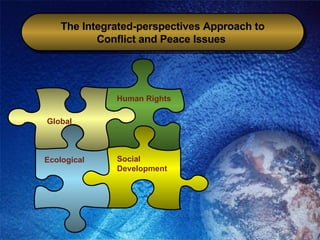
The Integrated-perspectives Approach to Conflict and Peace Issues   Human Rights Social  Development Ecological Global
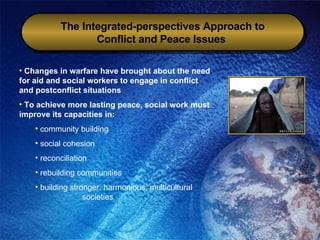
The Integrated-perspectives Approach to Conflict and Peace Issues   Changes in warfare have brought about the need for aid and social workers to engage in conflict and postconflict situations To achieve more lasting peace, social work must improve its capacities in: community building social cohesion reconciliation rebuilding communities building stronger, harmonious, multicultural  societies
The Integrated-perspectives Approach to Conflict and Peace Issues   Global Perspective:  Creating a Global Civil Society is Essential Prevalence of conflict makes it a global issue Among the causes of conflict are the inequitable distributions of wealth, trade, aid Response must be global as reconstruction requires well-coordinated international efforts and requires helping professionals to share resources Human Rights Perspective: Common causal factor Must be emphasized over the economic and political Social workers must protect the rights of marginalized/overlooked persons
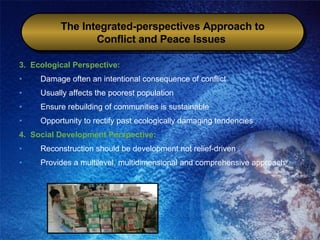
3.  Ecological Perspective: Damage often an intentional consequence of conflict  Usually affects the poorest population Ensure rebuilding of communities is sustainable Opportunity to rectify past ecologically damaging tendencies 4.  Social Development Perspective: Reconstruction should be development not relief-driven Provides a multilevel, multidimensional and comprehensive approach The Integrated-perspectives Approach to Conflict and Peace Issues
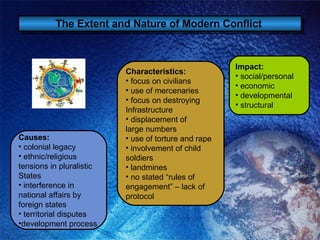
The Extent and Nature of Modern Conflict   Causes: colonial legacy ethnic/religious  tensions in pluralistic States interference in  national affairs by foreign states territorial disputes development process Impact: social/personal economic developmental structural Characteristics: focus on civilians use of mercenaries focus on destroying  Infrastructure displacement of large numbers use of torture and rape involvement of child soldiers landmines no stated “rules of engagement” – lack of  protocol
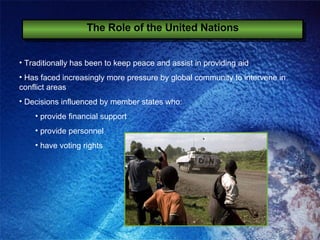
The Role of the United Nations Traditionally has been to keep peace and assist in providing aid Has faced increasingly more pressure by global community to intervene in conflict areas Decisions influenced by member states who: provide financial support provide personnel have voting rights
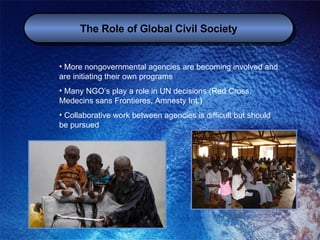
The Role of Global Civil Society More nongovernmental agencies are becoming involved and are initiating their own programs Many NGO’s play a role in UN decisions (Red Cross, Medecins sans Frontieres, Amnesty Int.) Collaborative work between agencies is difficult but should be pursued
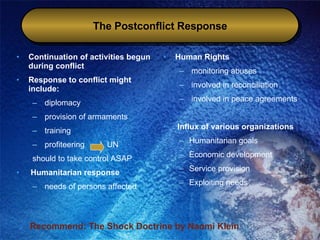
Continuation of activities begun during conflict Response to conflict might include: diplomacy provision of armaments training profiteering  UN  should to take control ASAP Humanitarian response needs of persons affected Human Rights monitoring abuses involved in reconciliation involved in peace agreements Influx of various organizations Humanitarian goals Economic development Service provision Exploiting needs The Postconflict Response Recommend: The Shock Doctrine by Naomi Klein
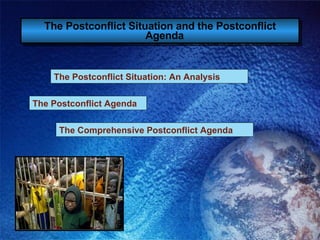
The Postconflict Situation and the Postconflict Agenda   The Postconflict Situation: An Analysis The Postconflict Agenda The Comprehensive Postconflict Agenda
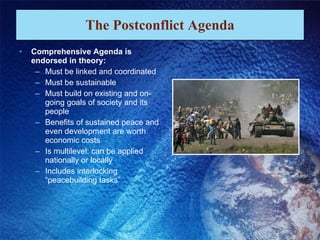
Comprehensive Agenda is endorsed in theory: Must be linked and coordinated Must be sustainable Must build on existing and on-going goals of society and its people Benefits of sustained peace and even development are worth economic costs Is multilevel: can be applied nationally or locally Includes interlocking “peacebuilding tasks” The Postconflict Agenda
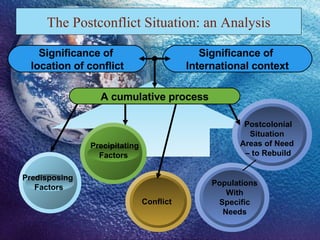
A cumulative process Predisposing Factors Conflict Precipitating Factors   Postcolonial Situation  Areas of Need  –  to Rebuild Populations With Specific Needs Significance of  International context Significance of  location of conflict The Postconflict Situation: an Analysis
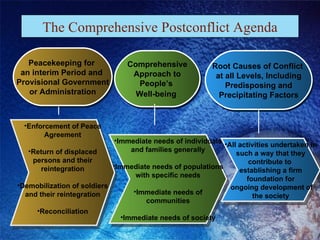
The Comprehensive Postconflict Agenda All activities undertaken in such a way that they contribute to  establishing a firm foundation for ongoing development of the society Immediate needs of individuals and families generally Immediate needs of populations  with specific needs Immediate needs of communities Immediate needs of society Enforcement of Peace Agreement Return of displaced persons and their reintegration Demobilization of soldiers and their reintegration Reconciliation Peacekeeping for  an interim Period and  Provisional Government or Administration Comprehensive Approach to People’s  Well-being   Root Causes of Conflict  at all Levels, Including Predisposing and Precipitating Factors
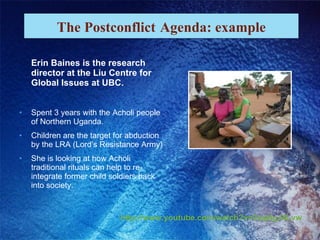
Erin Baines is the research director at the Liu Centre for Global Issues at UBC. Spent 3 years with the Acholi people of Northern Uganda. Children are the target for abduction by the LRA (Lord’s Resistance Army) She is looking at how Acholi traditional rituals can help to re-integrate former child soldiers back into society. The Postconflict   Agenda: example http://www.youtube.com/watch?v=2saj4gJ4Lvw
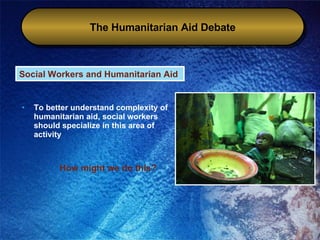
To better understand complexity of humanitarian aid, social workers should specialize in this area of activity How might we do this? The Humanitarian Aid Debate Social Workers and Humanitarian Aid
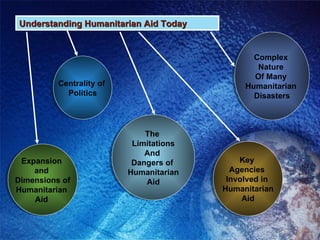
Understanding Humanitarian Aid Today Expansion  and  Dimensions of Humanitarian  Aid   Key  Agencies  Involved in  Humanitarian Aid Centrality of  Politics The  Limitations And  Dangers of  Humanitarian Aid Complex  Nature  Of Many  Humanitarian  Disasters
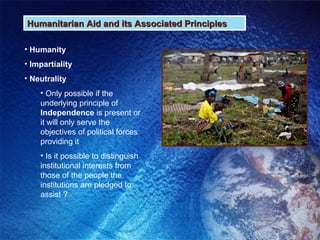
Humanitarian Aid and its Associated Principles Humanity Impartiality Neutrality Only possible if the underlying principle of  Independence  is present or it will only serve the objectives of political forces providing it Is it possible to distinguish institutional interests from those of the people the institutions are pledged to assist ?
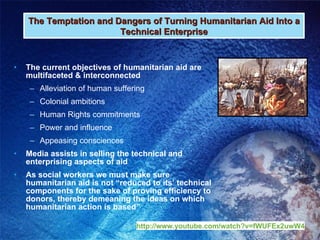
The current objectives of humanitarian aid are multifaceted & interconnected  Alleviation of human suffering Colonial ambitions Human Rights commitments Power and influence Appeasing consciences Media assists in selling the technical and enterprising aspects of aid As social workers we must make sure humanitarian aid is not “reduced to its’ technical components for the sake of proving efficiency to donors, thereby demeaning the ideas on which humanitarian action is based” The Temptation and Dangers of Turning Humanitarian Aid Into a Technical Enterprise http:// www.youtube.com/watch?v =fWUFEx2uwW4
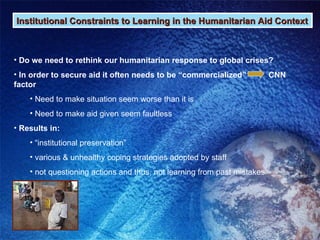
Institutional Constraints to Learning in the Humanitarian Aid Context Do we need to rethink our humanitarian response to global crises? In order to secure aid it often needs to be “commercialized”  CNN factor Need to make situation seem worse than it is Need to make aid given seem faultless  Results in: “ institutional preservation”  various & unhealthy coping strategies adopted by staff not questioning actions and thus, not learning from past mistakes
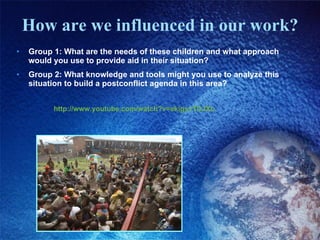
How are we influenced in our work? Group 1: What are the needs of these children and what approach would you use to provide aid in their situation?  Group 2: What knowledge and tools might you use to analyze this situation to build a postconflict agenda in this area? http://www.youtube.com/watch?v=ekigsvTDJXo
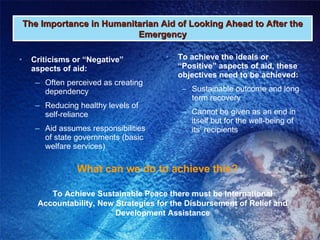
Criticisms or “Negative” aspects of aid: Often perceived as creating dependency Reducing healthy levels of self-reliance Aid assumes responsibilities of state governments (basic welfare services) To achieve the ideals or “Positive” aspects of aid, these objectives need to be achieved: Sustainable outcome and long term recovery Cannot be given as an end in itself but for the well-being of its’ recipients The Importance in Humanitarian Aid of Looking Ahead to After the Emergency What can we do to achieve this? To Achieve Sustainable Peace there must be International Accountability, New Strategies for the Disbursement of Relief and Development Assistance
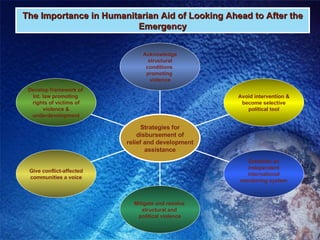
The Importance in Humanitarian Aid of Looking Ahead to After the Emergency Acknowledge structural  conditions  promoting  violence Avoid intervention & become selective political tool Establish an independent international monitoring system Mitigate and resolve  structural and  political violence Give conflict-affected communities a voice Develop framework of  Int. law promoting  rights of victims of violence & underdevelopment Strategies for disbursement of relief and development assistance
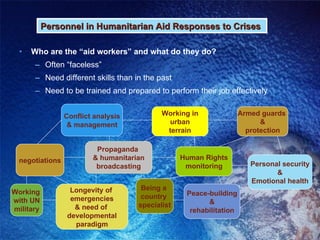
Who are the “aid workers” and what do they do? Often “faceless” Need different skills than in the past Need to be trained and prepared to perform their job effectively Personnel in Humanitarian Aid Responses to Crises Conflict analysis & management negotiations Human Rights monitoring Working  with UN military Propaganda  & humanitarian broadcasting Longevity of  emergencies & need of  developmental paradigm Being a  country  specialist Working in urban terrain Peace-building & rehabilitation Personal security & Emotional health Armed guards  & protection

Conflict And Postconflict Reconstruction

  • 1.
    Conflict and PostconflictReconstruction: Background and Issues By Monika Wroz
  • 2.
    The Integrated-perspectives Approachto Conflict and Peace Issues Human Rights Social Development Ecological Global
  • 3.
    The Integrated-perspectives Approachto Conflict and Peace Issues Changes in warfare have brought about the need for aid and social workers to engage in conflict and postconflict situations To achieve more lasting peace, social work must improve its capacities in: community building social cohesion reconciliation rebuilding communities building stronger, harmonious, multicultural societies
  • 4.
    The Integrated-perspectives Approachto Conflict and Peace Issues Global Perspective: Creating a Global Civil Society is Essential Prevalence of conflict makes it a global issue Among the causes of conflict are the inequitable distributions of wealth, trade, aid Response must be global as reconstruction requires well-coordinated international efforts and requires helping professionals to share resources Human Rights Perspective: Common causal factor Must be emphasized over the economic and political Social workers must protect the rights of marginalized/overlooked persons
  • 5.
    3. EcologicalPerspective: Damage often an intentional consequence of conflict Usually affects the poorest population Ensure rebuilding of communities is sustainable Opportunity to rectify past ecologically damaging tendencies 4. Social Development Perspective: Reconstruction should be development not relief-driven Provides a multilevel, multidimensional and comprehensive approach The Integrated-perspectives Approach to Conflict and Peace Issues
  • 6.
    The Extent andNature of Modern Conflict Causes: colonial legacy ethnic/religious tensions in pluralistic States interference in national affairs by foreign states territorial disputes development process Impact: social/personal economic developmental structural Characteristics: focus on civilians use of mercenaries focus on destroying Infrastructure displacement of large numbers use of torture and rape involvement of child soldiers landmines no stated “rules of engagement” – lack of protocol
  • 7.
    The Role ofthe United Nations Traditionally has been to keep peace and assist in providing aid Has faced increasingly more pressure by global community to intervene in conflict areas Decisions influenced by member states who: provide financial support provide personnel have voting rights
  • 8.
    The Role ofGlobal Civil Society More nongovernmental agencies are becoming involved and are initiating their own programs Many NGO’s play a role in UN decisions (Red Cross, Medecins sans Frontieres, Amnesty Int.) Collaborative work between agencies is difficult but should be pursued
  • 9.
    Continuation of activitiesbegun during conflict Response to conflict might include: diplomacy provision of armaments training profiteering UN should to take control ASAP Humanitarian response needs of persons affected Human Rights monitoring abuses involved in reconciliation involved in peace agreements Influx of various organizations Humanitarian goals Economic development Service provision Exploiting needs The Postconflict Response Recommend: The Shock Doctrine by Naomi Klein
  • 10.
    The Postconflict Situationand the Postconflict Agenda The Postconflict Situation: An Analysis The Postconflict Agenda The Comprehensive Postconflict Agenda
  • 11.
    Comprehensive Agenda isendorsed in theory: Must be linked and coordinated Must be sustainable Must build on existing and on-going goals of society and its people Benefits of sustained peace and even development are worth economic costs Is multilevel: can be applied nationally or locally Includes interlocking “peacebuilding tasks” The Postconflict Agenda
  • 12.
    A cumulative processPredisposing Factors Conflict Precipitating Factors Postcolonial Situation Areas of Need – to Rebuild Populations With Specific Needs Significance of International context Significance of location of conflict The Postconflict Situation: an Analysis
  • 13.
    The Comprehensive PostconflictAgenda All activities undertaken in such a way that they contribute to establishing a firm foundation for ongoing development of the society Immediate needs of individuals and families generally Immediate needs of populations with specific needs Immediate needs of communities Immediate needs of society Enforcement of Peace Agreement Return of displaced persons and their reintegration Demobilization of soldiers and their reintegration Reconciliation Peacekeeping for an interim Period and Provisional Government or Administration Comprehensive Approach to People’s Well-being Root Causes of Conflict at all Levels, Including Predisposing and Precipitating Factors
  • 14.
    Erin Baines isthe research director at the Liu Centre for Global Issues at UBC. Spent 3 years with the Acholi people of Northern Uganda. Children are the target for abduction by the LRA (Lord’s Resistance Army) She is looking at how Acholi traditional rituals can help to re-integrate former child soldiers back into society. The Postconflict Agenda: example http://www.youtube.com/watch?v=2saj4gJ4Lvw
  • 15.
    To better understandcomplexity of humanitarian aid, social workers should specialize in this area of activity How might we do this? The Humanitarian Aid Debate Social Workers and Humanitarian Aid
  • 16.
    Understanding Humanitarian AidToday Expansion and Dimensions of Humanitarian Aid Key Agencies Involved in Humanitarian Aid Centrality of Politics The Limitations And Dangers of Humanitarian Aid Complex Nature Of Many Humanitarian Disasters
  • 17.
    Humanitarian Aid andits Associated Principles Humanity Impartiality Neutrality Only possible if the underlying principle of Independence is present or it will only serve the objectives of political forces providing it Is it possible to distinguish institutional interests from those of the people the institutions are pledged to assist ?
  • 18.
    The current objectivesof humanitarian aid are multifaceted & interconnected Alleviation of human suffering Colonial ambitions Human Rights commitments Power and influence Appeasing consciences Media assists in selling the technical and enterprising aspects of aid As social workers we must make sure humanitarian aid is not “reduced to its’ technical components for the sake of proving efficiency to donors, thereby demeaning the ideas on which humanitarian action is based” The Temptation and Dangers of Turning Humanitarian Aid Into a Technical Enterprise http:// www.youtube.com/watch?v =fWUFEx2uwW4
  • 19.
    Institutional Constraints toLearning in the Humanitarian Aid Context Do we need to rethink our humanitarian response to global crises? In order to secure aid it often needs to be “commercialized” CNN factor Need to make situation seem worse than it is Need to make aid given seem faultless Results in: “ institutional preservation” various & unhealthy coping strategies adopted by staff not questioning actions and thus, not learning from past mistakes
  • 20.
    How are weinfluenced in our work? Group 1: What are the needs of these children and what approach would you use to provide aid in their situation? Group 2: What knowledge and tools might you use to analyze this situation to build a postconflict agenda in this area? http://www.youtube.com/watch?v=ekigsvTDJXo
  • 21.
    Criticisms or “Negative”aspects of aid: Often perceived as creating dependency Reducing healthy levels of self-reliance Aid assumes responsibilities of state governments (basic welfare services) To achieve the ideals or “Positive” aspects of aid, these objectives need to be achieved: Sustainable outcome and long term recovery Cannot be given as an end in itself but for the well-being of its’ recipients The Importance in Humanitarian Aid of Looking Ahead to After the Emergency What can we do to achieve this? To Achieve Sustainable Peace there must be International Accountability, New Strategies for the Disbursement of Relief and Development Assistance
  • 22.
    The Importance inHumanitarian Aid of Looking Ahead to After the Emergency Acknowledge structural conditions promoting violence Avoid intervention & become selective political tool Establish an independent international monitoring system Mitigate and resolve structural and political violence Give conflict-affected communities a voice Develop framework of Int. law promoting rights of victims of violence & underdevelopment Strategies for disbursement of relief and development assistance
  • 23.
    Who are the“aid workers” and what do they do? Often “faceless” Need different skills than in the past Need to be trained and prepared to perform their job effectively Personnel in Humanitarian Aid Responses to Crises Conflict analysis & management negotiations Human Rights monitoring Working with UN military Propaganda & humanitarian broadcasting Longevity of emergencies & need of developmental paradigm Being a country specialist Working in urban terrain Peace-building & rehabilitation Personal security & Emotional health Armed guards & protection