CONFIGURATION
MANAGEMENT


RIZKA MARSA PRAMADANI
PRELIMINARY
•   Software configuration item (SCI) or configuration item (CI)
An approved unit of software code, a document or piece of hardware that is
designed for configuration management and treated as a distinct entity in
the software configuration management process.
•   SCI version
The approved state of an SCI at any given point of time during the
development or maintenance process.
•   Software configuration version
An approved selected set of documented SCI versions that constitute a
software system or document at a given point of time, where the activities
to be performed are controlled by software configuration management
procedures. The software configuration versions are released according to
the cited procedures
(CONT’D)..
The SCIs are generally placed into four classes, as follows:
• Design documents
• Software code
• Data files, including files of test cases and test scripts
• Software development tools.
COMMON TYPES OF SOFTWARE
CONFIGURATION ITEMS

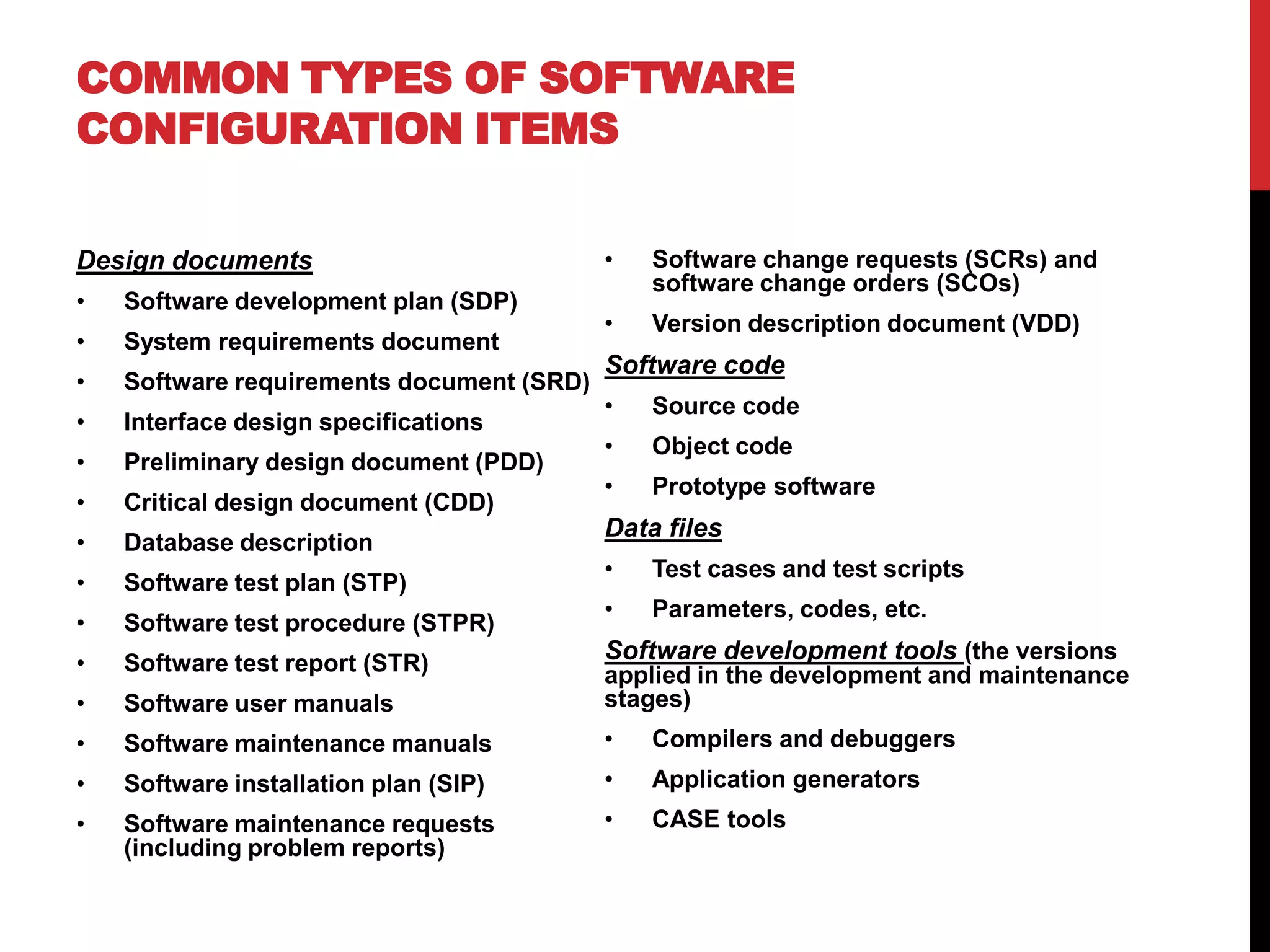
Design documents                           •   Software change requests (SCRs) and
                                               software change orders (SCOs)
•   Software development plan (SDP)
                                           •   Version description document (VDD)
•   System requirements document
                                           Software code
•   Software requirements document (SRD)
                                           •   Source code
•   Interface design specifications
                                           •   Object code
•   Preliminary design document (PDD)
                                           •   Prototype software
•   Critical design document (CDD)
                                           Data files
•   Database description
                                           •   Test cases and test scripts
•   Software test plan (STP)
                                           •   Parameters, codes, etc.
•   Software test procedure (STPR)
•   Software test report (STR)             Software development tools (the versions
                                           applied in the development and maintenance
•   Software user manuals                  stages)
•   Software maintenance manuals           •   Compilers and debuggers
•   Software installation plan (SIP)       •   Application generators
•   Software maintenance requests          •   CASE tools
    (including problem reports)
SOFTWARE CONFIGURATION
MANAGEMENT
An SQA component responsible for applying (computerized
and non-computerized) technical tools and administrative
procedures that enable completion of the tasks required to
maintain SCIs and software configuration versions
TASKS
AND ORGANIZATION
The tasks of software configuration management may be
classified into four groups:
• Control software change
• Release of SCI and software configuration versions
• Provision of SCM information services
• Verification of compliance to SCM procedures
SOFTWARE CHANGE
CONTROL
Software change management controls the process of
introducing changes mainly by doing the following:
• Examining change requests and approving
  implementation of appropriate requests.
• Assuring the quality of each new version of software
  configuration before it becomes operational.
APPROVAL TO CARRY OUT
PROPOSED CHANGES
The factors affecting the decision whether to implement a
proposed change include:
• Expected contribution of the proposed change
• Urgency of the change
• Effect of the proposed change on project timetables, level
  of service, etc.
• Efforts required in making the change operational
• Required software quality assurance efforts
• Estimated required professional resources and cost of
  performing the change.
RELEASE OF SOFTWARE
CONFIGURATION VERSIONS
The need to release a new software configuration version usually
stems from one or more of the following conditions:
• Defective SCIs
• Special features demanded by new customers
• The team’s initiatives to introduce SCI improvements.
TYPES OF SOFTWARE
CONFIGURATION RELEASES

  Baseline versions

  • Baseline software configuration versions are planned
    early, during a system’s development or operating
    stage. As part of the process, they are reviewed, tested
    and approved, as are their SCIs

  Intermediate versions

  • When problems arise that require immediate attention
    – such as the need to correct defects identified in an
    important SCI, or perform immediate adaptation as
    defined in a contract with a new customer – an
    intermediate version of the software is often prepared.
TYPES OF SOFTWARE
CONFIGURATION RELEASES
(CONT’D)


   Revisions

   • Revisions introduce minor changes and corrections
     to a given software configuration version.

   Numeration conventions for identification
   of SCI and software versions
   • Numeration conventions have been formulated to
     identify SCIs; the most commonly used is decimal
     numeration, which indicates the successive version
     and revision numbers and is registered accordingly
SOFTWARE CONFIGURATION
MANAGEMENT PLANS
(SCMPS)
The main objective of a software configuration management plan (SCMP) is
to plan ahead the schedule of baseline version releases and the required
resources to carry out all the activities required for the software configuration
releases. Accordingly, an SCMP usually includes:
•   An overview of the software development project or existing software
    system.
•   A list of scheduled baseline version releases.
•   A list of SCIs (documents, code, etc.) to be included in each version.
•   A table identifying the relationship of software development project plans
    and maintenance plans to scheduled releases of new SCIs or SCI
    versions.
•   A list of assumptions about the resources required to perform the various
    activities required by the SCMP.
•   Estimates of the human resources and budget needed to perform the
    SCMP.
SOFTWARE CONFIGURATION
EVOLUTION MODELS

 The linear evolution model
 • This model is the natural choice for software systems developed
   to serve a single organization.The model is also applied to
   popular software packages, which tend to be uniform in structure,
   where the need to meet a wide range of maintenance demands
   for a single version is a great advantage.

  The tree evolution model

 • According to this model, several parallel versions of the software
   are developed to serve the needs of different customers
   simultaneously throughout the system’s life cycle. Tree models
   are typically applied in firmware configuration versions, where
   each branch serves a different product or product line.

Configuration management

  • 1.
  • 2.
    PRELIMINARY • Software configuration item (SCI) or configuration item (CI) An approved unit of software code, a document or piece of hardware that is designed for configuration management and treated as a distinct entity in the software configuration management process. • SCI version The approved state of an SCI at any given point of time during the development or maintenance process. • Software configuration version An approved selected set of documented SCI versions that constitute a software system or document at a given point of time, where the activities to be performed are controlled by software configuration management procedures. The software configuration versions are released according to the cited procedures
  • 3.
    (CONT’D).. The SCIs aregenerally placed into four classes, as follows: • Design documents • Software code • Data files, including files of test cases and test scripts • Software development tools.
  • 4.
    COMMON TYPES OFSOFTWARE CONFIGURATION ITEMS Design documents • Software change requests (SCRs) and software change orders (SCOs) • Software development plan (SDP) • Version description document (VDD) • System requirements document Software code • Software requirements document (SRD) • Source code • Interface design specifications • Object code • Preliminary design document (PDD) • Prototype software • Critical design document (CDD) Data files • Database description • Test cases and test scripts • Software test plan (STP) • Parameters, codes, etc. • Software test procedure (STPR) • Software test report (STR) Software development tools (the versions applied in the development and maintenance • Software user manuals stages) • Software maintenance manuals • Compilers and debuggers • Software installation plan (SIP) • Application generators • Software maintenance requests • CASE tools (including problem reports)
  • 5.
    SOFTWARE CONFIGURATION MANAGEMENT An SQAcomponent responsible for applying (computerized and non-computerized) technical tools and administrative procedures that enable completion of the tasks required to maintain SCIs and software configuration versions
  • 6.
    TASKS AND ORGANIZATION The tasksof software configuration management may be classified into four groups: • Control software change • Release of SCI and software configuration versions • Provision of SCM information services • Verification of compliance to SCM procedures
  • 7.
    SOFTWARE CHANGE CONTROL Software changemanagement controls the process of introducing changes mainly by doing the following: • Examining change requests and approving implementation of appropriate requests. • Assuring the quality of each new version of software configuration before it becomes operational.
  • 8.
    APPROVAL TO CARRYOUT PROPOSED CHANGES The factors affecting the decision whether to implement a proposed change include: • Expected contribution of the proposed change • Urgency of the change • Effect of the proposed change on project timetables, level of service, etc. • Efforts required in making the change operational • Required software quality assurance efforts • Estimated required professional resources and cost of performing the change.
  • 9.
    RELEASE OF SOFTWARE CONFIGURATIONVERSIONS The need to release a new software configuration version usually stems from one or more of the following conditions: • Defective SCIs • Special features demanded by new customers • The team’s initiatives to introduce SCI improvements.
  • 10.
    TYPES OF SOFTWARE CONFIGURATIONRELEASES Baseline versions • Baseline software configuration versions are planned early, during a system’s development or operating stage. As part of the process, they are reviewed, tested and approved, as are their SCIs Intermediate versions • When problems arise that require immediate attention – such as the need to correct defects identified in an important SCI, or perform immediate adaptation as defined in a contract with a new customer – an intermediate version of the software is often prepared.
  • 11.
    TYPES OF SOFTWARE CONFIGURATIONRELEASES (CONT’D) Revisions • Revisions introduce minor changes and corrections to a given software configuration version. Numeration conventions for identification of SCI and software versions • Numeration conventions have been formulated to identify SCIs; the most commonly used is decimal numeration, which indicates the successive version and revision numbers and is registered accordingly
  • 12.
    SOFTWARE CONFIGURATION MANAGEMENT PLANS (SCMPS) Themain objective of a software configuration management plan (SCMP) is to plan ahead the schedule of baseline version releases and the required resources to carry out all the activities required for the software configuration releases. Accordingly, an SCMP usually includes: • An overview of the software development project or existing software system. • A list of scheduled baseline version releases. • A list of SCIs (documents, code, etc.) to be included in each version. • A table identifying the relationship of software development project plans and maintenance plans to scheduled releases of new SCIs or SCI versions. • A list of assumptions about the resources required to perform the various activities required by the SCMP. • Estimates of the human resources and budget needed to perform the SCMP.
  • 13.
    SOFTWARE CONFIGURATION EVOLUTION MODELS The linear evolution model • This model is the natural choice for software systems developed to serve a single organization.The model is also applied to popular software packages, which tend to be uniform in structure, where the need to meet a wide range of maintenance demands for a single version is a great advantage. The tree evolution model • According to this model, several parallel versions of the software are developed to serve the needs of different customers simultaneously throughout the system’s life cycle. Tree models are typically applied in firmware configuration versions, where each branch serves a different product or product line.