Gandhinagar Institute of Technology(012)
Active Learning Assignment
Guided By:prof. Nairav Pandya
Prepared By:Harsh kothari
Branch:CE-B
Enrolment no.:170120107066
Contents
• Definition
• Types of dielectric Materials
 Solid
 Liquid
 Gas
• Properties of good Dielectric
• Application of Dielectric
Capacitor
Transformer
• Insulating materials are also termed as dielectrics.
The difference in the name between dielectric and
insulator lies in the application to which these
materials are put.
• When these materials are used to prevent flow of
electricity through them on the application of
potential difference, then they are called insulators or
passive dielectrics.
• On the other hand, if they are used for charge
storage then they are called dielectrics or active
dielectrics.
What Is Dielectric Material ?
: : : TYPES OF DIELECTRIC
MATERIALS : : :
Dielectric materials can be SOLID
, LIQUID , GASES.
 A high vacuum can also be used
as a dielectric even
though its relative dielectric constant
is only unity
SOLID DIELECTRICS: They are the most
commonly used in electrical engineering ;
these are very good insulators.
Examples : Porcelain , glass , rubber ,
mica.
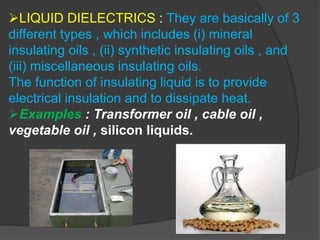
LIQUID DIELECTRICS : They are basically of 3
different types , which includes (i) mineral
insulating oils , (ii) synthetic insulating oils , and
(iii) miscellaneous insulating oils.
The function of insulating liquid is to provide
electrical insulation and to dissipate heat.
Examples : Transformer oil , cable oil ,
vegetable oil , silicon liquids.
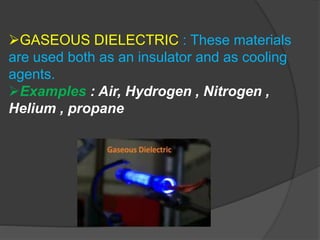
GASEOUS DIELECTRIC : These materials
are used both as an insulator and as cooling
agents.
Examples : Air, Hydrogen , Nitrogen ,
Helium , propane
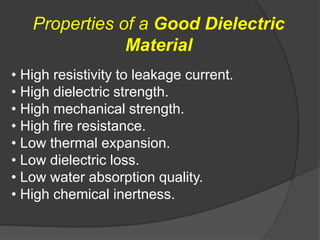
• High resistivity to leakage current.
• High dielectric strength.
• High mechanical strength.
• High fire resistance.
• Low thermal expansion.
• Low dielectric loss.
• Low water absorption quality.
• High chemical inertness.
Properties of a Good Dielectric
Material
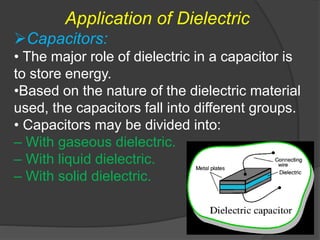
Application of Dielectric
Capacitors:
• The major role of dielectric in a capacitor is
to store energy.
•Based on the nature of the dielectric material
used, the capacitors fall into different groups.
• Capacitors may be divided into:
– With gaseous dielectric.
– With liquid dielectric.
– With solid dielectric.
Transformer:
•We can say that transformer is basic
arrangement of conductors and dielectric
insulators.
• We know that transformer contains two parts:
Primary coil and secondary coil.
• Energy transforms from primary coil to
secondary coil only through magnetic induction,
not by any electrical path. So to avoid electrical
conduction we must use dielectric insulator at all
possible places.
• The major role of dielectric in a transformer is to
as insulators as well as cooling agent.
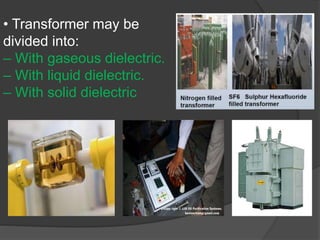
• Transformer may be
divided into:
– With gaseous dielectric.
– With liquid dielectric.
– With solid dielectric
170120107066 dielectric.ppt

170120107066 dielectric.ppt

  • 1.
    Gandhinagar Institute ofTechnology(012) Active Learning Assignment Guided By:prof. Nairav Pandya Prepared By:Harsh kothari Branch:CE-B Enrolment no.:170120107066
  • 2.
    Contents • Definition • Typesof dielectric Materials  Solid  Liquid  Gas • Properties of good Dielectric • Application of Dielectric Capacitor Transformer
  • 3.
    • Insulating materialsare also termed as dielectrics. The difference in the name between dielectric and insulator lies in the application to which these materials are put. • When these materials are used to prevent flow of electricity through them on the application of potential difference, then they are called insulators or passive dielectrics. • On the other hand, if they are used for charge storage then they are called dielectrics or active dielectrics. What Is Dielectric Material ?
  • 4.
    : : :TYPES OF DIELECTRIC MATERIALS : : : Dielectric materials can be SOLID , LIQUID , GASES.  A high vacuum can also be used as a dielectric even though its relative dielectric constant is only unity
  • 5.
    SOLID DIELECTRICS: Theyare the most commonly used in electrical engineering ; these are very good insulators. Examples : Porcelain , glass , rubber , mica.
  • 6.
    LIQUID DIELECTRICS :They are basically of 3 different types , which includes (i) mineral insulating oils , (ii) synthetic insulating oils , and (iii) miscellaneous insulating oils. The function of insulating liquid is to provide electrical insulation and to dissipate heat. Examples : Transformer oil , cable oil , vegetable oil , silicon liquids.
  • 7.
    GASEOUS DIELECTRIC :These materials are used both as an insulator and as cooling agents. Examples : Air, Hydrogen , Nitrogen , Helium , propane
  • 8.
    • High resistivityto leakage current. • High dielectric strength. • High mechanical strength. • High fire resistance. • Low thermal expansion. • Low dielectric loss. • Low water absorption quality. • High chemical inertness. Properties of a Good Dielectric Material
  • 9.
    Application of Dielectric Capacitors: •The major role of dielectric in a capacitor is to store energy. •Based on the nature of the dielectric material used, the capacitors fall into different groups. • Capacitors may be divided into: – With gaseous dielectric. – With liquid dielectric. – With solid dielectric.
  • 10.
    Transformer: •We can saythat transformer is basic arrangement of conductors and dielectric insulators. • We know that transformer contains two parts: Primary coil and secondary coil. • Energy transforms from primary coil to secondary coil only through magnetic induction, not by any electrical path. So to avoid electrical conduction we must use dielectric insulator at all possible places. • The major role of dielectric in a transformer is to as insulators as well as cooling agent.
  • 11.
    • Transformer maybe divided into: – With gaseous dielectric. – With liquid dielectric. – With solid dielectric