Conducting & Evaluating
      Research
Preliminary Research Question
• Avoid research questions that are:
  – Too broad
     • What are the hazards of fad diets?
     • What are the hazards of low-carb diets?
  – Too bland
     • How does DNA testing work?
     • How reliable is DNA testing?
  – Too speculative
     • Is it wrong to share music files on the Internet?
     • How has Internet file sharing affected musicians?
GATHERING & EVALUATING SOURCES
Databases
• Found on/through library computer systems
• Both general and subject specific
• Searching a database
  – Vary key words
  – Use quotation marks, AND, OR, NOT
  – Limit search to:
     • Peer-reviewed articles
     • Full-text articles
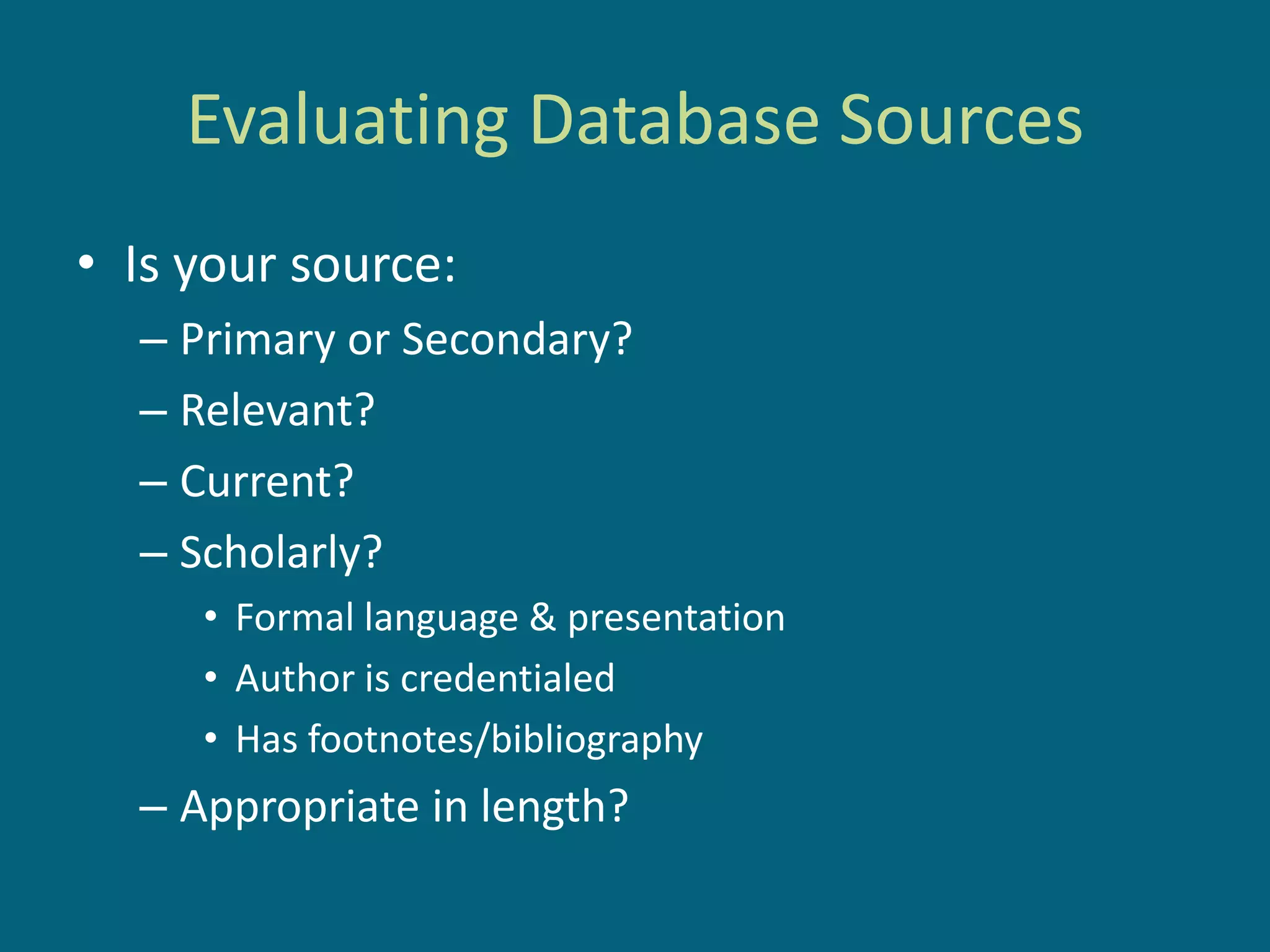
Evaluating Database Sources
• Is your source:
  – Primary or Secondary?
  – Relevant?
  – Current?
  – Scholarly?
     • Formal language & presentation
     • Author is credentialed
     • Has footnotes/bibliography
  – Appropriate in length?
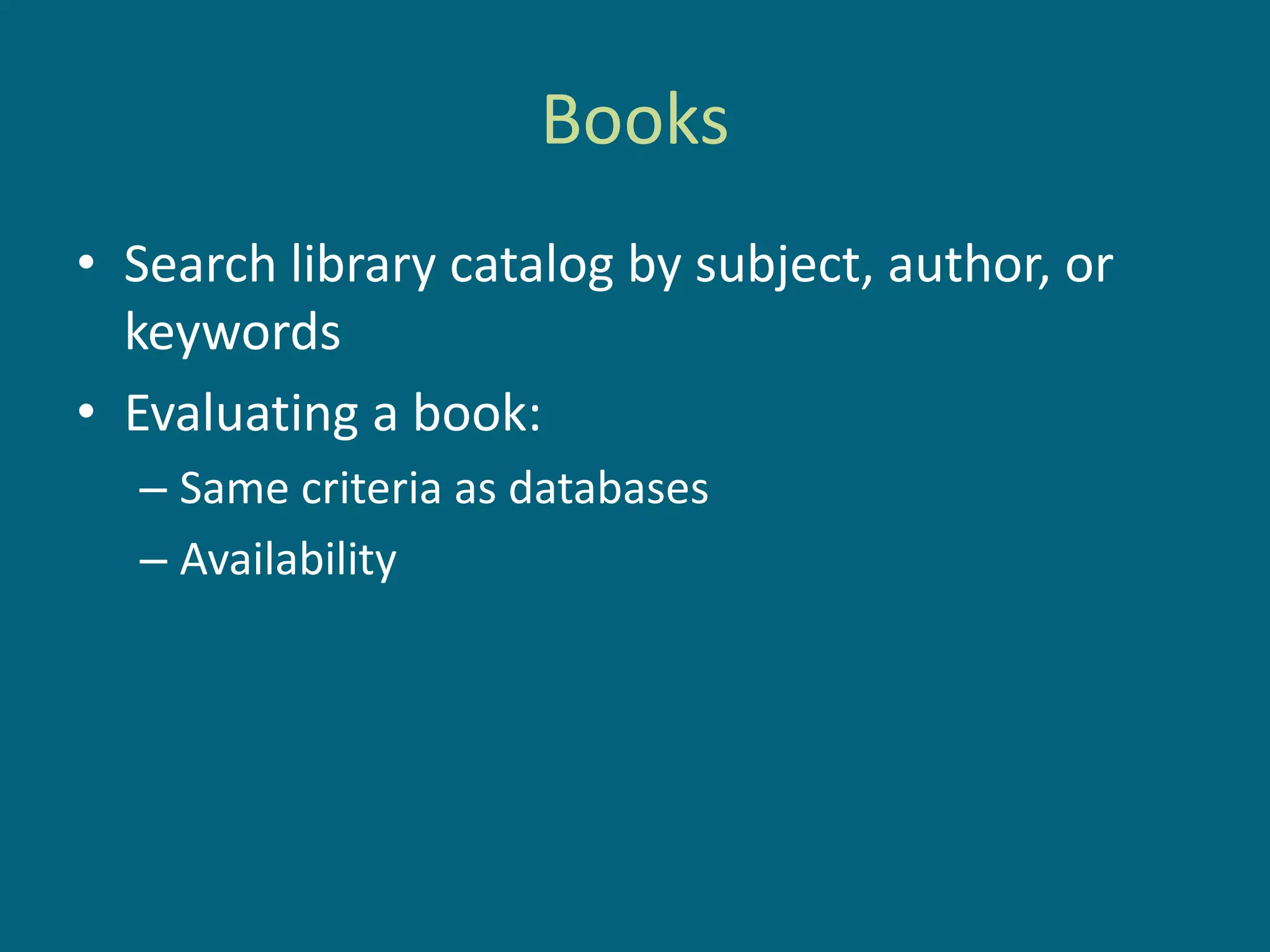
Books
• Search library catalog by subject, author, or
  keywords
• Evaluating a book:
  – Same criteria as databases
  – Availability
Search Engines
• Google, Yahoo, Dogpile, etc.
• Use advanced search form & refine
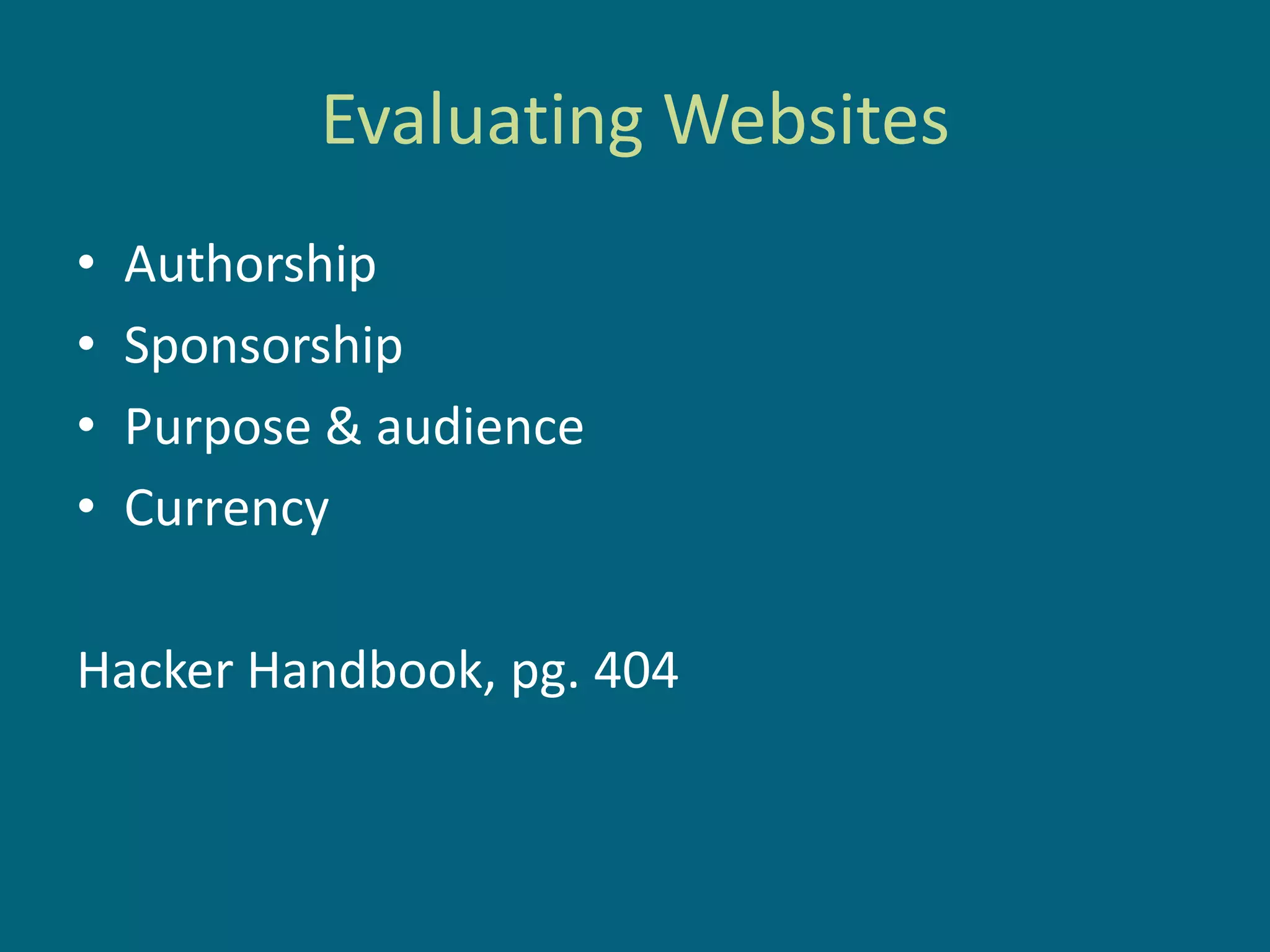
Evaluating Websites
•   Authorship
•   Sponsorship
•   Purpose & audience
•   Currency

Hacker Handbook, pg. 404
Other Sources
•   Archives (Hacker Handbook, 434)
•   Directories (Hacker Handbook, 433)
•   Reference Books (Hacker Handbook, 436)
•   Field Research
General Questions
• Check for bias
• Evaluate argument

Hacker Handbook, pg. 403
MANAGING SOURCES
Managing Sources
• Keep a working Bibliography
• Make/keep a copy of all sources
• Annotate Sources
• Include brief sentences that summarize key
  points
• Web 2.0: Diigo, Zotero, Noodle Tools
Working Bibliography: Books
•   Authors/editors/translators
•   Title and subtitle
•   Edition (if not the first)
•   Publication information: city, publisher, state
Working Bibliography: Periodical
•   All authors
•   Title and subtitle
•   Title of the magazine, journal, or newspaper
•   Date; volume, issue, and page numbers
Working Bibliography: Database
•   All authors
•   Title and subtitle
•   Title of the magazine, journal, or newspaper
•   Date; volume, issue, and page numbers
•   Name of database and a item number
•   Name of subscription service
•   URL of subscription service
•   Date you retrieved source
Working Bibliography: Web
•   Authors, editors, or creators
•   Editor or compiler, if there is one
•   Title and subtitle
•   Title of site
•   Publication information, if available
•   Page or paragraph numbers, if any
•   Date of online publication or recent update
•   Sponsor of site
•   Date accessed
•   URL

Conducting & evaluating research

  • 1.
  • 2.
    Preliminary Research Question •Avoid research questions that are: – Too broad • What are the hazards of fad diets? • What are the hazards of low-carb diets? – Too bland • How does DNA testing work? • How reliable is DNA testing? – Too speculative • Is it wrong to share music files on the Internet? • How has Internet file sharing affected musicians?
  • 3.
  • 4.
    Databases • Found on/throughlibrary computer systems • Both general and subject specific • Searching a database – Vary key words – Use quotation marks, AND, OR, NOT – Limit search to: • Peer-reviewed articles • Full-text articles
  • 5.
    Evaluating Database Sources •Is your source: – Primary or Secondary? – Relevant? – Current? – Scholarly? • Formal language & presentation • Author is credentialed • Has footnotes/bibliography – Appropriate in length?
  • 6.
    Books • Search librarycatalog by subject, author, or keywords • Evaluating a book: – Same criteria as databases – Availability
  • 7.
    Search Engines • Google,Yahoo, Dogpile, etc. • Use advanced search form & refine
  • 8.
    Evaluating Websites • Authorship • Sponsorship • Purpose & audience • Currency Hacker Handbook, pg. 404
  • 9.
    Other Sources • Archives (Hacker Handbook, 434) • Directories (Hacker Handbook, 433) • Reference Books (Hacker Handbook, 436) • Field Research
  • 10.
    General Questions • Checkfor bias • Evaluate argument Hacker Handbook, pg. 403
  • 11.
  • 12.
    Managing Sources • Keepa working Bibliography • Make/keep a copy of all sources • Annotate Sources • Include brief sentences that summarize key points • Web 2.0: Diigo, Zotero, Noodle Tools
  • 13.
    Working Bibliography: Books • Authors/editors/translators • Title and subtitle • Edition (if not the first) • Publication information: city, publisher, state
  • 14.
    Working Bibliography: Periodical • All authors • Title and subtitle • Title of the magazine, journal, or newspaper • Date; volume, issue, and page numbers
  • 15.
    Working Bibliography: Database • All authors • Title and subtitle • Title of the magazine, journal, or newspaper • Date; volume, issue, and page numbers • Name of database and a item number • Name of subscription service • URL of subscription service • Date you retrieved source
  • 16.
    Working Bibliography: Web • Authors, editors, or creators • Editor or compiler, if there is one • Title and subtitle • Title of site • Publication information, if available • Page or paragraph numbers, if any • Date of online publication or recent update • Sponsor of site • Date accessed • URL