


Lesson 7
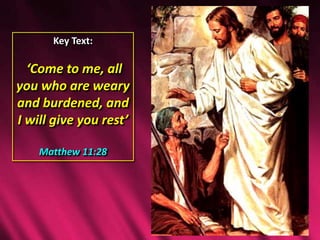
Key Text:
‘Come to me, all
you who are weary
and burdened, and
I will give you rest’
Matthew 11:28
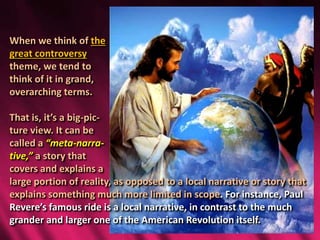
When we think of the
great controversy
theme, we tend to
think of it in grand,
overarching terms.
That is, it’s a big-pic-
ture view. It can be
called a “meta-narra-
tive,” a story that
covers and explains a
large portion of reality, as opposed to a local narrative or story that
explains something much more limited in scope. For instance, Paul
Revere’s famous ride is a local narrative, in contrast to the much
grander and larger one of the American Revolution itself.
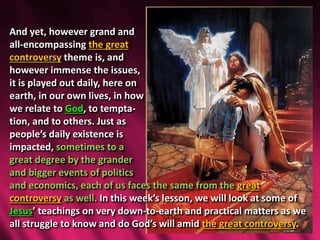
And yet, however grand and
all-encompassing the great
controversy theme is, and
however immense the issues,
it is played out daily, here on
earth, in our own lives, in how
we relate to God, to tempta-
tion, and to others. Just as
people’s daily existence is
impacted, sometimes to a
great degree by the grander
and bigger events of politics
and economics, each of us faces the same from the great
controversy as well. In this week’s lesson, we will look at some of
Jesus’ teachings on very down-to-earth and practical matters as we
all struggle to know and do God’s will amid the great controversy.
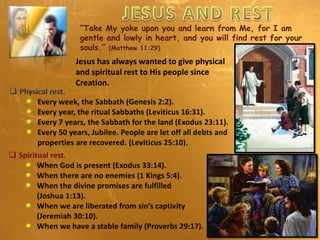
“Take My yoke upon you and learn from Me, for I am
gentle and lowly in heart, and you will find rest for your
souls.” (Matthew 11:29)
Jesus has always wanted to give physical
and spiritual rest to His people since
Creation.
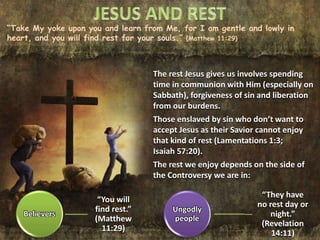
“Take My yoke upon you and learn from Me, for I am gentle and lowly in
heart, and you will find rest for your souls.” (Matthew 11:29)
The rest Jesus gives us involves spending
time in communion with Him (especially on
Sabbath), forgiveness of sin and liberation
from our burdens.
Those enslaved by sin who don’t want to
accept Jesus as their Savior cannot enjoy
that kind of rest (Lamentations 1:3;
Isaiah 57:20).
The rest we enjoy depends on the side of
the Controversy we are in:
Believers
“You will
find rest.”
(Matthew
11:29)
Ungodly
people
“They have
no rest day or
night.”
(Revelation
14:11)
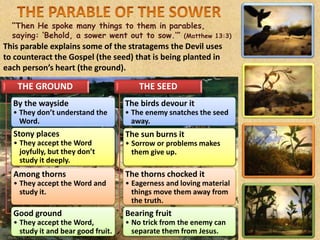
“Then He spoke many things to them in parables,
saying: ‘Behold, a sower went out to sow.’” (Matthew 13:3)
This parable explains some of the stratagems the Devil uses
to counteract the Gospel (the seed) that is being planted in
each person’s heart (the ground).
By the wayside
• They don’t understand the
Word.
Stony places
• They accept the Word
joyfully, but they don’t
study it deeply.
Among thorns
• They accept the Word and
study it.
Good ground
• They accept the Word,
study it and bear good fruit.
The birds devour it
• The enemy snatches the seed
away.
The sun burns it
• Sorrow or problems makes
them give up.
The thorns chocked it
• Eagerness and loving material
things move them away from
the truth.
Bearing fruit
• No trick from the enemy can
separate them from Jesus.
THE GROUND THE SEED
“Grace can thrive only in the heart that is being
constantly prepared for the precious seeds of truth. The
thorns of sin will grow in any soil; they need no
cultivation; but grace must be carefully cultivated. The
briers and thorns are always ready to spring up, and the
work of purification must advance continually. If the
heart is not kept under the control of God, if the Holy
Spirit does not work unceasingly to refine and ennoble
the character, the old habits will reveal themselves in
the life. Men may profess to believe the gospel; but
unless they are sanctified by the gospel their profession
is of no avail. If they do not gain the victory over sin,
then sin is gaining the victory over them. The thorns
that have been cut off but not uprooted grow apace,
until the soul is overspread with them.”
E.G.W. (Christ’s Object Lessons, cp. 2, pg. 31)
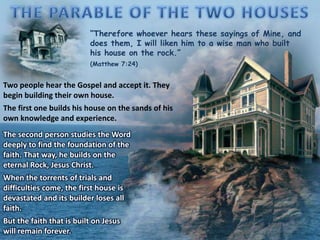
“Therefore whoever hears these sayings of Mine, and
does them, I will liken him to a wise man who built
his house on the rock.”
(Matthew 7:24)
Two people hear the Gospel and accept it. They
begin building their own house.
The first one builds his house on the sands of his
own knowledge and experience.
The second person studies the Word
deeply to find the foundation of the
faith. That way, he builds on the
eternal Rock, Jesus Christ.
When the torrents of trials and
difficulties come, the first house is
devastated and its builder loses all
faith.
But the faith that is built on Jesus
will remain forever.
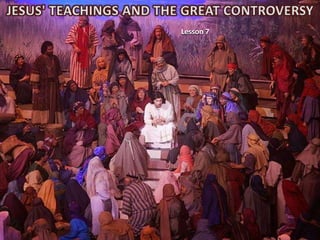
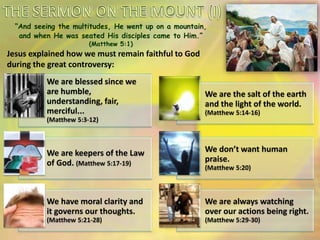
“And seeing the multitudes, He went up on a mountain,
and when He was seated His disciples came to Him.”
(Matthew 5:1)
Jesus explained how we must remain faithful to God
during the great controversy:
We are blessed since we
are humble,
understanding, fair,
merciful...
(Matthew 5:3-12)
We are the salt of the earth
and the light of the world.
(Matthew 5:14-16)
We are keepers of the Law
of God. (Matthew 5:17-19)
We don’t want human
praise.
(Matthew 5:20)
We have moral clarity and
it governs our thoughts.
(Matthew 5:21-28)
We are always watching
over our actions being right.
(Matthew 5:29-30)
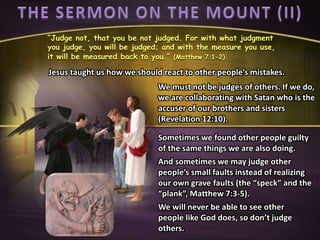
“Judge not, that you be not judged. For with what judgment
you judge, you will be judged; and with the measure you use,
it will be measured back to you.” (Matthew 7:1-2)
We must not be judges of others. If we do,
we are collaborating with Satan who is the
accuser of our brothers and sisters
(Revelation 12:10).
Jesus taught us how we should react to other people’s mistakes.
Sometimes we found other people guilty
of the same things we are also doing.
And sometimes we may judge other
people’s small faults instead of realizing
our own grave faults (the “speck” and the
“plank”, Matthew 7:3-5).
We will never be able to see other
people like God does, so don’t judge
others.
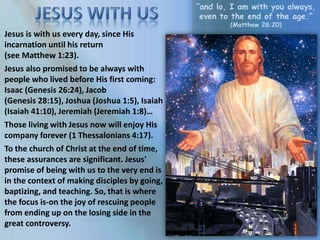
“and lo, I am with you always,
even to the end of the age.”
(Matthew 28:20)
Jesus is with us every day, since His
incarnation until his return
(see Matthew 1:23).
Jesus also promised to be always with
people who lived before His first coming:
Isaac (Genesis 26:24), Jacob
(Genesis 28:15), Joshua (Joshua 1:5), Isaiah
(Isaiah 41:10), Jeremiah (Jeremiah 1:8)…
Those living with Jesus now will enjoy His
company forever (1 Thessalonians 4:17).
To the church of Christ at the end of time,
these assurances are significant. Jesus'
promise of being with us to the very end is
in the context of making disciples by going,
baptizing, and teaching. So, that is where
the focus is-on the joy of rescuing people
from ending up on the losing side in the
great controversy.
“Christ did not tell His disciples that
their work would be easy. He showed
them the vast confederacy of evil
arrayed against them. They would have
to fight ‘against principalities, against
powers, against the rulers of the
darkness of this world, against spiritual
wickedness in high places.’ Ephesians
6:12. But they would not be left to fight
alone. He assured them that He would be
with them; and that if they would go
forth in faith, they should move under
the shield of Omnipotence.”
E.G.W. (The Acts of the Apostles, cp. 3, pg. 29)
Further Thought:
Author Leon Wieseltier
wrote about what he said
was “one of the saddest
stories in the world.” He told
of an Englishman, named
“S.B.,” who had been blind
from birth. However, the
good news was that, at 52
years old, S.B. had a corneal
transplant that gave him sight.
For the first time in his life, S.B.
was able to see! It must have been incredibly exciting for him to finally
see the world that had unfolded all around him his whole life but was,
literally, out of sight. However, Wieseltier then quotes the source in
which he first read the story. S.B., said the author, “found the world
drab, and was upset by flaking paint and blemishes.
He noted more and more the imperfections in things, and would
examine small irregularities and marks in paintwork or wood,
which he found upsetting, evidently expecting a more perfect
world. He liked bright colours, but became depressed when the
light faded. His depression became marked and general. He
gradually gave up active living, and three years later he died.”—
www.newrepublic.com/article/113312.
Wow! Though hard to understand on one level, on another it’s not.
Our world is a damaged place. The great controversy has been raging
here for about six thousand years. A 6,000-year war is going to leave
a lot of wreckage in its wake.
And despite all our attempts to make this world better, the trajec-
tory doesn’t seem to be heading in the right direction. In fact, it’s
going to get only worse. That’s why we need the promise of Redem-
ption, which comes to us only from Christ’s victory in the great con-
troversy, a victory secured at the cross and offered freely to us all.
Slideshare.net/chucho1943
We invite you to download and study each one of the 13 lessons
about this serie
THIS SERVICE IS
FREE AND YOU
CAN USE IT
 Rebellion Redemption

07 jesus teachings

  • 1.
  • 2.
    Key Text: ‘Come tome, all you who are weary and burdened, and I will give you rest’ Matthew 11:28
  • 3.
    When we thinkof the great controversy theme, we tend to think of it in grand, overarching terms. That is, it’s a big-pic- ture view. It can be called a “meta-narra- tive,” a story that covers and explains a large portion of reality, as opposed to a local narrative or story that explains something much more limited in scope. For instance, Paul Revere’s famous ride is a local narrative, in contrast to the much grander and larger one of the American Revolution itself.
  • 4.
    And yet, howevergrand and all-encompassing the great controversy theme is, and however immense the issues, it is played out daily, here on earth, in our own lives, in how we relate to God, to tempta- tion, and to others. Just as people’s daily existence is impacted, sometimes to a great degree by the grander and bigger events of politics and economics, each of us faces the same from the great controversy as well. In this week’s lesson, we will look at some of Jesus’ teachings on very down-to-earth and practical matters as we all struggle to know and do God’s will amid the great controversy.
  • 5.
    “Take My yokeupon you and learn from Me, for I am gentle and lowly in heart, and you will find rest for your souls.” (Matthew 11:29) Jesus has always wanted to give physical and spiritual rest to His people since Creation.
  • 6.
    “Take My yokeupon you and learn from Me, for I am gentle and lowly in heart, and you will find rest for your souls.” (Matthew 11:29) The rest Jesus gives us involves spending time in communion with Him (especially on Sabbath), forgiveness of sin and liberation from our burdens. Those enslaved by sin who don’t want to accept Jesus as their Savior cannot enjoy that kind of rest (Lamentations 1:3; Isaiah 57:20). The rest we enjoy depends on the side of the Controversy we are in: Believers “You will find rest.” (Matthew 11:29) Ungodly people “They have no rest day or night.” (Revelation 14:11)
  • 7.
    “Then He spokemany things to them in parables, saying: ‘Behold, a sower went out to sow.’” (Matthew 13:3) This parable explains some of the stratagems the Devil uses to counteract the Gospel (the seed) that is being planted in each person’s heart (the ground). By the wayside • They don’t understand the Word. Stony places • They accept the Word joyfully, but they don’t study it deeply. Among thorns • They accept the Word and study it. Good ground • They accept the Word, study it and bear good fruit. The birds devour it • The enemy snatches the seed away. The sun burns it • Sorrow or problems makes them give up. The thorns chocked it • Eagerness and loving material things move them away from the truth. Bearing fruit • No trick from the enemy can separate them from Jesus. THE GROUND THE SEED
  • 8.
    “Grace can thriveonly in the heart that is being constantly prepared for the precious seeds of truth. The thorns of sin will grow in any soil; they need no cultivation; but grace must be carefully cultivated. The briers and thorns are always ready to spring up, and the work of purification must advance continually. If the heart is not kept under the control of God, if the Holy Spirit does not work unceasingly to refine and ennoble the character, the old habits will reveal themselves in the life. Men may profess to believe the gospel; but unless they are sanctified by the gospel their profession is of no avail. If they do not gain the victory over sin, then sin is gaining the victory over them. The thorns that have been cut off but not uprooted grow apace, until the soul is overspread with them.” E.G.W. (Christ’s Object Lessons, cp. 2, pg. 31)
  • 9.
    “Therefore whoever hearsthese sayings of Mine, and does them, I will liken him to a wise man who built his house on the rock.” (Matthew 7:24) Two people hear the Gospel and accept it. They begin building their own house. The first one builds his house on the sands of his own knowledge and experience. The second person studies the Word deeply to find the foundation of the faith. That way, he builds on the eternal Rock, Jesus Christ. When the torrents of trials and difficulties come, the first house is devastated and its builder loses all faith. But the faith that is built on Jesus will remain forever.
  • 10.
    “And seeing themultitudes, He went up on a mountain, and when He was seated His disciples came to Him.” (Matthew 5:1) Jesus explained how we must remain faithful to God during the great controversy: We are blessed since we are humble, understanding, fair, merciful... (Matthew 5:3-12) We are the salt of the earth and the light of the world. (Matthew 5:14-16) We are keepers of the Law of God. (Matthew 5:17-19) We don’t want human praise. (Matthew 5:20) We have moral clarity and it governs our thoughts. (Matthew 5:21-28) We are always watching over our actions being right. (Matthew 5:29-30)
  • 11.
    “Judge not, thatyou be not judged. For with what judgment you judge, you will be judged; and with the measure you use, it will be measured back to you.” (Matthew 7:1-2) We must not be judges of others. If we do, we are collaborating with Satan who is the accuser of our brothers and sisters (Revelation 12:10). Jesus taught us how we should react to other people’s mistakes. Sometimes we found other people guilty of the same things we are also doing. And sometimes we may judge other people’s small faults instead of realizing our own grave faults (the “speck” and the “plank”, Matthew 7:3-5). We will never be able to see other people like God does, so don’t judge others.
  • 12.
    “and lo, Iam with you always, even to the end of the age.” (Matthew 28:20) Jesus is with us every day, since His incarnation until his return (see Matthew 1:23). Jesus also promised to be always with people who lived before His first coming: Isaac (Genesis 26:24), Jacob (Genesis 28:15), Joshua (Joshua 1:5), Isaiah (Isaiah 41:10), Jeremiah (Jeremiah 1:8)… Those living with Jesus now will enjoy His company forever (1 Thessalonians 4:17). To the church of Christ at the end of time, these assurances are significant. Jesus' promise of being with us to the very end is in the context of making disciples by going, baptizing, and teaching. So, that is where the focus is-on the joy of rescuing people from ending up on the losing side in the great controversy.
  • 13.
    “Christ did nottell His disciples that their work would be easy. He showed them the vast confederacy of evil arrayed against them. They would have to fight ‘against principalities, against powers, against the rulers of the darkness of this world, against spiritual wickedness in high places.’ Ephesians 6:12. But they would not be left to fight alone. He assured them that He would be with them; and that if they would go forth in faith, they should move under the shield of Omnipotence.” E.G.W. (The Acts of the Apostles, cp. 3, pg. 29)
  • 14.
    Further Thought: Author LeonWieseltier wrote about what he said was “one of the saddest stories in the world.” He told of an Englishman, named “S.B.,” who had been blind from birth. However, the good news was that, at 52 years old, S.B. had a corneal transplant that gave him sight. For the first time in his life, S.B. was able to see! It must have been incredibly exciting for him to finally see the world that had unfolded all around him his whole life but was, literally, out of sight. However, Wieseltier then quotes the source in which he first read the story. S.B., said the author, “found the world drab, and was upset by flaking paint and blemishes.
  • 15.
    He noted moreand more the imperfections in things, and would examine small irregularities and marks in paintwork or wood, which he found upsetting, evidently expecting a more perfect world. He liked bright colours, but became depressed when the light faded. His depression became marked and general. He gradually gave up active living, and three years later he died.”— www.newrepublic.com/article/113312.
  • 16.
    Wow! Though hardto understand on one level, on another it’s not. Our world is a damaged place. The great controversy has been raging here for about six thousand years. A 6,000-year war is going to leave a lot of wreckage in its wake. And despite all our attempts to make this world better, the trajec- tory doesn’t seem to be heading in the right direction. In fact, it’s going to get only worse. That’s why we need the promise of Redem- ption, which comes to us only from Christ’s victory in the great con- troversy, a victory secured at the cross and offered freely to us all.
  • 17.
    Slideshare.net/chucho1943 We invite youto download and study each one of the 13 lessons about this serie THIS SERVICE IS FREE AND YOU CAN USE IT  Rebellion Redemption