MCC Libraries


                Evaluating Web-Sites
 By Sal Anchondo, Lori Annesi, Pam Czaja and Alice Harrington
The Internet has revolutionized the way college students conduct
research. Unlike your predecessors, you have quick and easy
access to millions of valuable resources from around the globe.

Is all Internet information valuable? Unlike the book and magazine
publication processes, there are no editors or fact checkers to
prevent an incorrect web-site from being created. Not all of the
information you will find on the web will be useful or accurate.

This online tutorial will help you analyze web-sites for their value
more accurately.
By the end of this tutorial you will be able to…


       Differentiate between these types of web-site addresses:
                   .com
                   .edu
                   .gov
                   .org

       Apply the following criteria in order to evaluate web-sites:
                  Authority
                  Accuracy
                  Objectivity
                  Currency
                  Coverage
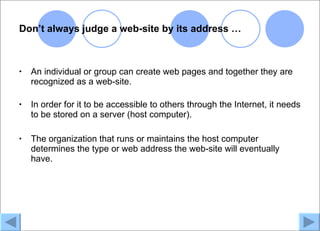
Don’t always judge a web-site by its address …


•   An individual or group can create web pages and together they are
    recognized as a web-site.

•   In order for it to be accessible to others through the Internet, it needs
    to be stored on a server (host computer).

•   The organization that runs or maintains the host computer
    determines the type or web address the web-site will eventually
    have.
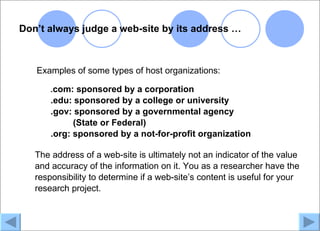
Don’t always judge a web-site by its address …


   Examples of some types of host organizations:

       .com: sponsored by a corporation
       .edu: sponsored by a college or university
       .gov: sponsored by a governmental agency
             (State or Federal)
       .org: sponsored by a not-for-profit organization

   The address of a web-site is ultimately not an indicator of the value
   and accuracy of the information on it. You as a researcher have the
   responsibility to determine if a web-site’s content is useful for your
   research project.
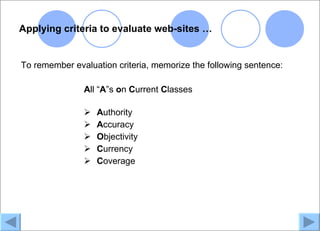
Applying criteria to evaluate web-sites …


To remember evaluation criteria, memorize the following sentence:

               All “A”s on Current Classes

                  Authority
                  Accuracy
                  Objectivity
                  Currency
                  Coverage
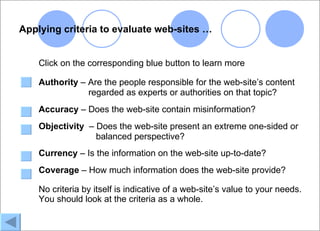
Applying criteria to evaluate web-sites …


    Click on the corresponding blue button to learn more

    Authority – Are the people responsible for the web-site’s content
                regarded as experts or authorities on that topic?
    Accuracy – Does the web-site contain misinformation?
    Objectivity – Does the web-site present an extreme one-sided or
                  balanced perspective?
    Currency – Is the information on the web-site up-to-date?
    Coverage – How much information does the web-site provide?

    No criteria by itself is indicative of a web-site’s value to your needs.
    You should look at the criteria as a whole.
Authority


You need to take into account whether the web-site author has
credentials in the subject being presented.

Questions regarding authority:

      Who wrote this? Who is the sponsor? An e-mail contact is not
       enough. Most reliable web-sites have an “about us” link. Click
       on it and read it.

      Is the person or organization well-regarded by others?

      Do their credentials allow them to speak with authority?
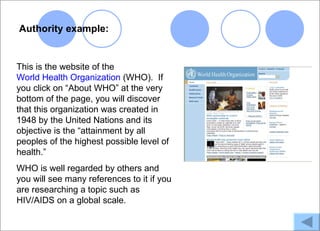
Authority example:


This is the website of the
World Health Organization (WHO). If
you click on “About WHO” at the very
bottom of the page, you will discover
that this organization was created in
1948 by the United Nations and its
objective is the “attainment by all
peoples of the highest possible level of
health.”
WHO is well regarded by others and
you will see many references to it if you
are researching a topic such as
HIV/AIDS on a global scale.
Accuracy


•   Authority and accuracy go hand in hand. The more authoritative the
    creator of a web-site is, the less likely you will find errors and
    inaccurate information.

•   The responsibility of accuracy falls solely on the shoulders of the
    web creator.

•   If the web-site is full of errors, there is a high probability that the
    information provided might also be inaccurate.
Questions regarding accuracy:


      Is the web-site free from spelling and grammatical errors?

      Is the information that you find on a web-site consistent with what
       you see in other sources (i.e. books, magazines, journals, other
       websites, etc.)?
Objectivity


 •   Remember every issue has more than one side.

 •   Objectivity is a criteria that is difficult to measure if you haven’t
     viewed or investigated other sources or viewpoints.

 •   You need to gain perspective on the issue at hand before you
     can accurately judge objectivity.
Questions regarding objectivity:


   Is the web-site consistent with the information that you’ve been
    gathering?

   Does it radically represent one side of the issue or the other?

   Are opinion and editorial sections clearly labeled?
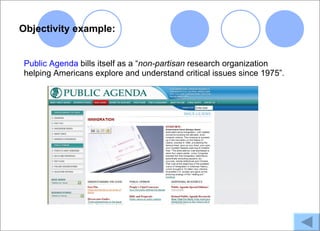
Objectivity example:


Public Agenda bills itself as a “non-partisan research organization
helping Americans explore and understand critical issues since 1975”.
Currency


You can look at currency in two ways when evaluating a web-site.
Currency equates to up-to-date information. It also relates to how often
the web-site is checked for accuracy.

Questions regarding currency:

       How current is the information on the web-site?

       When was the web-site last updated?

       Are the links still active?
Coverage


   How much information is provided compared to other sources
    (i.e. newspaper and magazine articles) used on the same topic?

   Is there an indication that the page has been completed and is still
    not under construction?
In conclusion …


   When you apply these five evaluation criteria, you will discover they
   overlap. Using them in your analysis will ultimately help make up your
   mind to use a web-site. On occasion, you will encounter sites that are
   difficult to analyze. In those instances, do not hesitate to contact a
   librarian or your instructor.

   More on web-site evaluation …
    Evaluating Web Resources – Wolfgram
     Memorial Library, Widener University
    Checklist for Evaluating Web Resources – University of Southern Maine Libraries
    Evaluating Web Pages – Duke University Libraries
    Web-site Evaluation - Purdue University Libraries


Restart                                                      Go Back to Student
Tutorial                                                     Resources web page

Web Site Evaluation

  • 1.
    MCC Libraries Evaluating Web-Sites By Sal Anchondo, Lori Annesi, Pam Czaja and Alice Harrington
  • 2.
    The Internet hasrevolutionized the way college students conduct research. Unlike your predecessors, you have quick and easy access to millions of valuable resources from around the globe. Is all Internet information valuable? Unlike the book and magazine publication processes, there are no editors or fact checkers to prevent an incorrect web-site from being created. Not all of the information you will find on the web will be useful or accurate. This online tutorial will help you analyze web-sites for their value more accurately.
  • 3.
    By the endof this tutorial you will be able to…  Differentiate between these types of web-site addresses:  .com  .edu  .gov  .org  Apply the following criteria in order to evaluate web-sites:  Authority  Accuracy  Objectivity  Currency  Coverage
  • 4.
    Don’t always judgea web-site by its address … • An individual or group can create web pages and together they are recognized as a web-site. • In order for it to be accessible to others through the Internet, it needs to be stored on a server (host computer). • The organization that runs or maintains the host computer determines the type or web address the web-site will eventually have.
  • 5.
    Don’t always judgea web-site by its address … Examples of some types of host organizations: .com: sponsored by a corporation .edu: sponsored by a college or university .gov: sponsored by a governmental agency (State or Federal) .org: sponsored by a not-for-profit organization The address of a web-site is ultimately not an indicator of the value and accuracy of the information on it. You as a researcher have the responsibility to determine if a web-site’s content is useful for your research project.
  • 6.
    Applying criteria toevaluate web-sites … To remember evaluation criteria, memorize the following sentence: All “A”s on Current Classes  Authority  Accuracy  Objectivity  Currency  Coverage
  • 7.
    Applying criteria toevaluate web-sites … Click on the corresponding blue button to learn more Authority – Are the people responsible for the web-site’s content regarded as experts or authorities on that topic? Accuracy – Does the web-site contain misinformation? Objectivity – Does the web-site present an extreme one-sided or balanced perspective? Currency – Is the information on the web-site up-to-date? Coverage – How much information does the web-site provide? No criteria by itself is indicative of a web-site’s value to your needs. You should look at the criteria as a whole.
  • 8.
    Authority You need totake into account whether the web-site author has credentials in the subject being presented. Questions regarding authority:  Who wrote this? Who is the sponsor? An e-mail contact is not enough. Most reliable web-sites have an “about us” link. Click on it and read it.  Is the person or organization well-regarded by others?  Do their credentials allow them to speak with authority?
  • 9.
    Authority example: This isthe website of the World Health Organization (WHO). If you click on “About WHO” at the very bottom of the page, you will discover that this organization was created in 1948 by the United Nations and its objective is the “attainment by all peoples of the highest possible level of health.” WHO is well regarded by others and you will see many references to it if you are researching a topic such as HIV/AIDS on a global scale.
  • 10.
    Accuracy • Authority and accuracy go hand in hand. The more authoritative the creator of a web-site is, the less likely you will find errors and inaccurate information. • The responsibility of accuracy falls solely on the shoulders of the web creator. • If the web-site is full of errors, there is a high probability that the information provided might also be inaccurate.
  • 11.
    Questions regarding accuracy:  Is the web-site free from spelling and grammatical errors?  Is the information that you find on a web-site consistent with what you see in other sources (i.e. books, magazines, journals, other websites, etc.)?
  • 12.
    Objectivity • Remember every issue has more than one side. • Objectivity is a criteria that is difficult to measure if you haven’t viewed or investigated other sources or viewpoints. • You need to gain perspective on the issue at hand before you can accurately judge objectivity.
  • 13.
    Questions regarding objectivity:  Is the web-site consistent with the information that you’ve been gathering?  Does it radically represent one side of the issue or the other?  Are opinion and editorial sections clearly labeled?
  • 14.
    Objectivity example: Public Agendabills itself as a “non-partisan research organization helping Americans explore and understand critical issues since 1975”.
  • 15.
    Currency You can lookat currency in two ways when evaluating a web-site. Currency equates to up-to-date information. It also relates to how often the web-site is checked for accuracy. Questions regarding currency:  How current is the information on the web-site?  When was the web-site last updated?  Are the links still active?
  • 16.
    Coverage  How much information is provided compared to other sources (i.e. newspaper and magazine articles) used on the same topic?  Is there an indication that the page has been completed and is still not under construction?
  • 17.
    In conclusion … When you apply these five evaluation criteria, you will discover they overlap. Using them in your analysis will ultimately help make up your mind to use a web-site. On occasion, you will encounter sites that are difficult to analyze. In those instances, do not hesitate to contact a librarian or your instructor. More on web-site evaluation …  Evaluating Web Resources – Wolfgram Memorial Library, Widener University  Checklist for Evaluating Web Resources – University of Southern Maine Libraries  Evaluating Web Pages – Duke University Libraries  Web-site Evaluation - Purdue University Libraries Restart Go Back to Student Tutorial Resources web page