Conditionals

María Irene Albers de Urriola
M. In Applied Linguistics
Specialization Computer Technology in
Education
Identifying Conditional Statements
• Cause – effect relationship. Situation A is
necessary for B to happen.
• Some ways to express conditional
relationships:
– Can result
– Whenever
– Providing
– if
•
•
•

María Irene Albers de Urriola
M. In Applied Linguistics
Specialization Computer Technology in
Education
Conditional Sentences
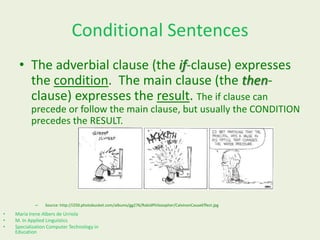
• The adverbial clause (the if-clause) expresses
the condition. The main clause (the thenclause) expresses the result. The if clause can
precede or follow the main clause, but usually the CONDITION
precedes the RESULT.

–

•
•
•

Source: http://i250.photobucket.com/albums/gg276/RabidPhilosopher/CalvinonCauseEffect.jpg

María Irene Albers de Urriola
M. In Applied Linguistics
Specialization Computer Technology in
Education
Conditional Sentences
Conditionals in English

Conditionals in English

  • 1.
    Conditionals María Irene Albersde Urriola M. In Applied Linguistics Specialization Computer Technology in Education
  • 2.
    Identifying Conditional Statements •Cause – effect relationship. Situation A is necessary for B to happen. • Some ways to express conditional relationships: – Can result – Whenever – Providing – if • • • María Irene Albers de Urriola M. In Applied Linguistics Specialization Computer Technology in Education
  • 3.
    Conditional Sentences • Theadverbial clause (the if-clause) expresses the condition. The main clause (the thenclause) expresses the result. The if clause can precede or follow the main clause, but usually the CONDITION precedes the RESULT. – • • • Source: http://i250.photobucket.com/albums/gg276/RabidPhilosopher/CalvinonCauseEffect.jpg María Irene Albers de Urriola M. In Applied Linguistics Specialization Computer Technology in Education
  • 4.