Conditionals in English

María Irene Albers de Urriola
M. In Applied Linguistics
Specialization Computer
Technology in Education
University of Sevilla PhD Candidate


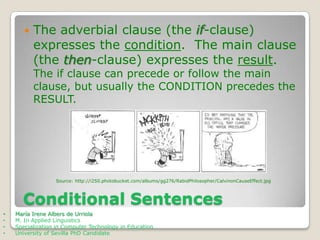
The adverbial clause (the if-clause)
expresses the condition. The main clause
(the then-clause) expresses the result.
The if clause can precede or follow the main
clause, but usually the CONDITION precedes the
RESULT.

Source: http://i250.photobucket.com/albums/gg276/RabidPhilosopher/CalvinonCauseEffect.jpg

Conditional Sentences
•
•
•
•

María Irene Albers de Urriola
M. In Applied Linguistics
Specialization in Computer Technology in Education
University of Sevilla PhD Candidate
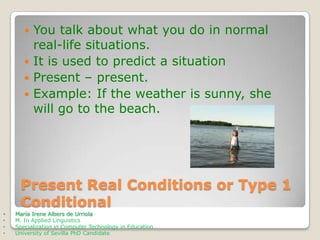
You talk about what you do in normal
real-life situations.
 It is used to predict a situation
 Present – present.
 Example: If the weather is sunny, she
will go to the beach.


Present Real Conditions or Type 1
Conditional
•
•
•
•

María Irene Albers de Urriola
M. In Applied Linguistics
Specialization in Computer Technology in Education
University of Sevilla PhD Candidate
It talks about what you would do in
imaginary situations.
 It is possible, but very unlikely that the
condition will be fulfilled.
 Simple past – conditional (would or could)
 Example: If I had more time, I would go
to the beach.


Hypothetical - Imaginary Situations
in the Present or Type 2 Conditional
•
•
•
•

María Irene Albers de Urriola
M. In Applied Linguistics
Specialization in Computer Technology in Education
University of Sevilla PhD Candidate
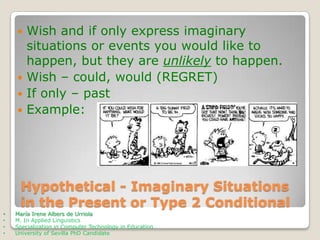
Wish and if only express imaginary
situations or events you would like to
happen, but they are unlikely to happen.
 Wish – could, would (REGRET)
 If only – past
 Example:


Hypothetical - Imaginary Situations
in the Present or Type 2 Conditional
•
•
•
•

María Irene Albers de Urriola
M. In Applied Linguistics
Specialization in Computer Technology in Education
University of Sevilla PhD Candidate
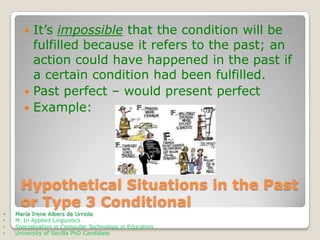
It’s impossible that the condition will be
fulfilled because it refers to the past; an
action could have happened in the past if
a certain condition had been fulfilled.
 Past perfect – would present perfect
 Example:


Hypothetical Situations in the Past
or Type 3 Conditional
•
•
•
•

María Irene Albers de Urriola
M. In Applied Linguistics
Specialization in Computer Technology in Education
University of Sevilla PhD Candidate

Conditionals

  • 1.
    Conditionals in English MaríaIrene Albers de Urriola M. In Applied Linguistics Specialization Computer Technology in Education University of Sevilla PhD Candidate
  • 2.
     The adverbial clause(the if-clause) expresses the condition. The main clause (the then-clause) expresses the result. The if clause can precede or follow the main clause, but usually the CONDITION precedes the RESULT. Source: http://i250.photobucket.com/albums/gg276/RabidPhilosopher/CalvinonCauseEffect.jpg Conditional Sentences • • • • María Irene Albers de Urriola M. In Applied Linguistics Specialization in Computer Technology in Education University of Sevilla PhD Candidate
  • 3.
    You talk aboutwhat you do in normal real-life situations.  It is used to predict a situation  Present – present.  Example: If the weather is sunny, she will go to the beach.  Present Real Conditions or Type 1 Conditional • • • • María Irene Albers de Urriola M. In Applied Linguistics Specialization in Computer Technology in Education University of Sevilla PhD Candidate
  • 4.
    It talks aboutwhat you would do in imaginary situations.  It is possible, but very unlikely that the condition will be fulfilled.  Simple past – conditional (would or could)  Example: If I had more time, I would go to the beach.  Hypothetical - Imaginary Situations in the Present or Type 2 Conditional • • • • María Irene Albers de Urriola M. In Applied Linguistics Specialization in Computer Technology in Education University of Sevilla PhD Candidate
  • 5.
    Wish and ifonly express imaginary situations or events you would like to happen, but they are unlikely to happen.  Wish – could, would (REGRET)  If only – past  Example:  Hypothetical - Imaginary Situations in the Present or Type 2 Conditional • • • • María Irene Albers de Urriola M. In Applied Linguistics Specialization in Computer Technology in Education University of Sevilla PhD Candidate
  • 6.
    It’s impossible thatthe condition will be fulfilled because it refers to the past; an action could have happened in the past if a certain condition had been fulfilled.  Past perfect – would present perfect  Example:  Hypothetical Situations in the Past or Type 3 Conditional • • • • María Irene Albers de Urriola M. In Applied Linguistics Specialization in Computer Technology in Education University of Sevilla PhD Candidate