The Writing Process
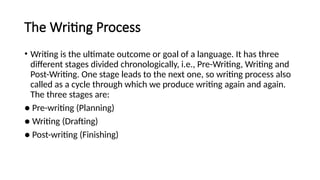
•Writing is the ultimate outcome or goal of a language. It has three
different stages divided chronologically, i.e., Pre-Writing, Writing and
Post-Writing. One stage leads to the next one, so writing process also
called as a cycle through which we produce writing again and again.
The three stages are:
● Pre-writing (Planning)
● Writing (Drafting)
● Post-writing (Finishing)
3.
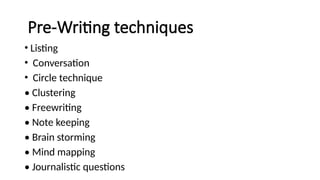
Pre-writing
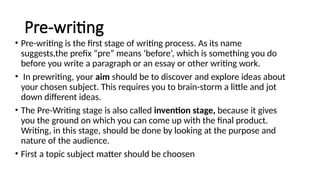
• Pre-writing isthe first stage of writing process. As its name
suggests,the prefix “pre” means ‘before’, which is something you do
before you write a paragraph or an essay or other writing work.
• In prewriting, your aim should be to discover and explore ideas about
your chosen subject. This requires you to brain-storm a little and jot
down different ideas.
• The Pre-Writing stage is also called invention stage, because it gives
you the ground on which you can come up with the final product.
Writing, in this stage, should be done by looking at the purpose and
nature of the audience.
• First a topic subject matter should be choosen
4.
Pre-Writing (Discover &Narrow)
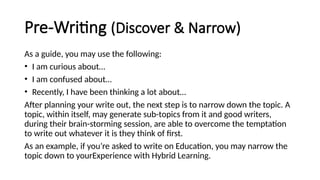
As a guide, you may use the following:
• I am curious about…
• I am confused about…
• Recently, I have been thinking a lot about…
After planning your write out, the next step is to narrow down the topic. A
topic, within itself, may generate sub-topics from it and good writers,
during their brain-storming session, are able to overcome the temptation
to write out whatever it is they think of first.
As an example, if you’re asked to write on Education, you may narrow the
topic down to yourExperience with Hybrid Learning.
Listing
•Jot down everyidea you have about your topic. Free-
associate; don’t hold back anything.
•Write everything down in a list form can be one
word, a phrase, an entire sentence, or more
•Do not worry about grammar and spelling at this
point, just get your thoughts on paper.
7.
Free- Writing
•Take outa blank sheet of paper or open a new word
document
•Begin writing for at least ten to fifteen minutes.
•Write whatever comes to your mind about your
subject.
•Do not worry about spelling, punctuation, or grammar
•Do not change, correct, or delete anything
8.
Free- Writing
•If youcannot think of something to write about, just
write “I can’t think of anything to write right now; I’m
stumped.” Simply keep writing until a new thought
comes into your mind.
9.
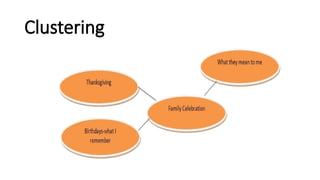
Clustering
•Place your generalsubject in a circle in the middle of a
blank sheet of paper
•Begin to draw other lines or circles that shoot out
from the original topic
•Cluster the ideas that seem to go together
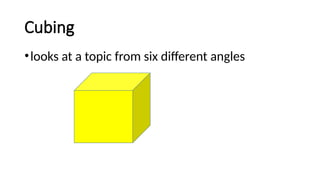
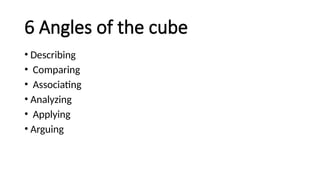
a. Describe it
•Whatdoes your subject look like?
•What size, colors, texture does it
have?
•Any special features worth
noting?
14.
b. Compare orcontrast it
•What is your subject similar to?
•What is your subject different
from? In what ways?
15.
c. Free-associate it
•Whatdoes this subject remind
you of?
•What does it call to mind?
• What memories does it conjure
up?
16.
d. Analyze it
•Howdoes it work?
•How are the parts connected?
•What is its significance?
17.
e. Argue foror against it
•What arguments can you make for or
against your subject?
• What advantages or disadvantages does
it have?
•What changes or improvements should
be made?
18.
f. Apply it
•Whatare the uses of your
subject?
•What can you do with it?
19.
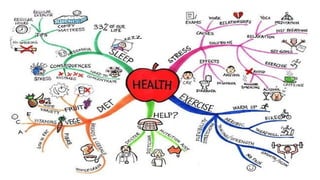
Mind mapping
• Mindmapping is a pre-writing technique that helps organize
ideas visually before starting the actual writing process. It
involves creating a diagram where the main topic is placed in
the center, and related ideas, subtopics, and details branch
out from it.
20.
Mind mapping
•Write themain topic in the center of a page.
•Draw branches for key ideas related to the topic.
•Expand further by adding subtopics and details to
each branch.
•Use colors, symbols, or images to make connections
clearer.
•Review the map and arrange ideas logically for
writing.
Journalistic questions
E.g., Imagineyou have heard about a robbery. A bag of
diamonds is stolen and the owner is murdered.
What journalistic questions would you ask to investigate?
• Who was involved in this criminal activiy ?
• Where this incident happened?
• When this Act was performed ?
• How this illigal task was completed?
• Which persons can be the part of this robbery?
24.
Conversation
Conversation is atwo-way traffic to share your ideas and
simultaneously, getting feedback. This technique is useful if
you have a friend or a mentor to help you explore and
discover better ideas also.
25.
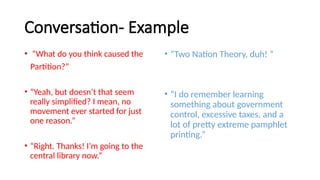
Conversation- Example
• “Whatdo you think caused the
Partition?”
• “Yeah, but doesn’t that seem
really simplified? I mean, no
movement ever started for just
one reason.”
• “Right. Thanks! I’m going to the
central library now.”
• “Two Nation Theory, duh! ”
• “I do remember learning
something about government
control, excessive taxes, and a
lot of pretty extreme pamphlet
printing.”
26.
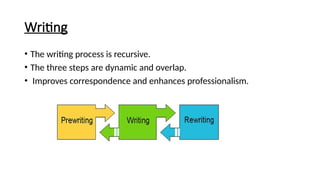
Writing
• The writingprocess is recursive.
• The three steps are dynamic and overlap.
• Improves correspondence and enhances professionalism.
27.
Drafting
• Drafting refersto a preliminary form of writing. It’s a tentative piece
of writing, which is subject to improvement.
• This draft leads us towards the final shape of the content which by
organizing our ideas and considering the audience.
• Draft can be completed by organizing paragraphs considering
aspects of unity, support and coherence
28.
Generation of Ideas
•Ask yourself questions regarding your knowledge, your requirements
and your audience.
• Experiment with different ways to organize your ideas.
• Write content in such a way that it is comprehensive and readable to
your audience.
• Before making a draft, write all the points so that the core idea
doesn’t get mixed up.
• To generate ideas, ask yourself the following:
● How can I group my ideas in paragraphs?
● What is the focus and purpose of each paragraph.
● In what order, should I present my idea?
29.
Steps in Writinga Draft
There are three parts of writing a draft.
1. Research
2. Organizing Ideas
3. Composing/Drafting
1.Research
Research is based on collecting specific data for your piece of writing
by different means and resources. Such resources may include
books, newspapers, research journals, magazine articles, internet
etc. What must be ensured is that the source us credible enough.
30.
2.Organizing
• Organizing issomehow tricky. There are two basic ideas to organize
content.
1)Divergent method
2)Convergent method
Divergent method
• It applies when argument stems from one focal point and branches
off. This is usually assumed to be a productive strategy. This way, the
argument probably develops into different directions.
Convergent method
• It is about gathering information and then coming close to an
objective. This method may work well for those who are subject
experts and know which area to branch off and which to stop. Thus,
for beginners, this approach may not be very productive.
31.
3.Composing/Drafting
• After thepreliminary research has been done, you can then move on
to write your first draft.
• It will usually be a rough draft where in you let the ideas come freely.
• This rough draft is then refined to develop connection between ideas.
32.
Structure of aDraft
The draft writing follows a certain procedure;
• Thesis Statement
• Topic Sentence
• Sufficent suport
• Coherence
• Unity
33.
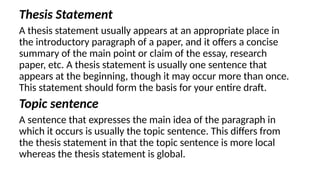
Thesis Statement
A thesisstatement usually appears at an appropriate place in
the introductory paragraph of a paper, and it offers a concise
summary of the main point or claim of the essay, research
paper, etc. A thesis statement is usually one sentence that
appears at the beginning, though it may occur more than once.
This statement should form the basis for your entire draft.
Topic sentence
A sentence that expresses the main idea of the paragraph in
which it occurs is usually the topic sentence. This differs from
the thesis statement in that the topic sentence is more local
whereas the thesis statement is global.
34.
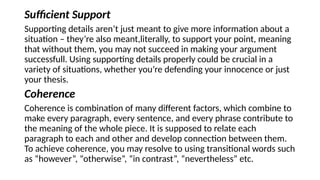
Sufficient Support
Supporting detailsaren’t just meant to give more information about a
situation – they’re also meant,literally, to support your point, meaning
that without them, you may not succeed in making your argument
successfull. Using supporting details properly could be crucial in a
variety of situations, whether you’re defending your innocence or just
your thesis.
Coherence
Coherence is combination of many different factors, which combine to
make every paragraph, every sentence, and every phrase contribute to
the meaning of the whole piece. It is supposed to relate each
paragraph to each and other and develop connection between them.
To achieve coherence, you may resolve to using transitional words such
as “however”, “otherwise”, “in contrast”, “nevertheless” etc.
35.
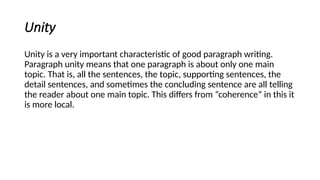
Unity
Unity is avery important characteristic of good paragraph writing.
Paragraph unity means that one paragraph is about only one main
topic. That is, all the sentences, the topic, supporting sentences, the
detail sentences, and sometimes the concluding sentence are all telling
the reader about one main topic. This differs from “coherence” in this it
is more local.
36.
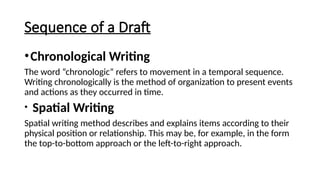
Sequence of aDraft
•Chronological Writing
The word “chronologic” refers to movement in a temporal sequence.
Writing chronologically is the method of organization to present events
and actions as they occurred in time.
• Spatial Writing
Spatial writing method describes and explains items according to their
physical position or relationship. This may be, for example, in the form
the top-to-bottom approach or the left-to-right approach.
37.
• Writing forImportance
Another way to organize a draft is in increasing or decreasing
order of significance to highlight and emphasize the
significance of a subject matter.
For example, the sentence “CIIT-pioneered Hybrid learning is
gaining momentum across Pakistan, offering education at par
with international standards” starts with a general observation
and then emphasizes its importance.
• Writing for a problem
This type of logical sequencing is used to provide a solution for
a problem.
38.
• Consider thesentence “EcoIdle system has been integrated in the
modern automobiles to reduce the percentage of Global Carbon
Emission, which are responsible for increasing the greenhouse effect
and consequently Global Warming.” This method first talks about an
implementation and then about the problem the implementation
addresses.
39.
Writing for Comparison/Contrast
•As the term implies, this method is used in writing for comparing and
contrasting two different ideas and to furnish an analysis. This may
include comparison between two car companies, universities, airlines
etc. After finalizing a draft, remember to make your piece of writing
clear and follow logical formatting.