Grammar Note
Conditionals
Conditionals zero-1-2
If you freeze water, it becomes solid.
If it rains tomorrow, I'll take the car.
If I lived closer to the cinema, I would go more often.
Grammar explanation
Conditionals describe the result of a certain condition. The if clause tells you the condition
(If you study hard) and the main clause tells you the result (you will pass your exams).
The order of the clauses does not change the meaning.
If you study hard, you will pass your exams.
You will pass your exams if you study hard.
Conditional sentences are often divided into different types.
Zero conditional
We use the zero conditional to talk about things that are generally true, especially for laws and rules.
If I drink too much coffee, I can't sleep at night.
Ice melts if you heat it.
When the sun goes down, it gets dark.
The structure is: if/when + present simple >> present simple.
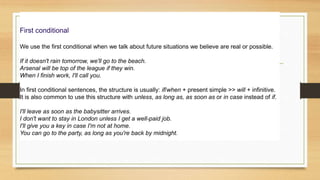
First conditional
We use the first conditional when we talk about future situations we believe are real or possible.
If it doesn't rain tomorrow, we'll go to the beach.
Arsenal will be top of the league if they win.
When I finish work, I'll call you.
In first conditional sentences, the structure is usually: if/when + present simple >> will + infinitive.
It is also common to use this structure with unless, as long as, as soon as or in case instead of if.
I'll leave as soon as the babysitter arrives.
I don't want to stay in London unless I get a well-paid job.
I'll give you a key in case I'm not at home.
You can go to the party, as long as you're back by midnight.
Second conditional
The second conditional is used to imagine present or future situations that are impossible or unlikely in reality.
If we had a garden, we could have a cat.
If I won a lot of money, I'd buy a big house in the country.
I wouldn't worry if I were you.
The structure is usually: if + past simple >> + would + infinitive.
When if is followed by the verb be, it is grammatically correct to say if I were, if he were, if she were and if it were.
However, it is also common to hear these structures with was, especially in the he/she form.
If I were you, I wouldn't mention it.
If she was prime minister, she would invest more money in schools.
He would travel more if he was younger.
If I _____ the more expensive bike, I won't have enough money to pay my rent.
buy
bought
will buy
The project _____ delayed if I don't finish this report on time.
is
will be
would be
What would you do differently if you _____ to do this again?
have
had
would have
If I _____ you, I'd go to the doctor's.
am
were
will be
When I look at a computer screen for too long, I _____ a headache.
get
got
would get
When I look at a computer screen for too long, I _____ a headache.
get
got
would get
You don't need to print your ticket as long as _____ the email.
you have
you had
you'll have
If I cared what people think, I _____ a very boring life!
had
will have
would have
I'll go and visit her as soon as I _____ time.
have
will have
had
4. Third conditional
Last but not least, we have the third conditional. We use this structure to talk about an imagined past. That’s right ladies and
gentlemen, here’s where you can change the past. Well, at least speculate how things could have been different.
Structure & Examples
The structure of the third conditional is: If + past perfect,…would/wouldn’t + have + past participle.

Conditionals .pptx

  • 1.
  • 2.
    Conditionals zero-1-2 If youfreeze water, it becomes solid. If it rains tomorrow, I'll take the car. If I lived closer to the cinema, I would go more often.
  • 3.
    Grammar explanation Conditionals describethe result of a certain condition. The if clause tells you the condition (If you study hard) and the main clause tells you the result (you will pass your exams). The order of the clauses does not change the meaning. If you study hard, you will pass your exams. You will pass your exams if you study hard. Conditional sentences are often divided into different types.
  • 4.
    Zero conditional We usethe zero conditional to talk about things that are generally true, especially for laws and rules. If I drink too much coffee, I can't sleep at night. Ice melts if you heat it. When the sun goes down, it gets dark. The structure is: if/when + present simple >> present simple.
  • 5.
    First conditional We usethe first conditional when we talk about future situations we believe are real or possible. If it doesn't rain tomorrow, we'll go to the beach. Arsenal will be top of the league if they win. When I finish work, I'll call you. In first conditional sentences, the structure is usually: if/when + present simple >> will + infinitive. It is also common to use this structure with unless, as long as, as soon as or in case instead of if. I'll leave as soon as the babysitter arrives. I don't want to stay in London unless I get a well-paid job. I'll give you a key in case I'm not at home. You can go to the party, as long as you're back by midnight.
  • 6.
    Second conditional The secondconditional is used to imagine present or future situations that are impossible or unlikely in reality. If we had a garden, we could have a cat. If I won a lot of money, I'd buy a big house in the country. I wouldn't worry if I were you. The structure is usually: if + past simple >> + would + infinitive. When if is followed by the verb be, it is grammatically correct to say if I were, if he were, if she were and if it were. However, it is also common to hear these structures with was, especially in the he/she form. If I were you, I wouldn't mention it. If she was prime minister, she would invest more money in schools. He would travel more if he was younger.
  • 7.
    If I _____the more expensive bike, I won't have enough money to pay my rent. buy bought will buy The project _____ delayed if I don't finish this report on time. is will be would be What would you do differently if you _____ to do this again? have had would have
  • 8.
    If I _____you, I'd go to the doctor's. am were will be When I look at a computer screen for too long, I _____ a headache. get got would get When I look at a computer screen for too long, I _____ a headache. get got would get
  • 9.
    You don't needto print your ticket as long as _____ the email. you have you had you'll have If I cared what people think, I _____ a very boring life! had will have would have I'll go and visit her as soon as I _____ time. have will have had
  • 10.
    4. Third conditional Lastbut not least, we have the third conditional. We use this structure to talk about an imagined past. That’s right ladies and gentlemen, here’s where you can change the past. Well, at least speculate how things could have been different. Structure & Examples The structure of the third conditional is: If + past perfect,…would/wouldn’t + have + past participle.