Department of Civil Engineering
Welcome To Our Presentation
TOPIC OF OUR PRESENTATION:
“Effect of different proportions of Local & Sylhet
sand on compressive strength of concrete”
1
Presented By:
Name ID
01. Kawshik Ahmed 180119021
02. Md. Mahfuz Bin Hamid 160119016
03. Moshiur Rahman 180119042
04. Murari Mohan Biswas 150119002
Supervisor:
Md. Menaz
Senior Lecturer
Dept. of Civil Engineering, EUB
2
 Objectives
 Material Properties
 Methodology
 Test Results & Data Analysis
 Conclusion
Table of Contents:
3
 To observe the compressive strength of concrete made of
Sylhet Sand.
 To observe the compressive strength of concrete made of
Local Sand.
 To observe the compressive strength of concrete made of
different proportions of Local sand & Sylhet sand.
 To compare the compressive strength and to determine the
economic Local & Sylhet sand ratio which give the best
performance.
Objectives:
4
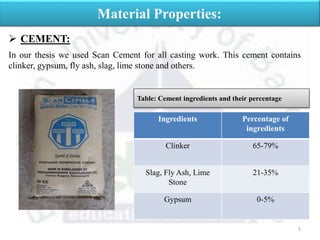
 CEMENT:
In our thesis we used Scan Cement for all casting work. This cement contains
clinker, gypsum, fly ash, slag, lime stone and others.
Material Properties:
Ingredients Percentage of
ingredients
Clinker 65-79%
Slag, Fly Ash, Lime
Stone
21-35%
Gypsum 0-5%
Table: Cement ingredients and their percentage
5
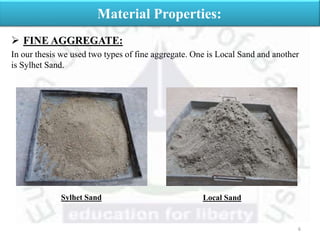
 FINE AGGREGATE:
In our thesis we used two types of fine aggregate. One is Local Sand and another
is Sylhet Sand.
Material Properties:
6
Local SandSylhet Sand
Material Properties:
7
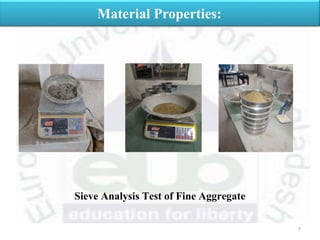
Sieve Analysis Test of Fine Aggregate
8
Material Properties:
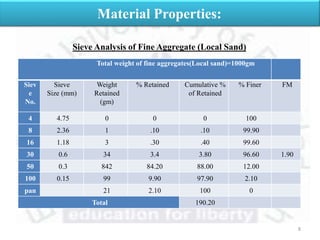
Total weight of fine aggregates(Local sand)=1000gm
Siev
e
No.
Sieve
Size (mm)
Weight
Retained
(gm)
% Retained Cumulative %
of Retained
% Finer FM
4 4.75 0 0 0 100
8 2.36 1 .10 .10 99.90
16 1.18 3 .30 .40 99.60
30 0.6 34 3.4 3.80 96.60 1.90
50 0.3 842 84.20 88.00 12.00
100 0.15 99 9.90 97.90 2.10
pan 21 2.10 100 0
Total 190.20
Sieve Analysis of Fine Aggregate (Local Sand)
Material Properties:
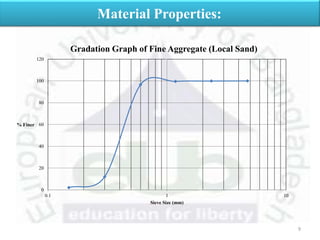
0
20
40
60
80
100
120
0.1 1 10
% Finer
Sieve Size (mm)
Gradation Graph of Fine Aggregate (Local Sand)
9
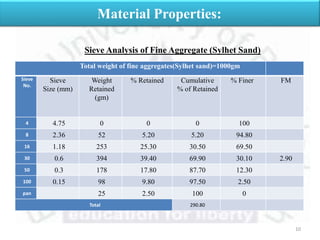
Sieve Analysis of Fine Aggregate (Sylhet Sand)
Material Properties:
Total weight of fine aggregates(Sylhet sand)=1000gm
Sieve
No.
Sieve
Size (mm)
Weight
Retained
(gm)
% Retained Cumulative
% of Retained
% Finer FM
4 4.75 0 0 0 100
8 2.36 52 5.20 5.20 94.80
16 1.18 253 25.30 30.50 69.50
30 0.6 394 39.40 69.90 30.10 2.90
50 0.3 178 17.80 87.70 12.30
100 0.15 98 9.80 97.50 2.50
pan 25 2.50 100 0
Total 290.80
10
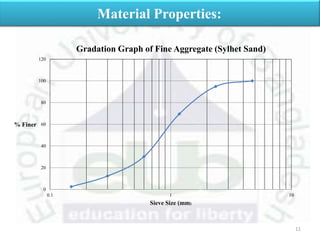
0
20
40
60
80
100
120
0.1 1 10
% Finer
Sieve Size (mm)
Gradation Graph of Fine Aggregate (Sylhet Sand)
Material Properties:
11
12
Material Properties:
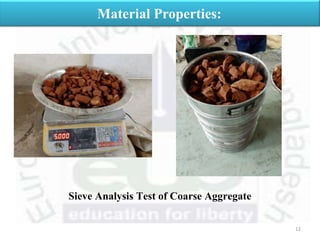
Sieve Analysis Test of Coarse Aggregate
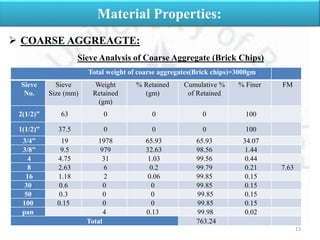
 COARSE AGGREAGTE:
Sieve Analysis of Coarse Aggregate (Brick Chips)
Material Properties:
Total weight of coarse aggregates(Brick chips)=3000gm
Sieve
No.
Sieve
Size (mm)
Weight
Retained
(gm)
% Retained
(gm)
Cumulative %
of Retained
% Finer FM
2(1/2)” 63 0 0 0 100
1(1/2)” 37.5 0 0 0 100
3/4” 19 1978 65.93 65.93 34.07
3/8” 9.5 979 32.63 98.56 1.44
4 4.75 31 1.03 99.56 0.44
8 2.63 6 0.2 99.79 0.21 7.63
16 1.18 2 0.06 99.85 0.15
30 0.6 0 0 99.85 0.15
50 0.3 0 0 99.85 0.15
100 0.15 0 0 99.85 0.15
pan 4 0.13 99.98 0.02
Total 763.24
13
Material Properties:
0
20
40
60
80
100
120
0.1 1 10 100
% Finer
Sieve Size (mm)
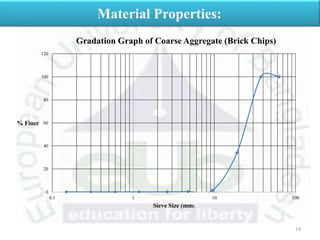
Gradation Graph of Coarse Aggregate (Brick Chips)
14
 Water Absorption Capacity of Coarse Aggregate:
Material Properties:
Wet Weight after 24 hours
Immersion= 5792 gm
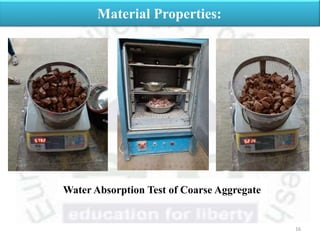
Oven Dry Weight after 24 hours = 5214 gm
Water Absorption Capacity
= [(5792-5214)/5214]X 100
=11.08 %
15
Material Properties:
Water Absorption Test of Coarse Aggregate
16
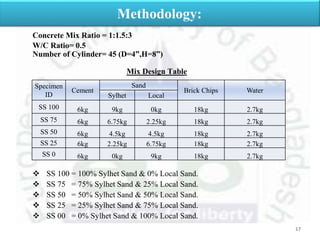
Concrete Mix Ratio = 1:1.5:3
W/C Ratio= 0.5
Number of Cylinder= 45 (D=4”,H=8”)
Mix Design Table
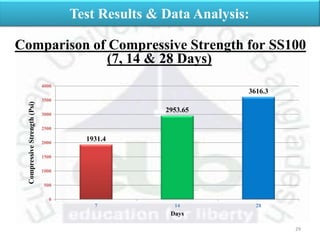
 SS 100 = 100% Sylhet Sand & 0% Local Sand.
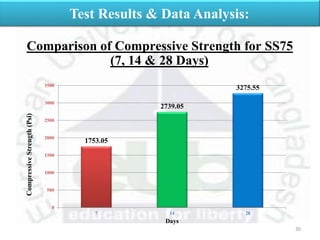
 SS 75 = 75% Sylhet Sand & 25% Local Sand.
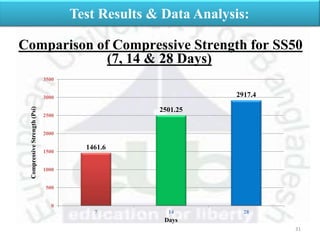
 SS 50 = 50% Sylhet Sand & 50% Local Sand.
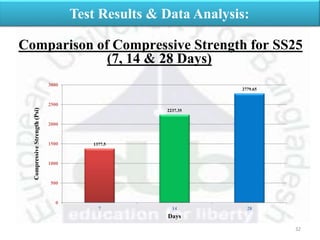
 SS 25 = 25% Sylhet Sand & 75% Local Sand.
 SS 00 = 0% Sylhet Sand & 100% Local Sand.
17
Methodology:
Specimen
ID
Cement
Sand
Brick Chips Water
Sylhet Local
SS 100 6kg 9kg 0kg 18kg 2.7kg
SS 75 6kg 6.75kg 2.25kg 18kg 2.7kg
SS 50 6kg 4.5kg 4.5kg 18kg 2.7kg
SS 25 6kg 2.25kg 6.75kg 18kg 2.7kg
SS 0 6kg 0kg 9kg 18kg 2.7kg
18
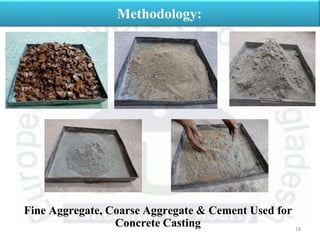
Fine Aggregate, Coarse Aggregate & Cement Used for
Concrete Casting
Methodology:
19
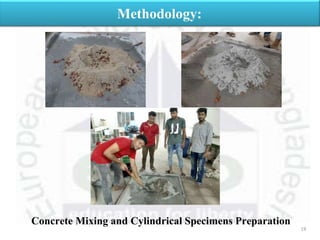
Methodology:
Concrete Mixing and Cylindrical Specimens Preparation
20
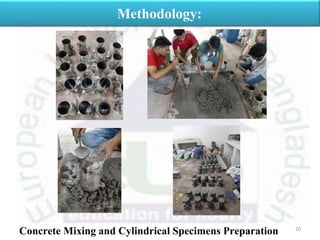
Methodology:
Concrete Mixing and Cylindrical Specimens Preparation
21
Methodology:
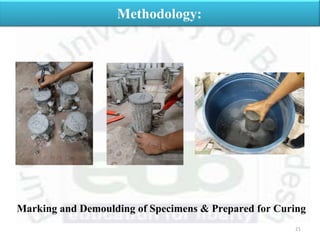
Marking and Demoulding of Specimens & Prepared for Curing
22
Methodology:
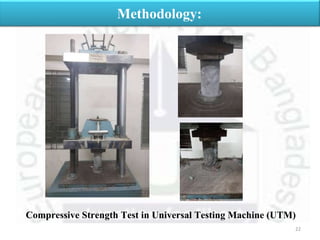
Compressive Strength Test in Universal Testing Machine (UTM)
23
Test Results & Data Analysis:
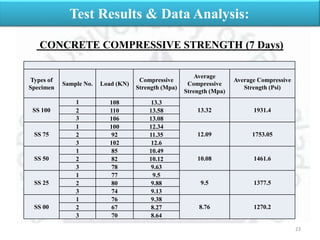
CONCRETE COMPRESSIVE STRENGTH (7 Days)
Types of
Specimen
Sample No. Load (KN)
Compressive
Strength (Mpa)
Average
Compressive
Strength (Mpa)
Average Compressive
Strength (Psi)
SS 100
1 108 13.3
13.32 1931.42 110 13.58
3 106 13.08
SS 75
1 100 12.34
12.09 1753.052 92 11.35
3 102 12.6
SS 50
1 85 10.49
10.08 1461.62 82 10.12
3 78 9.63
SS 25
1 77 9.5
9.5 1377.52 80 9.88
3 74 9.13
SS 00
1 76 9.38
8.76 1270.22 67 8.27
3 70 8.64
24
Test Results & Data Analysis:
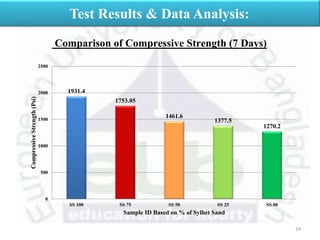
Comparison of Compressive Strength (7 Days)
1931.4
1753.05
1461.6
1377.5
1270.2
0
500
1000
1500
2000
2500
SS 100 SS 75 SS 50 SS 25 SS 00
CompressiveStrength(Psi)
Sample ID Based on % of Sylhet Sand
25
Test Results & Data Analysis:
Types of
Specimen
Sample No. Load (KN)
Compressive
Strength (Mpa)
Average
Compressive
Strength (Mpa)
Average Compressive
Strength (Psi)
SS 100
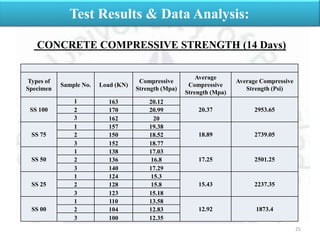
1 163 20.12
20.37 2953.652 170 20.99
3 162 20
SS 75
1 157 19.38
18.89 2739.052 150 18.52
3 152 18.77
SS 50
1 138 17.03
17.25 2501.252 136 16.8
3 140 17.29
SS 25
1 124 15.3
15.43 2237.352 128 15.8
3 123 15.18
SS 00
1 110 13.58
12.92 1873.42 104 12.83
3 100 12.35
CONCRETE COMPRESSIVE STRENGTH (14 Days)
26
Test Results & Data Analysis:
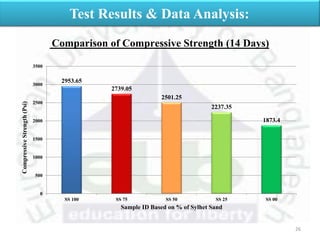
Comparison of Compressive Strength (14 Days)
2953.65
2739.05
2501.25
2237.35
1873.4
0
500
1000
1500
2000
2500
3000
3500
SS 100 SS 75 SS 50 SS 25 SS 00
CompressiveStrength(Psi)
Sample ID Based on % of Sylhet Sand
27
Test Results & Data Analysis:
Types of
Specimen
Sample No. Load (KN)
Compressive
Strength (Mpa)
Average
Compressive
Strength (Mpa)
Average Compressive
Strength (Psi)
SS 100
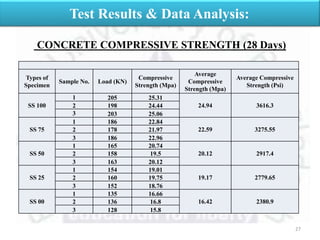
1 205 25.31
24.94 3616.32 198 24.44
3 203 25.06
SS 75
1 186 22.84
22.59 3275.552 178 21.97
3 186 22.96
SS 50
1 165 20.74
20.12 2917.42 158 19.5
3 163 20.12
SS 25
1 154 19.01
19.17 2779.652 160 19.75
3 152 18.76
SS 00
1 135 16.66
16.42 2380.92 136 16.8
3 128 15.8
CONCRETE COMPRESSIVE STRENGTH (28 Days)
28
Test Results & Data Analysis:
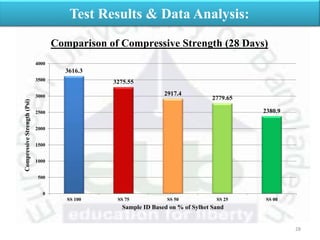
Comparison of Compressive Strength (28 Days)
3616.3
3275.55
2917.4
2779.65
2380.9
0
500
1000
1500
2000
2500
3000
3500
4000
SS 100 SS 75 SS 50 SS 25 SS 00
CompressiveStrength(Psi)
Sample ID Based on % of Sylhet Sand
29
Test Results & Data Analysis:
Comparison of Compressive Strength for SS100
(7, 14 & 28 Days)
1931.4
2953.65
3616.3
0
500
1000
1500
2000
2500
3000
3500
4000
7 14 28
CompressiveStrength(Psi)
Days
30
Test Results & Data Analysis:
Comparison of Compressive Strength for SS75
(7, 14 & 28 Days)
1753.05
2739.05
3275.55
0
500
1000
1500
2000
2500
3000
3500
7 14 28
CompressiveStrength(Psi)
Days
31
Test Results & Data Analysis:
Comparison of Compressive Strength for SS50
(7, 14 & 28 Days)
1461.6
2501.25
2917.4
0
500
1000
1500
2000
2500
3000
3500
7 14 28
CompressiveStrength(Psi)
Days
32
Test Results & Data Analysis:
Comparison of Compressive Strength for SS25
(7, 14 & 28 Days)
1377.5
2237.35
2779.65
0
500
1000
1500
2000
2500
3000
7 14 28
CompressiveStrength(Psi)
Days
33
Test Results & Data Analysis:
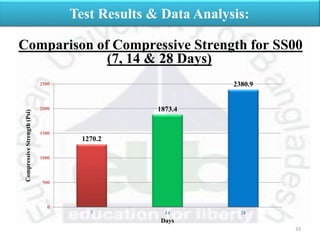
Comparison of Compressive Strength for SS00
(7, 14 & 28 Days)
1270.2
1873.4
2380.9
0
500
1000
1500
2000
2500
7 14 28
CompressiveStrength(Psi)
Days
34
Test Results & Data Analysis:
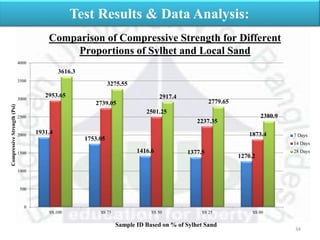
Comparison of Compressive Strength for Different
Proportions of Sylhet and Local Sand
1931.4
1753.05
1416.6 1377.5
1270.2
2953.65
2739.05
2501.25
2237.35
1873.4
3616.3
3275.55
2917.4
2779.65
2380.9
0
500
1000
1500
2000
2500
3000
3500
4000
SS 100 SS 75 SS 50 SS 25 SS 00
CompressiveStrength(Psi)
Sample ID Based on % of Sylhet Sand
7 Days
14 Days
28 Days
35
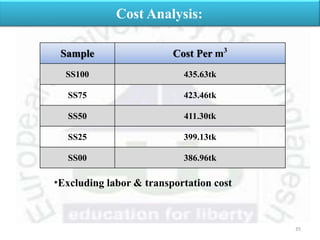
Cost Analysis:
Sample Cost Per m3
SS100 435.63tk
SS75 423.46tk
SS50 411.30tk
SS25 399.13tk
SS00 386.96tk
*Excluding labor & transportation cost
36
Conclusion:
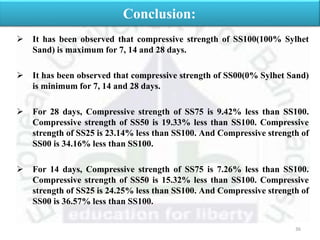
 It has been observed that compressive strength of SS100(100% Sylhet
Sand) is maximum for 7, 14 and 28 days.
 It has been observed that compressive strength of SS00(0% Sylhet Sand)
is minimum for 7, 14 and 28 days.
 For 28 days, Compressive strength of SS75 is 9.42% less than SS100.
Compressive strength of SS50 is 19.33% less than SS100. Compressive
strength of SS25 is 23.14% less than SS100. And Compressive strength of
SS00 is 34.16% less than SS100.
 For 14 days, Compressive strength of SS75 is 7.26% less than SS100.
Compressive strength of SS50 is 15.32% less than SS100. Compressive
strength of SS25 is 24.25% less than SS100. And Compressive strength of
SS00 is 36.57% less than SS100.
37
Conclusion:
 For 7 days, Compressive strength of SS75 is 9.23% less than SS100.
Compressive strength of SS50 is 26.65% less than SS100. Compressive
strength of SS25 is 28.68% less than SS100. And Compressive strength
of SS00 is 34.23% less than SS100.
 By evaluating and comparing the results, it may be suggested that
local sand up to 50% may be used with Sylhet sand for economic
purpose.
38

Concrete Mix design

  • 1.
    Department of CivilEngineering Welcome To Our Presentation TOPIC OF OUR PRESENTATION: “Effect of different proportions of Local & Sylhet sand on compressive strength of concrete” 1
  • 2.
    Presented By: Name ID 01.Kawshik Ahmed 180119021 02. Md. Mahfuz Bin Hamid 160119016 03. Moshiur Rahman 180119042 04. Murari Mohan Biswas 150119002 Supervisor: Md. Menaz Senior Lecturer Dept. of Civil Engineering, EUB 2
  • 3.
     Objectives  MaterialProperties  Methodology  Test Results & Data Analysis  Conclusion Table of Contents: 3
  • 4.
     To observethe compressive strength of concrete made of Sylhet Sand.  To observe the compressive strength of concrete made of Local Sand.  To observe the compressive strength of concrete made of different proportions of Local sand & Sylhet sand.  To compare the compressive strength and to determine the economic Local & Sylhet sand ratio which give the best performance. Objectives: 4
  • 5.
     CEMENT: In ourthesis we used Scan Cement for all casting work. This cement contains clinker, gypsum, fly ash, slag, lime stone and others. Material Properties: Ingredients Percentage of ingredients Clinker 65-79% Slag, Fly Ash, Lime Stone 21-35% Gypsum 0-5% Table: Cement ingredients and their percentage 5
  • 6.
     FINE AGGREGATE: Inour thesis we used two types of fine aggregate. One is Local Sand and another is Sylhet Sand. Material Properties: 6 Local SandSylhet Sand
  • 7.
  • 8.
    8 Material Properties: Total weightof fine aggregates(Local sand)=1000gm Siev e No. Sieve Size (mm) Weight Retained (gm) % Retained Cumulative % of Retained % Finer FM 4 4.75 0 0 0 100 8 2.36 1 .10 .10 99.90 16 1.18 3 .30 .40 99.60 30 0.6 34 3.4 3.80 96.60 1.90 50 0.3 842 84.20 88.00 12.00 100 0.15 99 9.90 97.90 2.10 pan 21 2.10 100 0 Total 190.20 Sieve Analysis of Fine Aggregate (Local Sand)
  • 9.
    Material Properties: 0 20 40 60 80 100 120 0.1 110 % Finer Sieve Size (mm) Gradation Graph of Fine Aggregate (Local Sand) 9
  • 10.
    Sieve Analysis ofFine Aggregate (Sylhet Sand) Material Properties: Total weight of fine aggregates(Sylhet sand)=1000gm Sieve No. Sieve Size (mm) Weight Retained (gm) % Retained Cumulative % of Retained % Finer FM 4 4.75 0 0 0 100 8 2.36 52 5.20 5.20 94.80 16 1.18 253 25.30 30.50 69.50 30 0.6 394 39.40 69.90 30.10 2.90 50 0.3 178 17.80 87.70 12.30 100 0.15 98 9.80 97.50 2.50 pan 25 2.50 100 0 Total 290.80 10
  • 11.
    0 20 40 60 80 100 120 0.1 1 10 %Finer Sieve Size (mm) Gradation Graph of Fine Aggregate (Sylhet Sand) Material Properties: 11
  • 12.
  • 13.
     COARSE AGGREAGTE: SieveAnalysis of Coarse Aggregate (Brick Chips) Material Properties: Total weight of coarse aggregates(Brick chips)=3000gm Sieve No. Sieve Size (mm) Weight Retained (gm) % Retained (gm) Cumulative % of Retained % Finer FM 2(1/2)” 63 0 0 0 100 1(1/2)” 37.5 0 0 0 100 3/4” 19 1978 65.93 65.93 34.07 3/8” 9.5 979 32.63 98.56 1.44 4 4.75 31 1.03 99.56 0.44 8 2.63 6 0.2 99.79 0.21 7.63 16 1.18 2 0.06 99.85 0.15 30 0.6 0 0 99.85 0.15 50 0.3 0 0 99.85 0.15 100 0.15 0 0 99.85 0.15 pan 4 0.13 99.98 0.02 Total 763.24 13
  • 14.
    Material Properties: 0 20 40 60 80 100 120 0.1 110 100 % Finer Sieve Size (mm) Gradation Graph of Coarse Aggregate (Brick Chips) 14
  • 15.
     Water AbsorptionCapacity of Coarse Aggregate: Material Properties: Wet Weight after 24 hours Immersion= 5792 gm Oven Dry Weight after 24 hours = 5214 gm Water Absorption Capacity = [(5792-5214)/5214]X 100 =11.08 % 15
  • 16.
    Material Properties: Water AbsorptionTest of Coarse Aggregate 16
  • 17.
    Concrete Mix Ratio= 1:1.5:3 W/C Ratio= 0.5 Number of Cylinder= 45 (D=4”,H=8”) Mix Design Table  SS 100 = 100% Sylhet Sand & 0% Local Sand.  SS 75 = 75% Sylhet Sand & 25% Local Sand.  SS 50 = 50% Sylhet Sand & 50% Local Sand.  SS 25 = 25% Sylhet Sand & 75% Local Sand.  SS 00 = 0% Sylhet Sand & 100% Local Sand. 17 Methodology: Specimen ID Cement Sand Brick Chips Water Sylhet Local SS 100 6kg 9kg 0kg 18kg 2.7kg SS 75 6kg 6.75kg 2.25kg 18kg 2.7kg SS 50 6kg 4.5kg 4.5kg 18kg 2.7kg SS 25 6kg 2.25kg 6.75kg 18kg 2.7kg SS 0 6kg 0kg 9kg 18kg 2.7kg
  • 18.
    18 Fine Aggregate, CoarseAggregate & Cement Used for Concrete Casting Methodology:
  • 19.
    19 Methodology: Concrete Mixing andCylindrical Specimens Preparation
  • 20.
    20 Methodology: Concrete Mixing andCylindrical Specimens Preparation
  • 21.
    21 Methodology: Marking and Demouldingof Specimens & Prepared for Curing
  • 22.
    22 Methodology: Compressive Strength Testin Universal Testing Machine (UTM)
  • 23.
    23 Test Results &Data Analysis: CONCRETE COMPRESSIVE STRENGTH (7 Days) Types of Specimen Sample No. Load (KN) Compressive Strength (Mpa) Average Compressive Strength (Mpa) Average Compressive Strength (Psi) SS 100 1 108 13.3 13.32 1931.42 110 13.58 3 106 13.08 SS 75 1 100 12.34 12.09 1753.052 92 11.35 3 102 12.6 SS 50 1 85 10.49 10.08 1461.62 82 10.12 3 78 9.63 SS 25 1 77 9.5 9.5 1377.52 80 9.88 3 74 9.13 SS 00 1 76 9.38 8.76 1270.22 67 8.27 3 70 8.64
  • 24.
    24 Test Results &Data Analysis: Comparison of Compressive Strength (7 Days) 1931.4 1753.05 1461.6 1377.5 1270.2 0 500 1000 1500 2000 2500 SS 100 SS 75 SS 50 SS 25 SS 00 CompressiveStrength(Psi) Sample ID Based on % of Sylhet Sand
  • 25.
    25 Test Results &Data Analysis: Types of Specimen Sample No. Load (KN) Compressive Strength (Mpa) Average Compressive Strength (Mpa) Average Compressive Strength (Psi) SS 100 1 163 20.12 20.37 2953.652 170 20.99 3 162 20 SS 75 1 157 19.38 18.89 2739.052 150 18.52 3 152 18.77 SS 50 1 138 17.03 17.25 2501.252 136 16.8 3 140 17.29 SS 25 1 124 15.3 15.43 2237.352 128 15.8 3 123 15.18 SS 00 1 110 13.58 12.92 1873.42 104 12.83 3 100 12.35 CONCRETE COMPRESSIVE STRENGTH (14 Days)
  • 26.
    26 Test Results &Data Analysis: Comparison of Compressive Strength (14 Days) 2953.65 2739.05 2501.25 2237.35 1873.4 0 500 1000 1500 2000 2500 3000 3500 SS 100 SS 75 SS 50 SS 25 SS 00 CompressiveStrength(Psi) Sample ID Based on % of Sylhet Sand
  • 27.
    27 Test Results &Data Analysis: Types of Specimen Sample No. Load (KN) Compressive Strength (Mpa) Average Compressive Strength (Mpa) Average Compressive Strength (Psi) SS 100 1 205 25.31 24.94 3616.32 198 24.44 3 203 25.06 SS 75 1 186 22.84 22.59 3275.552 178 21.97 3 186 22.96 SS 50 1 165 20.74 20.12 2917.42 158 19.5 3 163 20.12 SS 25 1 154 19.01 19.17 2779.652 160 19.75 3 152 18.76 SS 00 1 135 16.66 16.42 2380.92 136 16.8 3 128 15.8 CONCRETE COMPRESSIVE STRENGTH (28 Days)
  • 28.
    28 Test Results &Data Analysis: Comparison of Compressive Strength (28 Days) 3616.3 3275.55 2917.4 2779.65 2380.9 0 500 1000 1500 2000 2500 3000 3500 4000 SS 100 SS 75 SS 50 SS 25 SS 00 CompressiveStrength(Psi) Sample ID Based on % of Sylhet Sand
  • 29.
    29 Test Results &Data Analysis: Comparison of Compressive Strength for SS100 (7, 14 & 28 Days) 1931.4 2953.65 3616.3 0 500 1000 1500 2000 2500 3000 3500 4000 7 14 28 CompressiveStrength(Psi) Days
  • 30.
    30 Test Results &Data Analysis: Comparison of Compressive Strength for SS75 (7, 14 & 28 Days) 1753.05 2739.05 3275.55 0 500 1000 1500 2000 2500 3000 3500 7 14 28 CompressiveStrength(Psi) Days
  • 31.
    31 Test Results &Data Analysis: Comparison of Compressive Strength for SS50 (7, 14 & 28 Days) 1461.6 2501.25 2917.4 0 500 1000 1500 2000 2500 3000 3500 7 14 28 CompressiveStrength(Psi) Days
  • 32.
    32 Test Results &Data Analysis: Comparison of Compressive Strength for SS25 (7, 14 & 28 Days) 1377.5 2237.35 2779.65 0 500 1000 1500 2000 2500 3000 7 14 28 CompressiveStrength(Psi) Days
  • 33.
    33 Test Results &Data Analysis: Comparison of Compressive Strength for SS00 (7, 14 & 28 Days) 1270.2 1873.4 2380.9 0 500 1000 1500 2000 2500 7 14 28 CompressiveStrength(Psi) Days
  • 34.
    34 Test Results &Data Analysis: Comparison of Compressive Strength for Different Proportions of Sylhet and Local Sand 1931.4 1753.05 1416.6 1377.5 1270.2 2953.65 2739.05 2501.25 2237.35 1873.4 3616.3 3275.55 2917.4 2779.65 2380.9 0 500 1000 1500 2000 2500 3000 3500 4000 SS 100 SS 75 SS 50 SS 25 SS 00 CompressiveStrength(Psi) Sample ID Based on % of Sylhet Sand 7 Days 14 Days 28 Days
  • 35.
    35 Cost Analysis: Sample CostPer m3 SS100 435.63tk SS75 423.46tk SS50 411.30tk SS25 399.13tk SS00 386.96tk *Excluding labor & transportation cost
  • 36.
    36 Conclusion:  It hasbeen observed that compressive strength of SS100(100% Sylhet Sand) is maximum for 7, 14 and 28 days.  It has been observed that compressive strength of SS00(0% Sylhet Sand) is minimum for 7, 14 and 28 days.  For 28 days, Compressive strength of SS75 is 9.42% less than SS100. Compressive strength of SS50 is 19.33% less than SS100. Compressive strength of SS25 is 23.14% less than SS100. And Compressive strength of SS00 is 34.16% less than SS100.  For 14 days, Compressive strength of SS75 is 7.26% less than SS100. Compressive strength of SS50 is 15.32% less than SS100. Compressive strength of SS25 is 24.25% less than SS100. And Compressive strength of SS00 is 36.57% less than SS100.
  • 37.
    37 Conclusion:  For 7days, Compressive strength of SS75 is 9.23% less than SS100. Compressive strength of SS50 is 26.65% less than SS100. Compressive strength of SS25 is 28.68% less than SS100. And Compressive strength of SS00 is 34.23% less than SS100.  By evaluating and comparing the results, it may be suggested that local sand up to 50% may be used with Sylhet sand for economic purpose.
  • 38.