CEE 371 Fall 2009
Homework #7. Filtration
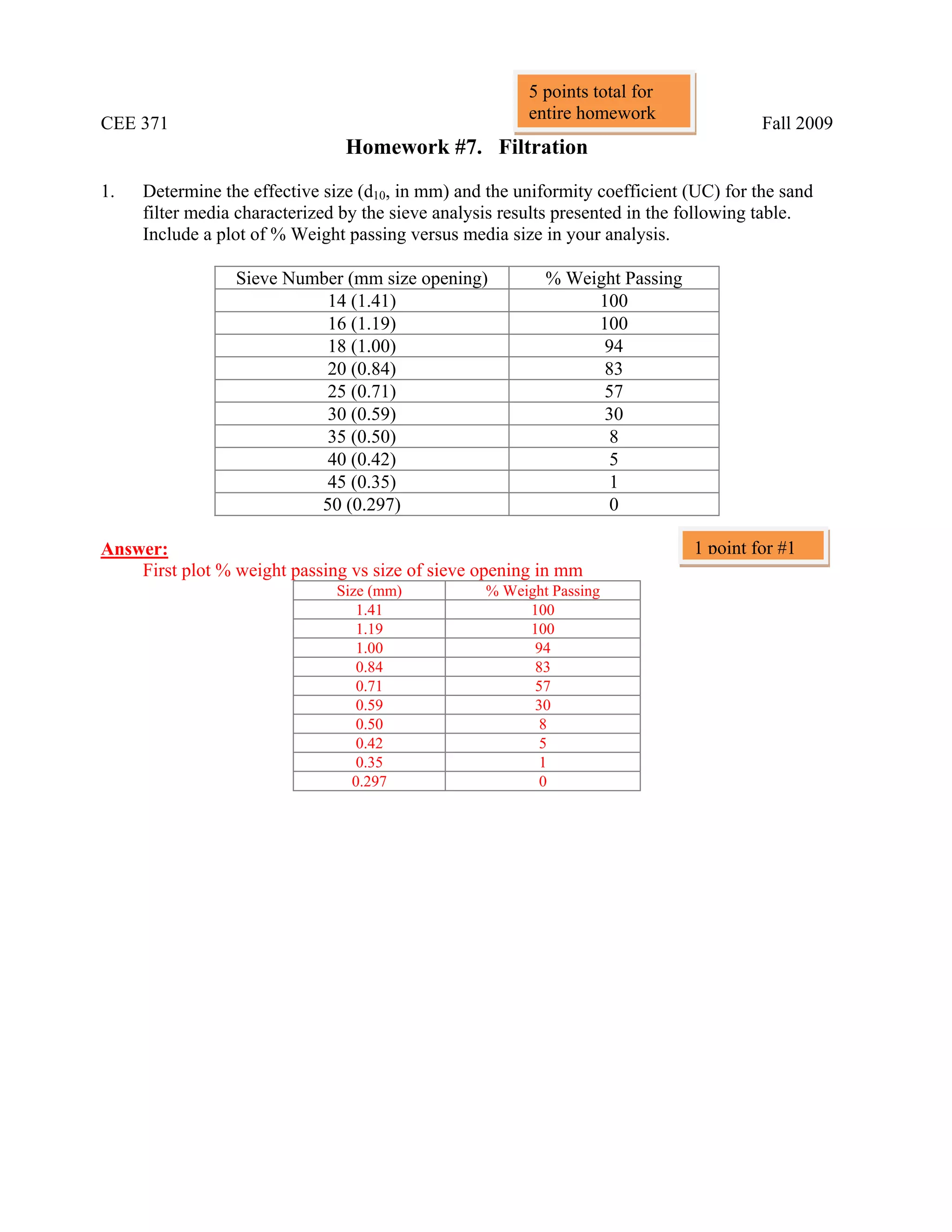
1. Determine the effective size (d10, in mm) and the uniformity coefficient (UC) for the sand
filter media characterized by the sieve analysis results presented in the following table.
Include a plot of % Weight passing versus media size in your analysis.
Sieve Number (mm size opening) % Weight Passing
14 (1.41) 100
16 (1.19) 100
18 (1.00) 94
20 (0.84) 83
25 (0.71) 57
30 (0.59) 30
35 (0.50) 8
40 (0.42) 5
45 (0.35) 1
50 (0.297) 0
Answer:
First plot % weight passing vs size of sieve opening in mm
Size (mm) % Weight Passing
1.41 100
1.19 100
1.00 94
0.84 83
0.71 57
0.59 30
0.50 8
0.42 5
0.35 1
0.297 0
5 points total for
entire homework
1 point for #1
Sieve Size (mm)
0.2 0.3 0.4 0.5 0.6 0.7 0.8 0.9 1.0 1.1 1.2 1.3 1.4 1.5
%
Weight
Passing
0
10
20
30
40
50
60
70
80
90
100
110
d60
d10
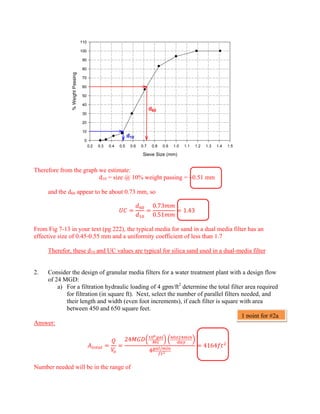
Therefore from the graph we estimate:
d10 = size @ 10% weight passing = ~0.51 mm
and the d60 appear to be about 0.73 mm, so
0.73
0.51
1.43
From Fig 7-13 in your text (pg 222), the typical media for sand in a dual media filter has an
effective size of 0.45-0.55 mm and a uniformity coefficient of less than 1.7
Therefor, these d10 and UC values are typical for silica sand used in a dual-media filter
2. Consider the design of granular media filters for a water treatment plant with a design flow
of 24 MGD:
a) For a filtration hydraulic loading of 4 gpm/ft2
determine the total filter area required
for filtration (in square ft). Next, select the number of parallel filters needed, and
their length and width (even foot increments), if each filter is square with area
between 450 and 650 square feet.
Answer:
24
4 /
4164
Number needed will be in the range of
1 point for #2a
4164
650
6.4       7
To
4164
450
9.25       10
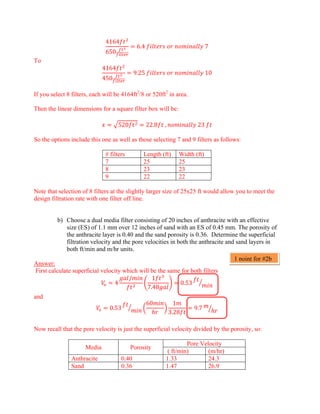
If you select 8 filters, each will be 4164ft2
/8 or 520ft2
in area.
Then the linear dimensions for a square filter box will be:
520 22.8  ,  23 
So the options include this one as well as those selecting 7 and 9 filters as follows:
# filters Length (ft) Width (ft)
7 25 25
8 23 23
9 22 22
Note that selection of 8 filters at the slightly larger size of 25x25 ft would allow you to meet the
design filtration rate with one filter off line.
b) Choose a dual media filter consisting of 20 inches of anthracite with an effective
size (ES) of 1.1 mm over 12 inches of sand with an ES of 0.45 mm. The porosity of
the anthracite layer is 0.40 and the sand porosity is 0.36. Determine the superficial
filtration velocity and the pore velocities in both the anthracite and sand layers in
both ft/min and m/hr units.
Answer:
First calculate superficial velocity which will be the same for both filters
4
/ 1
7.48
0.53
and
0.53
60 1
3.28
9.7
Now recall that the pore velocity is just the superficial velocity divided by the porosity, so:
Media Porosity
Pore Velocity
( ft/min) (m/hr)
Anthracite 0.40 1.33 24.3
Sand 0.36 1.47 26.9
1 point for #2b
c) Calculate the detention time (in minutes) through the entire depth of the filter.
Answer:
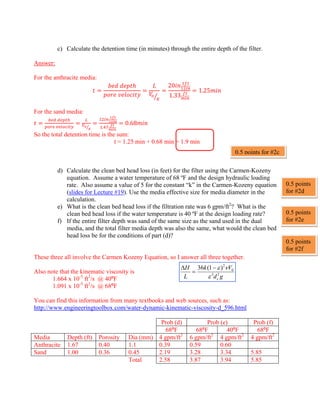
For the anthracite media:
 
 
20
1.33
1.25
For the sand media:
 
  .
0.68
So the total detention time is the sum:
t = 1.25 min + 0.68 min = 1.9 min
d) Calculate the clean bed head loss (in feet) for the filter using the Carmen-Kozeny
equation. Assume a water temperature of 68 ºF and the design hydraulic loading
rate. Also assume a value of 5 for the constant “k” in the Carmen-Kozeny equation
(slides for Lecture #19). Use the media effective size for media diameter in the
calculation.
e) What is the clean bed head loss if the filtration rate was 6 gpm/ft2
? What is the
clean bed head loss if the water temperature is 40 ºF at the design loading rate?
f) If the entire filter depth was sand of the same size as the sand used in the dual
media, and the total filter media depth was also the same, what would the clean bed
head loss be for the conditions of part (d)?
These three all involve the Carmen Kozeny Equation, so I answer all three together.
Also note that the kinematic viscosity is
1.664 x 10⁻⁵
ft2
/s @ 40ºF
1.091 x 10⁻⁵
ft2
/s @ 68ºF
You can find this information from many textbooks and web sources, such as:
http://www.engineeringtoolbox.com/water-dynamic-kinematic-viscosity-d_596.html
Prob (d) Prob (e) Prob (f)
68ºF 68ºF 40ºF 68ºF
Media Depth (ft) Porosity Dia (mm) 4 gpm/ft2
6 gpm/ft2
4 gpm/ft2
4 gpm/ft2
Anthracite 1.67 0.40 1.1 0.39 0.59 0.60
Sand 1.00 0.36 0.45 2.19 3.28 3.34 5.85
Total 2.58 3.87 3.94 5.85
g
d
V
k
L
H
c
2
3
0
2
)
1
(
36
ε
ν
ε
−
=
Δ
0.5 points for #2c
0.5 points
for #2d
0.5 points
for #2e
0.5 points
for #2f

371hw07s

  • 1.
    CEE 371 Fall2009 Homework #7. Filtration 1. Determine the effective size (d10, in mm) and the uniformity coefficient (UC) for the sand filter media characterized by the sieve analysis results presented in the following table. Include a plot of % Weight passing versus media size in your analysis. Sieve Number (mm size opening) % Weight Passing 14 (1.41) 100 16 (1.19) 100 18 (1.00) 94 20 (0.84) 83 25 (0.71) 57 30 (0.59) 30 35 (0.50) 8 40 (0.42) 5 45 (0.35) 1 50 (0.297) 0 Answer: First plot % weight passing vs size of sieve opening in mm Size (mm) % Weight Passing 1.41 100 1.19 100 1.00 94 0.84 83 0.71 57 0.59 30 0.50 8 0.42 5 0.35 1 0.297 0 5 points total for entire homework 1 point for #1
  • 2.
    Sieve Size (mm) 0.20.3 0.4 0.5 0.6 0.7 0.8 0.9 1.0 1.1 1.2 1.3 1.4 1.5 % Weight Passing 0 10 20 30 40 50 60 70 80 90 100 110 d60 d10 Therefore from the graph we estimate: d10 = size @ 10% weight passing = ~0.51 mm and the d60 appear to be about 0.73 mm, so 0.73 0.51 1.43 From Fig 7-13 in your text (pg 222), the typical media for sand in a dual media filter has an effective size of 0.45-0.55 mm and a uniformity coefficient of less than 1.7 Therefor, these d10 and UC values are typical for silica sand used in a dual-media filter 2. Consider the design of granular media filters for a water treatment plant with a design flow of 24 MGD: a) For a filtration hydraulic loading of 4 gpm/ft2 determine the total filter area required for filtration (in square ft). Next, select the number of parallel filters needed, and their length and width (even foot increments), if each filter is square with area between 450 and 650 square feet. Answer: 24 4 / 4164 Number needed will be in the range of 1 point for #2a
  • 3.
    4164 650 6.4      7 To 4164 450 9.25       10 If you select 8 filters, each will be 4164ft2 /8 or 520ft2 in area. Then the linear dimensions for a square filter box will be: 520 22.8  ,  23  So the options include this one as well as those selecting 7 and 9 filters as follows: # filters Length (ft) Width (ft) 7 25 25 8 23 23 9 22 22 Note that selection of 8 filters at the slightly larger size of 25x25 ft would allow you to meet the design filtration rate with one filter off line. b) Choose a dual media filter consisting of 20 inches of anthracite with an effective size (ES) of 1.1 mm over 12 inches of sand with an ES of 0.45 mm. The porosity of the anthracite layer is 0.40 and the sand porosity is 0.36. Determine the superficial filtration velocity and the pore velocities in both the anthracite and sand layers in both ft/min and m/hr units. Answer: First calculate superficial velocity which will be the same for both filters 4 / 1 7.48 0.53 and 0.53 60 1 3.28 9.7 Now recall that the pore velocity is just the superficial velocity divided by the porosity, so: Media Porosity Pore Velocity ( ft/min) (m/hr) Anthracite 0.40 1.33 24.3 Sand 0.36 1.47 26.9 1 point for #2b
  • 4.
    c) Calculate thedetention time (in minutes) through the entire depth of the filter. Answer: For the anthracite media:     20 1.33 1.25 For the sand media:     . 0.68 So the total detention time is the sum: t = 1.25 min + 0.68 min = 1.9 min d) Calculate the clean bed head loss (in feet) for the filter using the Carmen-Kozeny equation. Assume a water temperature of 68 ºF and the design hydraulic loading rate. Also assume a value of 5 for the constant “k” in the Carmen-Kozeny equation (slides for Lecture #19). Use the media effective size for media diameter in the calculation. e) What is the clean bed head loss if the filtration rate was 6 gpm/ft2 ? What is the clean bed head loss if the water temperature is 40 ºF at the design loading rate? f) If the entire filter depth was sand of the same size as the sand used in the dual media, and the total filter media depth was also the same, what would the clean bed head loss be for the conditions of part (d)? These three all involve the Carmen Kozeny Equation, so I answer all three together. Also note that the kinematic viscosity is 1.664 x 10⁻⁵ ft2 /s @ 40ºF 1.091 x 10⁻⁵ ft2 /s @ 68ºF You can find this information from many textbooks and web sources, such as: http://www.engineeringtoolbox.com/water-dynamic-kinematic-viscosity-d_596.html Prob (d) Prob (e) Prob (f) 68ºF 68ºF 40ºF 68ºF Media Depth (ft) Porosity Dia (mm) 4 gpm/ft2 6 gpm/ft2 4 gpm/ft2 4 gpm/ft2 Anthracite 1.67 0.40 1.1 0.39 0.59 0.60 Sand 1.00 0.36 0.45 2.19 3.28 3.34 5.85 Total 2.58 3.87 3.94 5.85 g d V k L H c 2 3 0 2 ) 1 ( 36 ε ν ε − = Δ 0.5 points for #2c 0.5 points for #2d 0.5 points for #2e 0.5 points for #2f