Umapathy U et al Int. Journal of Engineering Research and Applications www.ijera.com
ISSN : 2248-9622, Vol. 4, Issue 5( Version 1), May 2014, pp.72-76
www.ijera.com 72 | P a g e
Assessment of Concrete Strength Using Partial Replacement of
Coarse Aggregate for Wast Tiles and Cement for Rice Husk Ash
in Concrete
Umapathy U 1
, Mala C2
, Siva K 3
1(
M. tech Structural Engineering student in Faculty of engineering and technology, PRIST University, Thanjur)
2
(Department of civil Engineering, PRIST University, Puducheery- 613403)
3
(Department of Civil Engineering, Tirumala polytechnic college, Tiruvannamalai-606 611)
ABSTRACT
Conservation of natural resources and preservation of environment is the essence of any development. The
problem arising from continuous technological and industrial development is the disposal of waste material. If
some of the waste materials are found suitable in concrete making, not only cost of construction can be cut
down, but also safe disposal of waste materials can be achieved. So in our project, an attempt has been made to
assess the suitability of stone with waste tills in concrete making. In the laboratory tiles has been tried as coarse
aggregate has been used as partial substitute to conventional coarse aggregate concrete making and today many
researches are ongoing into the use of Portland cement replacements, using many waste materials like
pulverized fly ash (PFA) and ground granulated blast furnace slag (GGBS). Like PFA and GGBS a waste glass
powder (GLP) is also used as a binder with partial replacement of cement which takes some part of reaction at
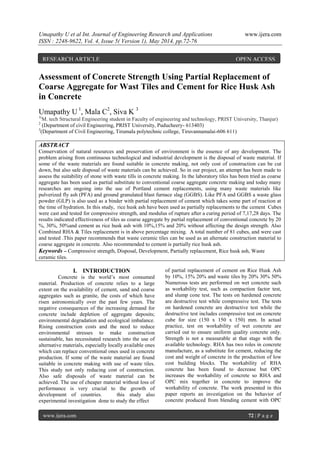
the time of hydration. In this study, rice husk ash have been used as partially replacements to the cement Cubes
were cast and tested for compressive strength, and modulus of rupture after a curing period of 7,17,28 days. The
results indicated effectiveness of tiles as coarse aggregate by partial replacement of conventional concrete by 20
%, 30%, 50%and cement as rice husk ash with 10%,15% and 20% without affecting the design strength. Also
Combined RHA & Tiles replacement is in above percentage mixing. A total number of 81 cubes, and were cast
and tested .This paper recommends that waste ceramic tiles can be used as an alternate construction material to
coarse aggregate in concrete. Also recommended to cement is partially rice husk ash.
Keywords – Compressive strength, Disposal, Development, Partially replacement, Rice husk ash, Waste
ceramic tiles.
I. INTRODUCTION
Concrete is the world’s most consumed
material. Production of concrete relies to a large
extent on the availability of cement, sand and coarse
aggregates such as granite, the costs of which have
risen astronomically over the past few years. The
negative consequences of the increasing demand for
concrete include depletion of aggregate deposits;
environmental degradation and ecological imbalance.
Rising construction costs and the need to reduce
environmental stresses to make construction
sustainable, has necessitated research into the use of
alternative materials, especially locally available ones
which can replace conventional ones used in concrete
production. If some of the waste material are found
suitable in concrete making with use of waste tiles.
This study not only reducing cost of construction.
Also safe disposals of waste material can be
achieved. The use of cheaper material without loss of
performance is very crucial to the growth of
development of countries. this study also
experimental investigation done to study the effect
of partial replacement of cement on Rice Husk Ash
by 10%, 15% 20% and waste tiles by 20% 30% 50%
Numerous tests are performed on wet concrete such
as workability test, such as compaction factor test,
and slump cone test. The tests on hardened concrete
are destructive test while compressive test. The tests
on hardened concrete are destructive test while the
destructive test includes compressive test on concrete
cube for size (150 x 150 x 150) mm. In actual
practice, test on workability of wet concrete are
carried out to ensure uniform quality concrete only.
Strength is not a measurable at that stage with the
available technology. RHA has two roles in concrete
manufacture, as a substitute for cement, reducing the
cost and weight of concrete in the production of low
cost building blocks. The workability of RHA
concrete has been found to decrease but OPC
increases the workability of concrete so RHA and
OPC mix together in concrete to improve the
workability of concrete. The work presented in this
paper reports an investigation on the behavior of
concrete produced from blending cement with OPC
RESEARCH ARTICLE OPEN ACCESS
Umapathy U et al Int. Journal of Engineering Research and Applications www.ijera.com
ISSN : 2248-9622, Vol. 4, Issue 5( Version 1), May 2014, pp.72-76
www.ijera.com 73 | P a g e
by RHA. Regression analysis method for predicting
the 7, 14, 28 day’s compressive strength of concrete
is presented in this project. The proposed method is
aimed at establishing a predictive relationship
between properties and proportions of ingredients of
concrete, compaction factor, weight of concrete
cubes and strength of concrete
1.1 THE OBJECTIVES AND SCOPE OF PRESENT
STUDY ARE
 To find the optimum mix design with regards to
the amount of water, RHA, OPC and cement
ratio.
 To investigate the physical properties of the
RHA and tiles strength (compression), water
absorption and moisture content.
 To study the relative strength development with
age of (RHA + OPC) and waste tiles as coarse
concrete with control concrete.
 Use of industrial waste in a useful manner.
 To conduct compression test on (RHA+OPC)
and control concrete on standard IS specimen
size (150 x 150 x 150) mm.
 To conduct compression test on (Tiles+
conventional coarse aggregate) and control
concrete on standard IS specimen size (150 x
150 x 150) mm.
 To provide economical construction material.
 Provide safeguard to the environment by
utilizing waste properly.
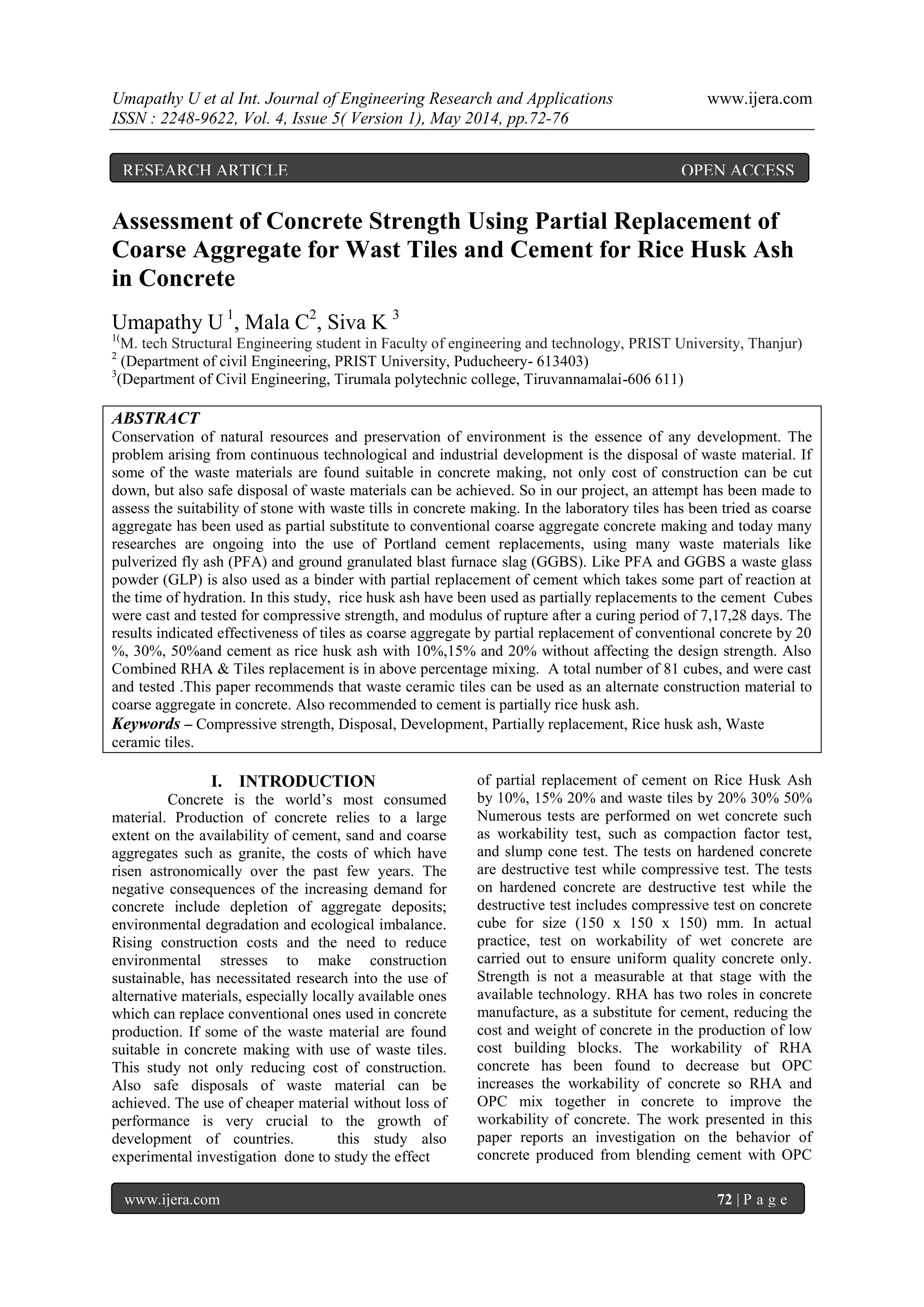
II. MATERIALS USED
1. Cement
2. Fine Aggregate
3. Coarse Aggregate
4. Course aggregate as tiles
5. Cement as rice husk ash
6. Water
Fig 1 Material used in this project
2.1 PROPERTIES OF MATERIAL ORDINARY
PORTLAND CEMENT (OPC)
TABLE: 1 TEST ON CEMENT
Properties Values
Specific gravity 3.15
Initial setting time 30 minutes
Final setting time 10 hours
2.2 PHYSICAL PROPERTIES OF RICE HUSK
ASH
1. Initial Setting time=195min
2. Final Setting time = 265min.
3. Compressive Strength = 11 N/mm2
4. Specific Gravity = 2.09
2.3PROPERTY STONE CERAMIC TILES
PROPERTIES GRANITE TILES
Specific gravity 2.67 2.400
Fineness Modulus 3.81 5.91
Minimum size(mm) 12.5 12.5
Impact Value (%) 38 25
III. EXPERIMENTAL PROGRAM
The mix design is produced for maximum
size of aggregate is 20mm conventional aggregate
and crushed ceramic aggregate. The variation of
strength of hardened concrete using solid wastes as
partial replacement of conventional aggregate is
studied by casting cubes, until 50%. The concrete
was prepared in the laboratory using mixer. The
cement, fine aggregate and coarse aggregate and
solid wastes tiles and rice husk ash are mixed in dry
state and then the desired water quantity is added and
the whole concrete is mixed for 5 minutes, the
concrete is poured in the mould which is screwed
tightly. The concrete is poured into the mould in 3
layers by poking with tamping rod for cubes of
150X150X150 mm size were tested for compression.
The cast specimens are removed after 24 hours and
these are immersed in a water tank. After a curing
period of 7, 14,28 days the specimens are removed
and these are tested for compressive strength and the
results are compared with conventional concrete.
Umapathy U et al Int. Journal of Engineering Research and Applications www.ijera.com
ISSN : 2248-9622, Vol. 4, Issue 5( Version 1), May 2014, pp.72-76
www.ijera.com 74 | P a g e
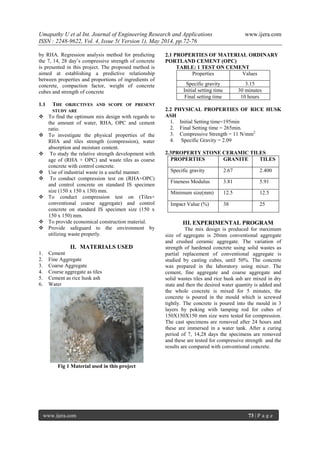
MIX PROPORTION OF CONCRERE WITH RHA REPLACEMENT
MIX PROPORTION OF CONCRETE WITH TILES REPLACEMENT
For 50 kg MIX COMPOSITION OF REPLACEMENT IN TILES AND RHA
IV. RESULTS AND DISCUSSION
4.1 GENERAL
In order to assess mechanical properties of
concrete using waste tiles aggregates and cement by
RHA with partial replacement, suitable size
specimens were cast and tested at the appropriate
ages as per the guidelines of I.S 516-1959. Care was
taken to maintain accuracy of weight of the concrete
ingredients and well calibrated measuring devices
used to find the loads. This chapter presents the test
results and discussion.
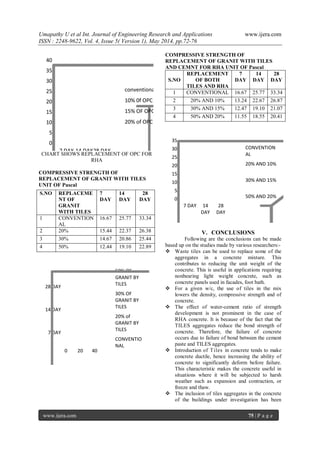
4.2 COMPRESSIVE STRENGTH
Compressive strength has been found out at
the ages 7, 14 and 28 days after moist curing the
specimens continuously. The test results are
presented in table 6.1.
Strength of concrete mainly depends on
three factors viz.
i. Strength of coarse aggregate ;
Ii Strength of mortar matrix;
Iii Bond strength between mortar part and
coarse aggregate;
The result of the present investigation reveals
that the strength of concrete up to 25MPa is governed
by the strength of all the above factors.
Strength of concrete beyond the level is
governed by the strength of the aggregate alone.
COMPRESSIVE STRENGTH OF RHA
REPLACEMENT CONCRETE UNIT OF Pascal
%REPLACEME
NTRHA
RHA Kg/m3
CEMENT
Kg/m3
AGGFINE
Kg/m3
AGG COARSE WATER
CONVENTION
AL
0 377.6 576 1201.01 188.8
10% 37.76 339.84 576 1201.01 188.8
15% 56.64 320.96 576 1201.01 188.8
20% 75.52 302.08 576 1201.01 188.8
% REPLACEMENT
TILES
CEMENT
Kg/m3
FINE AGG
Kg/m3
TILES
Kg/m3
GRANITE
Kg/m3
WATER
CONVENTIONAL 377.6 576 0 1201.01 188.8
20% 377.6 576 240.202 960.808 188.8
30% 377.6 576 360.303 840.707 188.8
50% 377.6 576 600.505 600.505 188.8
S.NO MIX OPC
(kg)
RHA
(kg)
TILES
(kg)
GRANIT
(kg)
SAND
(kg)
WATER
(l)
1 conventional 50 - - 94.5 80 25.03
2 Mix 1 45 5 18.9 75.6 80 25.03
3 Mix2 42.5 7.5 28.35 66.15 80 25.03
4 Mix3 40 10 47.25 47.25 80 25.03
S.NO REPLACEME
NT OF OPC
WITH RHA
7
DAY
14
DAY
28
DAY
1 CONVENTIO
NAL
16.67 25.77 33.34
2 10% 13.01 14.44 25.38
3 15% 12.44 20.84 22.66
4 20% 11.77 19.10 20.66
Umapathy U et al Int. Journal of Engineering Research and Applications www.ijera.com
ISSN : 2248-9622, Vol. 4, Issue 5( Version 1), May 2014, pp.72-76
www.ijera.com 75 | P a g e
0
5
10
15
20
25
30
35
40
7 DAY 14 DAY28 DAY
conventional
10% 0f OPC
15% OF OPC
20% of OPC
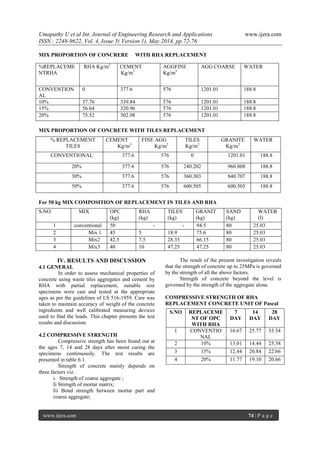
CHART SHOWS REPLACEMENT OF OPC FOR
RHA
COMPRESSIVE STRENGTH OF
REPLACEMENT OF GRANIT WITH TILES
UNIT OF Pascal
0 20 40
7 DAY
14 DAY
28 DAY
50% OF
GRANIT BY
TILES
30% OF
GRANIT BY
TILES
20% of
GRANIT BY
TILES
CONVENTIO
NAL
COMPRESSIVE STRENGTH OF
REPLACEMENT OF GRANIT WITH TILES
AND CEMNT FOR RHA UNIT OF Pascal
S.NO
REPLACEMENT
OF BOTH
TILES AND RHA
7
DAY
14
DAY
28
DAY
1 CONVENTIONAL 16.67 25.77 33.34
2 20% AND 10% 13.24 22.67 26.87
3 30% AND 15% 12.47 19.10 21.07
4 50% AND 20% 11.55 18.55 20.41
0
5
10
15
20
25
30
35
7 DAY 14
DAY
28
DAY
CONVENTION
AL
20% AND 10%
30% AND 15%
50% AND 20%
V. CONCLUSIONS
Following are the conclusions can be made
based up on the studies made by various researchers:-
 Waste tiles can be used to replace some of the
aggregates in a concrete mixture. This
contributes to reducing the unit weight of the
concrete. This is useful in applications requiring
nonbearing light weight concrete, such as
concrete panels used in facades, foot bath.
 For a given w/c, the use of tiles in the mix
lowers the density, compressive strength and of
concrete.
 The effect of water-cement ratio of strength
development is not prominent in the case of
RHA concrete. It is because of the fact that the
TILES aggregates reduce the bond strength of
concrete. Therefore, the failure of concrete
occurs due to failure of bond between the cement
paste and TILES aggregates.
 Introduction of Tiles in concrete tends to make
concrete ductile, hence increasing the ability of
concrete to significantly deform before failure.
This characteristic makes the concrete useful in
situations where it will be subjected to harsh
weather such as expansion and contraction, or
freeze and thaw.
 The inclusion of tiles aggregates in the concrete
of the buildings under investigation has been
S.NO REPLACEME
NT OF
GRANIT
WITH TILES
7
DAY
14
DAY
28
DAY
1 CONVENTION
AL
16.67 25.77 33.34
2 20% 15.44 22.37 26.38
3 30% 14.67 20.86 25.44
4 50% 12.44 19.10 22.89
Umapathy U et al Int. Journal of Engineering Research and Applications www.ijera.com
ISSN : 2248-9622, Vol. 4, Issue 5( Version 1), May 2014, pp.72-76
www.ijera.com 76 | P a g e
shown to be advantageous from an energy point
of view. The use of tiles aggregate shelled in
keeping the interior cooler, when the outside
temperature is raised, as compared to the
corresponding control concrete.
REFERENCES
[1] B. Topcu and Canbaz. Utilization of crushed
tile as aggregate in concrete. Iranian
Journal of science & technology,
Transaction B, Engineering, Vol. 31, No.
B5, pp561-565
[2] Rao, A., Jha, K.n. and Misra S.(2005).’Use
of aggregates from recycled construction
and demolition waste in concrete’. Journal
of resources conservation and recycling,
50(2007); 71-81
[3] Investigations on stone dust and ceramic
scrap as aggregate replacement in concrete.
International journal of civil and structural
Engineering volume1, No 3, 2010.

M45017276

  • 1.
    Umapathy U etal Int. Journal of Engineering Research and Applications www.ijera.com ISSN : 2248-9622, Vol. 4, Issue 5( Version 1), May 2014, pp.72-76 www.ijera.com 72 | P a g e Assessment of Concrete Strength Using Partial Replacement of Coarse Aggregate for Wast Tiles and Cement for Rice Husk Ash in Concrete Umapathy U 1 , Mala C2 , Siva K 3 1( M. tech Structural Engineering student in Faculty of engineering and technology, PRIST University, Thanjur) 2 (Department of civil Engineering, PRIST University, Puducheery- 613403) 3 (Department of Civil Engineering, Tirumala polytechnic college, Tiruvannamalai-606 611) ABSTRACT Conservation of natural resources and preservation of environment is the essence of any development. The problem arising from continuous technological and industrial development is the disposal of waste material. If some of the waste materials are found suitable in concrete making, not only cost of construction can be cut down, but also safe disposal of waste materials can be achieved. So in our project, an attempt has been made to assess the suitability of stone with waste tills in concrete making. In the laboratory tiles has been tried as coarse aggregate has been used as partial substitute to conventional coarse aggregate concrete making and today many researches are ongoing into the use of Portland cement replacements, using many waste materials like pulverized fly ash (PFA) and ground granulated blast furnace slag (GGBS). Like PFA and GGBS a waste glass powder (GLP) is also used as a binder with partial replacement of cement which takes some part of reaction at the time of hydration. In this study, rice husk ash have been used as partially replacements to the cement Cubes were cast and tested for compressive strength, and modulus of rupture after a curing period of 7,17,28 days. The results indicated effectiveness of tiles as coarse aggregate by partial replacement of conventional concrete by 20 %, 30%, 50%and cement as rice husk ash with 10%,15% and 20% without affecting the design strength. Also Combined RHA & Tiles replacement is in above percentage mixing. A total number of 81 cubes, and were cast and tested .This paper recommends that waste ceramic tiles can be used as an alternate construction material to coarse aggregate in concrete. Also recommended to cement is partially rice husk ash. Keywords – Compressive strength, Disposal, Development, Partially replacement, Rice husk ash, Waste ceramic tiles. I. INTRODUCTION Concrete is the world’s most consumed material. Production of concrete relies to a large extent on the availability of cement, sand and coarse aggregates such as granite, the costs of which have risen astronomically over the past few years. The negative consequences of the increasing demand for concrete include depletion of aggregate deposits; environmental degradation and ecological imbalance. Rising construction costs and the need to reduce environmental stresses to make construction sustainable, has necessitated research into the use of alternative materials, especially locally available ones which can replace conventional ones used in concrete production. If some of the waste material are found suitable in concrete making with use of waste tiles. This study not only reducing cost of construction. Also safe disposals of waste material can be achieved. The use of cheaper material without loss of performance is very crucial to the growth of development of countries. this study also experimental investigation done to study the effect of partial replacement of cement on Rice Husk Ash by 10%, 15% 20% and waste tiles by 20% 30% 50% Numerous tests are performed on wet concrete such as workability test, such as compaction factor test, and slump cone test. The tests on hardened concrete are destructive test while compressive test. The tests on hardened concrete are destructive test while the destructive test includes compressive test on concrete cube for size (150 x 150 x 150) mm. In actual practice, test on workability of wet concrete are carried out to ensure uniform quality concrete only. Strength is not a measurable at that stage with the available technology. RHA has two roles in concrete manufacture, as a substitute for cement, reducing the cost and weight of concrete in the production of low cost building blocks. The workability of RHA concrete has been found to decrease but OPC increases the workability of concrete so RHA and OPC mix together in concrete to improve the workability of concrete. The work presented in this paper reports an investigation on the behavior of concrete produced from blending cement with OPC RESEARCH ARTICLE OPEN ACCESS
  • 2.
    Umapathy U etal Int. Journal of Engineering Research and Applications www.ijera.com ISSN : 2248-9622, Vol. 4, Issue 5( Version 1), May 2014, pp.72-76 www.ijera.com 73 | P a g e by RHA. Regression analysis method for predicting the 7, 14, 28 day’s compressive strength of concrete is presented in this project. The proposed method is aimed at establishing a predictive relationship between properties and proportions of ingredients of concrete, compaction factor, weight of concrete cubes and strength of concrete 1.1 THE OBJECTIVES AND SCOPE OF PRESENT STUDY ARE  To find the optimum mix design with regards to the amount of water, RHA, OPC and cement ratio.  To investigate the physical properties of the RHA and tiles strength (compression), water absorption and moisture content.  To study the relative strength development with age of (RHA + OPC) and waste tiles as coarse concrete with control concrete.  Use of industrial waste in a useful manner.  To conduct compression test on (RHA+OPC) and control concrete on standard IS specimen size (150 x 150 x 150) mm.  To conduct compression test on (Tiles+ conventional coarse aggregate) and control concrete on standard IS specimen size (150 x 150 x 150) mm.  To provide economical construction material.  Provide safeguard to the environment by utilizing waste properly. II. MATERIALS USED 1. Cement 2. Fine Aggregate 3. Coarse Aggregate 4. Course aggregate as tiles 5. Cement as rice husk ash 6. Water Fig 1 Material used in this project 2.1 PROPERTIES OF MATERIAL ORDINARY PORTLAND CEMENT (OPC) TABLE: 1 TEST ON CEMENT Properties Values Specific gravity 3.15 Initial setting time 30 minutes Final setting time 10 hours 2.2 PHYSICAL PROPERTIES OF RICE HUSK ASH 1. Initial Setting time=195min 2. Final Setting time = 265min. 3. Compressive Strength = 11 N/mm2 4. Specific Gravity = 2.09 2.3PROPERTY STONE CERAMIC TILES PROPERTIES GRANITE TILES Specific gravity 2.67 2.400 Fineness Modulus 3.81 5.91 Minimum size(mm) 12.5 12.5 Impact Value (%) 38 25 III. EXPERIMENTAL PROGRAM The mix design is produced for maximum size of aggregate is 20mm conventional aggregate and crushed ceramic aggregate. The variation of strength of hardened concrete using solid wastes as partial replacement of conventional aggregate is studied by casting cubes, until 50%. The concrete was prepared in the laboratory using mixer. The cement, fine aggregate and coarse aggregate and solid wastes tiles and rice husk ash are mixed in dry state and then the desired water quantity is added and the whole concrete is mixed for 5 minutes, the concrete is poured in the mould which is screwed tightly. The concrete is poured into the mould in 3 layers by poking with tamping rod for cubes of 150X150X150 mm size were tested for compression. The cast specimens are removed after 24 hours and these are immersed in a water tank. After a curing period of 7, 14,28 days the specimens are removed and these are tested for compressive strength and the results are compared with conventional concrete.
  • 3.
    Umapathy U etal Int. Journal of Engineering Research and Applications www.ijera.com ISSN : 2248-9622, Vol. 4, Issue 5( Version 1), May 2014, pp.72-76 www.ijera.com 74 | P a g e MIX PROPORTION OF CONCRERE WITH RHA REPLACEMENT MIX PROPORTION OF CONCRETE WITH TILES REPLACEMENT For 50 kg MIX COMPOSITION OF REPLACEMENT IN TILES AND RHA IV. RESULTS AND DISCUSSION 4.1 GENERAL In order to assess mechanical properties of concrete using waste tiles aggregates and cement by RHA with partial replacement, suitable size specimens were cast and tested at the appropriate ages as per the guidelines of I.S 516-1959. Care was taken to maintain accuracy of weight of the concrete ingredients and well calibrated measuring devices used to find the loads. This chapter presents the test results and discussion. 4.2 COMPRESSIVE STRENGTH Compressive strength has been found out at the ages 7, 14 and 28 days after moist curing the specimens continuously. The test results are presented in table 6.1. Strength of concrete mainly depends on three factors viz. i. Strength of coarse aggregate ; Ii Strength of mortar matrix; Iii Bond strength between mortar part and coarse aggregate; The result of the present investigation reveals that the strength of concrete up to 25MPa is governed by the strength of all the above factors. Strength of concrete beyond the level is governed by the strength of the aggregate alone. COMPRESSIVE STRENGTH OF RHA REPLACEMENT CONCRETE UNIT OF Pascal %REPLACEME NTRHA RHA Kg/m3 CEMENT Kg/m3 AGGFINE Kg/m3 AGG COARSE WATER CONVENTION AL 0 377.6 576 1201.01 188.8 10% 37.76 339.84 576 1201.01 188.8 15% 56.64 320.96 576 1201.01 188.8 20% 75.52 302.08 576 1201.01 188.8 % REPLACEMENT TILES CEMENT Kg/m3 FINE AGG Kg/m3 TILES Kg/m3 GRANITE Kg/m3 WATER CONVENTIONAL 377.6 576 0 1201.01 188.8 20% 377.6 576 240.202 960.808 188.8 30% 377.6 576 360.303 840.707 188.8 50% 377.6 576 600.505 600.505 188.8 S.NO MIX OPC (kg) RHA (kg) TILES (kg) GRANIT (kg) SAND (kg) WATER (l) 1 conventional 50 - - 94.5 80 25.03 2 Mix 1 45 5 18.9 75.6 80 25.03 3 Mix2 42.5 7.5 28.35 66.15 80 25.03 4 Mix3 40 10 47.25 47.25 80 25.03 S.NO REPLACEME NT OF OPC WITH RHA 7 DAY 14 DAY 28 DAY 1 CONVENTIO NAL 16.67 25.77 33.34 2 10% 13.01 14.44 25.38 3 15% 12.44 20.84 22.66 4 20% 11.77 19.10 20.66
  • 4.
    Umapathy U etal Int. Journal of Engineering Research and Applications www.ijera.com ISSN : 2248-9622, Vol. 4, Issue 5( Version 1), May 2014, pp.72-76 www.ijera.com 75 | P a g e 0 5 10 15 20 25 30 35 40 7 DAY 14 DAY28 DAY conventional 10% 0f OPC 15% OF OPC 20% of OPC CHART SHOWS REPLACEMENT OF OPC FOR RHA COMPRESSIVE STRENGTH OF REPLACEMENT OF GRANIT WITH TILES UNIT OF Pascal 0 20 40 7 DAY 14 DAY 28 DAY 50% OF GRANIT BY TILES 30% OF GRANIT BY TILES 20% of GRANIT BY TILES CONVENTIO NAL COMPRESSIVE STRENGTH OF REPLACEMENT OF GRANIT WITH TILES AND CEMNT FOR RHA UNIT OF Pascal S.NO REPLACEMENT OF BOTH TILES AND RHA 7 DAY 14 DAY 28 DAY 1 CONVENTIONAL 16.67 25.77 33.34 2 20% AND 10% 13.24 22.67 26.87 3 30% AND 15% 12.47 19.10 21.07 4 50% AND 20% 11.55 18.55 20.41 0 5 10 15 20 25 30 35 7 DAY 14 DAY 28 DAY CONVENTION AL 20% AND 10% 30% AND 15% 50% AND 20% V. CONCLUSIONS Following are the conclusions can be made based up on the studies made by various researchers:-  Waste tiles can be used to replace some of the aggregates in a concrete mixture. This contributes to reducing the unit weight of the concrete. This is useful in applications requiring nonbearing light weight concrete, such as concrete panels used in facades, foot bath.  For a given w/c, the use of tiles in the mix lowers the density, compressive strength and of concrete.  The effect of water-cement ratio of strength development is not prominent in the case of RHA concrete. It is because of the fact that the TILES aggregates reduce the bond strength of concrete. Therefore, the failure of concrete occurs due to failure of bond between the cement paste and TILES aggregates.  Introduction of Tiles in concrete tends to make concrete ductile, hence increasing the ability of concrete to significantly deform before failure. This characteristic makes the concrete useful in situations where it will be subjected to harsh weather such as expansion and contraction, or freeze and thaw.  The inclusion of tiles aggregates in the concrete of the buildings under investigation has been S.NO REPLACEME NT OF GRANIT WITH TILES 7 DAY 14 DAY 28 DAY 1 CONVENTION AL 16.67 25.77 33.34 2 20% 15.44 22.37 26.38 3 30% 14.67 20.86 25.44 4 50% 12.44 19.10 22.89
  • 5.
    Umapathy U etal Int. Journal of Engineering Research and Applications www.ijera.com ISSN : 2248-9622, Vol. 4, Issue 5( Version 1), May 2014, pp.72-76 www.ijera.com 76 | P a g e shown to be advantageous from an energy point of view. The use of tiles aggregate shelled in keeping the interior cooler, when the outside temperature is raised, as compared to the corresponding control concrete. REFERENCES [1] B. Topcu and Canbaz. Utilization of crushed tile as aggregate in concrete. Iranian Journal of science & technology, Transaction B, Engineering, Vol. 31, No. B5, pp561-565 [2] Rao, A., Jha, K.n. and Misra S.(2005).’Use of aggregates from recycled construction and demolition waste in concrete’. Journal of resources conservation and recycling, 50(2007); 71-81 [3] Investigations on stone dust and ceramic scrap as aggregate replacement in concrete. International journal of civil and structural Engineering volume1, No 3, 2010.