A Conceptual Design Of
UNMANNED MARS ATMOSPHERIC CRAFT
‘REDPLANE’
Submitted by
Tez Borah
Atmospheric Challenges
■ Mars atmosphere is very thin. It is not possible to use Earth aircrafts to
fly.
■ Atmosphere mostly contains Carbon di oxide (96%). Conventional Earth
aircraft’s engines cannot be used.
■ Gravitational force is smaller than that of Earth, about 0.6%. It can be
useful for glider like structures.
■ Use of non airbreathing engine aircraft is not efficient because it is not
feasible to carry propellants from Earth to Mars.
■ With such thin atmosphere, it would take nearly Mach no. 1 to take off
for Mars aircraft to fly.
■ Propeller aircrafts are even harder to build. Due to the very thin
atmosphere, the propellers have to spin at very high rate to produce the
lift. This may cause propeller compressibility problem.
REDPLANE & DESIGN CHALLENGES
■ An aircraft that can fly in Martian atmosphere with engine power & can glide
efficiently with Mars Aerodynamics design.
■ An airbreathing engine that can take Martian air & produce a thrust for the
cruise stage.
■ Since, the gravity is 0.6, glider can be very useful. For that, a large wing size is
with subsonic aerofoil is preferred. For the early stage of flight, a delta wing
with supercritical/transonic aerofoil is preferred. Hence, a combined variable
geometry smart wing design will be preferred for RedPlane.
■ A vision based navigation system will be used for the navigation system of the
craft. Optical gyroscope with gimballed thrust will be preferred since control
surfaces are not sufficient to control the craft in Martian atmosphere.
■ VTOL(Vertical Take off & Landing) is preferred since it will be much
complicated to build a runway in Mars.
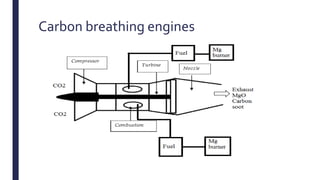
Carbon breathing Engine
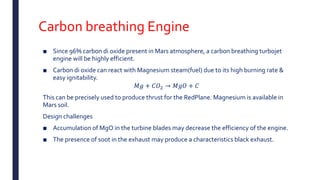
■ Since 96% carbon di oxide present in Mars atmosphere, a carbon breathing turbojet
engine will be highly efficient.
■ Carbon di oxide can react with Magnesium steam(fuel) due to its high burning rate &
easy ignitability.
𝑀𝑔 + 𝐶𝑂2 → 𝑀𝑔𝑂 + 𝐶
This can be precisely used to produce thrust for the RedPlane. Magnesium is available in
Mars soil.
Design challenges
■ Accumulation of MgO in the turbine blades may decrease the efficiency of the engine.
■ The presence of soot in the exhaust may produce a characteristics black exhaust.
Carbon breathing engines
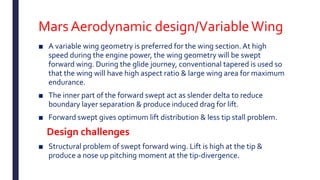
Mars Aerodynamic design/VariableWing
■ A variable wing geometry is preferred for the wing section. At high
speed during the engine power, the wing geometry will be swept
forward wing. During the glide journey, conventional tapered is used so
that the wing will have high aspect ratio & large wing area for maximum
endurance.
■ The inner part of the forward swept act as slender delta to reduce
boundary layer separation & produce induced drag for lift.
■ Forward swept gives optimum lift distribution & less tip stall problem.
Design challenges
■ Structural problem of swept forward wing. Lift is high at the tip &
produce a nose up pitching moment at the tip-divergence.
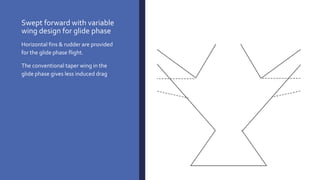
Swept forward with variable
wing design for glide phase
Horizontal fins & rudder are provided
for the glide phase flight.
The conventional taper wing in the
glide phase gives less induced drag.
Supercritical aerofoil design according to
Mars atmosphere/design challenges
■ In Supercritical aerofoil, Roof top pressure distribution: local surface Mach n.o is close
to 1.
■ Keep in mind that the speed of sound in Carbon di oxide is less compared to Air. So
shockwave formation above the upper surface of the aerofoil likely to occur at less
speed than in Earth. So, Redplane wing must be designed according to these
conditions.
Vision base/Homography matrix
navigation/Guidance/Control
■ A low cost vision based navigation system can be applied for the navigation of
Redplane. A on-board monocular camera is installed on the beneath of the craft which
will capture the photographs of Mars surface.With the comparison of two clips, the
any movement along Roll,Yaw & Pitch axis can be calculated using Camera calibration
matrix.
■ The change in any turn in any one of the axis due to Martian wind/ atmosphere can be
controlled by deflection in the nozzle thrust line.Thus flexible nozzle joint is provided
for the deflection of the nozzle.
■ A pulse wave radar is placed at the front of the craft to detect any obstacles along the
flight path.
Other designs
■ Electrical power generation will be done by MMRTG-Multimission Radio
thermoelectric generators.
■ VTOL is employed.Wheels will be employed for the soft landing of the craft on the
Mars surface.Wheels are employed with pulse radar for the soft landing.The nozzle
thrust will be used for the vertical take off & landing.
■ Other auxiliaries: scientific instruments, auto pilot, communication antenna with the
Earth via Mars orbiter; will be placed accordingly.
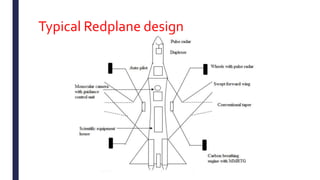
Typical Redplane design
Tez Borah
Aerospace engineer, India
Email:Tezborah@gmail.com
Thank you

Conceptual study: Unmanned Mars Atmospheric Craft "Redplane"

  • 1.
    A Conceptual DesignOf UNMANNED MARS ATMOSPHERIC CRAFT ‘REDPLANE’ Submitted by Tez Borah
  • 2.
    Atmospheric Challenges ■ Marsatmosphere is very thin. It is not possible to use Earth aircrafts to fly. ■ Atmosphere mostly contains Carbon di oxide (96%). Conventional Earth aircraft’s engines cannot be used. ■ Gravitational force is smaller than that of Earth, about 0.6%. It can be useful for glider like structures. ■ Use of non airbreathing engine aircraft is not efficient because it is not feasible to carry propellants from Earth to Mars. ■ With such thin atmosphere, it would take nearly Mach no. 1 to take off for Mars aircraft to fly. ■ Propeller aircrafts are even harder to build. Due to the very thin atmosphere, the propellers have to spin at very high rate to produce the lift. This may cause propeller compressibility problem.
  • 3.
    REDPLANE & DESIGNCHALLENGES ■ An aircraft that can fly in Martian atmosphere with engine power & can glide efficiently with Mars Aerodynamics design. ■ An airbreathing engine that can take Martian air & produce a thrust for the cruise stage. ■ Since, the gravity is 0.6, glider can be very useful. For that, a large wing size is with subsonic aerofoil is preferred. For the early stage of flight, a delta wing with supercritical/transonic aerofoil is preferred. Hence, a combined variable geometry smart wing design will be preferred for RedPlane. ■ A vision based navigation system will be used for the navigation system of the craft. Optical gyroscope with gimballed thrust will be preferred since control surfaces are not sufficient to control the craft in Martian atmosphere. ■ VTOL(Vertical Take off & Landing) is preferred since it will be much complicated to build a runway in Mars.
  • 4.
    Carbon breathing Engine ■Since 96% carbon di oxide present in Mars atmosphere, a carbon breathing turbojet engine will be highly efficient. ■ Carbon di oxide can react with Magnesium steam(fuel) due to its high burning rate & easy ignitability. 𝑀𝑔 + 𝐶𝑂2 → 𝑀𝑔𝑂 + 𝐶 This can be precisely used to produce thrust for the RedPlane. Magnesium is available in Mars soil. Design challenges ■ Accumulation of MgO in the turbine blades may decrease the efficiency of the engine. ■ The presence of soot in the exhaust may produce a characteristics black exhaust.
  • 5.
  • 6.
    Mars Aerodynamic design/VariableWing ■A variable wing geometry is preferred for the wing section. At high speed during the engine power, the wing geometry will be swept forward wing. During the glide journey, conventional tapered is used so that the wing will have high aspect ratio & large wing area for maximum endurance. ■ The inner part of the forward swept act as slender delta to reduce boundary layer separation & produce induced drag for lift. ■ Forward swept gives optimum lift distribution & less tip stall problem. Design challenges ■ Structural problem of swept forward wing. Lift is high at the tip & produce a nose up pitching moment at the tip-divergence.
  • 7.
    Swept forward withvariable wing design for glide phase Horizontal fins & rudder are provided for the glide phase flight. The conventional taper wing in the glide phase gives less induced drag.
  • 8.
    Supercritical aerofoil designaccording to Mars atmosphere/design challenges ■ In Supercritical aerofoil, Roof top pressure distribution: local surface Mach n.o is close to 1. ■ Keep in mind that the speed of sound in Carbon di oxide is less compared to Air. So shockwave formation above the upper surface of the aerofoil likely to occur at less speed than in Earth. So, Redplane wing must be designed according to these conditions.
  • 9.
    Vision base/Homography matrix navigation/Guidance/Control ■A low cost vision based navigation system can be applied for the navigation of Redplane. A on-board monocular camera is installed on the beneath of the craft which will capture the photographs of Mars surface.With the comparison of two clips, the any movement along Roll,Yaw & Pitch axis can be calculated using Camera calibration matrix. ■ The change in any turn in any one of the axis due to Martian wind/ atmosphere can be controlled by deflection in the nozzle thrust line.Thus flexible nozzle joint is provided for the deflection of the nozzle. ■ A pulse wave radar is placed at the front of the craft to detect any obstacles along the flight path.
  • 10.
    Other designs ■ Electricalpower generation will be done by MMRTG-Multimission Radio thermoelectric generators. ■ VTOL is employed.Wheels will be employed for the soft landing of the craft on the Mars surface.Wheels are employed with pulse radar for the soft landing.The nozzle thrust will be used for the vertical take off & landing. ■ Other auxiliaries: scientific instruments, auto pilot, communication antenna with the Earth via Mars orbiter; will be placed accordingly.
  • 11.
  • 12.
    Tez Borah Aerospace engineer,India Email:Tezborah@gmail.com Thank you