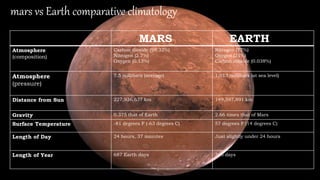
mars vs Earth comparative climatology
MARS EARTH
Atmosphere
(composition)
Carbon dioxide (95.32%)
Nitrogen (2.7%)
Oxygen (0.13%)
Nitrogen (77%)
Oxygen (21%)
Carbon dioxide (0.038%)
Atmosphere
(pressure)
7.5 millibars (average) 1,013 millibars (at sea level)
Distance from Sun 227,936,637 km 149,597,891 km
Gravity 0.375 that of Earth 2.66 times that of Mars
Surface Temperature -81 degrees F (-63 degrees C) 57 degrees F (14 degrees C)
Length of Day 24 hours, 37 minutes Just slightly under 24 hours
Length of Year 687 Earth days 365 days
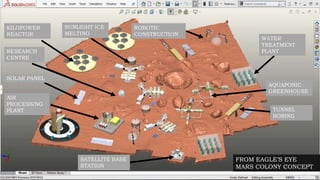
KILOPOWER
REACTOR
SUNLIGHT ICE
MELTING
WATER
TREATMENT
PLANT
AQUAPONIC
GREENHOUSE
TUNNEL
BORING
SATELLITE BASE
STATION
AIR
PROCESSING
PLANT
SOLAR PANEL
RESEARCH
CENTRE
ROBOTIC
CONSTRUCTION
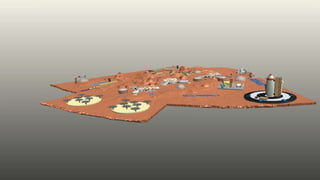
FROM EAGLE’S EYE
MARS COLONY CONCEPT
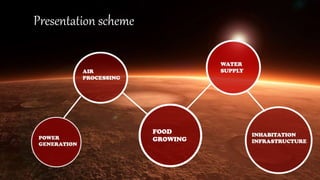
Presentation scheme
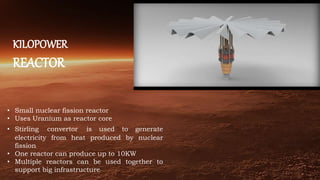
KILOPOWER
REACTOR
• Small nuclear fission reactor
• Uses Uranium as reactor core
• Stirling convertor is used to generate
electricity from heat produced by nuclear
fission
• One reactor can produce up to 10KW
• Multiple reactors can be used together to
support big infrastructure
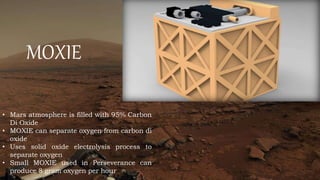
MOXIE
• Mars atmosphere is filled with 95% Carbon
Di Oxide
• MOXIE can separate oxygen from carbon di
oxide
• Uses solid oxide electrolysis process to
separate oxygen
• Small MOXIE used in Perseverance can
produce 8 gram oxygen per hour
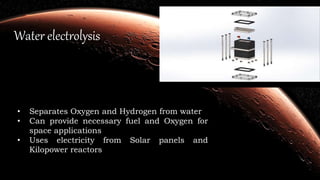
Water electrolysis
• Separates Oxygen and Hydrogen from water
• Can provide necessary fuel and Oxygen for
space applications
• Uses electricity from Solar panels and
Kilopower reactors
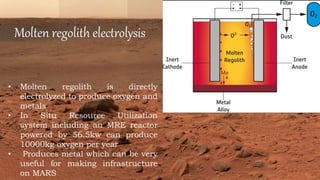
Molten regolith electrolysis
• Molten regolith is directly
electrolyzed to produce oxygen and
metals
• In Situ Resource Utilization
system including an MRE reactor
powered by 56.5kw can produce
10000kg oxygen per year
• Produces metal which can be very
useful for making infrastructure
on MARS
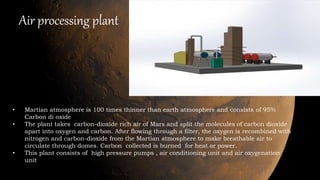
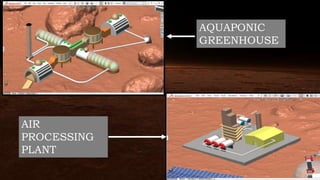
Air processing plant
• Martian atmosphere is 100 times thinner than earth atmosphere and consists of 95%
Carbon di oxide
• The plant takes carbon-dioxide rich air of Mars and split the molecules of carbon dioxide
apart into oxygen and carbon. After flowing through a filter, the oxygen is recombined with
nitrogen and carbon-dioxide from the Martian atmosphere to make breathable air to
circulate through domes. Carbon collected is burned for heat or power.
• This plant consists of high pressure pumps , air conditioning unit and air oxygenation
unit
Greenhouse
aquaponic System
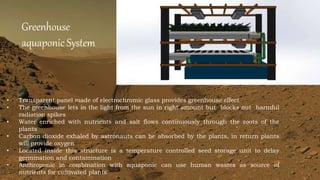
• Transparent panel made of electrochromic glass provides greenhouse effect
• The greenhouse lets in the light from the sun in right amount but blocks out harmful
radiation spikes
• Water enriched with nutrients and salt flows continuously through the roots of the
plants
• Carbon dioxide exhaled by astronauts can be absorbed by the plants, in return plants
will provide oxygen
• Located inside this structure is a temperature controlled seed storage unit to delay
germination and contamination
• Anthroponic in combination with aquaponic can use human wastes as source of
nutrients for cultivated plants
Ice melting and treatment
plant
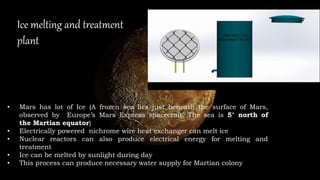
• Mars has lot of Ice (A frozen sea lies just beneath the surface of Mars,
observed by Europe’s Mars Express spacecraft. The sea is 5° north of
the Martian equator)
• Electrically powered nichrome wire heat exchanger can melt ice
• Nuclear reactors can also produce electrical energy for melting and
treatment
• Ice can be melted by sunlight during day
• This process can produce necessary water supply for Martian colony
Bio-
Geodesicdomes
• A pressurized structure that holds life generating Oxygen and food
• Domes on mars need to be anchored against internal pressure
• 100m dome covers 7800m^2 and exerts 250 tons per meter of perimeter wall
• Temperature and radiation inside the dome will be controlled
• To convert the entirety of Mars into biodome , scientists have suggested the use of
Cyanobacteria Chroococcidiopsisn to help convert the regolith into soil by creating organic
element
Surface excavation and
construction
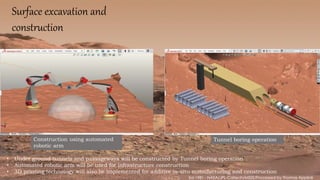
• Under ground tunnels and passageways will be constructed by Tunnel boring operation
• Automated robotic arm will be used for infrastructure construction
• 3D printing technology will also be implemented for additive in-situ manufacturing and construction
Tunnel boring operation
Construction using automated
robotic arm
COMMUNICATION
WITH EARTH
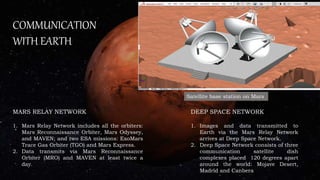
MARS RELAY NETWORK
1. Mars Relay Network includes all the orbiters:
Mars Reconnaissance Orbiter, Mars Odyssey,
and MAVEN; and two ESA missions: ExoMars
Trace Gas Orbiter (TGO) and Mars Express.
2. Data transmits via Mars Reconnaissance
Orbiter (MRO) and MAVEN at least twice a
day.
DEEP SPACE NETWORK
1. Images and data transmitted to
Earth via the Mars Relay Network
arrives at Deep Space Network.
2. Deep Space Network consists of three
communication satellite dish
complexes placed 120 degrees apart
around the world: Mojave Desert,
Madrid and Canbera
Satellite base station on Mars
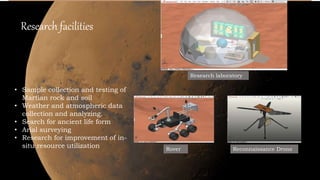
Research facilities
• Sample collection and testing of
Martian rock and soil
• Weather and atmospheric data
collection and analyzing.
• Search for ancient life form
• Arial surveying
• Research for improvement of in-
situ resource utilization
Research laboratory
Rover Reconnaissance Drone
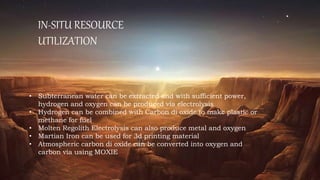
IN-SITU RESOURCE
UTILIZATION
• Subterranean water can be extracted and with sufficient power,
hydrogen and oxygen can be produced via electrolysis
• Hydrogen can be combined with Carbon di oxide to make plastic or
methane for fuel
• Molten Regolith Electrolysis can also produce metal and oxygen
• Martian Iron can be used for 3d printing material
• Atmospheric carbon di oxide can be converted into oxygen and
carbon via using MOXIE
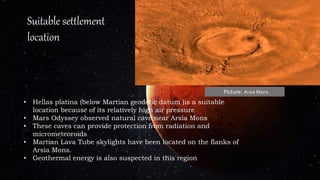
• Hellas platina (below Martian geodetic datum )is a suitable
location because of its relatively high air pressure
• Mars Odyssey observed natural cave near Arsia Mons
• These caves can provide protection from radiation and
micrometeoroids
• Martian Lava Tube skylights have been located on the flanks of
Arsia Mons.
• Geothermal energy is also suspected in this region
Suitable settlement
location
Picture: Arsia Mons
AQUAPONIC
GREENHOUSE
AIR
PROCESSING
PLANT
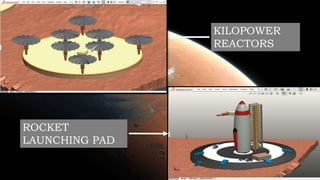
KILOPOWER
REACTORS
ROCKET
LAUNCHING PAD
MARS HABITAT DESIGN
MARS HABITAT DESIGN

MARS HABITAT DESIGN

  • 2.
    mars vs Earthcomparative climatology MARS EARTH Atmosphere (composition) Carbon dioxide (95.32%) Nitrogen (2.7%) Oxygen (0.13%) Nitrogen (77%) Oxygen (21%) Carbon dioxide (0.038%) Atmosphere (pressure) 7.5 millibars (average) 1,013 millibars (at sea level) Distance from Sun 227,936,637 km 149,597,891 km Gravity 0.375 that of Earth 2.66 times that of Mars Surface Temperature -81 degrees F (-63 degrees C) 57 degrees F (14 degrees C) Length of Day 24 hours, 37 minutes Just slightly under 24 hours Length of Year 687 Earth days 365 days
  • 3.
  • 4.
  • 5.
    KILOPOWER REACTOR • Small nuclearfission reactor • Uses Uranium as reactor core • Stirling convertor is used to generate electricity from heat produced by nuclear fission • One reactor can produce up to 10KW • Multiple reactors can be used together to support big infrastructure
  • 6.
    MOXIE • Mars atmosphereis filled with 95% Carbon Di Oxide • MOXIE can separate oxygen from carbon di oxide • Uses solid oxide electrolysis process to separate oxygen • Small MOXIE used in Perseverance can produce 8 gram oxygen per hour
  • 7.
    Water electrolysis • SeparatesOxygen and Hydrogen from water • Can provide necessary fuel and Oxygen for space applications • Uses electricity from Solar panels and Kilopower reactors
  • 8.
    Molten regolith electrolysis •Molten regolith is directly electrolyzed to produce oxygen and metals • In Situ Resource Utilization system including an MRE reactor powered by 56.5kw can produce 10000kg oxygen per year • Produces metal which can be very useful for making infrastructure on MARS
  • 9.
    Air processing plant •Martian atmosphere is 100 times thinner than earth atmosphere and consists of 95% Carbon di oxide • The plant takes carbon-dioxide rich air of Mars and split the molecules of carbon dioxide apart into oxygen and carbon. After flowing through a filter, the oxygen is recombined with nitrogen and carbon-dioxide from the Martian atmosphere to make breathable air to circulate through domes. Carbon collected is burned for heat or power. • This plant consists of high pressure pumps , air conditioning unit and air oxygenation unit
  • 10.
    Greenhouse aquaponic System • Transparentpanel made of electrochromic glass provides greenhouse effect • The greenhouse lets in the light from the sun in right amount but blocks out harmful radiation spikes • Water enriched with nutrients and salt flows continuously through the roots of the plants • Carbon dioxide exhaled by astronauts can be absorbed by the plants, in return plants will provide oxygen • Located inside this structure is a temperature controlled seed storage unit to delay germination and contamination • Anthroponic in combination with aquaponic can use human wastes as source of nutrients for cultivated plants
  • 11.
    Ice melting andtreatment plant • Mars has lot of Ice (A frozen sea lies just beneath the surface of Mars, observed by Europe’s Mars Express spacecraft. The sea is 5° north of the Martian equator) • Electrically powered nichrome wire heat exchanger can melt ice • Nuclear reactors can also produce electrical energy for melting and treatment • Ice can be melted by sunlight during day • This process can produce necessary water supply for Martian colony
  • 12.
    Bio- Geodesicdomes • A pressurizedstructure that holds life generating Oxygen and food • Domes on mars need to be anchored against internal pressure • 100m dome covers 7800m^2 and exerts 250 tons per meter of perimeter wall • Temperature and radiation inside the dome will be controlled • To convert the entirety of Mars into biodome , scientists have suggested the use of Cyanobacteria Chroococcidiopsisn to help convert the regolith into soil by creating organic element
  • 13.
    Surface excavation and construction •Under ground tunnels and passageways will be constructed by Tunnel boring operation • Automated robotic arm will be used for infrastructure construction • 3D printing technology will also be implemented for additive in-situ manufacturing and construction Tunnel boring operation Construction using automated robotic arm
  • 14.
    COMMUNICATION WITH EARTH MARS RELAYNETWORK 1. Mars Relay Network includes all the orbiters: Mars Reconnaissance Orbiter, Mars Odyssey, and MAVEN; and two ESA missions: ExoMars Trace Gas Orbiter (TGO) and Mars Express. 2. Data transmits via Mars Reconnaissance Orbiter (MRO) and MAVEN at least twice a day. DEEP SPACE NETWORK 1. Images and data transmitted to Earth via the Mars Relay Network arrives at Deep Space Network. 2. Deep Space Network consists of three communication satellite dish complexes placed 120 degrees apart around the world: Mojave Desert, Madrid and Canbera Satellite base station on Mars
  • 15.
    Research facilities • Samplecollection and testing of Martian rock and soil • Weather and atmospheric data collection and analyzing. • Search for ancient life form • Arial surveying • Research for improvement of in- situ resource utilization Research laboratory Rover Reconnaissance Drone
  • 16.
    IN-SITU RESOURCE UTILIZATION • Subterraneanwater can be extracted and with sufficient power, hydrogen and oxygen can be produced via electrolysis • Hydrogen can be combined with Carbon di oxide to make plastic or methane for fuel • Molten Regolith Electrolysis can also produce metal and oxygen • Martian Iron can be used for 3d printing material • Atmospheric carbon di oxide can be converted into oxygen and carbon via using MOXIE
  • 17.
    • Hellas platina(below Martian geodetic datum )is a suitable location because of its relatively high air pressure • Mars Odyssey observed natural cave near Arsia Mons • These caves can provide protection from radiation and micrometeoroids • Martian Lava Tube skylights have been located on the flanks of Arsia Mons. • Geothermal energy is also suspected in this region Suitable settlement location Picture: Arsia Mons
  • 18.
  • 19.