High Altitude
Supersonic UAVMMAE 452 Propulsion Project
-Kevin Boldt
-Alex Landis
-Connor McGuire
-Jacob Fogarty
-Grayson Watson
-Kraig Van Wieringen
-Mike Dobben
-Leana Osmer
Group Members
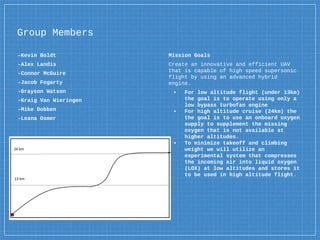
Mission Goals
Create an innovative and efficient UAV
that is capable of high speed supersonic
flight by using an advanced hybrid
engine.
▪ For low altitude flight (under 13km)
the goal is to operate using only a
low bypass turbofan engine
▪ For high altitude cruise (24km) the
the goal is to use an onboard oxygen
supply to supplement the missing
oxygen that is not available at
higher altitudes.
▪ To minimize takeoff and climbing
weight we will utilize an
experimental system that compresses
the incoming air into liquid oxygen
(LOX) at low altitudes and stores it
to be used in high altitude flight.
Why is this mission plan effective?
Benefits
▪ Higher altitudes have
lower ram drags
▪ On board oxygen allows
comparable thrust at
these altitudes
▪ Net thrust is greater
overall
▪ Overcomes a classic
problem of traditional
airbreathing engine’s
being unable to operate
at extreme altitudes.
Disadvantages
▪ Liquid oxygen is heavy
and can drastically add
weight to the aircraft.
▪ Difficult to compress
and store in liquid form
while in flight
1
Low Altitude Flight
Conditions
For takeoff and climbing
at altitudes below 13km
(40,000 ft)
Flight Conditions
▪ Climbing Conditions (Turbofan):
-Transition Altitude = 13 km (40,000 ft)
-Transition Temp = -57 C = 217 K
-Air Density = 0.27 kg/m^3
-Absolute Pressure = 170 kPa
-Transition Mach Number = 1.5
-Mass Flow rate m0 = 100 kg/s
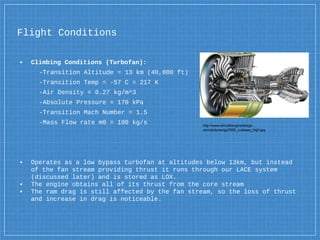
▪ Operates as a low bypass turbofan at altitudes below 13km, but instead
of the fan stream providing thrust it runs through our LACE system
(discussed later) and is stored as LOX.
▪ The engine obtains all of its thrust from the core stream
▪ The ram drag is still affected by the fan stream, so the loss of thrust
and increase in drag is noticeable.
http://www.aircraftenginedesign.
com/pictures/gp7000_cutaway_high.jpg
Turbofan Specs (some values based off Pratt & Whitney F100)
○ Pressure Ratios
■ Πd
= 0.995
■ Πf
= 1.6
■ Πfn
= 0.98
■ Πn
= 0.98
○ Temperature Considerations
■ Τλ
= 8
■ Q (jet fuel) = 42,800 KJ/kg
○ Efficiencies
■ ec
= 0.9
■ ef
= 0.9
■ et
=0.85
■ ηb
= 0.922
■ ηm
= 0.995
▪ To reduce the scope of this project we fixed all of these variables and
focused only on changing the bypass ratio as it would have the greatest
effect on the engine performance.
Engine Values
Net Thrust for different Bypass ratios
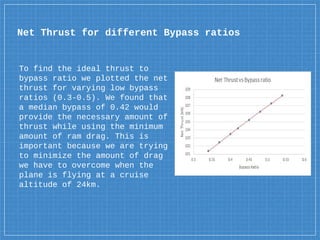
To find the ideal thrust to
bypass ratio we plotted the net
thrust for varying low bypass
ratios (0.3-0.5). We found that
a median bypass of 0.42 would
provide the necessary amount of
thrust while using the minimum
amount of ram drag. This is
important because we are trying
to minimize the amount of drag
we have to overcome when the
plane is flying at a cruise
altitude of 24km.
2
High Altitude Flight
Conditions
For cruising
at an altitude of
24km (80,000 ft)
Cruise Conditions
-Cruise Altitude = 24 km (80,000 ft)
-Cruise Temp = -60 C = 220K
-Air density = 0.04008 kg/m^3
-Absolute Pressure = 29 kPa
-Cruise Mach Number = 4.5
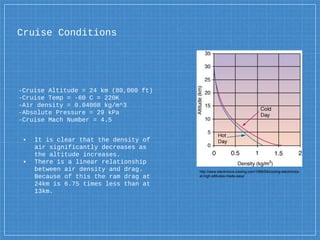
▪ It is clear that the density of
air significantly decreases as
the altitude increases.
▪ There is a linear relationship
between air density and drag.
Because of this the ram drag at
24km is 6.75 times less than at
13km.
http://www.electronics-cooling.com/1998/09/cooling-electronics-
at-high-altitudes-made-easy/
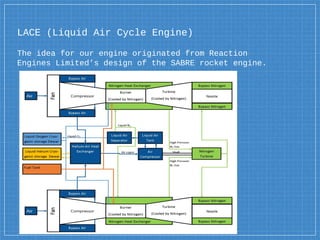
LACE (Liquid Air Cycle Engine)
The idea for our engine originated from Reaction
Engines Limited’s design of the SABRE rocket engine.
How it works...
▪ At an oxygen rich altitude (< 13km) the engine bypass
collects air which is immediately fed into the Helium
heat exchanger
▪ In this heat exchanger the gaseous air is cooled to
below 90K and compressed where it becomes liquid air,
after this point the oxygen and nitrogen are separated
from each other.
▪ The LOX is then stored in a cooled tank, this will be
used later in our cruise flight at 24km utilizing a
splash plate injector.
▪ The liquid Nitrogen is then pumped and used to cool the
burner and turbine.
▪ After being heated, the gaseous Nitrogen is used to turn
the turbine that drives the liquid air compressor.
▪ The Nitrogen is then expelled through a bypass system in
the engines.
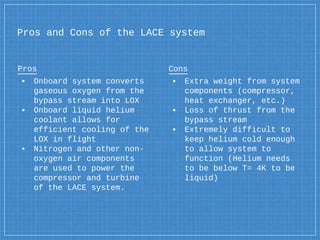
Pros and Cons of the LACE system
Pros
▪ Onboard system converts
gaseous oxygen from the
bypass stream into LOX
▪ Onboard liquid helium
coolant allows for
efficient cooling of the
LOX in flight
▪ Nitrogen and other non-
oxygen air components
are used to power the
compressor and turbine
of the LACE system.
Cons
▪ Extra weight from system
components (compressor,
heat exchanger, etc.)
▪ Loss of thrust from the
bypass stream
▪ Extremely difficult to
keep helium cold enough
to allow system to
function (Helium needs
to be below T= 4K to be
liquid)
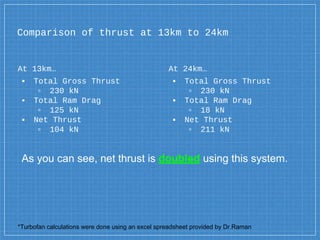
Comparison of thrust at 13km to 24km
At 13km…
▪ Total Gross Thrust
▫ 230 kN
▪ Total Ram Drag
▫ 125 kN
▪ Net Thrust
▫ 104 kN
At 24km…
▪ Total Gross Thrust
▫ 230 kN
▪ Total Ram Drag
▫ 18 kN
▪ Net Thrust
▫ 211 kN
As you can see, net thrust is doubled using this system.
*Turbofan calculations were done using an excel spreadsheet provided by Dr.Raman
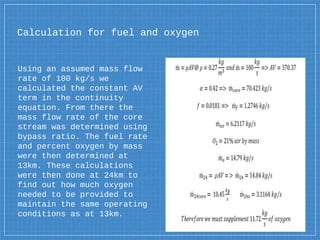
Calculation for fuel and oxygen
Using an assumed mass flow
rate of 100 kg/s we
calculated the constant AV
term in the continuity
equation. From there the
mass flow rate of the core
stream was determined using
bypass ratio. The fuel rate
and percent oxygen by mass
were then determined at
13km. These calculations
were then done at 24km to
find out how much oxygen
needed to be provided to
maintain the same operating
conditions as at 13km.
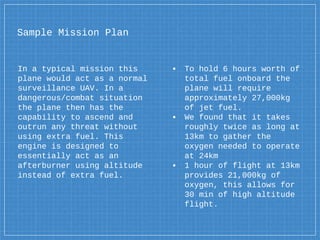
Sample Mission Plan
In a typical mission this
plane would act as a normal
surveillance UAV. In a
dangerous/combat situation
the plane then has the
capability to ascend and
outrun any threat without
using extra fuel. This
engine is designed to
essentially act as an
afterburner using altitude
instead of extra fuel.
▪ To hold 6 hours worth of
total fuel onboard the
plane will require
approximately 27,000kg
of jet fuel.
▪ We found that it takes
roughly twice as long at
13km to gather the
oxygen needed to operate
at 24km
▪ 1 hour of flight at 13km
provides 21,000kg of
oxygen, this allows for
30 min of high altitude
flight.
Project Conclusions
▪ We get higher thrust
despite using no extra
fuel.
▪ We can function at
higher altitudes than a
conventional turbofan
engine.
▪ Offers protection from
combat situations for
surveillance drones.
▪ Utilizes a LACE system
so oxygen does not need
to be carried at takeoff
and can be refilled in
flight. This allows low
takeoff weight and
multiple high altitude
trips.
▪ Storing and obtaining
liquid helium and oxygen is
extremely difficult to do
while in flight due to
weight, pressure, and
temperature considerations.
▪ The aircraft needs to spend
twice the amount of time at
low altitude as high
altitude
▪ Due to weight issues the
aircraft can only carry
about 30 minutes worth of
oxygen at a time.
Benefits Disadvantages
Thoughts
-Assuming Liquid helium carried onboard can cool oxygen to the point we can liquify it.
-Oxygen needs to be below 90K to liquify
-@24km we are injecting oxygen directly into chamber assuming it is perfectly efficient (not the case)
-Found Area using mass flow rate calculations at 13km
-LInear proportional A to V @24km
-i.e only density is changing when out mass flowrate changes from one altitude to the next
-Can’t use rocket fuel since combustion temperature is too high
-heat transfer coefficient assumed high enough to cool oxygen with low amount of helium utilizing only
an onboard compressor
-There is a service ceiling where pressure gradient is too great to allow for oxygen combustion
-Only getting thrust from about 80% of the bypass stream (nitrogen portion).
- Fuel per hour 4588.7 kg
- twice the flight time at 13km to fill up o2 tanks for enough to fly at 24km
-Almost twice the net thrust at 24km cruise
-Alex will add in all equatioins as pictures later today (fuel and oxygen)
-problem is that liquid oxygen is heavier than the jet fuel and the engine requires 10 times the amount of
it for operation
-

MMAE 452 Project-Final

  • 1.
    High Altitude Supersonic UAVMMAE452 Propulsion Project
  • 2.
    -Kevin Boldt -Alex Landis -ConnorMcGuire -Jacob Fogarty -Grayson Watson -Kraig Van Wieringen -Mike Dobben -Leana Osmer Group Members Mission Goals Create an innovative and efficient UAV that is capable of high speed supersonic flight by using an advanced hybrid engine. ▪ For low altitude flight (under 13km) the goal is to operate using only a low bypass turbofan engine ▪ For high altitude cruise (24km) the the goal is to use an onboard oxygen supply to supplement the missing oxygen that is not available at higher altitudes. ▪ To minimize takeoff and climbing weight we will utilize an experimental system that compresses the incoming air into liquid oxygen (LOX) at low altitudes and stores it to be used in high altitude flight.
  • 3.
    Why is thismission plan effective? Benefits ▪ Higher altitudes have lower ram drags ▪ On board oxygen allows comparable thrust at these altitudes ▪ Net thrust is greater overall ▪ Overcomes a classic problem of traditional airbreathing engine’s being unable to operate at extreme altitudes. Disadvantages ▪ Liquid oxygen is heavy and can drastically add weight to the aircraft. ▪ Difficult to compress and store in liquid form while in flight
  • 4.
    1 Low Altitude Flight Conditions Fortakeoff and climbing at altitudes below 13km (40,000 ft)
  • 5.
    Flight Conditions ▪ ClimbingConditions (Turbofan): -Transition Altitude = 13 km (40,000 ft) -Transition Temp = -57 C = 217 K -Air Density = 0.27 kg/m^3 -Absolute Pressure = 170 kPa -Transition Mach Number = 1.5 -Mass Flow rate m0 = 100 kg/s ▪ Operates as a low bypass turbofan at altitudes below 13km, but instead of the fan stream providing thrust it runs through our LACE system (discussed later) and is stored as LOX. ▪ The engine obtains all of its thrust from the core stream ▪ The ram drag is still affected by the fan stream, so the loss of thrust and increase in drag is noticeable. http://www.aircraftenginedesign. com/pictures/gp7000_cutaway_high.jpg
  • 6.
    Turbofan Specs (somevalues based off Pratt & Whitney F100) ○ Pressure Ratios ■ Πd = 0.995 ■ Πf = 1.6 ■ Πfn = 0.98 ■ Πn = 0.98 ○ Temperature Considerations ■ Τλ = 8 ■ Q (jet fuel) = 42,800 KJ/kg ○ Efficiencies ■ ec = 0.9 ■ ef = 0.9 ■ et =0.85 ■ ηb = 0.922 ■ ηm = 0.995 ▪ To reduce the scope of this project we fixed all of these variables and focused only on changing the bypass ratio as it would have the greatest effect on the engine performance. Engine Values
  • 7.
    Net Thrust fordifferent Bypass ratios To find the ideal thrust to bypass ratio we plotted the net thrust for varying low bypass ratios (0.3-0.5). We found that a median bypass of 0.42 would provide the necessary amount of thrust while using the minimum amount of ram drag. This is important because we are trying to minimize the amount of drag we have to overcome when the plane is flying at a cruise altitude of 24km.
  • 8.
    2 High Altitude Flight Conditions Forcruising at an altitude of 24km (80,000 ft)
  • 9.
    Cruise Conditions -Cruise Altitude= 24 km (80,000 ft) -Cruise Temp = -60 C = 220K -Air density = 0.04008 kg/m^3 -Absolute Pressure = 29 kPa -Cruise Mach Number = 4.5 ▪ It is clear that the density of air significantly decreases as the altitude increases. ▪ There is a linear relationship between air density and drag. Because of this the ram drag at 24km is 6.75 times less than at 13km. http://www.electronics-cooling.com/1998/09/cooling-electronics- at-high-altitudes-made-easy/
  • 10.
    LACE (Liquid AirCycle Engine) The idea for our engine originated from Reaction Engines Limited’s design of the SABRE rocket engine.
  • 11.
    How it works... ▪At an oxygen rich altitude (< 13km) the engine bypass collects air which is immediately fed into the Helium heat exchanger ▪ In this heat exchanger the gaseous air is cooled to below 90K and compressed where it becomes liquid air, after this point the oxygen and nitrogen are separated from each other. ▪ The LOX is then stored in a cooled tank, this will be used later in our cruise flight at 24km utilizing a splash plate injector. ▪ The liquid Nitrogen is then pumped and used to cool the burner and turbine. ▪ After being heated, the gaseous Nitrogen is used to turn the turbine that drives the liquid air compressor. ▪ The Nitrogen is then expelled through a bypass system in the engines.
  • 12.
    Pros and Consof the LACE system Pros ▪ Onboard system converts gaseous oxygen from the bypass stream into LOX ▪ Onboard liquid helium coolant allows for efficient cooling of the LOX in flight ▪ Nitrogen and other non- oxygen air components are used to power the compressor and turbine of the LACE system. Cons ▪ Extra weight from system components (compressor, heat exchanger, etc.) ▪ Loss of thrust from the bypass stream ▪ Extremely difficult to keep helium cold enough to allow system to function (Helium needs to be below T= 4K to be liquid)
  • 13.
    Comparison of thrustat 13km to 24km At 13km… ▪ Total Gross Thrust ▫ 230 kN ▪ Total Ram Drag ▫ 125 kN ▪ Net Thrust ▫ 104 kN At 24km… ▪ Total Gross Thrust ▫ 230 kN ▪ Total Ram Drag ▫ 18 kN ▪ Net Thrust ▫ 211 kN As you can see, net thrust is doubled using this system. *Turbofan calculations were done using an excel spreadsheet provided by Dr.Raman
  • 14.
    Calculation for fueland oxygen Using an assumed mass flow rate of 100 kg/s we calculated the constant AV term in the continuity equation. From there the mass flow rate of the core stream was determined using bypass ratio. The fuel rate and percent oxygen by mass were then determined at 13km. These calculations were then done at 24km to find out how much oxygen needed to be provided to maintain the same operating conditions as at 13km.
  • 15.
    Sample Mission Plan Ina typical mission this plane would act as a normal surveillance UAV. In a dangerous/combat situation the plane then has the capability to ascend and outrun any threat without using extra fuel. This engine is designed to essentially act as an afterburner using altitude instead of extra fuel. ▪ To hold 6 hours worth of total fuel onboard the plane will require approximately 27,000kg of jet fuel. ▪ We found that it takes roughly twice as long at 13km to gather the oxygen needed to operate at 24km ▪ 1 hour of flight at 13km provides 21,000kg of oxygen, this allows for 30 min of high altitude flight.
  • 16.
    Project Conclusions ▪ Weget higher thrust despite using no extra fuel. ▪ We can function at higher altitudes than a conventional turbofan engine. ▪ Offers protection from combat situations for surveillance drones. ▪ Utilizes a LACE system so oxygen does not need to be carried at takeoff and can be refilled in flight. This allows low takeoff weight and multiple high altitude trips. ▪ Storing and obtaining liquid helium and oxygen is extremely difficult to do while in flight due to weight, pressure, and temperature considerations. ▪ The aircraft needs to spend twice the amount of time at low altitude as high altitude ▪ Due to weight issues the aircraft can only carry about 30 minutes worth of oxygen at a time. Benefits Disadvantages
  • 17.
    Thoughts -Assuming Liquid heliumcarried onboard can cool oxygen to the point we can liquify it. -Oxygen needs to be below 90K to liquify -@24km we are injecting oxygen directly into chamber assuming it is perfectly efficient (not the case) -Found Area using mass flow rate calculations at 13km -LInear proportional A to V @24km -i.e only density is changing when out mass flowrate changes from one altitude to the next -Can’t use rocket fuel since combustion temperature is too high -heat transfer coefficient assumed high enough to cool oxygen with low amount of helium utilizing only an onboard compressor -There is a service ceiling where pressure gradient is too great to allow for oxygen combustion -Only getting thrust from about 80% of the bypass stream (nitrogen portion). - Fuel per hour 4588.7 kg - twice the flight time at 13km to fill up o2 tanks for enough to fly at 24km -Almost twice the net thrust at 24km cruise -Alex will add in all equatioins as pictures later today (fuel and oxygen) -problem is that liquid oxygen is heavier than the jet fuel and the engine requires 10 times the amount of it for operation -