Basic Elements of
Demand and Supply
PRESENTED BY: RANA SAJJAD ALI
ROLL NUMBER: BCSF16A540
Contents:
 Demand
 Law of Demand
 Demand curve
 Forces behind the demand curve & Shift
 Elasticity
 Calculating Demand Elasticities
 Factors affecting Elasticity
 Supply
 Law of Supply
 Supply Curve
 Shift in supply curve
 calculating Supply Elasticity
What is Demand?
Quantity demanded of a product or service is the number
that would be bought by the public at a given price
 Quantity Demand is the function of Price level.
Law of Demand
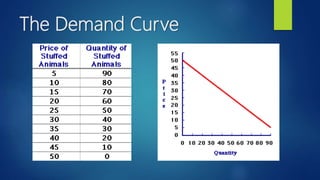
Quantity Demand is Inversely Proportional to the Price Level.
while keeping other things constant.
Law of Demand is affected By:
1. Substitution Effect
2. Income Effect
Assumptions
 Homogeneous Commodity
 Same taste or feasibility
 No change in income
 No change in climate
 No change in price of substitutes
 No change in population growth
The Substitution Effect
As the price for one good rises compared to a
similar good, consumers will substitute the
similar good for their purchases.
The Income Effect
 As prices go up, your money becomes worth
less than it was worth before
 People are less likely to buy the good now
The Demand Curve
Forces Behind the Demand
curve
These are the Constant things:
 Average Income
 Size of Market
 Influence of Related Goods
 Taste And Preference
 Special Influence
 Population Growth
 Climate
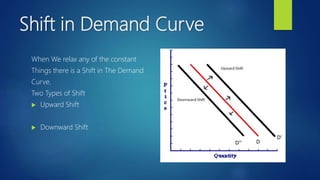
Shift in Demand Curve
When We relax any of the constant
Things there is a Shift in The Demand
Curve.
Two Types of Shift
 Upward Shift
 Downward Shift
Elasticity
Elasticity refers to how responsive the quantity demanded is to
a change in prices, it is also called price elasticity of demand.
Types of Elasticity
 Price Elasticity
 Income Elasticity
 Cross Elasticity
Calculating Elasticity
1. Price Elasticity
1. Expenditure Method
2. Geometrical Method
3. %age Method
2. Income Elasticity
%age Method
3. Cross Elasticity
%age Method
Calculating Elasticity
 Price Elasticity:
 Total Outlay method(Expenditure Method):
 In it we measure the change in expenditure. Before and after the
Variation in price.
 Geometrical Method(Point Method):
no. of Lower points of Demand curve
Elasticity demand = ______________________________________
no. of upper points of the Demand curve
 Percentage Method
Elasticity demand = (%age change in Q)/(%age Change in P)
Calculating Elasticity
 Income Elasticity:
%age change in Q
Elasticity = _______________________________
%age change in Income(Y)
 Cross Elasticity:
%age change in Quantity of Y
Elasticity = ________________________________
%age change in Quantity of X
Factors Affecting Elasticity
 Price Level
 Income Level
 Price of Substitutions
 Consumer Adjustment
 Market Size
What is Supply?
Quantity supplied is the quantity of a commodity that
producers are willing to sell at a particular price at a particular
point of time.
Quantity Supply is the function of Price level.
Law Of Supply
 “Other things remaining same, when price of a
commodity increases its quantity supplied increases
and if price of a commodity decreases, quantity
supplied also decreases”.
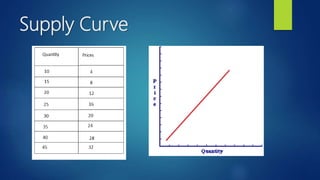
 Quantity Supply is Directly Proportional
To the Price level.
Assumptions:
 No Change in cost of production
 No change in Technology
 No change in efficiency of Factors of production
 No new Invention/ Innovation
 No natural Calamities
 No change in Weather conditions
 No change in Government Policies
Supply Curve
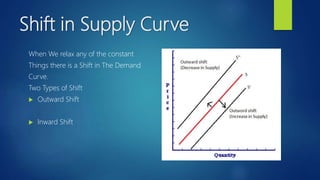
Shift in Supply Curve
When We relax any of the constant
Things there is a Shift in The Demand
Curve.
Two Types of Shift
 Outward Shift
 Inward Shift
Supply Elasticity
 There is only one supply elasticity.
%age change in Quantity Supply
E(S) = __________________________________
%age change in Price Level
Any Question?
Thank you…..!!!

Basic elements of demand and supply

  • 1.
    Basic Elements of Demandand Supply PRESENTED BY: RANA SAJJAD ALI ROLL NUMBER: BCSF16A540
  • 2.
    Contents:  Demand  Lawof Demand  Demand curve  Forces behind the demand curve & Shift  Elasticity  Calculating Demand Elasticities  Factors affecting Elasticity  Supply  Law of Supply  Supply Curve  Shift in supply curve  calculating Supply Elasticity
  • 3.
    What is Demand? Quantitydemanded of a product or service is the number that would be bought by the public at a given price  Quantity Demand is the function of Price level.
  • 4.
    Law of Demand QuantityDemand is Inversely Proportional to the Price Level. while keeping other things constant. Law of Demand is affected By: 1. Substitution Effect 2. Income Effect
  • 5.
    Assumptions  Homogeneous Commodity Same taste or feasibility  No change in income  No change in climate  No change in price of substitutes  No change in population growth
  • 6.
    The Substitution Effect Asthe price for one good rises compared to a similar good, consumers will substitute the similar good for their purchases.
  • 7.
    The Income Effect As prices go up, your money becomes worth less than it was worth before  People are less likely to buy the good now
  • 8.
  • 9.
    Forces Behind theDemand curve These are the Constant things:  Average Income  Size of Market  Influence of Related Goods  Taste And Preference  Special Influence  Population Growth  Climate
  • 10.
    Shift in DemandCurve When We relax any of the constant Things there is a Shift in The Demand Curve. Two Types of Shift  Upward Shift  Downward Shift
  • 11.
    Elasticity Elasticity refers tohow responsive the quantity demanded is to a change in prices, it is also called price elasticity of demand.
  • 12.
    Types of Elasticity Price Elasticity  Income Elasticity  Cross Elasticity
  • 13.
    Calculating Elasticity 1. PriceElasticity 1. Expenditure Method 2. Geometrical Method 3. %age Method 2. Income Elasticity %age Method 3. Cross Elasticity %age Method
  • 14.
    Calculating Elasticity  PriceElasticity:  Total Outlay method(Expenditure Method):  In it we measure the change in expenditure. Before and after the Variation in price.  Geometrical Method(Point Method): no. of Lower points of Demand curve Elasticity demand = ______________________________________ no. of upper points of the Demand curve  Percentage Method Elasticity demand = (%age change in Q)/(%age Change in P)
  • 15.
    Calculating Elasticity  IncomeElasticity: %age change in Q Elasticity = _______________________________ %age change in Income(Y)  Cross Elasticity: %age change in Quantity of Y Elasticity = ________________________________ %age change in Quantity of X
  • 16.
    Factors Affecting Elasticity Price Level  Income Level  Price of Substitutions  Consumer Adjustment  Market Size
  • 17.
    What is Supply? Quantitysupplied is the quantity of a commodity that producers are willing to sell at a particular price at a particular point of time. Quantity Supply is the function of Price level.
  • 18.
    Law Of Supply “Other things remaining same, when price of a commodity increases its quantity supplied increases and if price of a commodity decreases, quantity supplied also decreases”.  Quantity Supply is Directly Proportional To the Price level.
  • 19.
    Assumptions:  No Changein cost of production  No change in Technology  No change in efficiency of Factors of production  No new Invention/ Innovation  No natural Calamities  No change in Weather conditions  No change in Government Policies
  • 20.
  • 21.
    Shift in SupplyCurve When We relax any of the constant Things there is a Shift in The Demand Curve. Two Types of Shift  Outward Shift  Inward Shift
  • 22.
    Supply Elasticity  Thereis only one supply elasticity. %age change in Quantity Supply E(S) = __________________________________ %age change in Price Level
  • 23.
  • 24.