ELASTICITY OF DEMAND 
Price, Income and Cross Elasticity 
Dr.Sunitha.S 
Assistant Professor, 
School of Management Studies, 
National Institute of Technology (NIT) Calicut
Elasticity – the concept 
 The responsiveness of one variable to 
changes in another 
 When price rises, what happens 
to demand? 
 Demand falls 
 BUT! 
 How much does demand fall?
Elasticity – the concept 
 If price rises by 10% - what happens 
to demand? 
 We know demand will fall 
 By more than 10%? 
 By less than 10%? 
 Elasticity measures the extent to 
which demand will change
The Concept of Elasticity 
• Elasticity is a measure of the responsiveness of 
one variable to another. 
• The greater the elasticity, the greater the 
responsiveness.
Elasticity of Demand : Definition 
• The degree of responsiveness of quantity 
demanded as a result of change in price of the 
good , income or relative goods’ prices.
Types Elasticity of Demand 
 Price elasticity of demand 
 Income elasticity of demand 
 Cross elasticity
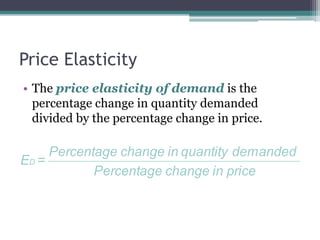
Price Elasticity 
• The price elasticity of demand is the 
percentage change in quantity demanded 
divided by the percentage change in price. 
Percentage change in quantity demanded 
Percentage change in price 
ED =
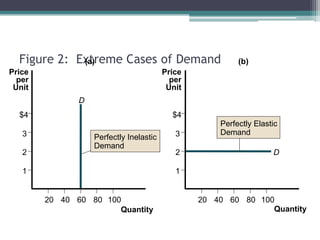
Figure 2: Extreme Cases of Demand 
D 
(a) 
Perfectly Inelastic 
Demand 
Quantity 
Price 
per 
Unit 
$4 
3 
2 
1 
20 40 60 80 100 
(b) 
D 
20 40 60 80 100 
Quantity 
Price 
per 
Unit 
$4 
3 
2 
1 
Perfectly Elastic 
Demand
Sign of Price Elasticity 
• According to the law of demand, whenever the 
price rises, the quantity demanded falls. Thus 
the price elasticity of demand is always 
negative. 
• Because it is always negative, economists usually 
state the value without the sign.
What Information Price Elasticity 
Provides 
• Price elasticity of demand and supply gives the 
exact quantity response to a change in price.
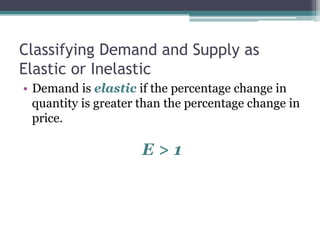
Classifying Demand and Supply as 
Elastic or Inelastic 
• Demand is elastic if the percentage change in 
quantity is greater than the percentage change in 
price. 
E > 1
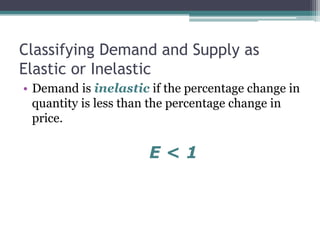
Classifying Demand and Supply as 
Elastic or Inelastic 
• Demand is inelastic if the percentage change in 
quantity is less than the percentage change in 
price. 
E < 1
Elastic Demand 
• Elastic Demand means that quantity changes by 
a greater percentage than the percentage change 
in price.
Inelastic Demand 
• Inelastic Demand means that quantity doesn't 
change much with a change in price.
Defining elasticities 
• When price elasticity is between zero and -1 we 
say demand is inelastic. 
• When price elasticity is between -1 and 
- infinity, we say demand is elastic. 
• When price elasticity is -1, we say demand is 
unit elastic.
Elasticity Is Independent of Units 
• Percentages allow us to have a measure of 
responsiveness that is independent of units. 
• This makes comparisons of responsiveness of 
different goods easier.
Calculating Elasticities 
• To determine elasticity divide the percentage 
change in quantity by the percentage change in 
price.
Categories of Price Elasticity of Demand 
• Perfect elastic demand 
• Perfect inelastic demand 
• Unit elasticity of demand 
• Relatively elastic demand 
• Relatively inelastic demand
Elasticity 
 Price Elasticity of Demand 
 The responsiveness of demand 
to changes in price 
 Where % change in demand 
is greater than % change in price – 
elastic 
 Where % change in demand is less than 
% change in price - inelastic
Elasticity 
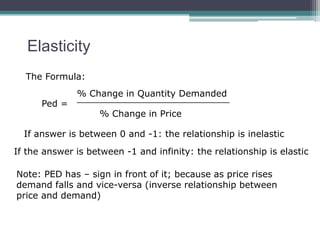
The Formula: 
Ped = 
% Change in Quantity Demanded 
___________________________ 
% Change in Price 
If answer is between 0 and -1: the relationship is inelastic 
If the answer is between -1 and infinity: the relationship is elastic 
Note: PED has – sign in front of it; because as price rises 
demand falls and vice-versa (inverse relationship between 
price and demand)
Price Elasticity of Demand 
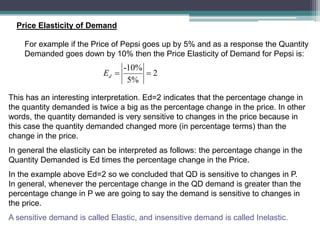
For example if the Price of Pepsi goes up by 5% and as a response the Quantity 
Demanded goes down by 10% then the Price Elasticity of Demand for Pepsi is: 
-10% 
E   
2 
d 5% This has an interesting interpretation. Ed=2 indicates that the percentage change in 
the quantity demanded is twice a big as the percentage change in the price. In other 
words, the quantity demanded is very sensitive to changes in the price because in 
this case the quantity demanded changed more (in percentage terms) than the 
change in the price. 
In general the elasticity can be interpreted as follows: the percentage change in the 
Quantity Demanded is Ed times the percentage change in the Price. 
In the example above Ed=2 so we concluded that QD is sensitive to changes in P. 
In general, whenever the percentage change in the QD demand is greater than the 
percentage change in P we are going to say the demand is sensitive to changes in 
the price. 
A sensitive demand is called Elastic, and insensitive demand is called Inelastic.
Elasticity 
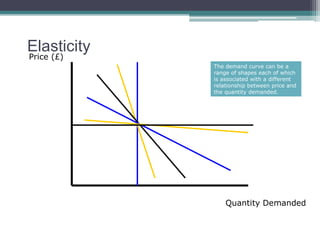
Price (£) 
The demand curve can be a 
range of shapes each of which 
is associated with a different 
relationship between price and 
the quantity demanded. 
Quantity Demanded
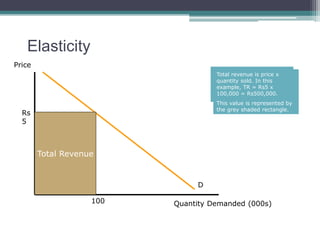
Elasticity 
Price 
D 
The importance of elasticity 
is the information it 
provides on the effect on 
total revenue of changes in 
price. 
Quantity Demanded (000s) 
Rs 
5 
100 
Total revenue is price x 
quantity sold. In this 
example, TR = Rs5 x 
100,000 = Rs500,000. 
This value is represented by 
the grey shaded rectangle. 
Total Revenue
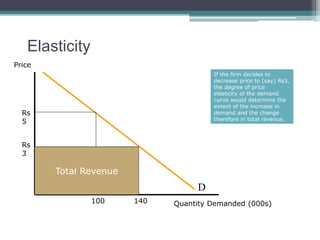
Elasticity 
Price 
D 
If the firm decides to 
decrease price to (say) Rs3, 
the degree of price 
elasticity of the demand 
curve would determine the 
extent of the increase in 
demand and the change 
therefore in total revenue. 
Quantity Demanded (000s) 
Rs 
5 
100 
Rs 
3 
140 
Total Revenue
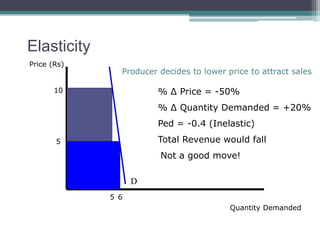
Elasticity 
Price (Rs) 
Producer decides to lower price to attract sales 
Quantity Demanded 
10 
D 
5 
5 
6 
% Δ Price = -50% 
% Δ Quantity Demanded = +20% 
Ped = -0.4 (Inelastic) 
Total Revenue would fall 
Not a good move!
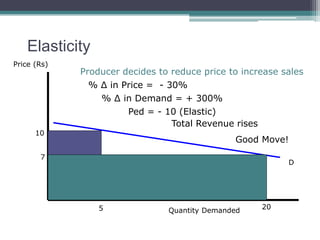
Elasticity 
Price (Rs) 
Producer decides to reduce price to increase sales 
Quantity Demanded 
D 
10 
5 20 
7 
% Δ in Price = - 30% 
% Δ in Demand = + 300% 
Ped = - 10 (Elastic) 
Total Revenue rises 
Good Move!
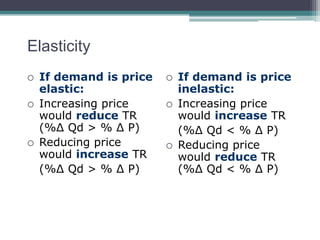
Elasticity 
 If demand is price 
elastic: 
 Increasing price 
would reduce TR 
(%Δ Qd > % Δ P) 
 Reducing price 
would increase TR 
(%Δ Qd > % Δ P) 
 If demand is price 
inelastic: 
 Increasing price 
would increase TR 
(%Δ Qd < % Δ P) 
 Reducing price 
would reduce TR 
(%Δ Qd < % Δ P)
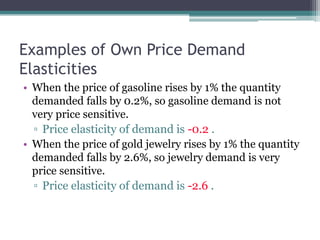
Examples of Own Price Demand 
Elasticities 
• When the price of gasoline rises by 1% the quantity 
demanded falls by 0.2%, so gasoline demand is not 
very price sensitive. 
▫ Price elasticity of demand is -0.2 . 
• When the price of gold jewelry rises by 1% the quantity 
demanded falls by 2.6%, so jewelry demand is very 
price sensitive. 
▫ Price elasticity of demand is -2.6 .
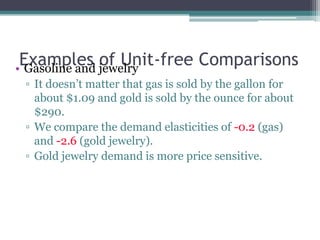
Examples of Unit-free Comparisons 
• Gasoline and jewelry 
▫ It doesn’t matter that gas is sold by the gallon for 
about $1.09 and gold is sold by the ounce for about 
$290. 
▫ We compare the demand elasticities of -0.2 (gas) 
and -2.6 (gold jewelry). 
▫ Gold jewelry demand is more price sensitive.
Inelastic Economic Relations 
• When an elasticity is small (between 0 and 1 in 
absolute value), we call the relation that it 
describes inelastic. 
▫ Inelastic demand means that the quantity 
demanded is not very sensitive to the price. 
▫ Inelastic supply means that the quantity supplied 
is not very sensitive to the price.
Elastic Economic Relations 
• When an elasticity is large (greater than 1 in 
absolute value), we call the relation that it 
describes elastic. 
▫ Elastic demand means that the quantity 
demanded is sensitive to the price. 
▫ Elastic supply means that the quantity supplied is 
sensitive to the price.
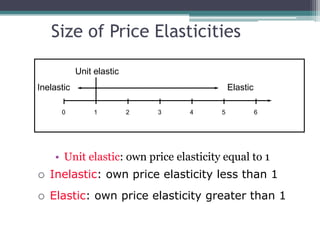
Size of Price Elasticities 
Unit elastic 
Inelastic Elastic 
0 1 2 3 4 5 6 
• Unit elastic: own price elasticity equal to 1 
 Inelastic: own price elasticity less than 1 
 Elastic: own price elasticity greater than 1
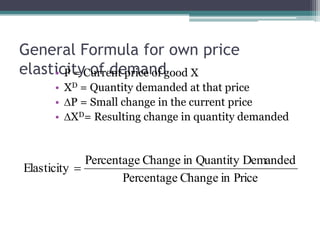
General Formula for own price 
elasti•cPi t=y C ourfr ednte pmricaen odf good X 
• XD = Quantity demanded at that price 
• DP = Small change in the current price 
• DXD= Resulting change in quantity demanded 
Percentage Change in Quantity Demanded 
Percentage Change in Price 
Elasticity 
Note: 
• The own price elasticity of demand is always negative. 
• Economists usually refer to the own price elasticity of 
demand by its absolute value (ignore the negative 
sign). 
• So, even though the formula says that the own price 
elasticity of demand is negative, we would say the 
elasticity of demand is 1.5 in the first example and 
0.67 in the second.
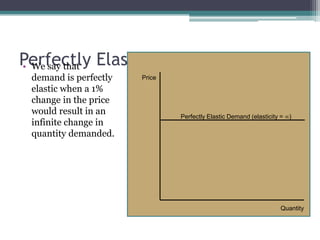
Perfectly Elastic Demand • We say that 
demand is perfectly 
elastic when a 1% 
change in the price 
would result in an 
infinite change in 
quantity demanded. 
Price 
Perfectly Elastic Demand (elasticity = ) 
Quantity
Perfectly Inelastic Demand • We say that demand 
is perfectly inelastic 
when a 1% change 
in the price would 
result in no change 
in quantity 
demanded. 
Price 
Quantity 
Perfectly 
Inelastic 
Demand 
(elasticity = 0)
Elasticity 
 Income Elasticity of Demand: 
 The responsiveness of demand 
to changes in incomes 
 Normal Good – demand rises 
as income rises and vice versa 
 Inferior Good – demand falls 
as income rises and vice versa
Elasticity 
 Income Elasticity of Demand: 
 A positive sign denotes a normal good 
 A negative sign denotes an inferior good
• The Price Elasticity of Demand will vary across goods. The 
following are the main determinants of Ed: 
• Goods with many close substitutes will have higher elasticities: 
if a good can be easily substituted for another then consumer 
will be very sensitive to prices. For example if two gas stations 
are located in the same corner (and the gasoline is roughly the 
same between the two) then consumers will pay close attention 
to the price between the two gas stations.
Elasticity 
 For example: 
 Yed = - 0.6: Good is an inferior good but inelastic – a 
rise in income of 3% would lead to demand falling 
by 1.8% 
 Yed = + 0.4: Good is a normal good but inelastic – 
a rise in incomes of 3% would lead to demand rising 
by 1.2% 
 Yed = + 1.6: Good is a normal good and elastic – 
a rise in incomes of 3% would lead to demand rising 
by 4.8% 
 Yed = - 2.1: Good is an inferior good and elastic – 
a rise in incomes of 3% would lead to a fall in demand of 
6.3%
• Luxuries and Necessities: Luxuries will tend to have higher elasticities. 
Necessities will tend to have lower elasticities. 
• In the latter, since the good is a necessity consumer will not be very 
responsive to price changes, they still have to purchase the good. 
• In the case of luxuries since consumers do not really need to buy the good 
then they will pay attention to the price and therefore will be sensitive to 
price changes. 
• For example, vacations are luxury goods, if the price of a vacations 
increases most consumer will reduce the number of vacations more than 
proportionally to the change in price. 
• However, if the price of food goes up people will only reduce the amount 
of food purchased a little bit because without food they will die or get sick.
Elasticity 
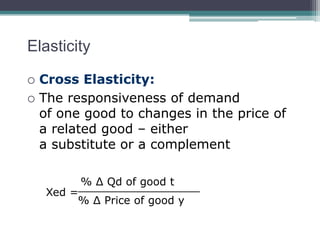
 Cross Elasticity: 
 The responsiveness of demand 
of one good to changes in the price of 
a related good – either 
a substitute or a complement 
% Δ Qd of good t 
__________________ 
% Δ Price of good y 
Xed =
Elasticity 
 Goods which are complements: 
 Cross Elasticity will have negative sign 
(inverse relationship between the two) 
 Goods which are substitutes: 
 Cross Elasticity will have a positive sign 
(positive relationship between the two)
Elasticity 
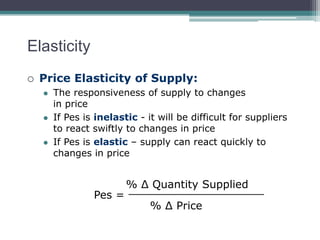
 Price Elasticity of Supply: 
 The responsiveness of supply to changes 
in price 
 If Pes is inelastic - it will be difficult for suppliers 
to react swiftly to changes in price 
 If Pes is elastic – supply can react quickly to 
changes in price 
Pes = 
% Δ Quantity Supplied 
____________________ 
% Δ Price
Determinants of Elasticity 
 Time period – the longer the time under 
consideration the more elastic a good is likely to be 
 Number and closeness of substitutes – 
the greater the number of substitutes, 
the more elastic 
 The proportion of income taken up by the 
product – the smaller the proportion the more 
inelastic 
 Luxury or Necessity - for example, 
addictive drugs
Importance of Elasticity 
 Relationship between changes 
in price and total revenue 
 Importance in determining 
what goods to tax (tax revenue) 
 Importance in analysing time lags in 
production 
 Influences the behaviour of a firm
What does the elasticity “measure” 
rea•llTyh me eelaasstiucirtey ?measure is a ratio between two 
percentage measures: the percentage change 
in one variable over the percentage change in 
another variable 
• A price elasticity of -6.25 means that for each 
one percent change in price the quantity 
demanded will change by 6.25 percent.
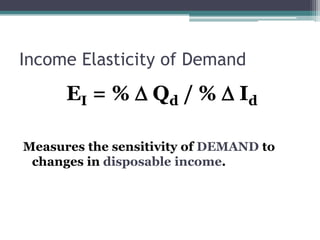
Income Elasticity of Demand 
EI = % D Qd / % D Id 
Measures the sensitivity of DEMAND to 
changes in disposable income.
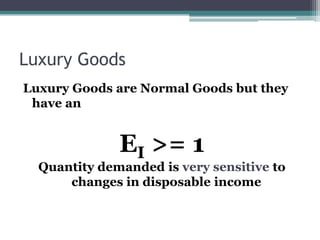
Luxury Goods 
Luxury Goods are Normal Goods but they 
have an 
EI >= 1 
Quantity demanded is very sensitive to 
changes in disposable income
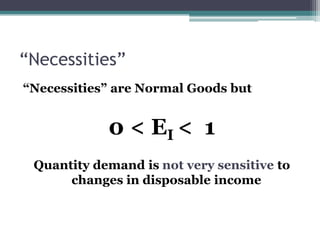
“Necessities” 
“Necessities” are Normal Goods but 
0 < EI < 1 
Quantity demand is not very sensitive to 
changes in disposable income
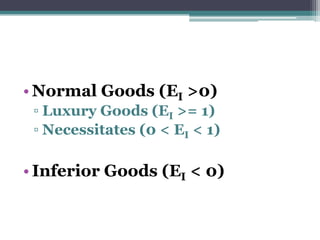
•Normal Goods (EI >0) 
▫ Luxury Goods (EI >= 1) 
▫ Necessitates (0 < EI < 1) 
• Inferior Goods (EI < 0)
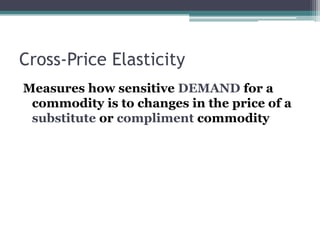
Cross-Price Elasticity 
Measures how sensitive DEMAND for a 
commodity is to changes in the price of a 
substitute or compliment commodity
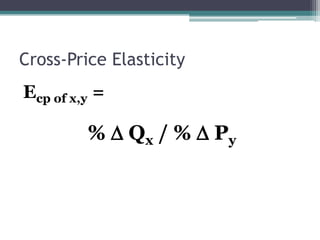
Cross-Price Elasticity 
Ecp of x,y = 
% D Qx / % D Py
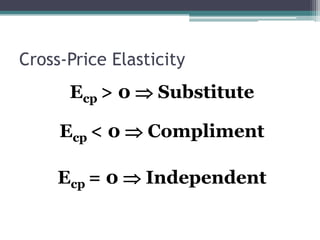
Cross-Price Elasticity 
Ecp > 0  Substitute 
Ecp < 0  Compliment 
Ecp = 0  Independent
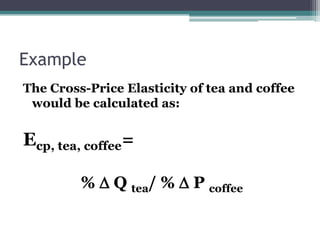
Example 
The Cross-Price Elasticity of tea and coffee 
would be calculated as: 
Ecp, tea, coffee= 
% D Q tea/ % D P coffee
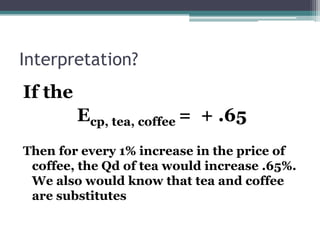
Interpretation? 
If the 
Ecp, tea, coffee = + .65 
Then for every 1% increase in the price of 
coffee, the Qd of tea would increase .65%. 
We also would know that tea and coffee 
are substitutes
Slope Compared to Elasticity 
• The slope measures the rate of change of one 
variable (P, say) in terms of another (X, say). 
• The elasticity measures the percentage change of 
one variable (X, say) in terms of another (P, say).
Summing up : 
PrPicriece e ellaassttiiccitiyt yo fo df edmeamnda nmdeasures how much 
the quantity demanded responds to changes in 
the price. 
• Price elasticity of demand is calculated as the 
percentage change in quantity demanded 
divided by the percentage change in price. 
• If a demand curve is elastic, total revenue falls 
when the price rises. 
• If it is inelastic, total revenue rises as the price 
rises.
Summing up : 
Income elasticity of demand 
The income elasticity of demand measures how much 
the quantity demanded responds to changes in 
consumers’ income. 
• The cross-price elasticity of demand measures how 
much the quantity demanded of one good responds 
to the price of another good. 
• The price elasticity of supply measures how much 
the quantity supplied responds to changes in the 
price. . 
Thank You

Lecture 4 elsasticity

  • 1.
    ELASTICITY OF DEMAND Price, Income and Cross Elasticity Dr.Sunitha.S Assistant Professor, School of Management Studies, National Institute of Technology (NIT) Calicut
  • 2.
    Elasticity – theconcept  The responsiveness of one variable to changes in another  When price rises, what happens to demand?  Demand falls  BUT!  How much does demand fall?
  • 3.
    Elasticity – theconcept  If price rises by 10% - what happens to demand?  We know demand will fall  By more than 10%?  By less than 10%?  Elasticity measures the extent to which demand will change
  • 4.
    The Concept ofElasticity • Elasticity is a measure of the responsiveness of one variable to another. • The greater the elasticity, the greater the responsiveness.
  • 5.
    Elasticity of Demand: Definition • The degree of responsiveness of quantity demanded as a result of change in price of the good , income or relative goods’ prices.
  • 6.
    Types Elasticity ofDemand  Price elasticity of demand  Income elasticity of demand  Cross elasticity
  • 7.
    Price Elasticity •The price elasticity of demand is the percentage change in quantity demanded divided by the percentage change in price. Percentage change in quantity demanded Percentage change in price ED =
  • 8.
    Figure 2: ExtremeCases of Demand D (a) Perfectly Inelastic Demand Quantity Price per Unit $4 3 2 1 20 40 60 80 100 (b) D 20 40 60 80 100 Quantity Price per Unit $4 3 2 1 Perfectly Elastic Demand
  • 9.
    Sign of PriceElasticity • According to the law of demand, whenever the price rises, the quantity demanded falls. Thus the price elasticity of demand is always negative. • Because it is always negative, economists usually state the value without the sign.
  • 10.
    What Information PriceElasticity Provides • Price elasticity of demand and supply gives the exact quantity response to a change in price.
  • 11.
    Classifying Demand andSupply as Elastic or Inelastic • Demand is elastic if the percentage change in quantity is greater than the percentage change in price. E > 1
  • 12.
    Classifying Demand andSupply as Elastic or Inelastic • Demand is inelastic if the percentage change in quantity is less than the percentage change in price. E < 1
  • 13.
    Elastic Demand •Elastic Demand means that quantity changes by a greater percentage than the percentage change in price.
  • 14.
    Inelastic Demand •Inelastic Demand means that quantity doesn't change much with a change in price.
  • 15.
    Defining elasticities •When price elasticity is between zero and -1 we say demand is inelastic. • When price elasticity is between -1 and - infinity, we say demand is elastic. • When price elasticity is -1, we say demand is unit elastic.
  • 16.
    Elasticity Is Independentof Units • Percentages allow us to have a measure of responsiveness that is independent of units. • This makes comparisons of responsiveness of different goods easier.
  • 17.
    Calculating Elasticities •To determine elasticity divide the percentage change in quantity by the percentage change in price.
  • 18.
    Categories of PriceElasticity of Demand • Perfect elastic demand • Perfect inelastic demand • Unit elasticity of demand • Relatively elastic demand • Relatively inelastic demand
  • 19.
    Elasticity  PriceElasticity of Demand  The responsiveness of demand to changes in price  Where % change in demand is greater than % change in price – elastic  Where % change in demand is less than % change in price - inelastic
  • 20.
    Elasticity The Formula: Ped = % Change in Quantity Demanded ___________________________ % Change in Price If answer is between 0 and -1: the relationship is inelastic If the answer is between -1 and infinity: the relationship is elastic Note: PED has – sign in front of it; because as price rises demand falls and vice-versa (inverse relationship between price and demand)
  • 21.
    Price Elasticity ofDemand For example if the Price of Pepsi goes up by 5% and as a response the Quantity Demanded goes down by 10% then the Price Elasticity of Demand for Pepsi is: -10% E   2 d 5% This has an interesting interpretation. Ed=2 indicates that the percentage change in the quantity demanded is twice a big as the percentage change in the price. In other words, the quantity demanded is very sensitive to changes in the price because in this case the quantity demanded changed more (in percentage terms) than the change in the price. In general the elasticity can be interpreted as follows: the percentage change in the Quantity Demanded is Ed times the percentage change in the Price. In the example above Ed=2 so we concluded that QD is sensitive to changes in P. In general, whenever the percentage change in the QD demand is greater than the percentage change in P we are going to say the demand is sensitive to changes in the price. A sensitive demand is called Elastic, and insensitive demand is called Inelastic.
  • 22.
    Elasticity Price (£) The demand curve can be a range of shapes each of which is associated with a different relationship between price and the quantity demanded. Quantity Demanded
  • 23.
    Elasticity Price D The importance of elasticity is the information it provides on the effect on total revenue of changes in price. Quantity Demanded (000s) Rs 5 100 Total revenue is price x quantity sold. In this example, TR = Rs5 x 100,000 = Rs500,000. This value is represented by the grey shaded rectangle. Total Revenue
  • 24.
    Elasticity Price D If the firm decides to decrease price to (say) Rs3, the degree of price elasticity of the demand curve would determine the extent of the increase in demand and the change therefore in total revenue. Quantity Demanded (000s) Rs 5 100 Rs 3 140 Total Revenue
  • 25.
    Elasticity Price (Rs) Producer decides to lower price to attract sales Quantity Demanded 10 D 5 5 6 % Δ Price = -50% % Δ Quantity Demanded = +20% Ped = -0.4 (Inelastic) Total Revenue would fall Not a good move!
  • 26.
    Elasticity Price (Rs) Producer decides to reduce price to increase sales Quantity Demanded D 10 5 20 7 % Δ in Price = - 30% % Δ in Demand = + 300% Ped = - 10 (Elastic) Total Revenue rises Good Move!
  • 27.
    Elasticity  Ifdemand is price elastic:  Increasing price would reduce TR (%Δ Qd > % Δ P)  Reducing price would increase TR (%Δ Qd > % Δ P)  If demand is price inelastic:  Increasing price would increase TR (%Δ Qd < % Δ P)  Reducing price would reduce TR (%Δ Qd < % Δ P)
  • 28.
    Examples of OwnPrice Demand Elasticities • When the price of gasoline rises by 1% the quantity demanded falls by 0.2%, so gasoline demand is not very price sensitive. ▫ Price elasticity of demand is -0.2 . • When the price of gold jewelry rises by 1% the quantity demanded falls by 2.6%, so jewelry demand is very price sensitive. ▫ Price elasticity of demand is -2.6 .
  • 29.
    Examples of Unit-freeComparisons • Gasoline and jewelry ▫ It doesn’t matter that gas is sold by the gallon for about $1.09 and gold is sold by the ounce for about $290. ▫ We compare the demand elasticities of -0.2 (gas) and -2.6 (gold jewelry). ▫ Gold jewelry demand is more price sensitive.
  • 30.
    Inelastic Economic Relations • When an elasticity is small (between 0 and 1 in absolute value), we call the relation that it describes inelastic. ▫ Inelastic demand means that the quantity demanded is not very sensitive to the price. ▫ Inelastic supply means that the quantity supplied is not very sensitive to the price.
  • 31.
    Elastic Economic Relations • When an elasticity is large (greater than 1 in absolute value), we call the relation that it describes elastic. ▫ Elastic demand means that the quantity demanded is sensitive to the price. ▫ Elastic supply means that the quantity supplied is sensitive to the price.
  • 32.
    Size of PriceElasticities Unit elastic Inelastic Elastic 0 1 2 3 4 5 6 • Unit elastic: own price elasticity equal to 1  Inelastic: own price elasticity less than 1  Elastic: own price elasticity greater than 1
  • 33.
    General Formula forown price elasti•cPi t=y C ourfr ednte pmricaen odf good X • XD = Quantity demanded at that price • DP = Small change in the current price • DXD= Resulting change in quantity demanded Percentage Change in Quantity Demanded Percentage Change in Price Elasticity 
  • 34.
    Note: • Theown price elasticity of demand is always negative. • Economists usually refer to the own price elasticity of demand by its absolute value (ignore the negative sign). • So, even though the formula says that the own price elasticity of demand is negative, we would say the elasticity of demand is 1.5 in the first example and 0.67 in the second.
  • 35.
    Perfectly Elastic Demand• We say that demand is perfectly elastic when a 1% change in the price would result in an infinite change in quantity demanded. Price Perfectly Elastic Demand (elasticity = ) Quantity
  • 36.
    Perfectly Inelastic Demand• We say that demand is perfectly inelastic when a 1% change in the price would result in no change in quantity demanded. Price Quantity Perfectly Inelastic Demand (elasticity = 0)
  • 37.
    Elasticity  IncomeElasticity of Demand:  The responsiveness of demand to changes in incomes  Normal Good – demand rises as income rises and vice versa  Inferior Good – demand falls as income rises and vice versa
  • 38.
    Elasticity  IncomeElasticity of Demand:  A positive sign denotes a normal good  A negative sign denotes an inferior good
  • 39.
    • The PriceElasticity of Demand will vary across goods. The following are the main determinants of Ed: • Goods with many close substitutes will have higher elasticities: if a good can be easily substituted for another then consumer will be very sensitive to prices. For example if two gas stations are located in the same corner (and the gasoline is roughly the same between the two) then consumers will pay close attention to the price between the two gas stations.
  • 40.
    Elasticity  Forexample:  Yed = - 0.6: Good is an inferior good but inelastic – a rise in income of 3% would lead to demand falling by 1.8%  Yed = + 0.4: Good is a normal good but inelastic – a rise in incomes of 3% would lead to demand rising by 1.2%  Yed = + 1.6: Good is a normal good and elastic – a rise in incomes of 3% would lead to demand rising by 4.8%  Yed = - 2.1: Good is an inferior good and elastic – a rise in incomes of 3% would lead to a fall in demand of 6.3%
  • 41.
    • Luxuries andNecessities: Luxuries will tend to have higher elasticities. Necessities will tend to have lower elasticities. • In the latter, since the good is a necessity consumer will not be very responsive to price changes, they still have to purchase the good. • In the case of luxuries since consumers do not really need to buy the good then they will pay attention to the price and therefore will be sensitive to price changes. • For example, vacations are luxury goods, if the price of a vacations increases most consumer will reduce the number of vacations more than proportionally to the change in price. • However, if the price of food goes up people will only reduce the amount of food purchased a little bit because without food they will die or get sick.
  • 42.
    Elasticity  CrossElasticity:  The responsiveness of demand of one good to changes in the price of a related good – either a substitute or a complement % Δ Qd of good t __________________ % Δ Price of good y Xed =
  • 43.
    Elasticity  Goodswhich are complements:  Cross Elasticity will have negative sign (inverse relationship between the two)  Goods which are substitutes:  Cross Elasticity will have a positive sign (positive relationship between the two)
  • 44.
    Elasticity  PriceElasticity of Supply:  The responsiveness of supply to changes in price  If Pes is inelastic - it will be difficult for suppliers to react swiftly to changes in price  If Pes is elastic – supply can react quickly to changes in price Pes = % Δ Quantity Supplied ____________________ % Δ Price
  • 45.
    Determinants of Elasticity  Time period – the longer the time under consideration the more elastic a good is likely to be  Number and closeness of substitutes – the greater the number of substitutes, the more elastic  The proportion of income taken up by the product – the smaller the proportion the more inelastic  Luxury or Necessity - for example, addictive drugs
  • 46.
    Importance of Elasticity  Relationship between changes in price and total revenue  Importance in determining what goods to tax (tax revenue)  Importance in analysing time lags in production  Influences the behaviour of a firm
  • 47.
    What does theelasticity “measure” rea•llTyh me eelaasstiucirtey ?measure is a ratio between two percentage measures: the percentage change in one variable over the percentage change in another variable • A price elasticity of -6.25 means that for each one percent change in price the quantity demanded will change by 6.25 percent.
  • 48.
    Income Elasticity ofDemand EI = % D Qd / % D Id Measures the sensitivity of DEMAND to changes in disposable income.
  • 49.
    Luxury Goods LuxuryGoods are Normal Goods but they have an EI >= 1 Quantity demanded is very sensitive to changes in disposable income
  • 50.
    “Necessities” “Necessities” areNormal Goods but 0 < EI < 1 Quantity demand is not very sensitive to changes in disposable income
  • 51.
    •Normal Goods (EI>0) ▫ Luxury Goods (EI >= 1) ▫ Necessitates (0 < EI < 1) • Inferior Goods (EI < 0)
  • 52.
    Cross-Price Elasticity Measureshow sensitive DEMAND for a commodity is to changes in the price of a substitute or compliment commodity
  • 53.
    Cross-Price Elasticity Ecpof x,y = % D Qx / % D Py
  • 54.
    Cross-Price Elasticity Ecp> 0  Substitute Ecp < 0  Compliment Ecp = 0  Independent
  • 55.
    Example The Cross-PriceElasticity of tea and coffee would be calculated as: Ecp, tea, coffee= % D Q tea/ % D P coffee
  • 56.
    Interpretation? If the Ecp, tea, coffee = + .65 Then for every 1% increase in the price of coffee, the Qd of tea would increase .65%. We also would know that tea and coffee are substitutes
  • 57.
    Slope Compared toElasticity • The slope measures the rate of change of one variable (P, say) in terms of another (X, say). • The elasticity measures the percentage change of one variable (X, say) in terms of another (P, say).
  • 58.
    Summing up : PrPicriece e ellaassttiiccitiyt yo fo df edmeamnda nmdeasures how much the quantity demanded responds to changes in the price. • Price elasticity of demand is calculated as the percentage change in quantity demanded divided by the percentage change in price. • If a demand curve is elastic, total revenue falls when the price rises. • If it is inelastic, total revenue rises as the price rises.
  • 59.
    Summing up : Income elasticity of demand The income elasticity of demand measures how much the quantity demanded responds to changes in consumers’ income. • The cross-price elasticity of demand measures how much the quantity demanded of one good responds to the price of another good. • The price elasticity of supply measures how much the quantity supplied responds to changes in the price. . Thank You