E-Marketing Strategy
Objectives
You will be able to:
  Explain the importance of strategic planning,
   strategy, e-business strategy, and e-marketing
   strategy.
  Identify the main e-business models at the
   activity, business process, and enterprise
   levels.
  Discuss the use of performance metrics and
   the Balanced Scorecard to measure e-
   business and e-marketing performance.
The Amazon Phenomenon
3


     "Online, you can build a store that can't
      exist in real life--if we printed a catalog of
      what we offer, it would be the size of seven
      New York City phone books." Jeff Bezos
Amazon.com’s
Value Proposition
4


     Traditional Bookstore           Amazon.com
                                      More than 2,000,000
          Less than 100,000 titles    titles
          Focus on best-sellers      Broad offering on hard
                                       to find titles
          Very long reorder times    Max wait 6 weeks
          Little information about   Plenty of information,
           books                       reviews, etc.
                                      Heavily discounted
          Marginal discounts
                                       prices (up to 40% off)
          One-to-Many marketing      One-to-One marketing
Amazon.com
5

    Founded in 1995 as an online retailer.
       Did not become profitable until Q4 2001.
       In 2007, generated $14.8 billion in net sales,
        $476 million in net income.
    Leveraged its competencies into different e-
     business models.
       Established e-commerce partnerships with
        Target, Macy’s, and others.
       Provided developer services.
       Created the first affiliate program.
Amazon.com, cont.
6

    Amazon’s success is based on selection,
     lower prices, product availability, innovative
     technology, and better product information.
    CEO Jeff Bezos is not interested in expanding
     to the physical world.
    Which of Amazon’s core competencies do you
     think will drive its strategy in the future?
Strategic Planning
7

    A managerial process to develop and maintain a
     viable fit between the organization and its
     changing market opportunities.
    Process identifies firm’s goals for
      Growth
      Competitive position
      Geographic scope
      Other objectives, such as industry, products,
       etc.
ESP: Environment, Strategy, and
Performance
The e-marketing plan flows from the
 organization’s overall goals and strategies.
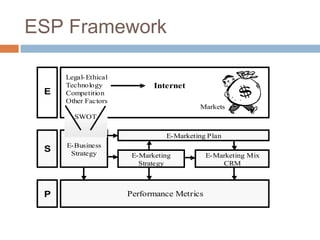
The ESP framework illustrates the
 relationships among environment, strategy,
 and performance.
A SWOT analysis of the business environment
 (E) leads to the development of strategy (S)
 and the measurement of performance (P).
ESP Framework

     Legal- Ethical
     Technology              Internet
 E   Competition
     Other Factors
                                         Markets
       SWOT

                                E-Marketing Plan
     E-Business
 S    Strategy         E-Marketing          E-Marketing Mix
                         Strategy               CRM


 P                    Performance Metrics
Strategy
10

     Strategy is the means to achieve a goal.
     E-business strategy
        Strategy that deploys enterprise resources to
         reach performance objectives, competitive
         advantages.
     E-marketing strategy
        Strategy that capitalizes on information
         technology to reach marketing objectives.
Rationale for e-Business
11

     Strategic justification – “fit”
        Alignment with the overall ‘mission’
     Operational justification – process
      improvement
        Identifies/quantifies the specific process
         improvements resulting from the strategy
     Technical justification – synergy
        Shows how technology will fit and provide
         synergy
     Financial justification – ROI
        Examine each metric for opportunities
Business Models
12

     A business model is a method for long-term
      survival and a value proposition for partners,
      customers, and revenue.
     E-business models include the use of
      information technology to achieve long-term
      goals.
     Firm selects one or more models as strategies
      to accomplish enterprise goals.
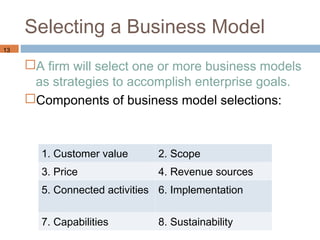
Selecting a Business Model
13

     A firm will select one or more business models
      as strategies to accomplish enterprise goals.
     Components of business model selections:


       1. Customer value      2. Scope
       3. Price               4. Revenue sources
       5. Connected activities 6. Implementation


       7. Capabilities        8. Sustainability
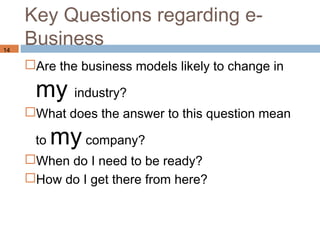
Key Questions regarding e-
14
     Business
     Are the business models likely to change in

      my industry?
     What does the answer to this question mean

      to   my company?
     When do I need to be ready?
     How do I get there from here?
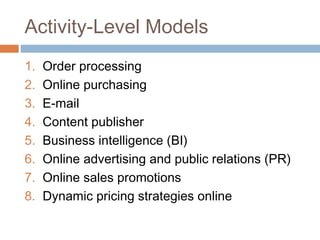
Activity-Level Models
1.   Order processing
2.   Online purchasing
3.   E-mail
4.   Content publisher
5.   Business intelligence (BI)
6.   Online advertising and public relations (PR)
7.   Online sales promotions
8.   Dynamic pricing strategies online
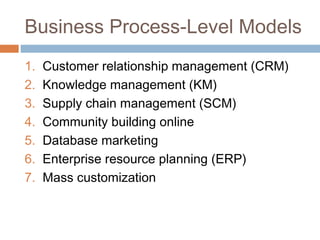
Business Process-Level Models
1.   Customer relationship management (CRM)
2.   Knowledge management (KM)
3.   Supply chain management (SCM)
4.   Community building online
5.   Database marketing
6.   Enterprise resource planning (ERP)
7.   Mass customization
Enterprise-Level Models
1.       E-commerce, direct selling, content sponsorship
2.       Portal
3.       Social networking
4.       Broker models
          Online exchange, hub
          Online auction
5. Agent models
          Manufacturer’s/selling agents
          Shopping agent
          Reverse auction
Pure Play Models
Pure plays are businesses that began on the
 internet.
   They represent the top level of the E-Business
    pyramid.
Pure plays face significant challenges.
   They must compete as new brands.
   They may need to take customers away from
    established businesses.
Some pure plays have redefined industries:
 E*Trade, eBay, Yahoo!, MySpace.
Performance Metrics
19

     Performance metrics are specific measures
      designed to evaluate the effectiveness and
      efficiency of operations.
     Performance metrics:
       Provide measurable outcomes.
       Must be easy to understand and use.
       Must be actionable.
       Can be utilized for employee evaluations.
Web Analytics
 Web analytics, commonly called metrics, is the study
  of user behavior on Web pages.
 Metrics measure activities such as:
   Click throughs
   Visitor patterns
   Length of time spent on a page or site
   Conversions to sales
 Web analytics software helps companies analyze
  data on server logs for marketing purposes.
 What does Google offer in this area?
Social Engagement Metrics
Online measurement also includes metrics for
 evaluating Web 2.0 technologies.
Social engagement metrics allow marketers to
 know how visitors participate, not just whether
 they landed on a page.
   Time spent viewing a video, playing a game,
    or listening to music.
   Writing a comment on a blog.
   Downloading a MP3 file, ring tone, or other
    content.
The Balanced Scorecard
22

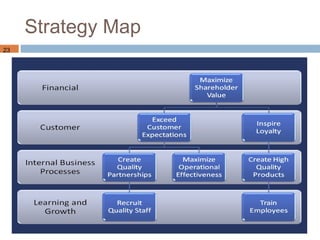
     The Balanced Scorecard provides a framework
      for understanding e-marketing metrics.
     The Balanced Scorecard provides 4
      perspectives.
        Customer perspective
        Internal perspective
        Learning and growth perspective
        Financial perspective
Strategy Map
23
The Balanced Scorecard:
     Customer Perspective
24


     The customer perspective scorecard
      includes ways to measure goals such as
      customer loyalty, satisfaction, appropriateness
      of target markets, etc.
        Loyalty and satisfaction measures may
         include percentage of visitors who return to
         site and time between visits.
        Transaction measures may include
         measurement of unique visitors, online sales
         abandoned, etc.
The Balanced Scorecard:
     Internal Perspectives
25


     The Internal perspective scorecard includes
      ways to measure goals related to the quality of
      online services.
       Quality of online technical help such as
        amount of time to answer e-mail
       Web page loading time
       Inventory levels, inventory turns
The Balanced Scorecard:
     Learning and Growth Perspectives
26


     The learning     and growth perspective
      scorecard includes ways to measure goals
      related to online service innovation and
      continuous improvement.
       Average time from concept to start
       Speed to match a rival’s site
       Time between site relaunches
The Balanced Scorecard:
Financial Perspectives
The financial perspective scorecard
 includes ways to measure financial goals.
   Sales growth and market share
   Return on invested capital
   Average order value
   Individual customer profit
Summary
28

     This week, ask yourself the following questions:

     What is Strategy? How do you pursue
      “strategy” in e-Business?
     What are “e-Business Models”?
     What is the Balanced Scorecard and why do I
      care?

Emarketing Strategy Topic 6

  • 1.
  • 2.
    Objectives You will beable to:  Explain the importance of strategic planning, strategy, e-business strategy, and e-marketing strategy.  Identify the main e-business models at the activity, business process, and enterprise levels.  Discuss the use of performance metrics and the Balanced Scorecard to measure e- business and e-marketing performance.
  • 3.
    The Amazon Phenomenon 3  "Online, you can build a store that can't exist in real life--if we printed a catalog of what we offer, it would be the size of seven New York City phone books." Jeff Bezos
  • 4.
    Amazon.com’s Value Proposition 4  Traditional Bookstore Amazon.com More than 2,000,000  Less than 100,000 titles titles  Focus on best-sellers Broad offering on hard to find titles  Very long reorder times Max wait 6 weeks  Little information about Plenty of information, books reviews, etc. Heavily discounted  Marginal discounts prices (up to 40% off)  One-to-Many marketing One-to-One marketing
  • 5.
    Amazon.com 5 Founded in 1995 as an online retailer.  Did not become profitable until Q4 2001.  In 2007, generated $14.8 billion in net sales, $476 million in net income. Leveraged its competencies into different e- business models.  Established e-commerce partnerships with Target, Macy’s, and others.  Provided developer services.  Created the first affiliate program.
  • 6.
    Amazon.com, cont. 6 Amazon’s success is based on selection, lower prices, product availability, innovative technology, and better product information. CEO Jeff Bezos is not interested in expanding to the physical world. Which of Amazon’s core competencies do you think will drive its strategy in the future?
  • 7.
    Strategic Planning 7 A managerial process to develop and maintain a viable fit between the organization and its changing market opportunities. Process identifies firm’s goals for  Growth  Competitive position  Geographic scope  Other objectives, such as industry, products, etc.
  • 8.
    ESP: Environment, Strategy,and Performance The e-marketing plan flows from the organization’s overall goals and strategies. The ESP framework illustrates the relationships among environment, strategy, and performance. A SWOT analysis of the business environment (E) leads to the development of strategy (S) and the measurement of performance (P).
  • 9.
    ESP Framework Legal- Ethical Technology Internet E Competition Other Factors Markets SWOT E-Marketing Plan E-Business S Strategy E-Marketing E-Marketing Mix Strategy CRM P Performance Metrics
  • 10.
    Strategy 10 Strategy is the means to achieve a goal. E-business strategy  Strategy that deploys enterprise resources to reach performance objectives, competitive advantages. E-marketing strategy  Strategy that capitalizes on information technology to reach marketing objectives.
  • 11.
    Rationale for e-Business 11 Strategic justification – “fit”  Alignment with the overall ‘mission’ Operational justification – process improvement  Identifies/quantifies the specific process improvements resulting from the strategy Technical justification – synergy  Shows how technology will fit and provide synergy Financial justification – ROI  Examine each metric for opportunities
  • 12.
    Business Models 12 A business model is a method for long-term survival and a value proposition for partners, customers, and revenue. E-business models include the use of information technology to achieve long-term goals. Firm selects one or more models as strategies to accomplish enterprise goals.
  • 13.
    Selecting a BusinessModel 13 A firm will select one or more business models as strategies to accomplish enterprise goals. Components of business model selections: 1. Customer value 2. Scope 3. Price 4. Revenue sources 5. Connected activities 6. Implementation 7. Capabilities 8. Sustainability
  • 14.
    Key Questions regardinge- 14 Business Are the business models likely to change in my industry? What does the answer to this question mean to my company? When do I need to be ready? How do I get there from here?
  • 15.
    Activity-Level Models 1. Order processing 2. Online purchasing 3. E-mail 4. Content publisher 5. Business intelligence (BI) 6. Online advertising and public relations (PR) 7. Online sales promotions 8. Dynamic pricing strategies online
  • 16.
    Business Process-Level Models 1. Customer relationship management (CRM) 2. Knowledge management (KM) 3. Supply chain management (SCM) 4. Community building online 5. Database marketing 6. Enterprise resource planning (ERP) 7. Mass customization
  • 17.
    Enterprise-Level Models 1. E-commerce, direct selling, content sponsorship 2. Portal 3. Social networking 4. Broker models  Online exchange, hub  Online auction 5. Agent models  Manufacturer’s/selling agents  Shopping agent  Reverse auction
  • 18.
    Pure Play Models Pureplays are businesses that began on the internet.  They represent the top level of the E-Business pyramid. Pure plays face significant challenges.  They must compete as new brands.  They may need to take customers away from established businesses. Some pure plays have redefined industries: E*Trade, eBay, Yahoo!, MySpace.
  • 19.
    Performance Metrics 19 Performance metrics are specific measures designed to evaluate the effectiveness and efficiency of operations. Performance metrics:  Provide measurable outcomes.  Must be easy to understand and use.  Must be actionable.  Can be utilized for employee evaluations.
  • 20.
    Web Analytics  Webanalytics, commonly called metrics, is the study of user behavior on Web pages.  Metrics measure activities such as:  Click throughs  Visitor patterns  Length of time spent on a page or site  Conversions to sales  Web analytics software helps companies analyze data on server logs for marketing purposes.  What does Google offer in this area?
  • 21.
    Social Engagement Metrics Onlinemeasurement also includes metrics for evaluating Web 2.0 technologies. Social engagement metrics allow marketers to know how visitors participate, not just whether they landed on a page.  Time spent viewing a video, playing a game, or listening to music.  Writing a comment on a blog.  Downloading a MP3 file, ring tone, or other content.
  • 22.
    The Balanced Scorecard 22 The Balanced Scorecard provides a framework for understanding e-marketing metrics. The Balanced Scorecard provides 4 perspectives.  Customer perspective  Internal perspective  Learning and growth perspective  Financial perspective
  • 23.
  • 24.
    The Balanced Scorecard: Customer Perspective 24 The customer perspective scorecard includes ways to measure goals such as customer loyalty, satisfaction, appropriateness of target markets, etc.  Loyalty and satisfaction measures may include percentage of visitors who return to site and time between visits.  Transaction measures may include measurement of unique visitors, online sales abandoned, etc.
  • 25.
    The Balanced Scorecard: Internal Perspectives 25 The Internal perspective scorecard includes ways to measure goals related to the quality of online services.  Quality of online technical help such as amount of time to answer e-mail  Web page loading time  Inventory levels, inventory turns
  • 26.
    The Balanced Scorecard: Learning and Growth Perspectives 26 The learning and growth perspective scorecard includes ways to measure goals related to online service innovation and continuous improvement.  Average time from concept to start  Speed to match a rival’s site  Time between site relaunches
  • 27.
    The Balanced Scorecard: FinancialPerspectives The financial perspective scorecard includes ways to measure financial goals.  Sales growth and market share  Return on invested capital  Average order value  Individual customer profit
  • 28.
    Summary 28 This week, ask yourself the following questions: What is Strategy? How do you pursue “strategy” in e-Business? What are “e-Business Models”? What is the Balanced Scorecard and why do I care?

Editor's Notes

  • #14 A firm may find “fit” in the following: Customer value – through product offerings differentiated from the competition Scope – which markets does the firm serve and are they growing? Price – are the products priced to appeal to markets and achieve market share and profit targets? Revenue sources – where is the money sourced? Is it plentiful enough to sustain targets over time? Connected activities – how will the firm create value? Does the firm have this capability? Implementation – does the company have the ability? Capabilities – does the firm have the financial, core competencies and HR to make the model work? Sustainability – will the model create competitive advantage?