CRM
Unit 3
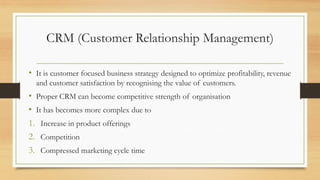
CRM (Customer Relationship Management)
• It is customer focused business strategy designed to optimize profitability, revenue
and customer satisfaction by recognising the value of customers.
• Proper CRM can become competitive strength of organisation
• It has becomes more complex due to
1. Increase in product offerings
2. Competition
3. Compressed marketing cycle time
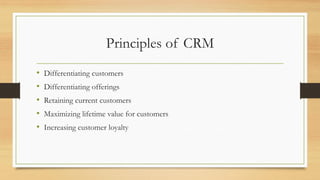
Principles of CRM
• Differentiating customers
• Differentiating offerings
• Retaining current customers
• Maximizing lifetime value for customers
• Increasing customer loyalty
Goals of CRM
• To simplify marketing and sales process
• To make call centers more efficient
• To provide better customer service
• To discover new customers and increase customer revenue
• To cross sell products more effectively
Insights of E- CRM
• Electronic customer relationship management (E-CRM) is the application of
Internet-based technologies such as emails, websites, chat rooms, forums and
other channels to achieve CRM objectives.
• It is a well-structured and coordinated process of CRM that automates the
processes in marketing, sales and customer service.
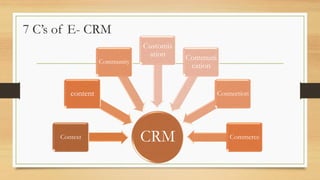
7 C’s of E- CRM
CRMContext
content
Community
Customis
ation Communi
cation
Connection
Commerce
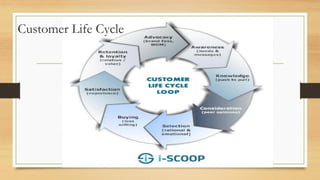
Customer Life Cycle
Marketing applications of CRM
• Benefits of E- CRM
• Permission Marketing
• Customer Profiling
Benefits of E- CRM
• Business Management
• Customer Tracking
• Targeted Marketing
• Integration
• Customer Feedback
• Data Analysis
• Sales Tracking
• Mobility
• Task Management
• Document MAnagement
Permission Marketing
• Permission marketing is an approach to selling goods and services in which a
prospect explicitly agrees in advance to receive marketing information.
• Opt-in e-mail, where Internet users sign up in advance for information about
certain product categories, is a good example of permission marketing.
• It is effective because the prospect is more receptive to a message that has been
requested in advance and more cost-efficient because the prospect is already
identified and targeted.
• In a world of information overload, automated telemarketing, and spam, most
people welcome the idea of Permission Marketing.
Customer Profiling
• Customer profiling is a way to create a portrait of customers to help in make
design decisions concerning the service.
• Customers are broken down into groups of customers sharing similar goals
and characteristics and each group is given a representative with a photo, a
name, and a description.
• A small group of customer profiles or ‘personas’ are then used to make key
design decisions.

E crm

  • 1.
  • 2.
    CRM (Customer RelationshipManagement) • It is customer focused business strategy designed to optimize profitability, revenue and customer satisfaction by recognising the value of customers. • Proper CRM can become competitive strength of organisation • It has becomes more complex due to 1. Increase in product offerings 2. Competition 3. Compressed marketing cycle time
  • 3.
    Principles of CRM •Differentiating customers • Differentiating offerings • Retaining current customers • Maximizing lifetime value for customers • Increasing customer loyalty
  • 4.
    Goals of CRM •To simplify marketing and sales process • To make call centers more efficient • To provide better customer service • To discover new customers and increase customer revenue • To cross sell products more effectively
  • 5.
    Insights of E-CRM • Electronic customer relationship management (E-CRM) is the application of Internet-based technologies such as emails, websites, chat rooms, forums and other channels to achieve CRM objectives. • It is a well-structured and coordinated process of CRM that automates the processes in marketing, sales and customer service.
  • 6.
    7 C’s ofE- CRM CRMContext content Community Customis ation Communi cation Connection Commerce
  • 7.
  • 8.
    Marketing applications ofCRM • Benefits of E- CRM • Permission Marketing • Customer Profiling
  • 9.
    Benefits of E-CRM • Business Management • Customer Tracking • Targeted Marketing • Integration • Customer Feedback • Data Analysis • Sales Tracking • Mobility • Task Management • Document MAnagement
  • 10.
    Permission Marketing • Permissionmarketing is an approach to selling goods and services in which a prospect explicitly agrees in advance to receive marketing information. • Opt-in e-mail, where Internet users sign up in advance for information about certain product categories, is a good example of permission marketing. • It is effective because the prospect is more receptive to a message that has been requested in advance and more cost-efficient because the prospect is already identified and targeted. • In a world of information overload, automated telemarketing, and spam, most people welcome the idea of Permission Marketing.
  • 11.
    Customer Profiling • Customerprofiling is a way to create a portrait of customers to help in make design decisions concerning the service. • Customers are broken down into groups of customers sharing similar goals and characteristics and each group is given a representative with a photo, a name, and a description. • A small group of customer profiles or ‘personas’ are then used to make key design decisions.