15-05-2020 1Vijayakumar H B,Assistant Professor
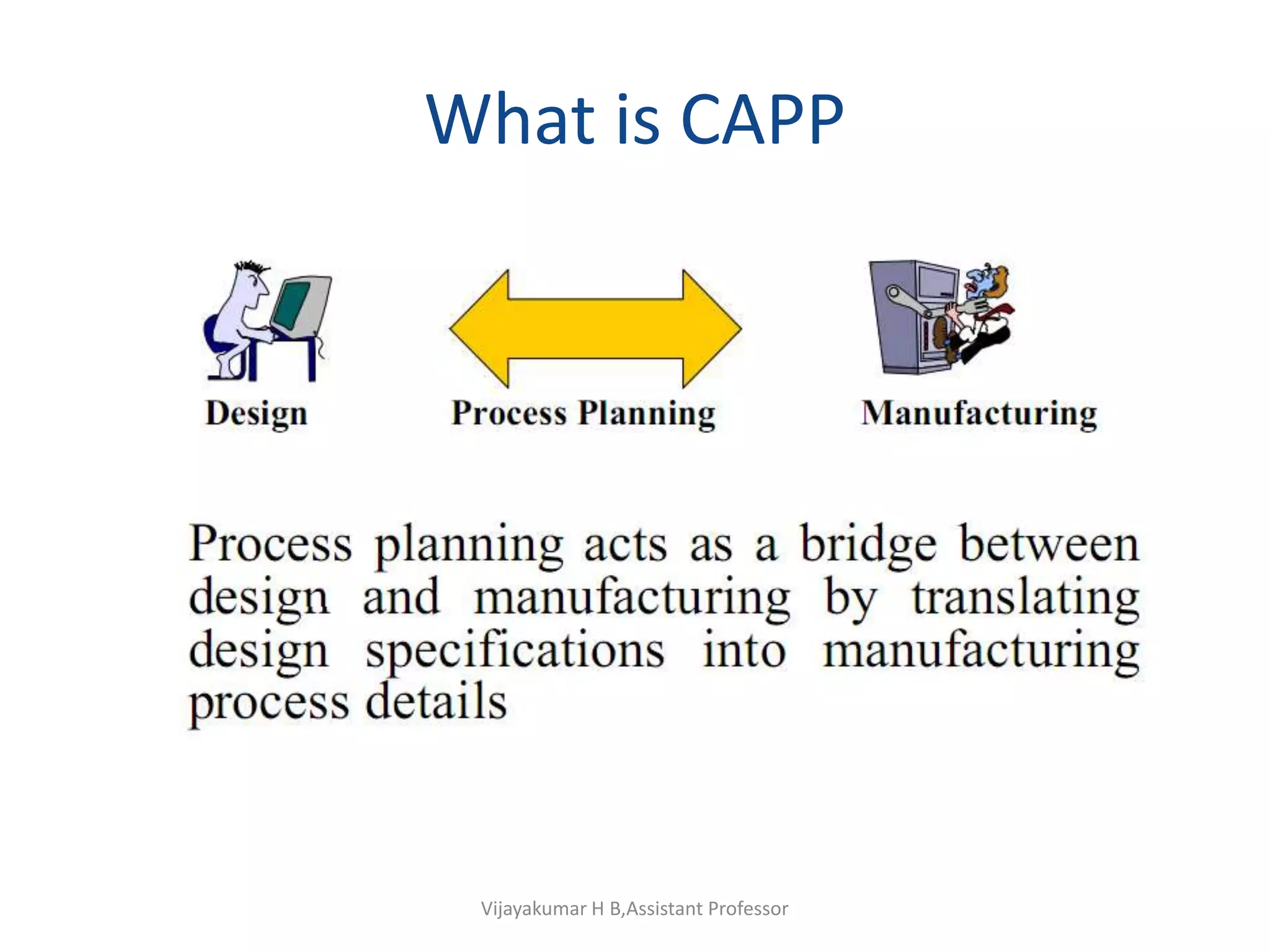
What is CAPP
Vijayakumar H B,Assistant Professor
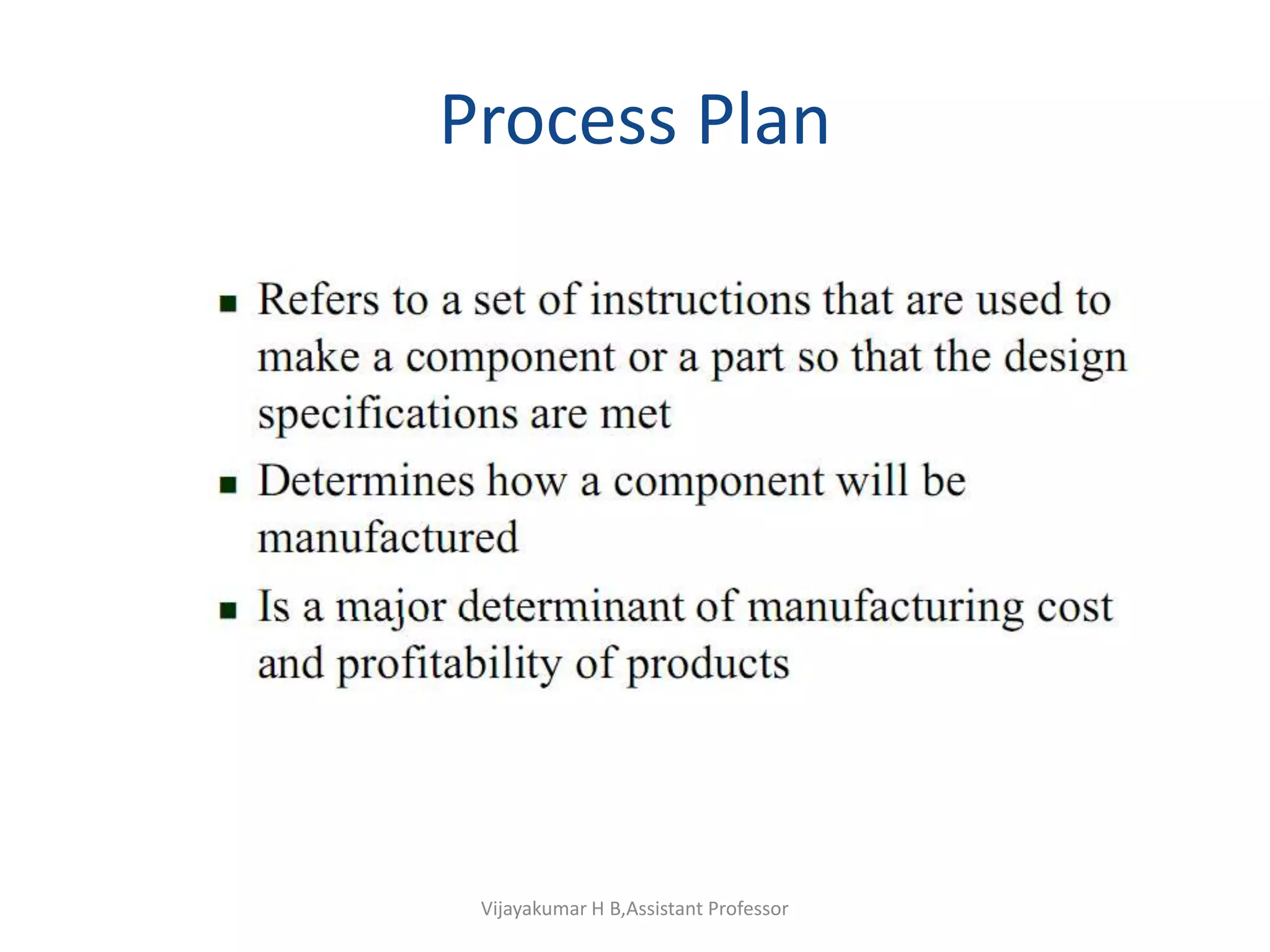
Process Plan
Vijayakumar H B,Assistant Professor
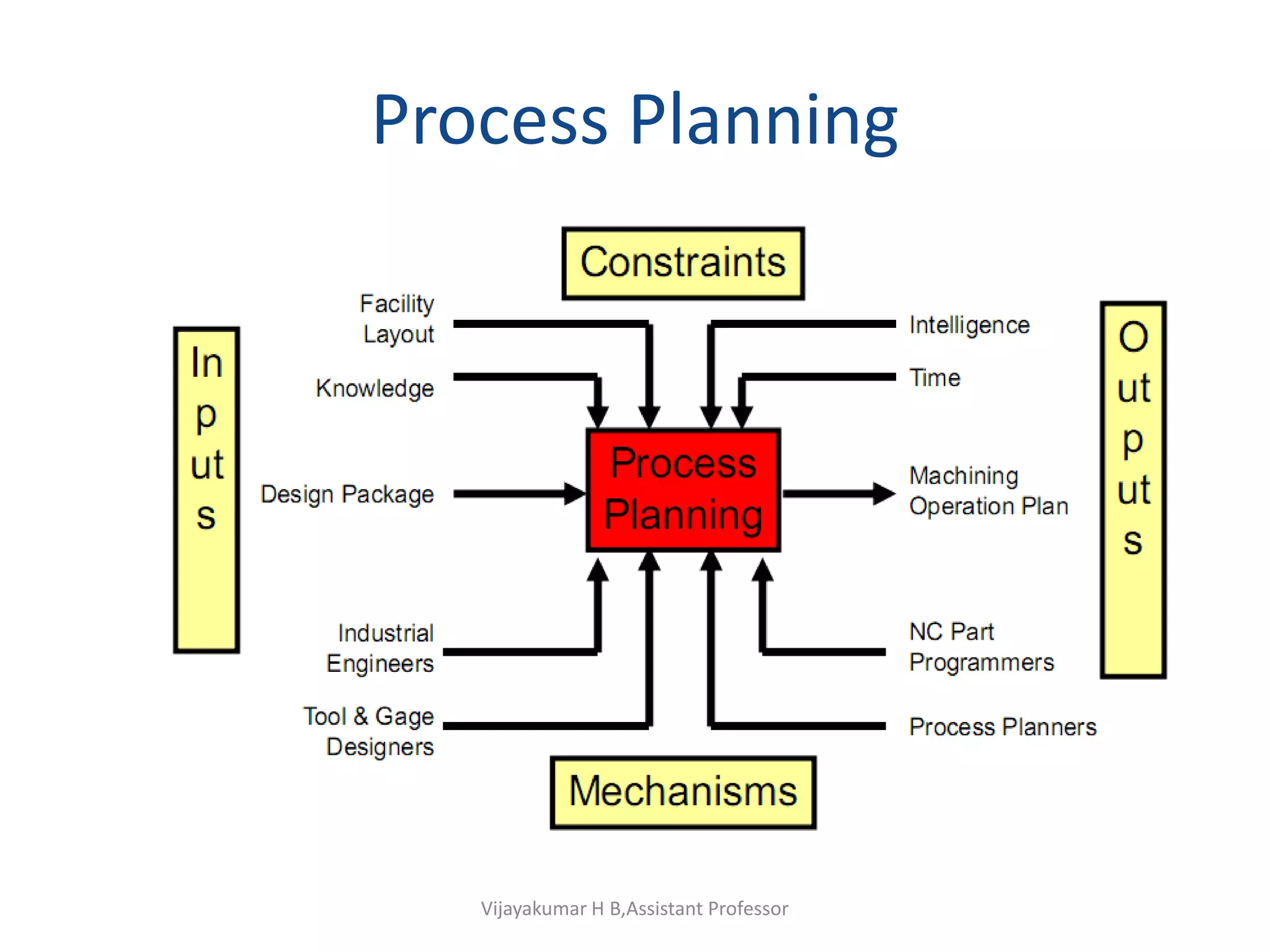
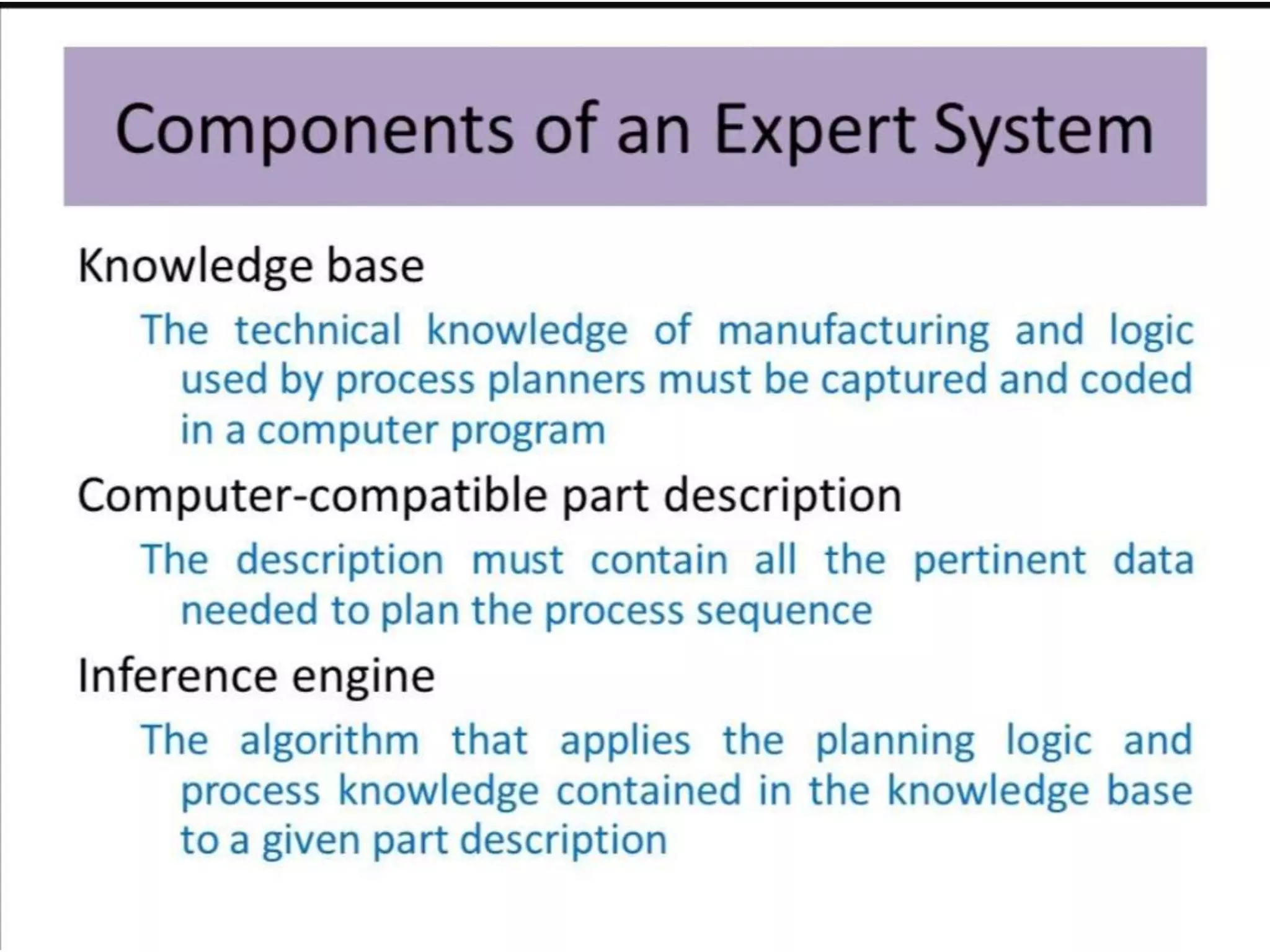
Process Planning
Vijayakumar H B,Assistant Professor
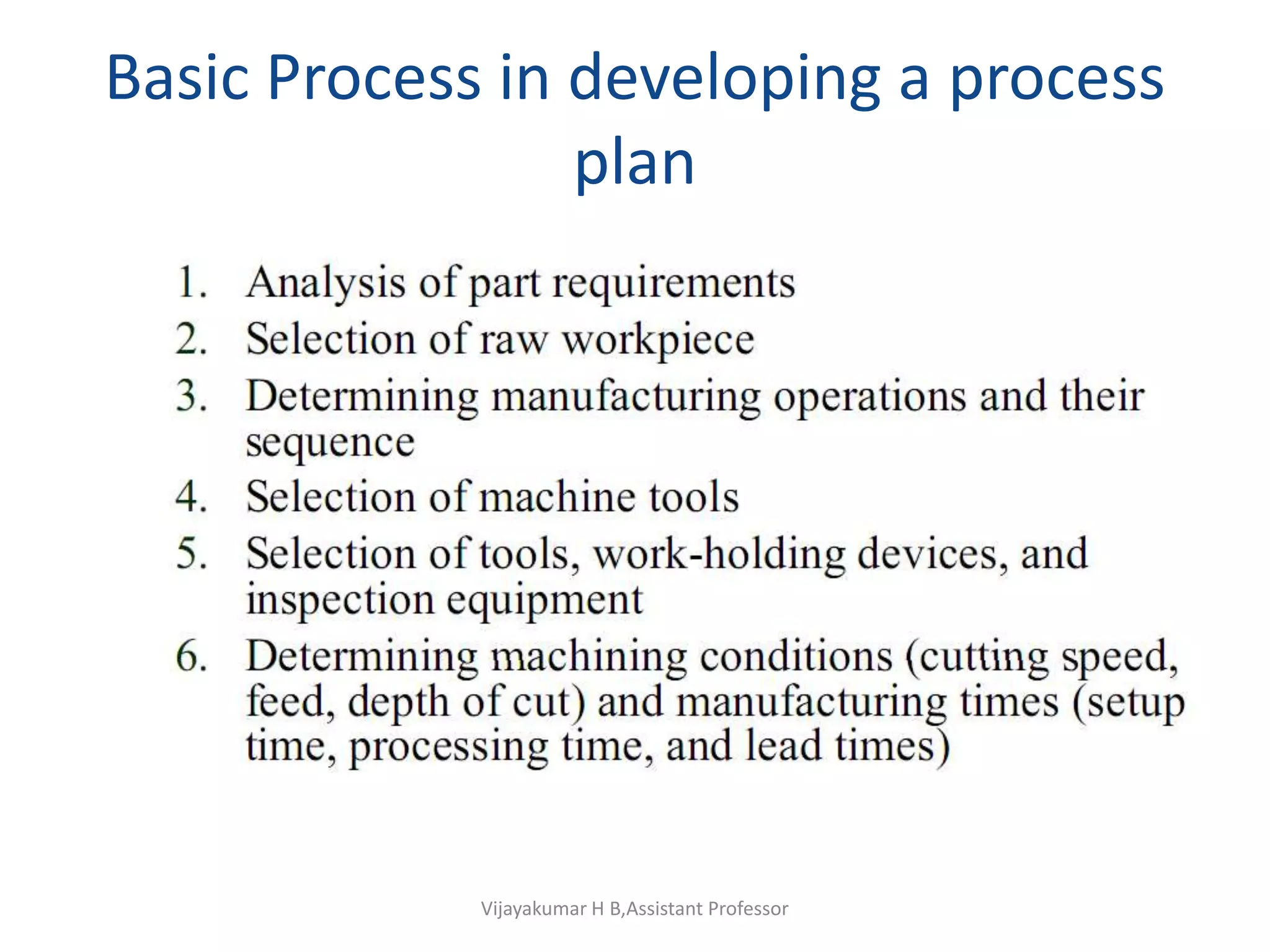
Basic Process in developing a process
plan
Vijayakumar H B,Assistant Professor
Process Planning Approaches
• Manual Systems
• Computer Aided Process Planning
– Retrieval(Variant)CAPP System
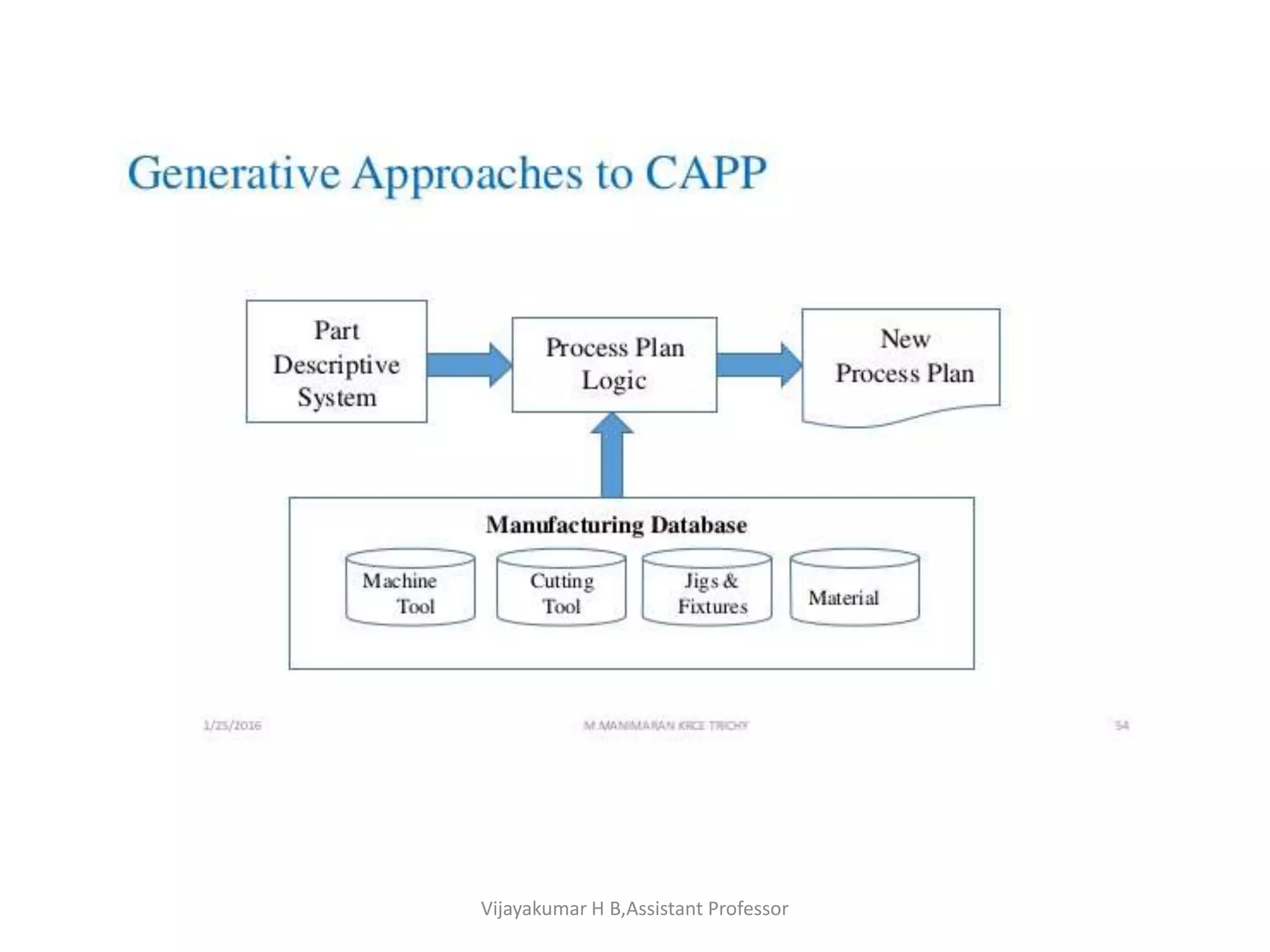
– Generative CAPP System
Vijayakumar H B,Assistant Professor
Process Planning Approaches
• Manual Systems
• Computer Aided Process Planning
– Retrieval(Variant)CAPP System
– Generative CAPP System
Vijayakumar H B,Assistant Professor
Process Planning Approaches
• Manual Systems
• Computer Aided Process Planning
– Retrieval(Variant)CAPP System
– Generative CAPP System
Vijayakumar H B,Assistant Professor
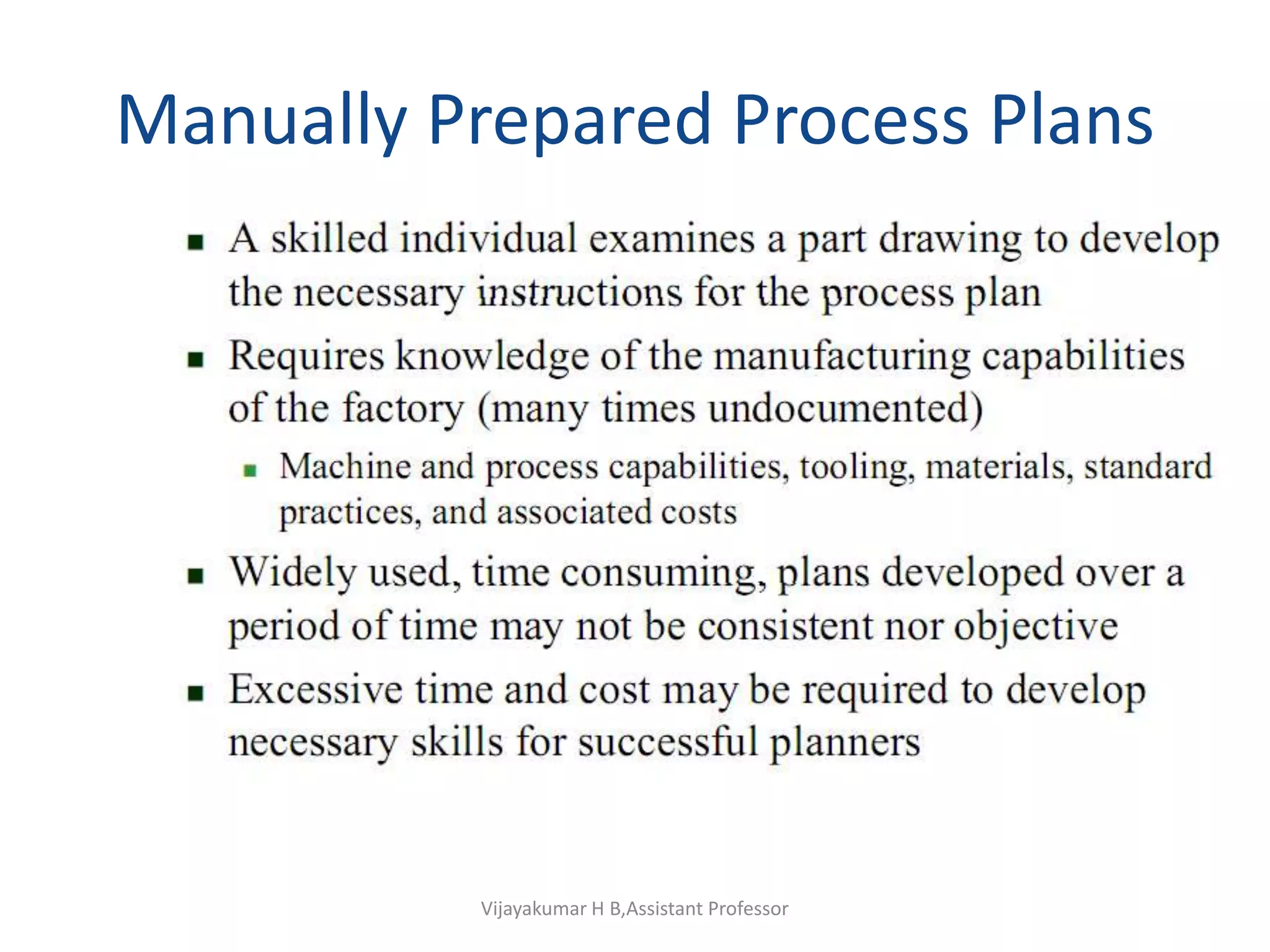
Manually Prepared Process Plans
Vijayakumar H B,Assistant Professor
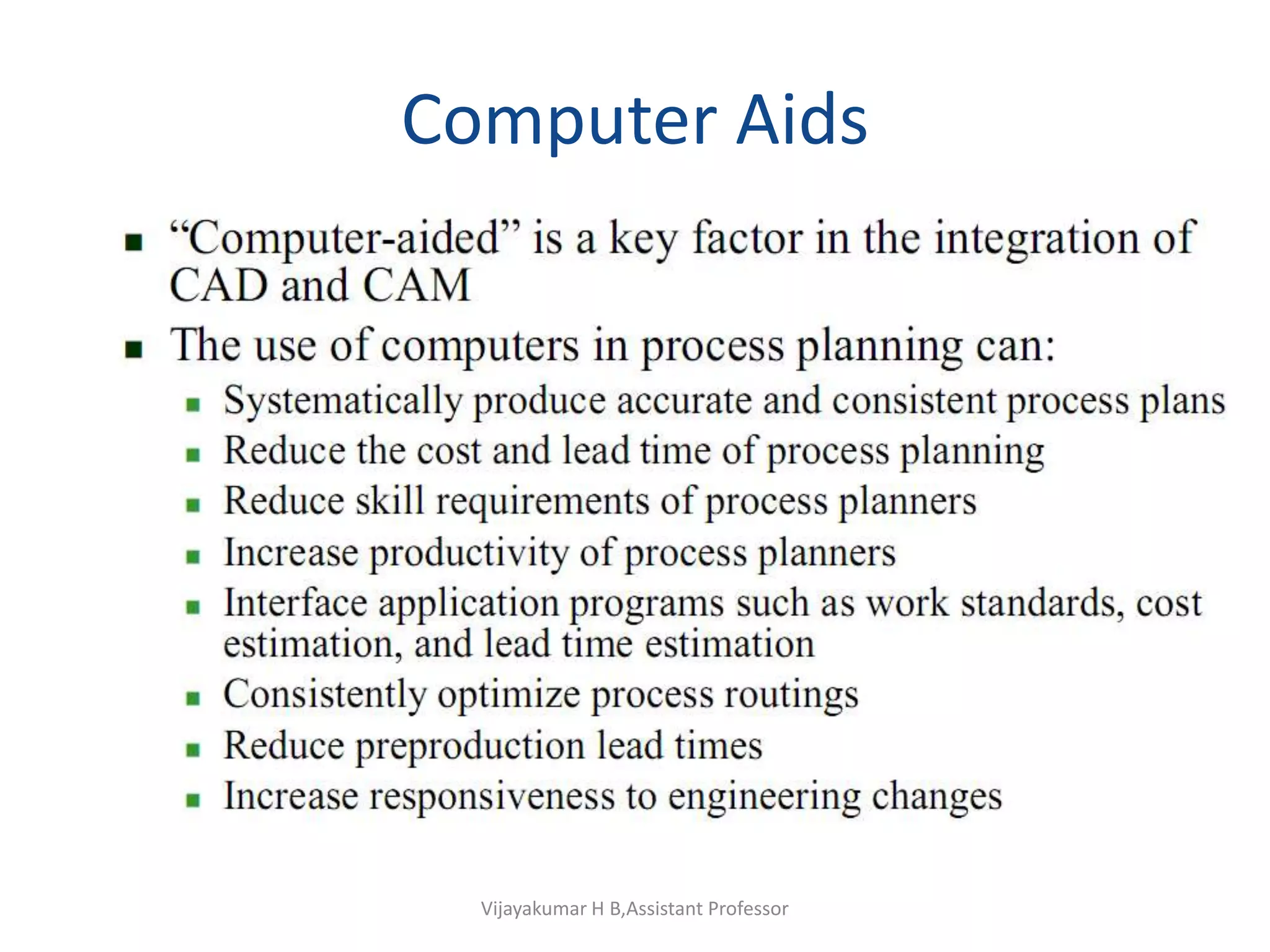
Computer Aids
Vijayakumar H B,Assistant Professor
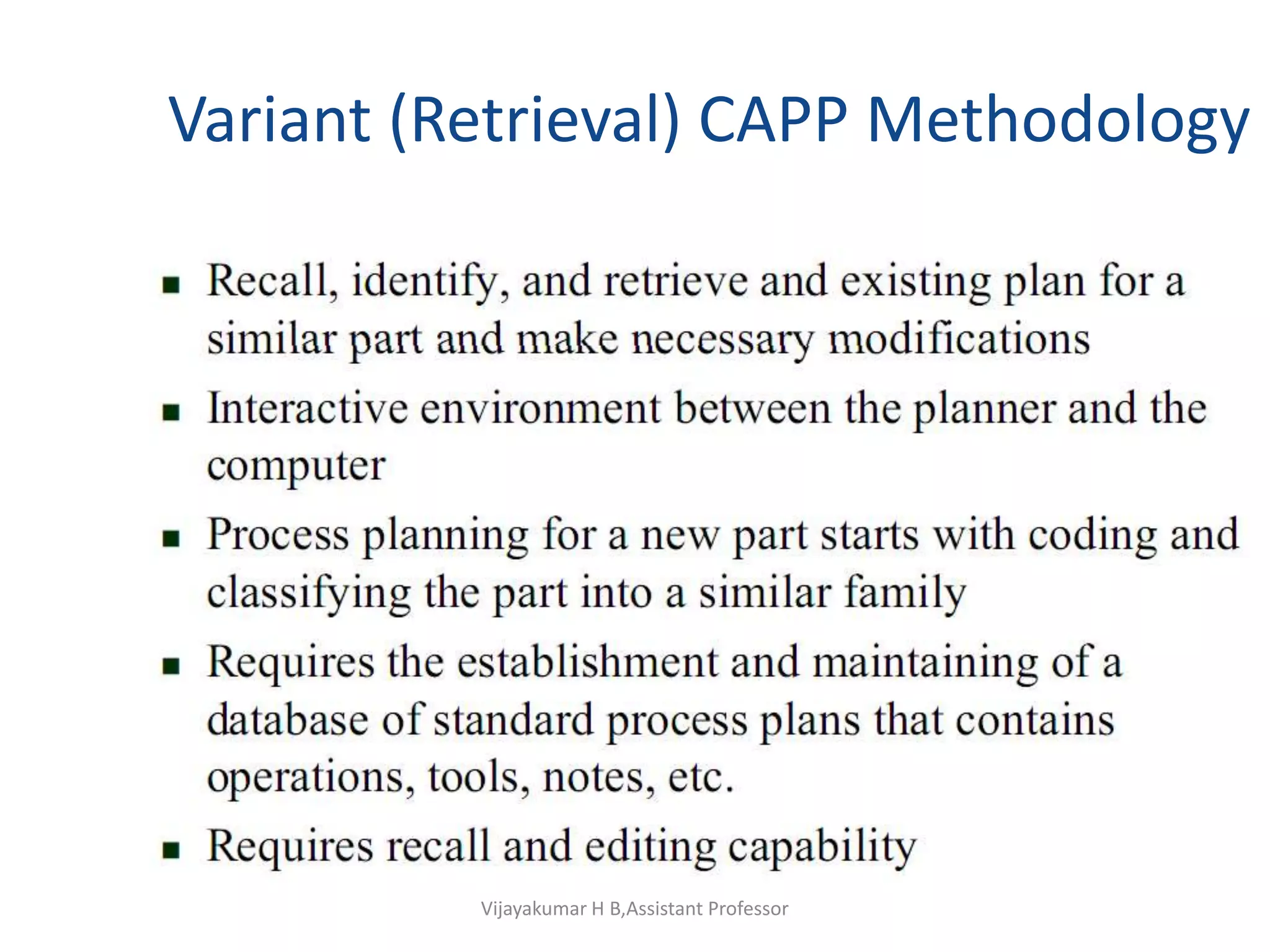
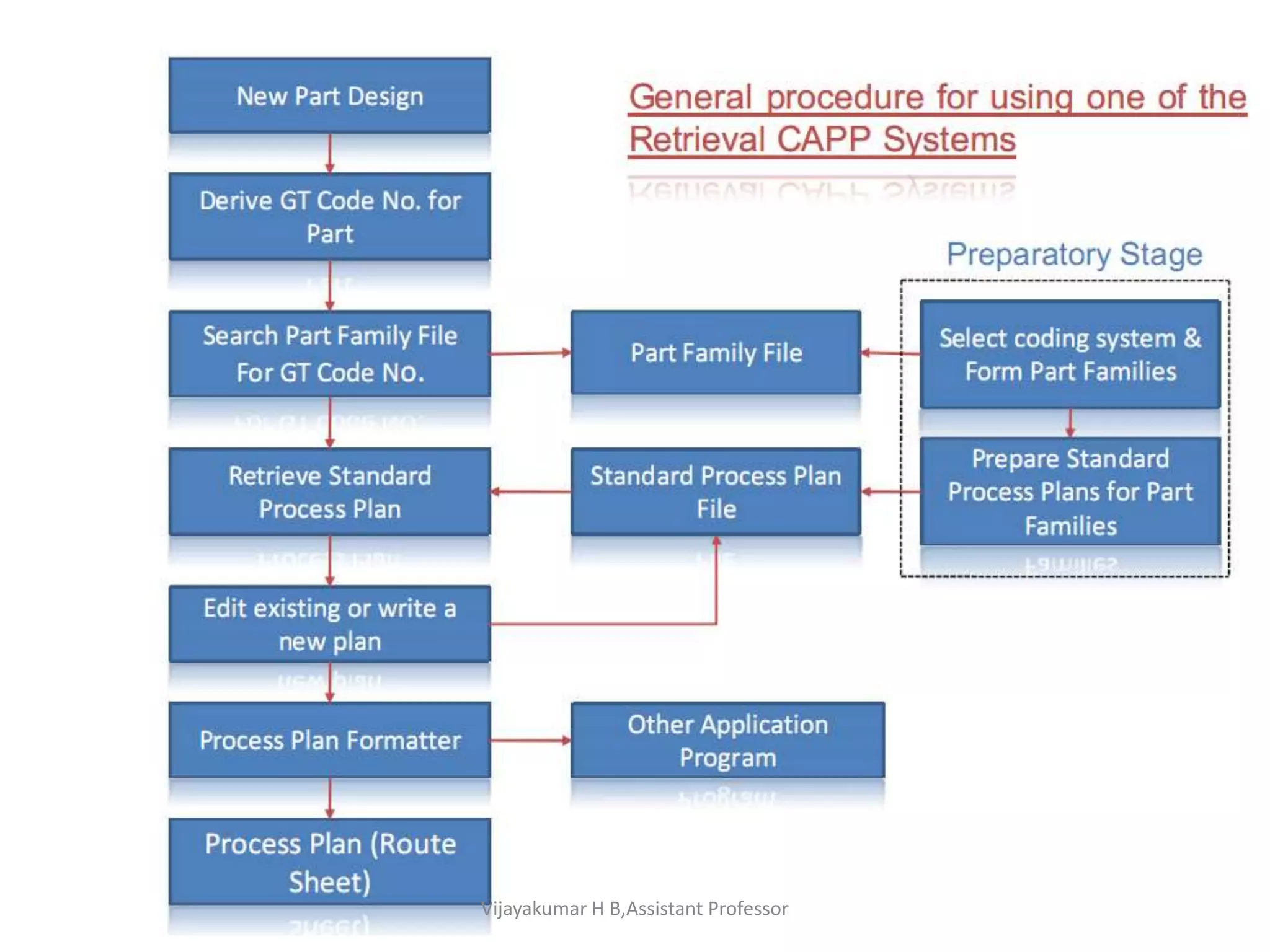
Variant (Retrieval) CAPP Methodology
Vijayakumar H B,Assistant Professor
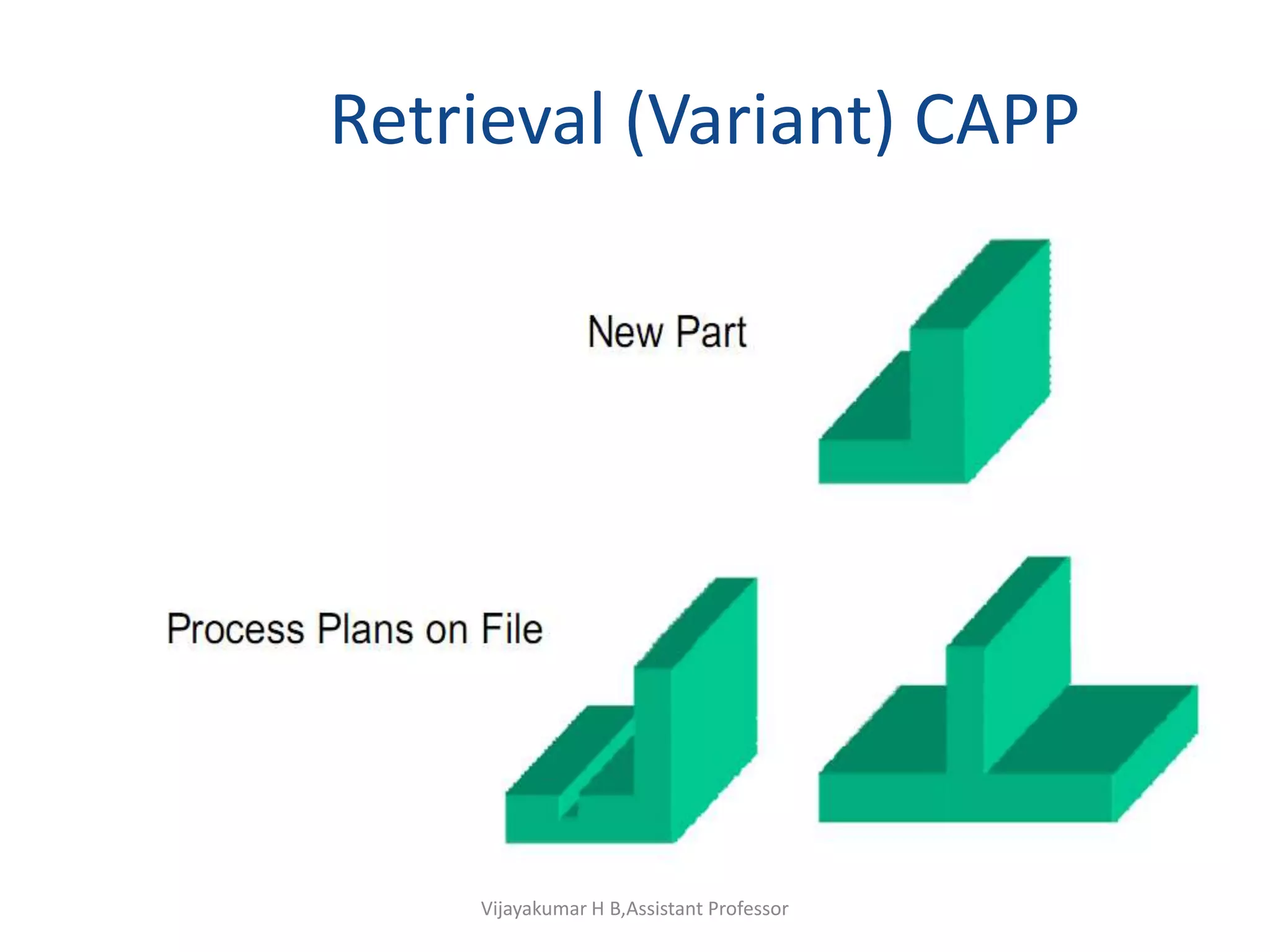
Retrieval (Variant) CAPP
Vijayakumar H B,Assistant Professor
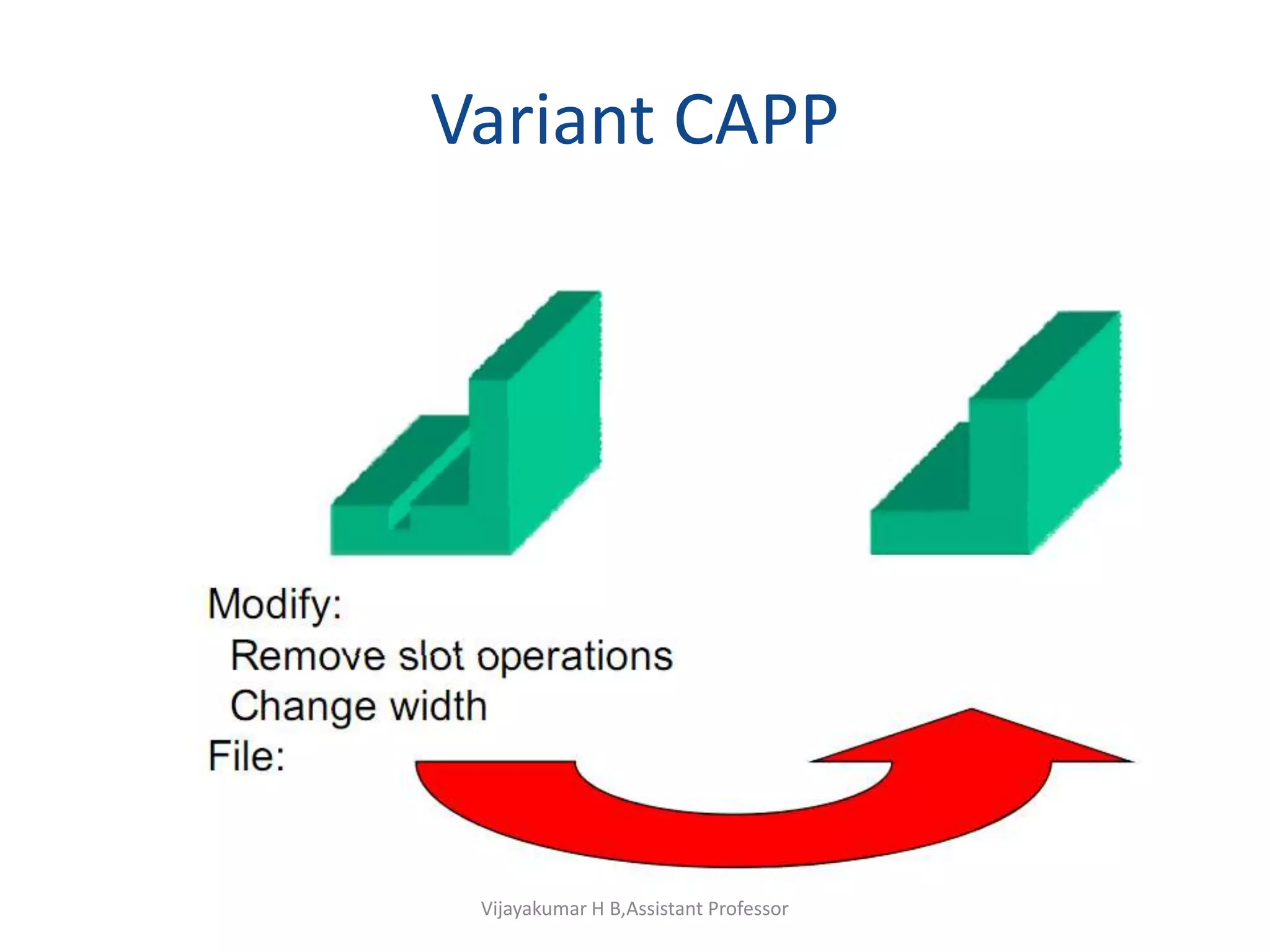
Variant CAPP
Vijayakumar H B,Assistant Professor
15-05-2020 Vijayakumar H B,Assistant Professor 15
Group Technology (GT) Defined
A manufacturing philosophy in which similar parts are identified
and grouped together to take advantage of their similarities in
design and production
• Similarities among parts permit them to be classified into part
families
– In each part family, processing steps are similar
• The improvement is typically achieved by organizing the
production facilities into manufacturing cells that specialize in
production of certain part families
Vijayakumar H B,Assistant Professor
15-05-2020 Vijayakumar H B,Assistant Professor 16
Part Family
A collection of parts that possess similarities in
geometric shape and size, or in the processing
steps used in their manufacture
• Part families are a central feature of group
technology
– There are always differences among parts in a
family
– But the similarities are close enough that the parts
can be grouped into the same family
Vijayakumar H B,Assistant Professor
15-05-2020 Vijayakumar H B,Assistant Professor 17
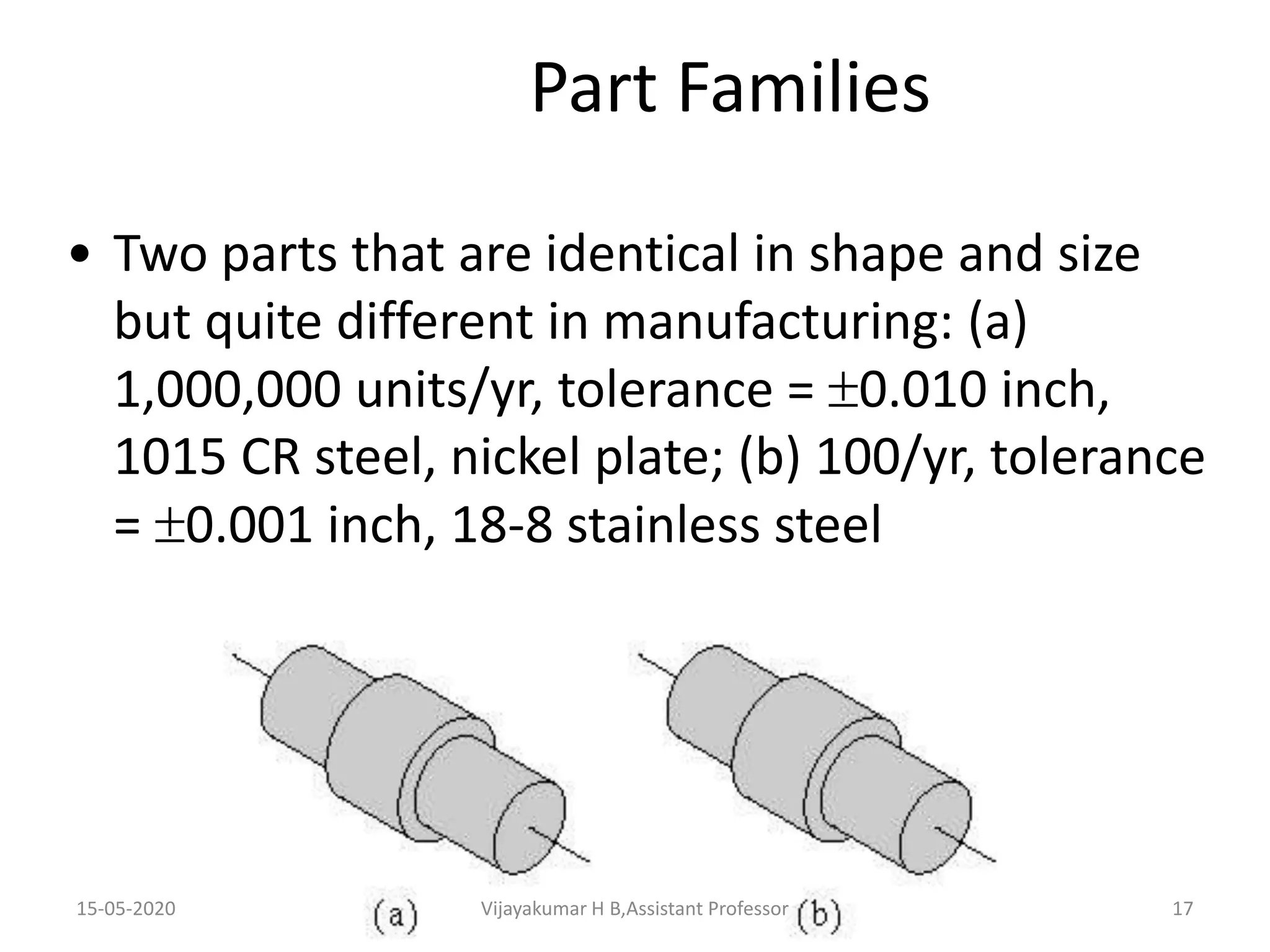
Part Families
• Two parts that are identical in shape and size
but quite different in manufacturing: (a)
1,000,000 units/yr, tolerance = 0.010 inch,
1015 CR steel, nickel plate; (b) 100/yr, tolerance
= 0.001 inch, 18-8 stainless steel
Vijayakumar H B,Assistant Professor
15-05-2020 Vijayakumar H B,Assistant Professor 18
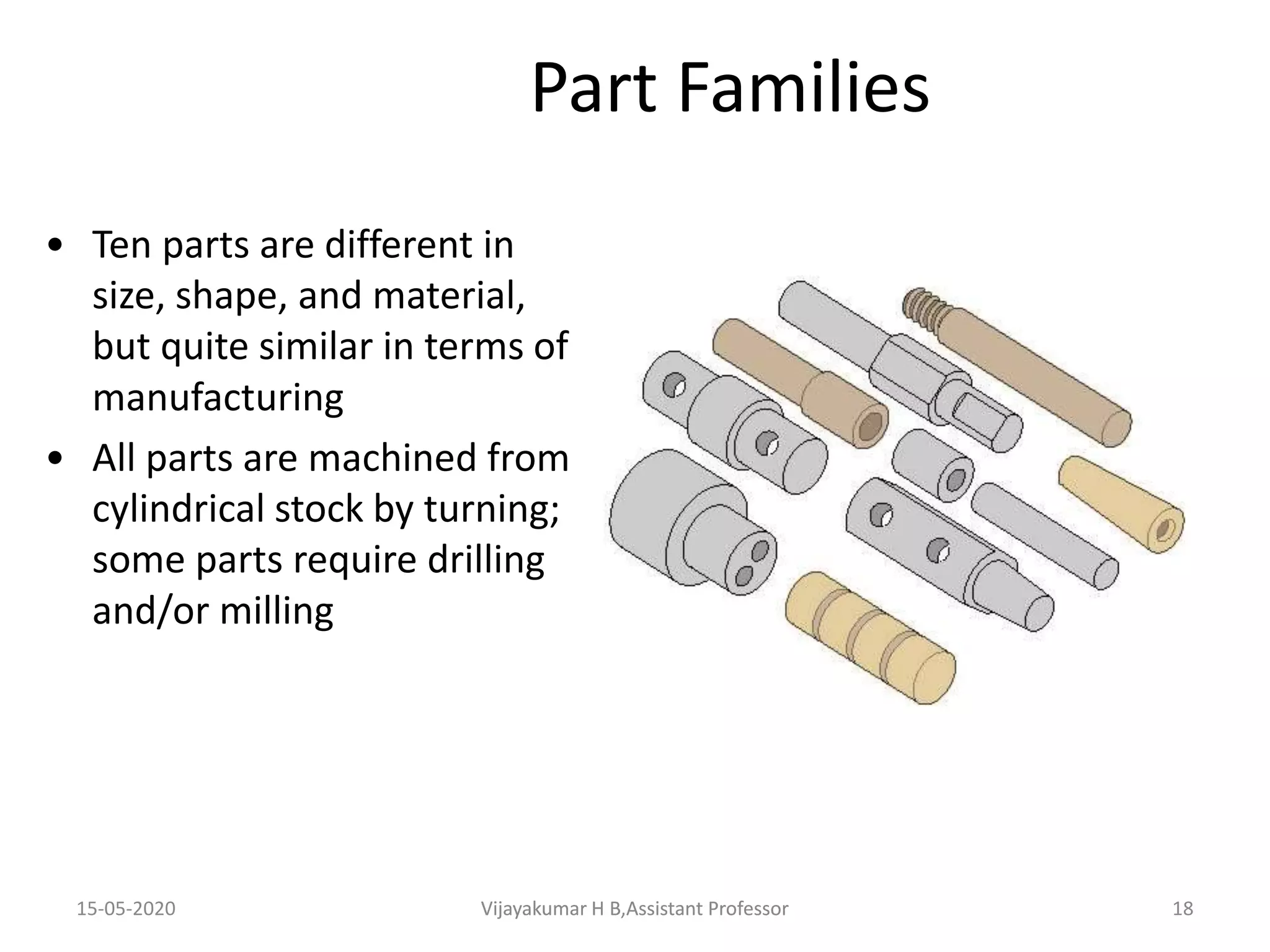
Part Families
• Ten parts are different in
size, shape, and material,
but quite similar in terms of
manufacturing
• All parts are machined from
cylindrical stock by turning;
some parts require drilling
and/or milling
Vijayakumar H B,Assistant Professor
15-05-2020 23
Vijayakumar H B , Assistant
Professor
Material Requirements Planning (MRP)
Computer-based information system for ordering
and scheduling of dependent-demand
inventories, i.e. what is needed, how much is
needed, and when is it needed
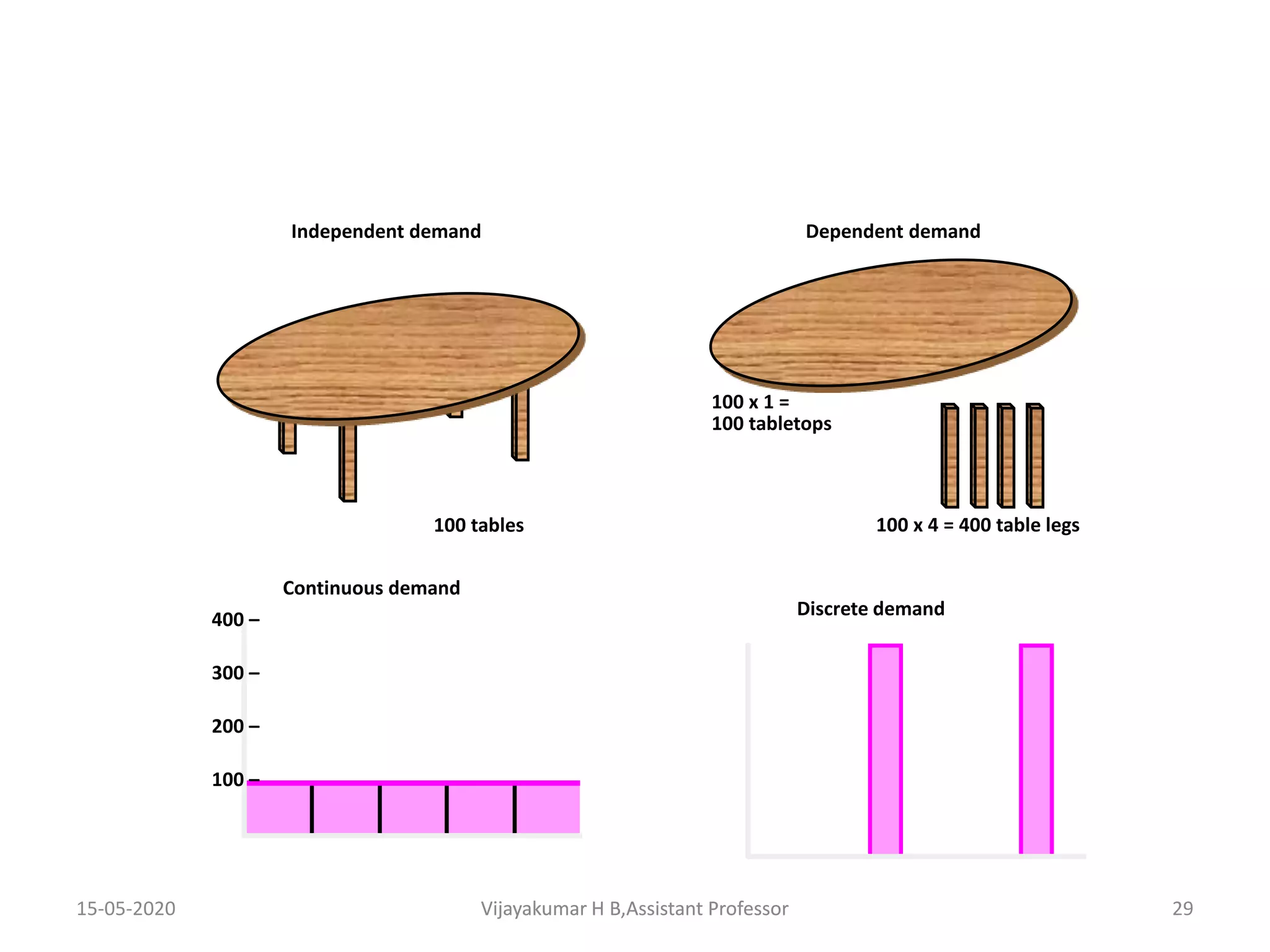
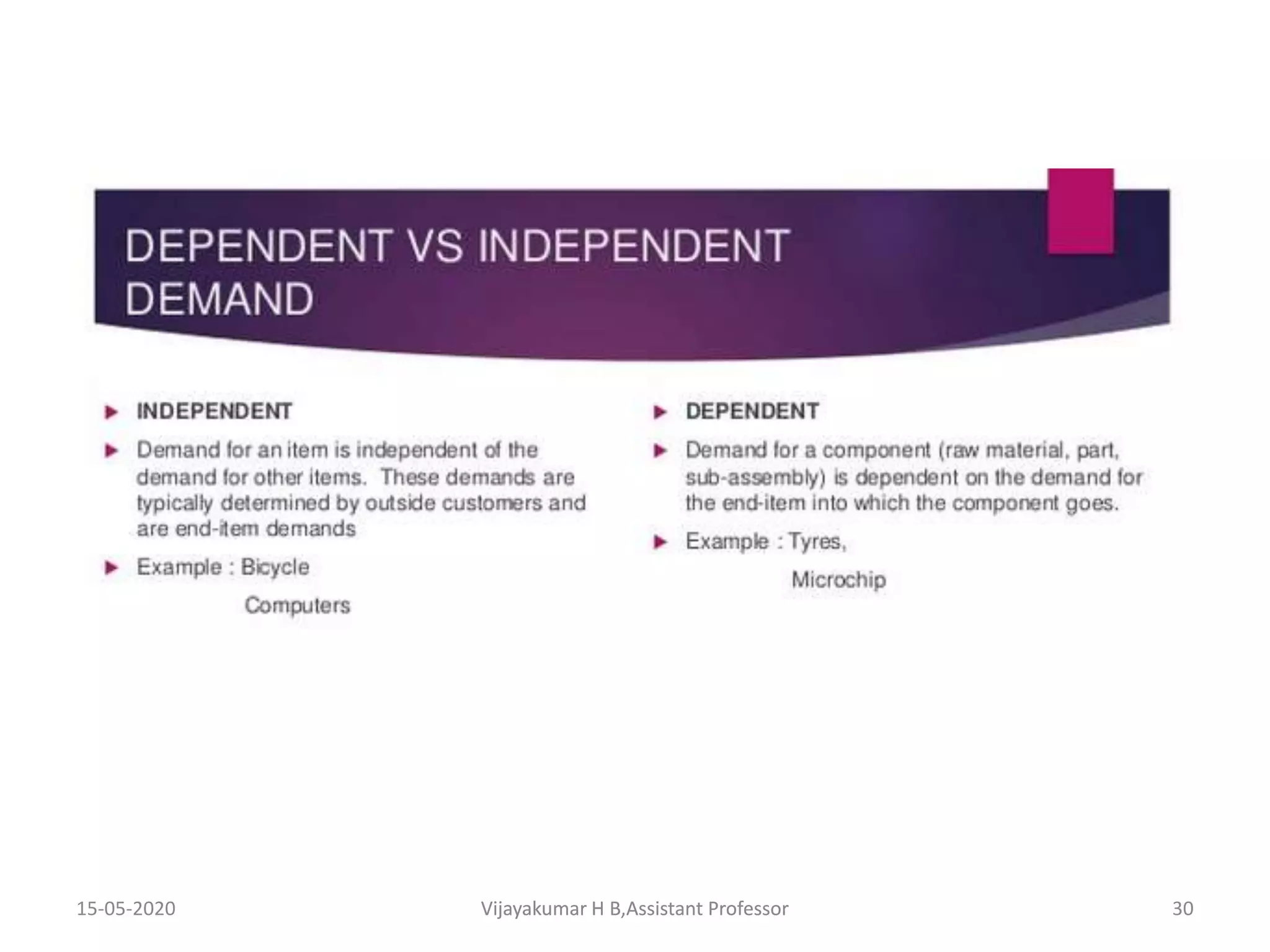
– Dependent demand – Demand for items that are sub-
assemblies, parts or raw materials to be used in the
production of finished goods.
– Independent demand – finished products
15-05-2020 24Vijayakumar H B,Assistant ProfessorVijayakumar H B,Assistant Professor
How does MRP work?
• The goal of the MRP or Material Requirements Planning
document is to supply information that will enable the company to
have enough inventory on hand to fulfill demand, available only
when needed, at a quality level that meets specification, (but does
not have to exceed it) and at the lowest price.
• A good MRP or Material Requirements Planning program can
provide the basic needs of keeping inventory levels low and
fulfilling customer expectations for on time delivery.
15-05-2020 25Vijayakumar H B,Assistant ProfessorVijayakumar H B,Assistant Professor
There are two important questions to ask
here. How much of an item is needed? When is
an item needed to complete a specified number
of units, in a specified period of time? The MRP
process involves the following steps:
• Determine the gross requirements for a particular
item
• Determine the net requirements and when
orders will be released for fabrication or
subassembly
• Net Requirements = Total Requirements –
Available Inventory
• Net Requirements = (Gross Requirements +
Allocations) – (On Hand) + Scheduled Receipts
15-05-2020 26Vijayakumar H B,Assistant ProfessorVijayakumar H B,Assistant Professor
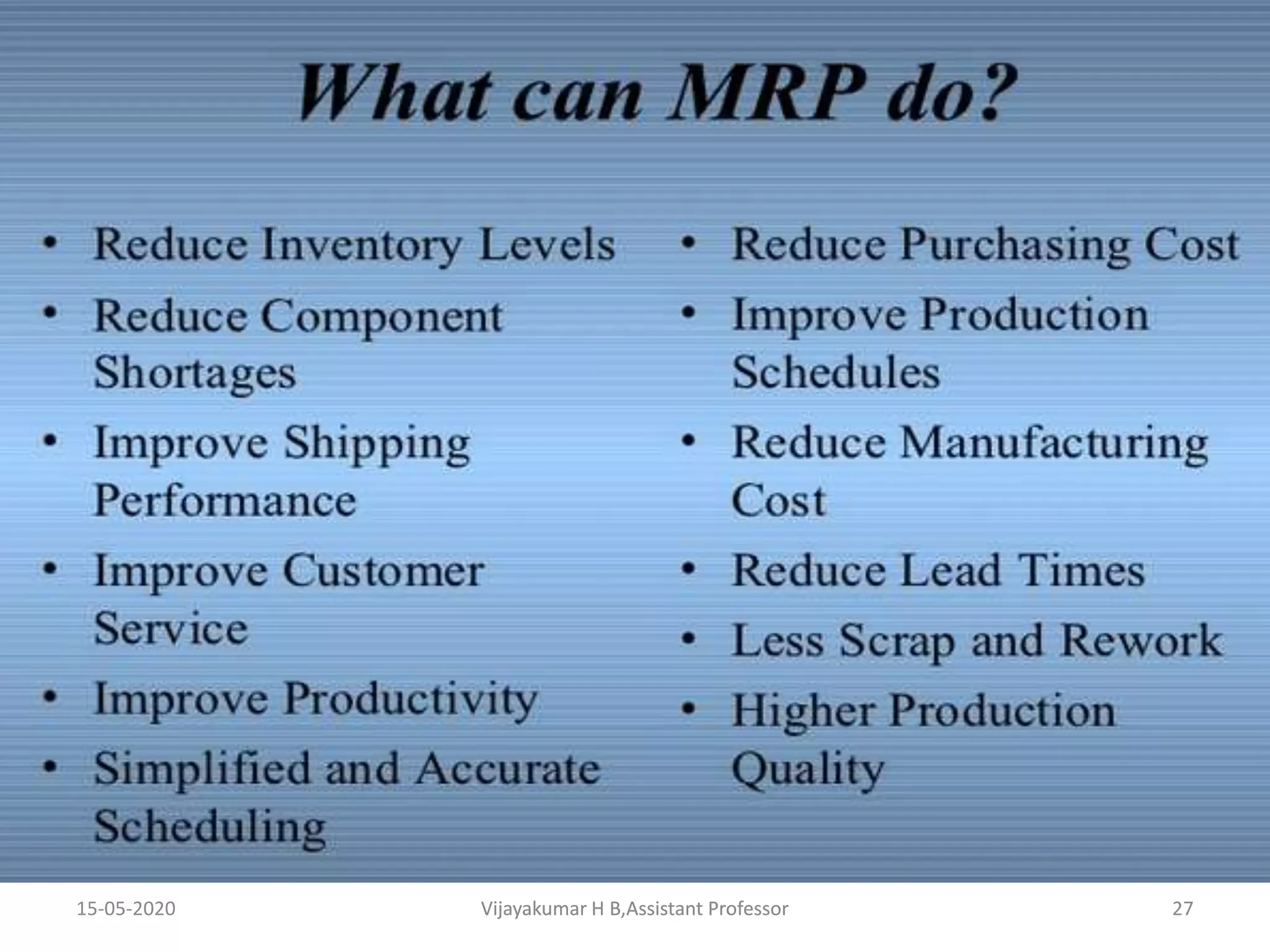
15-05-2020 27Vijayakumar H B,Assistant ProfessorVijayakumar H B,Assistant Professor
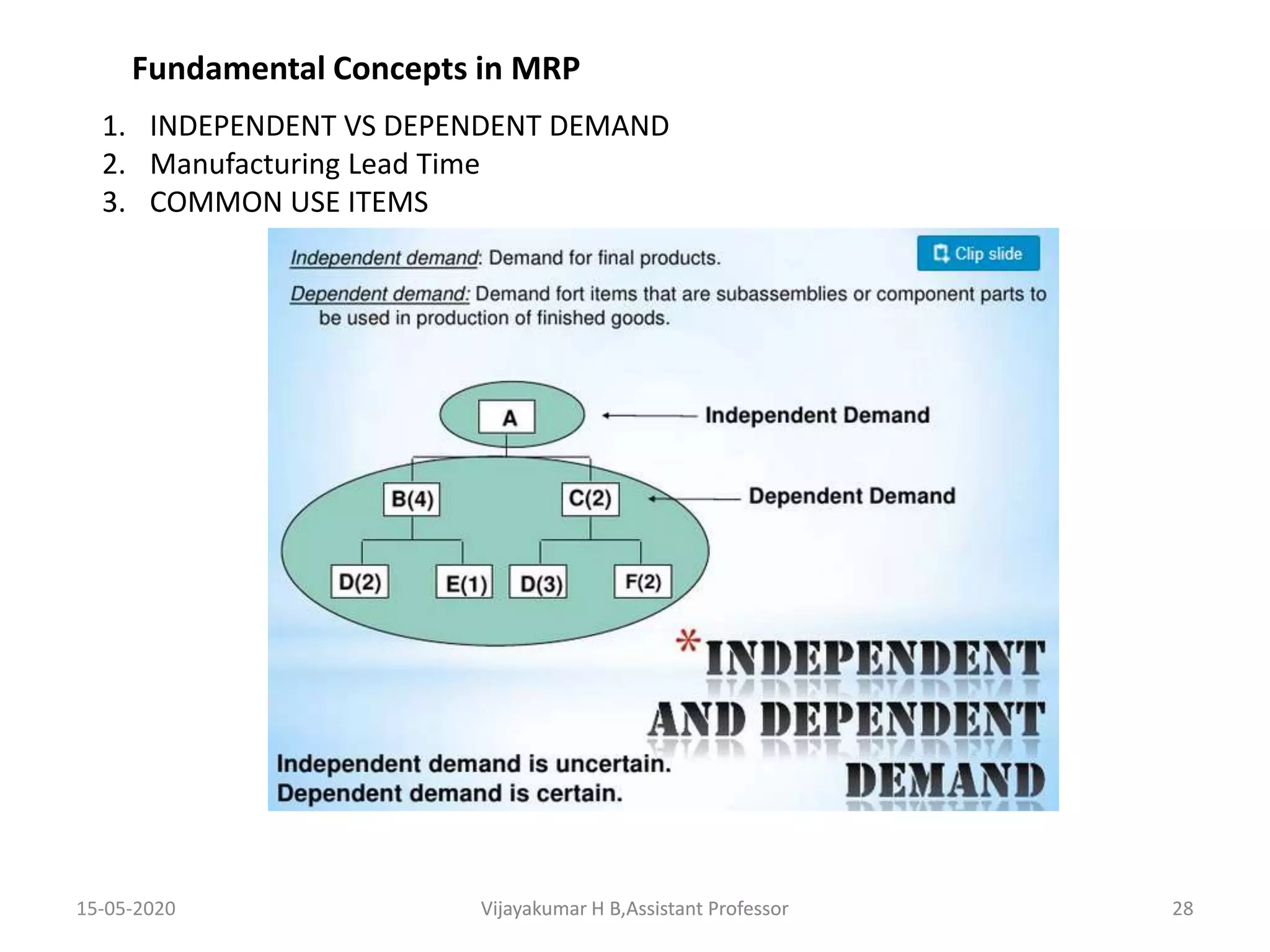
Fundamental Concepts in MRP
1. INDEPENDENT VS DEPENDENT DEMAND
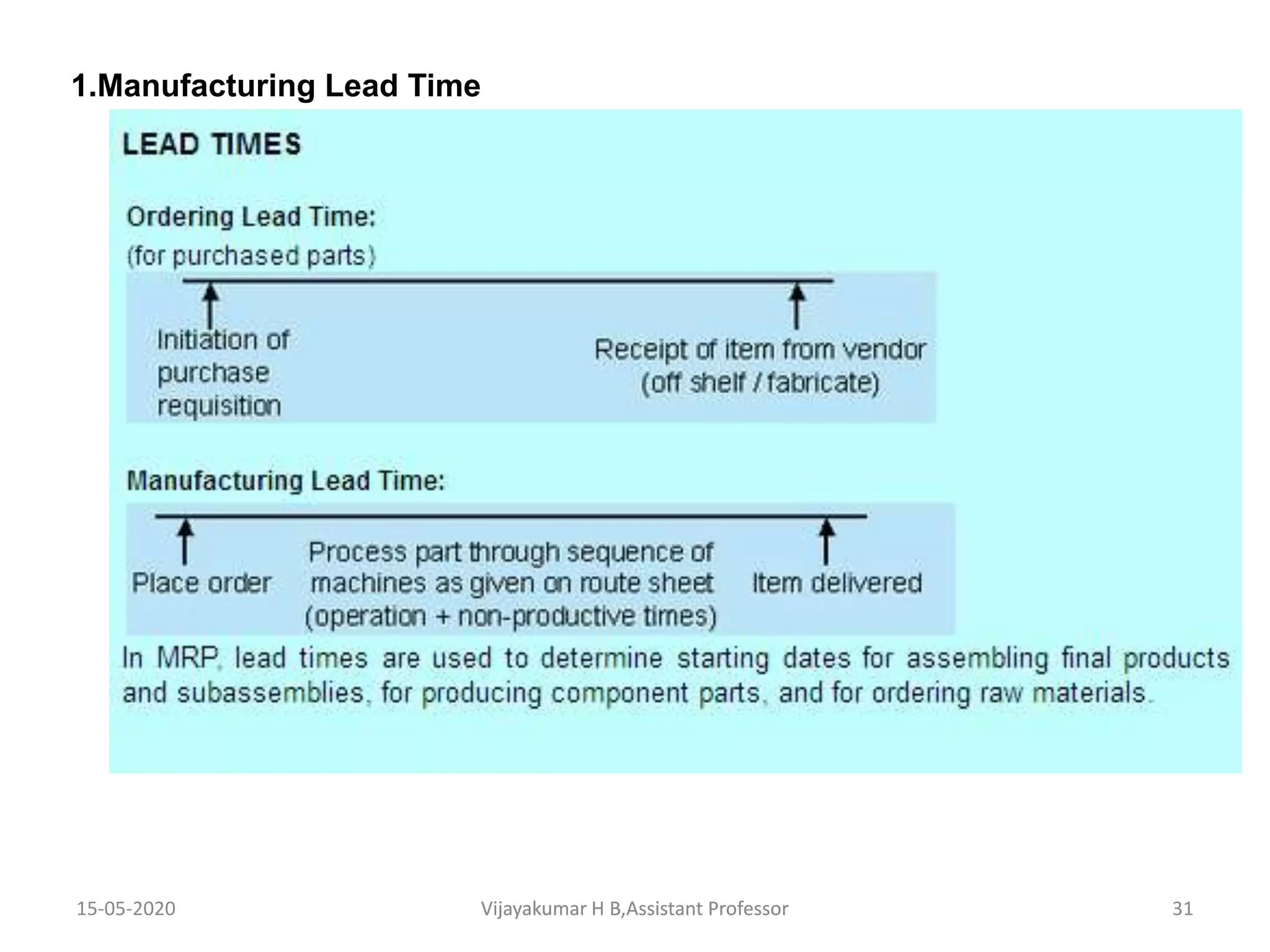
2. Manufacturing Lead Time
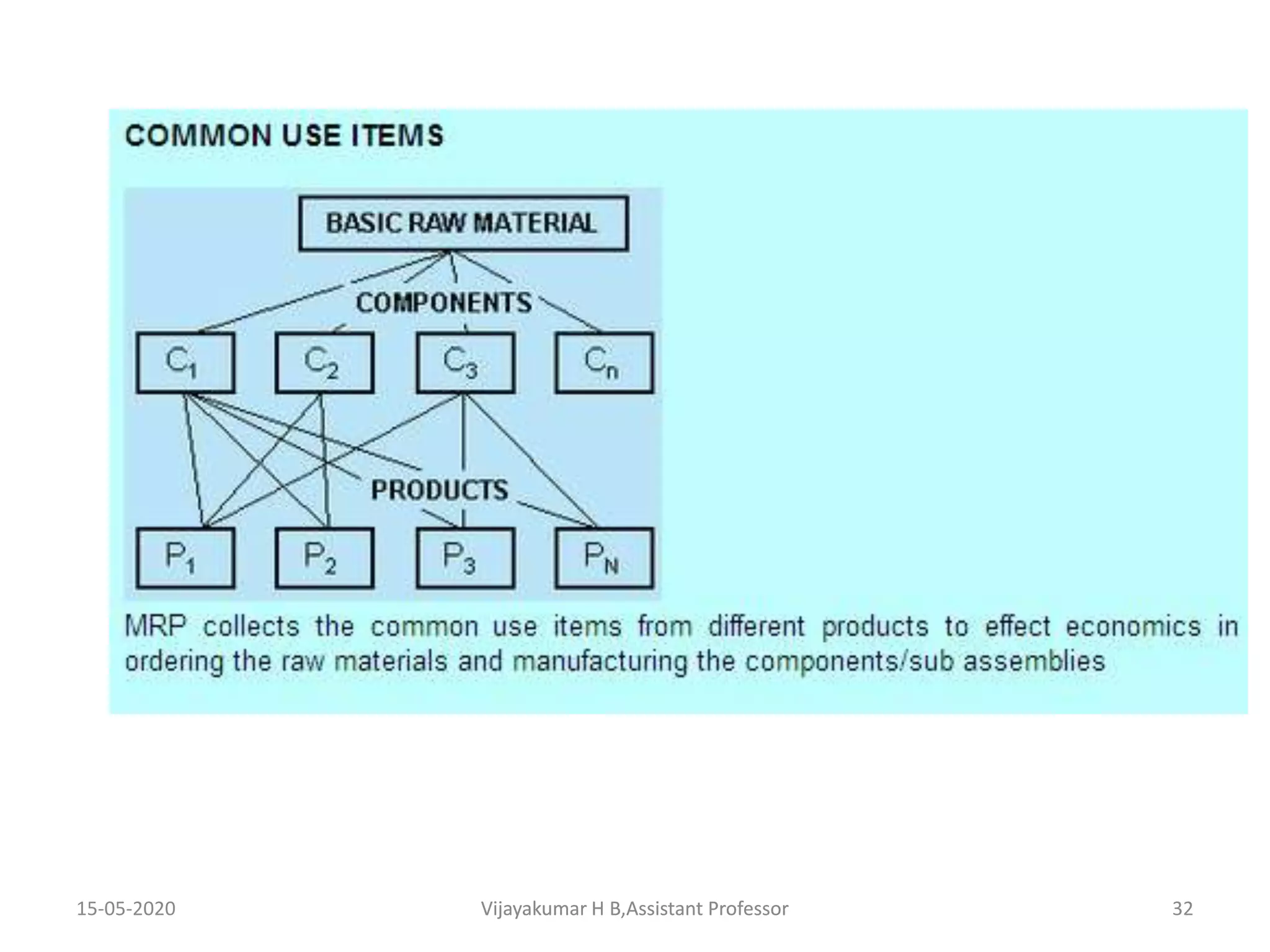
3. COMMON USE ITEMS
15-05-2020 28Vijayakumar H B,Assistant ProfessorVijayakumar H B,Assistant Professor
400 –
300 –
200 –
100 –
Continuous demand
Discrete demand
Independent demand
100 tables
Dependent demand
100 x 1 =
100 tabletops
100 x 4 = 400 table legs
15-05-2020 29Vijayakumar H B,Assistant ProfessorVijayakumar H B,Assistant Professor
15-05-2020 Vijayakumar H B,Assistant Professor 30Vijayakumar H B,Assistant Professor
15-05-2020 31Vijayakumar H B,Assistant ProfessorVijayakumar H B,Assistant Professor
1.Manufacturing Lead Time
15-05-2020 32Vijayakumar H B,Assistant ProfessorVijayakumar H B,Assistant Professor
15-05-2020 33Vijayakumar H B,Assistant ProfessorVijayakumar H B,Assistant Professor
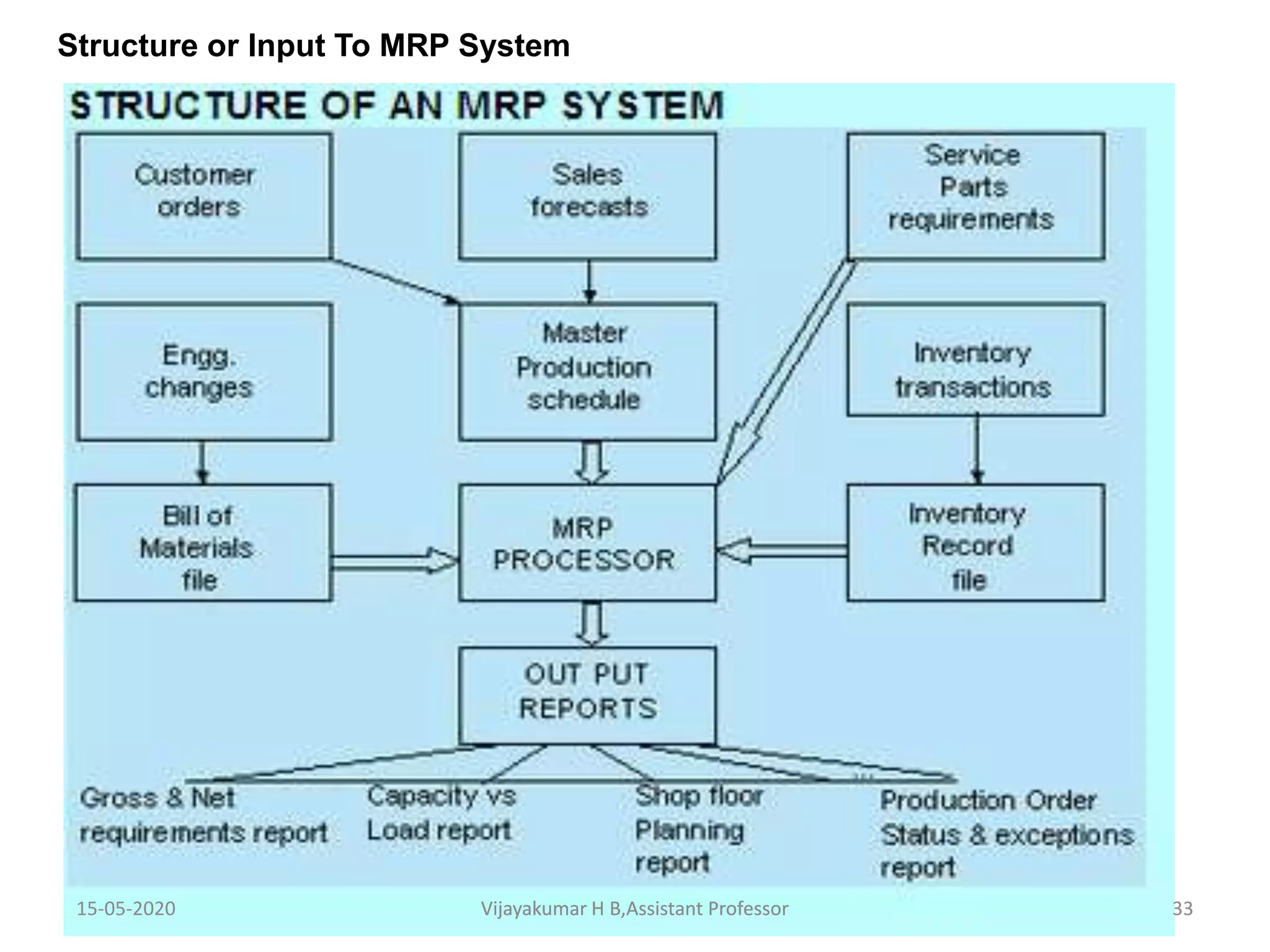
Structure or Input To MRP System
Vijayakumar H B,Assistant Professor
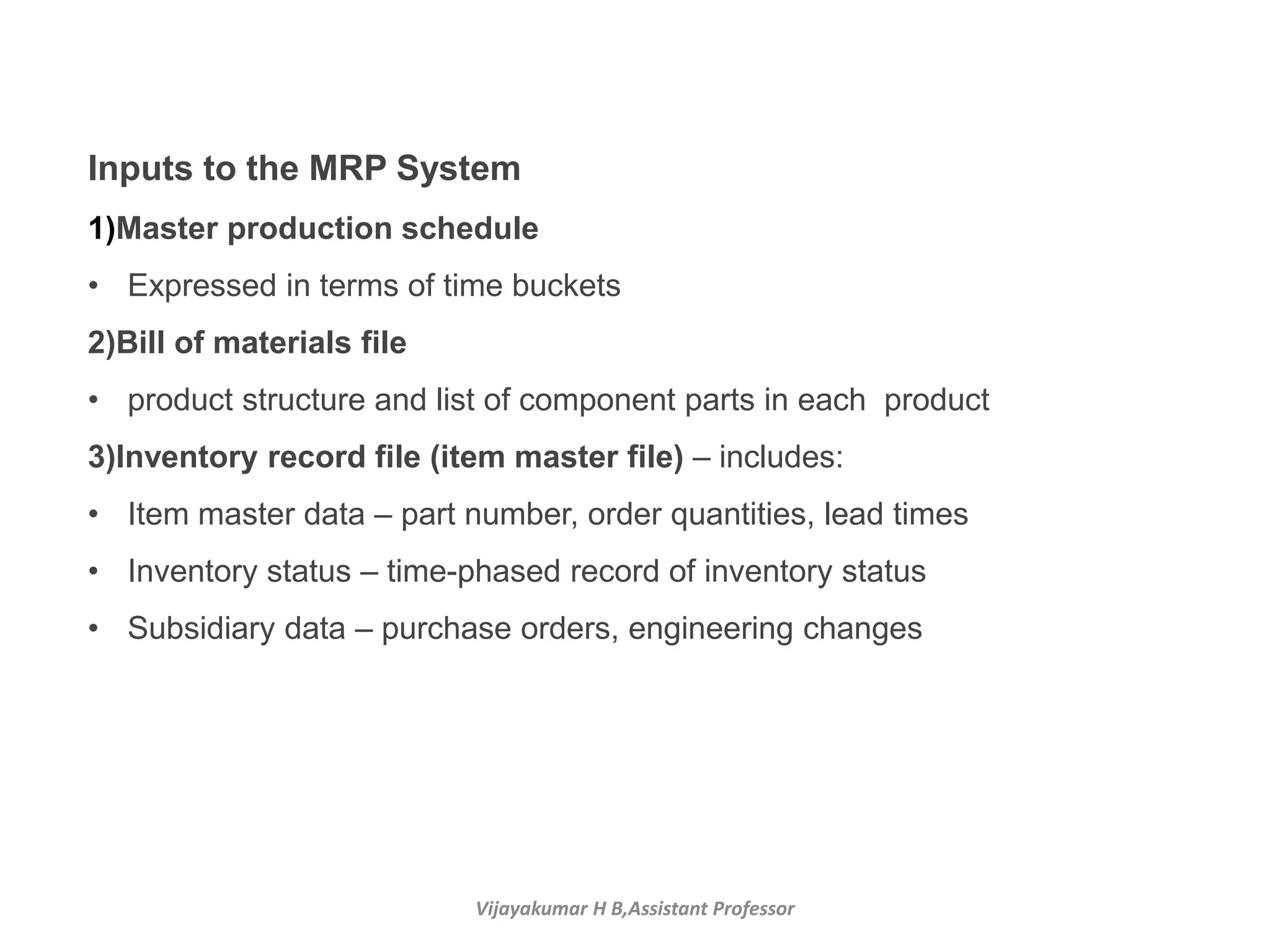
Inputs to the MRP System
1)Master production schedule
• Expressed in terms of time buckets
2)Bill of materials file
• product structure and list of component parts in each product
3)Inventory record file (item master file) – includes:
• Item master data – part number, order quantities, lead times
• Inventory status – time-phased record of inventory status
• Subsidiary data – purchase orders, engineering changes
Vijayakumar H B,Assistant Professor
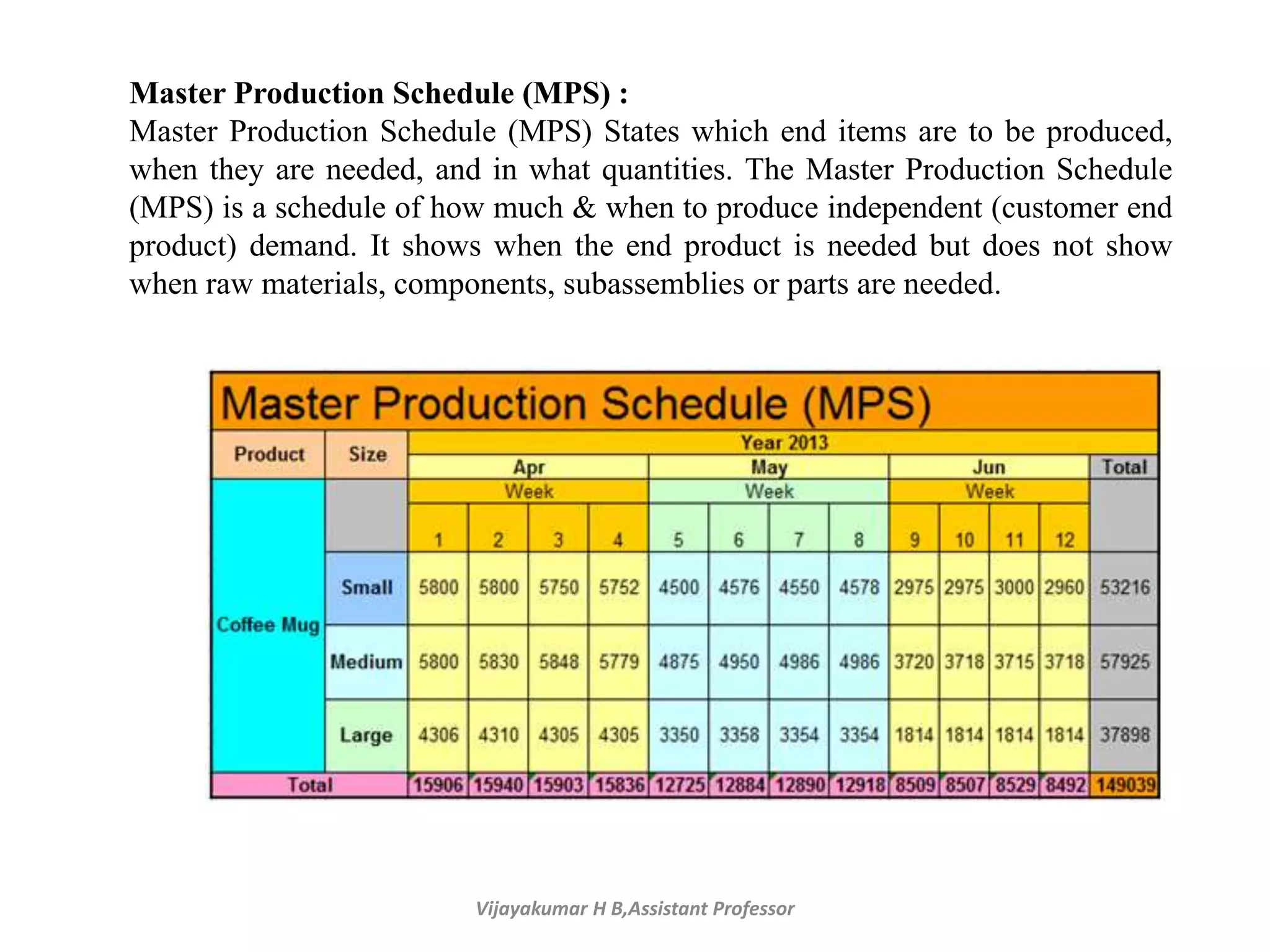
Master Production Schedule (MPS) :
Master Production Schedule (MPS) States which end items are to be produced,
when they are needed, and in what quantities. The Master Production Schedule
(MPS) is a schedule of how much & when to produce independent (customer end
product) demand. It shows when the end product is needed but does not show
when raw materials, components, subassemblies or parts are needed.
Vijayakumar H B,Assistant Professor
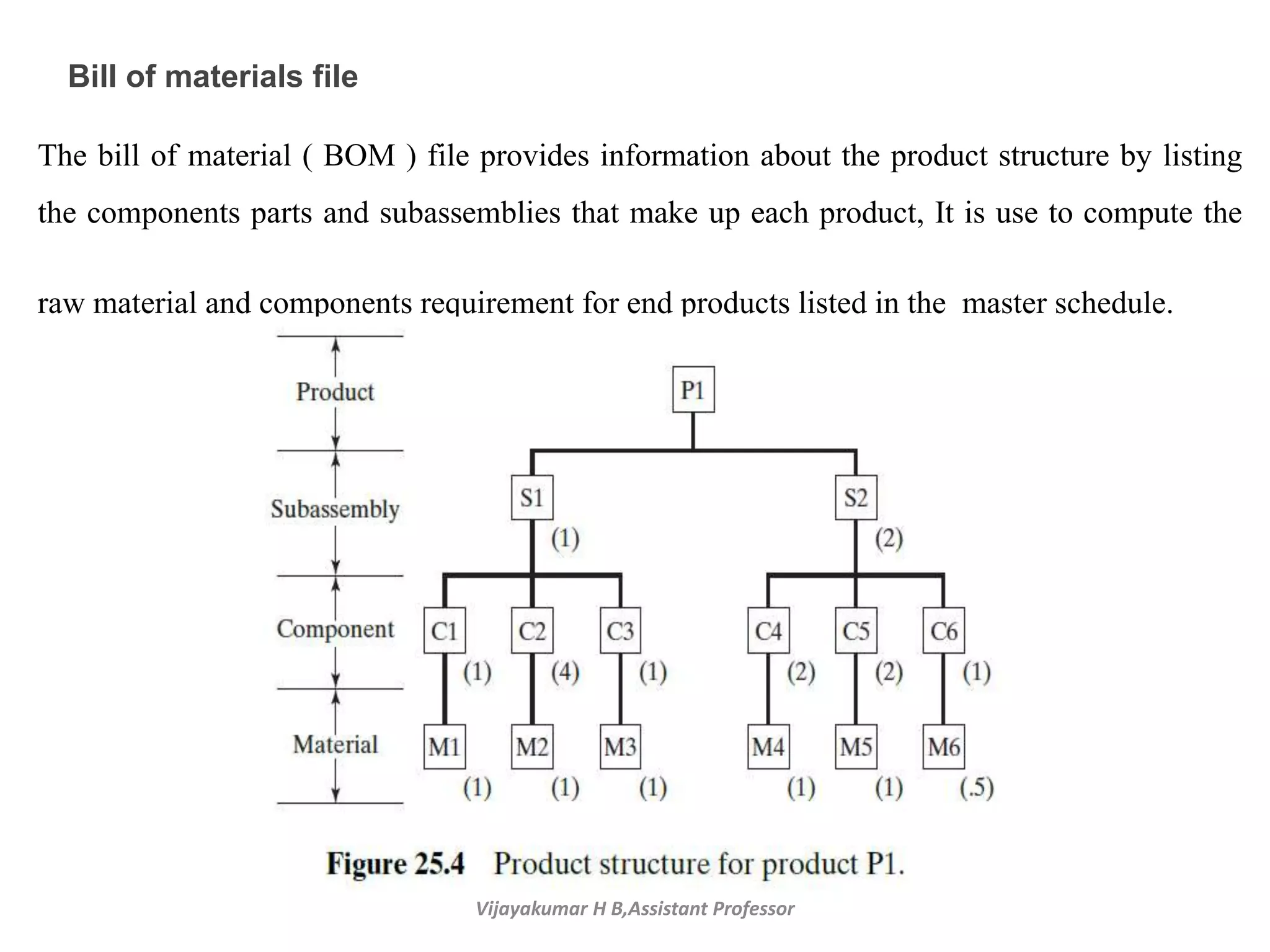
The bill of material ( BOM ) file provides information about the product structure by listing
the components parts and subassemblies that make up each product, It is use to compute the
raw material and components requirement for end products listed in the master schedule.
Bill of materials file
Vijayakumar H B,Assistant Professor
Inventory record file (item master file)
Vijayakumar H B,Assistant Professor
MRP Output
The MRP program generates a variety of outputs that can be used in planning and
managing plant operations. The output include
(1) Planned order releases, which provide the authority to place orders that have been planned by
the MRP system.
(2) Report of planned order releases in future periods .
(3) Rescheduling notices, indicating changes in due dates for open orders.
(4) Cancellation notices, indicating that certain open orders have been canceled because in the
MPS.
(5)Reports on inventory status.
(6) Performance reports of various types , indicating costs, item usage, actual versus planned lead
times, and so on.
(7) Exception report , showing deviations from the schedule from the schedule, orders that
are overdue, scrap, and so on; and
(8) Inventory forecasts, indicating projected inventory levels in future periods.
Vijayakumar H B,Assistant Professor
Benefits reported by users of MRP systems include the following:
1.Reduction in inventory,
2.Quicker response to changes in demand than is possible with a manual
requirements planning systems,
3. Reduced setup and product changeover costs,
4. Better machine utilization,
5. Improved capacity to respond to changes in the master schedule, and
6. Aid in developing the master schedule.
Benefits of MRP System
15-05-2020 40
Vijayakumar H B , Assistant
Professor
Sri Taralabalu Jagadguru Education Society®, Sirigere
S T J Institute of Technology, Ranebennur
Department of Mechanical Engineering
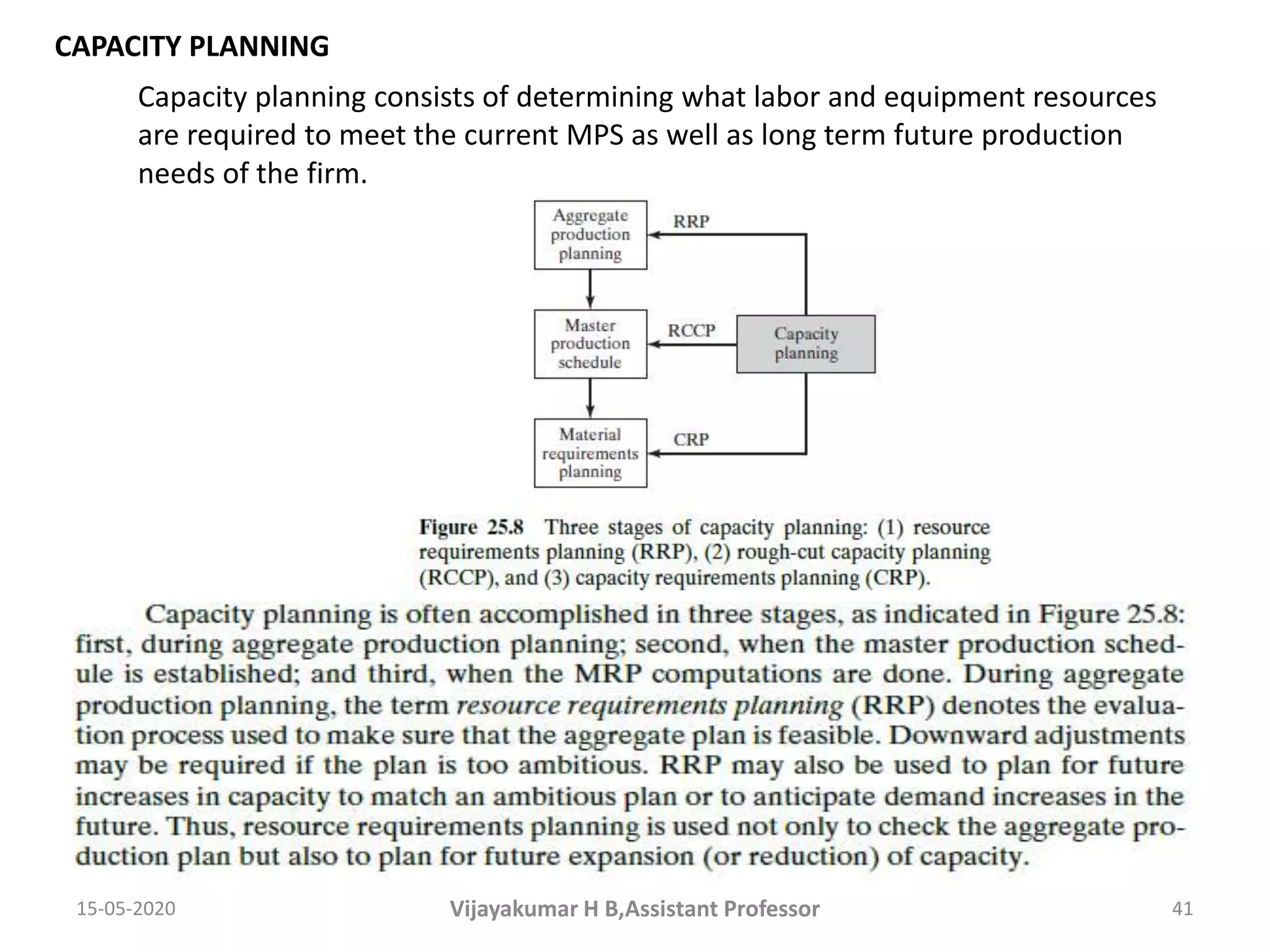
Capacity planning consists of determining what labor and equipment resources
are required to meet the current MPS as well as long term future production
needs of the firm.
CAPACITY PLANNING
15-05-2020 41Vijayakumar H B,Assistant Professor
Vijayakumar H B,Assistant Professor
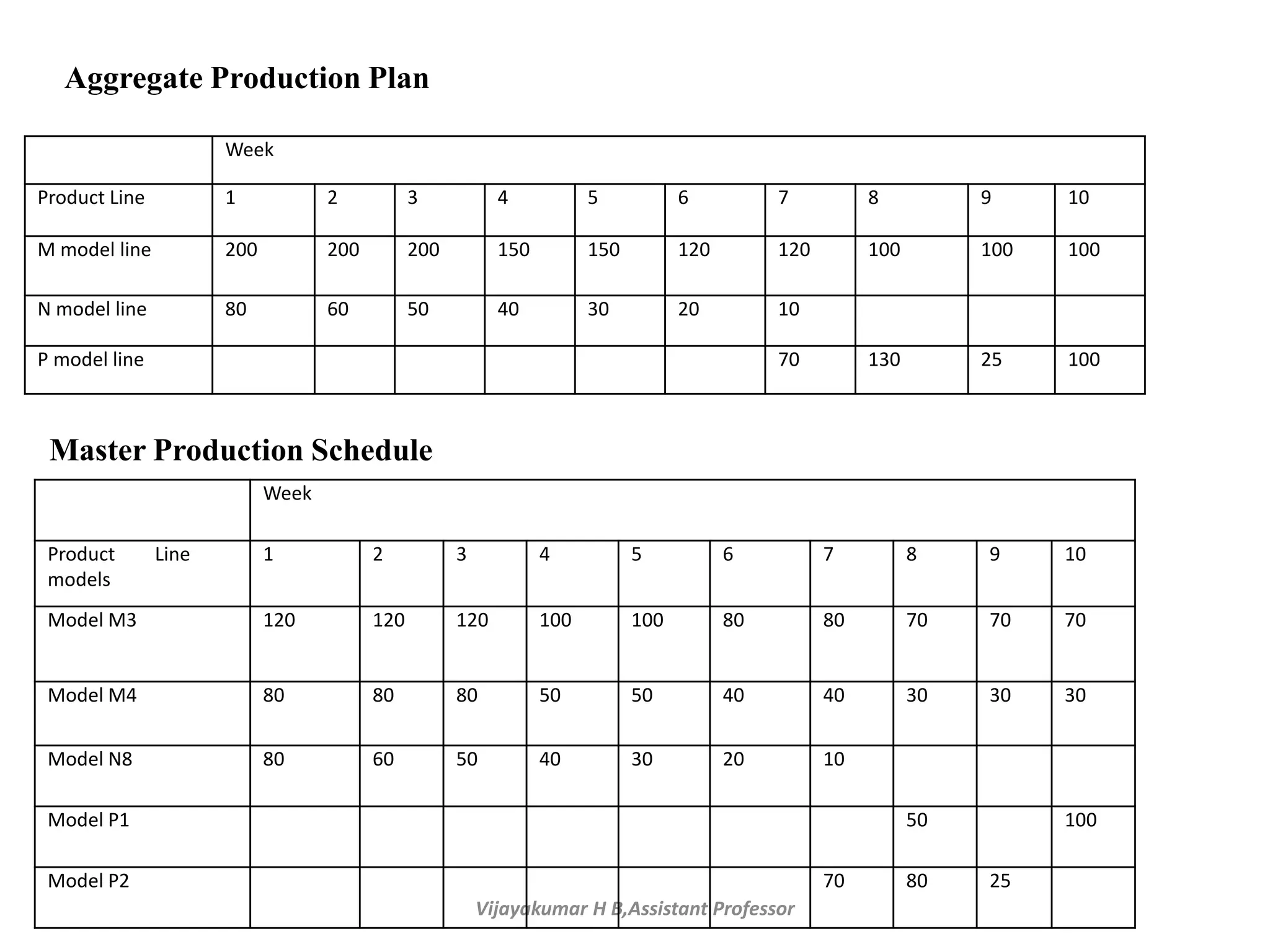
Week
Product Line 1 2 3 4 5 6 7 8 9 10
M model line 200 200 200 150 150 120 120 100 100 100
N model line 80 60 50 40 30 20 10
P model line 70 130 25 100
Aggregate Production Plan
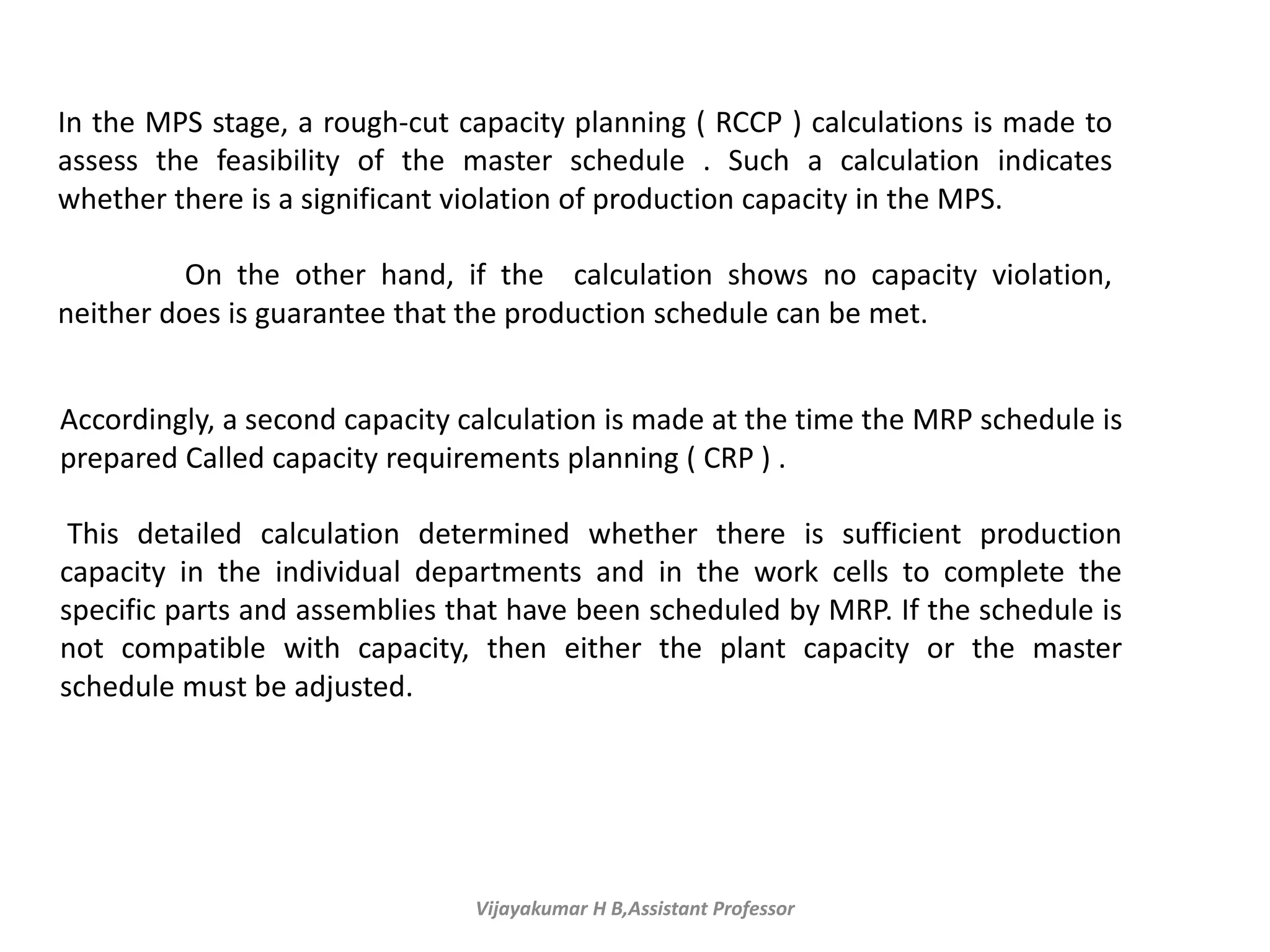
Week
Product Line
models
1 2 3 4 5 6 7 8 9 10
Model M3 120 120 120 100 100 80 80 70 70 70
Model M4 80 80 80 50 50 40 40 30 30 30
Model N8 80 60 50 40 30 20 10
Model P1 50 100
Model P2 70 80 25
Master Production Schedule
Vijayakumar H B,Assistant Professor
In the MPS stage, a rough-cut capacity planning ( RCCP ) calculations is made to
assess the feasibility of the master schedule . Such a calculation indicates
whether there is a significant violation of production capacity in the MPS.
On the other hand, if the calculation shows no capacity violation,
neither does is guarantee that the production schedule can be met.
Accordingly, a second capacity calculation is made at the time the MRP schedule is
prepared Called capacity requirements planning ( CRP ) .
This detailed calculation determined whether there is sufficient production
capacity in the individual departments and in the work cells to complete the
specific parts and assemblies that have been scheduled by MRP. If the schedule is
not compatible with capacity, then either the plant capacity or the master
schedule must be adjusted.
Capacity adjustments can be divided into short-term adjustment and long-term adjustments.
SHORT-TERM ADJUSTMENTS
• Employment levels : Employment in the plant can be increase or decrease in
response to changes in capacity requirements.
• Number of temporary workers. Increase in employment level can also be achieved
by using workers from temporary agency. When the busy period is passed, these
workers move to positions at other companies where their services are needed
• Number of work shifts. The numbers of shifts worked per production period can be
increased or decreased.
• Number of labor hours. The numbers of labor hours per shift can be increased or
decreased, through the use of overtime or reduce hours.
• Inventory stockpiling. This tactic might be used to maintain steady employment
level during slow demand periods.
• Order backlogs. : Deliveries of the product to the customer could be delayed during
busy period when production resources are insufficient to keep up with demand.
• Workload through subcontracting. This involves the letting of the jobs to other
shops during busy periods , or the taking in of extra work during slack periods.
15-05-2020 44Vijayakumar H B,Assistant ProfessorVijayakumar H B,Assistant Professor
LONG-TERM ADJUSTMENTS
• Investing in new equipment. This involves investing in more machines or more
productive machines to meet increased future production requirements, ore
investing in new types of machines to match changes in product design.
• Constructing new plants: Building a new factory represents a major investment for
the company. However, it also represents a significant increase in production
capacity for the firm.
• Purchasing existing plants from other companies.
• Acquiring existing companies : This may be done to increase productive capacity.
However , there are usually more important reasons for taking over an existing
company, such as to achieve economies of scale that result from increase market
share and reducing staff.
• Closing Plants: This involves the closing of plants that will not be needed in the
future
15-05-2020 45Vijayakumar H B,Assistant ProfessorVijayakumar H B,Assistant Professor
15-05-2020 46
Vijayakumar H B , Assistant
Professor
Sri Taralabalu Jagadguru Education Society®, Sirigere
S T J Institute of Technology, Ranebennur
Department of Mechanical Engineering
15-05-2020 Vijayakumar H B,Assistant Professor 47Vijayakumar H B,Assistant Professor
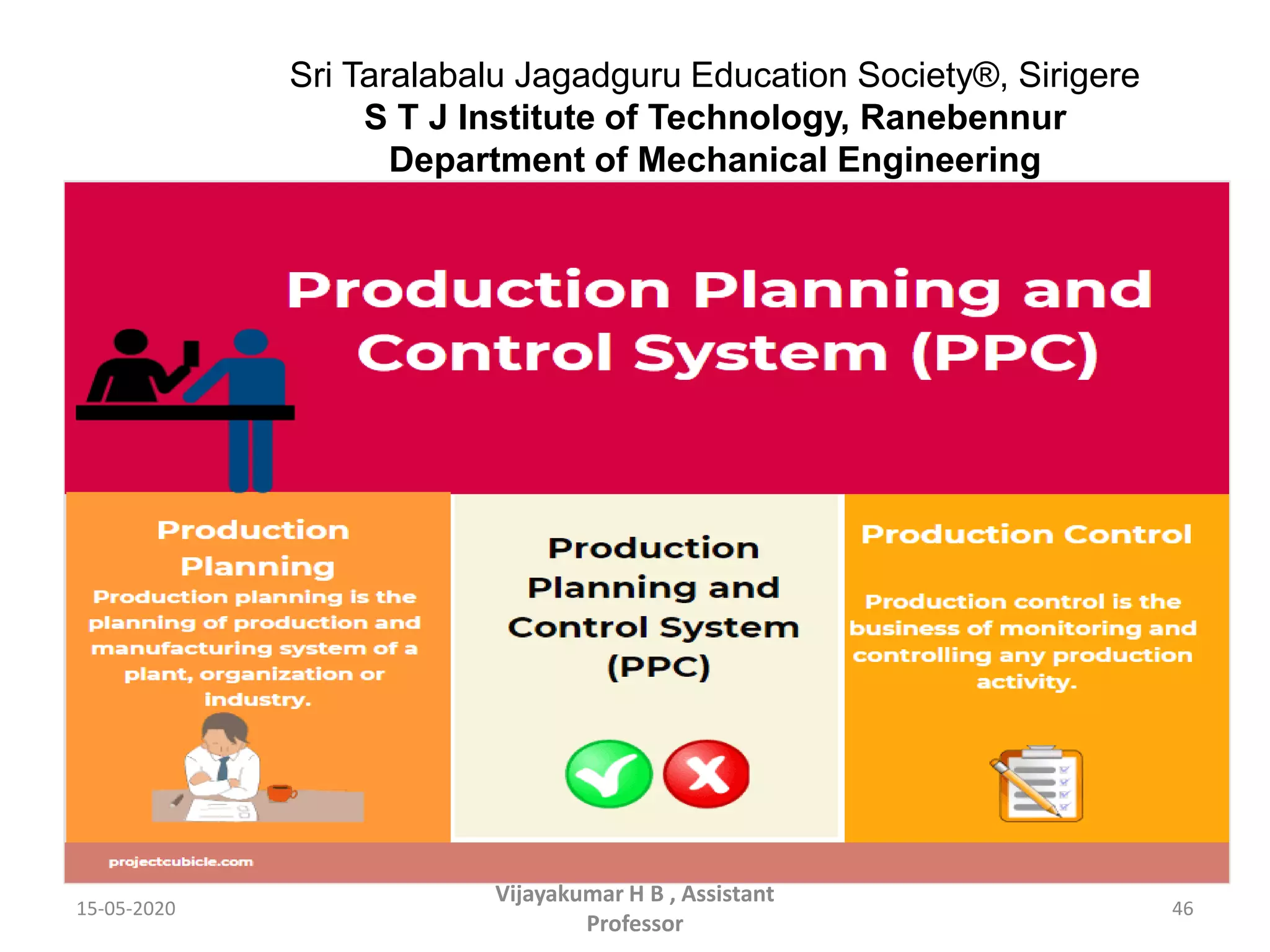
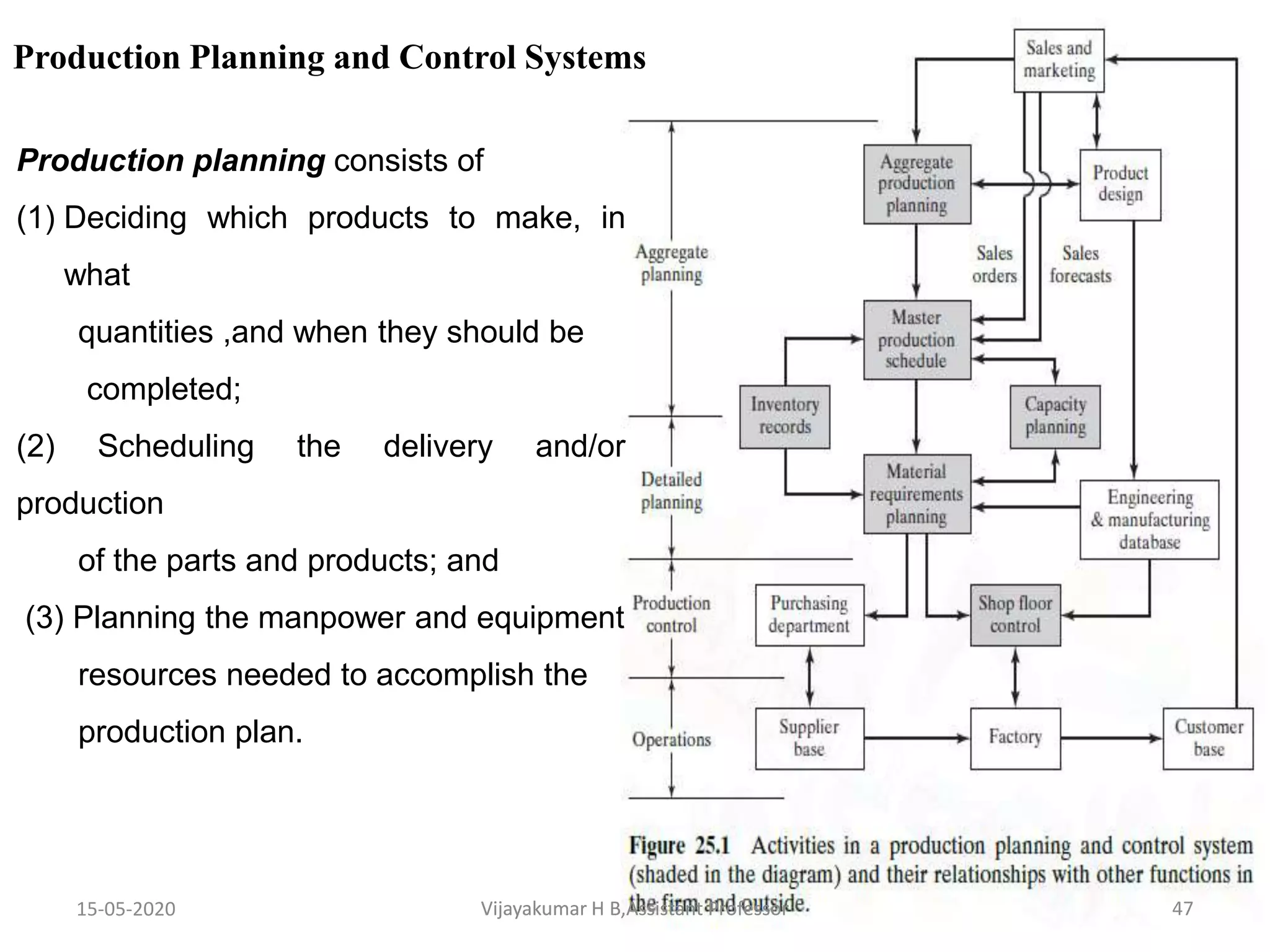
Production Planning and Control Systems
Production planning consists of
(1) Deciding which products to make, in
what
quantities ,and when they should be
completed;
(2) Scheduling the delivery and/or
production
of the parts and products; and
(3) Planning the manpower and equipment
resources needed to accomplish the
production plan.
Vijayakumar H B,Assistant Professor
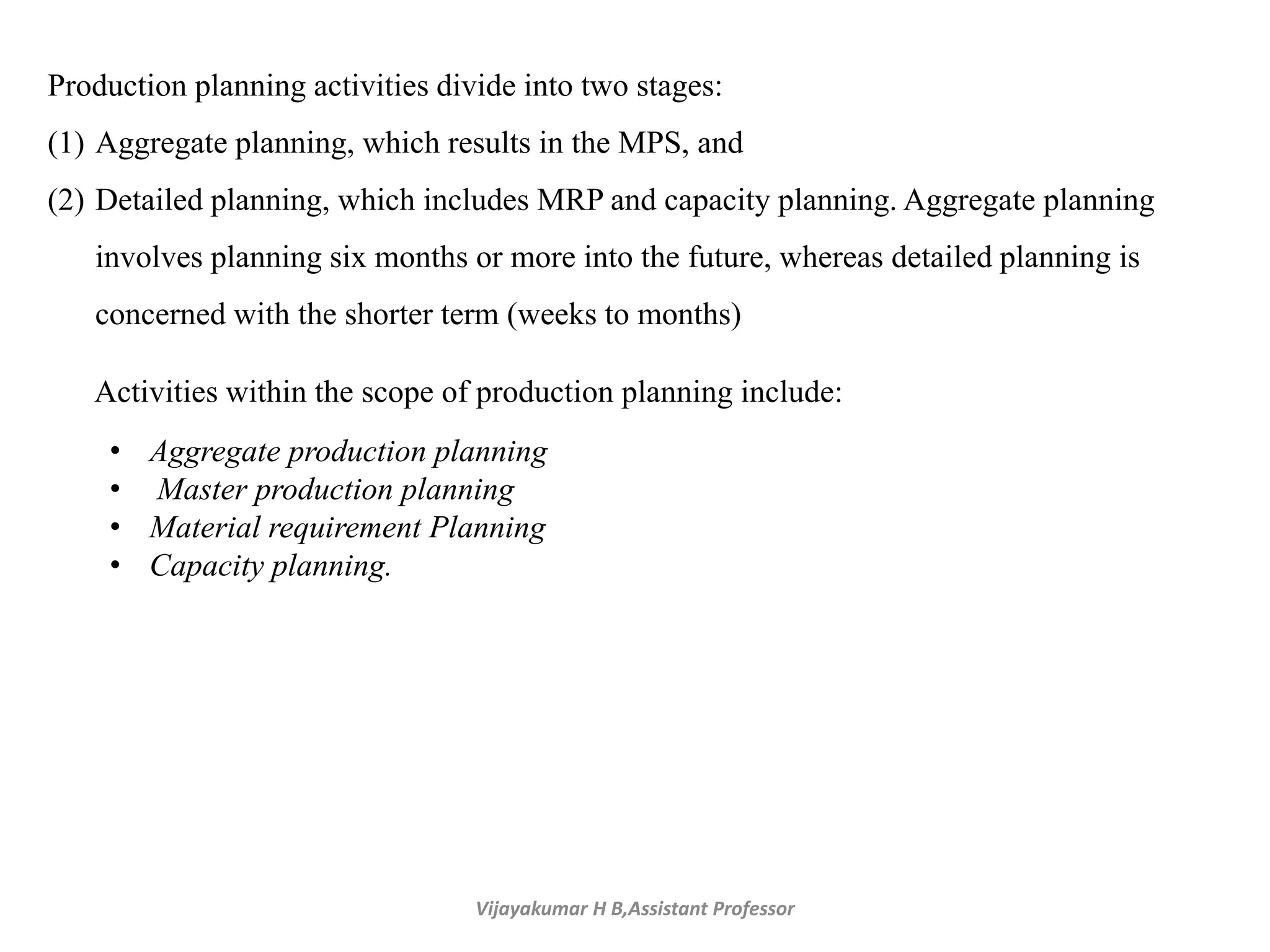
Production planning activities divide into two stages:
(1) Aggregate planning, which results in the MPS, and
(2) Detailed planning, which includes MRP and capacity planning. Aggregate planning
involves planning six months or more into the future, whereas detailed planning is
concerned with the shorter term (weeks to months)
Activities within the scope of production planning include:
• Aggregate production planning
• Master production planning
• Material requirement Planning
• Capacity planning.
Vijayakumar H B,Assistant Professor
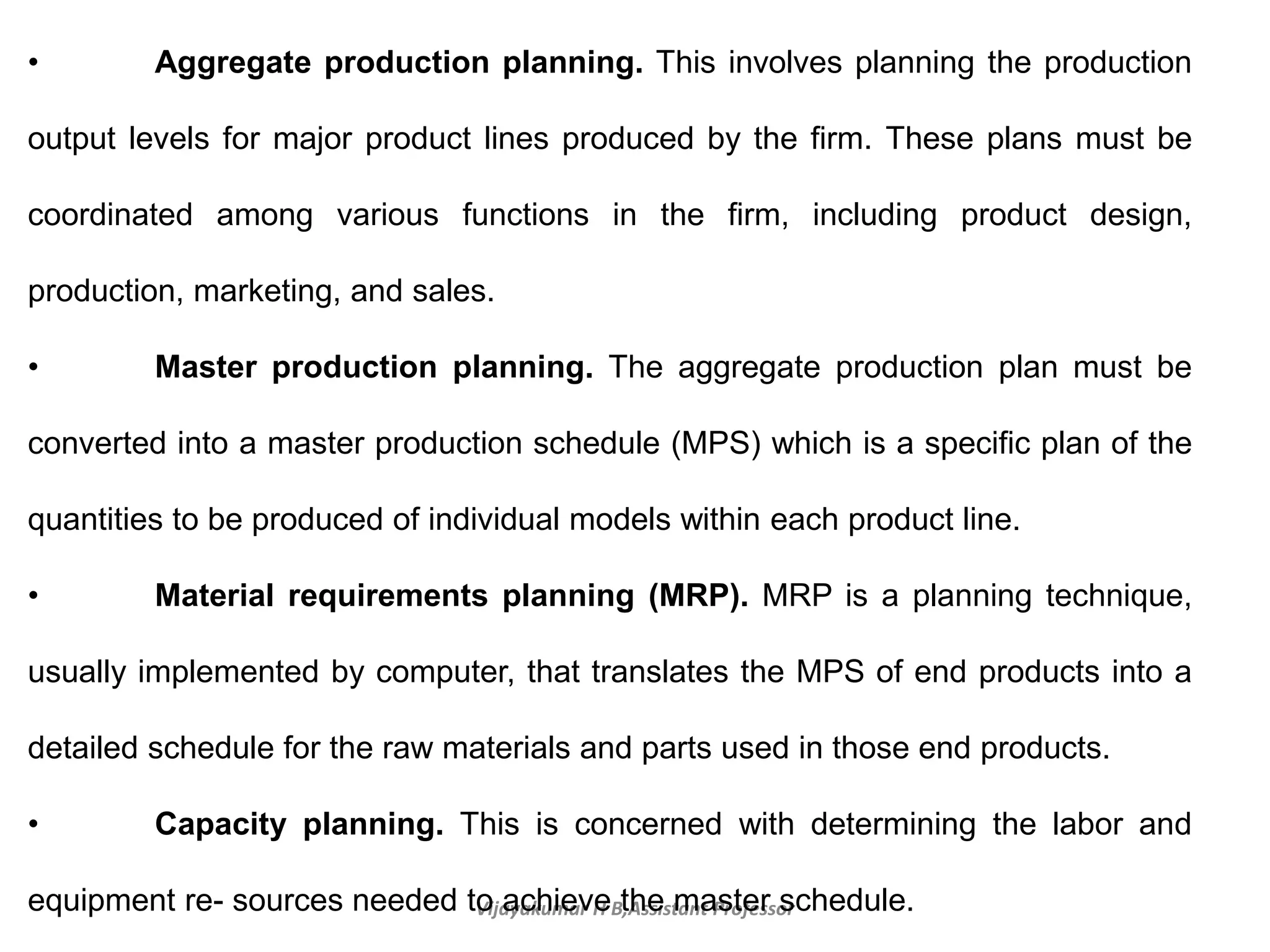
• Aggregate production planning. This involves planning the production
output levels for major product lines produced by the firm. These plans must be
coordinated among various functions in the firm, including product design,
production, marketing, and sales.
• Master production planning. The aggregate production plan must be
converted into a master production schedule (MPS) which is a specific plan of the
quantities to be produced of individual models within each product line.
• Material requirements planning (MRP). MRP is a planning technique,
usually implemented by computer, that translates the MPS of end products into a
detailed schedule for the raw materials and parts used in those end products.
• Capacity planning. This is concerned with determining the labor and
equipment re- sources needed to achieve the master schedule.
Vijayakumar H B,Assistant Professor
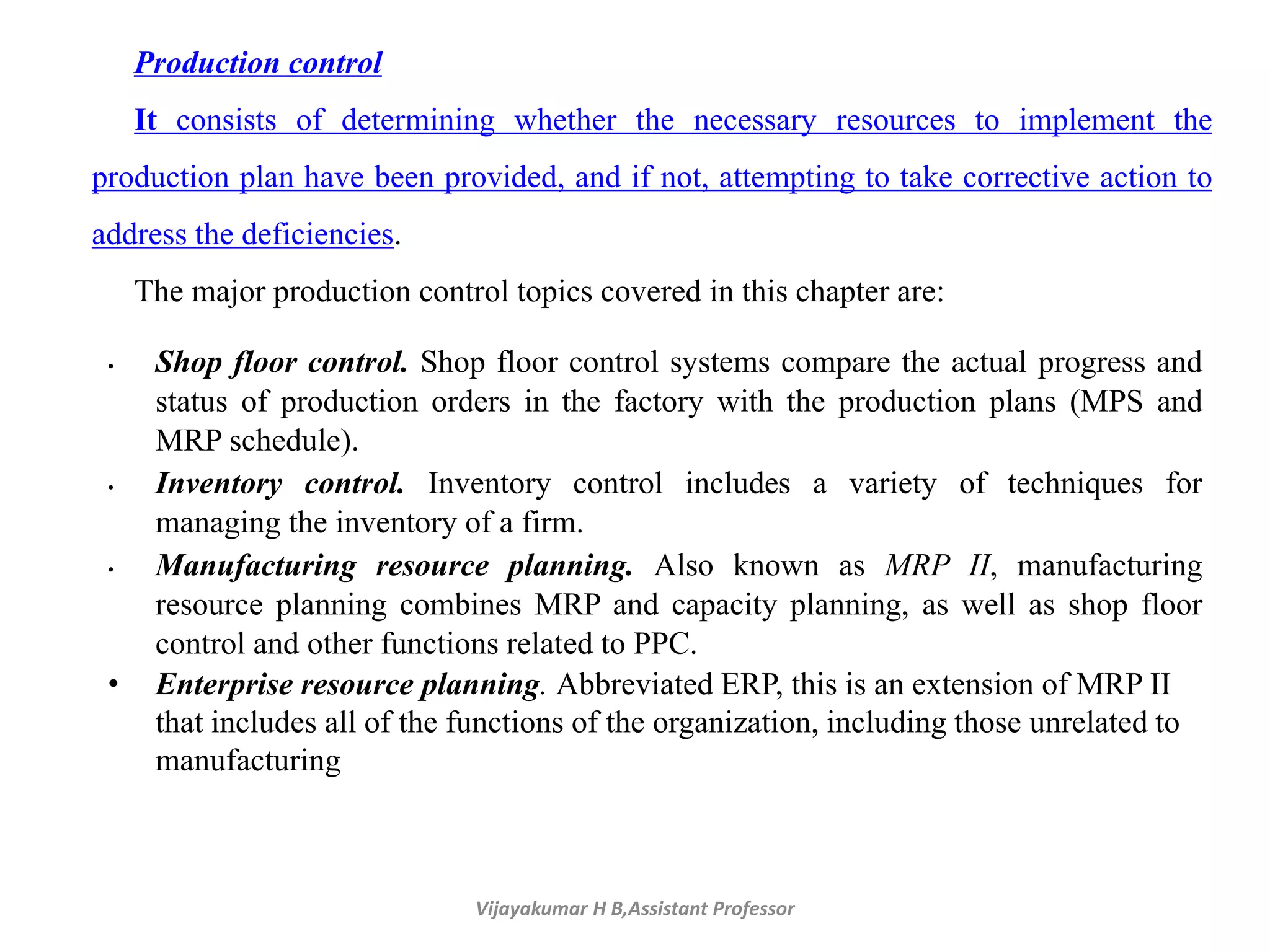
Production control
It consists of determining whether the necessary resources to implement the
production plan have been provided, and if not, attempting to take corrective action to
address the deficiencies.
The major production control topics covered in this chapter are:
• Shop floor control. Shop floor control systems compare the actual progress and
status of production orders in the factory with the production plans (MPS and
MRP schedule).
• Inventory control. Inventory control includes a variety of techniques for
managing the inventory of a firm.
• Manufacturing resource planning. Also known as MRP II, manufacturing
resource planning combines MRP and capacity planning, as well as shop floor
control and other functions related to PPC.
• Enterprise resource planning. Abbreviated ERP, this is an extension of MRP II
that includes all of the functions of the organization, including those unrelated to
manufacturing
Vijayakumar H B,Assistant Professor
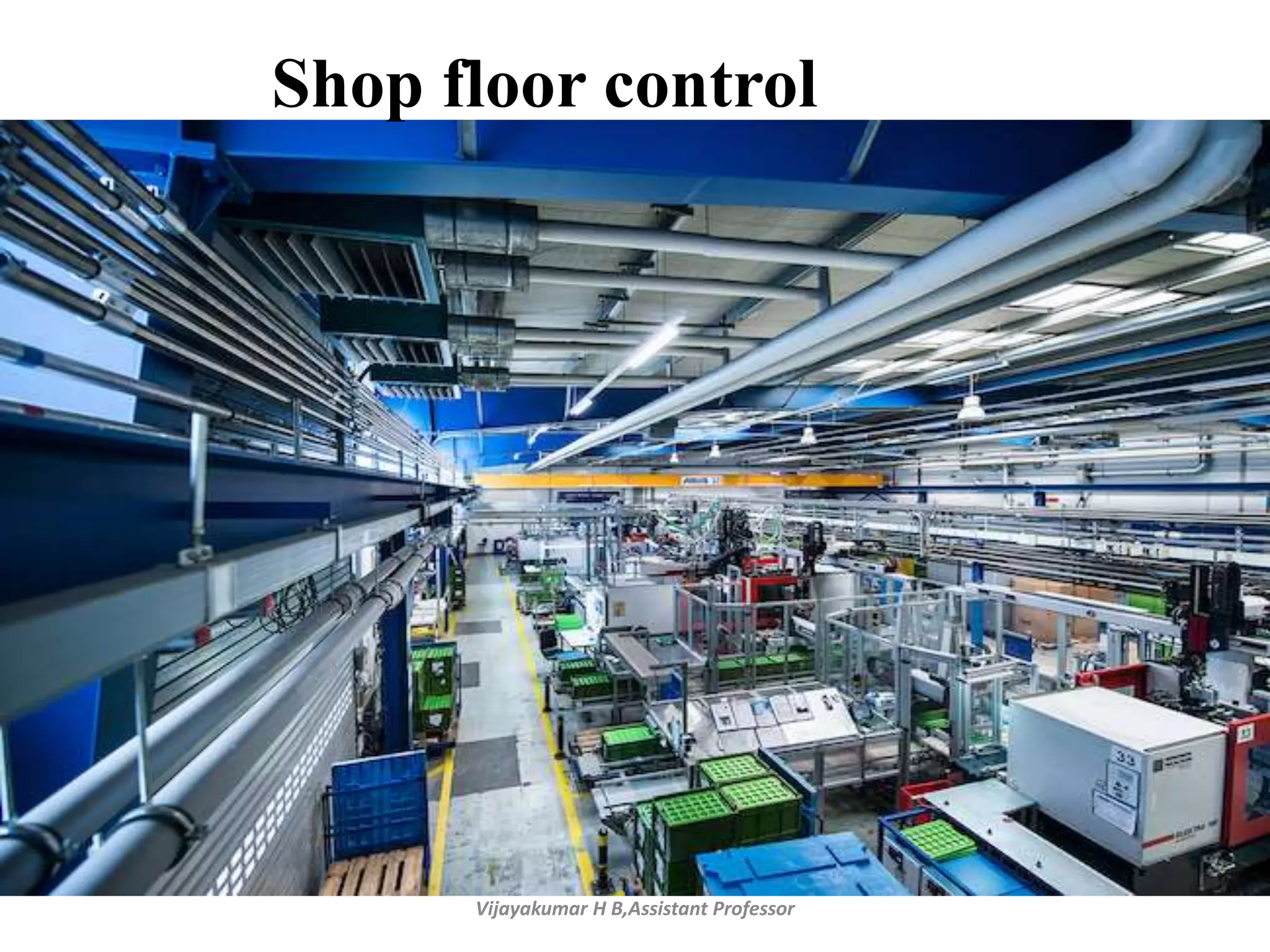
Shop floor control
Vijayakumar H B,Assistant Professor
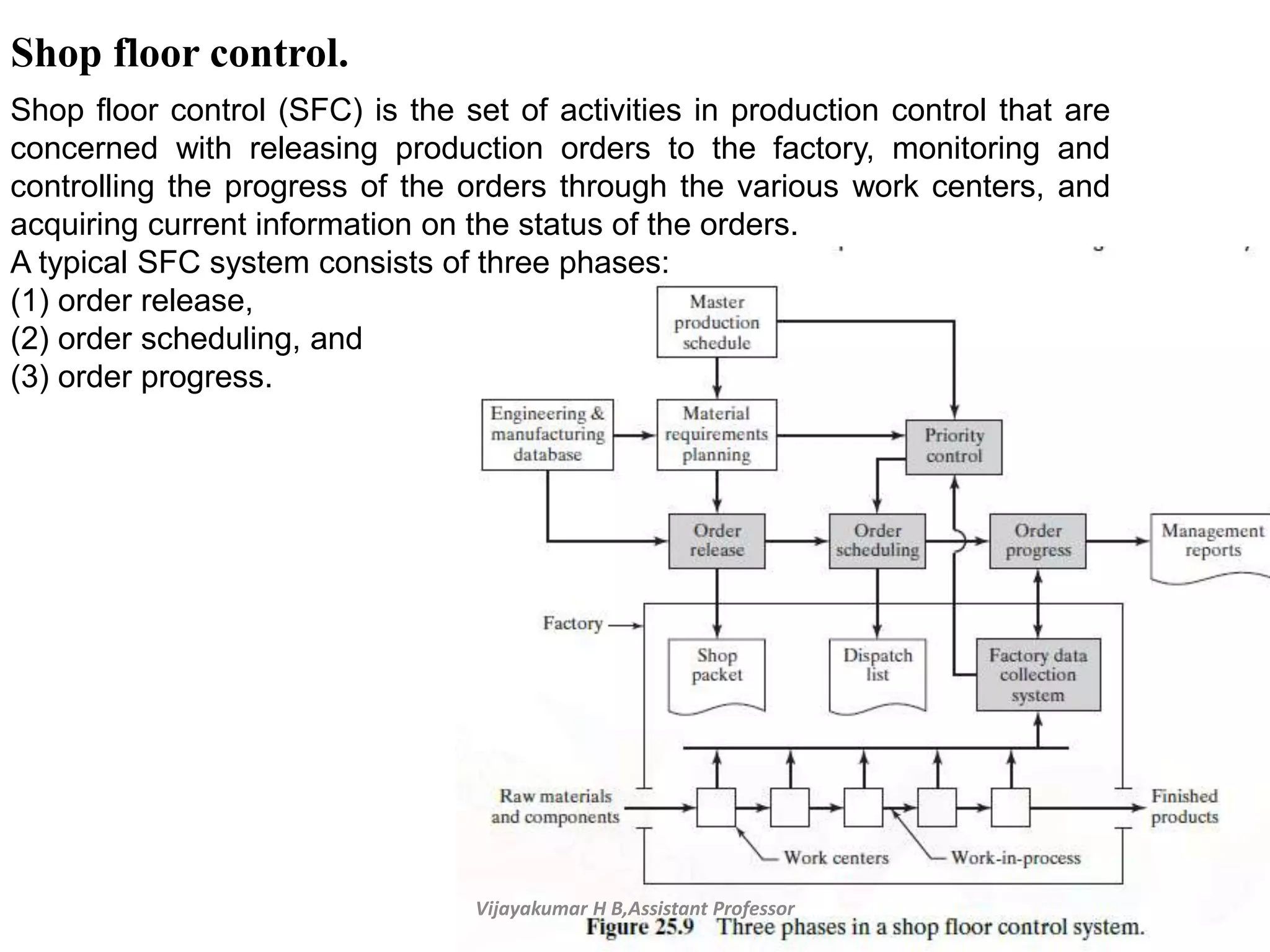
Shop floor control.
Shop floor control (SFC) is the set of activities in production control that are
concerned with releasing production orders to the factory, monitoring and
controlling the progress of the orders through the various work centers, and
acquiring current information on the status of the orders.
A typical SFC system consists of three phases:
(1) order release,
(2) order scheduling, and
(3) order progress.
Vijayakumar H B,Assistant Professor
1)Order Release
The order release phase of shop floor control provides the documentation needed to process
a production order through the factory.
The collection of documents is some- times called the shop packet. It typically includes
(1)The route sheet, which documents the process plan for the item to be produced
(2)Material requisitions to draw the necessary raw materials from inventory,
(3) Job cards or other means to report direct labor time devoted to the order and to indicate
progress of the order through the factory,
(4) Move tickets to authorize the material handling personnel to transport parts between
work centers in the factory if this kind of authorization is required, and
(5) The parts list, if required for assembly jobs. In the operation of a conventional factory,
which relies heavily on manual labor, these are paper documents that move with the
production order and are used to track its progress through the shop.
Vijayakumar H B,Assistant Professor
2)order scheduling
• The order scheduling phase follows directly from the order release phase and
assigns the
production orders to the various work centers in the plant.
• In effect, order schedulingexecutes the dispatching function in PPC.
• The order scheduling phase prepares a dispatch list that indicates which
production orders should be accomplished at the various work centers.
• It also provides information about relative priorities of the different jobs, for
example, by showing due dates for each job.
• In shop floor control, the dispatch list guides the shop foreman in making work
assignments and allocating resources to different jobs to comply with the master
schedule.
The order scheduling phase in shop floor control is intended to solve two problems
in production control: (1) machine loading and (2) job sequencing.
Allocating orders to work centers is referred to as machine loading. The term
shop loading is also used, which refers to the loading of all machines in the plant.
Since
the total number of production orders usually exceeds the number of work centers,
each
work center will have a queue of orders waiting to be processed.
Vijayakumar H B,Assistant Professor
Job sequencing, which involves determining the sequence in which the jobs will
be processed through a given work center. To determine this sequence, priorities
are established among the jobs in the queue, and the jobs are processed in the
order of their relative priorities.
Some of the dispatching rules used to establish priorities for production orders in the
plant include:
•First-come-first served. Jobs are processed in the order in which they arrive at the
machine. One might argue that this rule is the most fair.
•Earliest due date. Orders with earlier due dates are given higher priorities.
•Shortest processing time. Orders with shorter processing times are given higher
priorities.
•Least slack time. Slack time is defined as the difference between the time remaining
until due date and the process time remaining. Orders with the least slack in their
schedule are given higher priorities.
•Critical ratio. The critical ratio is defined as the ratio of the time remaining until due
date divided by the process time remaining. Orders with the lowest critical ratio are given
higher priorities.
Vijayakumar H B,Assistant Professor
3)order progress
The order progress phase in shop floor control monitors the status of the various orders in the plant, work-in-
process, and other measures that indicate the progress of production. The function of the order progress phase is to
provide information that is useful in managing the factory.
The information presented to production management is often summarized in the form of reports, such as the
following:
•Work order status reports. These reports indicate the status of production orders. Typical information in the
report includes the current work center where each order is located, processing hours remaining before completion
of each order, whether each job is on time or behind schedule, and the priority level of each order.
•Progress reports. A progress report is used to report performance of the shop during a certain time period (e.g., a
week or month in the master schedule). It provides in- formation on how many orders were completed during the
period, how many orders should have been completed during the period but were not, and so forth.
•Exception reports. An exception report identifies deviations from the production schedule (e.g., overdue jobs) and
similar nonconformities
Vijayakumar H B,Assistant Professor
Factory Data Collection system
• Various techniques are used to collect data from the factory floor. These techniques range from manual methods
that require workers to fill out paper forms that are later compiled to fully automated methods that require no
human participation.
• The factory data collection system (FDC system) consists of the various paper documents, terminals, and
automated devices located throughout the plant for collecting data on shop floor operations, plus the means for
compiling and processing the data.
• The factory data collection system serves as an input to the order progress phase in shop floor control. It is also
an input to priority control, which affects order scheduling. Examples of the types of data on factory operations
collected by the FDC system include:
• Piece counts completed at each work center
• Scrapped parts and parts needing rework
• Operations completed in the routing sequence for each order
• Direct labor time expended on each order
• Machine downtime.

Computerized process planning system

  • 1.
    15-05-2020 1Vijayakumar HB,Assistant Professor
  • 2.
    What is CAPP VijayakumarH B,Assistant Professor
  • 3.
    Process Plan Vijayakumar HB,Assistant Professor
  • 4.
    Process Planning Vijayakumar HB,Assistant Professor
  • 5.
    Basic Process indeveloping a process plan Vijayakumar H B,Assistant Professor
  • 6.
    Process Planning Approaches •Manual Systems • Computer Aided Process Planning – Retrieval(Variant)CAPP System – Generative CAPP System Vijayakumar H B,Assistant Professor
  • 7.
    Process Planning Approaches •Manual Systems • Computer Aided Process Planning – Retrieval(Variant)CAPP System – Generative CAPP System Vijayakumar H B,Assistant Professor
  • 8.
    Process Planning Approaches •Manual Systems • Computer Aided Process Planning – Retrieval(Variant)CAPP System – Generative CAPP System Vijayakumar H B,Assistant Professor
  • 9.
    Manually Prepared ProcessPlans Vijayakumar H B,Assistant Professor
  • 10.
    Computer Aids Vijayakumar HB,Assistant Professor
  • 11.
  • 12.
    Variant (Retrieval) CAPPMethodology Vijayakumar H B,Assistant Professor
  • 13.
    Retrieval (Variant) CAPP VijayakumarH B,Assistant Professor
  • 14.
    Variant CAPP Vijayakumar HB,Assistant Professor
  • 15.
    15-05-2020 Vijayakumar HB,Assistant Professor 15 Group Technology (GT) Defined A manufacturing philosophy in which similar parts are identified and grouped together to take advantage of their similarities in design and production • Similarities among parts permit them to be classified into part families – In each part family, processing steps are similar • The improvement is typically achieved by organizing the production facilities into manufacturing cells that specialize in production of certain part families Vijayakumar H B,Assistant Professor
  • 16.
    15-05-2020 Vijayakumar HB,Assistant Professor 16 Part Family A collection of parts that possess similarities in geometric shape and size, or in the processing steps used in their manufacture • Part families are a central feature of group technology – There are always differences among parts in a family – But the similarities are close enough that the parts can be grouped into the same family Vijayakumar H B,Assistant Professor
  • 17.
    15-05-2020 Vijayakumar HB,Assistant Professor 17 Part Families • Two parts that are identical in shape and size but quite different in manufacturing: (a) 1,000,000 units/yr, tolerance = 0.010 inch, 1015 CR steel, nickel plate; (b) 100/yr, tolerance = 0.001 inch, 18-8 stainless steel Vijayakumar H B,Assistant Professor
  • 18.
    15-05-2020 Vijayakumar HB,Assistant Professor 18 Part Families • Ten parts are different in size, shape, and material, but quite similar in terms of manufacturing • All parts are machined from cylindrical stock by turning; some parts require drilling and/or milling Vijayakumar H B,Assistant Professor
  • 19.
  • 20.
  • 21.
  • 22.
  • 23.
    15-05-2020 23 Vijayakumar HB , Assistant Professor
  • 24.
    Material Requirements Planning(MRP) Computer-based information system for ordering and scheduling of dependent-demand inventories, i.e. what is needed, how much is needed, and when is it needed – Dependent demand – Demand for items that are sub- assemblies, parts or raw materials to be used in the production of finished goods. – Independent demand – finished products 15-05-2020 24Vijayakumar H B,Assistant ProfessorVijayakumar H B,Assistant Professor
  • 25.
    How does MRPwork? • The goal of the MRP or Material Requirements Planning document is to supply information that will enable the company to have enough inventory on hand to fulfill demand, available only when needed, at a quality level that meets specification, (but does not have to exceed it) and at the lowest price. • A good MRP or Material Requirements Planning program can provide the basic needs of keeping inventory levels low and fulfilling customer expectations for on time delivery. 15-05-2020 25Vijayakumar H B,Assistant ProfessorVijayakumar H B,Assistant Professor
  • 26.
    There are twoimportant questions to ask here. How much of an item is needed? When is an item needed to complete a specified number of units, in a specified period of time? The MRP process involves the following steps: • Determine the gross requirements for a particular item • Determine the net requirements and when orders will be released for fabrication or subassembly • Net Requirements = Total Requirements – Available Inventory • Net Requirements = (Gross Requirements + Allocations) – (On Hand) + Scheduled Receipts 15-05-2020 26Vijayakumar H B,Assistant ProfessorVijayakumar H B,Assistant Professor
  • 27.
    15-05-2020 27Vijayakumar HB,Assistant ProfessorVijayakumar H B,Assistant Professor
  • 28.
    Fundamental Concepts inMRP 1. INDEPENDENT VS DEPENDENT DEMAND 2. Manufacturing Lead Time 3. COMMON USE ITEMS 15-05-2020 28Vijayakumar H B,Assistant ProfessorVijayakumar H B,Assistant Professor
  • 29.
    400 – 300 – 200– 100 – Continuous demand Discrete demand Independent demand 100 tables Dependent demand 100 x 1 = 100 tabletops 100 x 4 = 400 table legs 15-05-2020 29Vijayakumar H B,Assistant ProfessorVijayakumar H B,Assistant Professor
  • 30.
    15-05-2020 Vijayakumar HB,Assistant Professor 30Vijayakumar H B,Assistant Professor
  • 31.
    15-05-2020 31Vijayakumar HB,Assistant ProfessorVijayakumar H B,Assistant Professor 1.Manufacturing Lead Time
  • 32.
    15-05-2020 32Vijayakumar HB,Assistant ProfessorVijayakumar H B,Assistant Professor
  • 33.
    15-05-2020 33Vijayakumar HB,Assistant ProfessorVijayakumar H B,Assistant Professor Structure or Input To MRP System
  • 34.
    Vijayakumar H B,AssistantProfessor Inputs to the MRP System 1)Master production schedule • Expressed in terms of time buckets 2)Bill of materials file • product structure and list of component parts in each product 3)Inventory record file (item master file) – includes: • Item master data – part number, order quantities, lead times • Inventory status – time-phased record of inventory status • Subsidiary data – purchase orders, engineering changes
  • 35.
    Vijayakumar H B,AssistantProfessor Master Production Schedule (MPS) : Master Production Schedule (MPS) States which end items are to be produced, when they are needed, and in what quantities. The Master Production Schedule (MPS) is a schedule of how much & when to produce independent (customer end product) demand. It shows when the end product is needed but does not show when raw materials, components, subassemblies or parts are needed.
  • 36.
    Vijayakumar H B,AssistantProfessor The bill of material ( BOM ) file provides information about the product structure by listing the components parts and subassemblies that make up each product, It is use to compute the raw material and components requirement for end products listed in the master schedule. Bill of materials file
  • 37.
    Vijayakumar H B,AssistantProfessor Inventory record file (item master file)
  • 38.
    Vijayakumar H B,AssistantProfessor MRP Output The MRP program generates a variety of outputs that can be used in planning and managing plant operations. The output include (1) Planned order releases, which provide the authority to place orders that have been planned by the MRP system. (2) Report of planned order releases in future periods . (3) Rescheduling notices, indicating changes in due dates for open orders. (4) Cancellation notices, indicating that certain open orders have been canceled because in the MPS. (5)Reports on inventory status. (6) Performance reports of various types , indicating costs, item usage, actual versus planned lead times, and so on. (7) Exception report , showing deviations from the schedule from the schedule, orders that are overdue, scrap, and so on; and (8) Inventory forecasts, indicating projected inventory levels in future periods.
  • 39.
    Vijayakumar H B,AssistantProfessor Benefits reported by users of MRP systems include the following: 1.Reduction in inventory, 2.Quicker response to changes in demand than is possible with a manual requirements planning systems, 3. Reduced setup and product changeover costs, 4. Better machine utilization, 5. Improved capacity to respond to changes in the master schedule, and 6. Aid in developing the master schedule. Benefits of MRP System
  • 40.
    15-05-2020 40 Vijayakumar HB , Assistant Professor Sri Taralabalu Jagadguru Education Society®, Sirigere S T J Institute of Technology, Ranebennur Department of Mechanical Engineering
  • 41.
    Capacity planning consistsof determining what labor and equipment resources are required to meet the current MPS as well as long term future production needs of the firm. CAPACITY PLANNING 15-05-2020 41Vijayakumar H B,Assistant Professor
  • 42.
    Vijayakumar H B,AssistantProfessor Week Product Line 1 2 3 4 5 6 7 8 9 10 M model line 200 200 200 150 150 120 120 100 100 100 N model line 80 60 50 40 30 20 10 P model line 70 130 25 100 Aggregate Production Plan Week Product Line models 1 2 3 4 5 6 7 8 9 10 Model M3 120 120 120 100 100 80 80 70 70 70 Model M4 80 80 80 50 50 40 40 30 30 30 Model N8 80 60 50 40 30 20 10 Model P1 50 100 Model P2 70 80 25 Master Production Schedule
  • 43.
    Vijayakumar H B,AssistantProfessor In the MPS stage, a rough-cut capacity planning ( RCCP ) calculations is made to assess the feasibility of the master schedule . Such a calculation indicates whether there is a significant violation of production capacity in the MPS. On the other hand, if the calculation shows no capacity violation, neither does is guarantee that the production schedule can be met. Accordingly, a second capacity calculation is made at the time the MRP schedule is prepared Called capacity requirements planning ( CRP ) . This detailed calculation determined whether there is sufficient production capacity in the individual departments and in the work cells to complete the specific parts and assemblies that have been scheduled by MRP. If the schedule is not compatible with capacity, then either the plant capacity or the master schedule must be adjusted.
  • 44.
    Capacity adjustments canbe divided into short-term adjustment and long-term adjustments. SHORT-TERM ADJUSTMENTS • Employment levels : Employment in the plant can be increase or decrease in response to changes in capacity requirements. • Number of temporary workers. Increase in employment level can also be achieved by using workers from temporary agency. When the busy period is passed, these workers move to positions at other companies where their services are needed • Number of work shifts. The numbers of shifts worked per production period can be increased or decreased. • Number of labor hours. The numbers of labor hours per shift can be increased or decreased, through the use of overtime or reduce hours. • Inventory stockpiling. This tactic might be used to maintain steady employment level during slow demand periods. • Order backlogs. : Deliveries of the product to the customer could be delayed during busy period when production resources are insufficient to keep up with demand. • Workload through subcontracting. This involves the letting of the jobs to other shops during busy periods , or the taking in of extra work during slack periods. 15-05-2020 44Vijayakumar H B,Assistant ProfessorVijayakumar H B,Assistant Professor
  • 45.
    LONG-TERM ADJUSTMENTS • Investingin new equipment. This involves investing in more machines or more productive machines to meet increased future production requirements, ore investing in new types of machines to match changes in product design. • Constructing new plants: Building a new factory represents a major investment for the company. However, it also represents a significant increase in production capacity for the firm. • Purchasing existing plants from other companies. • Acquiring existing companies : This may be done to increase productive capacity. However , there are usually more important reasons for taking over an existing company, such as to achieve economies of scale that result from increase market share and reducing staff. • Closing Plants: This involves the closing of plants that will not be needed in the future 15-05-2020 45Vijayakumar H B,Assistant ProfessorVijayakumar H B,Assistant Professor
  • 46.
    15-05-2020 46 Vijayakumar HB , Assistant Professor Sri Taralabalu Jagadguru Education Society®, Sirigere S T J Institute of Technology, Ranebennur Department of Mechanical Engineering
  • 47.
    15-05-2020 Vijayakumar HB,Assistant Professor 47Vijayakumar H B,Assistant Professor Production Planning and Control Systems Production planning consists of (1) Deciding which products to make, in what quantities ,and when they should be completed; (2) Scheduling the delivery and/or production of the parts and products; and (3) Planning the manpower and equipment resources needed to accomplish the production plan.
  • 48.
    Vijayakumar H B,AssistantProfessor Production planning activities divide into two stages: (1) Aggregate planning, which results in the MPS, and (2) Detailed planning, which includes MRP and capacity planning. Aggregate planning involves planning six months or more into the future, whereas detailed planning is concerned with the shorter term (weeks to months) Activities within the scope of production planning include: • Aggregate production planning • Master production planning • Material requirement Planning • Capacity planning.
  • 49.
    Vijayakumar H B,AssistantProfessor • Aggregate production planning. This involves planning the production output levels for major product lines produced by the firm. These plans must be coordinated among various functions in the firm, including product design, production, marketing, and sales. • Master production planning. The aggregate production plan must be converted into a master production schedule (MPS) which is a specific plan of the quantities to be produced of individual models within each product line. • Material requirements planning (MRP). MRP is a planning technique, usually implemented by computer, that translates the MPS of end products into a detailed schedule for the raw materials and parts used in those end products. • Capacity planning. This is concerned with determining the labor and equipment re- sources needed to achieve the master schedule.
  • 50.
    Vijayakumar H B,AssistantProfessor Production control It consists of determining whether the necessary resources to implement the production plan have been provided, and if not, attempting to take corrective action to address the deficiencies. The major production control topics covered in this chapter are: • Shop floor control. Shop floor control systems compare the actual progress and status of production orders in the factory with the production plans (MPS and MRP schedule). • Inventory control. Inventory control includes a variety of techniques for managing the inventory of a firm. • Manufacturing resource planning. Also known as MRP II, manufacturing resource planning combines MRP and capacity planning, as well as shop floor control and other functions related to PPC. • Enterprise resource planning. Abbreviated ERP, this is an extension of MRP II that includes all of the functions of the organization, including those unrelated to manufacturing
  • 51.
  • 52.
    Vijayakumar H B,AssistantProfessor Shop floor control
  • 53.
    Vijayakumar H B,AssistantProfessor Shop floor control. Shop floor control (SFC) is the set of activities in production control that are concerned with releasing production orders to the factory, monitoring and controlling the progress of the orders through the various work centers, and acquiring current information on the status of the orders. A typical SFC system consists of three phases: (1) order release, (2) order scheduling, and (3) order progress.
  • 54.
    Vijayakumar H B,AssistantProfessor 1)Order Release The order release phase of shop floor control provides the documentation needed to process a production order through the factory. The collection of documents is some- times called the shop packet. It typically includes (1)The route sheet, which documents the process plan for the item to be produced (2)Material requisitions to draw the necessary raw materials from inventory, (3) Job cards or other means to report direct labor time devoted to the order and to indicate progress of the order through the factory, (4) Move tickets to authorize the material handling personnel to transport parts between work centers in the factory if this kind of authorization is required, and (5) The parts list, if required for assembly jobs. In the operation of a conventional factory, which relies heavily on manual labor, these are paper documents that move with the production order and are used to track its progress through the shop.
  • 55.
    Vijayakumar H B,AssistantProfessor 2)order scheduling • The order scheduling phase follows directly from the order release phase and assigns the production orders to the various work centers in the plant. • In effect, order schedulingexecutes the dispatching function in PPC. • The order scheduling phase prepares a dispatch list that indicates which production orders should be accomplished at the various work centers. • It also provides information about relative priorities of the different jobs, for example, by showing due dates for each job. • In shop floor control, the dispatch list guides the shop foreman in making work assignments and allocating resources to different jobs to comply with the master schedule. The order scheduling phase in shop floor control is intended to solve two problems in production control: (1) machine loading and (2) job sequencing. Allocating orders to work centers is referred to as machine loading. The term shop loading is also used, which refers to the loading of all machines in the plant. Since the total number of production orders usually exceeds the number of work centers, each work center will have a queue of orders waiting to be processed.
  • 56.
    Vijayakumar H B,AssistantProfessor Job sequencing, which involves determining the sequence in which the jobs will be processed through a given work center. To determine this sequence, priorities are established among the jobs in the queue, and the jobs are processed in the order of their relative priorities. Some of the dispatching rules used to establish priorities for production orders in the plant include: •First-come-first served. Jobs are processed in the order in which they arrive at the machine. One might argue that this rule is the most fair. •Earliest due date. Orders with earlier due dates are given higher priorities. •Shortest processing time. Orders with shorter processing times are given higher priorities. •Least slack time. Slack time is defined as the difference between the time remaining until due date and the process time remaining. Orders with the least slack in their schedule are given higher priorities. •Critical ratio. The critical ratio is defined as the ratio of the time remaining until due date divided by the process time remaining. Orders with the lowest critical ratio are given higher priorities.
  • 57.
    Vijayakumar H B,AssistantProfessor 3)order progress The order progress phase in shop floor control monitors the status of the various orders in the plant, work-in- process, and other measures that indicate the progress of production. The function of the order progress phase is to provide information that is useful in managing the factory. The information presented to production management is often summarized in the form of reports, such as the following: •Work order status reports. These reports indicate the status of production orders. Typical information in the report includes the current work center where each order is located, processing hours remaining before completion of each order, whether each job is on time or behind schedule, and the priority level of each order. •Progress reports. A progress report is used to report performance of the shop during a certain time period (e.g., a week or month in the master schedule). It provides in- formation on how many orders were completed during the period, how many orders should have been completed during the period but were not, and so forth. •Exception reports. An exception report identifies deviations from the production schedule (e.g., overdue jobs) and similar nonconformities
  • 58.
    Vijayakumar H B,AssistantProfessor Factory Data Collection system • Various techniques are used to collect data from the factory floor. These techniques range from manual methods that require workers to fill out paper forms that are later compiled to fully automated methods that require no human participation. • The factory data collection system (FDC system) consists of the various paper documents, terminals, and automated devices located throughout the plant for collecting data on shop floor operations, plus the means for compiling and processing the data. • The factory data collection system serves as an input to the order progress phase in shop floor control. It is also an input to priority control, which affects order scheduling. Examples of the types of data on factory operations collected by the FDC system include: • Piece counts completed at each work center • Scrapped parts and parts needing rework • Operations completed in the routing sequence for each order • Direct labor time expended on each order • Machine downtime.