Accounting Information Systems, 6th
edition
James A. Hall
COPYRIGHT © 2009 South-Western, a division of Cengage Learning. Cengage Learning and South-
Western
are trademarks used herein under license
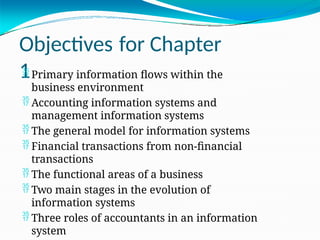
Objectives for Chapter
1
 Primary information flows within the
business environment
 Accounting information systems and
management information systems
 The general model for information systems
 Financial transactions from non-financial
transactions
 The functional areas of a business
 Two main stages in the evolution of
information systems
 Three roles of accountants in an information
system
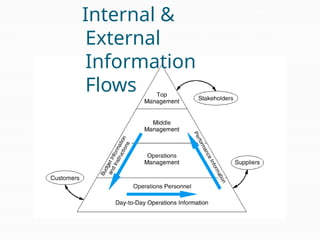
Internal &
External
Information
Flows
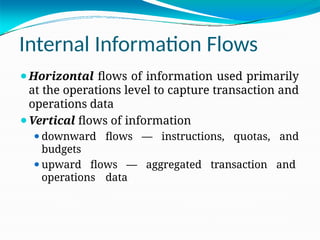
Internal Information Flows
⚫Horizontal flows of information used primarily
at the operations level to capture transaction and
operations data
⚫Vertical flows of information
⚫downward flows — instructions, quotas, and
budgets
⚫upward flows — aggregated transaction and
operations data
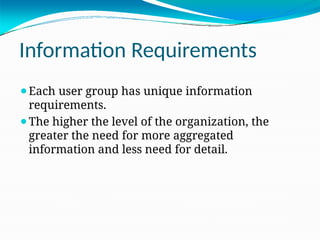
Information Requirements
⚫Each user group has unique information
requirements.
⚫The higher the level of the organization, the
greater the need for more aggregated
information and less need for detail.
Information in Business
⚫Information is a business
resource
that:
⚫needs to be appropriately
managed
⚫is vital to the survival
of contemporary
businesses
What is a System?
⚫A group of interrelated multiple
components or subsystems that serve a
common purpose
⚫System or subsystem?
⚫A system is called a subsystem when it is
viewed as a component of a larger system.
⚫A subsystem is considered a system when it is the
focus of attention.
System Decomposition versus
System Interdependency
⚫System Decomposition
⚫the process of dividing the system into
smaller subsystem parts
⚫System Interdependency
⚫distinct parts are not self-contained
⚫they are reliant upon the functioning of the other
parts of the system
⚫all distinct parts must be functioning or the
system will
fail
What is an Information System?
An information system is the set
of formal procedures by which
data are collected, processed into
information, and distributed to
users.
Transactions
⚫A transaction is a business event.
⚫Financial transactions
⚫economic events that affect the assets and
equities of the organization
⚫e.g., purchase of an airline ticket
⚫Nonfinancial transactions
⚫all other events processed by the
organization’s information system
⚫e.g., an airline reservation — no commitment
by the customer
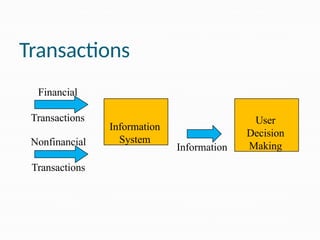
Transactions
Financial
Transactions
Nonfinancial
Transactions
Information
System
User
Decision
Making
Information
What is Accounting Information
Systems?
⚫Accounting is an information system.
⚫It identifies, collects, processes, and
communicates economic
information about a firm using a wide
variety of technologies.
⚫It captures and records the financial
effects of the firm’s transactions.
⚫It distributes transaction information to
operations personnel to coordinate
many key tasks.
AIS versus MIS
⚫Accounting Information Systems (AIS)
process
⚫financial transactions; e.g., sale of goods
⚫and nonfinancial transactions that directly
affect the processing of financial
transactions; e.g., addition of newly
approved vendors
⚫Management Information Systems
(MIS) process
⚫nonfinancial transactions that are not
normally processed by traditional AIS; e.g.,
tracking customer complaints
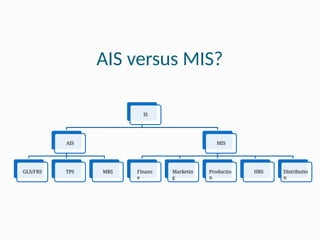
AIS versus MIS?
IS
AIS
GLS/FRS TPS MRS
MIS
Financ
e
Marketin
g
Productio
n
HRS Distributio
n
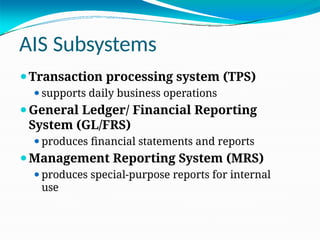
AIS Subsystems
⚫Transaction processing system (TPS)
⚫supports daily business operations
⚫General Ledger/ Financial Reporting
System (GL/FRS)
⚫produces financial statements and reports
⚫Management Reporting System (MRS)
⚫produces special-purpose reports for internal
use
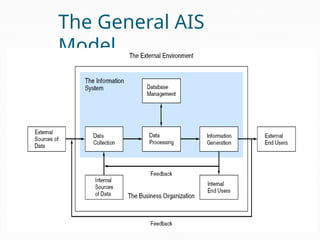
The General AIS
Model
Data Sources
⚫Data sources are financial transactions that
enter the information system from
internal and external sources.
⚫External financial transactions are the most
common source of data for most organizations.
⚫ E.g., sale of goods and services, purchase of
inventory, receipt of cash, and disbursement of cash
(including payroll).
⚫Internal financial transactions involve the
exchange or movement of resources within the
organization.
⚫ E.g., movement of raw materials into work-in-process
(WIP), application of labor and overhead to WIP,
transfer of WIP into finished goods inventory, and
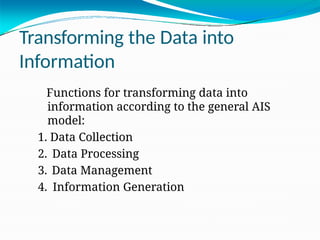
Transforming the Data into
Information
Functions for transforming data into
information according to the general AIS
model:
1. Data Collection
2. Data Processing
3. Data Management
4. Information Generation
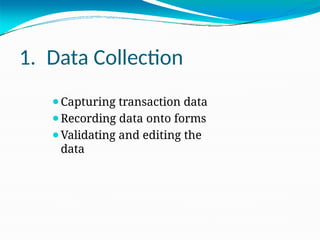
1. Data Collection
⚫Capturing transaction data
⚫Recording data onto forms
⚫Validating and editing the
data
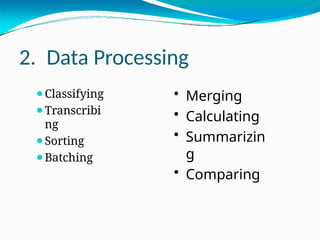
2. Data Processing
⚫Classifying
⚫Transcribi
ng
⚫Sorting
⚫Batching
• Merging
• Calculating
• Summarizin
g
• Comparing
3. Data Management
⚫Storing
⚫Retrievin
g
⚫Deleting
4. Information Generation
⚫Compiling
⚫Arranging
⚫Formattin
g
⚫Presentin
g
Characteristics of Useful Information
⚫Regardless of physical form or technology,
useful
information has the following characteristics:
⚫Relevance: serves a purpose
⚫Timeliness: no older than the time period of the
action
it supports
⚫Accuracy: free from material errors
⚫Completeness: all information essential to a
decision or task is present
⚫Summarization: aggregated in accordance
with the user’s needs
Information System Objectives in a
Business Context
⚫The goal of an information system
is to support
⚫the stewardship function of
management
⚫management decision making
⚫the firm’s day-to-day operations
Organizational Structure
⚫The structure of an organization helps to
allocate
⚫responsibility
⚫authority
⚫accountability
⚫Segmenting by business function is a very
common method of organizing.
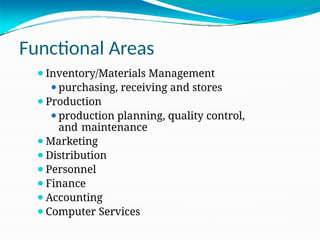
Functional Areas
⚫Inventory/Materials Management
⚫purchasing, receiving and stores
⚫Production
⚫production planning, quality control,
and maintenance
⚫Marketing
⚫Distribution
⚫Personnel
⚫Finance
⚫Accounting
⚫Computer Services
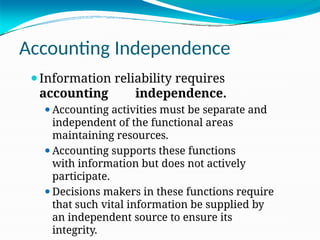
Accounting Independence
⚫Information reliability requires
accounting independence.
⚫Accounting activities must be separate and
independent of the functional areas
maintaining resources.
⚫Accounting supports these functions
with information but does not actively
participate.
⚫Decisions makers in these functions require
that such vital information be supplied by
an independent source to ensure its
integrity.
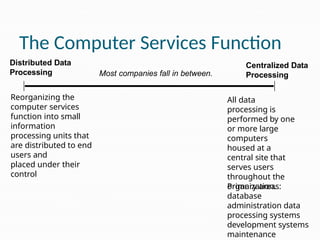
The Computer Services Function
Centralized Data
Processing
Distributed Data
Processing Most companies fall in between.
All data
processing is
performed by one
or more large
computers
housed at a
central site that
serves users
throughout the
organization.
Primary areas:
database
administration data
processing systems
development systems
maintenance
Reorganizing the
computer services
function into small
information
processing units that
are distributed to end
users and
placed under their
control
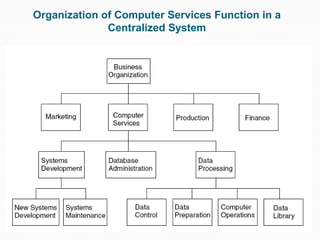
Organization of Computer Services Function in a
Centralized System
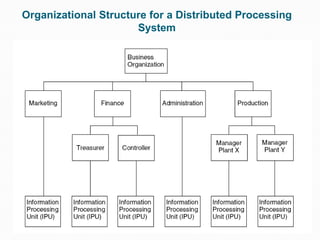
Organizational Structure for a Distributed Processing
System
Potential Advantages of DDP
⚫Cost reductions in hardware and data entry tasks
⚫Improved cost control responsibility
⚫Improved user satisfaction since control is closer
to the user level
⚫Backup of data can be improved through the
use of multiple data storage sites
Potential Disadvantages of DDP
⚫Loss of control
⚫Mismanagement of company
resources
⚫Hardware and software
incompatibility
⚫Redundant tasks and data
⚫Consolidating tasks usually
segregated
⚫Difficulty attracting qualified
personnel
⚫Lack of standards
Manual Process Model
⚫Transaction processing, information processing,
and accounting are physically performed by
people, usually using paper documents.
⚫Useful to study because:
⚫helps link AIS courses to other accounting courses
⚫often easier to understand business processes
when not shrouded in technology
⚫facilitates understanding internal controls
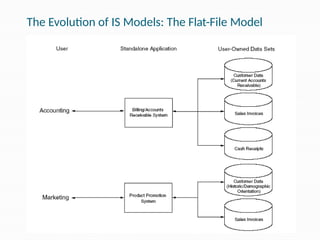
The Evolution of IS Models: The Flat-File Model
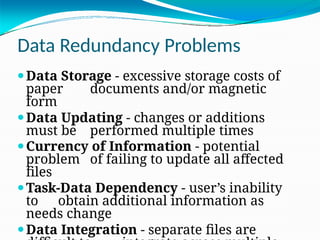
Data Redundancy Problems
⚫Data Storage - excessive storage costs of
paper documents and/or magnetic
form
⚫Data Updating - changes or additions
must be performed multiple times
⚫Currency of Information - potential
problem of failing to update all affected
files
⚫Task-Data Dependency - user’s inability
to obtain additional information as
needs change
⚫Data Integration - separate files are
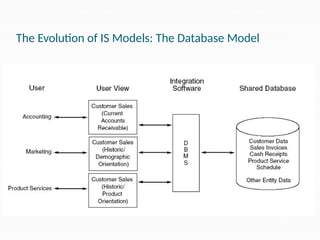
The Evolution of IS Models: The Database Model
34
An REA Data Model Example
Inventory Sales Party to
Sales
person
Pays for
Cash
Collections
Increases
Cash
Made to
Customer
Cashier
Received
from
Received
by
M
1
M
Line items
M
M
M
M
M
M
M
1
1
1
1
R E A
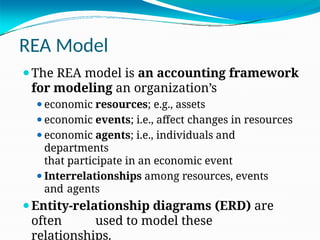
REA Model
⚫The REA model is an accounting framework
for modeling an organization’s
⚫economic resources; e.g., assets
⚫economic events; i.e., affect changes in resources
⚫economic agents; i.e., individuals and
departments
that participate in an economic event
⚫Interrelationships among resources, events
and agents
⚫Entity-relationship diagrams (ERD) are
often used to model these
relationships.
Accountants as Information
System Users
⚫Accountants must be able to clearly convey their
needs to the systems professionals who design
the system.
⚫The accountant should actively
participate in systems development
projects to ensure appropriate
systems design.
Accountants as System Designers
⚫The accounting function is responsible for the
conceptual system, while the computer
function is responsible for the physical system.
⚫The conceptual system determines the nature
of the information required, its sources, its
destination, and the accounting rules that must
be applied.
Accountants as System Auditors
⚫External Auditors
⚫attest to fairness of financial
statements
⚫assurance service: broader in scope
than traditional attestation audit
⚫IT Auditors
⚫evaluate IT, often as part of external
audit
⚫Internal Auditors
⚫

james-a-hall-accounting-information-system-chapter-1.pptx

  • 1.
    Accounting Information Systems,6th edition James A. Hall COPYRIGHT © 2009 South-Western, a division of Cengage Learning. Cengage Learning and South- Western are trademarks used herein under license
  • 2.
    Objectives for Chapter 1 Primary information flows within the business environment  Accounting information systems and management information systems  The general model for information systems  Financial transactions from non-financial transactions  The functional areas of a business  Two main stages in the evolution of information systems  Three roles of accountants in an information system
  • 3.
  • 4.
    Internal Information Flows ⚫Horizontalflows of information used primarily at the operations level to capture transaction and operations data ⚫Vertical flows of information ⚫downward flows — instructions, quotas, and budgets ⚫upward flows — aggregated transaction and operations data
  • 5.
    Information Requirements ⚫Each usergroup has unique information requirements. ⚫The higher the level of the organization, the greater the need for more aggregated information and less need for detail.
  • 6.
    Information in Business ⚫Informationis a business resource that: ⚫needs to be appropriately managed ⚫is vital to the survival of contemporary businesses
  • 7.
    What is aSystem? ⚫A group of interrelated multiple components or subsystems that serve a common purpose ⚫System or subsystem? ⚫A system is called a subsystem when it is viewed as a component of a larger system. ⚫A subsystem is considered a system when it is the focus of attention.
  • 8.
    System Decomposition versus SystemInterdependency ⚫System Decomposition ⚫the process of dividing the system into smaller subsystem parts ⚫System Interdependency ⚫distinct parts are not self-contained ⚫they are reliant upon the functioning of the other parts of the system ⚫all distinct parts must be functioning or the system will fail
  • 9.
    What is anInformation System? An information system is the set of formal procedures by which data are collected, processed into information, and distributed to users.
  • 10.
    Transactions ⚫A transaction isa business event. ⚫Financial transactions ⚫economic events that affect the assets and equities of the organization ⚫e.g., purchase of an airline ticket ⚫Nonfinancial transactions ⚫all other events processed by the organization’s information system ⚫e.g., an airline reservation — no commitment by the customer
  • 11.
  • 12.
    What is AccountingInformation Systems? ⚫Accounting is an information system. ⚫It identifies, collects, processes, and communicates economic information about a firm using a wide variety of technologies. ⚫It captures and records the financial effects of the firm’s transactions. ⚫It distributes transaction information to operations personnel to coordinate many key tasks.
  • 13.
    AIS versus MIS ⚫AccountingInformation Systems (AIS) process ⚫financial transactions; e.g., sale of goods ⚫and nonfinancial transactions that directly affect the processing of financial transactions; e.g., addition of newly approved vendors ⚫Management Information Systems (MIS) process ⚫nonfinancial transactions that are not normally processed by traditional AIS; e.g., tracking customer complaints
  • 14.
    AIS versus MIS? IS AIS GLS/FRSTPS MRS MIS Financ e Marketin g Productio n HRS Distributio n
  • 15.
    AIS Subsystems ⚫Transaction processingsystem (TPS) ⚫supports daily business operations ⚫General Ledger/ Financial Reporting System (GL/FRS) ⚫produces financial statements and reports ⚫Management Reporting System (MRS) ⚫produces special-purpose reports for internal use
  • 16.
  • 17.
    Data Sources ⚫Data sourcesare financial transactions that enter the information system from internal and external sources. ⚫External financial transactions are the most common source of data for most organizations. ⚫ E.g., sale of goods and services, purchase of inventory, receipt of cash, and disbursement of cash (including payroll). ⚫Internal financial transactions involve the exchange or movement of resources within the organization. ⚫ E.g., movement of raw materials into work-in-process (WIP), application of labor and overhead to WIP, transfer of WIP into finished goods inventory, and
  • 18.
    Transforming the Datainto Information Functions for transforming data into information according to the general AIS model: 1. Data Collection 2. Data Processing 3. Data Management 4. Information Generation
  • 19.
    1. Data Collection ⚫Capturingtransaction data ⚫Recording data onto forms ⚫Validating and editing the data
  • 20.
    2. Data Processing ⚫Classifying ⚫Transcribi ng ⚫Sorting ⚫Batching •Merging • Calculating • Summarizin g • Comparing
  • 21.
  • 22.
  • 23.
    Characteristics of UsefulInformation ⚫Regardless of physical form or technology, useful information has the following characteristics: ⚫Relevance: serves a purpose ⚫Timeliness: no older than the time period of the action it supports ⚫Accuracy: free from material errors ⚫Completeness: all information essential to a decision or task is present ⚫Summarization: aggregated in accordance with the user’s needs
  • 24.
    Information System Objectivesin a Business Context ⚫The goal of an information system is to support ⚫the stewardship function of management ⚫management decision making ⚫the firm’s day-to-day operations
  • 25.
    Organizational Structure ⚫The structureof an organization helps to allocate ⚫responsibility ⚫authority ⚫accountability ⚫Segmenting by business function is a very common method of organizing.
  • 26.
    Functional Areas ⚫Inventory/Materials Management ⚫purchasing,receiving and stores ⚫Production ⚫production planning, quality control, and maintenance ⚫Marketing ⚫Distribution ⚫Personnel ⚫Finance ⚫Accounting ⚫Computer Services
  • 27.
    Accounting Independence ⚫Information reliabilityrequires accounting independence. ⚫Accounting activities must be separate and independent of the functional areas maintaining resources. ⚫Accounting supports these functions with information but does not actively participate. ⚫Decisions makers in these functions require that such vital information be supplied by an independent source to ensure its integrity.
  • 28.
    The Computer ServicesFunction Centralized Data Processing Distributed Data Processing Most companies fall in between. All data processing is performed by one or more large computers housed at a central site that serves users throughout the organization. Primary areas: database administration data processing systems development systems maintenance Reorganizing the computer services function into small information processing units that are distributed to end users and placed under their control
  • 29.
    Organization of ComputerServices Function in a Centralized System
  • 30.
    Organizational Structure fora Distributed Processing System
  • 31.
    Potential Advantages ofDDP ⚫Cost reductions in hardware and data entry tasks ⚫Improved cost control responsibility ⚫Improved user satisfaction since control is closer to the user level ⚫Backup of data can be improved through the use of multiple data storage sites
  • 32.
    Potential Disadvantages ofDDP ⚫Loss of control ⚫Mismanagement of company resources ⚫Hardware and software incompatibility ⚫Redundant tasks and data ⚫Consolidating tasks usually segregated ⚫Difficulty attracting qualified personnel ⚫Lack of standards
  • 33.
    Manual Process Model ⚫Transactionprocessing, information processing, and accounting are physically performed by people, usually using paper documents. ⚫Useful to study because: ⚫helps link AIS courses to other accounting courses ⚫often easier to understand business processes when not shrouded in technology ⚫facilitates understanding internal controls
  • 34.
    The Evolution ofIS Models: The Flat-File Model
  • 35.
    Data Redundancy Problems ⚫DataStorage - excessive storage costs of paper documents and/or magnetic form ⚫Data Updating - changes or additions must be performed multiple times ⚫Currency of Information - potential problem of failing to update all affected files ⚫Task-Data Dependency - user’s inability to obtain additional information as needs change ⚫Data Integration - separate files are
  • 36.
    The Evolution ofIS Models: The Database Model
  • 37.
    34 An REA DataModel Example Inventory Sales Party to Sales person Pays for Cash Collections Increases Cash Made to Customer Cashier Received from Received by M 1 M Line items M M M M M M M 1 1 1 1 R E A
  • 38.
    REA Model ⚫The REAmodel is an accounting framework for modeling an organization’s ⚫economic resources; e.g., assets ⚫economic events; i.e., affect changes in resources ⚫economic agents; i.e., individuals and departments that participate in an economic event ⚫Interrelationships among resources, events and agents ⚫Entity-relationship diagrams (ERD) are often used to model these relationships.
  • 39.
    Accountants as Information SystemUsers ⚫Accountants must be able to clearly convey their needs to the systems professionals who design the system. ⚫The accountant should actively participate in systems development projects to ensure appropriate systems design.
  • 40.
    Accountants as SystemDesigners ⚫The accounting function is responsible for the conceptual system, while the computer function is responsible for the physical system. ⚫The conceptual system determines the nature of the information required, its sources, its destination, and the accounting rules that must be applied.
  • 41.
    Accountants as SystemAuditors ⚫External Auditors ⚫attest to fairness of financial statements ⚫assurance service: broader in scope than traditional attestation audit ⚫IT Auditors ⚫evaluate IT, often as part of external audit ⚫Internal Auditors ⚫