1
Computer Organization Computer Architecture
Computer Organization and
Architecture
II B.Tech I Sem
CSE
By
G.Swarnalatha
2
Computer Organization Computer Architecture
Syllabus
UNIT – I
Digital Computers: Introduction, Block diagram of
Digital Computer, Definition of, Computer
Organization, Computer Design and Computer
Architecture.
Register Transfer Language and Micro operations:
Register Transfer language, Register Transfer, Bus
and memory transfers, Arithmetic Micro operations,
logic microoperations, shift micro operations,
Arithmetic logic shift unit.
Basic Computer Organization and Design: Instruction
codes, Computer Registers, Computer instructions,
Timing and Control, Instruction cycle, Memory
Reference Instructions, Input – Output and Interrupt.
3
Computer Organization Computer Architecture
Syllabus
UNIT – II
Microprogrammed Control: Control memory, Address
sequencing, micro program example, design of
control unit.
Central Processing Unit: General Register
Organization, Instruction Formats, Addressing
modes, Data Transfer and Manipulation, Program
Control.
4
Computer Organization Computer Architecture
Syllabus
UNIT – III
Data Representation: Data types, Complements, Fixed
Point Representation, Floating Point Representation.
Computer Arithmetic: Addition and subtraction,
multiplication Algorithms, Division Algorithms,
Floating– point Arithmetic operations. Decimal
Arithmetic unit, Decimal Arithmetic operations.
5
Computer Organization Computer Architecture
Syllabus
UNIT – IV
Input-Output Organization: Input-Output Interface,
Asynchronous data transfer, Modes of Transfer,
Priority Interrupt Direct memory Access.
Memory Organization: Memory Hierarchy, Main
Memory, Auxiliary memory, Associate Memory,
Cache Memory.
6
Computer Organization Computer Architecture
Syllabus
UNIT – V
Reduced Instruction Set Computer: CISC
Characteristics, RISC Characteristics.
Pipeline and Vector Processing: Parallel Processing,
Pipelining, Arithmetic Pipeline, Instruction Pipeline,
RISC Pipeline, Vector Processing, Array Processor.
Multi Processors: Characteristics of Multiprocessors,
Interconnection Structures, Interprocessor
arbitration, Interprocessor communication and
synchronization, Cache Coherence.
7
Computer Organization Computer Architecture
Digital Computers
• The digital computer is a digital system that performs
various computational tasks.
• The word digital implies that the information in the
computer is represented by variables that take a
limited number of discrete values.
• Digital computers use the binary number system,
which has two digits: 0 and 1.
• A binary digit is called a bit. Information is
represented in digital computers in groups of bits.
Represent binary numbers, discrete symbols -
decimal digits or letters of the alphabet.
8
Computer Organization Computer Architecture
Digital Computers
• A computer system is sometimes subdivided into
two functional entities:
(a) Hardware (b) Software
• Hardware: The hardware of the computer consists of
all the electronic components and electromechanical
devices that comprise the physical entity of the
device.
• Software: The software consists of the instructions
and data that the computer manipulates to perform
various data-processing tasks.
A sequence of instructions for the computer is
called a program. The data that are manipulated by
the program constitute the data base.
9
Computer Organization Computer Architecture
Block Diagram of Digital Computer
10
Computer Organization Computer Architecture
Block Diagram of Digital Computer
• The central processing unit (CPU) contains an
arithmetic and logic unit for manipulating data, a
number of registers for storing data, and control
circuits for fetching and executing instructions.
• The memory of a computer contains storage for
instructions and data. It is called a random-access
memory (RAM)
11
Computer Organization Computer Architecture
Block Diagram of Digital Computer
• The input and output processor (IOP) contains
electronic circuits for communicating and controlling
the transfer of information between the computer and
the outside world.
• The input and output devices connected to the
computer include keyboards, printers, terminals,
magnetic disk drives, and other communication
devices.
12
Computer Organization Computer Architecture
Computer Organization
• Computer organization is concerned with the way the
hardware components operate and the way they are
connected together to form the computer system.
• The various components are assumed to be in place
and the task is to investigate the organizational
structure to verify that the computer parts operate as
intended.
13
Computer Organization Computer Architecture
Computer Design
• Computer design is concerned with the hardware
design of the computer. Once the computer
specifications are formulated, it is the task of the
designer to develop hardware for the system.
• Computer design is concerned with the
determination of what hardware should be used and
how the parts should be connected.
• This aspect of computer hardware is sometimes
referred to as computer implementation.
14
Computer Organization Computer Architecture
Computer Architecture
• Computer architecture is concerned with the
structure and behavior of the computer as seen by
the user. It includes the information, formats, the
instruction set, and techniques for addressing
memory.
• The architectural design of a computer system is
concerned with the specifications of the various
functional modules, such as processors and
memories, and structuring them together into a
computer system.
15
Computer Organization Computer Architecture
REGISTER TRANSFER AND MICROOPERATIONS
• Register Transfer Language
• Register Transfer
• Bus and Memory Transfers
• Arithmetic Microoperations
• Logic Microoperations
• Shift Microoperations
• Arithmetic Logic Shift Unit
Register Transfer & -operations
16
Computer Organization Computer Architecture
MICROOPERATIONS (1)
Register Transfer Language
• The operations on the data in registers are called
microoperations.
• The functions built into registers are examples of
microoperations
– Shift
– Load
– Clear
– Increment
– …
Register Transfer & -operations
17
Computer Organization Computer Architecture
MICROOPERATION (2)
An elementary operation performed (during
one clock pulse), on the information stored
in one or more registers
R  f(R, R)
f: shift, load, clear, increment, add, subtract, complement,
and, or, xor, …
ALU
(f)
Registers
(R)
1 clock cycle
Register Transfer Language
Register Transfer & -operations
18
Computer Organization Computer Architecture
ORGANIZATION OF A DIGITAL SYSTEM
- Set of registers and their functions
- Microoperations set
Set of allowable microoperations provided
by the organization of the computer
- Control signals that initiate the sequence of
microoperations (to perform the functions)
• Definition of the (internal) organization of a computer
Register Transfer Language
Register Transfer & -operations
19
Computer Organization Computer Architecture
REGISTER TRANSFER LEVEL
Register Transfer Language
• Viewing a computer, or any digital system, in this way is
called the register transfer level
• This is because we’re focusing on
– The system’s registers
– The data transformations in them, and
– The data transfers between them.
Register Transfer & -operations
20
Computer Organization Computer Architecture
REGISTER TRANSFER LANGUAGE
Register Transfer Language
• Rather than specifying a digital system in words, a specific
notation is used, register transfer language
• For any function of the computer, the register transfer
language can be used to describe the (sequence of)
microoperations
• Register transfer language
– A symbolic language
– A convenient tool for describing the internal organization of digital
computers
– Can also be used to facilitate the design process of digital systems.
Register Transfer & -operations
21
Computer Organization Computer Architecture
DESIGNATION OF REGISTERS
Register Transfer Language
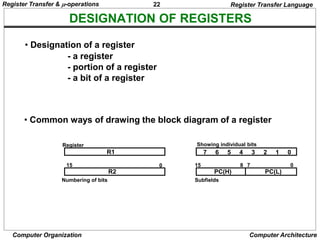
• Registers are designated by capital letters, sometimes
followed by numbers (e.g., A, R13, IR)
• Often the names indicate function:
– MAR - memory address register
– PC - program counter
– IR - instruction register
• Registers and their contents can be viewed and represented in
various ways
– A register can be viewed as a single entity:
– Registers may also be represented showing the bits of data they contain
MAR
Register Transfer & -operations
22
Computer Organization Computer Architecture
DESIGNATION OF REGISTERS
Register Transfer Language
R1
Register
Numbering of bits
Showing individual bits
Subfields
PC(H) PC(L)
15 8 7 0
- a register
- portion of a register
- a bit of a register
• Common ways of drawing the block diagram of a register
7 6 5 4 3 2 1 0
R2
15 0
• Designation of a register
Register Transfer & -operations
23
Computer Organization Computer Architecture
REGISTER TRANSFER
Register Transfer
• Copying the contents of one register to another is a register
transfer
• A register transfer is indicated as
R2  R1
– In this case the contents of register R2 are copied (loaded) into
register R1
– A simultaneous transfer of all bits from the source R1 to the
destination register R2, during one clock pulse
– Note that this is a non-destructive; i.e. the contents of R1 are not
altered by copying (loading) them to R2
Register Transfer & -operations
24
Computer Organization Computer Architecture
REGISTER TRANSFER
Register Transfer
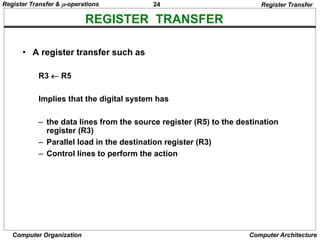
• A register transfer such as
R3  R5
Implies that the digital system has
– the data lines from the source register (R5) to the destination
register (R3)
– Parallel load in the destination register (R3)
– Control lines to perform the action
Register Transfer & -operations
25
Computer Organization Computer Architecture
CONTROL FUNCTIONS
Register Transfer
• Often actions need to only occur if a certain condition is true
• This is similar to an “if” statement in a programming language
• In digital systems, this is often done via a control signal, called
a control function
– If the signal is 1, the action takes place
• This is represented as:
P: R2  R1
Which means “if P = 1, then load the contents of register R1 into
register R2”, i.e., if (P = 1) then (R2  R1)
Register Transfer & -operations
26
Computer Organization Computer Architecture
HARDWARE IMPLEMENTATION OF CONTROLLED TRANSFERS
Implementation of controlled transfer
P: R2 R1
Block diagram
Timing diagram
Clock
Register Transfer
Transfer occurs here
R2
R1
Control
Circuit
Load
P
n
Clock
Load
t t+1
• The same clock controls the circuits that generate the control function
and the destination register
• Registers are assumed to use positive-edge-triggered flip-flops
Register Transfer & -operations
27
Computer Organization Computer Architecture
SIMULTANEOUS OPERATIONS
Register Transfer
• If two or more operations are to occur
simultaneously, they are separated with commas
P: R3  R5, MAR  IR
• Here, if the control function P = 1, load the contents
of R5 into R3, and at the same time (clock), load the
contents of register IR into register MAR
Register Transfer & -operations
28
Computer Organization Computer Architecture
BASIC SYMBOLS FOR REGISTER TRANSFERS
Capital letters Denotes a register MAR, R2
& numerals
Parentheses () Denotes a part of a register R2(0-7), R2(L)
Arrow  Denotes transfer of information R2  R1
Colon : Denotes termination of control function P:
Comma , Separates two micro-operations A  B, B  A
Symbols Description Examples
Register Transfer
Register Transfer & -operations
29
Computer Organization Computer Architecture
CONNECTING REGISTRS
Register Transfer
• In a digital system with many registers, it is impractical to
have data and control lines to directly allow each register
to be loaded with the contents of every possible other
registers
• To completely connect n registers  n(n-1) lines
• O(n2) cost
– This is not a realistic approach to use in a large digital system
• Instead, take a different approach
• Have one centralized set of circuits for data transfer – the
bus
• Have control circuits to select which register is the source,
and which is the destination
Register Transfer & -operations
30
Computer Organization Computer Architecture
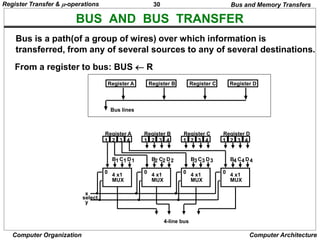
BUS AND BUS TRANSFER
Bus is a path(of a group of wires) over which information is
transferred, from any of several sources to any of several destinations.
From a register to bus: BUS  R
1 2 3 4 1 2 3 4 1 2 3 4 1 2 3 4
Register A Register B Register C Register D
B C D
1 1 1
4 x1
MUX
B C D
2 2 2
4 x1
MUX
B C D
3 3 3
4 x1
MUX
B C D
4 4 4
4 x1
MUX
4-line bus
x
y
select
0 0 0 0
Register A Register B Register C Register D
Bus lines
Bus and Memory Transfers
Register Transfer & -operations
31
Computer Organization Computer Architecture
TRANSFER FROM BUS TO A DESTINATION REGISTER
Three-State Bus Buffers
Bus line with three-state buffers
Reg. R0 Reg. R1 Reg. R2 Reg. R3
Bus lines
2 x 4
Decoder
Load
D0 D1 D2 D3
z
w
Select E (enable)
Output Y=A if C=1
High-impedence if C=0
Normal input A
Control input C
Select
Enable
0
1
2
3
S0
S1
A0
B0
C0
D0
Bus line for bit 0
Bus and Memory Transfers
Register Transfer & -operations
32
Computer Organization Computer Architecture
BUS TRANSFER IN RTL
Bus and Memory Transfers
• Depending on whether the bus is to be mentioned
explicitly or not, register transfer can be indicated as
either
or
• In the former case the bus is implicit, but in the latter, it is
explicitly indicated
R2 R1
BUS R1, R2  BUS
Register Transfer & -operations
33
Computer Organization Computer Architecture
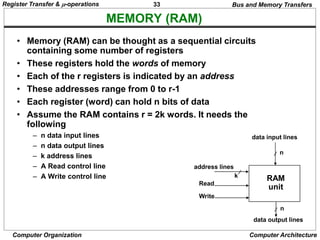
MEMORY (RAM)
Bus and Memory Transfers
• Memory (RAM) can be thought as a sequential circuits
containing some number of registers
• These registers hold the words of memory
• Each of the r registers is indicated by an address
• These addresses range from 0 to r-1
• Each register (word) can hold n bits of data
• Assume the RAM contains r = 2k words. It needs the
following
– n data input lines
– n data output lines
– k address lines
– A Read control line
– A Write control line
data input lines
data output lines
n
n
k
address lines
Read
Write
RAM
unit
Register Transfer & -operations
34
Computer Organization Computer Architecture
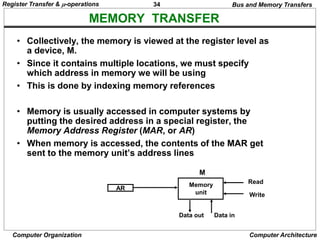
MEMORY TRANSFER
Bus and Memory Transfers
• Collectively, the memory is viewed at the register level as
a device, M.
• Since it contains multiple locations, we must specify
which address in memory we will be using
• This is done by indexing memory references
• Memory is usually accessed in computer systems by
putting the desired address in a special register, the
Memory Address Register (MAR, or AR)
• When memory is accessed, the contents of the MAR get
sent to the memory unit’s address lines
AR
Memory
unit
Read
Write
Data in
Data out
M
Register Transfer & -operations
35
Computer Organization Computer Architecture
MEMORY READ
Bus and Memory Transfers
• To read a value from a location in memory and load it into
a register, the register transfer language notation looks
like this:
• This causes the following to occur
– The contents of the MAR get sent to the memory address lines
– A Read (= 1) gets sent to the memory unit
– The contents of the specified address are put on the memory’s
output data lines
– These get sent over the bus to be loaded into register R1
R1  M[MAR]
Register Transfer & -operations
36
Computer Organization Computer Architecture
MEMORY WRITE
Bus and Memory Transfers
• To write a value from a register to a location in memory
looks like this in register transfer language:
• This causes the following to occur
– The contents of the MAR get sent to the memory address lines
– A Write (= 1) gets sent to the memory unit
– The values in register R1 get sent over the bus to the data input lines
of the memory
– The values get loaded into the specified address in the memory
M[MAR]  R1
Register Transfer & -operations
37
Computer Organization Computer Architecture
SUMMARY OF R. TRANSFER MICROOPERATIONS
Bus and Memory Transfers
A  B Transfer content of reg. B into reg. A
AR  DR(AD) Transfer content of AD portion of reg. DR into reg. AR
A  constant Transfer a binary constant into reg. A
ABUS  R1, Transfer content of R1 into bus A and, at the same time,
R2  ABUS transfer content of bus A into R2
AR Address register
DR Data register
M[R] Memory word specified by reg. R
M Equivalent to M[AR]
DR  M Memory read operation: transfers content of
memory word specified by AR into DR
M  DR Memory write operation: transfers content of
DR into memory word specified by AR
Register Transfer & -operations
38
Computer Organization Computer Architecture
MICROOPERATIONS
• Computer system microoperations are of four types:
- Register transfer microoperations
- Arithmetic microoperations
- Logic microoperations
- Shift microoperations
Arithmetic Microoperations
Register Transfer & -operations
39
Computer Organization Computer Architecture
ARITHMETIC MICROOPERATIONS
Summary of Typical Arithmetic Micro-Operations
Arithmetic Microoperations
R3  R1 + R2 Contents of R1 plus R2 transferred to R3
R3  R1 - R2 Contents of R1 minus R2 transferred to R3
R2  R2’ Complement the contents of R2
R2  R2’+ 1 2's complement the contents of R2 (negate)
R3  R1 + R2’+ 1 subtraction
R1  R1 + 1 Increment
R1  R1 - 1 Decrement
• The basic arithmetic microoperations are
– Addition
– Subtraction
– Increment
– Decrement
• The additional arithmetic microoperations are
– Add with carry
– Subtract with borrow
– Transfer/Load
– etc. …
Register Transfer & -operations
40
Computer Organization Computer Architecture
BINARY ADDER / SUBTRACTOR / INCREMENTER
FA
B0 A0
S0
C0
FA
B1 A1
S1
C1
FA
B2 A2
S2
C2
FA
B3 A3
S3
C3
C4
Binary Adder-Subtractor
FA
B0 A0
S0
C0
C1
FA
B1 A1
S1
C2
FA
B2 A2
S2
C3
FA
B3 A3
S3
C4
M
Binary Incrementer
HA
x y
C S
A0 1
S0
HA
x y
C S
A1
S1
HA
x y
C S
A2
S2
HA
x y
C S
A3
S3
C4
Binary Adder
Arithmetic Microoperations
Register Transfer & -operations
41
Computer Organization Computer Architecture
ARITHMETIC CIRCUIT
S1
S0
0
1
2
3
4x1
MUX
X0
Y0
C0
C1
D0
FA
S1
S0
0
1
2
3
4x1
MUX
X1
Y1
C1
C2
D1
FA
S1
S0
0
1
2
3
4x1
MUX
X2
Y2
C2
C3
D2
FA
S1
S0
0
1
2
3
4x1
MUX
X3
Y3
C3
C4
D3
FA
Cout
A0
B0
A1
B1
A2
B2
A3
B3
0 1
S0
S1
Cin
S1 S0 Cin Y Output Microoperation
0 0 0 B D = A + B Add
0 0 1 B D = A + B + 1 Add with carry
0 1 0 B’ D = A + B’ Subtract with borrow
0 1 1 B’ D = A + B’+ 1 Subtract
1 0 0 0 D = A Transfer A
1 0 1 0 D = A + 1 Increment A
1 1 0 1 D = A - 1 Decrement A
1 1 1 1 D = A Transfer A
Arithmetic Microoperations
Register Transfer & -operations
42
Computer Organization Computer Architecture
LOGIC MICROOPERATIONS
Logic Microoperations
• Specify binary operations on the strings of bits in registers
– Logic microoperations are bit-wise operations, i.e., they work on the
individual bits of data
– useful for bit manipulations on binary data
– useful for making logical decisions based on the bit value
• There are, in principle, 16 different logic functions that can
be defined over two binary input variables
• However, most systems only implement four of these
– AND (), OR (), XOR (), Complement/NOT
• The others can be created from combination of these
0 0 0 0 0 … 1 1 1
0 1 0 0 0 … 1 1 1
1 0 0 0 1 … 0 1 1
1 1 0 1 0 … 1 0 1
A B F0 F1 F2 … F13 F14 F15
Register Transfer & -operations
43
Computer Organization Computer Architecture
LIST OF LOGIC MICROOPERATIONS
• List of Logic Microoperations
- 16 different logic operations with 2 binary vars.
- n binary vars → functions
2 2 n
• Truth tables for 16 functions of 2 variables and the
corresponding 16 logic micro-operations
Boolean
Function
Micro-
Operations
Name
x 0 0 1 1
y 0 1 0 1
Logic Microoperations
0 0 0 0 F0 = 0 F  0 Clear
0 0 0 1 F1 = xy F  A  B AND
0 0 1 0 F2 = xy' F  A  B’
0 0 1 1 F3 = x F  A Transfer A
0 1 0 0 F4 = x'y F  A’ B
0 1 0 1 F5 = y F  B Transfer B
0 1 1 0 F6 = x  y F  A  B Exclusive-OR
0 1 1 1 F7 = x + y F  A  B OR
1 0 0 0 F8 = (x + y)' F  A  B)’ NOR
1 0 0 1 F9 = (x  y)' F  (A  B)’ Exclusive-NOR
1 0 1 0 F10 = y' F  B’ Complement B
1 0 1 1 F11 = x + y' F  A  B
1 1 0 0 F12 = x' F  A’ Complement A
1 1 0 1 F13 = x' + y F  A’ B
1 1 1 0 F14 = (xy)' F  (A  B)’ NAND
1 1 1 1 F15 = 1 F  all 1's Set to all 1's
Register Transfer & -operations
44
Computer Organization Computer Architecture
HARDWARE IMPLEMENTATION OF LOGIC MICROOPERATIONS
0 0 F = A  B AND
0 1 F = AB OR
1 0 F = A  B XOR
1 1 F = A’ Complement
S1 S0 Output -operation
Function table
Logic Microoperations
B
A
S
S
F
1
0
i
i
i
0
1
2
3
4 X 1
MUX
Select
Register Transfer & -operations
45
Computer Organization Computer Architecture
APPLICATIONS OF LOGIC MICROOPERATIONS
Logic Microoperations
• Logic microoperations can be used to manipulate individual
bits or a portions of a word in a register
• Consider the data in a register A. In another register, B, is bit
data that will be used to modify the contents of A
– Selective-set A  A + B
– Selective-complement A  A  B
– Selective-clear A  A • B’
– Mask (Delete) A  A • B
– Clear A  A  B
– Insert A  (A • B) + C
– Compare A  A  B
– . . .
Register Transfer & -operations
46
Computer Organization Computer Architecture
SELECTIVE SET
Logic Microoperations
• In a selective set operation, the bit pattern in B is used to set
certain bits in A
1 1 0 0 At
1 0 1 0 B
1 1 1 0 At+1 (A  A + B)
• If a bit in B is set to 1, that same position in A gets set to 1,
otherwise that bit in A keeps its previous value
Register Transfer & -operations
47
Computer Organization Computer Architecture
SELECTIVE COMPLEMENT
Logic Microoperations
• In a selective complement operation, the bit pattern in B is
used to complement certain bits in A
1 1 0 0 At
1 0 1 0 B
0 1 1 0 At+1 (A  A  B)
• If a bit in B is set to 1, that same position in A gets
complemented from its original value, otherwise it is
unchanged
Register Transfer & -operations
48
Computer Organization Computer Architecture
SELECTIVE CLEAR
Logic Microoperations
• In a selective clear operation, the bit pattern in B is used to
clear certain bits in A
1 1 0 0 At
1 0 1 0 B
0 1 0 0 At+1 (A  A  B’)
• If a bit in B is set to 1, that same position in A gets set to 0,
otherwise it is unchanged
Register Transfer & -operations
49
Computer Organization Computer Architecture
MASK OPERATION
Logic Microoperations
• In a mask operation, the bit pattern in B is used to clear
certain bits in A
1 1 0 0 At
1 0 1 0 B
1 0 0 0 At+1 (A  A  B)
• If a bit in B is set to 0, that same position in A gets set to 0,
otherwise it is unchanged
Register Transfer & -operations
50
Computer Organization Computer Architecture
CLEAR OPERATION
Logic Microoperations
• In a clear operation, if the bits in the same position in A and
B are the same, they are cleared in A, otherwise they are set
in A
1 1 0 0 At
1 0 1 0 B
0 1 1 0 At+1 (A  A  B)
Register Transfer & -operations
51
Computer Organization Computer Architecture
INSERT OPERATION
Logic Microoperations
• An insert operation is used to introduce a specific bit pattern
into A register, leaving the other bit positions unchanged
• This is done as
– A mask operation to clear the desired bit positions, followed by
– An OR operation to introduce the new bits into the desired
positions
– Example
» Suppose you wanted to introduce 1010 into the low order
four bits of A: 1101 1000 1011 0001 A (Original)
1101 1000 1011 1010 A (Desired)
» 1101 1000 1011 0001 A (Original)
1111 1111 1111 0000 Mask
1101 1000 1011 0000 A (Intermediate)
0000 0000 0000 1010 Added bits
1101 1000 1011 1010 A (Desired)
Register Transfer & -operations
52
Computer Organization Computer Architecture
SHIFT MICROOPERATIONS
Shift Microoperations
• There are three types of shifts
– Logical shift
– Circular shift
– Arithmetic shift
• What differentiates them is the information that goes into
the serial input
Serial
input
• A right shift operation
• A left shift operation Serial
input
Register Transfer & -operations
53
Computer Organization Computer Architecture
LOGICAL SHIFT
Shift Microoperations
• In a logical shift the serial input to the shift is a 0.
• A right logical shift operation:
• A left logical shift operation:
• In a Register Transfer Language, the following notation is used
– shl for a logical shift left
– shr for a logical shift right
– Examples:
» R2  shr R2
» R3  shl R3
0
0
Register Transfer & -operations
54
Computer Organization Computer Architecture
CIRCULAR SHIFT
Shift Microoperations
• In a circular shift the serial input is the bit that is shifted out of
the other end of the register.
• A right circular shift operation:
• A left circular shift operation:
• In a RTL, the following notation is used
– cil for a circular shift left
– cir for a circular shift right
– Examples:
» R2  cir R2
» R3  cil R3
Register Transfer & -operations
55
Computer Organization Computer Architecture
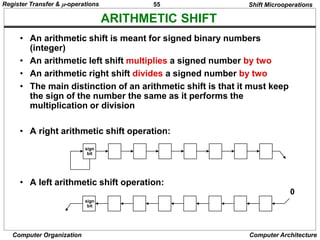
ARITHMETIC SHIFT
Shift Microoperations
• An arithmetic shift is meant for signed binary numbers
(integer)
• An arithmetic left shift multiplies a signed number by two
• An arithmetic right shift divides a signed number by two
• The main distinction of an arithmetic shift is that it must keep
the sign of the number the same as it performs the
multiplication or division
• A right arithmetic shift operation:
• A left arithmetic shift operation:
0
sign
bit
sign
bit
Register Transfer & -operations
56
Computer Organization Computer Architecture
ARITHMETIC SHIFT
Shift Microoperations
• An left arithmetic shift operation must be checked for the
overflow
0
V
Before the shift, if the leftmost two
bits differ, the shift will result in an
overflow
• In a RTL, the following notation is used
– ashl for an arithmetic shift left
– ashr for an arithmetic shift right
– Examples:
» R2  ashr R2
» R3  ashl R3
sign
bit
Register Transfer & -operations
57
Computer Organization Computer Architecture
HARDWARE IMPLEMENTATION OF SHIFT MICROOPERATIONS
Shift Microoperations
S
0
1
H0
MUX
S
0
1
H1
MUX
S
0
1
H2
MUX
S
0
1
H3
MUX
Select
0 for shift right (down)
1 for shift left (up)
Serial
input (IR)
A0
A1
A2
A3
Serial
input (IL)
Register Transfer & -operations
58
Computer Organization Computer Architecture
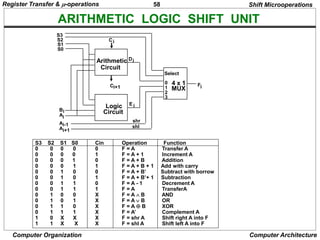
ARITHMETIC LOGIC SHIFT UNIT
S3 S2 S1 S0 Cin Operation Function
0 0 0 0 0 F = A Transfer A
0 0 0 0 1 F = A + 1 Increment A
0 0 0 1 0 F = A + B Addition
0 0 0 1 1 F = A + B + 1 Add with carry
0 0 1 0 0 F = A + B’ Subtract with borrow
0 0 1 0 1 F = A + B’+ 1 Subtraction
0 0 1 1 0 F = A - 1 Decrement A
0 0 1 1 1 F = A TransferA
0 1 0 0 X F = A  B AND
0 1 0 1 X F = A B OR
0 1 1 0 X F = A  B XOR
0 1 1 1 X F = A’ Complement A
1 0 X X X F = shr A Shift right A into F
1 1 X X X F = shl A Shift left A into F
Shift Microoperations
Arithmetic
Circuit
Logic
Circuit
C
C 4 x 1
MUX
Select
0
1
2
3
F
S3
S2
S1
S0
B
A
i
A
D
A
E
shr
shl
i+1 i
i
i
i+1
i-1
i
i
Register Transfer & -operations
59
Computer Organization Computer Architecture
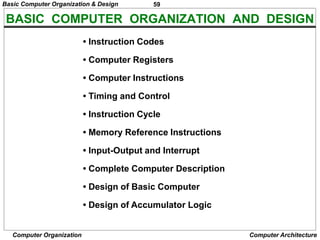
BASIC COMPUTER ORGANIZATION AND DESIGN
• Instruction Codes
• Computer Registers
• Computer Instructions
• Timing and Control
• Instruction Cycle
• Memory Reference Instructions
• Input-Output and Interrupt
• Complete Computer Description
• Design of Basic Computer
• Design of Accumulator Logic
Basic Computer Organization & Design
60
Computer Organization Computer Architecture
INTRODUCTION
• Every different processor type has its own design (different
registers, buses, microoperations, machine instructions, etc)
• Modern processor is a very complex device
• It contains
– Many registers
– Multiple arithmetic units, for both integer and floating point calculations
– The ability to pipeline several consecutive instructions to speed execution
– Etc.
• However, to understand how processors work, we will start with
a simplified processor model
• This is similar to what real processors were like ~25 years ago
• M. Morris Mano introduces a simple processor model he calls
the Basic Computer
• We will use this to introduce processor organization and the
relationship of the RTL model to the higher level computer
processor
Basic Computer Organization & Design
61
Computer Organization Computer Architecture
THE BASIC COMPUTER
• The Basic Computer has two components, a processor and
memory
• The memory has 4096 words in it
– 4096 = 212, so it takes 12 bits to select a word in memory
• Each word is 16 bits long
CPU RAM
0
4095
0
15
Basic Computer Organization & Design
62
Computer Organization Computer Architecture
INSTRUCTIONS
Instruction codes
• Program
– A sequence of (machine) instructions
• (Machine) Instruction
– A group of bits that tell the computer to perform a specific operation
(a sequence of micro-operation)
• The instructions of a program, along with any needed data
are stored in memory
• The CPU reads the next instruction from memory
• It is placed in an Instruction Register (IR)
• Control circuitry in control unit then translates the
instruction into the sequence of microoperations
necessary to implement it
Basic Computer Organization & Design
63
Computer Organization Computer Architecture
INSTRUCTION FORMAT
Instruction codes
• A computer instruction is often divided into two parts
– An opcode (Operation Code) that specifies the operation for that
instruction
– An address that specifies the registers and/or locations in memory to
use for that operation
• In the Basic Computer, since the memory contains 4096 (=
212) words, we needs 12 bit to specify which memory
address this instruction will use
• In the Basic Computer, bit 15 of the instruction specifies
the addressing mode (0: direct addressing, 1: indirect
addressing)
• Since the memory words, and hence the instructions, are
16 bits long, that leaves 3 bits for the instruction’s opcode
Opcode Address
Instruction Format
15 14 12 0
I
11
Addressing
mode
Basic Computer Organization & Design
64
Computer Organization Computer Architecture
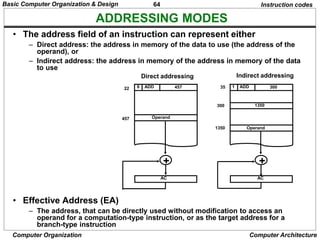
ADDRESSING MODES
Instruction codes
• The address field of an instruction can represent either
– Direct address: the address in memory of the data to use (the address of the
operand), or
– Indirect address: the address in memory of the address in memory of the data
to use
• Effective Address (EA)
– The address, that can be directly used without modification to access an
operand for a computation-type instruction, or as the target address for a
branch-type instruction
0 ADD 457
22
Operand
457
1 ADD 300
35
1350
300
Operand
1350
+
AC
+
AC
Direct addressing Indirect addressing
Basic Computer Organization & Design
65
Computer Organization Computer Architecture
PROCESSOR REGISTERS
Instruction codes
• A processor has many registers to hold instructions,
addresses, data, etc
• The processor has a register, the Program Counter (PC) that
holds the memory address of the next instruction to get
– Since the memory in the Basic Computer only has 4096 locations, the PC
only needs 12 bits
• In a direct or indirect addressing, the processor needs to keep
track of what locations in memory it is addressing: The
Address Register (AR) is used for this
– The AR is a 12 bit register in the Basic Computer
• When an operand is found, using either direct or indirect
addressing, it is placed in the Data Register (DR). The
processor then uses this value as data for its operation
• The Basic Computer has a single general purpose register –
the Accumulator (AC)
Basic Computer Organization & Design
66
Computer Organization Computer Architecture
PROCESSOR REGISTERS
Instruction codes
• The significance of a general purpose register is that it can be
referred to in instructions
– e.g. load AC with the contents of a specific memory location; store the
contents of AC into a specified memory location
• Often a processor will need a scratch register to store
intermediate results or other temporary data; in the Basic
Computer this is the Temporary Register (TR)
• The Basic Computer uses a very simple model of input/output
(I/O) operations
– Input devices are considered to send 8 bits of character data to the processor
– The processor can send 8 bits of character data to output devices
• The Input Register (INPR) holds an 8 bit character gotten from an
input device
• The Output Register (OUTR) holds an 8 bit character to be send
to an output device
Basic Computer Organization & Design
67
Computer Organization Computer Architecture
BASIC COMPUTER REGISTERS
List of BC Registers
DR 16 Data Register Holds memory operand
AR 12 Address Register Holds address for memory
AC 16 Accumulator Processor register
IR 16 Instruction Register Holds instruction code
PC 12 Program Counter Holds address of instruction
TR 16 Temporary Register Holds temporary data
INPR 8 Input Register Holds input character
OUTR 8 Output Register Holds output character
Registers
Registers in the Basic Computer
11 0
PC
15 0
IR
15 0
TR
7 0
OUTR
15 0
DR
15 0
AC
11 0
AR
INPR
0 7
Memory
4096 x 16
CPU
Basic Computer Organization & Design
68
Computer Organization Computer Architecture
COMMON BUS SYSTEM
Registers
• The registers in the Basic Computer are connected using a
bus
• This gives a savings in circuitry over complete
connections between registers
Basic Computer Organization & Design
69
Computer Organization Computer Architecture
COMMON BUS SYSTEM
Registers
S2
S1
S0
Bus
Memory unit
4096 x 16
LD INR CLR
Address
Read
Write
AR
LD INR CLR
PC
LD INR CLR
DR
LD INR CLR
AC
ALU
E
INPR
IR
LD
LD INR CLR
TR
OUTR
LD
Clock
16-bit common bus
7
1
2
3
4
5
6
Basic Computer Organization & Design
70
Computer Organization Computer Architecture
COMMON BUS SYSTEM
Registers
AR
PC
DR
L I C
L I C
L I C
AC
L I C
ALU
E
IR
L
TR
L I C
OUTR LD
INPR
Memory
4096 x 16
Address
Read
Write
16-bit Common Bus
7 1 2 3 4 5 6
S0 S1 S2
Basic Computer Organization & Design
71
Computer Organization Computer Architecture
COMMON BUS SYSTEM
Registers
• Three control lines, S2, S1, and S0 control which register the
bus selects as its input
• Either one of the registers will have its load signal
activated, or the memory will have its read signal activated
– Will determine where the data from the bus gets loaded
• The 12-bit registers, AR and PC, have 0’s loaded onto the
bus in the high order 4 bit positions
• When the 8-bit register OUTR is loaded from the bus, the
data comes from the low order 8 bits on the bus
0 0 0 x
0 0 1 AR
0 1 0 PC
0 1 1 DR
1 0 0 AC
1 0 1 IR
1 1 0 TR
1 1 1 Memory
S2 S1 S0 Register
Basic Computer Organization & Design
72
Computer Organization Computer Architecture
BASIC COMPUTER INSTRUCTIONS
Instructions
• Basic Computer Instruction Format
15 14 12 11 0
I Opcode Address
Memory-Reference Instructions (OP-code = 000 ~ 110)
Register-Reference Instructions (OP-code = 111, I = 0)
Input-Output Instructions (OP-code =111, I = 1)
15 12 11 0
Register operation
0 1 1 1
15 12 11 0
I/O operation
1 1 1 1
Basic Computer Organization & Design
73
Computer Organization Computer Architecture
BASIC COMPUTER INSTRUCTIONS
Hex Code
Symbol I = 0 I = 1 Description
AND 0xxx 8xxx AND memory word to AC
ADD 1xxx 9xxx Add memory word to AC
LDA 2xxx Axxx Load AC from memory
STA 3xxx Bxxx Store content of AC into memory
BUN 4xxx Cxxx Branch unconditionally
BSA 5xxx Dxxx Branch and save return address
ISZ 6xxx Exxx Increment and skip if zero
CLA 7800 Clear AC
CLE 7400 Clear E
CMA 7200 Complement AC
CME 7100 Complement E
CIR 7080 Circulate right AC and E
CIL 7040 Circulate left AC and E
INC 7020 Increment AC
SPA 7010 Skip next instr. if AC is positive
SNA 7008 Skip next instr. if AC is negative
SZA 7004 Skip next instr. if AC is zero
SZE 7002 Skip next instr. if E is zero
HLT 7001 Halt computer
INP F800 Input character to AC
OUT F400 Output character from AC
SKI F200 Skip on input flag
SKO F100 Skip on output flag
ION F080 Interrupt on
IOF F040 Interrupt off
Instructions
Basic Computer Organization & Design
74
Computer Organization Computer Architecture
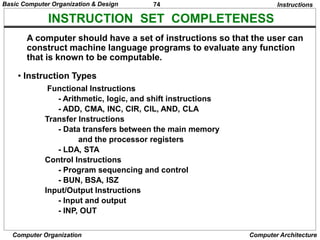
INSTRUCTION SET COMPLETENESS
• Instruction Types
A computer should have a set of instructions so that the user can
construct machine language programs to evaluate any function
that is known to be computable.
Functional Instructions
- Arithmetic, logic, and shift instructions
- ADD, CMA, INC, CIR, CIL, AND, CLA
Transfer Instructions
- Data transfers between the main memory
and the processor registers
- LDA, STA
Control Instructions
- Program sequencing and control
- BUN, BSA, ISZ
Input/Output Instructions
- Input and output
- INP, OUT
Instructions
Basic Computer Organization & Design
75
Computer Organization Computer Architecture
CONTROL UNIT
Instruction codes
• Control unit (CU) of a processor translates from machine
instructions to the control signals for the microoperations
that implement them
• Control units are implemented in one of two ways
• Hardwired Control
– CU is made up of sequential and combinational circuits to generate the
control signals
• Microprogrammed Control
– A control memory on the processor contains microprograms that
activate the necessary control signals
• We will consider a hardwired implementation of the control
unit for the Basic Computer
Basic Computer Organization & Design
76
Computer Organization Computer Architecture
TIMING AND CONTROL
Control unit of Basic Computer
Timing and control
Instruction register (IR)
15 14 13 12 11 - 0
3 x 8
decoder
7 6 5 4 3 2 1 0
I
D 0
15 14 . . . . 2 1 0
4 x 16
decoder
4-bit
sequence
counter
(SC)
Increment (INR)
Clear (CLR)
Clock
Other inputs
Control
signals
D
T
T
7
15
0
Combinational
Control
logic
Basic Computer Organization & Design
77
Computer Organization Computer Architecture
TIMING SIGNALS
Clock
T0 T1 T2 T3 T4 T0
T0
T1
T2
T3
T4
D3
CLR
SC
- Generated by 4-bit sequence counter and 416 decoder
- The SC can be incremented or cleared.
- Example: T0, T1, T2, T3, T4, T0, T1, . . .
Assume: At time T4, SC is cleared to 0 if decoder output D3 is active.
D3T4: SC 
0
Timing and control
Basic Computer Organization & Design
78
Computer Organization Computer Architecture
INSTRUCTION CYCLE
• In Basic Computer, a machine instruction is executed in the
following cycle:
1. Fetch an instruction from memory
2. Decode the instruction
3. Read the effective address from memory if the instruction has an
indirect address
4. Execute the instruction
• After an instruction is executed, the cycle starts again at
step 1, for the next instruction
• Note: Every different processor has its own (different)
instruction cycle
Basic Computer Organization & Design
79
Computer Organization Computer Architecture
FETCH and DECODE
• Fetch and Decode T0: AR PC (S0S1S2=010, T0=1)
T1: IR  M [AR], PC  PC + 1 (S0S1S2=111, T1=1)
T2: D0, . . . , D7  Decode IR(12-14), AR  IR(0-11), I  IR(15)
S2
S1
S0
Bus
7
Memory
unit
Address
Read
AR
LD
PC
INR
IR
LD
Clock
1
2
5
Common bus
T1
T0
Instruction Cycle
Basic Computer Organization & Design
80
Computer Organization Computer Architecture
DETERMINE THE TYPE OF INSTRUCTION
= 0 (direct)
D'7IT3: AR M[AR]
D'7I'T3: Nothing
D7I'T3: Execute a register-reference instr.
D7IT3: Execute an input-output instr.
Instrction Cycle
Start
SC  0
AR  PC
T0
IR  M[AR], PC  PC + 1
T1
AR  IR(0-11), I  IR(15)
Decode Opcode in IR(12-14),
T2
D7
= 0 (Memory-reference)
(Register or I/O) = 1
I
I
Execute
register-reference
instruction
SC  0
Execute
input-output
instruction
SC  0
M[AR]

AR Nothing
= 0 (register)
(I/O) = 1 (indirect) = 1
T3 T3 T3 T3
Execute
memory-reference
instruction
SC  0
T4
Basic Computer Organization & Design
81
Computer Organization Computer Architecture
REGISTER REFERENCE INSTRUCTIONS
r = D7 IT3 => Register Reference Instruction
Bi = IR(i) , i=0,1,2,...,11
- D7 = 1, I = 0
- Register Ref. Instr. is specified in b0 ~ b11 of IR
- Execution starts with timing signal T3
Instruction Cycle
Register Reference Instructions are identified when
r: SC  0
CLA rB11: AC  0
CLE rB10: E  0
CMA rB9: AC  AC’
CME rB8: E  E’
CIR rB7: AC  shr AC, AC(15)  E, E  AC(0)
CIL rB6: AC  shl AC, AC(0)  E, E  AC(15)
INC rB5: AC  AC + 1
SPA rB4: if (AC(15) = 0) then (PC  PC+1)
SNA rB3: if (AC(15) = 1) then (PC  PC+1)
SZA rB2: if (AC = 0) then (PC  PC+1)
SZE rB1: if (E = 0) then (PC  PC+1)
HLT rB0: S  0 (S is a start-stop flip-flop)
Basic Computer Organization & Design
82
Computer Organization Computer Architecture
MEMORY REFERENCE INSTRUCTIONS
AND to AC
D0T4: DR  M[AR] Read operand
D0T5: AC  AC  DR, SC  0 AND with AC
ADD to AC
D1T4: DR  M[AR] Read operand
D1T5: AC  AC + DR, E  Cout, SC  0 Add to AC and store carry in E
- The effective address of the instruction is in AR and was placed there during
timing signal T2 when I = 0, or during timing signal T3 when I = 1
- Memory cycle is assumed to be short enough to complete in a CPU cycle
- The execution of MR instruction starts with T4
MR Instructions
Symbol
Operation
Decoder Symbolic Description
AND D0 AC  AC  M[AR]
ADD D1 AC  AC + M[AR], E  Cout
LDA D2 AC  M[AR]
STA D3 M[AR]  AC
BUN D4 PC  AR
BSA D5 M[AR]  PC, PC  AR + 1
ISZ D6 M[AR]  M[AR] + 1, if M[AR] + 1 = 0 then PC  PC+1
Basic Computer Organization & Design
83
Computer Organization Computer Architecture
MEMORY REFERENCE INSTRUCTIONS
Memory, PC after execution
21
0 BSA 135
Next instruction
Subroutine
20
PC = 21
AR = 135
136
1 BUN 135
Memory, PC, AR at time T4
0 BSA 135
Next instruction
Subroutine
20
21
135
PC = 136
1 BUN 135
Memory Memory
LDA: Load to AC
D2T4: DR  M[AR]
D2T5: AC  DR, SC  0
STA: Store AC
D3T4: M[AR]  AC, SC  0
BUN: Branch Unconditionally
D4T4: PC  AR, SC  0
BSA: Branch and Save Return Address
M[AR]  PC, PC  AR + 1
Basic Computer Organization & Design
84
Computer Organization Computer Architecture
MEMORY REFERENCE INSTRUCTIONS
MR Instructions
BSA:
D5T4: M[AR]  PC, AR  AR + 1
D5T5: PC  AR, SC  0
ISZ: Increment and Skip-if-Zero
D6T4: DR  M[AR]
D6T5: DR  DR + 1
D6T4: M[AR]  DR, if (DR = 0) then (PC  PC + 1), SC  0
Basic Computer Organization & Design
85
Computer Organization Computer Architecture
FLOWCHART FOR MEMORY REFERENCE INSTRUCTIONS
MR Instructions
Memory-reference instruction
DR  M[AR] DR  M[AR] DR  M[AR] M[AR]  AC
SC  0
AND ADD LDA STA
AC  AC DR
SC  0
AC  AC + DR
E  Cout
SC  0
AC  DR
SC  0
D T
0 4 D T
1 4 D T
2 4 D T
3 4
D T
0 5 D T
1 5 D T
2 5
PC  AR
SC  0
M[AR]  PC
AR  AR + 1
DR  M[AR]
BUN BSA ISZ
D T
4 4 D T
5 4 D T
6 4
DR  DR + 1
D T
5 5 D T
6 5
PC  AR
SC  0
M[AR]  DR
If (DR = 0)
then (PC  PC + 1)
SC  0
D T
6 6

Basic Computer Organization & Design
86
Computer Organization Computer Architecture
INPUT-OUTPUT AND INTERRUPT
• Input-Output Configuration
INPR Input register - 8 bits
OUTR Output register - 8 bits
FGI Input flag - 1 bit
FGO Output flag - 1 bit
IEN Interrupt enable - 1 bit
- The terminal sends and receives serial information
- The serial info. from the keyboard is shifted into INPR
- The serial info. for the printer is stored in the OUTR
- INPR and OUTR communicate with the terminal
serially and with the AC in parallel.
- The flags are needed to synchronize the timing
difference between I/O device and the computer
A Terminal with a keyboard and a Printer
I/O and Interrupt
Input-output
terminal
Serial
communication
interface
Computer
registers and
flip-flops
Printer
Keyboard
Receiver
interface
Transmitter
interface
FGO
OUTR
AC
INPR FGI
Serial Communications Path
Parallel Communications Path
Basic Computer Organization & Design
87
Computer Organization Computer Architecture
PROGRAM CONTROLLED DATA TRANSFER
loop: If FGI = 1 goto loop
INPR  new data, FGI  1
loop: If FGO = 1 goto loop
consume OUTR, FGO  1
-- CPU -- -- I/O Device --
/* Input */ /* Initially FGI = 0 */
loop: If FGI = 0 goto loop
AC  INPR, FGI  0
/* Output */ /* Initially FGO = 1 */
loop: If FGO = 0 goto loop
OUTR  AC, FGO  0
I/O and Interrupt
Start Input
FGI  0
FGI=0
AC  INPR
More
Character
END
Start Output
FGO  0
FGO=0
More
Character
END
OUTR  AC
AC  Data
yes
no
yes
no
FGI=0 FGO=1
yes
yes
no
no
Basic Computer Organization & Design
88
Computer Organization Computer Architecture
INPUT-OUTPUT INSTRUCTIONS
D7IT3 = p
IR(i) = Bi, i = 6, …, 11
p: SC  0 Clear SC
INP pB11: AC(0-7)  INPR, FGI  0 Input char. to AC
OUT pB10: OUTR  AC(0-7), FGO  0 Output char. from AC
SKI pB9: if(FGI = 1) then (PC  PC + 1) Skip on input flag
SKO pB8: if(FGO = 1) then (PC  PC + 1) Skip on output flag
ION pB7: IEN  1 Interrupt enable on
IOF pB6: IEN  0 Interrupt enable off
Basic Computer Organization & Design
89
Computer Organization Computer Architecture
PROGRAM-CONTROLLED INPUT/OUTPUT
• Program-controlled I/O
- Continuous CPU involvement
I/O takes valuable CPU time
- CPU slowed down to I/O speed
- Simple
- Least hardware
I/O and Interrupt
Input
LOOP, SKI DEV
BUN LOOP
INP DEV
Output
LOOP, LDA DATA
LOP, SKO DEV
BUN LOP
OUT DEV
Basic Computer Organization & Design
90
Computer Organization Computer Architecture
INTERRUPT INITIATED INPUT/OUTPUT
- Open communication only when some data has to be passed --> interrupt.
- The I/O interface, instead of the CPU, monitors the I/O device.
- When the interface founds that the I/O device is ready for data transfer,
it generates an interrupt request to the CPU
- Upon detecting an interrupt, the CPU stops momentarily the task
it is doing, branches to the service routine to process the data
transfer, and then returns to the task it was performing.
* IEN (Interrupt-enable flip-flop)
- can be set and cleared by instructions
- when cleared, the computer cannot be interrupted
Basic Computer Organization & Design
91
Computer Organization Computer Architecture
FLOWCHART FOR INTERRUPT CYCLE
R = Interrupt f/f
- The interrupt cycle is a HW implementation of a branch
and save return address operation.
- At the beginning of the next instruction cycle, the
instruction that is read from memory is in address 1.
- At memory address 1, the programmer must store a branch instruction
that sends the control to an interrupt service routine
- The instruction that returns the control to the original
program is "indirect BUN 0"
I/O and Interrupt
Store return address
R
=1
=0
in location 0
M[0]  PC
Branch to location 1
PC  1
IEN  0
R  0
Interrupt cycle
Instruction cycle
Fetch and decode
instructions
IEN
FGI
FGO
Execute
instructions
R  1
=1
=1
=1
=0
=0
=0
Basic Computer Organization & Design
92
Computer Organization Computer Architecture
REGISTER TRANSFER OPERATIONS IN INTERRUPT CYCLE
Register Transfer Statements for Interrupt Cycle
- R F/F  1 if IEN (FGI + FGO)T0T1T2
 T0T1T2 (IEN)(FGI + FGO): R  1
- The fetch and decode phases of the instruction cycle
must be modified Replace T0, T1, T2 with R'T0, R'T1, R'T2
- The interrupt cycle :
RT0: AR  0, TR  PC
RT1: M[AR]  TR, PC  0
RT2: PC  PC + 1, IEN  0, R  0, SC  0
After interrupt cycle
0 BUN 1120
0
1
PC = 256
255
1 BUN 0
Before interrupt
Main
Program
1120
I/O
Program
0 BUN 1120
0
PC = 1
256
255
1 BUN 0
Memory
Main
Program
1120
I/O
Program
256
I/O and Interrupt
Basic Computer Organization & Design
93
Computer Organization Computer Architecture
FURTHER QUESTIONS ON INTERRUPT
How can the CPU recognize the device
requesting an interrupt ?
Since different devices are likely to require
different interrupt service routines, how can
the CPU obtain the starting address of the
appropriate routine in each case ?
Should any device be allowed to interrupt the
CPU while another interrupt is being serviced ?
How can the situation be handled when two or
more interrupt requests occur simultaneously ?
I/O and Interrupt
Basic Computer Organization & Design
94
Computer Organization Computer Architecture
COMPLETE COMPUTER DESCRIPTION
Flowchart of Operations
Description
=1 (I/O) =0 (Register) =1(Indir) =0(Dir)
start
SC  0, IEN  0, R  0
R
AR  PC
R’T0
IR  M[AR], PC  PC + 1
R’T1
AR  IR(0~11), I  IR(15)
D0...D7  Decode IR(12 ~ 14)
R’T2
AR  0, TR  PC
RT0
M[AR]  TR, PC  0
RT1
PC  PC + 1, IEN  0
R  0, SC  0
RT2
D7
I I
Execute
I/O
Instruction
Execute
RR
Instruction
AR <- M[AR] Idle
D7IT3 D7I’T3 D7’IT3 D7’I’T3
Execute MR
Instruction
=0(Instruction =1(Interrupt
Cycle) Cycle)
=1(Register or I/O) =0(Memory Ref)
D7’T4
Basic Computer Organization & Design
95
Computer Organization Computer Architecture
COMPLETE COMPUTER DESCRIPTION
Microoperations
Description
Fetch
Decode
Indirect
Interrupt
Memory-Reference
AND
ADD
LDA
STA
BUN
BSA
ISZ
RT0:
RT1:
RT2:
D7IT3:
RT0:
RT1:
RT2:
D0T4:
D0T5:
D1T4:
D1T5:
D2T4:
D2T5:
D3T4:
D4T4:
D5T4:
D5T5:
D6T4:
D6T5:
D6T6:
AR  PC
IR  M[AR], PC  PC + 1
D0, ..., D7  Decode IR(12 ~ 14),
AR  IR(0 ~ 11), I  IR(15)
AR  M[AR]
R  1
AR  0, TR  PC
M[AR]  TR, PC  0
PC  PC + 1, IEN  0, R  0, SC  0
DR  M[AR]
AC  AC  DR, SC  0
DR  M[AR]
AC  AC + DR, E  Cout, SC  0
DR  M[AR]
AC  DR, SC  0
M[AR]  AC, SC  0
PC  AR, SC  0
M[AR]  PC, AR  AR + 1
PC  AR, SC  0
DR  M[AR]
DR  DR + 1
M[AR]  DR, if(DR=0) then (PC  PC + 1),
SC  0
T0T1T2(IEN)(FGI + FGO):
Basic Computer Organization & Design
96
Computer Organization Computer Architecture
Register-Reference
CLA
CLE
CMA
CME
CIR
CIL
INC
SPA
SNA
SZA
SZE
HLT
Input-Output
INP
OUT
SKI
SKO
ION
IOF
D7IT3 = r
IR(i) = Bi
r:
rB11:
rB10:
rB9:
rB8:
rB7:
rB6:
rB5:
rB4:
rB3:
rB2:
rB1:
rB0:
D7IT3 = p
IR(i) = Bi
p:
pB11:
pB10:
pB9:
pB8:
pB7:
pB6:
(Common to all register-reference instr)
(i = 0,1,2, ..., 11)
SC  0
AC  0
E  0
AC  AC
E  E
AC  shr AC, AC(15)  E, E  AC(0)
AC  shl AC, AC(0)  E, E  AC(15)
AC  AC + 1
If(AC(15) =0) then (PC  PC + 1)
If(AC(15) =1) then (PC  PC + 1)
If(AC = 0) then (PC  PC + 1)
If(E=0) then (PC  PC + 1)
S  0
(Common to all input-output instructions)
(i = 6,7,8,9,10,11)
SC  0
AC(0-7)  INPR, FGI  0
OUTR  AC(0-7), FGO  0
If(FGI=1) then (PC  PC + 1)
If(FGO=1) then (PC  PC + 1)
IEN  1
IEN  0
Description
COMPLETE COMPUTER DESCRIPTION
Microoperations
Basic Computer Organization & Design
97
Computer Organization Computer Architecture
DESIGN OF BASIC COMPUTER(BC)
Hardware Components of BC
A memory unit: 4096 x 16.
Registers:
AR, PC, DR, AC, IR, TR, OUTR, INPR, and SC
Flip-Flops(Status):
I, S, E, R, IEN, FGI, and FGO
Decoders: a 3x8 Opcode decoder
a 4x16 timing decoder
Common bus: 16 bits
Control logic gates:
Adder and Logic circuit: Connected to AC
Control Logic Gates
- Input Controls of the nine registers
- Read and Write Controls of memory
- Set, Clear, or Complement Controls of the flip-flops
- S2, S1, S0 Controls to select a register for the bus
- AC, and Adder and Logic circuit
Design of Basic Computer
Basic Computer Organization & Design
98
Computer Organization Computer Architecture
CONTROL OF REGISTERS AND MEMORY
Scan all of the register transfer statements that change the content of AR:
LD(AR) = R'T0 + R'T2 + D'7IT3
CLR(AR) = RT0
INR(AR) = D5T4
Address Register; AR
R’T0: AR  PC LD(AR)
R’T2: AR  IR(0-11) LD(AR)
D’7IT3: AR  M[AR] LD(AR)
RT0: AR  0 CLR(AR)
D5T4: AR  AR + 1 INR(AR)
Design of Basic Computer
AR
LD
INR
CLR
Clock
To bus
12
From bus
12
D'
I
T
T
R
T
D
T
7
3
2
0
4
Basic Computer Organization & Design
99
Computer Organization Computer Architecture
CONTROL OF FLAGS
pB7: IEN  1 (I/O Instruction)
pB6: IEN  0 (I/O Instruction)
RT2: IEN  0 (Interrupt)
p = D7IT3 (Input/Output Instruction)
IEN: Interrupt Enable Flag
Design of Basic Computer
D
I
T3
7
J
K
Q IEN
p
B
7
B6
T2
R
Basic Computer Organization & Design
100
Computer Organization Computer Architecture
CONTROL OF COMMON BUS
For AR D4T4: PC  AR
D5T5: PC  AR
x1 = D4T4 + D5T5
Design of Basic Computer
x1
x2
x3
x4
x5
x6
x7
Encoder
S
2
S
1
S
0
Multiplexer
bus select
inputs
x1 x2 x3 x4 x5 x6 x7 S2 S1 S0
selected
register
0 0 0 0 0 0 0 0 0 0 none
1 0 0 0 0 0 0 0 0 1 AR
0 1 0 0 0 0 0 0 1 0 PC
0 0 1 0 0 0 0 0 1 1 DR
0 0 0 1 0 0 0 1 0 0 AC
0 0 0 0 1 0 0 1 0 1 IR
0 0 0 0 0 1 0 1 1 0 TR
0 0 0 0 0 0 1 1 1 1 Memory
Basic Computer Organization & Design
101
Computer Organization Computer Architecture
DESIGN OF ACCUMULATOR LOGIC
Circuits associated with AC
All the statements that change the content of AC
Design of AC Logic
16
16
8
Adder and
logic
circuit
16
AC
From DR
From INPR
Control
gates
LD INR CLR
16
To bus
Clock
D0T5: AC  AC  DR AND with DR
D1T5: AC  AC + DR Add with DR
D2T5: AC  DR Transfer from DR
pB11: AC(0-7)  INPR Transfer from INPR
rB9: AC  AC Complement
rB7 : AC  shr AC, AC(15)  E Shift right
rB6 : AC  shl AC, AC(0)  E Shift left
rB11 : AC  0 Clear
rB5 : AC  AC + 1 Increment
Basic Computer Organization & Design
102
Computer Organization Computer Architecture
CONTROL OF AC REGISTER
Gate structures for controlling
the LD, INR, and CLR of AC
AC
LD
INR
CLR
Clock
To bus
16
From Adder
and Logic
16
AND
ADD
DR
INPR
COM
SHR
SHL
INC
CLR
D0
D1
D2
B11
B9
B7
B6
B5
B11
r
p
T5
T5
Design of AC Logic
Basic Computer Organization & Design
103
Computer Organization Computer Architecture
ALU (ADDER AND LOGIC CIRCUIT)
One stage of Adder and Logic circuit
Design of AC Logic
AND
ADD
DR
INPR
COM
SHR
SHL
J
K
Q
AC(i)
LD
FA
C
C
From
INPR
bit(i)
DR(i)
AC(i)
AC(i+1)
AC(i-1)
i
i
i+1
I
Basic Computer Organization & Design
104
Computer Organization Computer Architecture
MICROPROGRAMMED CONTROL
• Control Memory
• Sequencing Microinstructions
• Microprogram Example
• Design of Control Unit
• Microinstruction Format
• Nanostorage and Nanoprogram
Microprogrammed Control
105
Computer Organization Computer Architecture
COMPARISON OF CONTROL UNIT IMPLEMENTATIONS
Implementation of Control Unit
Control Unit Implementation
Combinational Logic Circuits (Hard-wired)
Microprogram
I R Status F/Fs
Control Data
Combinational
Logic Circuits
Control
Points
CPU
Memory
Timing State
Ins. Cycle State
Control Unit's State
Status F/Fs
Control Data
Next Address
Generation
Logic
C
S
A
R
Control
Storage
(-program
memory)
M
e
m
o
r
y
I R
C
S
D
R
C
P
s
CPU
D
}
Microprogrammed Control
106
Computer Organization Computer Architecture
TERMINOLOGY
Microprogram
- Program stored in memory that generates all the control signals required
to execute the instruction set correctly
- Consists of microinstructions
Microinstruction
- Contains a control word and a sequencing word
Control Word - All the control information required for one clock cycle
Sequencing Word - Information needed to decide
the next microinstruction address
- Vocabulary to write a microprogram
Control Memory(Control Storage: CS)
- Storage in the microprogrammed control unit to store the microprogram
Writeable Control Memory(Writeable Control Storage:WCS)
- CS whose contents can be modified
-> Allows the microprogram can be changed
-> Instruction set can be changed or modified
Dynamic Microprogramming
- Computer system whose control unit is implemented with
a microprogram in WCS
- Microprogram can be changed by a systems programmer or a user
Microprogrammed Control
107
Computer Organization Computer Architecture
TERMINOLOGY
Sequencer (Microprogram Sequencer)
A Microprogram Control Unit that determines
the Microinstruction Address to be executed
in the next clock cycle
- In-line Sequencing
- Branch
- Conditional Branch
- Subroutine
- Loop
- Instruction OP-code mapping
Microprogrammed Control
108
Computer Organization Computer Architecture
MICROINSTRUCTION SEQUENCING
Sequencing Capabilities Required in a Control Storage
- Incrementing of the control address register
- Unconditional and conditional branches
- A mapping process from the bits of the machine
instruction to an address for control memory
- A facility for subroutine call and return
Sequencing
Instruction code
Mapping
logic
Multiplexers
Control memory (ROM)
Subroutine
register
(SBR)
Branch
logic
Status
bits
Microoperations
Control address register
(CAR)
Incrementer
MUX
select
select a status
bit
Branch address
Microprogrammed Control
109
Computer Organization Computer Architecture
CONDITIONAL BRANCH
Unconditional Branch
Fixing the value of one status bit at the input of the multiplexer to 1
Sequencing
Conditional Branch
If Condition is true, then Branch (address from
the next address field of the current microinstruction)
else Fall Through
Conditions to Test: O(overflow), N(negative),
Z(zero), C(carry), etc.
Control address register
Control memory
MUX
Load address
Increment
Status
(condition)
bits
Micro-operations
Condition select
Next address
...
Microprogrammed Control
110
Computer Organization Computer Architecture
MAPPING OF INSTRUCTIONS
Sequencing
ADD Routine
AND Routine
LDA Routine
STA Routine
BUN Routine
Control
Storage
0000
0001
0010
0011
0100
OP-codes of Instructions
ADD
AND
LDA
STA
BUN
0000
0001
0010
0011
0100
.
.
.
Direct Mapping
Address
10 0000 010
10 0001 010
10 0010 010
10 0011 010
10 0100 010
Mapping
Bits 10 xxxx 010
ADD Routine
Address
AND Routine
LDA Routine
STA Routine
BUN Routine
Microprogrammed Control
111
Computer Organization Computer Architecture
MAPPING OF INSTRUCTIONS TO MICROROUTINES
Mapping function implemented by ROM or PLA
OP-code
Mapping memory
(ROM or PLA)
Control address register
Control Memory
Mapping from the OP-code of an instruction to the
address of the Microinstruction which is the starting
microinstruction of its execution microprogram
1 0 1 1 Address
OP-code
Mapping bits
Microinstruction
address
0 x x x x 0 0
0 1 0 1 1 0 0
Machine
Instruction
Sequencing
Microprogrammed Control
112
Computer Organization Computer Architecture
MICROPROGRAM EXAMPLE
Microprogram
Computer Configuration
MUX
AR
10 0
PC
10 0
Address Memory
2048 x 16
MUX
DR
15 0
Arithmetic
logic and
shift unit
AC
15 0
SBR
6 0
CAR
6 0
Control memory
128 x 20
Control unit
Microprogrammed Control
113
Computer Organization Computer Architecture
MACHINE INSTRUCTION FORMAT
Microinstruction Format
Microprogram
EA is the effective address
Symbol OP-code Description
ADD 0000 AC  AC + M[EA]
BRANCH 0001 if (AC < 0) then (PC  EA)
STORE 0010 M[EA]  AC
EXCHANGE 0011 AC  M[EA], M[EA]  AC
Machine instruction format
I Opcode
15 14 11 10
Address
0
Sample machine instructions
F1 F2 F3 CD BR AD
3 3 3 2 2 7
F1, F2, F3: Microoperation fields
CD: Condition for branching
BR: Branch field
AD: Address field
Microprogrammed Control
114
Computer Organization Computer Architecture
MICROINSTRUCTION FIELD DESCRIPTIONS - F1,F2,F3
F1 Microoperation Symbol
000 None NOP
001 AC  AC + DR ADD
010 AC  0 CLRAC
011 AC  AC + 1 INCAC
100 AC  DR DRTAC
101 AR  DR(0-10) DRTAR
110 AR  PC PCTAR
111 M[AR]  DR WRITE
Microprogram
F2 Microoperation Symbol
000 None NOP
001 AC  AC - DR SUB
010 AC  AC  DR OR
011 AC  AC  DR AND
100 DR  M[AR] READ
101 DR  AC ACTDR
110 DR  DR + 1 INCDR
111 DR(0-10)  PC PCTDR
F3 Microoperation Symbol
000 None NOP
001 AC  AC  DR XOR
010 AC  AC’ COM
011 AC  shl AC SHL
100 AC  shr AC SHR
101 PC  PC + 1 INCPC
110 PC  AR ARTPC
111 Reserved
Microprogrammed Control
115
Computer Organization Computer Architecture
MICROINSTRUCTION FIELD DESCRIPTIONS - CD, BR
CD Condition Symbol Comments
00 Always = 1 U Unconditional branch
01 DR(15) I Indirect address bit
10 AC(15) S Sign bit of AC
11 AC = 0 Z Zero value in AC
BR Symbol Function
00 JMP CAR  AD if condition = 1
CAR  CAR + 1 if condition = 0
01 CALL CAR  AD, SBR  CAR + 1 if condition = 1
CAR  CAR + 1 if condition = 0
10 RET CAR  SBR (Return from subroutine)
11 MAP CAR(2-5)  DR(11-14), CAR(0,1,6)  0
Microprogram
Microprogrammed Control
116
Computer Organization Computer Architecture
SYMBOLIC MICROINSTRUCTIONS
• Symbols are used in microinstructions as in assembly language
• A symbolic microprogram can be translated into its binary equivalent
by a microprogram assembler.
Sample Format
five fields: label; micro-ops; CD; BR; AD
Label: may be empty or may specify a symbolic
address terminated with a colon
Micro-ops: consists of one, two, or three symbols
separated by commas
CD: one of {U, I, S, Z}, where U: Unconditional Branch
I: Indirect address bit
S: Sign of AC
Z: Zero value in AC
BR: one of {JMP, CALL, RET, MAP}
AD: one of {Symbolic address, NEXT, empty}
Microprogram
Microprogrammed Control
117
Computer Organization Computer Architecture
SYMBOLIC MICROPROGRAM - FETCH ROUTINE
AR  PC
DR  M[AR], PC  PC + 1
AR  DR(0-10), CAR(2-5)  DR(11-14), CAR(0,1,6)  0
Symbolic microprogram for the fetch cycle:
ORG 64
PCTAR U JMP NEXT
READ, INCPC U JMP NEXT
DRTAR U MAP
FETCH:
Binary equivalents translated by an assembler
1000000 110 000 000 00 00 1000001
1000001 000 100 101 00 00 1000010
1000010 101 000 000 00 11 0000000
Binary
address F1 F2 F3 CD BR AD
Microprogram
During FETCH, Read an instruction from memory
and decode the instruction and update PC
Sequence of microoperations in the fetch cycle:
Microprogrammed Control
118
Computer Organization Computer Architecture
SYMBOLIC MICROPROGRAM
• Control Storage: 128 20-bit words
• The first 64 words: Routines for the 16 machine instructions
• The last 64 words: Used for other purpose (e.g., fetch routine and other subroutines)
• Mapping: OP-code XXXX into 0XXXX00, the first address for the 16 routines are
0(0 0000 00), 4(0 0001 00), 8, 12, 16, 20, ..., 60
Microprogram
ORG 0
NOP
READ
ADD
ORG 4
NOP
NOP
NOP
ARTPC
ORG 8
NOP
ACTDR
WRITE
ORG 12
NOP
READ
ACTDR, DRTAC
WRITE
ORG 64
PCTAR
READ, INCPC
DRTAR
READ
DRTAR
I
U
U
S
U
I
U
I
U
U
I
U
U
U
U
U
U
U
U
CALL
JMP
JMP
JMP
JMP
CALL
JMP
CALL
JMP
JMP
CALL
JMP
JMP
JMP
JMP
JMP
MAP
JMP
RET
INDRCT
NEXT
FETCH
OVER
FETCH
INDRCT
FETCH
INDRCT
NEXT
FETCH
INDRCT
NEXT
NEXT
FETCH
NEXT
NEXT
NEXT
ADD:
BRANCH:
OVER:
STORE:
EXCHANGE:
FETCH:
INDRCT:
Label Microops CD BR AD
Partial Symbolic Microprogram
Microprogrammed Control
119
Computer Organization Computer Architecture
This microprogram can be implemented using ROM
Microprogram
Address Binary Microinstruction
Micro Routine Decimal Binary F1 F2 F3 CD BR AD
ADD 0 0000000 000 000 000 01 01 1000011
1 0000001 000 100 000 00 00 0000010
2 0000010 001 000 000 00 00 1000000
3 0000011 000 000 000 00 00 1000000
BRANCH 4 0000100 000 000 000 10 00 0000110
5 0000101 000 000 000 00 00 1000000
6 0000110 000 000 000 01 01 1000011
7 0000111 000 000 110 00 00 1000000
STORE 8 0001000 000 000 000 01 01 1000011
9 0001001 000 101 000 00 00 0001010
10 0001010 111 000 000 00 00 1000000
11 0001011 000 000 000 00 00 1000000
EXCHANGE 12 0001100 000 000 000 01 01 1000011
13 0001101 001 000 000 00 00 0001110
14 0001110 100 101 000 00 00 0001111
15 0001111 111 000 000 00 00 1000000
FETCH 64 1000000 110 000 000 00 00 1000001
65 1000001 000 100 101 00 00 1000010
66 1000010 101 000 000 00 11 0000000
INDRCT 67 1000011 000 100 000 00 00 1000100
68 1000100 101 000 000 00 10 0000000
BINARY MICROPROGRAM
Microprogrammed Control
120
Computer Organization Computer Architecture
DESIGN OF CONTROL UNIT
- DECODING ALU CONTROL INFORMATION -
Design of Control Unit
microoperation fields
3 x 8 decoder
7 6 5 4 3 2 1 0
F1
3 x 8 decoder
7 6 5 4 3 2 1 0
F2
3 x 8 decoder
7 6 5 4 3 2 1 0
F3
Arithmetic
logic and
shift unit
AND
ADD
DRTAC
AC
Load
From
PC
From
DR(0-10)
Select 0 1
Multiplexers
AR
Load Clock
AC
DR
DRTAR
PCTAR
Decoding of Microoperation Fields
Microprogrammed Control
121
Computer Organization Computer Architecture
MICROPROGRAM SEQUENCER
- NEXT MICROINSTRUCTION ADDRESS LOGIC -
Design of Control Unit
Subroutine
CALL
MUX-1 selects an address from one of four sources and routes it into a CAR
- In-Line Sequencing  CAR + 1
- Branch, Subroutine Call  CS(AD)
- Return from Subroutine  Output of SBR
- New Machine instruction  MAP
3 2 1 0
S
S
1
0
MUX1
External
(MAP)
SBR
L
Incrementer
CAR
Clock
Address
source
selection
In-Line
RETURN form Subroutine
Branch, CALL Address
Control Storage
S1S0 Address Source
00 CAR + 1, In-Line
01 SBR RETURN
10 CS(AD), Branch or CALL
11 MAP
Microprogrammed Control
122
Computer Organization Computer Architecture
MICROPROGRAM SEQUENCER
- CONDITION AND BRANCH CONTROL -
Design of Control Unit
Input
logic
I0
I
1
T
MUX2
Select
1
I
S
Z
Test
CD Field of CS
From
CPU BR field
of CS
L(load SBR with PC)
for subroutine Call
S0
S1
for next address
selection
I1I0T Meaning Source of Address S1S0 L
000 In-Line CAR+1 00 0
001 JMP CS(AD) 01 0
010 In-Line CAR+1 00 0
011 CALL CS(AD) and SBR <- CAR+1 01 1
10x RET SBR 10 0
11x MAP DR(11-14) 11 0
L
S1 = I1
S0 = I1I0 + I1’T
L = I1’I0T
Input Logic
Microprogrammed Control
123
Computer Organization Computer Architecture
MICROPROGRAM SEQUENCER
Design of Control Unit
3 2 1 0
S1 MUX1
External
(MAP)
SBR
Load
Incrementer
CAR
Input
logic
I
0
T
MUX2
Select
1
I
S
Z
Test
Clock
Control memory
Microops CD BR AD
L
I
1 S0
. . .
. . .
Microprogrammed Control
124
Computer Organization Computer Architecture
MICROINSTRUCTION FORMAT
Microinstruction Format
Information in a Microinstruction
- Control Information
- Sequencing Information
- Constant
Information which is useful when feeding into the system
These information needs to be organized in some way for
- Efficient use of the microinstruction bits
- Fast decoding
Field Encoding
- Encoding the microinstruction bits
- Encoding slows down the execution speed
due to the decoding delay
- Encoding also reduces the flexibility due to
the decoding hardware
Microprogrammed Control
125
Computer Organization Computer Architecture
HORIZONTAL AND VERTICAL
MICROINSTRUCTION FORMAT
Horizontal Microinstructions
Each bit directly controls each micro-operation or each control point
Horizontal implies a long microinstruction word
Advantages: Can control a variety of components operating in parallel.
--> Advantage of efficient hardware utilization
Disadvantages: Control word bits are not fully utilized
--> CS becomes large --> Costly
Vertical Microinstructions
A microinstruction format that is not horizontal
Vertical implies a short microinstruction word
Encoded Microinstruction fields
--> Needs decoding circuits for one or two levels of decoding
Microinstruction Format
One-level decoding
Field A
2 bits
2 x 4
Decoder
3 x 8
Decoder
Field B
3 bits
1 of 4 1 of 8
Two-level decoding
Field A
2 bits
2 x 4
Decoder
6 x 64
Decoder
Field B
6 bits
Decoder and
selection logic
Microprogrammed Control
126
Computer Organization Computer Architecture
NANOSTORAGE AND NANOINSTRUCTION
The decoder circuits in a vertical microprogram
storage organization can be replaced by a ROM
=> Two levels of control storage
First level - Control Storage
Second level - Nano Storage
Two-level microprogram
First level
-Vertical format Microprogram
Second level
-Horizontal format Nanoprogram
- Interprets the microinstruction fields, thus converts a vertical
microinstruction format into a horizontal
nanoinstruction format.
Usually, the microprogram consists of a large number of short
microinstructions, while the nanoprogram contains fewer words
with longer nanoinstructions.
Control Storage Hierarchy
Microprogrammed Control
127
Computer Organization Computer Architecture
TWO-LEVEL MICROPROGRAMMING - EXAMPLE
* Microprogram: 2048 microinstructions of 200 bits each
* With 1-Level Control Storage: 2048 x 200 = 409,600 bits
* Assumption:
256 distinct microinstructions among 2048
* With 2-Level Control Storage:
Nano Storage: 256 x 200 bits to store 256 distinct nanoinstructions
Control storage: 2048 x 8 bits
To address 256 nano storage locations 8 bits are needed
* Total 1-Level control storage: 409,600 bits
Total 2-Level control storage: 67,584 bits (256 x 200 + 2048 x 8)
Control Storage Hierarchy
Control address register
11 bits
Control memory
2048 x 8
Microinstruction (8 bits)
Nanomemory address
Nanomemory
256 x 200
Nanoinstructions (200 bits)
Microprogrammed Control
128
Computer Organization Computer Architecture
Overview
• Instruction Set Processor (ISP)
• Central Processing Unit (CPU)
• A typical computing task consists of a series of
steps specified by a sequence of machine
instructions that constitute a program.
• An instruction is executed by carrying out a
sequence of more rudimentary operations.
Central Processing Unit
129
Computer Organization Computer Architecture
Fundamental Concepts
• Processor fetches one instruction at a time and
perform the operation specified.
• Instructions are fetched from successive
memory locations until a branch or a jump
instruction is encountered.
• Processor keeps track of the address of the
memory location containing the next instruction
to be fetched using Program Counter (PC).
• Instruction Register (IR)
Central Processing Unit
130
Computer Organization Computer Architecture
Executing an Instruction
• Fetch the contents of the memory location
pointed to by the PC. The contents of this
location are loaded into the IR (fetch phase).
IR ← [[PC]]
• Assuming that the memory is byte addressable,
increment the contents of the PC by 4 (fetch
phase).
PC ← [PC] + 4
• Carry out the actions specified by the instruction
in the IR (execution phase).
Central Processing Unit
131
Computer Organization Computer Architecture
Processor Organization
lines
Data
Address
lines
bus
Memory
Carry -in
ALU
PC
MAR
MDR
Y
Z
Add
XOR
Sub
bus
IR
TEMP
R0
control
ALU
lines
Control signals
R n 1
-
 
Instruction
decoder and
Internal processor
control logic
A B
Figure 7.1. Single-bus organization of the datapath inside a processor.
MUX
Select
Constant 4
Datapath
Textbook Page 413
MDR HAS
TWO INPUTS
AND TWO
OUTPUTS
Central Processing Unit
132
Computer Organization Computer Architecture
Executing an Instruction
• Transfer a word of data from one processor register
to another or to the ALU.
• Perform an arithmetic or a logic operation and store
the result in a processor register.
• Fetch the contents of a given memory location and
load them into a processor register.
• Store a word of data from a processor register into a
given memory location.
Central Processing Unit
133
Computer Organization Computer Architecture
Register Transfers
B
A
Z
ALU
Yin
Y
Zin
Zout
Riin
Ri
Riout
bus
Internal processor
Constant 4
MUX
Figure 7.2. Input and output gating for the registers in Figure 7.1.
Select
Central Processing Unit
134
Computer Organization Computer Architecture
Register Transfers
• All operations and data transfers are controlled by the processor
clock.
Figure 7.3. Input and output g
ating for one re
gister bit.
D Q
Q
Clock
1
0
Riout
Riin
Bus
Figure 7.3. Input and output gating for one register bit.
Central Processing Unit
135
Computer Organization Computer Architecture
Performing an Arithmetic or Logic
Operation
• The ALU is a combinational circuit that has no
internal storage.
• ALU gets the two operands from MUX and bus.
The result is temporarily stored in register Z.
• What is the sequence of operations to add the
contents of register R1 to those of R2 and store
the result in R3?
1. R1out, Yin
2. R2out, SelectY, Add, Zin
3. Zout, R3in
Central Processing Unit
136
Computer Organization Computer Architecture
Fetching a Word from Memory
• Address into MAR; issue Read operation; data into MDR.
MDR
Memory -b
us
Figure 7.4. Connection and control signals for re
gister MDR.
data lines
Internal processor
bus
MDRout
MDRoutE
MDRin
MDRinE
Figure 7.4. Connection and control signals for register MDR.
Central Processing Unit
137
Computer Organization Computer Architecture
Fetching a Word from Memory
• The response time of each memory access
varies (cache miss, memory-mapped I/O,…).
• To accommodate this, the processor waits until
it receives an indication that the requested
operation has been completed (Memory-
Function-Completed, MFC).
• Move (R1), R2
 MAR ← [R1]
 Start a Read operation on the memory bus
 Wait for the MFC response from the memory
 Load MDR from the memory bus
 R2 ← [MDR]
Central Processing Unit
138
Computer Organization Computer Architecture
Timing
Figure 7.5. Timing of a memory Read operation.
MFC
MDRout
Assume MAR
is always available
on the address lines
of the memory bus.
R2 ← [MDR]
MAR ← [R1]
Start a Read operation on the memory bus
Wait for the MFC response from the memory
Load MDR from the memory bus
Central Processing Unit
139
Computer Organization Computer Architecture
Execution of a Complete
Instruction
• Add (R3), R1
• Fetch the instruction
• Fetch the first operand (the contents of the memory
location pointed to by R3)
• Perform the addition
• Load the result into R1
Central Processing Unit
140
Computer Organization Computer Architecture
Architecture
B
A
Z
ALU
Yin
Y
Zin
Zout
Riin
Ri
Riout
bus
Internal processor
Constant 4
MUX
Figure 7.2. Input and output gating for the registers in Figure 7.1.
Select
Central Processing Unit
141
Computer Organization Computer Architecture
Execution of a Complete
Instruction
Step Action
1 PCout , MARin , Read,Select4,
Add, Zin
2 Zout , PCin , Yin , WMF C
3 MDRout , IRin
4 R3out , MARin , Read
5 R1out , Yin , WMF C
6 MDRout , SelectY,Add, Zin
7 Zout , R1in , End
Figure7.6. Control sequence
for executionof the instruction Add (R3),R1.
lines
Data
Address
lines
bus
Memory
Carry -in
ALU
PC
MAR
MDR
Y
Z
Add
XOR
Sub
bus
IR
TEMP
R0
control
ALU
lines
Control signals
R n 1
-
 
Instruction
decoder and
Internal processor
control logic
A B
Figure 7.1. Single-bus organization of the datapath inside a processor.
MUX
Select
Constant 4
Add (R3), R1
Central Processing Unit
142
Computer Organization Computer Architecture
Execution of Branch Instructions
• A branch instruction replaces the contents of PC
with the branch target address, which is usually
obtained by adding an offset X given in the branch
instruction.
• The offset X is usually the difference between the
branch target address and the address immediately
following the branch instruction.
• Conditional branch
Central Processing Unit
143
Computer Organization Computer Architecture
Execution of Branch Instructions
Step Action
1 PCout, MAR in, Read,Select4,
Add, Zin
2 Zout, PCin , Yin, WMF C
3 MDRout , IRin
4 Offset-field-of-IR
out, Add, Zin
5 Zout, PCin, End
Figure 7.7. Control sequence for an unconditional branch instruction.
Central Processing Unit
144
Computer Organization Computer Architecture
Multiple-Bus Organization
Memory b
us
data lines
Figure 7.8. Three-b
us or
ganization of the datapath.
Bus A Bus B Bus C
Instruction
decoder
PC
Re
gister
f ile
Constant 4
ALU
MDR
A
B
R
MUX
Incrementer
Address
lines
MAR
IR
Central Processing Unit
145
Computer Organization Computer Architecture
Multiple-Bus Organization
• Add R4, R5, R6
Step Action
1 PC
out
, R=B, MAR
in
, Read, IncPC
2 WMF C
3 MDR
outB
, R=B, IR
in
4 R4
outA
, R5
outB
, SelectA, Add, R6
in
, End
Figure 7.9. Control sequence for the instruction. Add R4,R5,R6,
for the three-bus organization in Figure 7.8.
Central Processing Unit
146
Computer Organization Computer Architecture
Quiz
• What is the control
sequence for execution
of the instruction
Add R1, R2
including the instruction
fetch phase? (Assume
single bus architecture)
lines
Data
Address
lines
bus
Memory
Carry -in
ALU
PC
MAR
MDR
Y
Z
Add
XOR
Sub
bus
IR
TEMP
R0
control
ALU
lines
Control signals
R n 1
-
 
Instruction
decoder and
Internal processor
control logic
A B
Figure 7.1. Single-bus organization of the datapath inside a processor.
MUX
Select
Constant 4
Central Processing Unit
147
Computer Organization Computer Architecture
Control Unit Organization
Figure 7.10. Control unit organization.
CLK
Clock
Control step
IR
encoder
Decoder/
Control signals
codes
counter
inputs
Condition
External
Central Processing Unit
148
Computer Organization Computer Architecture
Detailed Block Description
External
inputs
Figure 7.11. Separation of the decoding and encoding functions.
Encoder
Reset
CLK
Clock
Control signals
counter
Run End
Condition
codes
decoder
Instruction
Step decoder
Control step
IR
T1 T2 Tn
INS1
INS2
INS
m
Central Processing Unit
149
Computer Organization Computer Architecture
Generating Zin
• Zin = T1 + T6 • ADD + T4 • BR + …
Figure 7.12. Generation of the Zin control signal for the processor in Figure 7.1.
T1
Add
Branch
T4
T6
Central Processing Unit
150
Computer Organization Computer Architecture
Generating End
• End = T7 • ADD + T5 • BR + (T5 • N + T4 • N) • BRN +…
Figure 7.13.Generation of the End control signal.
T7
Add Branch
Branch<0
T5
End
N
N
T4
T5
Central Processing Unit
151
Computer Organization Computer Architecture
A Complete Processor
Instruction
unit
Inte
ger
unit
Floating-point
unit
Instruction
cache
Data
cache
Bus interf
ace
Main
memory
Input/
Output
Sy stem b
us
Processor
Figure 7.14. Block diagram of a complete processor
.
Central Processing Unit
152
Computer Organization Computer Architecture
Overview
• Control signals are generated by a program similar to machine
language programs.
• Control Word (CW); microroutine; microinstruction
PC
in
PC
out
MAR
in
Read
MDR
out
IR
in
Y
in
Select
Add
Z
in
Z
out
R1
out
R1
in
R3
out
WMFC
End
0
1
0
0
0
0
0
0
0
0
0
0
0
1
1
0
0
0
0
0
0
1
0
0
1
0
0
0
1
0
0
1
0
0
0
0
0
1
0
0
1
0
0
0
1
0
0
0
0
0
1
0
0
1
0
0
1
0
0
0
0
0
0
1
0
0
0
0
1
0
1
0
0
0
0
1
0
0
1
0
0
0
0
1
0
0
0
0
1
0
0
0
0
0
0
0
0
1
0
0
0
1
0
0
0
0
1
0
0
1
0
0
Micro -
instruction
1
2
3
4
5
6
7
Figure 7.15 An e
xample of microinstructions for Figure 7.6.
Microprogrammed Control
153
Computer Organization Computer Architecture
Overview
Step Action
1 PCout , MARin , Read,Select4,
Add, Zin
2 Zout , PCin , Yin , WMF C
3 MDRout , IRin
4 R3out , MARin , Read
5 R1out , Yin , WMF C
6 MDRout , SelectY,Add, Zin
7 Zout , R1in , End
Figure7.6. Control sequence
for executionof the instruction Add (R3),R1.
Microprogrammed Control
154
Computer Organization Computer Architecture
Overview
• Control store
Figure 7.16. Basic organization of a microprogrammed control unit.
store
Control
generator
Starting
address
CW
Clock PC
IR
One function
cannot be carried
out by this simple
organization.
Microprogrammed Control
155
Computer Organization Computer Architecture
Overview
• The previous organization cannot handle the situation when the
control unit is required to check the status of the condition codes
or external inputs to choose between alternative courses of action.
• Use conditional branch microinstruction.
AddressMicroinstruction
0 PCout , MARin , Read,Select4,Add, Zin
1 Zout , PCin , Yin , WMFC
2 MDRout , IRin
3 Branchto starting
address
of appropriate
microroutine
. ... .. ... ... .. ... .. ... ... .. ... ... .. ... .. ... ... .. ... .. ... ... .. ... ..
25 If N=0, thenbranchto microinstruction
0
26 Offset-field-of-IR
out, SelectY,Add, Zin
27 Zout , PCin , End
Figure 7.17. Microroutine for the instruction Branch<0.
Microprogrammed Control
156
Computer Organization Computer Architecture
Overview
Figure 7.18. Organization of the control unit to allow
conditional branching in the microprogram.
Control
store
Clock
generator
Starting and
branch address Condition
codes
inputs
External
CW
IR
PC
Microprogrammed Control
157
Computer Organization Computer Architecture
Microinstructions
• A straightforward way to structure microinstructions
is to assign one bit position to each control signal.
• However, this is very inefficient.
• The length can be reduced: most signals are not
needed simultaneously, and many signals are
mutually exclusive.
• All mutually exclusive signals are placed in the same
group in binary coding.
Microprogrammed Control
158
Computer Organization Computer Architecture
Partial Format for the
Microinstructions
F2 (3 bits)
000: No transf er
001: PC
in
010: IR
in
011: Z
in
100: R0
in
101: R1
in
110: R2
in
111: R3
in
F1 F2 F3 F4 F5
F1 (4 bits) F3 (3 bits) F4 (4 bits) F5 (2 bits)
0000: No transf er
0001: PC
out
0010: MDR
out
0011: Z
out
0100: R0
out
0101: R1
out
0110: R2
out
0111: R3
out
1010: TEMP
out
1011: Of f set
out
000: No transf er
001: MARin
010: MDR
in
011: TEMP
in
100: Y
in
0000: Add
0001: Sub
1111: XOR
16 ALU
f unctions
00: No action
01: Read
10: Write
F6 F7 F8
F6 (1 bit) F7 (1 bit) F8 (1 bit)
0: SelectY
1: Select4
0: No action
1: WMFC
0: Continue
1: End
Figure 7.19. An example of a partial format for field-encoded microinstructions.
Microinstruction
What is the price paid for
this scheme?
Microprogrammed Control
159
Computer Organization Computer Architecture
Further Improvement
• Enumerate the patterns of required signals in all
possible microinstructions. Each meaningful
combination of active control signals can then be
assigned a distinct code.
• Vertical organization
• Horizontal organization
Microprogrammed Control
160
Computer Organization Computer Architecture
Microprogram Sequencing
• If all microprograms require only straightforward
sequential execution of microinstructions except
for branches, letting a μPC governs the
sequencing would be efficient.
• However, two disadvantages:
 Having a separate microroutine for each machine instruction
results in a large total number of microinstructions and a large
control store.
 Longer execution time because it takes more time to carry out
the required branches.
• Example: Add src, Rdst
• Four addressing modes: register, autoincrement,
autodecrement, and indexed (with indirect
forms).
Microprogrammed Control
161
Computer Organization Computer Architecture
- Bit-ORing
- Wide-Branch Addressing
- WMFC
Microprogrammed Control
162
Computer Organization Computer Architecture
OP code 0 1 0 Rsrc Rdst
Mode
Contents of IR
0
3
4
7
8
10
11
Figure 7.21.Microinstruction for Add (Rsrc)+,Rdst.
Note:Microinstruction at location 170 is not executed for this addressing mode.
Address Microinstruction
(octal)
000 PC
out
, MARin, Read, Select
4, Add, Z
in
001 Zout
, PC
in, Yin, WMFC
002 MDRout
, IRin
003 Branch {
PC 101 (from Instruction decoder);
PC
5,4  [IR10,9
]; PC
3 
121 Rsrc
out, MAR
in, Read, Select4, Add, Z
in
122 Zout
, Rsrc
in
123
170 MDRout
, MARin, Read, WMFC
171 MDRout
, Yin
172 Rdst
out, SelectY
, Add, Z
in
173 Zout
, Rdst
in, End
[IR10] ×
[IR9] ×
[IR8]}
Branch {
PC 170;PC
0  [IR8]}, WMFC
Microprogrammed Control
163
Computer Organization Computer Architecture
Microinstructions with Next-
Address Field
• The microprogram we discussed requires
several branch microinstructions, which perform
no useful operation in the datapath.
• A powerful alternative approach is to include an
address field as a part of every microinstruction
to indicate the location of the next
microinstruction to be fetched.
• Pros: separate branch microinstructions are
virtually eliminated; few limitations in assigning
addresses to microinstructions.
• Cons: additional bits for the address field
(around 1/6)
Microprogrammed Control
164
Computer Organization Computer Architecture
Microinstructions with Next-
Address Field
Figure 7.22. Microinstruction-sequencing organization.
Condition
codes
IR
Decoding circuits
Control store
Next address
Microinstruction decoder
Control signals
Inputs
External
AR
I R
Microprogrammed Control
165
Computer Organization Computer Architecture
Microprogrammed Control
166
Computer Organization Computer Architecture
Implementation of the Microroutine
(See Figure 7.23 for encoded signals.)
Figure 7.24. Implementation of the microroutine of Figure 7.21 using a
1
0
1
1
1
1
1
0
0
1
1
1
1
1
0
0
0
1
0
0
1
1
2
1 0
0
0
0
0
0
0
0
0
0
0
0
0
0
0
0
0 0
0
0
0
0
0 0
0
1
0
1
1
1
0
3
7
7
0
0
0
0
0
0
0
0
0 1
1
1
1
1
1
0
0
0
0
1
7
0
7
F9
0
0
0
0
0
0
F10
0
0
0
0
0
0
0
0
0
0
0
0
0
0
F8
F7
F6
F5
F4
0
0
0 0 0 0 0 0
0
0
0
0
0
1
0
0
0
0
0
0
0
0
0
0
0
0 1
1
0
0
0 0
1
0
0
0
1
0
0
0
0
0
0
0
0
1
1
0
0
0
0
0
1
0
0
0
0
0
0
0
1
0 0
0
0
0
0
0
0
0 0
1
0
0
0
0
0
0
0
0
1
1
1
0
1
0
0
1
0
F2
1
1
1
0 0 0 0 0 0
1
1
2
2
1
0
1
1
1
1
0
1
1
1 0
0
1
1
2
0
2
1
0
0
0
address
Octal
1
1
1 0
0
0
0
0
1 0
0
0
0
0
0
0
1
0
0
0
0
0
0
0
F0 F1
0
0 0 1
0 0
0
1
0
0
1
0
0 1
1
0
0
1
1
1
0
1
0
0
0
0
0
1
1
0
1
F3
next-microinstruction address field.
0
1
1
0
0
0 0 0 0 0 0
0 0
0 0
0
0
0
0 0 0 0 0 0
3
0 0 0
0 0 0
Microprogrammed Control
167
Computer Organization Computer Architecture
decoder
Microinstruction
Other control signals
Rdst
in
Rsrc
out
Rsrc
in
Figure 7.25. Some details of the control-signal-generating circuitry.
Microprogrammed Control
168
Computer Organization Computer Architecture
bit-ORing
Microprogrammed Control
169
Computer Organization Computer Architecture
CENTRAL PROCESSING UNIT
• Introduction
• General Register Organization
• Stack Organization
• Instruction Formats
• Addressing Modes
• Data Transfer and Manipulation
• Program Control
• Reduced Instruction Set Computer
170
Computer Organization Computer Architecture
MAJOR COMPONENTS OF CPU
Introduction
Storage Components
Registers
Flags
Execution(Processing) Components
Arithmetic Logic Unit(ALU)
Arithmetic calculations, Logical computations, Shifts/Rotates
Transfer Components
Bus
Control Components
Control Unit
Register
File ALU
Control Unit
171
Computer Organization Computer Architecture
GENERAL REGISTER ORGANIZATION
General Register Organization
MUX
SELA{ MUX }SELB
ALU
OPR
R1
R2
R3
R4
R5
R6
R7
Input
3 x 8
decoder
SELD
Load
(7 lines)
Output
A bus B bus
Clock
172
Computer Organization Computer Architecture
OPERATION OF CONTROL UNIT
The control unit
Directs the information flow through ALU by
- Selecting various Components in the system
- Selecting the Function of ALU
Example: R1 <- R2 + R3
[1] MUX A selector (SELA): BUS A  R2
[2] MUX B selector (SELB): BUS B  R3
[3] ALU operation selector (OPR): ALU to ADD
[4] Decoder destination selector (SELD): R1  Out Bus
Control Word
Encoding of register selection fields
Control
Binary
Code SELA SELB SELD
000 Input Input None
001 R1 R1 R1
010 R2 R2 R2
011 R3 R3 R3
100 R4 R4 R4
101 R5 R5 R5
110 R6 R6 R6
111 R7 R7 R7
SELA SELB SELD OPR
3 3 3 5
173
Computer Organization Computer Architecture
ALU CONTROL
Encoding of ALU operations OPR
Select Operation Symbol
00000 Transfer A TSFA
00001 Increment A INCA
00010 ADD A + B ADD
00101 Subtract A - B SUB
00110 Decrement A DECA
01000 AND A and B AND
01010 OR A and B OR
01100 XOR A and B XOR
01110 Complement A COMA
10000 Shift right A SHRA
11000 Shift left A SHLA
Examples of ALU Microoperations
Symbolic Designation
Microoperation SELA SELB SELD OPR Control Word
Control
R1  R2 - R3 R2 R3 R1 SUB 010 011 001 00101
R4  R4  R5 R4 R5 R4 OR 100 101 100 01010
R6  R6 + 1 R6 - R6 INCA 110 000 110 00001
R7  R1 R1 - R7 TSFA 001 000 111 00000
Output  R2 R2 - None TSFA 010 000 000 00000
Output  Input Input - None TSFA 000 000 000 00000
R4  shl R4 R4 - R4 SHLA 100 000 100 11000
R5  0 R5 R5 R5 XOR 101 101 101 01100
174
Computer Organization Computer Architecture
REGISTER STACK ORGANIZATION
Register Stack
Push, Pop operations
/* Initially, SP = 0, EMPTY = 1, FULL = 0 */
PUSH POP
Stack Organization
SP  SP + 1 DR  M[SP]
M[SP]  DR SP  SP - 1
If (SP = 0) then (FULL  1) If (SP = 0) then (EMPTY  1)
EMPTY  0 FULL  0
Stack
- Very useful feature for nested subroutines, nested loops control
- Also efficient for arithmetic expression evaluation
- Storage which can be accessed in LIFO
- Pointer: SP
- Only PUSH and POP operations are applicable
A
B
C
0
1
2
3
4
63
Address
FULL EMPTY
SP
DR
Flags
Stack pointer
stack
175
Computer Organization Computer Architecture
MEMORY STACK ORGANIZATION
Stack Organization
- A portion of memory is used as a stack with a
processor register as a stack pointer
- PUSH: SP  SP - 1
M[SP]  DR
- POP: DR  M[SP]
SP  SP + 1
- Most computers do not provide hardware to check
stack overflow (full stack) or underflow(empty stack)
Memory with Program, Data,
and Stack Segments
DR
4001
4000
3999
3998
3997
3000
Data
(operands)
Program
(instructions)
1000
PC
AR
SP
stack
176
Computer Organization Computer Architecture
REVERSE POLISH NOTATION
A + B Infix notation
+ A B Prefix or Polish notation
A B + Postfix or reverse Polish notation
- The reverse Polish notation is very suitable for stack
manipulation
Evaluation of Arithmetic Expressions
Any arithmetic expression can be expressed in parenthesis-free
Polish notation, including reverse Polish notation
(3 * 4) + (5 * 6)  3 4 * 5 6 * +
Stack Organization
Arithmetic Expressions: A + B
3 3 12 12 12 12 42
4 5 5
6
30
3 4 * 5 6 * +
177
Computer Organization Computer Architecture
INSTRUCTION FORMAT
OP-code field - specifies the operation to be performed
Address field - designates memory address(es) or a processor register(s)
Mode field - specifies the way the operand or the
effective address is determined
The number of address fields in the instruction format
depends on the internal organization of CPU
- The three most common CPU organizations:
Instruction Format
Single accumulator organization:
ADD X /* AC  AC + M[X] */
General register organization:
ADD R1, R2, R3 /* R1  R2 + R3 */
ADD R1, R2 /* R1  R1 + R2 */
MOV R1, R2 /* R1  R2 */
ADD R1, X /* R1  R1 + M[X] */
Stack organization:
PUSH X /* TOS  M[X] */
ADD
Instruction Fields
178
Computer Organization Computer Architecture
Three-Address Instructions
Program to evaluate X = (A + B) * (C + D) :
ADD R1, A, B /* R1  M[A] + M[B] */
ADD R2, C, D /* R2  M[C] + M[D] */
MUL X, R1, R2 /* M[X]  R1 * R2 */
- Results in short programs
- Instruction becomes long (many bits)
Two-Address Instructions
Program to evaluate X = (A + B) * (C + D) :
MOV R1, A /* R1  M[A] */
ADD R1, B /* R1  R1 + M[A] */
MOV R2, C /* R2  M[C] */
ADD R2, D /* R2  R2 + M[D] */
MUL R1, R2 /* R1  R1 * R2 */
MOV X, R1 /* M[X]  R1 */
Instruction Format
THREE, AND TWO-ADDRESS INSTRUCTIONS
179
Computer Organization Computer Architecture
ONE, AND ZERO-ADDRESS INSTRUCTIONS
One-Address Instructions
- Use an implied AC register for all data manipulation
- Program to evaluate X = (A + B) * (C + D) :
Instruction Format
LOAD A /* AC  M[A] */
ADD B /* AC  AC + M[B] */
STORE T /* M[T]  AC */
LOAD C /* AC  M[C] */
ADD D /* AC  AC + M[D] */
MUL T /* AC  AC * M[T] */
STORE X /* M[X]  AC */
Zero-Address Instructions
- Can be found in a stack-organized computer
- Program to evaluate X = (A + B) * (C + D)
 (REVERSE POLISH NOTATION) A B + C D + *:
PUSH A /* TOS  A */
PUSH B /* TOS  B */
ADD /* TOS  (A + B) */
PUSH C /* TOS  C */
PUSH D /* TOS  D */
ADD /* TOS  (C + D) */
MUL /* TOS  (C + D) * (A + B) */
POP X /* M[X]  TOS */
180
Computer Organization Computer Architecture
ADDRESSING MODES
Addressing Modes
Addressing Modes
* Specifies a rule for interpreting or modifying the
address field of the instruction (before the operand
is actually referenced)
* Variety of addressing modes
- to give programming flexibility to the user
- to use the bits in the address field of the
instruction efficiently
181
Computer Organization Computer Architecture
TYPES OF ADDRESSING MODES
Implied Mode
Address of the operands are specified implicitly
in the definition of the instruction
- No need to specify address in the instruction
- EA = AC, or EA = Stack[SP]
Immediate Mode
Instead of specifying the address of the operand,
operand itself is specified
- No need to specify address in the instruction
- However, operand itself needs to be specified
- Sometimes, require more bits than the address
- Fast to acquire an operand
Register Mode
Address specified in the instruction is the register address
- Designated operand need to be in a register
- Shorter address than the memory address
- Saving address field in the instruction
- Faster to acquire an operand than the memory addressing
- EA = IR(R) (IR(R): Register field of IR)
Addressing Modes
182
Computer Organization Computer Architecture
TYPES OF ADDRESSING MODES
Addressing Modes
Register Indirect Mode
Instruction specifies a register which contains
the memory address of the operand
- Saving instruction bits since register address
is shorter than the memory address
- Slower to acquire an operand than both the
register addressing or memory addressing
- EA = [IR(R)] ([x]: Content of x)
Register used in Register Indirect Mode may have
Autoincrement or Autodecrement features
- When the address in the register is used to access memory, the
value in the register is incremented or decremented by 1
automatically
Direct Address Mode
Instruction specifies the memory address which
can be used directly to the physical memory
- Faster than the other memory addressing modes
- Too many bits are needed to specify the address
for a large physical memory space
- EA = IR(addr) (IR(addr): address field of IR)
183
Computer Organization Computer Architecture
TYPES OF ADDRESSING MODES
Addressing Modes
Indirect Addressing Mode
The address field of an instruction specifies the address of a memory
location that contains the address of the operand
- When the abbreviated address is used large physical memory can be
addressed with a relatively small number of bits
- Slow to acquire an operand because of an additional memory access
- EA = M[IR(address)]
Relative Addressing Modes
The Address fields of an instruction specifies the part of the address
(abbreviated address) which can be used along with a designated
register to calculate the address of the operand
- Address field of the instruction is short
- Large physical memory can be accessed with a small number of
address bits
- EA = f(IR(address), R), R is sometimes implied
3 different Relative Addressing Modes depending on R;
* PC Relative Addressing Mode(R = PC)
- EA = PC + IR(address)
* Indexed Addressing Mode(R = IX, where IX: Index Register)
- EA = IX + IR(address)
* Base Register Addressing Mode(R = BAR, where BAR: Base Address Register)
- EA = BAR + IR(address)
184
Computer Organization Computer Architecture
ADDRESSING MODES - EXAMPLES -
Addressing
Mode
Effective
Address
Content
of AC
Addressing Modes
Direct address 500 /* AC  (500) */ 800
Immediate operand - /* AC  500 */ 500
Indirect address 800 /* AC  ((500)) */ 300
Relative address 702 /* AC  (PC+500) */ 325
Indexed address 600 /* AC  (RX+500) */ 900
Register - /* AC  R1 */ 400
Register indirect 400 /* AC  (R1) */ 700
Autoincrement 400 /* AC  (R1)+ */ 700
Autodecrement 399 /* AC  -(R) */ 450
Load to AC Mode
Address = 500
Next instruction
200
201
202
399
400
450
700
500 800
600 900
702 325
800 300
Memory
Address
PC = 200
R1 = 400
XR = 100
AC
185
Computer Organization Computer Architecture
ADDRESSING MODES
Direct address LD ADR AC M[ADR]
Indirect address LD @ADR AC  M[M[ADR]]
Relative address LD $ADR AC  M[PC + ADR]
Immediate operand LD #NBR AC  NBR
Index addressing LD ADR(X) AC  M[ADR + XR]
Register LD R1 AC  R1
Register indirect LD (R1) AC  M[R1]
Autoincrement LD (R1)+ AC  M[R1], R1  R1 + 1
Autodecrement LD -(R1) R1  R1 - 1, AC  M[R1]
Mode
Assembly
Convention Register Transfer
Data Transfer and Manipulation
Data Transfer Instructions with Different Addressing Modes
186
Computer Organization Computer Architecture
PROGRAM INTERRUPT
Types of Interrupts
External interrupts
External Interrupts initiated from the outside of CPU and Memory
- I/O Device -> Data transfer request or Data transfer complete
- Timing Device -> Timeout
- Power Failure
- Operator
Internal interrupts (traps)
Internal Interrupts are caused by the currently running program
- Register, Stack Overflow
- Divide by zero
- OP-code Violation
- Protection Violation
Software Interrupts
Both External and Internal Interrupts are initiated by the computer HW.
Software Interrupts are initiated by the executing an instruction.
- Supervisor Call -> Switching from a user mode to the supervisor mode
-> Allows to execute a certain class of operations
which are not allowed in the user mode
Program Control
187
Computer Organization Computer Architecture
188
Computer Organization Computer Architecture
• Peripheral Devices
• Input-Output Interface
• Asynchronous Data Transfer
• Modes of Transfer
• Priority Interrupt
• Direct Memory Access
• Input-Output Processor
• Serial Communication
INPUT-OUTPUT ORGANIZATION
189
Computer Organization Computer Architecture
PERIPHERAL DEVICES
Input Devices
• Keyboard
• Optical input devices
- Card Reader
- Paper Tape Reader
- Bar code reader
- Digitizer
- Optical Mark Reader
• Magnetic Input Devices
- Magnetic Stripe Reader
• Screen Input Devices
- Touch Screen
- Light Pen
- Mouse
• Analog Input Devices
Output Devices
• Card Puncher, Paper Tape Puncher
• CRT
• Printer (Impact, Ink Jet,
Laser, Dot Matrix)
• Plotter
• Analog
• Voice
Peripheral Devices
190
Computer Organization Computer Architecture
* Provides a method for transferring information between internal storage
(such as memory and CPU registers) and external I/O devices
* Resolves the differences between the computer and peripheral devices
- Peripherals - Electromechanical Devices
CPU or Memory - Electronic Device
- Data Transfer Rate
Peripherals - Usually slower
CPU or Memory - Usually faster than peripherals
Some kinds of Synchronization mechanism may be needed
- Unit of Information
Peripherals - Byte
CPU or Memory - Word
- Operating Modes
Peripherals - Autonomous, Asynchronous
CPU or Memory - Synchronous
INPUT/OUTPUT INTERFACES
Input/Output Interfaces
191
Computer Organization Computer Architecture
I/O BUS AND INTERFACE MODULES
Each peripheral has an interface module associated with it
Interface
- Decodes the device address (device code)
- Decodes the commands (operation)
- Provides signals for the peripheral controller
- Synchronizes the data flow and supervises
the transfer rate between peripheral and CPU or Memory
Typical I/O instruction
(Command)
Op. code Device address Function code
Input/Output Interfaces
Processor
Interface
Keyboard
and
display
terminal
Magnetic
tape
Printer
Interface Interface Interface
Data
Address
Control
Magnetic
disk
I/O bus
192
Computer Organization Computer Architecture
CONNECTION OF I/O BUS
Connection of I/O Bus to One Interface
Connection of I/O Bus to CPU
Input/Output Interfaces
I/O
bus
Op.
code
Device
address
Function
code
Accumulator
register
Computer
I/O
control
Sense lines
Data lines
Function code lines
Device address lines
CPU
I/O
bus
Device
address
Command
decoder
Function code
Data lines
Buffer register
Peripheral
register
Status
register
Sense lines
Output
peripheral
device
and
controller
AD = 1101 Interface
Logic
193
Computer Organization Computer Architecture
I/O BUS AND MEMORY BUS
* MEMORY BUS is for information transfers between CPU and the MM
* I/O BUS is for information transfers between CPU
and I/O devices through their I/O interface
* Many computers use a common single bus system
for both memory and I/O interface units
- Use one common bus but separate control lines for each function
- Use one common bus with common control lines for both functions
* Some computer systems use two separate buses,
one to communicate with memory and the other with I/O interfaces
- Communication between CPU and all interface units is via a common
I/O Bus
- An interface connected to a peripheral device may have a number of
data registers , a control register, and a status register
- A command is passed to the peripheral by sending
to the appropriate interface register
- Function code and sense lines are not needed (Transfer of data, control,
and status information is always via the common I/O Bus)
Functions of Buses
Physical Organizations
I/O Bus
Input/Output Interfaces
194
Computer Organization Computer Architecture
ISOLATED vs MEMORY MAPPED I/O
- Separate I/O read/write control lines in addition to memory read/write
control lines
- Separate (isolated) memory and I/O address spaces
- Distinct input and output instructions
Isolated I/O
Memory-mapped I/O
- A single set of read/write control lines
(no distinction between memory and I/O transfer)
- Memory and I/O addresses share the common address space
-> reduces memory address range available
- No specific input or output instruction
-> The same memory reference instructions can
be used for I/O transfers
- Considerable flexibility in handling I/O operations
Input/Output Interfaces
195
Computer Organization Computer Architecture
I/O INTERFACE
- Information in each port can be assigned a meaning
depending on the mode of operation of the I/O device
-> Port A = Data; Port B = Command; Port C = Status
- CPU initializes(loads) each port by transferring a byte to the Control Register
-> Allows CPU can define the mode of operation of each port
-> Programmable Port: By changing the bits in the control register, it is
possible to change the interface characteristics
CS RS1 RS0 Register selected
0 x x None - data bus in high-impedence
1 0 0 Port A register
1 0 1 Port B register
1 1 0 Control register
1 1 1 Status register
Programmable Interface
Input/Output Interfaces
Chip select
Register select
Register select
I/O read
I/O write
CS
RS1
RS0
RD
WR
Timing
and
Control
Bus
buffers
Bidirectional
data bus
Port A
register
Port B
register
Control
register
Status
register
I/O data
I/O data
Control
Status
CPU I/O
Device
196
Computer Organization Computer Architecture
ASYNCHRONOUS DATA TRANSFER
Synchronous - All devices derive the timing
information from common clock line
Asynchronous - No common clock
Asynchronous data transfer between two independent units requires that
control signals be transmitted between the communicating units to
indicate the time at which data is being transmitted
Strobe pulse
- A strobe pulse is supplied by one unit to indicate
the other unit when the transfer has to occur
Handshaking
- A control signal is accompanied with each data
being transmitted to indicate the presence of data
- The receiving unit responds with another control
signal to acknowledge receipt of the data
Synchronous and Asynchronous Operations
Asynchronous Data Transfer
Two Asynchronous Data Transfer Methods
Asynchronous Data Transfer
197
Computer Organization Computer Architecture
* Employs a single control line to time each transfer
* The strobe may be activated by either the source or the destination unit
STROBE CONTROL
Source
unit
Destination
unit
Data bus
Strobe
Data
Strobe
Valid data
Block Diagram
Timing Diagram
Source-Initiated Strobe
for Data Transfer
Source
unit
Destination
unit
Data bus
Strobe
Data
Strobe
Valid data
Block Diagram
Asynchronous Data Transfer
Destination-Initiated Strobe
for Data Transfer
Timing Diagram
198
Computer Organization Computer Architecture
HANDSHAKING
Strobe Methods
Source-Initiated
The source unit that initiates the transfer has
no way of knowing whether the destination unit
has actually received data
Destination-Initiated
The destination unit that initiates the transfer
no way of knowing whether the source has
actually placed the data on the bus
To solve this problem, the HANDSHAKE method
introduces a second control signal to provide a Reply
to the unit that initiates the transfer
Asynchronous Data Transfer
199
Computer Organization Computer Architecture
SOURCE-INITIATED TRANSFER USING HANDSHAKE
* Allows arbitrary delays from one state to the next
* Permits each unit to respond at its own data transfer rate
* The rate of transfer is determined by the slower unit
Block Diagram
Timing Diagram
Accept data from bus.
Enable data accepted
Disable data accepted.
Ready to accept data
(initial state).
Sequence of Events
Place data on bus.
Enable data valid.
Source unit Destination unit
Disable data valid.
Invalidate data on bus.
Source
unit
Destination
unit
Data bus
Data accepted
Data bus
Data valid
Valid data
Data valid
Data accepted
Asynchronous Data Transfer
200
Computer Organization Computer Architecture
DESTINATION-INITIATED TRANSFER USING HANDSHAKE
* Handshaking provides a high degree of flexibility and reliability because the
successful completion of a data transfer relies on active participation by both units
* If one unit is faulty, data transfer will not be completed
-> Can be detected by means of a timeout mechanism
Block Diagram
Timing Diagram
Source
unit
Destination
unit
Data bus
Ready for data
Data valid
Sequence of Events
Place data on bus.
Enable data valid.
Source unit Destination unit
Ready to accept data.
Enable ready for data.
Disable data valid.
Invalidate data on bus
(initial state).
Accept data from bus.
Disable ready for data.
Ready for data
Data valid
Data bus
Valid data
Asynchronous Data Transfer
201
Computer Organization Computer Architecture
ASYNCHRONOUS SERIAL TRANSFER
Asynchronous serial transfer
Synchronous serial transfer
Asynchronous parallel transfer
Synchronous parallel transfer
- Employs special bits which are inserted at both
ends of the character code
- Each character consists of three parts; Start bit; Data bits; Stop bits.
A character can be detected by the receiver from the knowledge of 4 rules;
- When data are not being sent, the line is kept in the 1-state (idle state)
- The initiation of a character transmission is detected
by a Start Bit , which is always a 0
- The character bits always follow the Start Bit
- After the last character , a Stop Bit is detected when
the line returns to the 1-state for at least 1 bit time
The receiver knows in advance the transfer rate of the
bits and the number of information bits to expect
Four Different Types of Transfer
Asynchronous Serial Transfer
Start
bit
(1 bit)
Stop
bits
Character bits
1 1 0 0 0 1 0 1
(at least 1 bit)
Asynchronous Data Transfer
202
Computer Organization Computer Architecture
UNIVERSAL ASYNCHRONOUS RECEIVER-TRANSMITTER
- UART -
A typical asynchronous communication interface available as an IC
Transmitter Register
- Accepts a data byte(from CPU) through the data bus
- Transferred to a shift register for serial transmission
Receiver
- Receives serial information into another shift register
- Complete data byte is sent to the receiver register
Status Register Bits
- Used for I/O flags and for recording errors
Control Register Bits
- Define baud rate, no. of bits in each character, whether
to generate and check parity, and no. of stop bits
Chip select
Register select
I/O read
I/O write
CS
RS
RD
WR
Timing
and
Control
Bus
buffers
Bidirectional
data bus
Transmitter
register
Control
register
Status
register
Receiver
register
Shift
register
Transmitter
control
and clock
Receiver
control
and clock
Shift
register
Transmit
data
Transmitter
clock
Receiver
clock
Receive
data
Asynchronous Data Transfer
CS RS Oper. Register selected
0 x x None
1 0 WR Transmitter register
1 1 WR Control register
1 0 RD Receiver register
1 1 RD Status register
Internal
Bus
203
Computer Organization Computer Architecture
• Memory Hierarchy
• Main Memory
• Auxiliary Memory
• Associative Memory
• Cache Memory
• Virtual Memory
• Memory Management Hardware
MEMORY ORGANIZATION
204
Computer Organization Computer Architecture
MEMORY HIERARCHY
Magnetic
tapes
Magnetic
disks
I/O
processor
CPU
Main
memory
Cache
memory
Auxiliary memory
Register
Cache
Main Memory
Magnetic Disk
Magnetic Tape
Memory Hierarchy is to obtain the highest possible
access speed while minimizing the total cost of the memory system
205
Computer Organization Computer Architecture
MAIN MEMORY
RAM and ROM Chips
Typical RAM chip
Typical ROM chip
Chip select 1
Chip select 2
Read
Write
7-bit address
CS1
CS2
RD
WR
AD 7
128 x 8
RAM
8-bit data bus
CS1 CS2 RD WR
0 0 x x
0 1 x x
1 0 0 0
1 0 0 1
1 0 1 x
1 1 x x
Memory function
Inhibit
Inhibit
Inhibit
Write
Read
Inhibit
State of data bus
High-impedence
High-impedence
High-impedence
Input data to RAM
Output data from RAM
High-impedence
Chip select 1
Chip select 2
9-bit address
CS1
CS2
AD 9
512 x 8
ROM
8-bit data bus
Main Memory
206
Computer Organization Computer Architecture
MEMORY ADDRESS MAP
RAM 1
RAM 2
RAM 3
RAM 4
ROM
0000 - 007F
0080 - 00FF
0100 - 017F
0180 - 01FF
0200 - 03FF
Component
Hexa
address
0 0 0 x x x x x x x
0 0 1 x x x x x x x
0 1 0 x x x x x x x
0 1 1 x x x x x x x
1 x x x x x x x x x
10 9 8 7 6 5 4 3 2 1
Address bus
Memory Connection to CPU
- RAM and ROM chips are connected to a CPU
through the data and address buses
- The low-order lines in the address bus select
the byte within the chips and other lines in the
address bus select a particular chip through
its chip select inputs
Address space assignment to each memory chip
Example: 512 bytes RAM and 512 bytes ROM
Main Memory
207
Computer Organization Computer Architecture
CONNECTION OF MEMORY TO CPU
Main Memory
}
CS1
CS2
RD
WR
AD7
128 x 8
RAM 1
CS1
CS2
RD
WR
AD7
128 x 8
RAM 2
CS1
CS2
RD
WR
AD7
128 x 8
RAM 3
CS1
CS2
RD
WR
AD7
128 x 8
RAM 4
Decoder
3 2 1 0
WR
RD
9 8 7-1
10
16-11
Address bus
Data bus
CPU
CS1
CS2
512 x 8
ROM
AD9
1- 7
9
8
Data
Data
Data
Data
Data
208
Computer Organization Computer Architecture
AUXILIARY MEMORY
Information Organization on Magnetic Tapes
EOF
IRG
block 1 block 2
block 3
block 1
block 2
block 3
R1
R2 R3 R4
R5
R6
R1
R3 R2
R5 R4
file i
EOF
Organization of Disk Hardware
Track
Moving Head Disk Fixed Head Disk
Auxiliary Memory
209
Computer Organization Computer Architecture
ASSOCIATIVE MEMORY
- Accessed by the content of the data rather than by an address
- Also called Content Addressable Memory (CAM)
Hardware Organization Argument register(A)
Key register (K)
Associative memory
array and logic
m words
n bits per word
Match
register
Input
Read
Write
M
- Compare each word in CAM in parallel with the
content of A(Argument Register)
- If CAM Word[i] = A, M(i) = 1
- Read sequentially accessing CAM for CAM Word(i) for M(i) = 1
- K(Key Register) provides a mask for choosing a
particular field or key in the argument in A
(only those bits in the argument that have 1’s in
their corresponding position of K are compared)
Associative Memory
210
Computer Organization Computer Architecture
ORGANIZATION OF CAM
Internal organization of a typical cell Cij
C11
Word 1
Word i
Word m
Bit 1 Bit j Bit n
M1
Mi
Mm
Associative Memory
Aj
R S
Output
Match
logic
Input
Write
Read
Kj
Mi
To
Fij
A1
Aj An
K1
Kj Kn
C1j C1n
Ci1 Cij Cin
Cm1 Cmj Cmn
211
Computer Organization Computer Architecture
MATCH LOGIC
Associative Memory
F'i1 F i1
K1 A1
F'i2 F i2
K2 A2
F'in Fin
Kn An
. . . .
Mi
212
Computer Organization Computer Architecture
CACHE MEMORY
Locality of Reference
- The references to memory at any given time
interval tend to be confined within a localized areas
- This area contains a set of information and
the membership changes gradually as time goes by
- Temporal Locality
The information which will be used in near future
is likely to be in use already( e.g. Reuse of information in loops)
- Spatial Locality
If a word is accessed, adjacent(near) words are likely accessed soon
(e.g. Related data items (arrays) are usually stored together;
instructions are executed sequentially)
Cache
- The property of Locality of Reference makes the
Cache memory systems work
- Cache is a fast small capacity memory that should hold those information
which are most likely to be accessed
Cache Memory
Main memory
Cache memory
CPU
213
Computer Organization Computer Architecture
PERFORMANCE OF CACHE
All the memory accesses are directed first to Cache
If the word is in Cache; Access cache to provide it to CPU
If the word is not in Cache; Bring a block (or a line) including
that word to replace a block now in Cache
- How can we know if the word that is required
is there ?
- If a new block is to replace one of the old blocks,
which one should we choose ?
Memory Access
Performance of Cache Memory System
Hit Ratio - % of memory accesses satisfied by Cache memory system
Te: Effective memory access time in Cache memory system
Tc: Cache access time
Tm: Main memory access time
Te = Tc + (1 - h) Tm
Example: Tc = 0.4 s, Tm = 1.2s, h = 0.85%
Te = 0.4 + (1 - 0.85) * 1.2 = 0.58s
Cache Memory
214
Computer Organization Computer Architecture
MEMORY AND CACHE MAPPING - ASSOCIATIVE MAPPLING -
Associative mapping
Direct mapping
Set-associative mapping
Associative Mapping
Mapping Function
Specification of correspondence between main
memory blocks and cache blocks
- Any block location in Cache can store any block in memory
-> Most flexible
- Mapping Table is implemented in an associative memory
-> Fast, very Expensive
- Mapping Table
Stores both address and the content of the memory word
address (15 bits)
Argument register
Address Data
0 1 0 0 0
0 2 7 7 7
2 2 2 3 5
3 4 5 0
6 7 1 0
1 2 3 4
CAM
Cache Memory
215
Computer Organization Computer Architecture
MEMORY AND CACHE MAPPING - DIRECT MAPPING -
Addressing Relationships
Direct Mapping Cache Organization
Memory
address Memory data
00000 1 2 2 0
00777
01000
01777
02000
02777
2 3 4 0
3 4 5 0
4 5 6 0
5 6 7 0
6 7 1 0
Index
address Tag Data
000 0 0 1 2 2 0
0 2 6 7 1 0
777
Cache memory
Tag(6) Index(9)
32K x 12
Main memory
Address = 15 bits
Data = 12 bits
512 x 12
Cache memory
Address = 9 bits
Data = 12 bits
00 000
77 777
000
777
- Each memory block has only one place to load in Cache
- Mapping Table is made of RAM instead of CAM
- n-bit memory address consists of 2 parts; k bits of Index field and
n-k bits of Tag field
- n-bit addresses are used to access main memory
and k-bit Index is used to access the Cache
Cache Memory
216
Computer Organization Computer Architecture
DIRECT MAPPING
Direct Mapping with block size of 8 words
Operation
- CPU generates a memory request with (TAG;INDEX)
- Access Cache using INDEX ; (tag; data)
Compare TAG and tag
- If matches -> Hit
Provide Cache[INDEX](data) to CPU
- If not match -> Miss
M[tag;INDEX] <- Cache[INDEX](data)
Cache[INDEX] <- (TAG;M[TAG; INDEX])
CPU <- Cache[INDEX](data)
Index tag data
000 0 1 3 4 5 0
007 0 1 6 5 7 8
010
017
770 0 2
777 0 2 6 7 1 0
Block 0
Block 1
Block 63
Tag Block Word
6 6 3
INDEX
Cache Memory
217
Computer Organization Computer Architecture
MEMORY AND CACHE MAPPING - SET ASSOCIATIVE MAPPING -
Set Associative Mapping Cache with set size of two
- Each memory block has a set of locations in the Cache to load
Index Tag Data
000 0 1 3 4 5 0 0 2 5 6 7 0
Tag Data
777 0 2 6 7 1 0 0 0 2 3 4 0
Operation
- CPU generates a memory address(TAG; INDEX)
- Access Cache with INDEX, (Cache word = (tag 0, data 0); (tag 1, data 1))
- Compare TAG and tag 0 and then tag 1
- If tag i = TAG -> Hit, CPU <- data i
- If tag i  TAG -> Miss,
Replace either (tag 0, data 0) or (tag 1, data 1),
Assume (tag 0, data 0) is selected for replacement,
(Why (tag 0, data 0) instead of (tag 1, data 1) ?)
M[tag 0, INDEX] <- Cache[INDEX](data 0)
Cache[INDEX](tag 0, data 0) <- (TAG, M[TAG,INDEX]),
CPU <- Cache[INDEX](data 0)
Cache Memory
218
Computer Organization Computer Architecture
BLOCK REPLACEMENT POLICY
Many different block replacement policies are available
LRU(Least Recently Used) is most easy to implement
Cache word = (tag 0, data 0, U0);(tag 1, data 1, U1), Ui = 0 or 1(binary)
Implementation of LRU in the Set Associative Mapping with set size = 2
Modifications
Initially all U0 = U1 = 1
When Hit to (tag 0, data 0, U0), U1 <- 1(least recently used)
(When Hit to (tag 1, data 1, U1), U0 <- 1(least recently used))
When Miss, find the least recently used one(Ui=1)
If U0 = 1, and U1 = 0, then replace (tag 0, data 0)
M[tag 0, INDEX] <- Cache[INDEX](data 0)
Cache[INDEX](tag 0, data 0, U0) <- (TAG,M[TAG,INDEX], 0); U1 <- 1
If U0 = 0, and U1 = 1, then replace (tag 1, data 1)
Similar to above; U0 <- 1
If U0 = U1 = 0, this condition does not exist
If U0 = U1 = 1, Both of them are candidates,
Take arbitrary selection
Cache Memory
219
Computer Organization Computer Architecture
CACHE WRITE
Write Through
When writing into memory
If Hit, both Cache and memory is written in parallel
If Miss, Memory is written
For a read miss, missing block may be
overloaded onto a cache block
Memory is always updated
-> Important when CPU and DMA I/O are both executing
Slow, due to the memory access time
Write-Back (Copy-Back)
When writing into memory
If Hit, only Cache is written
If Miss, missing block is brought to Cache and write into Cache
For a read miss, candidate block must be
written back to the memory
Memory is not up-to-date, i.e., the same item in
Cache and memory may have different value
Cache Memory
220
Computer Organization Computer Architecture
VIRTUAL MEMORY
Give the programmer the illusion that the system has a very large memory,
even though the computer actually has a relatively small main memory
Address Space(Logical) and Memory Space(Physical)
Address Mapping
Memory Mapping Table for Virtual Address -> Physical Address
virtual address
(logical address) physical address
address space memory space
address generated by programs actual main memory address
Mapping
Virtual address
Virtual
address
register
Memory
mapping
table
Memory table
buffer register
Main memory
address
register
Main
memory
Main memory
buffer register
Physical
Address
Virtual Memory
221
Computer Organization Computer Architecture
ADDRESS MAPPING
Organization of memory Mapping Table in a paged system
Address Space and Memory Space are each divided
into fixed size group of words called blocks or pages
1K words group Page 0
Page 1
Page 2
Page 3
Page 4
Page 5
Page 6
Page 7
Block 3
Block 2
Block 1
Block 0
Address space
N = 8K = 213
Memory space
M = 4K = 212
0
000
1
001
1
010
0
011
0
100
1
101
1
110
0
111
1
Block 0
Block 1
Block 2
Block 3
MBR
0 1 0 1 0 1 0 1 0 0 1 1
1 0 1 0 1 0 1 0 1 0 0 1 1
Table
address
Presence
bit
Page no. Line number
Virtual address
Main memory
address register
Memory page table
Main memory
11
00
01
10
01
Virtual Memory
222
Computer Organization Computer Architecture
ASSOCIATIVE MEMORY PAGE TABLE
Assume that
Number of Blocks in memory = m
Number of Pages in Virtual Address Space = n
Page Table
- Straight forward design -> n entry table in memory
Inefficient storage space utilization
<- n-m entries of the table is empty
- More efficient method is m-entry Page Table
Page Table made of an Associative Memory
m words; (Page Number:Block Number)
1 0 1 Line number
Page no.
Argument register
1 0 1 0 0
0 0 1 1 1
0 1 0 0 0
1 0 1 0 1
1 1 0 1 0
Key register
Associative memory
Page no.Block no.
Virtual address
Page Fault
Page number cannot be found in the Page Table
Virtual Memory
223
Computer Organization Computer Architecture
PAGE FAULT
Processor architecture should provide the ability
to restart any instruction after a page fault.
1. Trap to the OS
2. Save the user registers and program state
3. Determine that the interrupt was a page fault
4. Check that the page reference was legal and
determine the location of the page on the
backing store(disk)
5. Issue a read from the backing store to a free
frame
a. Wait in a queue for this device until serviced
b. Wait for the device seek and/or latency time
c. Begin the transfer of the page to a free frame
6. While waiting, the CPU may be allocated to
some other process
7. Interrupt from the backing store (I/O completed)
8. Save the registers and program state for the other user
9. Determine that the interrupt was from the backing store
10. Correct the page tables (the desired page is now in memory)
11. Wait for the CPU to be allocated to this process again
12. Restore the user registers, program state, and new page table, then
resume the interrupted instruction.
LOAD M
0
Reference
1
OS
trap
2
3 Page is on backing store
free frame
main memory
4
bring in
missing
page
5
reset
page
table
6
restart
instruction
Virtual Memory
224
Computer Organization Computer Architecture
PAGE REPLACEMENT
Modified page fault service routine
Decision on which page to displace to make room for
an incoming page when no free frame is available
1. Find the location of the desired page on the backing store
2. Find a free frame
- If there is a free frame, use it
- Otherwise, use a page-replacement algorithm to select a victim frame
- Write the victim page to the backing store
3. Read the desired page into the (newly) free frame
4. Restart the user process
2
f 0 v i
f v
frame
valid/
invalid bit
page table
change to
invalid
4
reset page
table for
new page
victim
1
swap
out
victim
page
3
swap
desired
page in
backing store
physical memory
Virtual Memory
225
Computer Organization Computer Architecture
PAGE REPLACEMENT ALGORITHMS
FIFO
0
7
1
7
2 0 3 0 4 2 3 0 3 2 1 2 0 1 7
7 0 1
0 0
7
1
2
0
1
2
3
1
2
3
0
4
3
0
4
2
0
4
2
3
0
2
3
0
1
3
0
1
2
7
1
2
7
0
2
7
0
1
Page frames
Reference string
-
FIFO algorithm selects the page that has been in memory the longest time
Using a queue - every time a page is loaded, its
identification is inserted in the queue
Easy to implement
May result in a frequent page fault
Optimal Replacement (OPT) - Lowest page fault rate of all algorithms
Replace that page which will not be used for the longest period of time
0
7
1
7
2 0 3 0 4 2 3 0 3 2 1 2 0 1 7
7 0 1
0 0
7
1
2
0
1
2
0
3
2
4
3
2
0
3
2
0
1
7
0
1
Page frames
Reference string
Virtual Memory
226
Computer Organization Computer Architecture
PAGE REPLACEMENT ALGORITHMS
- OPT is difficult to implement since it requires future knowledge
- LRU uses the recent past as an approximation of near future.
Replace that page which has not been
used for the longest period of time
LRU
0
7
1
7
2 0 3 0 4 2 3 0 3 2 1 2 0 1 7
7 0 1
0 0
7
1
2
0
1
2
0
3
4
0
3
4
0
2
4
3
2
0
3
2
1
3
2
1
0
2
1
0
7
Page frames
Reference string
Virtual Memory
- LRU may require substantial hardware assistance
- The problem is to determine an order for the frames
defined by the time of last use
227
Computer Organization Computer Architecture
PAGE REPLACEMENT ALGORITHMS
LRU Approximation
- Reference (or use) bit is used to approximate the LRU
- Turned on when the corresponding page is
referenced after its initial loading
- Additional reference bits may be used
Virtual Memory
4 7 0 7 1 0 1 2 1 2 7 1 2
Reference string
2
1
0
7
4
7
2
1
0
4
LRU Implementation Methods
• Counters
- For each page table entry - time-of-use register
- Incremented for every memory reference
- Page with the smallest value in time-of-use register is replaced
• Stack
- Stack of page numbers
- Whenever a page is referenced its page number is
removed from the stack and pushed on top
- Least recently used page number is at the bottom
228
Computer Organization Computer Architecture
MEMORY MANAGEMENT HARDWARE
Basic Functions of MM
- Dynamic Storage Relocation - mapping logical
memory references to physical memory references
- Provision for Sharing common information stored
in memory by different users
- Protection of information against unauthorized access
Segmentation
- A segment is a set of logically related instructions
or data elements associated with a given name
- Variable size
Subroutine
Stack
SQRT
Main
Program
Symbol
Table
User's view of memory
User's view of a program
The user does not think of
memory as a linear array
of words. Rather the user
prefers to view memory as
a collection of variable
sized segments, with no
necessary ordering among
segments.
Memory Management Hardware
229
Computer Organization Computer Architecture
SEGMENTATION
- A memory management scheme which supports
user's view of memory
- A logical address space is a collection of segments
- Each segment has a name and a length
- Address specify both the segment name and the
offset within the segment.
- For simplicity of implementations, segments are numbered.
Segmentation Hardware
<
Segment Table
limit base
(s,d)
s
Memory
+
y
n
error
CPU
Memory Management Hardware
230
Computer Organization Computer Architecture
SEGMENTATION EXAMPLE
Subroutine
Segment 0
Stack
Segment 3
SQRT
Segment 1 Main
Program
Segment 2
Symbol
Table
Segment 4
Segment 0
Segment 3
Segment 2
Segment 4
Segment 1
1400
2400
3200
4300
4700
5700
6300
6700
Segment Table
1000 1400
400 6300
400 4300
1100 3200
1000 4700
limit base
0
1
2
3
4
Logical Address Space
Memory Management Hardware
231
Computer Organization Computer Architecture
SHARING OF SEGMENTS
Editor
Segment 0
Data 1
Segment 1
Logical Memory
(User 1)
Editor
Segment 0
Data 2
Segment 1
Logical Memory
(User 2)
Editor
43062
Data 1
68348
72773
90003
98556
Data 2
25286 43062
4425 68348
limit base
0
1
Segment Table
(User 1)
25286 43062
8550 90003
limit base
0
1
Segment Table
(User 2)
Physical Memory
Memory Management Hardware
232
Computer Organization Computer Architecture
SEGMENTED PAGE SYSTEM
Segment Page Word
Segment table Page table
+
Block Word
Logical address
Physical address
Memory Management Hardware
233
Computer Organization Computer Architecture
IMPLEMENTATION OF PAGE AND SEGMENT TABLES
Implementation of the Page Table
- Hardware registers (if the page table is reasonably small)
- Main memory
Implementation of the Segment Table
Similar to the case of the page table
- Cache memory (TLB: Translation Lookaside Buffer)
- To speedup the effective memory access time,
a special small memory called associative
memory, or cache is used
- Page Table Base Register(PTBR) points to PT
- Two memory accesses are needed to access
a word; one for the page table, one for the word
Memory Management Hardware
234
Computer Organization Computer Architecture
EXAMPLE
Logical and Physical Addresses
Logical and Physical Memory Address Assignment
Segment Page Word
4 8 8
Block Word
12 8
Physical address format: 4096 blocks of 256 words
each, each word has 32bits
2 x 32
Physical
memory
20
Logical address format: 16 segments of 256 pages
each, each page has 256words
Hexa
address Page number
Page 0
Page 1
Page 2
Page 3
Page 4
60000
60100
60200
60300
60400
604FF
Segment Page Block
6 00 012
6 01 000
6 02 019
6 03 053
6 04 A61
(a) Logical address assignment (b) Segment-page versus
memory block assignment
Memory Management Hardware
235
Computer Organization Computer Architecture
LOGICAL TO PHYSICAL MEMORY MAPPING
Segment table
0
F
35
6
A3
Page table
00
35 012
36 000
37 019
38 053
39 A61
012
A3
Physical memory
00000
000FF
Block 0
01200
012FF
Block 12
01900
019FF
32-bit word
0197E
Logical address (in hexadecimal)
6 02 7E
Segment and page table mapping
Segment Page Block
6 02 019
6 04 A61
Associative memory mapping
Memory Management Hardware
236
Computer Organization Computer Architecture
MEMORY PROTECTION
Protection information can be included in the
segment table or segment register of the memory
management hardware
- Format of a typical segment descriptor
- The protection field in a segment descriptor specifies
the Access Rights to the particular segment
- In a segmented-page organization, each entry in the
page table may have its own protection field to
describe the Access Rights of each page
- Access Rights:
Full read and write privileges.
Read only (write protection)
Execute only (program protection)
System only (O.S. Protection)
Base address Length Protection
Memory Management Hardware
237
Computer Organization Computer Architecture
A Typical Cache and TLB Design
Page
Number
Line
Number
Word in
Line
Virtual Address
Virtual
Address
Real
Address
From translator CPU
Hash
Function
S
Compare Virtual
Addresses
Real Address Data
CPU Memory
A
S
To translator
Compare Addresses
& Select Data
Word Select & Align
Data
Data Out
S = Select
A
Real
Address
To Main Memory
TLB
Cache
238
Computer Organization Computer Architecture
Structure of Cache Entry and Cache Set
Cache Entry
Real Address Tag Data Valid
Entry 1 Entry 2    Entry E Replacement status
Cache Set
239
Computer Organization Computer Architecture
Cache Operation Flow Chart
Receive Virtual Address
Hash Page Number
Search TLB
In TLB ?
Send Virtual Address
to Translator
Use Page & Segment tables
to Translate Address
Put in TLB
A
Use Line Number
to Select Set
Read Out Address Tags
Compare Addresses
Match ?
Send Real Address
to Main Memory
Receive Line from
Main Memory
Select Correct
Word from Line
Read Out
Store Line
in Cache
Update Replacement
Status in TLB
Update Replacement
Status
Select
Correct
Line
A
yes
yes
no
no
240
Computer Organization Computer Architecture
Virtual Address Format - Example
Byte within line
31 21 20 17 12 11 10 4 3 2 1 0
Byte within page
Page number
Byte within
word
Word within
line
Select set
in cache
Select set
in TLB
Line number
Map through
page directory Map through
page table
Virtual Address of Fairchild Clipper
241
Computer Organization Computer Architecture
RISC and CISC Computers
• An important aspect of computer architecture is the
design of the instruction set for the processor. The
instruction set chosen for a particular computer
determines the way that machine language programs are
constructed.
• A computer with a large number of instructions is
classified as a complex instruction set computer,
abbreviated CISC.
• 1980s, a number of computer designers recommended
that computers use fewer instructions with simple
constructs so they can be executed much faster within
the CPU without having to use memory as often. This
type of computer is classified as a reduced instruction set
RISC
242
Computer Organization Computer Architecture
CISC Characteristics
• One reason for the trend to provide a complex instruction
set is the desire to simplify the compilation and improve
the overall computer performance.
• The task of a compiler is to generate a sequence of
machine instructions for each high-level language
statement.
• The task is simplified if there are machine instructions
that implement the statements directly.
• The essential goal of a CISC architecture is to attempt to
provide a single machine instruction for each statement
that is written in a high-level language.
– Examples of CISC architectures are the Digital Equipment Corporation
VAX computer and the IBM 370 computer.
243
Computer Organization Computer Architecture
CISC Characteristics
• Another characteristic of CISC architecture is the
incorporation of variable-length instruction formats.
• Instructions that require register operands may be only
two bytes in length, but instructions that need two
memory addresses may need five bytes to include the
entire instruction code.
• The instructions in a typical CISC processor provide
direct manipulation of operands residing in memory.
• However, as more instructions and addressing modes
are incorporated into a computer, the more hardware
logic is needed to implement and support them, and this
may cause the computations to slow down.
244
Computer Organization Computer Architecture
CISC Characteristics
• In summary, the major characteristics of CISC
architecture are:
1. A large number of instructions-typically from 100 to 250
instructions
2. Some instructions that perform specialized tasks and are
used infrequently
3. A large variety of addressing modes-typically from 5 to
20 different modes
4. Variable-length instruction formats
5. Instructions that manipulate operands in memory
245
Computer Organization Computer Architecture
RISC Characteristics
• The concept of RISC architecture involves an attempt to
reduce execution time by simplifying the instruction set of
the computer.
The major characteristics of a RISC processor are:
1.Relatively few instructions
2.Relatively few addressing modes
3.Memory access limited to load and store instructions
4.All operations done within the registers of the CPU
5.Fixed-length, easily decoded instruction format
6.Single-cycle instruction execution
7.Hardwired rather than microprogrammed control
8.A relatively large number of registers in the processor
unit
9.Efficient instruction pipeline
246
Computer Organization Computer Architecture
RISC Characteristics
• A characteristic of RISC processors is their ability to
execute one instruction per clock cycle. This is done by
overlapping the fetch, decode, and execute phases of
two or three instructions by using a procedure referred to
as pipelining.
247
Computer Organization Computer Architecture
PIPELINING AND VECTOR PROCESSING
• Parallel Processing
• Pipelining
• Arithmetic Pipeline
• Instruction Pipeline
• RISC Pipeline
• Vector Processing
• Array Processors
Pipelining and Vector Processing
248
Computer Organization Computer Architecture
PARALLEL PROCESSING
Levels of Parallel Processing
- Job or Program level
- Task or Procedure level
- Inter-Instruction level
- Intra-Instruction level
Execution of Concurrent Events in the computing
process to achieve faster Computational Speed
Parallel Processing
Pipelining and Vector Processing
249
Computer Organization Computer Architecture
PARALLEL COMPUTERS
Architectural Classification
Number of Data Streams
Number of
Instruction
Streams
Single
Multiple
Single Multiple
SISD SIMD
MISD MIMD
Parallel Processing
– Flynn's classification
» Based on the multiplicity of Instruction Streams and
Data Streams
» Instruction Stream
• Sequence of Instructions read from memory
» Data Stream
• Operations performed on the data in the processor
Pipelining and Vector Processing
250
Computer Organization Computer Architecture
COMPUTER ARCHITECTURES FOR PARALLEL
PROCESSING
Von-Neuman
based
Dataflow
Reduction
SISD
MISD
SIMD
MIMD
Superscalar processors
Superpipelined processors
VLIW
Nonexistence
Array processors
Systolic arrays
Associative processors
Shared-memory multiprocessors
Bus based
Crossbar switch based
Multistage IN based
Message-passing multicomputers
Hypercube
Mesh
Reconfigurable
Parallel Processing
Pipelining and Vector Processing
251
Computer Organization Computer Architecture
SISD COMPUTER SYSTEMS
Control
Unit
Processor
Unit
Memory
Instruction stream
Data stream
Characteristics
- Standard von Neumann machine
- Instructions and data are stored in memory
- One operation at a time
Limitations
Von Neumann bottleneck
Maximum speed of the system is limited by the
Memory Bandwidth (bits/sec or bytes/sec)
- Limitation on Memory Bandwidth
- Memory is shared by CPU and I/O
Parallel Processing
Pipelining and Vector Processing
252
Computer Organization Computer Architecture
SISD PERFORMANCE IMPROVEMENTS
• Multiprogramming
• Spooling
• Multifunction processor
• Pipelining
• Exploiting instruction-level parallelism
- Superscalar
- Superpipelining
- VLIW (Very Long Instruction Word)
Parallel Processing
Pipelining and Vector Processing
253
Computer Organization Computer Architecture
MISD COMPUTER SYSTEMS
M CU P
M CU P
M CU P
•
•
•
•
•
•
Memory
Instruction stream
Data stream
Characteristics
- There is no computer at present that can be
classified as MISD
Parallel Processing
Pipelining and Vector Processing
254
Computer Organization Computer Architecture
SIMD COMPUTER SYSTEMS
Control Unit
Memory
Alignment network
P P P
• • •
M M
M • • •
Data bus
Instruction stream
Data stream
Processor units
Memory modules
Characteristics
- Only one copy of the program exists
- A single controller executes one instruction at a time
Parallel Processing
Pipelining and Vector Processing
255
Computer Organization Computer Architecture
TYPES OF SIMD COMPUTERS
Array Processors
- The control unit broadcasts instructions to all PEs,
and all active PEs execute the same instructions
- ILLIAC IV, GF-11, Connection Machine, DAP, MPP
Systolic Arrays
- Regular arrangement of a large number of
very simple processors constructed on
VLSI circuits
- CMU Warp, Purdue CHiP
Associative Processors
- Content addressing
- Data transformation operations over many sets
of arguments with a single instruction
- STARAN, PEPE
Parallel Processing
Pipelining and Vector Processing
256
Computer Organization Computer Architecture
MIMD COMPUTER SYSTEMS
Interconnection Network
P M P M
P M • • •
Shared Memory
Characteristics
- Multiple processing units
- Execution of multiple instructions on multiple data
Types of MIMD computer systems
- Shared memory multiprocessors
- Message-passing multicomputers
Parallel Processing
Pipelining and Vector Processing
257
Computer Organization Computer Architecture
SHARED MEMORY MULTIPROCESSORS
Characteristics
All processors have equally direct access to
one large memory address space
Example systems
Bus and cache-based systems
- Sequent Balance, Encore Multimax
Multistage IN-based systems
- Ultracomputer, Butterfly, RP3, HEP
Crossbar switch-based systems
- C.mmp, Alliant FX/8
Limitations
Memory access latency
Hot spot problem
Interconnection Network(IN)
• • •
• • •
P P
P
M M
M
Buses,
Multistage IN,
Crossbar Switch
Parallel Processing
Pipelining and Vector Processing
258
Computer Organization Computer Architecture
MESSAGE-PASSING MULTICOMPUTER
Characteristics
- Interconnected computers
- Each processor has its own memory, and
communicate via message-passing
Example systems
- Tree structure: Teradata, DADO
- Mesh-connected: Rediflow, Series 2010, J-Machine
- Hypercube: Cosmic Cube, iPSC, NCUBE, FPS T Series, Mark III
Limitations
- Communication overhead
- Hard to programming
Message-Passing Network
• • •
P P
P
M M M
• • •
Point-to-point connections
Parallel Processing
Pipelining and Vector Processing
259
Computer Organization Computer Architecture
PIPELINING
R1  Ai, R2  Bi Load Ai and Bi
R3  R1 * R2, R4  Ci Multiply and load Ci
R5  R3 + R4 Add
A technique of decomposing a sequential process
into suboperations, with each subprocess being
executed in a partial dedicated segment that
operates concurrently with all other segments.
Ai * Bi + Ci for i = 1, 2, 3, ... , 7
Ai
R1 R2
Multiplier
R3 R4
Adder
R5
Memory
Pipelining
Bi Ci
Segment 1
Segment 2
Segment 3
Pipelining and Vector Processing
260
Computer Organization Computer Architecture
OPERATIONS IN EACH PIPELINE STAGE
Clock
Pulse Segment 1 Segment 2 Segment 3
Number R1 R2 R3 R4 R5
1 A1 B1
2 A2 B2 A1 * B1 C1
3 A3 B3 A2 * B2 C2 A1 * B1 + C1
4 A4 B4 A3 * B3 C3 A2 * B2 + C2
5 A5 B5 A4 * B4 C4 A3 * B3 + C3
6 A6 B6 A5 * B5 C5 A4 * B4 + C4
7 A7 B7 A6 * B6 C6 A5 * B5 + C5
8 A7 * B7 C7 A6 * B6 + C6
9 A7 * B7 + C7
Pipelining
Pipelining and Vector Processing
261
Computer Organization Computer Architecture
GENERAL PIPELINE
General Structure of a 4-Segment Pipeline
S R
1 1 S R
2 2 S R
3 3 S R
4 4
Input
Clock
Space-Time Diagram
1 2 3 4 5 6 7 8 9
T1
T1
T1
T1
T2
T2
T2
T2
T3
T3
T3
T3 T4
T4
T4
T4 T5
T5
T5
T5 T6
T6
T6
T6
Clock cycles
Segment 1
2
3
4
Pipelining
Pipelining and Vector Processing
262
Computer Organization Computer Architecture
PIPELINE SPEEDUP
n: Number of tasks to be performed
Conventional Machine (Non-Pipelined)
tn: Clock cycle
t1: Time required to complete the n tasks
t1 = n * tn
Pipelined Machine (k stages)
tp: Clock cycle (time to complete each suboperation)
tk: Time required to complete the n tasks
tk = (k + n - 1) * tp
Speedup
Sk: Speedup
Sk = n*tn / (k + n - 1)*tp
n  
Sk =
tn
tp
( = k, if tn = k * tp )
lim
Pipelining
Pipelining and Vector Processing
263
Computer Organization Computer Architecture
PIPELINE AND MULTIPLE FUNCTION UNITS
P1
I i
P2
Ii+1
P3
I i+2
P4
I i+3
Multiple Functional Units
Example
- 4-stage pipeline
- subopertion in each stage; tp = 20nS
- 100 tasks to be executed
- 1 task in non-pipelined system; 20*4 = 80nS
Pipelined System
(k + n - 1)*tp = (4 + 99) * 20 = 2060nS
Non-Pipelined System
n*k*tp = 100 * 80 = 8000nS
Speedup
Sk = 8000 / 2060 = 3.88
4-Stage Pipeline is basically identical to the system
with 4 identical function units
Pipelining
Pipelining and Vector Processing
264
Computer Organization Computer Architecture
ARITHMETIC PIPELINE
Floating-point adder
[1] Compare the exponents
[2] Align the mantissa
[3] Add/sub the mantissa
[4] Normalize the result
X = A x 2a
Y = B x 2b
R
Compare
exponents
by subtraction
a b
R
Choose exponent
Exponents
R
A B
Align mantissa
Mantissas
Difference
R
Add or subtract
mantissas
R
Normalize
result
R
R
Adjust
exponent
R
Segment 1:
Segment 2:
Segment 3:
Segment 4:
Arithmetic Pipeline
Pipelining and Vector Processing
265
Computer Organization Computer Architecture
4-STAGE FLOATING POINT ADDER
A = a x 2p B = b x 2q
p a q b
Exponent
subtractor
Fraction
selector
Fraction with min(p,q)
Right shifter
Other
fraction
t = |p - q|
r = max(p,q)
Fraction
adder
Leading zero
counter
r c
Left shifter
c
Exponent
adder
r
s d
d
Stages:
S1
S2
S3
S4
C = A + B = c x 2 = d x 2
r s
(r = max (p,q), 0.5  d < 1)
Arithmetic Pipeline
Pipelining and Vector Processing
266
Computer Organization Computer Architecture
INSTRUCTION CYCLE
Six Phases* in an Instruction Cycle
[1] Fetch an instruction from memory
[2] Decode the instruction
[3] Calculate the effective address of the operand
[4] Fetch the operands from memory
[5] Execute the operation
[6] Store the result in the proper place
* Some instructions skip some phases
* Effective address calculation can be done in
the part of the decoding phase
* Storage of the operation result into a register
is done automatically in the execution phase
==> 4-Stage Pipeline
[1] FI: Fetch an instruction from memory
[2] DA: Decode the instruction and calculate
the effective address of the operand
[3] FO: Fetch the operand
[4] EX: Execute the operation
Instruction Pipeline
Pipelining and Vector Processing
267
Computer Organization Computer Architecture
INSTRUCTION PIPELINE
Execution of Three Instructions in a 4-Stage Pipeline
Instruction Pipeline
FI DA FO EX
FI DA FO EX
FI DA FO EX
i
i+1
i+2
Conventional
Pipelined
FI DA FO EX
FI DA FO EX
FI DA FO EX
i
i+1
i+2
Pipelining and Vector Processing
268
Computer Organization Computer Architecture
INSTRUCTION EXECUTION IN A 4-STAGE PIPELINE
1 2 3 4 5 6 7 8 9 10 12 13
11
FI DA FO EX
1
FI DA FO EX
FI DA FO EX
FI DA FO EX
FI DA FO EX
FI DA FO EX
FI DA FO EX
2
3
4
5
6
7
FI
Step:
Instruction
(Branch)
Instruction Pipeline
Fetch instruction
from memory
Decode instruction
and calculate
effective address
Branch?
Fetch operand
from memory
Execute instruction
Interrupt?
Interrupt
handling
Update PC
Empty pipe
no
yes
yes
no
Segment1:
Segment2:
Segment3:
Segment4:
Pipelining and Vector Processing
269
Computer Organization Computer Architecture
MAJOR HAZARDS IN PIPELINED EXECUTION
Structural hazards(Resource Conflicts)
Hardware Resources required by the instructions in
simultaneous overlapped execution cannot be met
Data hazards (Data Dependency Conflicts)
An instruction scheduled to be executed in the pipeline requires the
result of a previous instruction, which is not yet available
JMP ID PC + PC
bubble IF ID OF OE OS
Branch address dependency
Hazards in pipelines may make it
necessary to stall the pipeline
Pipeline Interlock:
Detect Hazards Stall until it is cleared
Instruction Pipeline
ADD DA B,C +
INC DA +1
R1
bubble
Data dependency
R1 <- B + C
R1 <- R1 + 1
Control hazards
Branches and other instructions that change the PC
make the fetch of the next instruction to be delayed
Pipelining and Vector Processing
270
Computer Organization Computer Architecture
STRUCTURAL HAZARDS
Structural Hazards
Occur when some resource has not been
duplicated enough to allow all combinations
of instructions in the pipeline to execute
Example: With one memory-port, a data and an instruction fetch
cannot be initiated in the same clock
The Pipeline is stalled for a structural hazard
<- Two Loads with one port memory
-> Two-port memory will serve without stall
Instruction Pipeline
FI DA FO EX
i
i+1
i+2
FI DA FO EX
FI DA FO EX
stall
stall
Pipelining and Vector Processing
271
Computer Organization Computer Architecture
DATA HAZARDS
Data Hazards
Occurs when the execution of an instruction
depends on the results of a previous instruction
ADD R1, R2, R3
SUB R4, R1, R5
Hardware Technique
Interlock
- hardware detects the data dependencies and delays the scheduling
of the dependent instruction by stalling enough clock cycles
Forwarding (bypassing, short-circuiting)
- Accomplished by a data path that routes a value from a source
(usually an ALU) to a user, bypassing a designated register. This
allows the value to be produced to be used at an earlier stage in the
pipeline than would otherwise be possible
Software Technique
Instruction Scheduling(compiler) for delayed load
Data hazard can be dealt with either hardware
techniques or software technique
Instruction Pipeline
Pipelining and Vector Processing
272
Computer Organization Computer Architecture
FORWARDING HARDWARE
Register
file
Result
write bus
Bypass
path
ALU result buffer
MUX
ALU
R4
MUX
Instruction Pipeline
Example:
ADD R1, R2, R3
SUB R4, R1, R5
3-stage Pipeline
I: Instruction Fetch
A: Decode, Read Registers,
ALU Operations
E: Write the result to the
destination register
I A E
ADD
SUB I A E Without Bypassing
I A E
SUB With Bypassing
Pipelining and Vector Processing
273
Computer Organization Computer Architecture
INSTRUCTION SCHEDULING
a = b + c;
d = e - f;
Unscheduled code:
Delayed Load
A load requiring that the following instruction not use its result
Scheduled Code:
LW Rb, b
LW Rc, c
LW Re, e
ADD Ra, Rb, Rc
LW Rf, f
SW a, Ra
SUB Rd, Re, Rf
SW d, Rd
LW Rb, b
LW Rc, c
ADD Ra, Rb, Rc
SW a, Ra
LW Re, e
LW Rf, f
SUB Rd, Re, Rf
SW d, Rd
Instruction Pipeline
Pipelining and Vector Processing
274
Computer Organization Computer Architecture
CONTROL HAZARDS
Branch Instructions
- Branch target address is not known until
the branch instruction is completed
- Stall -> waste of cycle times
FI DA FO EX
FI DA FO EX
Branch
Instruction
Next
Instruction
Target address available
Dealing with Control Hazards
* Prefetch Target Instruction
* Branch Target Buffer
* Loop Buffer
* Branch Prediction
* Delayed Branch
Instruction Pipeline
Pipelining and Vector Processing
275
Computer Organization Computer Architecture
CONTROL HAZARDS
Instruction Pipeline
Prefetch Target Instruction
– Fetch instructions in both streams, branch not taken and branch taken
– Both are saved until branch branch is executed. Then, select the right
instruction stream and discard the wrong stream
Branch Target Buffer(BTB; Associative Memory)
– Entry: Addr of previously executed branches; Target instruction
and the next few instructions
– When fetching an instruction, search BTB.
– If found, fetch the instruction stream in BTB;
– If not, new stream is fetched and update BTB
Loop Buffer(High Speed Register file)
– Storage of entire loop that allows to execute a loop without accessing memory
Branch Prediction
– Guessing the branch condition, and fetch an instruction stream based on
the guess. Correct guess eliminates the branch penalty
Delayed Branch
– Compiler detects the branch and rearranges the instruction sequence
by inserting useful instructions that keep the pipeline busy
in the presence of a branch instruction
Pipelining and Vector Processing
276
Computer Organization Computer Architecture
RISC PIPELINE
Instruction Cycles of Three-Stage Instruction Pipeline
RISC Pipeline
RISC
- Machine with a very fast clock cycle that
executes at the rate of one instruction per cycle
<- Simple Instruction Set
Fixed Length Instruction Format
Register-to-Register Operations
Data Manipulation Instructions
I: Instruction Fetch
A: Decode, Read Registers, ALU Operations
E: Write a Register
Load and Store Instructions
I: Instruction Fetch
A: Decode, Evaluate Effective Address
E: Register-to-Memory or Memory-to-Register
Program Control Instructions
I: Instruction Fetch
A: Decode, Evaluate Branch Address
E: Write Register(PC)
Pipelining and Vector Processing
277
Computer Organization Computer Architecture
DELAYED LOAD
Three-segment pipeline timing
Pipeline timing with data conflict
clock cycle 1 2 3 4 5 6
Load R1 I A E
Load R2 I A E
Add R1+R2 I A E
Store R3 I A E
Pipeline timing with delayed load
clock cycle 1 2 3 4 5 6 7
Load R1 I A E
Load R2 I A E
NOP I A E
Add R1+R2 I A E
Store R3 I A E
LOAD: R1  M[address 1]
LOAD: R2  M[address 2]
ADD: R3  R1 + R2
STORE: M[address 3]  R3
RISC Pipeline
The data dependency is taken
care by the compiler rather
than the hardware
Pipelining and Vector Processing
278
Computer Organization Computer Architecture
DELAYED BRANCH
1
I
3 4 6
5
2
Clock cycles:
1. Load A
2. Increment
4. Subtract
5. Branch to X
7
3. Add
8
6. NOP
E
I A E
I A E
I A E
I A E
I A E
9 10
7. NOP
8. Instr. in X
I A E
I A E
1
I
3 4 6
5
2
Clock cycles:
1. Load A
2. Increment
4. Add
5. Subtract
7
3. Branch to X
8
6. Instr. in X
E
I A E
I A E
I A E
I A E
I A E
Compiler analyzes the instructions before and after
the branch and rearranges the program sequence by
inserting useful instructions in the delay steps
Using no-operation instructions
Rearranging the instructions
RISC Pipeline
Pipelining and Vector Processing
279
Computer Organization Computer Architecture
VECTOR PROCESSING
Vector Processing
Vector Processing Applications
• Problems that can be efficiently formulated in terms of vectors
– Long-range weather forecasting
– Petroleum explorations
– Seismic data analysis
– Medical diagnosis
– Aerodynamics and space flight simulations
– Artificial intelligence and expert systems
– Mapping the human genome
– Image processing
Vector Processor (computer)
Ability to process vectors, and related data structures such as matrices
and multi-dimensional arrays, much faster than conventional computers
Vector Processors may also be pipelined
Pipelining and Vector Processing
280
Computer Organization Computer Architecture
VECTOR PROGRAMMING
DO 20 I = 1, 100
20 C(I) = B(I) + A(I)
Conventional computer
Initialize I = 0
20 Read A(I)
Read B(I)
Store C(I) = A(I) + B(I)
Increment I = i + 1
If I  100 goto 20
Vector computer
C(1:100) = A(1:100) + B(1:100)
Vector Processing
Pipelining and Vector Processing
281
Computer Organization Computer Architecture
VECTOR INSTRUCTIONS
f1: V * V
f2: V * S
f3: V x V * V
f4: V x S * V
V: Vector operand
S: Scalar operand
Type Mnemonic Description (I = 1, ..., n)
Vector Processing
f1 VSQR Vector square root B(I) * SQR(A(I))
VSIN Vector sine B(I) * sin(A(I))
VCOM Vector complement A(I) * A(I)
f2 VSUM Vector summation S * S A(I)
VMAX Vector maximum S * max{A(I)}
f3 VADD Vector add C(I) * A(I) + B(I)
VMPY Vector multiply C(I) * A(I) * B(I)
VAND Vector AND C(I) * A(I) . B(I)
VLAR Vector larger C(I) * max(A(I),B(I))
VTGE Vector test > C(I) * 0 if A(I) < B(I)
C(I) * 1 if A(I) > B(I)
f4 SADD Vector-scalar add B(I) * S + A(I)
SDIV Vector-scalar divide B(I) * A(I) / S
Pipelining and Vector Processing
282
Computer Organization Computer Architecture
VECTOR INSTRUCTION FORMAT
Operation
code
Base address
source 1
Base address
source 2
Base address
destination
Vector
length
Vector Processing
Vector Instruction Format
Source
A
Source
B
Multiplier
pipeline
Adder
pipeline
Pipeline for Inner Product
Pipelining and Vector Processing
283
Computer Organization Computer Architecture
MULTIPLE MEMORY MODULE AND INTERLEAVING
Vector Processing
Multiple Module Memory
Address Interleaving
Different sets of addresses are assigned to
different memory modules
AR
Memory
array
DR
AR
Memory
array
DR
AR
Memory
array
DR
AR
Memory
array
DR
Address bus
Data bus
M0 M1 M2 M3
Pipelining and Vector Processing
284
Computer Organization Computer Architecture
MULTIPROCESSORS
• Characteristics of Multiprocessors
• Interconnection Structures
• Interprocessor Arbitration
• Interprocessor Communication
and Synchronization
• Cache Coherence
Multiprocessors
285
Computer Organization Computer Architecture
TERMINOLOGY
Parallel Computing
Simultaneous use of multiple processors, all components
of a single architecture, to solve a task. Typically processors identical,
single user (even if machine multiuser)
Distributed Computing
Use of a network of processors, each capable of being
viewed as a computer in its own right, to solve a problem. Processors
may be heterogeneous, multiuser, usually individual task is assigned
to a single processors
Concurrent Computing
All of the above?
Characteristics of Multiprocessors
Multiprocessors
286
Computer Organization Computer Architecture
TERMINOLOGY
Supercomputing
Use of fastest, biggest machines to solve big, computationally
intensive problems. Historically machines were vector computers,
but parallel/vector or parallel becoming the norm
Pipelining
Breaking a task into steps performed by different units, and multiple
inputs stream through the units, with next input starting in a unit when
previous input done with the unit but not necessarily done with the task
Vector Computing
Use of vector processors, where operation such as multiply
broken into several steps, and is applied to a stream of operands
(“vectors”). Most common special case of pipelining
Systolic
Similar to pipelining, but units are not necessarily arranged linearly,
steps are typically small and more numerous, performed in lockstep
fashion. Often used in special-purpose hardware such as image or signal
processors
Characteristics of Multiprocessors
Multiprocessors
287
Computer Organization Computer Architecture
SPEEDUP AND EFFICIENCY
A: Given problem
T*(n): Time of best sequential algorithm to solve an
instance of A of size n on 1 processor
Tp(n): Time needed by a given parallel algorithm
and given parallel architecture to solve an
instance of A of size n, using p processors
Note: T*(n)  T1(n)
Speedup: T*(n) / Tp(n)
Efficiency: T*(n) / [pTp(n)]
Speedup should be between 0 and p, and
Efficiency should be between 0 and 1
Speedup is linear if there is a constant c > 0
so that speedup is always at least cp.
1 2 3 4 5 6 7 8 9 10
Processors
Speedup
Perfect Speedup
Characteristics of Multiprocessors
Multiprocessors
288
Computer Organization Computer Architecture
AMDAHL’S LAW
Given a program
f : Fraction of time that represents operations
that must be performed serially
Maximum Possible Speedup: S
S  , with p processors
f + (1 - f ) / p
1
S < 1 / f , with unlimited number of processors
- Ignores possibility of new algorithm, with much smaller f
- Ignores possibility that more of program is run from higher speed
memory such as Registers, Cache, Main Memory
- Often problem is scaled with number of processors, and f is a
function of size which may be decreasing (Serial code may take
constant amount of time, independent of size)
Characteristics of Multiprocessors
Multiprocessors
289
Computer Organization Computer Architecture
FLYNN’s HARDWARE TAXONOMY
SI: Single Instruction Stream
- All processors are executing the same instruction in the same cycle
- Instruction may be conditional
- For Multiple processors, the control processor issues an instruction
MI: Multiple Instruction Stream
- Different processors may be simultaneously
executing different instructions
SD: Single Data Stream
- All of the processors are operating on the same
data items at any given time
MD: Multiple Data Stream
- Different processors may be simultaneously
operating on different data items
SISD : standard serial computer
MISD : very rare
MIMD and SIMD : Parallel processing computers
I: Instruction Stream
D: Data Stream
M
S S
[ ] I [ ] D
M
Characteristics of Multiprocessors
Multiprocessors
290
Computer Organization Computer Architecture
Tightly Coupled System
- Tasks and/or processors communicate in a highly synchronized
fashion
- Communicates through a common shared memory
- Shared memory system
Loosely Coupled System
- Tasks or processors do not communicate in a
synchronized fashion
- Communicates by message passing packets
- Overhead for data exchange is high
- Distributed memory system
COUPLING OF PROCESSORS
Characteristics of Multiprocessors
Multiprocessors
291
Computer Organization Computer Architecture
Granularity of Parallelism
GRANULARITY OF PARALLELISM
Coarse-grain
- A task is broken into a handful of pieces, each
of which is executed by a powerful processor
- Processors may be heterogeneous
- Computation/communication ratio is very high
Medium-grain
- Tens to few thousands of pieces
- Processors typically run the same code
- Computation/communication ratio is often hundreds or more
Fine-grain
- Thousands to perhaps millions of small pieces, executed by very
small, simple processors or through pipelines
- Processors typically have instructions broadcasted to them
- Compute/communicate ratio often near unity
Characteristics of Multiprocessors
Multiprocessors
292
Computer Organization Computer Architecture
MEMORY
Network
Processors
Memory
SHARED MEMORY
Network
Processors/Memory
DISTRIBUTED MEMORY
Shared (Global) Memory
- A Global Memory Space accessible by all processors
- Processors may also have some local memory
Distributed (Local, Message-Passing) Memory
- All memory units are associated with processors
- To retrieve information from another processor's
memory a message must be sent there
Uniform Memory
- All processors take the same time to reach all memory locations
Nonuniform (NUMA) Memory
- Memory access is not uniform
Characteristics of Multiprocessors
Multiprocessors
293
Computer Organization Computer Architecture
SHARED MEMORY MULTIPROCESSORS
Characteristics
All processors have equally direct access to one
large memory address space
Example systems
- Bus and cache-based systems: Sequent Balance, Encore Multimax
- Multistage IN-based systems: Ultracomputer, Butterfly, RP3, HEP
- Crossbar switch-based systems: C.mmp, Alliant FX/8
Limitations
Memory access latency; Hot spot problem
Interconnection Network
. . .
. . .
P P
P
M M
M
Buses,
Multistage IN,
Crossbar Switch
Characteristics of Multiprocessors
Multiprocessors
294
Computer Organization Computer Architecture
MESSAGE-PASSING MULTIPROCESSORS
Characteristics
- Interconnected computers
- Each processor has its own memory, and
communicate via message-passing
Example systems
- Tree structure: Teradata, DADO
- Mesh-connected: Rediflow, Series 2010, J-Machine
- Hypercube: Cosmic Cube, iPSC, NCUBE, FPS T Series, Mark III
Limitations
- Communication overhead; Hard to programming
Message-Passing Network
. . .
P P
P
M M M
. . .
Point-to-point connections
Characteristics of Multiprocessors
Multiprocessors
295
Computer Organization Computer Architecture
* Time-Shared Common Bus
* Multiport Memory
* Crossbar Switch
* Multistage Switching Network
* Hypercube System
INTERCONNECTION STRUCTURES
Interconnection Structure
Bus
All processors (and memory) are connected to a
common bus or busses
- Memory access is fairly uniform, but not very scalable
Multiprocessors
296
Computer Organization Computer Architecture
- A collection of signal lines that carry module-to-module communication
- Data highways connecting several digital system elements
Operations of Bus
Bus
M3 wishes to communicate with S5
[1] M3 sends signals (address) on the bus that causes
S5 to respond
[2] M3 sends data to S5 or S5 sends data to
M3(determined by the command line)
Master Device: Device that initiates and controls the communication
Slave Device: Responding device
Multiple-master buses
-> Bus conflict
-> need bus arbitration
Devices
M3 S7 M6 S5 M4
S2
BUS
Interconnection Structure
Multiprocessors
297
Computer Organization Computer Architecture
SYSTEM BUS STRUCTURE FOR MULTIPROCESSORS
Interconnection Structure
Common
Shared
Memory
System
Bus
Controller
CPU IOP
Local
Memory
System
Bus
Controller
CPU
Local
Memory
System
Bus
Controller
CPU IOP
Local
Memory
Local Bus
SYSTEM BUS
Local Bus Local Bus
Multiprocessors
298
Computer Organization Computer Architecture
MULTIPORT MEMORY
Interconnection Structure
Multiport Memory Module
- Each port serves a CPU
Memory Module Control Logic
- Each memory module has control logic
- Resolve memory module conflicts Fixed priority among CPUs
Advantages
- Multiple paths -> high transfer rate
Disadvantages
- Memory control logic
- Large number of cables and
connections
MM 1 MM 2 MM 3 MM 4
CPU 1
CPU 2
CPU 3
CPU 4
Memory Modules
Multiprocessors
299
Computer Organization Computer Architecture
CROSSBAR SWITCH
Interconnection Structure
MM1
CPU1
CPU2
CPU3
CPU4
Memory modules
MM2 MM3 MM4
Block Diagram of Crossbar Switch
Memory
Module
data
address
R/W
memory
enable
}
}
}
}
data,address, and
control from CPU 1
data,address, and
control from CPU 2
data,address, and
control from CPU 3
data,address, and
control from CPU 4
Multiplexers
and
arbitration
logic
Multiprocessors
300
Computer Organization Computer Architecture
MULTISTAGE SWITCHING NETWORK
Interconnection Structure
A
B
0
1
A connected to 0
A
B
0
1
A connected to 1
A
B
0
1
B connected to 0
A
B
0
1
B connected to 1
Interstage Switch
Multiprocessors
301
Computer Organization Computer Architecture
MULTISTAGE INTERCONNECTION NETWORK
Interconnection Structure
0
1
000
001
0
1
010
011
0
1
100
101
0
1
110
111
0
1
0
1
0
1
P1
P2
8x8 Omega Switching Network
0
1
2
3
4
5
6
7
000
001
010
011
100
101
110
111
Binary Tree with 2 x 2 Switches
Multiprocessors
302
Computer Organization Computer Architecture
HYPERCUBE INTERCONNECTION
Interconnection Structure
- p = 2n
- processors are conceptually on the corners of a
n-dimensional hypercube, and each is directly
connected to the n neighboring nodes
- Degree = n
One-cube Two-cube Three-cube
11
01
0
1 00 10
010
110
011 111
101
100
001
000
n-dimensional hypercube (binary n-cube)
Multiprocessors
303
Computer Organization Computer Architecture
INTERPROCESSOR ARBITRATION
Bus
Board level bus
Backplane level bus
Interface level bus
System Bus - A Backplane level bus
- Printed Circuit Board
- Connects CPU, IOP, and Memory
- Each of CPU, IOP, and Memory board can be
plugged into a slot in the backplane(system bus)
- Bus signals are grouped into 3 groups
Data, Address, and Control(plus power)
- Only one of CPU, IOP, and Memory can be
granted to use the bus at a time
- Arbitration mechanism is needed to handle
multiple requests
Interprocessor Arbitration
e.g. IEEE standard 796 bus
- 86 lines
Data: 16(multiple of 8)
Address: 24
Control: 26
Power: 20
Multiprocessors
304
Computer Organization Computer Architecture
SYNCHRONOUS & ASYNCHRONOUS DATA TRANSFER
Synchronous Bus
Each data item is transferred over a time slice
known to both source and destination unit
- Common clock source
- Or separate clock and synchronization signal
is transmitted periodically to synchronize
the clocks in the system
Asynchronous Bus
* Each data item is transferred by Handshake
mechanism
- Unit that transmits the data transmits a control
signal that indicates the presence of data
- Unit that receiving the data responds with
another control signal to acknowledge the
receipt of the data
* Strobe pulse - supplied by one of the units to
indicate to the other unit when the data transfer
has to occur
Interprocessor Arbitration
Multiprocessors
305
Computer Organization Computer Architecture
BUS SIGNALS
Bus signal allocation
- address
- data
- control
- arbitration
- interrupt
- timing
- power, ground
IEEE Standard 796 Multibus Signals
Data and address
Data lines (16 lines) DATA0 - DATA15
Address lines (24 lines) ADRS0 - ADRS23
Data transfer
Memory read MRDC
Memory write MWTC
IO read IORC
IO write IOWC
Transfer acknowledge TACK (XACK)
Interrupt control
Interrupt request INT0 - INT7
interrupt acknowledge INTA
Interprocessor Arbitration
Multiprocessors
306
Computer Organization Computer Architecture
BUS SIGNALS
IEEE Standard 796 Multibus Signals (Cont’d)
Miscellaneous control
Master clock CCLK
System initialization INIT
Byte high enable BHEN
Memory inhibit (2 lines) INH1 - INH2
Bus lock LOCK
Bus arbitration
Bus request BREQ
Common bus request CBRQ
Bus busy BUSY
Bus clock BCLK
Bus priority in BPRN
Bus priority out BPRO
Power and ground (20 lines)
Interprocessor Arbitration
Multiprocessors
307
Computer Organization Computer Architecture
INTERPROCESSOR ARBITRATION STATIC ARBITRATION
Serial Arbitration Procedure
Parallel Arbitration Procedure
Interprocessor Arbitration
Bus
arbiter 1
PI PO Bus
arbiter 2
PI PO Bus
arbiter 3
PI PO Bus
arbiter 4
PI PO
Highest
priority
1
Bus busy line
To next
arbiter
Bus
arbiter 1
Ack Req
Bus
arbiter 2
Ack Req
Bus
arbiter 3
Ack Req
Bus
arbiter 4
Ack Req
Bus busy line
4 x 2
Priority encoder
2 x 4
Decoder
Multiprocessors
308
Computer Organization Computer Architecture
INTERPROCESSOR ARBITRATION DYNAMIC ARBITRATION
Priorities of the units can be dynamically changeable
while the system is in operation
Time Slice
Fixed length time slice is given sequentially to
each processor, round-robin fashion
Polling
Unit address polling - Bus controller advances
the address to identify the requesting unit
LRU
FIFO
Rotating Daisy Chain
Conventional Daisy Chain - Highest priority to the
nearest unit to the bus controller
Rotating Daisy Chain - Highest priority to the unit
that is nearest to the unit that has
most recently accessed the bus(it
becomes the bus controller)
Interprocessor Arbitration
Multiprocessors
309
Computer Organization Computer Architecture
INTERPROCESSOR COMMUNICATION
Interprocessor Communication
Interprocessor Communication and Synchronization
Shared Memory
Communication Area
Receiver(s)
Mark
Sending
Processor
Receiving
Processor
Receiving
Processor
Receiving
Processor
.
.
.
Message
Shared Memory
Receiver(s)
Mark
Sending
Processor
Receiving
Processor
Receiving
Processor
Receiving
Processor
.
.
.
Message
Instruction
Interrupt
Communication Area
Multiprocessors
310
Computer Organization Computer Architecture
INTERPROCESSOR SYNCHRONIZATION
Synchronization
Communication of control information between processors
- To enforce the correct sequence of processes
- To ensure mutually exclusive access to shared writable data
Hardware Implementation
Mutual Exclusion with a Semaphore
Mutual Exclusion
- One processor to exclude or lock out access to shared resource by
other processors when it is in a Critical Section
- Critical Section is a program sequence that,
once begun, must complete execution before
another processor accesses the same shared resource
Semaphore
- A binary variable
- 1: A processor is executing a critical section,
that not available to other processors
0: Available to any requesting processor
- Software controlled Flag that is stored in
memory that all processors can be access
Interprocessor Communication and Synchronization
Multiprocessors
311
Computer Organization Computer Architecture
SEMAPHORE
Testing and Setting the Semaphore
- Avoid two or more processors test or set the same semaphore
- May cause two or more processors enter the
same critical section at the same time
- Must be implemented with an indivisible operation
R <- M[SEM] / Test semaphore /
M[SEM] <- 1 / Set semaphore /
These are being done while locked, so that other processors cannot test
and set while current processor is being executing these instructions
If R=1, another processor is executing the
critical section, the processor executed
this instruction does not access the
shared memory
If R=0, available for access, set the semaphore to 1 and access
The last instruction in the program must clear the semaphore
Interprocessor Communication and Synchronization
Multiprocessors
312
Computer Organization Computer Architecture
CACHE COHERENCE
Cache Coherence
Caches are Coherent
Cache Incoherency in
Write Through Policy
Cache Incoherency in Write Back Policy
X = 120
X = 120
P1
X = 52
P2
X = 52
P3
Main memory
Caches
Processors
Bus
X = 52
X = 120
P1
X = 52
P2
X = 52
P3
Main memory
Caches
Processors
Bus
X = 52
X = 52
P1
X = 52
P2
X = 52
P3
Main memory
Caches
Processors
Bus
Multiprocessors
313
Computer Organization Computer Architecture
MAINTAINING CACHE COHERENCY
Shared Cache
- Disallow private cache
- Access time delay
Software Approaches
* Read-Only Data are Cacheable
- Private Cache is for Read-Only data
- Shared Writable Data are not cacheable
- Compiler tags data as cacheable and noncacheable
- Degrade performance due to software overhead
* Centralized Global Table
- Status of each memory block is maintained in CGT: RO(Read-Only); RW(Read and Write)
- All caches can have copies of RO blocks
- Only one cache can have a copy of RW block
Hardware Approaches
* Snoopy Cache Controller
- Cache Controllers monitor all the bus requests from CPUs and IOPs
- All caches attached to the bus monitor the write operations
- When a word in a cache is written, memory is also updated (write through)
- Local snoopy controllers in all other caches check their memory to determine if they have
a copy of that word; If they have, that location is marked invalid(future reference to
this location causes cache miss)
Cache Coherence
Multiprocessors
314
Computer Organization Computer Architecture
PARALLEL COMPUTING
Grosche’s Law
Grosch’s Law states that the speed of computers is proportional to the
square of their cost. Thus if you are looking for a fast computer, you are
better off spending your money buying one large computer than two
small computers and connecting them.
Grosch’s Law is true within classes of computers, but not true between
classes. Computers may be priced according to Groach’s Law, but the
Law cannot be true asymptotically.
Minsky’s Conjecture
Minsky’s conjecture states that the speedup achievable
by a parallel computer increases as the logarithm of the
number of processing elements,thus making large-scale
parallelism unproductive.
Many experimental results have shown linear speedup for over
100 processors.
Parallel Computing
Multiprocessors
315
Computer Organization Computer Architecture
PARALLEL COMPUTING
n 
Amdahl’s Law
A small number of sequential operations can effectively
limit the speedup of a parallel algorithm.
Let f be the fraction of operations in a computation that must be performed sequentially,
where 0 < f < 1. Then the maximum speedup S achievable by a parallel computer with p processors
performing the computation is S < 1 / [f + (1 - f) / p]. For example, if 10% of the computation must be
performed sequentially, then the maximum speedup achievable is 10, no matter how many
processors a parallel computer has.
There exist some parallel algorithms with almost no sequential operations. As the problem size(n)
increases, f becomes smaller (f -> 0 as n->In this case, lim S = p.
Parallel Computing
History
History tells us that the speed of traditional single CPU
Computers has increased 10 folds every 5 years.
Why should great effort be expended to devise a parallel
computer that will perform tasks 10 times faster when,
by the time the new architecture is developed and
implemented, single CPU computers will be just as fast.
Utilizing parallelism is better than waiting.
Multiprocessors
316
Computer Organization Computer Architecture
PARALLEL COMPUTING
Pipelined Computers are Sufficient
Most supercomputers are vector computers, and most of the successes
attributed to supercomputers have accomplished on pipelined vector
processors, especially Cray=1 and Cyber-205.
If only vector operations can be executed at high speed, supercomputers
will not be able to tackle a large number of important problems. The
latest supercomputers incorporate both pipelining and high level
parallelism (e.g., Cray-2)
Software Inertia
Billions of dollars worth of FORTRAN software exists.
Who will rewrite them? Virtually no programmers have
any experience with a machine other than a single CPU
computer. Who will retrain them ?
Parallel Computing
Multiprocessors
317
Computer Organization Computer Architecture
INTERCONNECTION NETWORKS
Switching Network (Dynamic Network)
Processors (and Memory) are connected to routing
switches like in telephone system
- Switches might have queues(combining logic),
which improve functionality but increase latency
- Switch settings may be determined by message
headers or preset by controller
- Connections can be packet-switched or circuit-
switched(remain connected as long as it is needed)
- Usually NUMA, blocking, often scalable and upgradable
Point-Point (Static Network)
Processors are directly connected to only certain other processors and
must go multiple hops to get to additional processors
- Usually distributed memory
- Hardware may handle only single hops, or multiple hops
- Software may mask hardware limitations
- Latency is related to graph diameter, among many other factors
- Usually NUMA, nonblocking, scalable, upgradable
- Ring, Mesh, Torus, Hypercube, Binary Tree
Interconnection Structure
Multiprocessors
318
Computer Organization Computer Architecture
INTERCONNECTION NETWORKS
Switch Processor
Multistage Interconnect
Bus
Interconnection Structure
Multiprocessors
319
Computer Organization Computer Architecture
INTERCONNECTION NETWORKS
Static Topology - Direct Connection
- Provide a direct inter-processor communication path
- Usually for distributed-memory multiprocessor
Dynamic Topology - Indirect Connection
- Provide a physically separate switching network
for inter-processor communication
- Usually for shared-memory multiprocessor
Direct Connection
Interconnection Network
A graph G(V,E)
V: a set of processors (nodes)
E: a set of wires (edges)
Performance Measures: - degree, diameter, etc
Interconnection Structure
Multiprocessors
320
Computer Organization Computer Architecture
INTERCONNECTION NETWORKS
Complete connection
- Every processor is directly connected to every other processors
- Diameter = 1, Degree = p - 1
- # of wires = p ( p - 1 ) / 2; dominant cost
- Fan-in/fanout limitation makes it impractical for large p
- Interesting as a theoretical model because algorithm bounds for this
model are automatically lower bounds for all direct connection machines
Ring
- Degree = 2, (not a function of p)
- Diameter =  p/2 
Interconnection Structure
Multiprocessors
321
Computer Organization Computer Architecture
INTERCONNECTION NETWORKS
• 2-Mesh
- Degree = 4
- Diameter = 2(m - 1)
- In general, an n-dimensional mesh has
diameter = d ( p1/n - 1)
- Diameter can be halved by having wrap-around
connections (-> Torus)
- Ring is a 1-dimensional mesh with wrap-around
connection
m = p
2
. . .
. . .
m
m
Interconnection Structure
Multiprocessors
322
Computer Organization Computer Architecture
INTERCONNECTION NETWORK
Binary Tree
- Degree = 3
- Diameter = 2 log
p + 1
2
Interconnection Structure
Multiprocessors
323
Computer Organization Computer Architecture
MIN SPACE
• Baseline [Wu80]
• Flip [Batcher76]
• Indirect binary
n-cube [Peas77]
• Omega [Lawrie75]
• Regular SW banyan
[Goke73]
Delta network [Patel81]
Banyan network
=(unique path network)
PM2I network
• Data Manipulator
[Feng74]
• Augmented DM
[Siegel78]
• Inverse ADM
[Siegel79]
• Gamma [Parker84]
• Extra stage Cube
[Adams82]
• Replicated/Dialted
Delta netork
[Kruskal83]
• B-delta [Yoon88]
Multiple Path Network
Permutation/Sorting Network
( N ! )
• Clos network [53]
• Benes network [62]
• Batcher sorting
network [68]
M I N
Interconnection Structure
Multiprocessors
324
Computer Organization Computer Architecture
SOME CURRENT PARALLEL COMPUTERS
DM-SIMD
• AMT DAP
• Goodyear MPP
• Thinking Machines CM series
• MasPar MP1
• IBM GF11
SM-MIMD
• Alliant FX
• BBN Butterfly
• Encore Multimax
• Sequent Balance/Symmetry
• CRAY 2, X-MP, Y-MP
• IBM RP3
• U. Illinois CEDAR
DM-MIMD
• Intel iPSC series, Delta machine
• NCUBE series
• Meiko Computing Surface
• Carnegie-Mellon/ Intel iWarp
Multiprocessors

Computer_System_Architecture en PPT.pptx

  • 1.
    1 Computer Organization ComputerArchitecture Computer Organization and Architecture II B.Tech I Sem CSE By G.Swarnalatha
  • 2.
    2 Computer Organization ComputerArchitecture Syllabus UNIT – I Digital Computers: Introduction, Block diagram of Digital Computer, Definition of, Computer Organization, Computer Design and Computer Architecture. Register Transfer Language and Micro operations: Register Transfer language, Register Transfer, Bus and memory transfers, Arithmetic Micro operations, logic microoperations, shift micro operations, Arithmetic logic shift unit. Basic Computer Organization and Design: Instruction codes, Computer Registers, Computer instructions, Timing and Control, Instruction cycle, Memory Reference Instructions, Input – Output and Interrupt.
  • 3.
    3 Computer Organization ComputerArchitecture Syllabus UNIT – II Microprogrammed Control: Control memory, Address sequencing, micro program example, design of control unit. Central Processing Unit: General Register Organization, Instruction Formats, Addressing modes, Data Transfer and Manipulation, Program Control.
  • 4.
    4 Computer Organization ComputerArchitecture Syllabus UNIT – III Data Representation: Data types, Complements, Fixed Point Representation, Floating Point Representation. Computer Arithmetic: Addition and subtraction, multiplication Algorithms, Division Algorithms, Floating– point Arithmetic operations. Decimal Arithmetic unit, Decimal Arithmetic operations.
  • 5.
    5 Computer Organization ComputerArchitecture Syllabus UNIT – IV Input-Output Organization: Input-Output Interface, Asynchronous data transfer, Modes of Transfer, Priority Interrupt Direct memory Access. Memory Organization: Memory Hierarchy, Main Memory, Auxiliary memory, Associate Memory, Cache Memory.
  • 6.
    6 Computer Organization ComputerArchitecture Syllabus UNIT – V Reduced Instruction Set Computer: CISC Characteristics, RISC Characteristics. Pipeline and Vector Processing: Parallel Processing, Pipelining, Arithmetic Pipeline, Instruction Pipeline, RISC Pipeline, Vector Processing, Array Processor. Multi Processors: Characteristics of Multiprocessors, Interconnection Structures, Interprocessor arbitration, Interprocessor communication and synchronization, Cache Coherence.
  • 7.
    7 Computer Organization ComputerArchitecture Digital Computers • The digital computer is a digital system that performs various computational tasks. • The word digital implies that the information in the computer is represented by variables that take a limited number of discrete values. • Digital computers use the binary number system, which has two digits: 0 and 1. • A binary digit is called a bit. Information is represented in digital computers in groups of bits. Represent binary numbers, discrete symbols - decimal digits or letters of the alphabet.
  • 8.
    8 Computer Organization ComputerArchitecture Digital Computers • A computer system is sometimes subdivided into two functional entities: (a) Hardware (b) Software • Hardware: The hardware of the computer consists of all the electronic components and electromechanical devices that comprise the physical entity of the device. • Software: The software consists of the instructions and data that the computer manipulates to perform various data-processing tasks. A sequence of instructions for the computer is called a program. The data that are manipulated by the program constitute the data base.
  • 9.
    9 Computer Organization ComputerArchitecture Block Diagram of Digital Computer
  • 10.
    10 Computer Organization ComputerArchitecture Block Diagram of Digital Computer • The central processing unit (CPU) contains an arithmetic and logic unit for manipulating data, a number of registers for storing data, and control circuits for fetching and executing instructions. • The memory of a computer contains storage for instructions and data. It is called a random-access memory (RAM)
  • 11.
    11 Computer Organization ComputerArchitecture Block Diagram of Digital Computer • The input and output processor (IOP) contains electronic circuits for communicating and controlling the transfer of information between the computer and the outside world. • The input and output devices connected to the computer include keyboards, printers, terminals, magnetic disk drives, and other communication devices.
  • 12.
    12 Computer Organization ComputerArchitecture Computer Organization • Computer organization is concerned with the way the hardware components operate and the way they are connected together to form the computer system. • The various components are assumed to be in place and the task is to investigate the organizational structure to verify that the computer parts operate as intended.
  • 13.
    13 Computer Organization ComputerArchitecture Computer Design • Computer design is concerned with the hardware design of the computer. Once the computer specifications are formulated, it is the task of the designer to develop hardware for the system. • Computer design is concerned with the determination of what hardware should be used and how the parts should be connected. • This aspect of computer hardware is sometimes referred to as computer implementation.
  • 14.
    14 Computer Organization ComputerArchitecture Computer Architecture • Computer architecture is concerned with the structure and behavior of the computer as seen by the user. It includes the information, formats, the instruction set, and techniques for addressing memory. • The architectural design of a computer system is concerned with the specifications of the various functional modules, such as processors and memories, and structuring them together into a computer system.
  • 15.
    15 Computer Organization ComputerArchitecture REGISTER TRANSFER AND MICROOPERATIONS • Register Transfer Language • Register Transfer • Bus and Memory Transfers • Arithmetic Microoperations • Logic Microoperations • Shift Microoperations • Arithmetic Logic Shift Unit Register Transfer & -operations
  • 16.
    16 Computer Organization ComputerArchitecture MICROOPERATIONS (1) Register Transfer Language • The operations on the data in registers are called microoperations. • The functions built into registers are examples of microoperations – Shift – Load – Clear – Increment – … Register Transfer & -operations
  • 17.
    17 Computer Organization ComputerArchitecture MICROOPERATION (2) An elementary operation performed (during one clock pulse), on the information stored in one or more registers R  f(R, R) f: shift, load, clear, increment, add, subtract, complement, and, or, xor, … ALU (f) Registers (R) 1 clock cycle Register Transfer Language Register Transfer & -operations
  • 18.
    18 Computer Organization ComputerArchitecture ORGANIZATION OF A DIGITAL SYSTEM - Set of registers and their functions - Microoperations set Set of allowable microoperations provided by the organization of the computer - Control signals that initiate the sequence of microoperations (to perform the functions) • Definition of the (internal) organization of a computer Register Transfer Language Register Transfer & -operations
  • 19.
    19 Computer Organization ComputerArchitecture REGISTER TRANSFER LEVEL Register Transfer Language • Viewing a computer, or any digital system, in this way is called the register transfer level • This is because we’re focusing on – The system’s registers – The data transformations in them, and – The data transfers between them. Register Transfer & -operations
  • 20.
    20 Computer Organization ComputerArchitecture REGISTER TRANSFER LANGUAGE Register Transfer Language • Rather than specifying a digital system in words, a specific notation is used, register transfer language • For any function of the computer, the register transfer language can be used to describe the (sequence of) microoperations • Register transfer language – A symbolic language – A convenient tool for describing the internal organization of digital computers – Can also be used to facilitate the design process of digital systems. Register Transfer & -operations
  • 21.
    21 Computer Organization ComputerArchitecture DESIGNATION OF REGISTERS Register Transfer Language • Registers are designated by capital letters, sometimes followed by numbers (e.g., A, R13, IR) • Often the names indicate function: – MAR - memory address register – PC - program counter – IR - instruction register • Registers and their contents can be viewed and represented in various ways – A register can be viewed as a single entity: – Registers may also be represented showing the bits of data they contain MAR Register Transfer & -operations
  • 22.
    22 Computer Organization ComputerArchitecture DESIGNATION OF REGISTERS Register Transfer Language R1 Register Numbering of bits Showing individual bits Subfields PC(H) PC(L) 15 8 7 0 - a register - portion of a register - a bit of a register • Common ways of drawing the block diagram of a register 7 6 5 4 3 2 1 0 R2 15 0 • Designation of a register Register Transfer & -operations
  • 23.
    23 Computer Organization ComputerArchitecture REGISTER TRANSFER Register Transfer • Copying the contents of one register to another is a register transfer • A register transfer is indicated as R2  R1 – In this case the contents of register R2 are copied (loaded) into register R1 – A simultaneous transfer of all bits from the source R1 to the destination register R2, during one clock pulse – Note that this is a non-destructive; i.e. the contents of R1 are not altered by copying (loading) them to R2 Register Transfer & -operations
  • 24.
    24 Computer Organization ComputerArchitecture REGISTER TRANSFER Register Transfer • A register transfer such as R3  R5 Implies that the digital system has – the data lines from the source register (R5) to the destination register (R3) – Parallel load in the destination register (R3) – Control lines to perform the action Register Transfer & -operations
  • 25.
    25 Computer Organization ComputerArchitecture CONTROL FUNCTIONS Register Transfer • Often actions need to only occur if a certain condition is true • This is similar to an “if” statement in a programming language • In digital systems, this is often done via a control signal, called a control function – If the signal is 1, the action takes place • This is represented as: P: R2  R1 Which means “if P = 1, then load the contents of register R1 into register R2”, i.e., if (P = 1) then (R2  R1) Register Transfer & -operations
  • 26.
    26 Computer Organization ComputerArchitecture HARDWARE IMPLEMENTATION OF CONTROLLED TRANSFERS Implementation of controlled transfer P: R2 R1 Block diagram Timing diagram Clock Register Transfer Transfer occurs here R2 R1 Control Circuit Load P n Clock Load t t+1 • The same clock controls the circuits that generate the control function and the destination register • Registers are assumed to use positive-edge-triggered flip-flops Register Transfer & -operations
  • 27.
    27 Computer Organization ComputerArchitecture SIMULTANEOUS OPERATIONS Register Transfer • If two or more operations are to occur simultaneously, they are separated with commas P: R3  R5, MAR  IR • Here, if the control function P = 1, load the contents of R5 into R3, and at the same time (clock), load the contents of register IR into register MAR Register Transfer & -operations
  • 28.
    28 Computer Organization ComputerArchitecture BASIC SYMBOLS FOR REGISTER TRANSFERS Capital letters Denotes a register MAR, R2 & numerals Parentheses () Denotes a part of a register R2(0-7), R2(L) Arrow  Denotes transfer of information R2  R1 Colon : Denotes termination of control function P: Comma , Separates two micro-operations A  B, B  A Symbols Description Examples Register Transfer Register Transfer & -operations
  • 29.
    29 Computer Organization ComputerArchitecture CONNECTING REGISTRS Register Transfer • In a digital system with many registers, it is impractical to have data and control lines to directly allow each register to be loaded with the contents of every possible other registers • To completely connect n registers  n(n-1) lines • O(n2) cost – This is not a realistic approach to use in a large digital system • Instead, take a different approach • Have one centralized set of circuits for data transfer – the bus • Have control circuits to select which register is the source, and which is the destination Register Transfer & -operations
  • 30.
    30 Computer Organization ComputerArchitecture BUS AND BUS TRANSFER Bus is a path(of a group of wires) over which information is transferred, from any of several sources to any of several destinations. From a register to bus: BUS  R 1 2 3 4 1 2 3 4 1 2 3 4 1 2 3 4 Register A Register B Register C Register D B C D 1 1 1 4 x1 MUX B C D 2 2 2 4 x1 MUX B C D 3 3 3 4 x1 MUX B C D 4 4 4 4 x1 MUX 4-line bus x y select 0 0 0 0 Register A Register B Register C Register D Bus lines Bus and Memory Transfers Register Transfer & -operations
  • 31.
    31 Computer Organization ComputerArchitecture TRANSFER FROM BUS TO A DESTINATION REGISTER Three-State Bus Buffers Bus line with three-state buffers Reg. R0 Reg. R1 Reg. R2 Reg. R3 Bus lines 2 x 4 Decoder Load D0 D1 D2 D3 z w Select E (enable) Output Y=A if C=1 High-impedence if C=0 Normal input A Control input C Select Enable 0 1 2 3 S0 S1 A0 B0 C0 D0 Bus line for bit 0 Bus and Memory Transfers Register Transfer & -operations
  • 32.
    32 Computer Organization ComputerArchitecture BUS TRANSFER IN RTL Bus and Memory Transfers • Depending on whether the bus is to be mentioned explicitly or not, register transfer can be indicated as either or • In the former case the bus is implicit, but in the latter, it is explicitly indicated R2 R1 BUS R1, R2  BUS Register Transfer & -operations
  • 33.
    33 Computer Organization ComputerArchitecture MEMORY (RAM) Bus and Memory Transfers • Memory (RAM) can be thought as a sequential circuits containing some number of registers • These registers hold the words of memory • Each of the r registers is indicated by an address • These addresses range from 0 to r-1 • Each register (word) can hold n bits of data • Assume the RAM contains r = 2k words. It needs the following – n data input lines – n data output lines – k address lines – A Read control line – A Write control line data input lines data output lines n n k address lines Read Write RAM unit Register Transfer & -operations
  • 34.
    34 Computer Organization ComputerArchitecture MEMORY TRANSFER Bus and Memory Transfers • Collectively, the memory is viewed at the register level as a device, M. • Since it contains multiple locations, we must specify which address in memory we will be using • This is done by indexing memory references • Memory is usually accessed in computer systems by putting the desired address in a special register, the Memory Address Register (MAR, or AR) • When memory is accessed, the contents of the MAR get sent to the memory unit’s address lines AR Memory unit Read Write Data in Data out M Register Transfer & -operations
  • 35.
    35 Computer Organization ComputerArchitecture MEMORY READ Bus and Memory Transfers • To read a value from a location in memory and load it into a register, the register transfer language notation looks like this: • This causes the following to occur – The contents of the MAR get sent to the memory address lines – A Read (= 1) gets sent to the memory unit – The contents of the specified address are put on the memory’s output data lines – These get sent over the bus to be loaded into register R1 R1  M[MAR] Register Transfer & -operations
  • 36.
    36 Computer Organization ComputerArchitecture MEMORY WRITE Bus and Memory Transfers • To write a value from a register to a location in memory looks like this in register transfer language: • This causes the following to occur – The contents of the MAR get sent to the memory address lines – A Write (= 1) gets sent to the memory unit – The values in register R1 get sent over the bus to the data input lines of the memory – The values get loaded into the specified address in the memory M[MAR]  R1 Register Transfer & -operations
  • 37.
    37 Computer Organization ComputerArchitecture SUMMARY OF R. TRANSFER MICROOPERATIONS Bus and Memory Transfers A  B Transfer content of reg. B into reg. A AR  DR(AD) Transfer content of AD portion of reg. DR into reg. AR A  constant Transfer a binary constant into reg. A ABUS  R1, Transfer content of R1 into bus A and, at the same time, R2  ABUS transfer content of bus A into R2 AR Address register DR Data register M[R] Memory word specified by reg. R M Equivalent to M[AR] DR  M Memory read operation: transfers content of memory word specified by AR into DR M  DR Memory write operation: transfers content of DR into memory word specified by AR Register Transfer & -operations
  • 38.
    38 Computer Organization ComputerArchitecture MICROOPERATIONS • Computer system microoperations are of four types: - Register transfer microoperations - Arithmetic microoperations - Logic microoperations - Shift microoperations Arithmetic Microoperations Register Transfer & -operations
  • 39.
    39 Computer Organization ComputerArchitecture ARITHMETIC MICROOPERATIONS Summary of Typical Arithmetic Micro-Operations Arithmetic Microoperations R3  R1 + R2 Contents of R1 plus R2 transferred to R3 R3  R1 - R2 Contents of R1 minus R2 transferred to R3 R2  R2’ Complement the contents of R2 R2  R2’+ 1 2's complement the contents of R2 (negate) R3  R1 + R2’+ 1 subtraction R1  R1 + 1 Increment R1  R1 - 1 Decrement • The basic arithmetic microoperations are – Addition – Subtraction – Increment – Decrement • The additional arithmetic microoperations are – Add with carry – Subtract with borrow – Transfer/Load – etc. … Register Transfer & -operations
  • 40.
    40 Computer Organization ComputerArchitecture BINARY ADDER / SUBTRACTOR / INCREMENTER FA B0 A0 S0 C0 FA B1 A1 S1 C1 FA B2 A2 S2 C2 FA B3 A3 S3 C3 C4 Binary Adder-Subtractor FA B0 A0 S0 C0 C1 FA B1 A1 S1 C2 FA B2 A2 S2 C3 FA B3 A3 S3 C4 M Binary Incrementer HA x y C S A0 1 S0 HA x y C S A1 S1 HA x y C S A2 S2 HA x y C S A3 S3 C4 Binary Adder Arithmetic Microoperations Register Transfer & -operations
  • 41.
    41 Computer Organization ComputerArchitecture ARITHMETIC CIRCUIT S1 S0 0 1 2 3 4x1 MUX X0 Y0 C0 C1 D0 FA S1 S0 0 1 2 3 4x1 MUX X1 Y1 C1 C2 D1 FA S1 S0 0 1 2 3 4x1 MUX X2 Y2 C2 C3 D2 FA S1 S0 0 1 2 3 4x1 MUX X3 Y3 C3 C4 D3 FA Cout A0 B0 A1 B1 A2 B2 A3 B3 0 1 S0 S1 Cin S1 S0 Cin Y Output Microoperation 0 0 0 B D = A + B Add 0 0 1 B D = A + B + 1 Add with carry 0 1 0 B’ D = A + B’ Subtract with borrow 0 1 1 B’ D = A + B’+ 1 Subtract 1 0 0 0 D = A Transfer A 1 0 1 0 D = A + 1 Increment A 1 1 0 1 D = A - 1 Decrement A 1 1 1 1 D = A Transfer A Arithmetic Microoperations Register Transfer & -operations
  • 42.
    42 Computer Organization ComputerArchitecture LOGIC MICROOPERATIONS Logic Microoperations • Specify binary operations on the strings of bits in registers – Logic microoperations are bit-wise operations, i.e., they work on the individual bits of data – useful for bit manipulations on binary data – useful for making logical decisions based on the bit value • There are, in principle, 16 different logic functions that can be defined over two binary input variables • However, most systems only implement four of these – AND (), OR (), XOR (), Complement/NOT • The others can be created from combination of these 0 0 0 0 0 … 1 1 1 0 1 0 0 0 … 1 1 1 1 0 0 0 1 … 0 1 1 1 1 0 1 0 … 1 0 1 A B F0 F1 F2 … F13 F14 F15 Register Transfer & -operations
  • 43.
    43 Computer Organization ComputerArchitecture LIST OF LOGIC MICROOPERATIONS • List of Logic Microoperations - 16 different logic operations with 2 binary vars. - n binary vars → functions 2 2 n • Truth tables for 16 functions of 2 variables and the corresponding 16 logic micro-operations Boolean Function Micro- Operations Name x 0 0 1 1 y 0 1 0 1 Logic Microoperations 0 0 0 0 F0 = 0 F  0 Clear 0 0 0 1 F1 = xy F  A  B AND 0 0 1 0 F2 = xy' F  A  B’ 0 0 1 1 F3 = x F  A Transfer A 0 1 0 0 F4 = x'y F  A’ B 0 1 0 1 F5 = y F  B Transfer B 0 1 1 0 F6 = x  y F  A  B Exclusive-OR 0 1 1 1 F7 = x + y F  A  B OR 1 0 0 0 F8 = (x + y)' F  A  B)’ NOR 1 0 0 1 F9 = (x  y)' F  (A  B)’ Exclusive-NOR 1 0 1 0 F10 = y' F  B’ Complement B 1 0 1 1 F11 = x + y' F  A  B 1 1 0 0 F12 = x' F  A’ Complement A 1 1 0 1 F13 = x' + y F  A’ B 1 1 1 0 F14 = (xy)' F  (A  B)’ NAND 1 1 1 1 F15 = 1 F  all 1's Set to all 1's Register Transfer & -operations
  • 44.
    44 Computer Organization ComputerArchitecture HARDWARE IMPLEMENTATION OF LOGIC MICROOPERATIONS 0 0 F = A  B AND 0 1 F = AB OR 1 0 F = A  B XOR 1 1 F = A’ Complement S1 S0 Output -operation Function table Logic Microoperations B A S S F 1 0 i i i 0 1 2 3 4 X 1 MUX Select Register Transfer & -operations
  • 45.
    45 Computer Organization ComputerArchitecture APPLICATIONS OF LOGIC MICROOPERATIONS Logic Microoperations • Logic microoperations can be used to manipulate individual bits or a portions of a word in a register • Consider the data in a register A. In another register, B, is bit data that will be used to modify the contents of A – Selective-set A  A + B – Selective-complement A  A  B – Selective-clear A  A • B’ – Mask (Delete) A  A • B – Clear A  A  B – Insert A  (A • B) + C – Compare A  A  B – . . . Register Transfer & -operations
  • 46.
    46 Computer Organization ComputerArchitecture SELECTIVE SET Logic Microoperations • In a selective set operation, the bit pattern in B is used to set certain bits in A 1 1 0 0 At 1 0 1 0 B 1 1 1 0 At+1 (A  A + B) • If a bit in B is set to 1, that same position in A gets set to 1, otherwise that bit in A keeps its previous value Register Transfer & -operations
  • 47.
    47 Computer Organization ComputerArchitecture SELECTIVE COMPLEMENT Logic Microoperations • In a selective complement operation, the bit pattern in B is used to complement certain bits in A 1 1 0 0 At 1 0 1 0 B 0 1 1 0 At+1 (A  A  B) • If a bit in B is set to 1, that same position in A gets complemented from its original value, otherwise it is unchanged Register Transfer & -operations
  • 48.
    48 Computer Organization ComputerArchitecture SELECTIVE CLEAR Logic Microoperations • In a selective clear operation, the bit pattern in B is used to clear certain bits in A 1 1 0 0 At 1 0 1 0 B 0 1 0 0 At+1 (A  A  B’) • If a bit in B is set to 1, that same position in A gets set to 0, otherwise it is unchanged Register Transfer & -operations
  • 49.
    49 Computer Organization ComputerArchitecture MASK OPERATION Logic Microoperations • In a mask operation, the bit pattern in B is used to clear certain bits in A 1 1 0 0 At 1 0 1 0 B 1 0 0 0 At+1 (A  A  B) • If a bit in B is set to 0, that same position in A gets set to 0, otherwise it is unchanged Register Transfer & -operations
  • 50.
    50 Computer Organization ComputerArchitecture CLEAR OPERATION Logic Microoperations • In a clear operation, if the bits in the same position in A and B are the same, they are cleared in A, otherwise they are set in A 1 1 0 0 At 1 0 1 0 B 0 1 1 0 At+1 (A  A  B) Register Transfer & -operations
  • 51.
    51 Computer Organization ComputerArchitecture INSERT OPERATION Logic Microoperations • An insert operation is used to introduce a specific bit pattern into A register, leaving the other bit positions unchanged • This is done as – A mask operation to clear the desired bit positions, followed by – An OR operation to introduce the new bits into the desired positions – Example » Suppose you wanted to introduce 1010 into the low order four bits of A: 1101 1000 1011 0001 A (Original) 1101 1000 1011 1010 A (Desired) » 1101 1000 1011 0001 A (Original) 1111 1111 1111 0000 Mask 1101 1000 1011 0000 A (Intermediate) 0000 0000 0000 1010 Added bits 1101 1000 1011 1010 A (Desired) Register Transfer & -operations
  • 52.
    52 Computer Organization ComputerArchitecture SHIFT MICROOPERATIONS Shift Microoperations • There are three types of shifts – Logical shift – Circular shift – Arithmetic shift • What differentiates them is the information that goes into the serial input Serial input • A right shift operation • A left shift operation Serial input Register Transfer & -operations
  • 53.
    53 Computer Organization ComputerArchitecture LOGICAL SHIFT Shift Microoperations • In a logical shift the serial input to the shift is a 0. • A right logical shift operation: • A left logical shift operation: • In a Register Transfer Language, the following notation is used – shl for a logical shift left – shr for a logical shift right – Examples: » R2  shr R2 » R3  shl R3 0 0 Register Transfer & -operations
  • 54.
    54 Computer Organization ComputerArchitecture CIRCULAR SHIFT Shift Microoperations • In a circular shift the serial input is the bit that is shifted out of the other end of the register. • A right circular shift operation: • A left circular shift operation: • In a RTL, the following notation is used – cil for a circular shift left – cir for a circular shift right – Examples: » R2  cir R2 » R3  cil R3 Register Transfer & -operations
  • 55.
    55 Computer Organization ComputerArchitecture ARITHMETIC SHIFT Shift Microoperations • An arithmetic shift is meant for signed binary numbers (integer) • An arithmetic left shift multiplies a signed number by two • An arithmetic right shift divides a signed number by two • The main distinction of an arithmetic shift is that it must keep the sign of the number the same as it performs the multiplication or division • A right arithmetic shift operation: • A left arithmetic shift operation: 0 sign bit sign bit Register Transfer & -operations
  • 56.
    56 Computer Organization ComputerArchitecture ARITHMETIC SHIFT Shift Microoperations • An left arithmetic shift operation must be checked for the overflow 0 V Before the shift, if the leftmost two bits differ, the shift will result in an overflow • In a RTL, the following notation is used – ashl for an arithmetic shift left – ashr for an arithmetic shift right – Examples: » R2  ashr R2 » R3  ashl R3 sign bit Register Transfer & -operations
  • 57.
    57 Computer Organization ComputerArchitecture HARDWARE IMPLEMENTATION OF SHIFT MICROOPERATIONS Shift Microoperations S 0 1 H0 MUX S 0 1 H1 MUX S 0 1 H2 MUX S 0 1 H3 MUX Select 0 for shift right (down) 1 for shift left (up) Serial input (IR) A0 A1 A2 A3 Serial input (IL) Register Transfer & -operations
  • 58.
    58 Computer Organization ComputerArchitecture ARITHMETIC LOGIC SHIFT UNIT S3 S2 S1 S0 Cin Operation Function 0 0 0 0 0 F = A Transfer A 0 0 0 0 1 F = A + 1 Increment A 0 0 0 1 0 F = A + B Addition 0 0 0 1 1 F = A + B + 1 Add with carry 0 0 1 0 0 F = A + B’ Subtract with borrow 0 0 1 0 1 F = A + B’+ 1 Subtraction 0 0 1 1 0 F = A - 1 Decrement A 0 0 1 1 1 F = A TransferA 0 1 0 0 X F = A  B AND 0 1 0 1 X F = A B OR 0 1 1 0 X F = A  B XOR 0 1 1 1 X F = A’ Complement A 1 0 X X X F = shr A Shift right A into F 1 1 X X X F = shl A Shift left A into F Shift Microoperations Arithmetic Circuit Logic Circuit C C 4 x 1 MUX Select 0 1 2 3 F S3 S2 S1 S0 B A i A D A E shr shl i+1 i i i i+1 i-1 i i Register Transfer & -operations
  • 59.
    59 Computer Organization ComputerArchitecture BASIC COMPUTER ORGANIZATION AND DESIGN • Instruction Codes • Computer Registers • Computer Instructions • Timing and Control • Instruction Cycle • Memory Reference Instructions • Input-Output and Interrupt • Complete Computer Description • Design of Basic Computer • Design of Accumulator Logic Basic Computer Organization & Design
  • 60.
    60 Computer Organization ComputerArchitecture INTRODUCTION • Every different processor type has its own design (different registers, buses, microoperations, machine instructions, etc) • Modern processor is a very complex device • It contains – Many registers – Multiple arithmetic units, for both integer and floating point calculations – The ability to pipeline several consecutive instructions to speed execution – Etc. • However, to understand how processors work, we will start with a simplified processor model • This is similar to what real processors were like ~25 years ago • M. Morris Mano introduces a simple processor model he calls the Basic Computer • We will use this to introduce processor organization and the relationship of the RTL model to the higher level computer processor Basic Computer Organization & Design
  • 61.
    61 Computer Organization ComputerArchitecture THE BASIC COMPUTER • The Basic Computer has two components, a processor and memory • The memory has 4096 words in it – 4096 = 212, so it takes 12 bits to select a word in memory • Each word is 16 bits long CPU RAM 0 4095 0 15 Basic Computer Organization & Design
  • 62.
    62 Computer Organization ComputerArchitecture INSTRUCTIONS Instruction codes • Program – A sequence of (machine) instructions • (Machine) Instruction – A group of bits that tell the computer to perform a specific operation (a sequence of micro-operation) • The instructions of a program, along with any needed data are stored in memory • The CPU reads the next instruction from memory • It is placed in an Instruction Register (IR) • Control circuitry in control unit then translates the instruction into the sequence of microoperations necessary to implement it Basic Computer Organization & Design
  • 63.
    63 Computer Organization ComputerArchitecture INSTRUCTION FORMAT Instruction codes • A computer instruction is often divided into two parts – An opcode (Operation Code) that specifies the operation for that instruction – An address that specifies the registers and/or locations in memory to use for that operation • In the Basic Computer, since the memory contains 4096 (= 212) words, we needs 12 bit to specify which memory address this instruction will use • In the Basic Computer, bit 15 of the instruction specifies the addressing mode (0: direct addressing, 1: indirect addressing) • Since the memory words, and hence the instructions, are 16 bits long, that leaves 3 bits for the instruction’s opcode Opcode Address Instruction Format 15 14 12 0 I 11 Addressing mode Basic Computer Organization & Design
  • 64.
    64 Computer Organization ComputerArchitecture ADDRESSING MODES Instruction codes • The address field of an instruction can represent either – Direct address: the address in memory of the data to use (the address of the operand), or – Indirect address: the address in memory of the address in memory of the data to use • Effective Address (EA) – The address, that can be directly used without modification to access an operand for a computation-type instruction, or as the target address for a branch-type instruction 0 ADD 457 22 Operand 457 1 ADD 300 35 1350 300 Operand 1350 + AC + AC Direct addressing Indirect addressing Basic Computer Organization & Design
  • 65.
    65 Computer Organization ComputerArchitecture PROCESSOR REGISTERS Instruction codes • A processor has many registers to hold instructions, addresses, data, etc • The processor has a register, the Program Counter (PC) that holds the memory address of the next instruction to get – Since the memory in the Basic Computer only has 4096 locations, the PC only needs 12 bits • In a direct or indirect addressing, the processor needs to keep track of what locations in memory it is addressing: The Address Register (AR) is used for this – The AR is a 12 bit register in the Basic Computer • When an operand is found, using either direct or indirect addressing, it is placed in the Data Register (DR). The processor then uses this value as data for its operation • The Basic Computer has a single general purpose register – the Accumulator (AC) Basic Computer Organization & Design
  • 66.
    66 Computer Organization ComputerArchitecture PROCESSOR REGISTERS Instruction codes • The significance of a general purpose register is that it can be referred to in instructions – e.g. load AC with the contents of a specific memory location; store the contents of AC into a specified memory location • Often a processor will need a scratch register to store intermediate results or other temporary data; in the Basic Computer this is the Temporary Register (TR) • The Basic Computer uses a very simple model of input/output (I/O) operations – Input devices are considered to send 8 bits of character data to the processor – The processor can send 8 bits of character data to output devices • The Input Register (INPR) holds an 8 bit character gotten from an input device • The Output Register (OUTR) holds an 8 bit character to be send to an output device Basic Computer Organization & Design
  • 67.
    67 Computer Organization ComputerArchitecture BASIC COMPUTER REGISTERS List of BC Registers DR 16 Data Register Holds memory operand AR 12 Address Register Holds address for memory AC 16 Accumulator Processor register IR 16 Instruction Register Holds instruction code PC 12 Program Counter Holds address of instruction TR 16 Temporary Register Holds temporary data INPR 8 Input Register Holds input character OUTR 8 Output Register Holds output character Registers Registers in the Basic Computer 11 0 PC 15 0 IR 15 0 TR 7 0 OUTR 15 0 DR 15 0 AC 11 0 AR INPR 0 7 Memory 4096 x 16 CPU Basic Computer Organization & Design
  • 68.
    68 Computer Organization ComputerArchitecture COMMON BUS SYSTEM Registers • The registers in the Basic Computer are connected using a bus • This gives a savings in circuitry over complete connections between registers Basic Computer Organization & Design
  • 69.
    69 Computer Organization ComputerArchitecture COMMON BUS SYSTEM Registers S2 S1 S0 Bus Memory unit 4096 x 16 LD INR CLR Address Read Write AR LD INR CLR PC LD INR CLR DR LD INR CLR AC ALU E INPR IR LD LD INR CLR TR OUTR LD Clock 16-bit common bus 7 1 2 3 4 5 6 Basic Computer Organization & Design
  • 70.
    70 Computer Organization ComputerArchitecture COMMON BUS SYSTEM Registers AR PC DR L I C L I C L I C AC L I C ALU E IR L TR L I C OUTR LD INPR Memory 4096 x 16 Address Read Write 16-bit Common Bus 7 1 2 3 4 5 6 S0 S1 S2 Basic Computer Organization & Design
  • 71.
    71 Computer Organization ComputerArchitecture COMMON BUS SYSTEM Registers • Three control lines, S2, S1, and S0 control which register the bus selects as its input • Either one of the registers will have its load signal activated, or the memory will have its read signal activated – Will determine where the data from the bus gets loaded • The 12-bit registers, AR and PC, have 0’s loaded onto the bus in the high order 4 bit positions • When the 8-bit register OUTR is loaded from the bus, the data comes from the low order 8 bits on the bus 0 0 0 x 0 0 1 AR 0 1 0 PC 0 1 1 DR 1 0 0 AC 1 0 1 IR 1 1 0 TR 1 1 1 Memory S2 S1 S0 Register Basic Computer Organization & Design
  • 72.
    72 Computer Organization ComputerArchitecture BASIC COMPUTER INSTRUCTIONS Instructions • Basic Computer Instruction Format 15 14 12 11 0 I Opcode Address Memory-Reference Instructions (OP-code = 000 ~ 110) Register-Reference Instructions (OP-code = 111, I = 0) Input-Output Instructions (OP-code =111, I = 1) 15 12 11 0 Register operation 0 1 1 1 15 12 11 0 I/O operation 1 1 1 1 Basic Computer Organization & Design
  • 73.
    73 Computer Organization ComputerArchitecture BASIC COMPUTER INSTRUCTIONS Hex Code Symbol I = 0 I = 1 Description AND 0xxx 8xxx AND memory word to AC ADD 1xxx 9xxx Add memory word to AC LDA 2xxx Axxx Load AC from memory STA 3xxx Bxxx Store content of AC into memory BUN 4xxx Cxxx Branch unconditionally BSA 5xxx Dxxx Branch and save return address ISZ 6xxx Exxx Increment and skip if zero CLA 7800 Clear AC CLE 7400 Clear E CMA 7200 Complement AC CME 7100 Complement E CIR 7080 Circulate right AC and E CIL 7040 Circulate left AC and E INC 7020 Increment AC SPA 7010 Skip next instr. if AC is positive SNA 7008 Skip next instr. if AC is negative SZA 7004 Skip next instr. if AC is zero SZE 7002 Skip next instr. if E is zero HLT 7001 Halt computer INP F800 Input character to AC OUT F400 Output character from AC SKI F200 Skip on input flag SKO F100 Skip on output flag ION F080 Interrupt on IOF F040 Interrupt off Instructions Basic Computer Organization & Design
  • 74.
    74 Computer Organization ComputerArchitecture INSTRUCTION SET COMPLETENESS • Instruction Types A computer should have a set of instructions so that the user can construct machine language programs to evaluate any function that is known to be computable. Functional Instructions - Arithmetic, logic, and shift instructions - ADD, CMA, INC, CIR, CIL, AND, CLA Transfer Instructions - Data transfers between the main memory and the processor registers - LDA, STA Control Instructions - Program sequencing and control - BUN, BSA, ISZ Input/Output Instructions - Input and output - INP, OUT Instructions Basic Computer Organization & Design
  • 75.
    75 Computer Organization ComputerArchitecture CONTROL UNIT Instruction codes • Control unit (CU) of a processor translates from machine instructions to the control signals for the microoperations that implement them • Control units are implemented in one of two ways • Hardwired Control – CU is made up of sequential and combinational circuits to generate the control signals • Microprogrammed Control – A control memory on the processor contains microprograms that activate the necessary control signals • We will consider a hardwired implementation of the control unit for the Basic Computer Basic Computer Organization & Design
  • 76.
    76 Computer Organization ComputerArchitecture TIMING AND CONTROL Control unit of Basic Computer Timing and control Instruction register (IR) 15 14 13 12 11 - 0 3 x 8 decoder 7 6 5 4 3 2 1 0 I D 0 15 14 . . . . 2 1 0 4 x 16 decoder 4-bit sequence counter (SC) Increment (INR) Clear (CLR) Clock Other inputs Control signals D T T 7 15 0 Combinational Control logic Basic Computer Organization & Design
  • 77.
    77 Computer Organization ComputerArchitecture TIMING SIGNALS Clock T0 T1 T2 T3 T4 T0 T0 T1 T2 T3 T4 D3 CLR SC - Generated by 4-bit sequence counter and 416 decoder - The SC can be incremented or cleared. - Example: T0, T1, T2, T3, T4, T0, T1, . . . Assume: At time T4, SC is cleared to 0 if decoder output D3 is active. D3T4: SC  0 Timing and control Basic Computer Organization & Design
  • 78.
    78 Computer Organization ComputerArchitecture INSTRUCTION CYCLE • In Basic Computer, a machine instruction is executed in the following cycle: 1. Fetch an instruction from memory 2. Decode the instruction 3. Read the effective address from memory if the instruction has an indirect address 4. Execute the instruction • After an instruction is executed, the cycle starts again at step 1, for the next instruction • Note: Every different processor has its own (different) instruction cycle Basic Computer Organization & Design
  • 79.
    79 Computer Organization ComputerArchitecture FETCH and DECODE • Fetch and Decode T0: AR PC (S0S1S2=010, T0=1) T1: IR  M [AR], PC  PC + 1 (S0S1S2=111, T1=1) T2: D0, . . . , D7  Decode IR(12-14), AR  IR(0-11), I  IR(15) S2 S1 S0 Bus 7 Memory unit Address Read AR LD PC INR IR LD Clock 1 2 5 Common bus T1 T0 Instruction Cycle Basic Computer Organization & Design
  • 80.
    80 Computer Organization ComputerArchitecture DETERMINE THE TYPE OF INSTRUCTION = 0 (direct) D'7IT3: AR M[AR] D'7I'T3: Nothing D7I'T3: Execute a register-reference instr. D7IT3: Execute an input-output instr. Instrction Cycle Start SC  0 AR  PC T0 IR  M[AR], PC  PC + 1 T1 AR  IR(0-11), I  IR(15) Decode Opcode in IR(12-14), T2 D7 = 0 (Memory-reference) (Register or I/O) = 1 I I Execute register-reference instruction SC  0 Execute input-output instruction SC  0 M[AR]  AR Nothing = 0 (register) (I/O) = 1 (indirect) = 1 T3 T3 T3 T3 Execute memory-reference instruction SC  0 T4 Basic Computer Organization & Design
  • 81.
    81 Computer Organization ComputerArchitecture REGISTER REFERENCE INSTRUCTIONS r = D7 IT3 => Register Reference Instruction Bi = IR(i) , i=0,1,2,...,11 - D7 = 1, I = 0 - Register Ref. Instr. is specified in b0 ~ b11 of IR - Execution starts with timing signal T3 Instruction Cycle Register Reference Instructions are identified when r: SC  0 CLA rB11: AC  0 CLE rB10: E  0 CMA rB9: AC  AC’ CME rB8: E  E’ CIR rB7: AC  shr AC, AC(15)  E, E  AC(0) CIL rB6: AC  shl AC, AC(0)  E, E  AC(15) INC rB5: AC  AC + 1 SPA rB4: if (AC(15) = 0) then (PC  PC+1) SNA rB3: if (AC(15) = 1) then (PC  PC+1) SZA rB2: if (AC = 0) then (PC  PC+1) SZE rB1: if (E = 0) then (PC  PC+1) HLT rB0: S  0 (S is a start-stop flip-flop) Basic Computer Organization & Design
  • 82.
    82 Computer Organization ComputerArchitecture MEMORY REFERENCE INSTRUCTIONS AND to AC D0T4: DR  M[AR] Read operand D0T5: AC  AC  DR, SC  0 AND with AC ADD to AC D1T4: DR  M[AR] Read operand D1T5: AC  AC + DR, E  Cout, SC  0 Add to AC and store carry in E - The effective address of the instruction is in AR and was placed there during timing signal T2 when I = 0, or during timing signal T3 when I = 1 - Memory cycle is assumed to be short enough to complete in a CPU cycle - The execution of MR instruction starts with T4 MR Instructions Symbol Operation Decoder Symbolic Description AND D0 AC  AC  M[AR] ADD D1 AC  AC + M[AR], E  Cout LDA D2 AC  M[AR] STA D3 M[AR]  AC BUN D4 PC  AR BSA D5 M[AR]  PC, PC  AR + 1 ISZ D6 M[AR]  M[AR] + 1, if M[AR] + 1 = 0 then PC  PC+1 Basic Computer Organization & Design
  • 83.
    83 Computer Organization ComputerArchitecture MEMORY REFERENCE INSTRUCTIONS Memory, PC after execution 21 0 BSA 135 Next instruction Subroutine 20 PC = 21 AR = 135 136 1 BUN 135 Memory, PC, AR at time T4 0 BSA 135 Next instruction Subroutine 20 21 135 PC = 136 1 BUN 135 Memory Memory LDA: Load to AC D2T4: DR  M[AR] D2T5: AC  DR, SC  0 STA: Store AC D3T4: M[AR]  AC, SC  0 BUN: Branch Unconditionally D4T4: PC  AR, SC  0 BSA: Branch and Save Return Address M[AR]  PC, PC  AR + 1 Basic Computer Organization & Design
  • 84.
    84 Computer Organization ComputerArchitecture MEMORY REFERENCE INSTRUCTIONS MR Instructions BSA: D5T4: M[AR]  PC, AR  AR + 1 D5T5: PC  AR, SC  0 ISZ: Increment and Skip-if-Zero D6T4: DR  M[AR] D6T5: DR  DR + 1 D6T4: M[AR]  DR, if (DR = 0) then (PC  PC + 1), SC  0 Basic Computer Organization & Design
  • 85.
    85 Computer Organization ComputerArchitecture FLOWCHART FOR MEMORY REFERENCE INSTRUCTIONS MR Instructions Memory-reference instruction DR  M[AR] DR  M[AR] DR  M[AR] M[AR]  AC SC  0 AND ADD LDA STA AC  AC DR SC  0 AC  AC + DR E  Cout SC  0 AC  DR SC  0 D T 0 4 D T 1 4 D T 2 4 D T 3 4 D T 0 5 D T 1 5 D T 2 5 PC  AR SC  0 M[AR]  PC AR  AR + 1 DR  M[AR] BUN BSA ISZ D T 4 4 D T 5 4 D T 6 4 DR  DR + 1 D T 5 5 D T 6 5 PC  AR SC  0 M[AR]  DR If (DR = 0) then (PC  PC + 1) SC  0 D T 6 6  Basic Computer Organization & Design
  • 86.
    86 Computer Organization ComputerArchitecture INPUT-OUTPUT AND INTERRUPT • Input-Output Configuration INPR Input register - 8 bits OUTR Output register - 8 bits FGI Input flag - 1 bit FGO Output flag - 1 bit IEN Interrupt enable - 1 bit - The terminal sends and receives serial information - The serial info. from the keyboard is shifted into INPR - The serial info. for the printer is stored in the OUTR - INPR and OUTR communicate with the terminal serially and with the AC in parallel. - The flags are needed to synchronize the timing difference between I/O device and the computer A Terminal with a keyboard and a Printer I/O and Interrupt Input-output terminal Serial communication interface Computer registers and flip-flops Printer Keyboard Receiver interface Transmitter interface FGO OUTR AC INPR FGI Serial Communications Path Parallel Communications Path Basic Computer Organization & Design
  • 87.
    87 Computer Organization ComputerArchitecture PROGRAM CONTROLLED DATA TRANSFER loop: If FGI = 1 goto loop INPR  new data, FGI  1 loop: If FGO = 1 goto loop consume OUTR, FGO  1 -- CPU -- -- I/O Device -- /* Input */ /* Initially FGI = 0 */ loop: If FGI = 0 goto loop AC  INPR, FGI  0 /* Output */ /* Initially FGO = 1 */ loop: If FGO = 0 goto loop OUTR  AC, FGO  0 I/O and Interrupt Start Input FGI  0 FGI=0 AC  INPR More Character END Start Output FGO  0 FGO=0 More Character END OUTR  AC AC  Data yes no yes no FGI=0 FGO=1 yes yes no no Basic Computer Organization & Design
  • 88.
    88 Computer Organization ComputerArchitecture INPUT-OUTPUT INSTRUCTIONS D7IT3 = p IR(i) = Bi, i = 6, …, 11 p: SC  0 Clear SC INP pB11: AC(0-7)  INPR, FGI  0 Input char. to AC OUT pB10: OUTR  AC(0-7), FGO  0 Output char. from AC SKI pB9: if(FGI = 1) then (PC  PC + 1) Skip on input flag SKO pB8: if(FGO = 1) then (PC  PC + 1) Skip on output flag ION pB7: IEN  1 Interrupt enable on IOF pB6: IEN  0 Interrupt enable off Basic Computer Organization & Design
  • 89.
    89 Computer Organization ComputerArchitecture PROGRAM-CONTROLLED INPUT/OUTPUT • Program-controlled I/O - Continuous CPU involvement I/O takes valuable CPU time - CPU slowed down to I/O speed - Simple - Least hardware I/O and Interrupt Input LOOP, SKI DEV BUN LOOP INP DEV Output LOOP, LDA DATA LOP, SKO DEV BUN LOP OUT DEV Basic Computer Organization & Design
  • 90.
    90 Computer Organization ComputerArchitecture INTERRUPT INITIATED INPUT/OUTPUT - Open communication only when some data has to be passed --> interrupt. - The I/O interface, instead of the CPU, monitors the I/O device. - When the interface founds that the I/O device is ready for data transfer, it generates an interrupt request to the CPU - Upon detecting an interrupt, the CPU stops momentarily the task it is doing, branches to the service routine to process the data transfer, and then returns to the task it was performing. * IEN (Interrupt-enable flip-flop) - can be set and cleared by instructions - when cleared, the computer cannot be interrupted Basic Computer Organization & Design
  • 91.
    91 Computer Organization ComputerArchitecture FLOWCHART FOR INTERRUPT CYCLE R = Interrupt f/f - The interrupt cycle is a HW implementation of a branch and save return address operation. - At the beginning of the next instruction cycle, the instruction that is read from memory is in address 1. - At memory address 1, the programmer must store a branch instruction that sends the control to an interrupt service routine - The instruction that returns the control to the original program is "indirect BUN 0" I/O and Interrupt Store return address R =1 =0 in location 0 M[0]  PC Branch to location 1 PC  1 IEN  0 R  0 Interrupt cycle Instruction cycle Fetch and decode instructions IEN FGI FGO Execute instructions R  1 =1 =1 =1 =0 =0 =0 Basic Computer Organization & Design
  • 92.
    92 Computer Organization ComputerArchitecture REGISTER TRANSFER OPERATIONS IN INTERRUPT CYCLE Register Transfer Statements for Interrupt Cycle - R F/F  1 if IEN (FGI + FGO)T0T1T2  T0T1T2 (IEN)(FGI + FGO): R  1 - The fetch and decode phases of the instruction cycle must be modified Replace T0, T1, T2 with R'T0, R'T1, R'T2 - The interrupt cycle : RT0: AR  0, TR  PC RT1: M[AR]  TR, PC  0 RT2: PC  PC + 1, IEN  0, R  0, SC  0 After interrupt cycle 0 BUN 1120 0 1 PC = 256 255 1 BUN 0 Before interrupt Main Program 1120 I/O Program 0 BUN 1120 0 PC = 1 256 255 1 BUN 0 Memory Main Program 1120 I/O Program 256 I/O and Interrupt Basic Computer Organization & Design
  • 93.
    93 Computer Organization ComputerArchitecture FURTHER QUESTIONS ON INTERRUPT How can the CPU recognize the device requesting an interrupt ? Since different devices are likely to require different interrupt service routines, how can the CPU obtain the starting address of the appropriate routine in each case ? Should any device be allowed to interrupt the CPU while another interrupt is being serviced ? How can the situation be handled when two or more interrupt requests occur simultaneously ? I/O and Interrupt Basic Computer Organization & Design
  • 94.
    94 Computer Organization ComputerArchitecture COMPLETE COMPUTER DESCRIPTION Flowchart of Operations Description =1 (I/O) =0 (Register) =1(Indir) =0(Dir) start SC  0, IEN  0, R  0 R AR  PC R’T0 IR  M[AR], PC  PC + 1 R’T1 AR  IR(0~11), I  IR(15) D0...D7  Decode IR(12 ~ 14) R’T2 AR  0, TR  PC RT0 M[AR]  TR, PC  0 RT1 PC  PC + 1, IEN  0 R  0, SC  0 RT2 D7 I I Execute I/O Instruction Execute RR Instruction AR <- M[AR] Idle D7IT3 D7I’T3 D7’IT3 D7’I’T3 Execute MR Instruction =0(Instruction =1(Interrupt Cycle) Cycle) =1(Register or I/O) =0(Memory Ref) D7’T4 Basic Computer Organization & Design
  • 95.
    95 Computer Organization ComputerArchitecture COMPLETE COMPUTER DESCRIPTION Microoperations Description Fetch Decode Indirect Interrupt Memory-Reference AND ADD LDA STA BUN BSA ISZ RT0: RT1: RT2: D7IT3: RT0: RT1: RT2: D0T4: D0T5: D1T4: D1T5: D2T4: D2T5: D3T4: D4T4: D5T4: D5T5: D6T4: D6T5: D6T6: AR  PC IR  M[AR], PC  PC + 1 D0, ..., D7  Decode IR(12 ~ 14), AR  IR(0 ~ 11), I  IR(15) AR  M[AR] R  1 AR  0, TR  PC M[AR]  TR, PC  0 PC  PC + 1, IEN  0, R  0, SC  0 DR  M[AR] AC  AC  DR, SC  0 DR  M[AR] AC  AC + DR, E  Cout, SC  0 DR  M[AR] AC  DR, SC  0 M[AR]  AC, SC  0 PC  AR, SC  0 M[AR]  PC, AR  AR + 1 PC  AR, SC  0 DR  M[AR] DR  DR + 1 M[AR]  DR, if(DR=0) then (PC  PC + 1), SC  0 T0T1T2(IEN)(FGI + FGO): Basic Computer Organization & Design
  • 96.
    96 Computer Organization ComputerArchitecture Register-Reference CLA CLE CMA CME CIR CIL INC SPA SNA SZA SZE HLT Input-Output INP OUT SKI SKO ION IOF D7IT3 = r IR(i) = Bi r: rB11: rB10: rB9: rB8: rB7: rB6: rB5: rB4: rB3: rB2: rB1: rB0: D7IT3 = p IR(i) = Bi p: pB11: pB10: pB9: pB8: pB7: pB6: (Common to all register-reference instr) (i = 0,1,2, ..., 11) SC  0 AC  0 E  0 AC  AC E  E AC  shr AC, AC(15)  E, E  AC(0) AC  shl AC, AC(0)  E, E  AC(15) AC  AC + 1 If(AC(15) =0) then (PC  PC + 1) If(AC(15) =1) then (PC  PC + 1) If(AC = 0) then (PC  PC + 1) If(E=0) then (PC  PC + 1) S  0 (Common to all input-output instructions) (i = 6,7,8,9,10,11) SC  0 AC(0-7)  INPR, FGI  0 OUTR  AC(0-7), FGO  0 If(FGI=1) then (PC  PC + 1) If(FGO=1) then (PC  PC + 1) IEN  1 IEN  0 Description COMPLETE COMPUTER DESCRIPTION Microoperations Basic Computer Organization & Design
  • 97.
    97 Computer Organization ComputerArchitecture DESIGN OF BASIC COMPUTER(BC) Hardware Components of BC A memory unit: 4096 x 16. Registers: AR, PC, DR, AC, IR, TR, OUTR, INPR, and SC Flip-Flops(Status): I, S, E, R, IEN, FGI, and FGO Decoders: a 3x8 Opcode decoder a 4x16 timing decoder Common bus: 16 bits Control logic gates: Adder and Logic circuit: Connected to AC Control Logic Gates - Input Controls of the nine registers - Read and Write Controls of memory - Set, Clear, or Complement Controls of the flip-flops - S2, S1, S0 Controls to select a register for the bus - AC, and Adder and Logic circuit Design of Basic Computer Basic Computer Organization & Design
  • 98.
    98 Computer Organization ComputerArchitecture CONTROL OF REGISTERS AND MEMORY Scan all of the register transfer statements that change the content of AR: LD(AR) = R'T0 + R'T2 + D'7IT3 CLR(AR) = RT0 INR(AR) = D5T4 Address Register; AR R’T0: AR  PC LD(AR) R’T2: AR  IR(0-11) LD(AR) D’7IT3: AR  M[AR] LD(AR) RT0: AR  0 CLR(AR) D5T4: AR  AR + 1 INR(AR) Design of Basic Computer AR LD INR CLR Clock To bus 12 From bus 12 D' I T T R T D T 7 3 2 0 4 Basic Computer Organization & Design
  • 99.
    99 Computer Organization ComputerArchitecture CONTROL OF FLAGS pB7: IEN  1 (I/O Instruction) pB6: IEN  0 (I/O Instruction) RT2: IEN  0 (Interrupt) p = D7IT3 (Input/Output Instruction) IEN: Interrupt Enable Flag Design of Basic Computer D I T3 7 J K Q IEN p B 7 B6 T2 R Basic Computer Organization & Design
  • 100.
    100 Computer Organization ComputerArchitecture CONTROL OF COMMON BUS For AR D4T4: PC  AR D5T5: PC  AR x1 = D4T4 + D5T5 Design of Basic Computer x1 x2 x3 x4 x5 x6 x7 Encoder S 2 S 1 S 0 Multiplexer bus select inputs x1 x2 x3 x4 x5 x6 x7 S2 S1 S0 selected register 0 0 0 0 0 0 0 0 0 0 none 1 0 0 0 0 0 0 0 0 1 AR 0 1 0 0 0 0 0 0 1 0 PC 0 0 1 0 0 0 0 0 1 1 DR 0 0 0 1 0 0 0 1 0 0 AC 0 0 0 0 1 0 0 1 0 1 IR 0 0 0 0 0 1 0 1 1 0 TR 0 0 0 0 0 0 1 1 1 1 Memory Basic Computer Organization & Design
  • 101.
    101 Computer Organization ComputerArchitecture DESIGN OF ACCUMULATOR LOGIC Circuits associated with AC All the statements that change the content of AC Design of AC Logic 16 16 8 Adder and logic circuit 16 AC From DR From INPR Control gates LD INR CLR 16 To bus Clock D0T5: AC  AC  DR AND with DR D1T5: AC  AC + DR Add with DR D2T5: AC  DR Transfer from DR pB11: AC(0-7)  INPR Transfer from INPR rB9: AC  AC Complement rB7 : AC  shr AC, AC(15)  E Shift right rB6 : AC  shl AC, AC(0)  E Shift left rB11 : AC  0 Clear rB5 : AC  AC + 1 Increment Basic Computer Organization & Design
  • 102.
    102 Computer Organization ComputerArchitecture CONTROL OF AC REGISTER Gate structures for controlling the LD, INR, and CLR of AC AC LD INR CLR Clock To bus 16 From Adder and Logic 16 AND ADD DR INPR COM SHR SHL INC CLR D0 D1 D2 B11 B9 B7 B6 B5 B11 r p T5 T5 Design of AC Logic Basic Computer Organization & Design
  • 103.
    103 Computer Organization ComputerArchitecture ALU (ADDER AND LOGIC CIRCUIT) One stage of Adder and Logic circuit Design of AC Logic AND ADD DR INPR COM SHR SHL J K Q AC(i) LD FA C C From INPR bit(i) DR(i) AC(i) AC(i+1) AC(i-1) i i i+1 I Basic Computer Organization & Design
  • 104.
    104 Computer Organization ComputerArchitecture MICROPROGRAMMED CONTROL • Control Memory • Sequencing Microinstructions • Microprogram Example • Design of Control Unit • Microinstruction Format • Nanostorage and Nanoprogram Microprogrammed Control
  • 105.
    105 Computer Organization ComputerArchitecture COMPARISON OF CONTROL UNIT IMPLEMENTATIONS Implementation of Control Unit Control Unit Implementation Combinational Logic Circuits (Hard-wired) Microprogram I R Status F/Fs Control Data Combinational Logic Circuits Control Points CPU Memory Timing State Ins. Cycle State Control Unit's State Status F/Fs Control Data Next Address Generation Logic C S A R Control Storage (-program memory) M e m o r y I R C S D R C P s CPU D } Microprogrammed Control
  • 106.
    106 Computer Organization ComputerArchitecture TERMINOLOGY Microprogram - Program stored in memory that generates all the control signals required to execute the instruction set correctly - Consists of microinstructions Microinstruction - Contains a control word and a sequencing word Control Word - All the control information required for one clock cycle Sequencing Word - Information needed to decide the next microinstruction address - Vocabulary to write a microprogram Control Memory(Control Storage: CS) - Storage in the microprogrammed control unit to store the microprogram Writeable Control Memory(Writeable Control Storage:WCS) - CS whose contents can be modified -> Allows the microprogram can be changed -> Instruction set can be changed or modified Dynamic Microprogramming - Computer system whose control unit is implemented with a microprogram in WCS - Microprogram can be changed by a systems programmer or a user Microprogrammed Control
  • 107.
    107 Computer Organization ComputerArchitecture TERMINOLOGY Sequencer (Microprogram Sequencer) A Microprogram Control Unit that determines the Microinstruction Address to be executed in the next clock cycle - In-line Sequencing - Branch - Conditional Branch - Subroutine - Loop - Instruction OP-code mapping Microprogrammed Control
  • 108.
    108 Computer Organization ComputerArchitecture MICROINSTRUCTION SEQUENCING Sequencing Capabilities Required in a Control Storage - Incrementing of the control address register - Unconditional and conditional branches - A mapping process from the bits of the machine instruction to an address for control memory - A facility for subroutine call and return Sequencing Instruction code Mapping logic Multiplexers Control memory (ROM) Subroutine register (SBR) Branch logic Status bits Microoperations Control address register (CAR) Incrementer MUX select select a status bit Branch address Microprogrammed Control
  • 109.
    109 Computer Organization ComputerArchitecture CONDITIONAL BRANCH Unconditional Branch Fixing the value of one status bit at the input of the multiplexer to 1 Sequencing Conditional Branch If Condition is true, then Branch (address from the next address field of the current microinstruction) else Fall Through Conditions to Test: O(overflow), N(negative), Z(zero), C(carry), etc. Control address register Control memory MUX Load address Increment Status (condition) bits Micro-operations Condition select Next address ... Microprogrammed Control
  • 110.
    110 Computer Organization ComputerArchitecture MAPPING OF INSTRUCTIONS Sequencing ADD Routine AND Routine LDA Routine STA Routine BUN Routine Control Storage 0000 0001 0010 0011 0100 OP-codes of Instructions ADD AND LDA STA BUN 0000 0001 0010 0011 0100 . . . Direct Mapping Address 10 0000 010 10 0001 010 10 0010 010 10 0011 010 10 0100 010 Mapping Bits 10 xxxx 010 ADD Routine Address AND Routine LDA Routine STA Routine BUN Routine Microprogrammed Control
  • 111.
    111 Computer Organization ComputerArchitecture MAPPING OF INSTRUCTIONS TO MICROROUTINES Mapping function implemented by ROM or PLA OP-code Mapping memory (ROM or PLA) Control address register Control Memory Mapping from the OP-code of an instruction to the address of the Microinstruction which is the starting microinstruction of its execution microprogram 1 0 1 1 Address OP-code Mapping bits Microinstruction address 0 x x x x 0 0 0 1 0 1 1 0 0 Machine Instruction Sequencing Microprogrammed Control
  • 112.
    112 Computer Organization ComputerArchitecture MICROPROGRAM EXAMPLE Microprogram Computer Configuration MUX AR 10 0 PC 10 0 Address Memory 2048 x 16 MUX DR 15 0 Arithmetic logic and shift unit AC 15 0 SBR 6 0 CAR 6 0 Control memory 128 x 20 Control unit Microprogrammed Control
  • 113.
    113 Computer Organization ComputerArchitecture MACHINE INSTRUCTION FORMAT Microinstruction Format Microprogram EA is the effective address Symbol OP-code Description ADD 0000 AC  AC + M[EA] BRANCH 0001 if (AC < 0) then (PC  EA) STORE 0010 M[EA]  AC EXCHANGE 0011 AC  M[EA], M[EA]  AC Machine instruction format I Opcode 15 14 11 10 Address 0 Sample machine instructions F1 F2 F3 CD BR AD 3 3 3 2 2 7 F1, F2, F3: Microoperation fields CD: Condition for branching BR: Branch field AD: Address field Microprogrammed Control
  • 114.
    114 Computer Organization ComputerArchitecture MICROINSTRUCTION FIELD DESCRIPTIONS - F1,F2,F3 F1 Microoperation Symbol 000 None NOP 001 AC  AC + DR ADD 010 AC  0 CLRAC 011 AC  AC + 1 INCAC 100 AC  DR DRTAC 101 AR  DR(0-10) DRTAR 110 AR  PC PCTAR 111 M[AR]  DR WRITE Microprogram F2 Microoperation Symbol 000 None NOP 001 AC  AC - DR SUB 010 AC  AC  DR OR 011 AC  AC  DR AND 100 DR  M[AR] READ 101 DR  AC ACTDR 110 DR  DR + 1 INCDR 111 DR(0-10)  PC PCTDR F3 Microoperation Symbol 000 None NOP 001 AC  AC  DR XOR 010 AC  AC’ COM 011 AC  shl AC SHL 100 AC  shr AC SHR 101 PC  PC + 1 INCPC 110 PC  AR ARTPC 111 Reserved Microprogrammed Control
  • 115.
    115 Computer Organization ComputerArchitecture MICROINSTRUCTION FIELD DESCRIPTIONS - CD, BR CD Condition Symbol Comments 00 Always = 1 U Unconditional branch 01 DR(15) I Indirect address bit 10 AC(15) S Sign bit of AC 11 AC = 0 Z Zero value in AC BR Symbol Function 00 JMP CAR  AD if condition = 1 CAR  CAR + 1 if condition = 0 01 CALL CAR  AD, SBR  CAR + 1 if condition = 1 CAR  CAR + 1 if condition = 0 10 RET CAR  SBR (Return from subroutine) 11 MAP CAR(2-5)  DR(11-14), CAR(0,1,6)  0 Microprogram Microprogrammed Control
  • 116.
    116 Computer Organization ComputerArchitecture SYMBOLIC MICROINSTRUCTIONS • Symbols are used in microinstructions as in assembly language • A symbolic microprogram can be translated into its binary equivalent by a microprogram assembler. Sample Format five fields: label; micro-ops; CD; BR; AD Label: may be empty or may specify a symbolic address terminated with a colon Micro-ops: consists of one, two, or three symbols separated by commas CD: one of {U, I, S, Z}, where U: Unconditional Branch I: Indirect address bit S: Sign of AC Z: Zero value in AC BR: one of {JMP, CALL, RET, MAP} AD: one of {Symbolic address, NEXT, empty} Microprogram Microprogrammed Control
  • 117.
    117 Computer Organization ComputerArchitecture SYMBOLIC MICROPROGRAM - FETCH ROUTINE AR  PC DR  M[AR], PC  PC + 1 AR  DR(0-10), CAR(2-5)  DR(11-14), CAR(0,1,6)  0 Symbolic microprogram for the fetch cycle: ORG 64 PCTAR U JMP NEXT READ, INCPC U JMP NEXT DRTAR U MAP FETCH: Binary equivalents translated by an assembler 1000000 110 000 000 00 00 1000001 1000001 000 100 101 00 00 1000010 1000010 101 000 000 00 11 0000000 Binary address F1 F2 F3 CD BR AD Microprogram During FETCH, Read an instruction from memory and decode the instruction and update PC Sequence of microoperations in the fetch cycle: Microprogrammed Control
  • 118.
    118 Computer Organization ComputerArchitecture SYMBOLIC MICROPROGRAM • Control Storage: 128 20-bit words • The first 64 words: Routines for the 16 machine instructions • The last 64 words: Used for other purpose (e.g., fetch routine and other subroutines) • Mapping: OP-code XXXX into 0XXXX00, the first address for the 16 routines are 0(0 0000 00), 4(0 0001 00), 8, 12, 16, 20, ..., 60 Microprogram ORG 0 NOP READ ADD ORG 4 NOP NOP NOP ARTPC ORG 8 NOP ACTDR WRITE ORG 12 NOP READ ACTDR, DRTAC WRITE ORG 64 PCTAR READ, INCPC DRTAR READ DRTAR I U U S U I U I U U I U U U U U U U U CALL JMP JMP JMP JMP CALL JMP CALL JMP JMP CALL JMP JMP JMP JMP JMP MAP JMP RET INDRCT NEXT FETCH OVER FETCH INDRCT FETCH INDRCT NEXT FETCH INDRCT NEXT NEXT FETCH NEXT NEXT NEXT ADD: BRANCH: OVER: STORE: EXCHANGE: FETCH: INDRCT: Label Microops CD BR AD Partial Symbolic Microprogram Microprogrammed Control
  • 119.
    119 Computer Organization ComputerArchitecture This microprogram can be implemented using ROM Microprogram Address Binary Microinstruction Micro Routine Decimal Binary F1 F2 F3 CD BR AD ADD 0 0000000 000 000 000 01 01 1000011 1 0000001 000 100 000 00 00 0000010 2 0000010 001 000 000 00 00 1000000 3 0000011 000 000 000 00 00 1000000 BRANCH 4 0000100 000 000 000 10 00 0000110 5 0000101 000 000 000 00 00 1000000 6 0000110 000 000 000 01 01 1000011 7 0000111 000 000 110 00 00 1000000 STORE 8 0001000 000 000 000 01 01 1000011 9 0001001 000 101 000 00 00 0001010 10 0001010 111 000 000 00 00 1000000 11 0001011 000 000 000 00 00 1000000 EXCHANGE 12 0001100 000 000 000 01 01 1000011 13 0001101 001 000 000 00 00 0001110 14 0001110 100 101 000 00 00 0001111 15 0001111 111 000 000 00 00 1000000 FETCH 64 1000000 110 000 000 00 00 1000001 65 1000001 000 100 101 00 00 1000010 66 1000010 101 000 000 00 11 0000000 INDRCT 67 1000011 000 100 000 00 00 1000100 68 1000100 101 000 000 00 10 0000000 BINARY MICROPROGRAM Microprogrammed Control
  • 120.
    120 Computer Organization ComputerArchitecture DESIGN OF CONTROL UNIT - DECODING ALU CONTROL INFORMATION - Design of Control Unit microoperation fields 3 x 8 decoder 7 6 5 4 3 2 1 0 F1 3 x 8 decoder 7 6 5 4 3 2 1 0 F2 3 x 8 decoder 7 6 5 4 3 2 1 0 F3 Arithmetic logic and shift unit AND ADD DRTAC AC Load From PC From DR(0-10) Select 0 1 Multiplexers AR Load Clock AC DR DRTAR PCTAR Decoding of Microoperation Fields Microprogrammed Control
  • 121.
    121 Computer Organization ComputerArchitecture MICROPROGRAM SEQUENCER - NEXT MICROINSTRUCTION ADDRESS LOGIC - Design of Control Unit Subroutine CALL MUX-1 selects an address from one of four sources and routes it into a CAR - In-Line Sequencing  CAR + 1 - Branch, Subroutine Call  CS(AD) - Return from Subroutine  Output of SBR - New Machine instruction  MAP 3 2 1 0 S S 1 0 MUX1 External (MAP) SBR L Incrementer CAR Clock Address source selection In-Line RETURN form Subroutine Branch, CALL Address Control Storage S1S0 Address Source 00 CAR + 1, In-Line 01 SBR RETURN 10 CS(AD), Branch or CALL 11 MAP Microprogrammed Control
  • 122.
    122 Computer Organization ComputerArchitecture MICROPROGRAM SEQUENCER - CONDITION AND BRANCH CONTROL - Design of Control Unit Input logic I0 I 1 T MUX2 Select 1 I S Z Test CD Field of CS From CPU BR field of CS L(load SBR with PC) for subroutine Call S0 S1 for next address selection I1I0T Meaning Source of Address S1S0 L 000 In-Line CAR+1 00 0 001 JMP CS(AD) 01 0 010 In-Line CAR+1 00 0 011 CALL CS(AD) and SBR <- CAR+1 01 1 10x RET SBR 10 0 11x MAP DR(11-14) 11 0 L S1 = I1 S0 = I1I0 + I1’T L = I1’I0T Input Logic Microprogrammed Control
  • 123.
    123 Computer Organization ComputerArchitecture MICROPROGRAM SEQUENCER Design of Control Unit 3 2 1 0 S1 MUX1 External (MAP) SBR Load Incrementer CAR Input logic I 0 T MUX2 Select 1 I S Z Test Clock Control memory Microops CD BR AD L I 1 S0 . . . . . . Microprogrammed Control
  • 124.
    124 Computer Organization ComputerArchitecture MICROINSTRUCTION FORMAT Microinstruction Format Information in a Microinstruction - Control Information - Sequencing Information - Constant Information which is useful when feeding into the system These information needs to be organized in some way for - Efficient use of the microinstruction bits - Fast decoding Field Encoding - Encoding the microinstruction bits - Encoding slows down the execution speed due to the decoding delay - Encoding also reduces the flexibility due to the decoding hardware Microprogrammed Control
  • 125.
    125 Computer Organization ComputerArchitecture HORIZONTAL AND VERTICAL MICROINSTRUCTION FORMAT Horizontal Microinstructions Each bit directly controls each micro-operation or each control point Horizontal implies a long microinstruction word Advantages: Can control a variety of components operating in parallel. --> Advantage of efficient hardware utilization Disadvantages: Control word bits are not fully utilized --> CS becomes large --> Costly Vertical Microinstructions A microinstruction format that is not horizontal Vertical implies a short microinstruction word Encoded Microinstruction fields --> Needs decoding circuits for one or two levels of decoding Microinstruction Format One-level decoding Field A 2 bits 2 x 4 Decoder 3 x 8 Decoder Field B 3 bits 1 of 4 1 of 8 Two-level decoding Field A 2 bits 2 x 4 Decoder 6 x 64 Decoder Field B 6 bits Decoder and selection logic Microprogrammed Control
  • 126.
    126 Computer Organization ComputerArchitecture NANOSTORAGE AND NANOINSTRUCTION The decoder circuits in a vertical microprogram storage organization can be replaced by a ROM => Two levels of control storage First level - Control Storage Second level - Nano Storage Two-level microprogram First level -Vertical format Microprogram Second level -Horizontal format Nanoprogram - Interprets the microinstruction fields, thus converts a vertical microinstruction format into a horizontal nanoinstruction format. Usually, the microprogram consists of a large number of short microinstructions, while the nanoprogram contains fewer words with longer nanoinstructions. Control Storage Hierarchy Microprogrammed Control
  • 127.
    127 Computer Organization ComputerArchitecture TWO-LEVEL MICROPROGRAMMING - EXAMPLE * Microprogram: 2048 microinstructions of 200 bits each * With 1-Level Control Storage: 2048 x 200 = 409,600 bits * Assumption: 256 distinct microinstructions among 2048 * With 2-Level Control Storage: Nano Storage: 256 x 200 bits to store 256 distinct nanoinstructions Control storage: 2048 x 8 bits To address 256 nano storage locations 8 bits are needed * Total 1-Level control storage: 409,600 bits Total 2-Level control storage: 67,584 bits (256 x 200 + 2048 x 8) Control Storage Hierarchy Control address register 11 bits Control memory 2048 x 8 Microinstruction (8 bits) Nanomemory address Nanomemory 256 x 200 Nanoinstructions (200 bits) Microprogrammed Control
  • 128.
    128 Computer Organization ComputerArchitecture Overview • Instruction Set Processor (ISP) • Central Processing Unit (CPU) • A typical computing task consists of a series of steps specified by a sequence of machine instructions that constitute a program. • An instruction is executed by carrying out a sequence of more rudimentary operations. Central Processing Unit
  • 129.
    129 Computer Organization ComputerArchitecture Fundamental Concepts • Processor fetches one instruction at a time and perform the operation specified. • Instructions are fetched from successive memory locations until a branch or a jump instruction is encountered. • Processor keeps track of the address of the memory location containing the next instruction to be fetched using Program Counter (PC). • Instruction Register (IR) Central Processing Unit
  • 130.
    130 Computer Organization ComputerArchitecture Executing an Instruction • Fetch the contents of the memory location pointed to by the PC. The contents of this location are loaded into the IR (fetch phase). IR ← [[PC]] • Assuming that the memory is byte addressable, increment the contents of the PC by 4 (fetch phase). PC ← [PC] + 4 • Carry out the actions specified by the instruction in the IR (execution phase). Central Processing Unit
  • 131.
    131 Computer Organization ComputerArchitecture Processor Organization lines Data Address lines bus Memory Carry -in ALU PC MAR MDR Y Z Add XOR Sub bus IR TEMP R0 control ALU lines Control signals R n 1 -   Instruction decoder and Internal processor control logic A B Figure 7.1. Single-bus organization of the datapath inside a processor. MUX Select Constant 4 Datapath Textbook Page 413 MDR HAS TWO INPUTS AND TWO OUTPUTS Central Processing Unit
  • 132.
    132 Computer Organization ComputerArchitecture Executing an Instruction • Transfer a word of data from one processor register to another or to the ALU. • Perform an arithmetic or a logic operation and store the result in a processor register. • Fetch the contents of a given memory location and load them into a processor register. • Store a word of data from a processor register into a given memory location. Central Processing Unit
  • 133.
    133 Computer Organization ComputerArchitecture Register Transfers B A Z ALU Yin Y Zin Zout Riin Ri Riout bus Internal processor Constant 4 MUX Figure 7.2. Input and output gating for the registers in Figure 7.1. Select Central Processing Unit
  • 134.
    134 Computer Organization ComputerArchitecture Register Transfers • All operations and data transfers are controlled by the processor clock. Figure 7.3. Input and output g ating for one re gister bit. D Q Q Clock 1 0 Riout Riin Bus Figure 7.3. Input and output gating for one register bit. Central Processing Unit
  • 135.
    135 Computer Organization ComputerArchitecture Performing an Arithmetic or Logic Operation • The ALU is a combinational circuit that has no internal storage. • ALU gets the two operands from MUX and bus. The result is temporarily stored in register Z. • What is the sequence of operations to add the contents of register R1 to those of R2 and store the result in R3? 1. R1out, Yin 2. R2out, SelectY, Add, Zin 3. Zout, R3in Central Processing Unit
  • 136.
    136 Computer Organization ComputerArchitecture Fetching a Word from Memory • Address into MAR; issue Read operation; data into MDR. MDR Memory -b us Figure 7.4. Connection and control signals for re gister MDR. data lines Internal processor bus MDRout MDRoutE MDRin MDRinE Figure 7.4. Connection and control signals for register MDR. Central Processing Unit
  • 137.
    137 Computer Organization ComputerArchitecture Fetching a Word from Memory • The response time of each memory access varies (cache miss, memory-mapped I/O,…). • To accommodate this, the processor waits until it receives an indication that the requested operation has been completed (Memory- Function-Completed, MFC). • Move (R1), R2  MAR ← [R1]  Start a Read operation on the memory bus  Wait for the MFC response from the memory  Load MDR from the memory bus  R2 ← [MDR] Central Processing Unit
  • 138.
    138 Computer Organization ComputerArchitecture Timing Figure 7.5. Timing of a memory Read operation. MFC MDRout Assume MAR is always available on the address lines of the memory bus. R2 ← [MDR] MAR ← [R1] Start a Read operation on the memory bus Wait for the MFC response from the memory Load MDR from the memory bus Central Processing Unit
  • 139.
    139 Computer Organization ComputerArchitecture Execution of a Complete Instruction • Add (R3), R1 • Fetch the instruction • Fetch the first operand (the contents of the memory location pointed to by R3) • Perform the addition • Load the result into R1 Central Processing Unit
  • 140.
    140 Computer Organization ComputerArchitecture Architecture B A Z ALU Yin Y Zin Zout Riin Ri Riout bus Internal processor Constant 4 MUX Figure 7.2. Input and output gating for the registers in Figure 7.1. Select Central Processing Unit
  • 141.
    141 Computer Organization ComputerArchitecture Execution of a Complete Instruction Step Action 1 PCout , MARin , Read,Select4, Add, Zin 2 Zout , PCin , Yin , WMF C 3 MDRout , IRin 4 R3out , MARin , Read 5 R1out , Yin , WMF C 6 MDRout , SelectY,Add, Zin 7 Zout , R1in , End Figure7.6. Control sequence for executionof the instruction Add (R3),R1. lines Data Address lines bus Memory Carry -in ALU PC MAR MDR Y Z Add XOR Sub bus IR TEMP R0 control ALU lines Control signals R n 1 -   Instruction decoder and Internal processor control logic A B Figure 7.1. Single-bus organization of the datapath inside a processor. MUX Select Constant 4 Add (R3), R1 Central Processing Unit
  • 142.
    142 Computer Organization ComputerArchitecture Execution of Branch Instructions • A branch instruction replaces the contents of PC with the branch target address, which is usually obtained by adding an offset X given in the branch instruction. • The offset X is usually the difference between the branch target address and the address immediately following the branch instruction. • Conditional branch Central Processing Unit
  • 143.
    143 Computer Organization ComputerArchitecture Execution of Branch Instructions Step Action 1 PCout, MAR in, Read,Select4, Add, Zin 2 Zout, PCin , Yin, WMF C 3 MDRout , IRin 4 Offset-field-of-IR out, Add, Zin 5 Zout, PCin, End Figure 7.7. Control sequence for an unconditional branch instruction. Central Processing Unit
  • 144.
    144 Computer Organization ComputerArchitecture Multiple-Bus Organization Memory b us data lines Figure 7.8. Three-b us or ganization of the datapath. Bus A Bus B Bus C Instruction decoder PC Re gister f ile Constant 4 ALU MDR A B R MUX Incrementer Address lines MAR IR Central Processing Unit
  • 145.
    145 Computer Organization ComputerArchitecture Multiple-Bus Organization • Add R4, R5, R6 Step Action 1 PC out , R=B, MAR in , Read, IncPC 2 WMF C 3 MDR outB , R=B, IR in 4 R4 outA , R5 outB , SelectA, Add, R6 in , End Figure 7.9. Control sequence for the instruction. Add R4,R5,R6, for the three-bus organization in Figure 7.8. Central Processing Unit
  • 146.
    146 Computer Organization ComputerArchitecture Quiz • What is the control sequence for execution of the instruction Add R1, R2 including the instruction fetch phase? (Assume single bus architecture) lines Data Address lines bus Memory Carry -in ALU PC MAR MDR Y Z Add XOR Sub bus IR TEMP R0 control ALU lines Control signals R n 1 -   Instruction decoder and Internal processor control logic A B Figure 7.1. Single-bus organization of the datapath inside a processor. MUX Select Constant 4 Central Processing Unit
  • 147.
    147 Computer Organization ComputerArchitecture Control Unit Organization Figure 7.10. Control unit organization. CLK Clock Control step IR encoder Decoder/ Control signals codes counter inputs Condition External Central Processing Unit
  • 148.
    148 Computer Organization ComputerArchitecture Detailed Block Description External inputs Figure 7.11. Separation of the decoding and encoding functions. Encoder Reset CLK Clock Control signals counter Run End Condition codes decoder Instruction Step decoder Control step IR T1 T2 Tn INS1 INS2 INS m Central Processing Unit
  • 149.
    149 Computer Organization ComputerArchitecture Generating Zin • Zin = T1 + T6 • ADD + T4 • BR + … Figure 7.12. Generation of the Zin control signal for the processor in Figure 7.1. T1 Add Branch T4 T6 Central Processing Unit
  • 150.
    150 Computer Organization ComputerArchitecture Generating End • End = T7 • ADD + T5 • BR + (T5 • N + T4 • N) • BRN +… Figure 7.13.Generation of the End control signal. T7 Add Branch Branch<0 T5 End N N T4 T5 Central Processing Unit
  • 151.
    151 Computer Organization ComputerArchitecture A Complete Processor Instruction unit Inte ger unit Floating-point unit Instruction cache Data cache Bus interf ace Main memory Input/ Output Sy stem b us Processor Figure 7.14. Block diagram of a complete processor . Central Processing Unit
  • 152.
    152 Computer Organization ComputerArchitecture Overview • Control signals are generated by a program similar to machine language programs. • Control Word (CW); microroutine; microinstruction PC in PC out MAR in Read MDR out IR in Y in Select Add Z in Z out R1 out R1 in R3 out WMFC End 0 1 0 0 0 0 0 0 0 0 0 0 0 1 1 0 0 0 0 0 0 1 0 0 1 0 0 0 1 0 0 1 0 0 0 0 0 1 0 0 1 0 0 0 1 0 0 0 0 0 1 0 0 1 0 0 1 0 0 0 0 0 0 1 0 0 0 0 1 0 1 0 0 0 0 1 0 0 1 0 0 0 0 1 0 0 0 0 1 0 0 0 0 0 0 0 0 1 0 0 0 1 0 0 0 0 1 0 0 1 0 0 Micro - instruction 1 2 3 4 5 6 7 Figure 7.15 An e xample of microinstructions for Figure 7.6. Microprogrammed Control
  • 153.
    153 Computer Organization ComputerArchitecture Overview Step Action 1 PCout , MARin , Read,Select4, Add, Zin 2 Zout , PCin , Yin , WMF C 3 MDRout , IRin 4 R3out , MARin , Read 5 R1out , Yin , WMF C 6 MDRout , SelectY,Add, Zin 7 Zout , R1in , End Figure7.6. Control sequence for executionof the instruction Add (R3),R1. Microprogrammed Control
  • 154.
    154 Computer Organization ComputerArchitecture Overview • Control store Figure 7.16. Basic organization of a microprogrammed control unit. store Control generator Starting address CW Clock PC IR One function cannot be carried out by this simple organization. Microprogrammed Control
  • 155.
    155 Computer Organization ComputerArchitecture Overview • The previous organization cannot handle the situation when the control unit is required to check the status of the condition codes or external inputs to choose between alternative courses of action. • Use conditional branch microinstruction. AddressMicroinstruction 0 PCout , MARin , Read,Select4,Add, Zin 1 Zout , PCin , Yin , WMFC 2 MDRout , IRin 3 Branchto starting address of appropriate microroutine . ... .. ... ... .. ... .. ... ... .. ... ... .. ... .. ... ... .. ... .. ... ... .. ... .. 25 If N=0, thenbranchto microinstruction 0 26 Offset-field-of-IR out, SelectY,Add, Zin 27 Zout , PCin , End Figure 7.17. Microroutine for the instruction Branch<0. Microprogrammed Control
  • 156.
    156 Computer Organization ComputerArchitecture Overview Figure 7.18. Organization of the control unit to allow conditional branching in the microprogram. Control store Clock generator Starting and branch address Condition codes inputs External CW IR PC Microprogrammed Control
  • 157.
    157 Computer Organization ComputerArchitecture Microinstructions • A straightforward way to structure microinstructions is to assign one bit position to each control signal. • However, this is very inefficient. • The length can be reduced: most signals are not needed simultaneously, and many signals are mutually exclusive. • All mutually exclusive signals are placed in the same group in binary coding. Microprogrammed Control
  • 158.
    158 Computer Organization ComputerArchitecture Partial Format for the Microinstructions F2 (3 bits) 000: No transf er 001: PC in 010: IR in 011: Z in 100: R0 in 101: R1 in 110: R2 in 111: R3 in F1 F2 F3 F4 F5 F1 (4 bits) F3 (3 bits) F4 (4 bits) F5 (2 bits) 0000: No transf er 0001: PC out 0010: MDR out 0011: Z out 0100: R0 out 0101: R1 out 0110: R2 out 0111: R3 out 1010: TEMP out 1011: Of f set out 000: No transf er 001: MARin 010: MDR in 011: TEMP in 100: Y in 0000: Add 0001: Sub 1111: XOR 16 ALU f unctions 00: No action 01: Read 10: Write F6 F7 F8 F6 (1 bit) F7 (1 bit) F8 (1 bit) 0: SelectY 1: Select4 0: No action 1: WMFC 0: Continue 1: End Figure 7.19. An example of a partial format for field-encoded microinstructions. Microinstruction What is the price paid for this scheme? Microprogrammed Control
  • 159.
    159 Computer Organization ComputerArchitecture Further Improvement • Enumerate the patterns of required signals in all possible microinstructions. Each meaningful combination of active control signals can then be assigned a distinct code. • Vertical organization • Horizontal organization Microprogrammed Control
  • 160.
    160 Computer Organization ComputerArchitecture Microprogram Sequencing • If all microprograms require only straightforward sequential execution of microinstructions except for branches, letting a μPC governs the sequencing would be efficient. • However, two disadvantages:  Having a separate microroutine for each machine instruction results in a large total number of microinstructions and a large control store.  Longer execution time because it takes more time to carry out the required branches. • Example: Add src, Rdst • Four addressing modes: register, autoincrement, autodecrement, and indexed (with indirect forms). Microprogrammed Control
  • 161.
    161 Computer Organization ComputerArchitecture - Bit-ORing - Wide-Branch Addressing - WMFC Microprogrammed Control
  • 162.
    162 Computer Organization ComputerArchitecture OP code 0 1 0 Rsrc Rdst Mode Contents of IR 0 3 4 7 8 10 11 Figure 7.21.Microinstruction for Add (Rsrc)+,Rdst. Note:Microinstruction at location 170 is not executed for this addressing mode. Address Microinstruction (octal) 000 PC out , MARin, Read, Select 4, Add, Z in 001 Zout , PC in, Yin, WMFC 002 MDRout , IRin 003 Branch { PC 101 (from Instruction decoder); PC 5,4  [IR10,9 ]; PC 3  121 Rsrc out, MAR in, Read, Select4, Add, Z in 122 Zout , Rsrc in 123 170 MDRout , MARin, Read, WMFC 171 MDRout , Yin 172 Rdst out, SelectY , Add, Z in 173 Zout , Rdst in, End [IR10] × [IR9] × [IR8]} Branch { PC 170;PC 0  [IR8]}, WMFC Microprogrammed Control
  • 163.
    163 Computer Organization ComputerArchitecture Microinstructions with Next- Address Field • The microprogram we discussed requires several branch microinstructions, which perform no useful operation in the datapath. • A powerful alternative approach is to include an address field as a part of every microinstruction to indicate the location of the next microinstruction to be fetched. • Pros: separate branch microinstructions are virtually eliminated; few limitations in assigning addresses to microinstructions. • Cons: additional bits for the address field (around 1/6) Microprogrammed Control
  • 164.
    164 Computer Organization ComputerArchitecture Microinstructions with Next- Address Field Figure 7.22. Microinstruction-sequencing organization. Condition codes IR Decoding circuits Control store Next address Microinstruction decoder Control signals Inputs External AR I R Microprogrammed Control
  • 165.
    165 Computer Organization ComputerArchitecture Microprogrammed Control
  • 166.
    166 Computer Organization ComputerArchitecture Implementation of the Microroutine (See Figure 7.23 for encoded signals.) Figure 7.24. Implementation of the microroutine of Figure 7.21 using a 1 0 1 1 1 1 1 0 0 1 1 1 1 1 0 0 0 1 0 0 1 1 2 1 0 0 0 0 0 0 0 0 0 0 0 0 0 0 0 0 0 0 0 0 0 0 0 0 0 1 0 1 1 1 0 3 7 7 0 0 0 0 0 0 0 0 0 1 1 1 1 1 1 0 0 0 0 1 7 0 7 F9 0 0 0 0 0 0 F10 0 0 0 0 0 0 0 0 0 0 0 0 0 0 F8 F7 F6 F5 F4 0 0 0 0 0 0 0 0 0 0 0 0 0 1 0 0 0 0 0 0 0 0 0 0 0 0 1 1 0 0 0 0 1 0 0 0 1 0 0 0 0 0 0 0 0 1 1 0 0 0 0 0 1 0 0 0 0 0 0 0 1 0 0 0 0 0 0 0 0 0 0 1 0 0 0 0 0 0 0 0 1 1 1 0 1 0 0 1 0 F2 1 1 1 0 0 0 0 0 0 1 1 2 2 1 0 1 1 1 1 0 1 1 1 0 0 1 1 2 0 2 1 0 0 0 address Octal 1 1 1 0 0 0 0 0 1 0 0 0 0 0 0 0 1 0 0 0 0 0 0 0 F0 F1 0 0 0 1 0 0 0 1 0 0 1 0 0 1 1 0 0 1 1 1 0 1 0 0 0 0 0 1 1 0 1 F3 next-microinstruction address field. 0 1 1 0 0 0 0 0 0 0 0 0 0 0 0 0 0 0 0 0 0 0 0 0 3 0 0 0 0 0 0 Microprogrammed Control
  • 167.
    167 Computer Organization ComputerArchitecture decoder Microinstruction Other control signals Rdst in Rsrc out Rsrc in Figure 7.25. Some details of the control-signal-generating circuitry. Microprogrammed Control
  • 168.
    168 Computer Organization ComputerArchitecture bit-ORing Microprogrammed Control
  • 169.
    169 Computer Organization ComputerArchitecture CENTRAL PROCESSING UNIT • Introduction • General Register Organization • Stack Organization • Instruction Formats • Addressing Modes • Data Transfer and Manipulation • Program Control • Reduced Instruction Set Computer
  • 170.
    170 Computer Organization ComputerArchitecture MAJOR COMPONENTS OF CPU Introduction Storage Components Registers Flags Execution(Processing) Components Arithmetic Logic Unit(ALU) Arithmetic calculations, Logical computations, Shifts/Rotates Transfer Components Bus Control Components Control Unit Register File ALU Control Unit
  • 171.
    171 Computer Organization ComputerArchitecture GENERAL REGISTER ORGANIZATION General Register Organization MUX SELA{ MUX }SELB ALU OPR R1 R2 R3 R4 R5 R6 R7 Input 3 x 8 decoder SELD Load (7 lines) Output A bus B bus Clock
  • 172.
    172 Computer Organization ComputerArchitecture OPERATION OF CONTROL UNIT The control unit Directs the information flow through ALU by - Selecting various Components in the system - Selecting the Function of ALU Example: R1 <- R2 + R3 [1] MUX A selector (SELA): BUS A  R2 [2] MUX B selector (SELB): BUS B  R3 [3] ALU operation selector (OPR): ALU to ADD [4] Decoder destination selector (SELD): R1  Out Bus Control Word Encoding of register selection fields Control Binary Code SELA SELB SELD 000 Input Input None 001 R1 R1 R1 010 R2 R2 R2 011 R3 R3 R3 100 R4 R4 R4 101 R5 R5 R5 110 R6 R6 R6 111 R7 R7 R7 SELA SELB SELD OPR 3 3 3 5
  • 173.
    173 Computer Organization ComputerArchitecture ALU CONTROL Encoding of ALU operations OPR Select Operation Symbol 00000 Transfer A TSFA 00001 Increment A INCA 00010 ADD A + B ADD 00101 Subtract A - B SUB 00110 Decrement A DECA 01000 AND A and B AND 01010 OR A and B OR 01100 XOR A and B XOR 01110 Complement A COMA 10000 Shift right A SHRA 11000 Shift left A SHLA Examples of ALU Microoperations Symbolic Designation Microoperation SELA SELB SELD OPR Control Word Control R1  R2 - R3 R2 R3 R1 SUB 010 011 001 00101 R4  R4  R5 R4 R5 R4 OR 100 101 100 01010 R6  R6 + 1 R6 - R6 INCA 110 000 110 00001 R7  R1 R1 - R7 TSFA 001 000 111 00000 Output  R2 R2 - None TSFA 010 000 000 00000 Output  Input Input - None TSFA 000 000 000 00000 R4  shl R4 R4 - R4 SHLA 100 000 100 11000 R5  0 R5 R5 R5 XOR 101 101 101 01100
  • 174.
    174 Computer Organization ComputerArchitecture REGISTER STACK ORGANIZATION Register Stack Push, Pop operations /* Initially, SP = 0, EMPTY = 1, FULL = 0 */ PUSH POP Stack Organization SP  SP + 1 DR  M[SP] M[SP]  DR SP  SP - 1 If (SP = 0) then (FULL  1) If (SP = 0) then (EMPTY  1) EMPTY  0 FULL  0 Stack - Very useful feature for nested subroutines, nested loops control - Also efficient for arithmetic expression evaluation - Storage which can be accessed in LIFO - Pointer: SP - Only PUSH and POP operations are applicable A B C 0 1 2 3 4 63 Address FULL EMPTY SP DR Flags Stack pointer stack
  • 175.
    175 Computer Organization ComputerArchitecture MEMORY STACK ORGANIZATION Stack Organization - A portion of memory is used as a stack with a processor register as a stack pointer - PUSH: SP  SP - 1 M[SP]  DR - POP: DR  M[SP] SP  SP + 1 - Most computers do not provide hardware to check stack overflow (full stack) or underflow(empty stack) Memory with Program, Data, and Stack Segments DR 4001 4000 3999 3998 3997 3000 Data (operands) Program (instructions) 1000 PC AR SP stack
  • 176.
    176 Computer Organization ComputerArchitecture REVERSE POLISH NOTATION A + B Infix notation + A B Prefix or Polish notation A B + Postfix or reverse Polish notation - The reverse Polish notation is very suitable for stack manipulation Evaluation of Arithmetic Expressions Any arithmetic expression can be expressed in parenthesis-free Polish notation, including reverse Polish notation (3 * 4) + (5 * 6)  3 4 * 5 6 * + Stack Organization Arithmetic Expressions: A + B 3 3 12 12 12 12 42 4 5 5 6 30 3 4 * 5 6 * +
  • 177.
    177 Computer Organization ComputerArchitecture INSTRUCTION FORMAT OP-code field - specifies the operation to be performed Address field - designates memory address(es) or a processor register(s) Mode field - specifies the way the operand or the effective address is determined The number of address fields in the instruction format depends on the internal organization of CPU - The three most common CPU organizations: Instruction Format Single accumulator organization: ADD X /* AC  AC + M[X] */ General register organization: ADD R1, R2, R3 /* R1  R2 + R3 */ ADD R1, R2 /* R1  R1 + R2 */ MOV R1, R2 /* R1  R2 */ ADD R1, X /* R1  R1 + M[X] */ Stack organization: PUSH X /* TOS  M[X] */ ADD Instruction Fields
  • 178.
    178 Computer Organization ComputerArchitecture Three-Address Instructions Program to evaluate X = (A + B) * (C + D) : ADD R1, A, B /* R1  M[A] + M[B] */ ADD R2, C, D /* R2  M[C] + M[D] */ MUL X, R1, R2 /* M[X]  R1 * R2 */ - Results in short programs - Instruction becomes long (many bits) Two-Address Instructions Program to evaluate X = (A + B) * (C + D) : MOV R1, A /* R1  M[A] */ ADD R1, B /* R1  R1 + M[A] */ MOV R2, C /* R2  M[C] */ ADD R2, D /* R2  R2 + M[D] */ MUL R1, R2 /* R1  R1 * R2 */ MOV X, R1 /* M[X]  R1 */ Instruction Format THREE, AND TWO-ADDRESS INSTRUCTIONS
  • 179.
    179 Computer Organization ComputerArchitecture ONE, AND ZERO-ADDRESS INSTRUCTIONS One-Address Instructions - Use an implied AC register for all data manipulation - Program to evaluate X = (A + B) * (C + D) : Instruction Format LOAD A /* AC  M[A] */ ADD B /* AC  AC + M[B] */ STORE T /* M[T]  AC */ LOAD C /* AC  M[C] */ ADD D /* AC  AC + M[D] */ MUL T /* AC  AC * M[T] */ STORE X /* M[X]  AC */ Zero-Address Instructions - Can be found in a stack-organized computer - Program to evaluate X = (A + B) * (C + D)  (REVERSE POLISH NOTATION) A B + C D + *: PUSH A /* TOS  A */ PUSH B /* TOS  B */ ADD /* TOS  (A + B) */ PUSH C /* TOS  C */ PUSH D /* TOS  D */ ADD /* TOS  (C + D) */ MUL /* TOS  (C + D) * (A + B) */ POP X /* M[X]  TOS */
  • 180.
    180 Computer Organization ComputerArchitecture ADDRESSING MODES Addressing Modes Addressing Modes * Specifies a rule for interpreting or modifying the address field of the instruction (before the operand is actually referenced) * Variety of addressing modes - to give programming flexibility to the user - to use the bits in the address field of the instruction efficiently
  • 181.
    181 Computer Organization ComputerArchitecture TYPES OF ADDRESSING MODES Implied Mode Address of the operands are specified implicitly in the definition of the instruction - No need to specify address in the instruction - EA = AC, or EA = Stack[SP] Immediate Mode Instead of specifying the address of the operand, operand itself is specified - No need to specify address in the instruction - However, operand itself needs to be specified - Sometimes, require more bits than the address - Fast to acquire an operand Register Mode Address specified in the instruction is the register address - Designated operand need to be in a register - Shorter address than the memory address - Saving address field in the instruction - Faster to acquire an operand than the memory addressing - EA = IR(R) (IR(R): Register field of IR) Addressing Modes
  • 182.
    182 Computer Organization ComputerArchitecture TYPES OF ADDRESSING MODES Addressing Modes Register Indirect Mode Instruction specifies a register which contains the memory address of the operand - Saving instruction bits since register address is shorter than the memory address - Slower to acquire an operand than both the register addressing or memory addressing - EA = [IR(R)] ([x]: Content of x) Register used in Register Indirect Mode may have Autoincrement or Autodecrement features - When the address in the register is used to access memory, the value in the register is incremented or decremented by 1 automatically Direct Address Mode Instruction specifies the memory address which can be used directly to the physical memory - Faster than the other memory addressing modes - Too many bits are needed to specify the address for a large physical memory space - EA = IR(addr) (IR(addr): address field of IR)
  • 183.
    183 Computer Organization ComputerArchitecture TYPES OF ADDRESSING MODES Addressing Modes Indirect Addressing Mode The address field of an instruction specifies the address of a memory location that contains the address of the operand - When the abbreviated address is used large physical memory can be addressed with a relatively small number of bits - Slow to acquire an operand because of an additional memory access - EA = M[IR(address)] Relative Addressing Modes The Address fields of an instruction specifies the part of the address (abbreviated address) which can be used along with a designated register to calculate the address of the operand - Address field of the instruction is short - Large physical memory can be accessed with a small number of address bits - EA = f(IR(address), R), R is sometimes implied 3 different Relative Addressing Modes depending on R; * PC Relative Addressing Mode(R = PC) - EA = PC + IR(address) * Indexed Addressing Mode(R = IX, where IX: Index Register) - EA = IX + IR(address) * Base Register Addressing Mode(R = BAR, where BAR: Base Address Register) - EA = BAR + IR(address)
  • 184.
    184 Computer Organization ComputerArchitecture ADDRESSING MODES - EXAMPLES - Addressing Mode Effective Address Content of AC Addressing Modes Direct address 500 /* AC  (500) */ 800 Immediate operand - /* AC  500 */ 500 Indirect address 800 /* AC  ((500)) */ 300 Relative address 702 /* AC  (PC+500) */ 325 Indexed address 600 /* AC  (RX+500) */ 900 Register - /* AC  R1 */ 400 Register indirect 400 /* AC  (R1) */ 700 Autoincrement 400 /* AC  (R1)+ */ 700 Autodecrement 399 /* AC  -(R) */ 450 Load to AC Mode Address = 500 Next instruction 200 201 202 399 400 450 700 500 800 600 900 702 325 800 300 Memory Address PC = 200 R1 = 400 XR = 100 AC
  • 185.
    185 Computer Organization ComputerArchitecture ADDRESSING MODES Direct address LD ADR AC M[ADR] Indirect address LD @ADR AC  M[M[ADR]] Relative address LD $ADR AC  M[PC + ADR] Immediate operand LD #NBR AC  NBR Index addressing LD ADR(X) AC  M[ADR + XR] Register LD R1 AC  R1 Register indirect LD (R1) AC  M[R1] Autoincrement LD (R1)+ AC  M[R1], R1  R1 + 1 Autodecrement LD -(R1) R1  R1 - 1, AC  M[R1] Mode Assembly Convention Register Transfer Data Transfer and Manipulation Data Transfer Instructions with Different Addressing Modes
  • 186.
    186 Computer Organization ComputerArchitecture PROGRAM INTERRUPT Types of Interrupts External interrupts External Interrupts initiated from the outside of CPU and Memory - I/O Device -> Data transfer request or Data transfer complete - Timing Device -> Timeout - Power Failure - Operator Internal interrupts (traps) Internal Interrupts are caused by the currently running program - Register, Stack Overflow - Divide by zero - OP-code Violation - Protection Violation Software Interrupts Both External and Internal Interrupts are initiated by the computer HW. Software Interrupts are initiated by the executing an instruction. - Supervisor Call -> Switching from a user mode to the supervisor mode -> Allows to execute a certain class of operations which are not allowed in the user mode Program Control
  • 187.
  • 188.
    188 Computer Organization ComputerArchitecture • Peripheral Devices • Input-Output Interface • Asynchronous Data Transfer • Modes of Transfer • Priority Interrupt • Direct Memory Access • Input-Output Processor • Serial Communication INPUT-OUTPUT ORGANIZATION
  • 189.
    189 Computer Organization ComputerArchitecture PERIPHERAL DEVICES Input Devices • Keyboard • Optical input devices - Card Reader - Paper Tape Reader - Bar code reader - Digitizer - Optical Mark Reader • Magnetic Input Devices - Magnetic Stripe Reader • Screen Input Devices - Touch Screen - Light Pen - Mouse • Analog Input Devices Output Devices • Card Puncher, Paper Tape Puncher • CRT • Printer (Impact, Ink Jet, Laser, Dot Matrix) • Plotter • Analog • Voice Peripheral Devices
  • 190.
    190 Computer Organization ComputerArchitecture * Provides a method for transferring information between internal storage (such as memory and CPU registers) and external I/O devices * Resolves the differences between the computer and peripheral devices - Peripherals - Electromechanical Devices CPU or Memory - Electronic Device - Data Transfer Rate Peripherals - Usually slower CPU or Memory - Usually faster than peripherals Some kinds of Synchronization mechanism may be needed - Unit of Information Peripherals - Byte CPU or Memory - Word - Operating Modes Peripherals - Autonomous, Asynchronous CPU or Memory - Synchronous INPUT/OUTPUT INTERFACES Input/Output Interfaces
  • 191.
    191 Computer Organization ComputerArchitecture I/O BUS AND INTERFACE MODULES Each peripheral has an interface module associated with it Interface - Decodes the device address (device code) - Decodes the commands (operation) - Provides signals for the peripheral controller - Synchronizes the data flow and supervises the transfer rate between peripheral and CPU or Memory Typical I/O instruction (Command) Op. code Device address Function code Input/Output Interfaces Processor Interface Keyboard and display terminal Magnetic tape Printer Interface Interface Interface Data Address Control Magnetic disk I/O bus
  • 192.
    192 Computer Organization ComputerArchitecture CONNECTION OF I/O BUS Connection of I/O Bus to One Interface Connection of I/O Bus to CPU Input/Output Interfaces I/O bus Op. code Device address Function code Accumulator register Computer I/O control Sense lines Data lines Function code lines Device address lines CPU I/O bus Device address Command decoder Function code Data lines Buffer register Peripheral register Status register Sense lines Output peripheral device and controller AD = 1101 Interface Logic
  • 193.
    193 Computer Organization ComputerArchitecture I/O BUS AND MEMORY BUS * MEMORY BUS is for information transfers between CPU and the MM * I/O BUS is for information transfers between CPU and I/O devices through their I/O interface * Many computers use a common single bus system for both memory and I/O interface units - Use one common bus but separate control lines for each function - Use one common bus with common control lines for both functions * Some computer systems use two separate buses, one to communicate with memory and the other with I/O interfaces - Communication between CPU and all interface units is via a common I/O Bus - An interface connected to a peripheral device may have a number of data registers , a control register, and a status register - A command is passed to the peripheral by sending to the appropriate interface register - Function code and sense lines are not needed (Transfer of data, control, and status information is always via the common I/O Bus) Functions of Buses Physical Organizations I/O Bus Input/Output Interfaces
  • 194.
    194 Computer Organization ComputerArchitecture ISOLATED vs MEMORY MAPPED I/O - Separate I/O read/write control lines in addition to memory read/write control lines - Separate (isolated) memory and I/O address spaces - Distinct input and output instructions Isolated I/O Memory-mapped I/O - A single set of read/write control lines (no distinction between memory and I/O transfer) - Memory and I/O addresses share the common address space -> reduces memory address range available - No specific input or output instruction -> The same memory reference instructions can be used for I/O transfers - Considerable flexibility in handling I/O operations Input/Output Interfaces
  • 195.
    195 Computer Organization ComputerArchitecture I/O INTERFACE - Information in each port can be assigned a meaning depending on the mode of operation of the I/O device -> Port A = Data; Port B = Command; Port C = Status - CPU initializes(loads) each port by transferring a byte to the Control Register -> Allows CPU can define the mode of operation of each port -> Programmable Port: By changing the bits in the control register, it is possible to change the interface characteristics CS RS1 RS0 Register selected 0 x x None - data bus in high-impedence 1 0 0 Port A register 1 0 1 Port B register 1 1 0 Control register 1 1 1 Status register Programmable Interface Input/Output Interfaces Chip select Register select Register select I/O read I/O write CS RS1 RS0 RD WR Timing and Control Bus buffers Bidirectional data bus Port A register Port B register Control register Status register I/O data I/O data Control Status CPU I/O Device
  • 196.
    196 Computer Organization ComputerArchitecture ASYNCHRONOUS DATA TRANSFER Synchronous - All devices derive the timing information from common clock line Asynchronous - No common clock Asynchronous data transfer between two independent units requires that control signals be transmitted between the communicating units to indicate the time at which data is being transmitted Strobe pulse - A strobe pulse is supplied by one unit to indicate the other unit when the transfer has to occur Handshaking - A control signal is accompanied with each data being transmitted to indicate the presence of data - The receiving unit responds with another control signal to acknowledge receipt of the data Synchronous and Asynchronous Operations Asynchronous Data Transfer Two Asynchronous Data Transfer Methods Asynchronous Data Transfer
  • 197.
    197 Computer Organization ComputerArchitecture * Employs a single control line to time each transfer * The strobe may be activated by either the source or the destination unit STROBE CONTROL Source unit Destination unit Data bus Strobe Data Strobe Valid data Block Diagram Timing Diagram Source-Initiated Strobe for Data Transfer Source unit Destination unit Data bus Strobe Data Strobe Valid data Block Diagram Asynchronous Data Transfer Destination-Initiated Strobe for Data Transfer Timing Diagram
  • 198.
    198 Computer Organization ComputerArchitecture HANDSHAKING Strobe Methods Source-Initiated The source unit that initiates the transfer has no way of knowing whether the destination unit has actually received data Destination-Initiated The destination unit that initiates the transfer no way of knowing whether the source has actually placed the data on the bus To solve this problem, the HANDSHAKE method introduces a second control signal to provide a Reply to the unit that initiates the transfer Asynchronous Data Transfer
  • 199.
    199 Computer Organization ComputerArchitecture SOURCE-INITIATED TRANSFER USING HANDSHAKE * Allows arbitrary delays from one state to the next * Permits each unit to respond at its own data transfer rate * The rate of transfer is determined by the slower unit Block Diagram Timing Diagram Accept data from bus. Enable data accepted Disable data accepted. Ready to accept data (initial state). Sequence of Events Place data on bus. Enable data valid. Source unit Destination unit Disable data valid. Invalidate data on bus. Source unit Destination unit Data bus Data accepted Data bus Data valid Valid data Data valid Data accepted Asynchronous Data Transfer
  • 200.
    200 Computer Organization ComputerArchitecture DESTINATION-INITIATED TRANSFER USING HANDSHAKE * Handshaking provides a high degree of flexibility and reliability because the successful completion of a data transfer relies on active participation by both units * If one unit is faulty, data transfer will not be completed -> Can be detected by means of a timeout mechanism Block Diagram Timing Diagram Source unit Destination unit Data bus Ready for data Data valid Sequence of Events Place data on bus. Enable data valid. Source unit Destination unit Ready to accept data. Enable ready for data. Disable data valid. Invalidate data on bus (initial state). Accept data from bus. Disable ready for data. Ready for data Data valid Data bus Valid data Asynchronous Data Transfer
  • 201.
    201 Computer Organization ComputerArchitecture ASYNCHRONOUS SERIAL TRANSFER Asynchronous serial transfer Synchronous serial transfer Asynchronous parallel transfer Synchronous parallel transfer - Employs special bits which are inserted at both ends of the character code - Each character consists of three parts; Start bit; Data bits; Stop bits. A character can be detected by the receiver from the knowledge of 4 rules; - When data are not being sent, the line is kept in the 1-state (idle state) - The initiation of a character transmission is detected by a Start Bit , which is always a 0 - The character bits always follow the Start Bit - After the last character , a Stop Bit is detected when the line returns to the 1-state for at least 1 bit time The receiver knows in advance the transfer rate of the bits and the number of information bits to expect Four Different Types of Transfer Asynchronous Serial Transfer Start bit (1 bit) Stop bits Character bits 1 1 0 0 0 1 0 1 (at least 1 bit) Asynchronous Data Transfer
  • 202.
    202 Computer Organization ComputerArchitecture UNIVERSAL ASYNCHRONOUS RECEIVER-TRANSMITTER - UART - A typical asynchronous communication interface available as an IC Transmitter Register - Accepts a data byte(from CPU) through the data bus - Transferred to a shift register for serial transmission Receiver - Receives serial information into another shift register - Complete data byte is sent to the receiver register Status Register Bits - Used for I/O flags and for recording errors Control Register Bits - Define baud rate, no. of bits in each character, whether to generate and check parity, and no. of stop bits Chip select Register select I/O read I/O write CS RS RD WR Timing and Control Bus buffers Bidirectional data bus Transmitter register Control register Status register Receiver register Shift register Transmitter control and clock Receiver control and clock Shift register Transmit data Transmitter clock Receiver clock Receive data Asynchronous Data Transfer CS RS Oper. Register selected 0 x x None 1 0 WR Transmitter register 1 1 WR Control register 1 0 RD Receiver register 1 1 RD Status register Internal Bus
  • 203.
    203 Computer Organization ComputerArchitecture • Memory Hierarchy • Main Memory • Auxiliary Memory • Associative Memory • Cache Memory • Virtual Memory • Memory Management Hardware MEMORY ORGANIZATION
  • 204.
    204 Computer Organization ComputerArchitecture MEMORY HIERARCHY Magnetic tapes Magnetic disks I/O processor CPU Main memory Cache memory Auxiliary memory Register Cache Main Memory Magnetic Disk Magnetic Tape Memory Hierarchy is to obtain the highest possible access speed while minimizing the total cost of the memory system
  • 205.
    205 Computer Organization ComputerArchitecture MAIN MEMORY RAM and ROM Chips Typical RAM chip Typical ROM chip Chip select 1 Chip select 2 Read Write 7-bit address CS1 CS2 RD WR AD 7 128 x 8 RAM 8-bit data bus CS1 CS2 RD WR 0 0 x x 0 1 x x 1 0 0 0 1 0 0 1 1 0 1 x 1 1 x x Memory function Inhibit Inhibit Inhibit Write Read Inhibit State of data bus High-impedence High-impedence High-impedence Input data to RAM Output data from RAM High-impedence Chip select 1 Chip select 2 9-bit address CS1 CS2 AD 9 512 x 8 ROM 8-bit data bus Main Memory
  • 206.
    206 Computer Organization ComputerArchitecture MEMORY ADDRESS MAP RAM 1 RAM 2 RAM 3 RAM 4 ROM 0000 - 007F 0080 - 00FF 0100 - 017F 0180 - 01FF 0200 - 03FF Component Hexa address 0 0 0 x x x x x x x 0 0 1 x x x x x x x 0 1 0 x x x x x x x 0 1 1 x x x x x x x 1 x x x x x x x x x 10 9 8 7 6 5 4 3 2 1 Address bus Memory Connection to CPU - RAM and ROM chips are connected to a CPU through the data and address buses - The low-order lines in the address bus select the byte within the chips and other lines in the address bus select a particular chip through its chip select inputs Address space assignment to each memory chip Example: 512 bytes RAM and 512 bytes ROM Main Memory
  • 207.
    207 Computer Organization ComputerArchitecture CONNECTION OF MEMORY TO CPU Main Memory } CS1 CS2 RD WR AD7 128 x 8 RAM 1 CS1 CS2 RD WR AD7 128 x 8 RAM 2 CS1 CS2 RD WR AD7 128 x 8 RAM 3 CS1 CS2 RD WR AD7 128 x 8 RAM 4 Decoder 3 2 1 0 WR RD 9 8 7-1 10 16-11 Address bus Data bus CPU CS1 CS2 512 x 8 ROM AD9 1- 7 9 8 Data Data Data Data Data
  • 208.
    208 Computer Organization ComputerArchitecture AUXILIARY MEMORY Information Organization on Magnetic Tapes EOF IRG block 1 block 2 block 3 block 1 block 2 block 3 R1 R2 R3 R4 R5 R6 R1 R3 R2 R5 R4 file i EOF Organization of Disk Hardware Track Moving Head Disk Fixed Head Disk Auxiliary Memory
  • 209.
    209 Computer Organization ComputerArchitecture ASSOCIATIVE MEMORY - Accessed by the content of the data rather than by an address - Also called Content Addressable Memory (CAM) Hardware Organization Argument register(A) Key register (K) Associative memory array and logic m words n bits per word Match register Input Read Write M - Compare each word in CAM in parallel with the content of A(Argument Register) - If CAM Word[i] = A, M(i) = 1 - Read sequentially accessing CAM for CAM Word(i) for M(i) = 1 - K(Key Register) provides a mask for choosing a particular field or key in the argument in A (only those bits in the argument that have 1’s in their corresponding position of K are compared) Associative Memory
  • 210.
    210 Computer Organization ComputerArchitecture ORGANIZATION OF CAM Internal organization of a typical cell Cij C11 Word 1 Word i Word m Bit 1 Bit j Bit n M1 Mi Mm Associative Memory Aj R S Output Match logic Input Write Read Kj Mi To Fij A1 Aj An K1 Kj Kn C1j C1n Ci1 Cij Cin Cm1 Cmj Cmn
  • 211.
    211 Computer Organization ComputerArchitecture MATCH LOGIC Associative Memory F'i1 F i1 K1 A1 F'i2 F i2 K2 A2 F'in Fin Kn An . . . . Mi
  • 212.
    212 Computer Organization ComputerArchitecture CACHE MEMORY Locality of Reference - The references to memory at any given time interval tend to be confined within a localized areas - This area contains a set of information and the membership changes gradually as time goes by - Temporal Locality The information which will be used in near future is likely to be in use already( e.g. Reuse of information in loops) - Spatial Locality If a word is accessed, adjacent(near) words are likely accessed soon (e.g. Related data items (arrays) are usually stored together; instructions are executed sequentially) Cache - The property of Locality of Reference makes the Cache memory systems work - Cache is a fast small capacity memory that should hold those information which are most likely to be accessed Cache Memory Main memory Cache memory CPU
  • 213.
    213 Computer Organization ComputerArchitecture PERFORMANCE OF CACHE All the memory accesses are directed first to Cache If the word is in Cache; Access cache to provide it to CPU If the word is not in Cache; Bring a block (or a line) including that word to replace a block now in Cache - How can we know if the word that is required is there ? - If a new block is to replace one of the old blocks, which one should we choose ? Memory Access Performance of Cache Memory System Hit Ratio - % of memory accesses satisfied by Cache memory system Te: Effective memory access time in Cache memory system Tc: Cache access time Tm: Main memory access time Te = Tc + (1 - h) Tm Example: Tc = 0.4 s, Tm = 1.2s, h = 0.85% Te = 0.4 + (1 - 0.85) * 1.2 = 0.58s Cache Memory
  • 214.
    214 Computer Organization ComputerArchitecture MEMORY AND CACHE MAPPING - ASSOCIATIVE MAPPLING - Associative mapping Direct mapping Set-associative mapping Associative Mapping Mapping Function Specification of correspondence between main memory blocks and cache blocks - Any block location in Cache can store any block in memory -> Most flexible - Mapping Table is implemented in an associative memory -> Fast, very Expensive - Mapping Table Stores both address and the content of the memory word address (15 bits) Argument register Address Data 0 1 0 0 0 0 2 7 7 7 2 2 2 3 5 3 4 5 0 6 7 1 0 1 2 3 4 CAM Cache Memory
  • 215.
    215 Computer Organization ComputerArchitecture MEMORY AND CACHE MAPPING - DIRECT MAPPING - Addressing Relationships Direct Mapping Cache Organization Memory address Memory data 00000 1 2 2 0 00777 01000 01777 02000 02777 2 3 4 0 3 4 5 0 4 5 6 0 5 6 7 0 6 7 1 0 Index address Tag Data 000 0 0 1 2 2 0 0 2 6 7 1 0 777 Cache memory Tag(6) Index(9) 32K x 12 Main memory Address = 15 bits Data = 12 bits 512 x 12 Cache memory Address = 9 bits Data = 12 bits 00 000 77 777 000 777 - Each memory block has only one place to load in Cache - Mapping Table is made of RAM instead of CAM - n-bit memory address consists of 2 parts; k bits of Index field and n-k bits of Tag field - n-bit addresses are used to access main memory and k-bit Index is used to access the Cache Cache Memory
  • 216.
    216 Computer Organization ComputerArchitecture DIRECT MAPPING Direct Mapping with block size of 8 words Operation - CPU generates a memory request with (TAG;INDEX) - Access Cache using INDEX ; (tag; data) Compare TAG and tag - If matches -> Hit Provide Cache[INDEX](data) to CPU - If not match -> Miss M[tag;INDEX] <- Cache[INDEX](data) Cache[INDEX] <- (TAG;M[TAG; INDEX]) CPU <- Cache[INDEX](data) Index tag data 000 0 1 3 4 5 0 007 0 1 6 5 7 8 010 017 770 0 2 777 0 2 6 7 1 0 Block 0 Block 1 Block 63 Tag Block Word 6 6 3 INDEX Cache Memory
  • 217.
    217 Computer Organization ComputerArchitecture MEMORY AND CACHE MAPPING - SET ASSOCIATIVE MAPPING - Set Associative Mapping Cache with set size of two - Each memory block has a set of locations in the Cache to load Index Tag Data 000 0 1 3 4 5 0 0 2 5 6 7 0 Tag Data 777 0 2 6 7 1 0 0 0 2 3 4 0 Operation - CPU generates a memory address(TAG; INDEX) - Access Cache with INDEX, (Cache word = (tag 0, data 0); (tag 1, data 1)) - Compare TAG and tag 0 and then tag 1 - If tag i = TAG -> Hit, CPU <- data i - If tag i  TAG -> Miss, Replace either (tag 0, data 0) or (tag 1, data 1), Assume (tag 0, data 0) is selected for replacement, (Why (tag 0, data 0) instead of (tag 1, data 1) ?) M[tag 0, INDEX] <- Cache[INDEX](data 0) Cache[INDEX](tag 0, data 0) <- (TAG, M[TAG,INDEX]), CPU <- Cache[INDEX](data 0) Cache Memory
  • 218.
    218 Computer Organization ComputerArchitecture BLOCK REPLACEMENT POLICY Many different block replacement policies are available LRU(Least Recently Used) is most easy to implement Cache word = (tag 0, data 0, U0);(tag 1, data 1, U1), Ui = 0 or 1(binary) Implementation of LRU in the Set Associative Mapping with set size = 2 Modifications Initially all U0 = U1 = 1 When Hit to (tag 0, data 0, U0), U1 <- 1(least recently used) (When Hit to (tag 1, data 1, U1), U0 <- 1(least recently used)) When Miss, find the least recently used one(Ui=1) If U0 = 1, and U1 = 0, then replace (tag 0, data 0) M[tag 0, INDEX] <- Cache[INDEX](data 0) Cache[INDEX](tag 0, data 0, U0) <- (TAG,M[TAG,INDEX], 0); U1 <- 1 If U0 = 0, and U1 = 1, then replace (tag 1, data 1) Similar to above; U0 <- 1 If U0 = U1 = 0, this condition does not exist If U0 = U1 = 1, Both of them are candidates, Take arbitrary selection Cache Memory
  • 219.
    219 Computer Organization ComputerArchitecture CACHE WRITE Write Through When writing into memory If Hit, both Cache and memory is written in parallel If Miss, Memory is written For a read miss, missing block may be overloaded onto a cache block Memory is always updated -> Important when CPU and DMA I/O are both executing Slow, due to the memory access time Write-Back (Copy-Back) When writing into memory If Hit, only Cache is written If Miss, missing block is brought to Cache and write into Cache For a read miss, candidate block must be written back to the memory Memory is not up-to-date, i.e., the same item in Cache and memory may have different value Cache Memory
  • 220.
    220 Computer Organization ComputerArchitecture VIRTUAL MEMORY Give the programmer the illusion that the system has a very large memory, even though the computer actually has a relatively small main memory Address Space(Logical) and Memory Space(Physical) Address Mapping Memory Mapping Table for Virtual Address -> Physical Address virtual address (logical address) physical address address space memory space address generated by programs actual main memory address Mapping Virtual address Virtual address register Memory mapping table Memory table buffer register Main memory address register Main memory Main memory buffer register Physical Address Virtual Memory
  • 221.
    221 Computer Organization ComputerArchitecture ADDRESS MAPPING Organization of memory Mapping Table in a paged system Address Space and Memory Space are each divided into fixed size group of words called blocks or pages 1K words group Page 0 Page 1 Page 2 Page 3 Page 4 Page 5 Page 6 Page 7 Block 3 Block 2 Block 1 Block 0 Address space N = 8K = 213 Memory space M = 4K = 212 0 000 1 001 1 010 0 011 0 100 1 101 1 110 0 111 1 Block 0 Block 1 Block 2 Block 3 MBR 0 1 0 1 0 1 0 1 0 0 1 1 1 0 1 0 1 0 1 0 1 0 0 1 1 Table address Presence bit Page no. Line number Virtual address Main memory address register Memory page table Main memory 11 00 01 10 01 Virtual Memory
  • 222.
    222 Computer Organization ComputerArchitecture ASSOCIATIVE MEMORY PAGE TABLE Assume that Number of Blocks in memory = m Number of Pages in Virtual Address Space = n Page Table - Straight forward design -> n entry table in memory Inefficient storage space utilization <- n-m entries of the table is empty - More efficient method is m-entry Page Table Page Table made of an Associative Memory m words; (Page Number:Block Number) 1 0 1 Line number Page no. Argument register 1 0 1 0 0 0 0 1 1 1 0 1 0 0 0 1 0 1 0 1 1 1 0 1 0 Key register Associative memory Page no.Block no. Virtual address Page Fault Page number cannot be found in the Page Table Virtual Memory
  • 223.
    223 Computer Organization ComputerArchitecture PAGE FAULT Processor architecture should provide the ability to restart any instruction after a page fault. 1. Trap to the OS 2. Save the user registers and program state 3. Determine that the interrupt was a page fault 4. Check that the page reference was legal and determine the location of the page on the backing store(disk) 5. Issue a read from the backing store to a free frame a. Wait in a queue for this device until serviced b. Wait for the device seek and/or latency time c. Begin the transfer of the page to a free frame 6. While waiting, the CPU may be allocated to some other process 7. Interrupt from the backing store (I/O completed) 8. Save the registers and program state for the other user 9. Determine that the interrupt was from the backing store 10. Correct the page tables (the desired page is now in memory) 11. Wait for the CPU to be allocated to this process again 12. Restore the user registers, program state, and new page table, then resume the interrupted instruction. LOAD M 0 Reference 1 OS trap 2 3 Page is on backing store free frame main memory 4 bring in missing page 5 reset page table 6 restart instruction Virtual Memory
  • 224.
    224 Computer Organization ComputerArchitecture PAGE REPLACEMENT Modified page fault service routine Decision on which page to displace to make room for an incoming page when no free frame is available 1. Find the location of the desired page on the backing store 2. Find a free frame - If there is a free frame, use it - Otherwise, use a page-replacement algorithm to select a victim frame - Write the victim page to the backing store 3. Read the desired page into the (newly) free frame 4. Restart the user process 2 f 0 v i f v frame valid/ invalid bit page table change to invalid 4 reset page table for new page victim 1 swap out victim page 3 swap desired page in backing store physical memory Virtual Memory
  • 225.
    225 Computer Organization ComputerArchitecture PAGE REPLACEMENT ALGORITHMS FIFO 0 7 1 7 2 0 3 0 4 2 3 0 3 2 1 2 0 1 7 7 0 1 0 0 7 1 2 0 1 2 3 1 2 3 0 4 3 0 4 2 0 4 2 3 0 2 3 0 1 3 0 1 2 7 1 2 7 0 2 7 0 1 Page frames Reference string - FIFO algorithm selects the page that has been in memory the longest time Using a queue - every time a page is loaded, its identification is inserted in the queue Easy to implement May result in a frequent page fault Optimal Replacement (OPT) - Lowest page fault rate of all algorithms Replace that page which will not be used for the longest period of time 0 7 1 7 2 0 3 0 4 2 3 0 3 2 1 2 0 1 7 7 0 1 0 0 7 1 2 0 1 2 0 3 2 4 3 2 0 3 2 0 1 7 0 1 Page frames Reference string Virtual Memory
  • 226.
    226 Computer Organization ComputerArchitecture PAGE REPLACEMENT ALGORITHMS - OPT is difficult to implement since it requires future knowledge - LRU uses the recent past as an approximation of near future. Replace that page which has not been used for the longest period of time LRU 0 7 1 7 2 0 3 0 4 2 3 0 3 2 1 2 0 1 7 7 0 1 0 0 7 1 2 0 1 2 0 3 4 0 3 4 0 2 4 3 2 0 3 2 1 3 2 1 0 2 1 0 7 Page frames Reference string Virtual Memory - LRU may require substantial hardware assistance - The problem is to determine an order for the frames defined by the time of last use
  • 227.
    227 Computer Organization ComputerArchitecture PAGE REPLACEMENT ALGORITHMS LRU Approximation - Reference (or use) bit is used to approximate the LRU - Turned on when the corresponding page is referenced after its initial loading - Additional reference bits may be used Virtual Memory 4 7 0 7 1 0 1 2 1 2 7 1 2 Reference string 2 1 0 7 4 7 2 1 0 4 LRU Implementation Methods • Counters - For each page table entry - time-of-use register - Incremented for every memory reference - Page with the smallest value in time-of-use register is replaced • Stack - Stack of page numbers - Whenever a page is referenced its page number is removed from the stack and pushed on top - Least recently used page number is at the bottom
  • 228.
    228 Computer Organization ComputerArchitecture MEMORY MANAGEMENT HARDWARE Basic Functions of MM - Dynamic Storage Relocation - mapping logical memory references to physical memory references - Provision for Sharing common information stored in memory by different users - Protection of information against unauthorized access Segmentation - A segment is a set of logically related instructions or data elements associated with a given name - Variable size Subroutine Stack SQRT Main Program Symbol Table User's view of memory User's view of a program The user does not think of memory as a linear array of words. Rather the user prefers to view memory as a collection of variable sized segments, with no necessary ordering among segments. Memory Management Hardware
  • 229.
    229 Computer Organization ComputerArchitecture SEGMENTATION - A memory management scheme which supports user's view of memory - A logical address space is a collection of segments - Each segment has a name and a length - Address specify both the segment name and the offset within the segment. - For simplicity of implementations, segments are numbered. Segmentation Hardware < Segment Table limit base (s,d) s Memory + y n error CPU Memory Management Hardware
  • 230.
    230 Computer Organization ComputerArchitecture SEGMENTATION EXAMPLE Subroutine Segment 0 Stack Segment 3 SQRT Segment 1 Main Program Segment 2 Symbol Table Segment 4 Segment 0 Segment 3 Segment 2 Segment 4 Segment 1 1400 2400 3200 4300 4700 5700 6300 6700 Segment Table 1000 1400 400 6300 400 4300 1100 3200 1000 4700 limit base 0 1 2 3 4 Logical Address Space Memory Management Hardware
  • 231.
    231 Computer Organization ComputerArchitecture SHARING OF SEGMENTS Editor Segment 0 Data 1 Segment 1 Logical Memory (User 1) Editor Segment 0 Data 2 Segment 1 Logical Memory (User 2) Editor 43062 Data 1 68348 72773 90003 98556 Data 2 25286 43062 4425 68348 limit base 0 1 Segment Table (User 1) 25286 43062 8550 90003 limit base 0 1 Segment Table (User 2) Physical Memory Memory Management Hardware
  • 232.
    232 Computer Organization ComputerArchitecture SEGMENTED PAGE SYSTEM Segment Page Word Segment table Page table + Block Word Logical address Physical address Memory Management Hardware
  • 233.
    233 Computer Organization ComputerArchitecture IMPLEMENTATION OF PAGE AND SEGMENT TABLES Implementation of the Page Table - Hardware registers (if the page table is reasonably small) - Main memory Implementation of the Segment Table Similar to the case of the page table - Cache memory (TLB: Translation Lookaside Buffer) - To speedup the effective memory access time, a special small memory called associative memory, or cache is used - Page Table Base Register(PTBR) points to PT - Two memory accesses are needed to access a word; one for the page table, one for the word Memory Management Hardware
  • 234.
    234 Computer Organization ComputerArchitecture EXAMPLE Logical and Physical Addresses Logical and Physical Memory Address Assignment Segment Page Word 4 8 8 Block Word 12 8 Physical address format: 4096 blocks of 256 words each, each word has 32bits 2 x 32 Physical memory 20 Logical address format: 16 segments of 256 pages each, each page has 256words Hexa address Page number Page 0 Page 1 Page 2 Page 3 Page 4 60000 60100 60200 60300 60400 604FF Segment Page Block 6 00 012 6 01 000 6 02 019 6 03 053 6 04 A61 (a) Logical address assignment (b) Segment-page versus memory block assignment Memory Management Hardware
  • 235.
    235 Computer Organization ComputerArchitecture LOGICAL TO PHYSICAL MEMORY MAPPING Segment table 0 F 35 6 A3 Page table 00 35 012 36 000 37 019 38 053 39 A61 012 A3 Physical memory 00000 000FF Block 0 01200 012FF Block 12 01900 019FF 32-bit word 0197E Logical address (in hexadecimal) 6 02 7E Segment and page table mapping Segment Page Block 6 02 019 6 04 A61 Associative memory mapping Memory Management Hardware
  • 236.
    236 Computer Organization ComputerArchitecture MEMORY PROTECTION Protection information can be included in the segment table or segment register of the memory management hardware - Format of a typical segment descriptor - The protection field in a segment descriptor specifies the Access Rights to the particular segment - In a segmented-page organization, each entry in the page table may have its own protection field to describe the Access Rights of each page - Access Rights: Full read and write privileges. Read only (write protection) Execute only (program protection) System only (O.S. Protection) Base address Length Protection Memory Management Hardware
  • 237.
    237 Computer Organization ComputerArchitecture A Typical Cache and TLB Design Page Number Line Number Word in Line Virtual Address Virtual Address Real Address From translator CPU Hash Function S Compare Virtual Addresses Real Address Data CPU Memory A S To translator Compare Addresses & Select Data Word Select & Align Data Data Out S = Select A Real Address To Main Memory TLB Cache
  • 238.
    238 Computer Organization ComputerArchitecture Structure of Cache Entry and Cache Set Cache Entry Real Address Tag Data Valid Entry 1 Entry 2    Entry E Replacement status Cache Set
  • 239.
    239 Computer Organization ComputerArchitecture Cache Operation Flow Chart Receive Virtual Address Hash Page Number Search TLB In TLB ? Send Virtual Address to Translator Use Page & Segment tables to Translate Address Put in TLB A Use Line Number to Select Set Read Out Address Tags Compare Addresses Match ? Send Real Address to Main Memory Receive Line from Main Memory Select Correct Word from Line Read Out Store Line in Cache Update Replacement Status in TLB Update Replacement Status Select Correct Line A yes yes no no
  • 240.
    240 Computer Organization ComputerArchitecture Virtual Address Format - Example Byte within line 31 21 20 17 12 11 10 4 3 2 1 0 Byte within page Page number Byte within word Word within line Select set in cache Select set in TLB Line number Map through page directory Map through page table Virtual Address of Fairchild Clipper
  • 241.
    241 Computer Organization ComputerArchitecture RISC and CISC Computers • An important aspect of computer architecture is the design of the instruction set for the processor. The instruction set chosen for a particular computer determines the way that machine language programs are constructed. • A computer with a large number of instructions is classified as a complex instruction set computer, abbreviated CISC. • 1980s, a number of computer designers recommended that computers use fewer instructions with simple constructs so they can be executed much faster within the CPU without having to use memory as often. This type of computer is classified as a reduced instruction set RISC
  • 242.
    242 Computer Organization ComputerArchitecture CISC Characteristics • One reason for the trend to provide a complex instruction set is the desire to simplify the compilation and improve the overall computer performance. • The task of a compiler is to generate a sequence of machine instructions for each high-level language statement. • The task is simplified if there are machine instructions that implement the statements directly. • The essential goal of a CISC architecture is to attempt to provide a single machine instruction for each statement that is written in a high-level language. – Examples of CISC architectures are the Digital Equipment Corporation VAX computer and the IBM 370 computer.
  • 243.
    243 Computer Organization ComputerArchitecture CISC Characteristics • Another characteristic of CISC architecture is the incorporation of variable-length instruction formats. • Instructions that require register operands may be only two bytes in length, but instructions that need two memory addresses may need five bytes to include the entire instruction code. • The instructions in a typical CISC processor provide direct manipulation of operands residing in memory. • However, as more instructions and addressing modes are incorporated into a computer, the more hardware logic is needed to implement and support them, and this may cause the computations to slow down.
  • 244.
    244 Computer Organization ComputerArchitecture CISC Characteristics • In summary, the major characteristics of CISC architecture are: 1. A large number of instructions-typically from 100 to 250 instructions 2. Some instructions that perform specialized tasks and are used infrequently 3. A large variety of addressing modes-typically from 5 to 20 different modes 4. Variable-length instruction formats 5. Instructions that manipulate operands in memory
  • 245.
    245 Computer Organization ComputerArchitecture RISC Characteristics • The concept of RISC architecture involves an attempt to reduce execution time by simplifying the instruction set of the computer. The major characteristics of a RISC processor are: 1.Relatively few instructions 2.Relatively few addressing modes 3.Memory access limited to load and store instructions 4.All operations done within the registers of the CPU 5.Fixed-length, easily decoded instruction format 6.Single-cycle instruction execution 7.Hardwired rather than microprogrammed control 8.A relatively large number of registers in the processor unit 9.Efficient instruction pipeline
  • 246.
    246 Computer Organization ComputerArchitecture RISC Characteristics • A characteristic of RISC processors is their ability to execute one instruction per clock cycle. This is done by overlapping the fetch, decode, and execute phases of two or three instructions by using a procedure referred to as pipelining.
  • 247.
    247 Computer Organization ComputerArchitecture PIPELINING AND VECTOR PROCESSING • Parallel Processing • Pipelining • Arithmetic Pipeline • Instruction Pipeline • RISC Pipeline • Vector Processing • Array Processors Pipelining and Vector Processing
  • 248.
    248 Computer Organization ComputerArchitecture PARALLEL PROCESSING Levels of Parallel Processing - Job or Program level - Task or Procedure level - Inter-Instruction level - Intra-Instruction level Execution of Concurrent Events in the computing process to achieve faster Computational Speed Parallel Processing Pipelining and Vector Processing
  • 249.
    249 Computer Organization ComputerArchitecture PARALLEL COMPUTERS Architectural Classification Number of Data Streams Number of Instruction Streams Single Multiple Single Multiple SISD SIMD MISD MIMD Parallel Processing – Flynn's classification » Based on the multiplicity of Instruction Streams and Data Streams » Instruction Stream • Sequence of Instructions read from memory » Data Stream • Operations performed on the data in the processor Pipelining and Vector Processing
  • 250.
    250 Computer Organization ComputerArchitecture COMPUTER ARCHITECTURES FOR PARALLEL PROCESSING Von-Neuman based Dataflow Reduction SISD MISD SIMD MIMD Superscalar processors Superpipelined processors VLIW Nonexistence Array processors Systolic arrays Associative processors Shared-memory multiprocessors Bus based Crossbar switch based Multistage IN based Message-passing multicomputers Hypercube Mesh Reconfigurable Parallel Processing Pipelining and Vector Processing
  • 251.
    251 Computer Organization ComputerArchitecture SISD COMPUTER SYSTEMS Control Unit Processor Unit Memory Instruction stream Data stream Characteristics - Standard von Neumann machine - Instructions and data are stored in memory - One operation at a time Limitations Von Neumann bottleneck Maximum speed of the system is limited by the Memory Bandwidth (bits/sec or bytes/sec) - Limitation on Memory Bandwidth - Memory is shared by CPU and I/O Parallel Processing Pipelining and Vector Processing
  • 252.
    252 Computer Organization ComputerArchitecture SISD PERFORMANCE IMPROVEMENTS • Multiprogramming • Spooling • Multifunction processor • Pipelining • Exploiting instruction-level parallelism - Superscalar - Superpipelining - VLIW (Very Long Instruction Word) Parallel Processing Pipelining and Vector Processing
  • 253.
    253 Computer Organization ComputerArchitecture MISD COMPUTER SYSTEMS M CU P M CU P M CU P • • • • • • Memory Instruction stream Data stream Characteristics - There is no computer at present that can be classified as MISD Parallel Processing Pipelining and Vector Processing
  • 254.
    254 Computer Organization ComputerArchitecture SIMD COMPUTER SYSTEMS Control Unit Memory Alignment network P P P • • • M M M • • • Data bus Instruction stream Data stream Processor units Memory modules Characteristics - Only one copy of the program exists - A single controller executes one instruction at a time Parallel Processing Pipelining and Vector Processing
  • 255.
    255 Computer Organization ComputerArchitecture TYPES OF SIMD COMPUTERS Array Processors - The control unit broadcasts instructions to all PEs, and all active PEs execute the same instructions - ILLIAC IV, GF-11, Connection Machine, DAP, MPP Systolic Arrays - Regular arrangement of a large number of very simple processors constructed on VLSI circuits - CMU Warp, Purdue CHiP Associative Processors - Content addressing - Data transformation operations over many sets of arguments with a single instruction - STARAN, PEPE Parallel Processing Pipelining and Vector Processing
  • 256.
    256 Computer Organization ComputerArchitecture MIMD COMPUTER SYSTEMS Interconnection Network P M P M P M • • • Shared Memory Characteristics - Multiple processing units - Execution of multiple instructions on multiple data Types of MIMD computer systems - Shared memory multiprocessors - Message-passing multicomputers Parallel Processing Pipelining and Vector Processing
  • 257.
    257 Computer Organization ComputerArchitecture SHARED MEMORY MULTIPROCESSORS Characteristics All processors have equally direct access to one large memory address space Example systems Bus and cache-based systems - Sequent Balance, Encore Multimax Multistage IN-based systems - Ultracomputer, Butterfly, RP3, HEP Crossbar switch-based systems - C.mmp, Alliant FX/8 Limitations Memory access latency Hot spot problem Interconnection Network(IN) • • • • • • P P P M M M Buses, Multistage IN, Crossbar Switch Parallel Processing Pipelining and Vector Processing
  • 258.
    258 Computer Organization ComputerArchitecture MESSAGE-PASSING MULTICOMPUTER Characteristics - Interconnected computers - Each processor has its own memory, and communicate via message-passing Example systems - Tree structure: Teradata, DADO - Mesh-connected: Rediflow, Series 2010, J-Machine - Hypercube: Cosmic Cube, iPSC, NCUBE, FPS T Series, Mark III Limitations - Communication overhead - Hard to programming Message-Passing Network • • • P P P M M M • • • Point-to-point connections Parallel Processing Pipelining and Vector Processing
  • 259.
    259 Computer Organization ComputerArchitecture PIPELINING R1  Ai, R2  Bi Load Ai and Bi R3  R1 * R2, R4  Ci Multiply and load Ci R5  R3 + R4 Add A technique of decomposing a sequential process into suboperations, with each subprocess being executed in a partial dedicated segment that operates concurrently with all other segments. Ai * Bi + Ci for i = 1, 2, 3, ... , 7 Ai R1 R2 Multiplier R3 R4 Adder R5 Memory Pipelining Bi Ci Segment 1 Segment 2 Segment 3 Pipelining and Vector Processing
  • 260.
    260 Computer Organization ComputerArchitecture OPERATIONS IN EACH PIPELINE STAGE Clock Pulse Segment 1 Segment 2 Segment 3 Number R1 R2 R3 R4 R5 1 A1 B1 2 A2 B2 A1 * B1 C1 3 A3 B3 A2 * B2 C2 A1 * B1 + C1 4 A4 B4 A3 * B3 C3 A2 * B2 + C2 5 A5 B5 A4 * B4 C4 A3 * B3 + C3 6 A6 B6 A5 * B5 C5 A4 * B4 + C4 7 A7 B7 A6 * B6 C6 A5 * B5 + C5 8 A7 * B7 C7 A6 * B6 + C6 9 A7 * B7 + C7 Pipelining Pipelining and Vector Processing
  • 261.
    261 Computer Organization ComputerArchitecture GENERAL PIPELINE General Structure of a 4-Segment Pipeline S R 1 1 S R 2 2 S R 3 3 S R 4 4 Input Clock Space-Time Diagram 1 2 3 4 5 6 7 8 9 T1 T1 T1 T1 T2 T2 T2 T2 T3 T3 T3 T3 T4 T4 T4 T4 T5 T5 T5 T5 T6 T6 T6 T6 Clock cycles Segment 1 2 3 4 Pipelining Pipelining and Vector Processing
  • 262.
    262 Computer Organization ComputerArchitecture PIPELINE SPEEDUP n: Number of tasks to be performed Conventional Machine (Non-Pipelined) tn: Clock cycle t1: Time required to complete the n tasks t1 = n * tn Pipelined Machine (k stages) tp: Clock cycle (time to complete each suboperation) tk: Time required to complete the n tasks tk = (k + n - 1) * tp Speedup Sk: Speedup Sk = n*tn / (k + n - 1)*tp n   Sk = tn tp ( = k, if tn = k * tp ) lim Pipelining Pipelining and Vector Processing
  • 263.
    263 Computer Organization ComputerArchitecture PIPELINE AND MULTIPLE FUNCTION UNITS P1 I i P2 Ii+1 P3 I i+2 P4 I i+3 Multiple Functional Units Example - 4-stage pipeline - subopertion in each stage; tp = 20nS - 100 tasks to be executed - 1 task in non-pipelined system; 20*4 = 80nS Pipelined System (k + n - 1)*tp = (4 + 99) * 20 = 2060nS Non-Pipelined System n*k*tp = 100 * 80 = 8000nS Speedup Sk = 8000 / 2060 = 3.88 4-Stage Pipeline is basically identical to the system with 4 identical function units Pipelining Pipelining and Vector Processing
  • 264.
    264 Computer Organization ComputerArchitecture ARITHMETIC PIPELINE Floating-point adder [1] Compare the exponents [2] Align the mantissa [3] Add/sub the mantissa [4] Normalize the result X = A x 2a Y = B x 2b R Compare exponents by subtraction a b R Choose exponent Exponents R A B Align mantissa Mantissas Difference R Add or subtract mantissas R Normalize result R R Adjust exponent R Segment 1: Segment 2: Segment 3: Segment 4: Arithmetic Pipeline Pipelining and Vector Processing
  • 265.
    265 Computer Organization ComputerArchitecture 4-STAGE FLOATING POINT ADDER A = a x 2p B = b x 2q p a q b Exponent subtractor Fraction selector Fraction with min(p,q) Right shifter Other fraction t = |p - q| r = max(p,q) Fraction adder Leading zero counter r c Left shifter c Exponent adder r s d d Stages: S1 S2 S3 S4 C = A + B = c x 2 = d x 2 r s (r = max (p,q), 0.5  d < 1) Arithmetic Pipeline Pipelining and Vector Processing
  • 266.
    266 Computer Organization ComputerArchitecture INSTRUCTION CYCLE Six Phases* in an Instruction Cycle [1] Fetch an instruction from memory [2] Decode the instruction [3] Calculate the effective address of the operand [4] Fetch the operands from memory [5] Execute the operation [6] Store the result in the proper place * Some instructions skip some phases * Effective address calculation can be done in the part of the decoding phase * Storage of the operation result into a register is done automatically in the execution phase ==> 4-Stage Pipeline [1] FI: Fetch an instruction from memory [2] DA: Decode the instruction and calculate the effective address of the operand [3] FO: Fetch the operand [4] EX: Execute the operation Instruction Pipeline Pipelining and Vector Processing
  • 267.
    267 Computer Organization ComputerArchitecture INSTRUCTION PIPELINE Execution of Three Instructions in a 4-Stage Pipeline Instruction Pipeline FI DA FO EX FI DA FO EX FI DA FO EX i i+1 i+2 Conventional Pipelined FI DA FO EX FI DA FO EX FI DA FO EX i i+1 i+2 Pipelining and Vector Processing
  • 268.
    268 Computer Organization ComputerArchitecture INSTRUCTION EXECUTION IN A 4-STAGE PIPELINE 1 2 3 4 5 6 7 8 9 10 12 13 11 FI DA FO EX 1 FI DA FO EX FI DA FO EX FI DA FO EX FI DA FO EX FI DA FO EX FI DA FO EX 2 3 4 5 6 7 FI Step: Instruction (Branch) Instruction Pipeline Fetch instruction from memory Decode instruction and calculate effective address Branch? Fetch operand from memory Execute instruction Interrupt? Interrupt handling Update PC Empty pipe no yes yes no Segment1: Segment2: Segment3: Segment4: Pipelining and Vector Processing
  • 269.
    269 Computer Organization ComputerArchitecture MAJOR HAZARDS IN PIPELINED EXECUTION Structural hazards(Resource Conflicts) Hardware Resources required by the instructions in simultaneous overlapped execution cannot be met Data hazards (Data Dependency Conflicts) An instruction scheduled to be executed in the pipeline requires the result of a previous instruction, which is not yet available JMP ID PC + PC bubble IF ID OF OE OS Branch address dependency Hazards in pipelines may make it necessary to stall the pipeline Pipeline Interlock: Detect Hazards Stall until it is cleared Instruction Pipeline ADD DA B,C + INC DA +1 R1 bubble Data dependency R1 <- B + C R1 <- R1 + 1 Control hazards Branches and other instructions that change the PC make the fetch of the next instruction to be delayed Pipelining and Vector Processing
  • 270.
    270 Computer Organization ComputerArchitecture STRUCTURAL HAZARDS Structural Hazards Occur when some resource has not been duplicated enough to allow all combinations of instructions in the pipeline to execute Example: With one memory-port, a data and an instruction fetch cannot be initiated in the same clock The Pipeline is stalled for a structural hazard <- Two Loads with one port memory -> Two-port memory will serve without stall Instruction Pipeline FI DA FO EX i i+1 i+2 FI DA FO EX FI DA FO EX stall stall Pipelining and Vector Processing
  • 271.
    271 Computer Organization ComputerArchitecture DATA HAZARDS Data Hazards Occurs when the execution of an instruction depends on the results of a previous instruction ADD R1, R2, R3 SUB R4, R1, R5 Hardware Technique Interlock - hardware detects the data dependencies and delays the scheduling of the dependent instruction by stalling enough clock cycles Forwarding (bypassing, short-circuiting) - Accomplished by a data path that routes a value from a source (usually an ALU) to a user, bypassing a designated register. This allows the value to be produced to be used at an earlier stage in the pipeline than would otherwise be possible Software Technique Instruction Scheduling(compiler) for delayed load Data hazard can be dealt with either hardware techniques or software technique Instruction Pipeline Pipelining and Vector Processing
  • 272.
    272 Computer Organization ComputerArchitecture FORWARDING HARDWARE Register file Result write bus Bypass path ALU result buffer MUX ALU R4 MUX Instruction Pipeline Example: ADD R1, R2, R3 SUB R4, R1, R5 3-stage Pipeline I: Instruction Fetch A: Decode, Read Registers, ALU Operations E: Write the result to the destination register I A E ADD SUB I A E Without Bypassing I A E SUB With Bypassing Pipelining and Vector Processing
  • 273.
    273 Computer Organization ComputerArchitecture INSTRUCTION SCHEDULING a = b + c; d = e - f; Unscheduled code: Delayed Load A load requiring that the following instruction not use its result Scheduled Code: LW Rb, b LW Rc, c LW Re, e ADD Ra, Rb, Rc LW Rf, f SW a, Ra SUB Rd, Re, Rf SW d, Rd LW Rb, b LW Rc, c ADD Ra, Rb, Rc SW a, Ra LW Re, e LW Rf, f SUB Rd, Re, Rf SW d, Rd Instruction Pipeline Pipelining and Vector Processing
  • 274.
    274 Computer Organization ComputerArchitecture CONTROL HAZARDS Branch Instructions - Branch target address is not known until the branch instruction is completed - Stall -> waste of cycle times FI DA FO EX FI DA FO EX Branch Instruction Next Instruction Target address available Dealing with Control Hazards * Prefetch Target Instruction * Branch Target Buffer * Loop Buffer * Branch Prediction * Delayed Branch Instruction Pipeline Pipelining and Vector Processing
  • 275.
    275 Computer Organization ComputerArchitecture CONTROL HAZARDS Instruction Pipeline Prefetch Target Instruction – Fetch instructions in both streams, branch not taken and branch taken – Both are saved until branch branch is executed. Then, select the right instruction stream and discard the wrong stream Branch Target Buffer(BTB; Associative Memory) – Entry: Addr of previously executed branches; Target instruction and the next few instructions – When fetching an instruction, search BTB. – If found, fetch the instruction stream in BTB; – If not, new stream is fetched and update BTB Loop Buffer(High Speed Register file) – Storage of entire loop that allows to execute a loop without accessing memory Branch Prediction – Guessing the branch condition, and fetch an instruction stream based on the guess. Correct guess eliminates the branch penalty Delayed Branch – Compiler detects the branch and rearranges the instruction sequence by inserting useful instructions that keep the pipeline busy in the presence of a branch instruction Pipelining and Vector Processing
  • 276.
    276 Computer Organization ComputerArchitecture RISC PIPELINE Instruction Cycles of Three-Stage Instruction Pipeline RISC Pipeline RISC - Machine with a very fast clock cycle that executes at the rate of one instruction per cycle <- Simple Instruction Set Fixed Length Instruction Format Register-to-Register Operations Data Manipulation Instructions I: Instruction Fetch A: Decode, Read Registers, ALU Operations E: Write a Register Load and Store Instructions I: Instruction Fetch A: Decode, Evaluate Effective Address E: Register-to-Memory or Memory-to-Register Program Control Instructions I: Instruction Fetch A: Decode, Evaluate Branch Address E: Write Register(PC) Pipelining and Vector Processing
  • 277.
    277 Computer Organization ComputerArchitecture DELAYED LOAD Three-segment pipeline timing Pipeline timing with data conflict clock cycle 1 2 3 4 5 6 Load R1 I A E Load R2 I A E Add R1+R2 I A E Store R3 I A E Pipeline timing with delayed load clock cycle 1 2 3 4 5 6 7 Load R1 I A E Load R2 I A E NOP I A E Add R1+R2 I A E Store R3 I A E LOAD: R1  M[address 1] LOAD: R2  M[address 2] ADD: R3  R1 + R2 STORE: M[address 3]  R3 RISC Pipeline The data dependency is taken care by the compiler rather than the hardware Pipelining and Vector Processing
  • 278.
    278 Computer Organization ComputerArchitecture DELAYED BRANCH 1 I 3 4 6 5 2 Clock cycles: 1. Load A 2. Increment 4. Subtract 5. Branch to X 7 3. Add 8 6. NOP E I A E I A E I A E I A E I A E 9 10 7. NOP 8. Instr. in X I A E I A E 1 I 3 4 6 5 2 Clock cycles: 1. Load A 2. Increment 4. Add 5. Subtract 7 3. Branch to X 8 6. Instr. in X E I A E I A E I A E I A E I A E Compiler analyzes the instructions before and after the branch and rearranges the program sequence by inserting useful instructions in the delay steps Using no-operation instructions Rearranging the instructions RISC Pipeline Pipelining and Vector Processing
  • 279.
    279 Computer Organization ComputerArchitecture VECTOR PROCESSING Vector Processing Vector Processing Applications • Problems that can be efficiently formulated in terms of vectors – Long-range weather forecasting – Petroleum explorations – Seismic data analysis – Medical diagnosis – Aerodynamics and space flight simulations – Artificial intelligence and expert systems – Mapping the human genome – Image processing Vector Processor (computer) Ability to process vectors, and related data structures such as matrices and multi-dimensional arrays, much faster than conventional computers Vector Processors may also be pipelined Pipelining and Vector Processing
  • 280.
    280 Computer Organization ComputerArchitecture VECTOR PROGRAMMING DO 20 I = 1, 100 20 C(I) = B(I) + A(I) Conventional computer Initialize I = 0 20 Read A(I) Read B(I) Store C(I) = A(I) + B(I) Increment I = i + 1 If I  100 goto 20 Vector computer C(1:100) = A(1:100) + B(1:100) Vector Processing Pipelining and Vector Processing
  • 281.
    281 Computer Organization ComputerArchitecture VECTOR INSTRUCTIONS f1: V * V f2: V * S f3: V x V * V f4: V x S * V V: Vector operand S: Scalar operand Type Mnemonic Description (I = 1, ..., n) Vector Processing f1 VSQR Vector square root B(I) * SQR(A(I)) VSIN Vector sine B(I) * sin(A(I)) VCOM Vector complement A(I) * A(I) f2 VSUM Vector summation S * S A(I) VMAX Vector maximum S * max{A(I)} f3 VADD Vector add C(I) * A(I) + B(I) VMPY Vector multiply C(I) * A(I) * B(I) VAND Vector AND C(I) * A(I) . B(I) VLAR Vector larger C(I) * max(A(I),B(I)) VTGE Vector test > C(I) * 0 if A(I) < B(I) C(I) * 1 if A(I) > B(I) f4 SADD Vector-scalar add B(I) * S + A(I) SDIV Vector-scalar divide B(I) * A(I) / S Pipelining and Vector Processing
  • 282.
    282 Computer Organization ComputerArchitecture VECTOR INSTRUCTION FORMAT Operation code Base address source 1 Base address source 2 Base address destination Vector length Vector Processing Vector Instruction Format Source A Source B Multiplier pipeline Adder pipeline Pipeline for Inner Product Pipelining and Vector Processing
  • 283.
    283 Computer Organization ComputerArchitecture MULTIPLE MEMORY MODULE AND INTERLEAVING Vector Processing Multiple Module Memory Address Interleaving Different sets of addresses are assigned to different memory modules AR Memory array DR AR Memory array DR AR Memory array DR AR Memory array DR Address bus Data bus M0 M1 M2 M3 Pipelining and Vector Processing
  • 284.
    284 Computer Organization ComputerArchitecture MULTIPROCESSORS • Characteristics of Multiprocessors • Interconnection Structures • Interprocessor Arbitration • Interprocessor Communication and Synchronization • Cache Coherence Multiprocessors
  • 285.
    285 Computer Organization ComputerArchitecture TERMINOLOGY Parallel Computing Simultaneous use of multiple processors, all components of a single architecture, to solve a task. Typically processors identical, single user (even if machine multiuser) Distributed Computing Use of a network of processors, each capable of being viewed as a computer in its own right, to solve a problem. Processors may be heterogeneous, multiuser, usually individual task is assigned to a single processors Concurrent Computing All of the above? Characteristics of Multiprocessors Multiprocessors
  • 286.
    286 Computer Organization ComputerArchitecture TERMINOLOGY Supercomputing Use of fastest, biggest machines to solve big, computationally intensive problems. Historically machines were vector computers, but parallel/vector or parallel becoming the norm Pipelining Breaking a task into steps performed by different units, and multiple inputs stream through the units, with next input starting in a unit when previous input done with the unit but not necessarily done with the task Vector Computing Use of vector processors, where operation such as multiply broken into several steps, and is applied to a stream of operands (“vectors”). Most common special case of pipelining Systolic Similar to pipelining, but units are not necessarily arranged linearly, steps are typically small and more numerous, performed in lockstep fashion. Often used in special-purpose hardware such as image or signal processors Characteristics of Multiprocessors Multiprocessors
  • 287.
    287 Computer Organization ComputerArchitecture SPEEDUP AND EFFICIENCY A: Given problem T*(n): Time of best sequential algorithm to solve an instance of A of size n on 1 processor Tp(n): Time needed by a given parallel algorithm and given parallel architecture to solve an instance of A of size n, using p processors Note: T*(n)  T1(n) Speedup: T*(n) / Tp(n) Efficiency: T*(n) / [pTp(n)] Speedup should be between 0 and p, and Efficiency should be between 0 and 1 Speedup is linear if there is a constant c > 0 so that speedup is always at least cp. 1 2 3 4 5 6 7 8 9 10 Processors Speedup Perfect Speedup Characteristics of Multiprocessors Multiprocessors
  • 288.
    288 Computer Organization ComputerArchitecture AMDAHL’S LAW Given a program f : Fraction of time that represents operations that must be performed serially Maximum Possible Speedup: S S  , with p processors f + (1 - f ) / p 1 S < 1 / f , with unlimited number of processors - Ignores possibility of new algorithm, with much smaller f - Ignores possibility that more of program is run from higher speed memory such as Registers, Cache, Main Memory - Often problem is scaled with number of processors, and f is a function of size which may be decreasing (Serial code may take constant amount of time, independent of size) Characteristics of Multiprocessors Multiprocessors
  • 289.
    289 Computer Organization ComputerArchitecture FLYNN’s HARDWARE TAXONOMY SI: Single Instruction Stream - All processors are executing the same instruction in the same cycle - Instruction may be conditional - For Multiple processors, the control processor issues an instruction MI: Multiple Instruction Stream - Different processors may be simultaneously executing different instructions SD: Single Data Stream - All of the processors are operating on the same data items at any given time MD: Multiple Data Stream - Different processors may be simultaneously operating on different data items SISD : standard serial computer MISD : very rare MIMD and SIMD : Parallel processing computers I: Instruction Stream D: Data Stream M S S [ ] I [ ] D M Characteristics of Multiprocessors Multiprocessors
  • 290.
    290 Computer Organization ComputerArchitecture Tightly Coupled System - Tasks and/or processors communicate in a highly synchronized fashion - Communicates through a common shared memory - Shared memory system Loosely Coupled System - Tasks or processors do not communicate in a synchronized fashion - Communicates by message passing packets - Overhead for data exchange is high - Distributed memory system COUPLING OF PROCESSORS Characteristics of Multiprocessors Multiprocessors
  • 291.
    291 Computer Organization ComputerArchitecture Granularity of Parallelism GRANULARITY OF PARALLELISM Coarse-grain - A task is broken into a handful of pieces, each of which is executed by a powerful processor - Processors may be heterogeneous - Computation/communication ratio is very high Medium-grain - Tens to few thousands of pieces - Processors typically run the same code - Computation/communication ratio is often hundreds or more Fine-grain - Thousands to perhaps millions of small pieces, executed by very small, simple processors or through pipelines - Processors typically have instructions broadcasted to them - Compute/communicate ratio often near unity Characteristics of Multiprocessors Multiprocessors
  • 292.
    292 Computer Organization ComputerArchitecture MEMORY Network Processors Memory SHARED MEMORY Network Processors/Memory DISTRIBUTED MEMORY Shared (Global) Memory - A Global Memory Space accessible by all processors - Processors may also have some local memory Distributed (Local, Message-Passing) Memory - All memory units are associated with processors - To retrieve information from another processor's memory a message must be sent there Uniform Memory - All processors take the same time to reach all memory locations Nonuniform (NUMA) Memory - Memory access is not uniform Characteristics of Multiprocessors Multiprocessors
  • 293.
    293 Computer Organization ComputerArchitecture SHARED MEMORY MULTIPROCESSORS Characteristics All processors have equally direct access to one large memory address space Example systems - Bus and cache-based systems: Sequent Balance, Encore Multimax - Multistage IN-based systems: Ultracomputer, Butterfly, RP3, HEP - Crossbar switch-based systems: C.mmp, Alliant FX/8 Limitations Memory access latency; Hot spot problem Interconnection Network . . . . . . P P P M M M Buses, Multistage IN, Crossbar Switch Characteristics of Multiprocessors Multiprocessors
  • 294.
    294 Computer Organization ComputerArchitecture MESSAGE-PASSING MULTIPROCESSORS Characteristics - Interconnected computers - Each processor has its own memory, and communicate via message-passing Example systems - Tree structure: Teradata, DADO - Mesh-connected: Rediflow, Series 2010, J-Machine - Hypercube: Cosmic Cube, iPSC, NCUBE, FPS T Series, Mark III Limitations - Communication overhead; Hard to programming Message-Passing Network . . . P P P M M M . . . Point-to-point connections Characteristics of Multiprocessors Multiprocessors
  • 295.
    295 Computer Organization ComputerArchitecture * Time-Shared Common Bus * Multiport Memory * Crossbar Switch * Multistage Switching Network * Hypercube System INTERCONNECTION STRUCTURES Interconnection Structure Bus All processors (and memory) are connected to a common bus or busses - Memory access is fairly uniform, but not very scalable Multiprocessors
  • 296.
    296 Computer Organization ComputerArchitecture - A collection of signal lines that carry module-to-module communication - Data highways connecting several digital system elements Operations of Bus Bus M3 wishes to communicate with S5 [1] M3 sends signals (address) on the bus that causes S5 to respond [2] M3 sends data to S5 or S5 sends data to M3(determined by the command line) Master Device: Device that initiates and controls the communication Slave Device: Responding device Multiple-master buses -> Bus conflict -> need bus arbitration Devices M3 S7 M6 S5 M4 S2 BUS Interconnection Structure Multiprocessors
  • 297.
    297 Computer Organization ComputerArchitecture SYSTEM BUS STRUCTURE FOR MULTIPROCESSORS Interconnection Structure Common Shared Memory System Bus Controller CPU IOP Local Memory System Bus Controller CPU Local Memory System Bus Controller CPU IOP Local Memory Local Bus SYSTEM BUS Local Bus Local Bus Multiprocessors
  • 298.
    298 Computer Organization ComputerArchitecture MULTIPORT MEMORY Interconnection Structure Multiport Memory Module - Each port serves a CPU Memory Module Control Logic - Each memory module has control logic - Resolve memory module conflicts Fixed priority among CPUs Advantages - Multiple paths -> high transfer rate Disadvantages - Memory control logic - Large number of cables and connections MM 1 MM 2 MM 3 MM 4 CPU 1 CPU 2 CPU 3 CPU 4 Memory Modules Multiprocessors
  • 299.
    299 Computer Organization ComputerArchitecture CROSSBAR SWITCH Interconnection Structure MM1 CPU1 CPU2 CPU3 CPU4 Memory modules MM2 MM3 MM4 Block Diagram of Crossbar Switch Memory Module data address R/W memory enable } } } } data,address, and control from CPU 1 data,address, and control from CPU 2 data,address, and control from CPU 3 data,address, and control from CPU 4 Multiplexers and arbitration logic Multiprocessors
  • 300.
    300 Computer Organization ComputerArchitecture MULTISTAGE SWITCHING NETWORK Interconnection Structure A B 0 1 A connected to 0 A B 0 1 A connected to 1 A B 0 1 B connected to 0 A B 0 1 B connected to 1 Interstage Switch Multiprocessors
  • 301.
    301 Computer Organization ComputerArchitecture MULTISTAGE INTERCONNECTION NETWORK Interconnection Structure 0 1 000 001 0 1 010 011 0 1 100 101 0 1 110 111 0 1 0 1 0 1 P1 P2 8x8 Omega Switching Network 0 1 2 3 4 5 6 7 000 001 010 011 100 101 110 111 Binary Tree with 2 x 2 Switches Multiprocessors
  • 302.
    302 Computer Organization ComputerArchitecture HYPERCUBE INTERCONNECTION Interconnection Structure - p = 2n - processors are conceptually on the corners of a n-dimensional hypercube, and each is directly connected to the n neighboring nodes - Degree = n One-cube Two-cube Three-cube 11 01 0 1 00 10 010 110 011 111 101 100 001 000 n-dimensional hypercube (binary n-cube) Multiprocessors
  • 303.
    303 Computer Organization ComputerArchitecture INTERPROCESSOR ARBITRATION Bus Board level bus Backplane level bus Interface level bus System Bus - A Backplane level bus - Printed Circuit Board - Connects CPU, IOP, and Memory - Each of CPU, IOP, and Memory board can be plugged into a slot in the backplane(system bus) - Bus signals are grouped into 3 groups Data, Address, and Control(plus power) - Only one of CPU, IOP, and Memory can be granted to use the bus at a time - Arbitration mechanism is needed to handle multiple requests Interprocessor Arbitration e.g. IEEE standard 796 bus - 86 lines Data: 16(multiple of 8) Address: 24 Control: 26 Power: 20 Multiprocessors
  • 304.
    304 Computer Organization ComputerArchitecture SYNCHRONOUS & ASYNCHRONOUS DATA TRANSFER Synchronous Bus Each data item is transferred over a time slice known to both source and destination unit - Common clock source - Or separate clock and synchronization signal is transmitted periodically to synchronize the clocks in the system Asynchronous Bus * Each data item is transferred by Handshake mechanism - Unit that transmits the data transmits a control signal that indicates the presence of data - Unit that receiving the data responds with another control signal to acknowledge the receipt of the data * Strobe pulse - supplied by one of the units to indicate to the other unit when the data transfer has to occur Interprocessor Arbitration Multiprocessors
  • 305.
    305 Computer Organization ComputerArchitecture BUS SIGNALS Bus signal allocation - address - data - control - arbitration - interrupt - timing - power, ground IEEE Standard 796 Multibus Signals Data and address Data lines (16 lines) DATA0 - DATA15 Address lines (24 lines) ADRS0 - ADRS23 Data transfer Memory read MRDC Memory write MWTC IO read IORC IO write IOWC Transfer acknowledge TACK (XACK) Interrupt control Interrupt request INT0 - INT7 interrupt acknowledge INTA Interprocessor Arbitration Multiprocessors
  • 306.
    306 Computer Organization ComputerArchitecture BUS SIGNALS IEEE Standard 796 Multibus Signals (Cont’d) Miscellaneous control Master clock CCLK System initialization INIT Byte high enable BHEN Memory inhibit (2 lines) INH1 - INH2 Bus lock LOCK Bus arbitration Bus request BREQ Common bus request CBRQ Bus busy BUSY Bus clock BCLK Bus priority in BPRN Bus priority out BPRO Power and ground (20 lines) Interprocessor Arbitration Multiprocessors
  • 307.
    307 Computer Organization ComputerArchitecture INTERPROCESSOR ARBITRATION STATIC ARBITRATION Serial Arbitration Procedure Parallel Arbitration Procedure Interprocessor Arbitration Bus arbiter 1 PI PO Bus arbiter 2 PI PO Bus arbiter 3 PI PO Bus arbiter 4 PI PO Highest priority 1 Bus busy line To next arbiter Bus arbiter 1 Ack Req Bus arbiter 2 Ack Req Bus arbiter 3 Ack Req Bus arbiter 4 Ack Req Bus busy line 4 x 2 Priority encoder 2 x 4 Decoder Multiprocessors
  • 308.
    308 Computer Organization ComputerArchitecture INTERPROCESSOR ARBITRATION DYNAMIC ARBITRATION Priorities of the units can be dynamically changeable while the system is in operation Time Slice Fixed length time slice is given sequentially to each processor, round-robin fashion Polling Unit address polling - Bus controller advances the address to identify the requesting unit LRU FIFO Rotating Daisy Chain Conventional Daisy Chain - Highest priority to the nearest unit to the bus controller Rotating Daisy Chain - Highest priority to the unit that is nearest to the unit that has most recently accessed the bus(it becomes the bus controller) Interprocessor Arbitration Multiprocessors
  • 309.
    309 Computer Organization ComputerArchitecture INTERPROCESSOR COMMUNICATION Interprocessor Communication Interprocessor Communication and Synchronization Shared Memory Communication Area Receiver(s) Mark Sending Processor Receiving Processor Receiving Processor Receiving Processor . . . Message Shared Memory Receiver(s) Mark Sending Processor Receiving Processor Receiving Processor Receiving Processor . . . Message Instruction Interrupt Communication Area Multiprocessors
  • 310.
    310 Computer Organization ComputerArchitecture INTERPROCESSOR SYNCHRONIZATION Synchronization Communication of control information between processors - To enforce the correct sequence of processes - To ensure mutually exclusive access to shared writable data Hardware Implementation Mutual Exclusion with a Semaphore Mutual Exclusion - One processor to exclude or lock out access to shared resource by other processors when it is in a Critical Section - Critical Section is a program sequence that, once begun, must complete execution before another processor accesses the same shared resource Semaphore - A binary variable - 1: A processor is executing a critical section, that not available to other processors 0: Available to any requesting processor - Software controlled Flag that is stored in memory that all processors can be access Interprocessor Communication and Synchronization Multiprocessors
  • 311.
    311 Computer Organization ComputerArchitecture SEMAPHORE Testing and Setting the Semaphore - Avoid two or more processors test or set the same semaphore - May cause two or more processors enter the same critical section at the same time - Must be implemented with an indivisible operation R <- M[SEM] / Test semaphore / M[SEM] <- 1 / Set semaphore / These are being done while locked, so that other processors cannot test and set while current processor is being executing these instructions If R=1, another processor is executing the critical section, the processor executed this instruction does not access the shared memory If R=0, available for access, set the semaphore to 1 and access The last instruction in the program must clear the semaphore Interprocessor Communication and Synchronization Multiprocessors
  • 312.
    312 Computer Organization ComputerArchitecture CACHE COHERENCE Cache Coherence Caches are Coherent Cache Incoherency in Write Through Policy Cache Incoherency in Write Back Policy X = 120 X = 120 P1 X = 52 P2 X = 52 P3 Main memory Caches Processors Bus X = 52 X = 120 P1 X = 52 P2 X = 52 P3 Main memory Caches Processors Bus X = 52 X = 52 P1 X = 52 P2 X = 52 P3 Main memory Caches Processors Bus Multiprocessors
  • 313.
    313 Computer Organization ComputerArchitecture MAINTAINING CACHE COHERENCY Shared Cache - Disallow private cache - Access time delay Software Approaches * Read-Only Data are Cacheable - Private Cache is for Read-Only data - Shared Writable Data are not cacheable - Compiler tags data as cacheable and noncacheable - Degrade performance due to software overhead * Centralized Global Table - Status of each memory block is maintained in CGT: RO(Read-Only); RW(Read and Write) - All caches can have copies of RO blocks - Only one cache can have a copy of RW block Hardware Approaches * Snoopy Cache Controller - Cache Controllers monitor all the bus requests from CPUs and IOPs - All caches attached to the bus monitor the write operations - When a word in a cache is written, memory is also updated (write through) - Local snoopy controllers in all other caches check their memory to determine if they have a copy of that word; If they have, that location is marked invalid(future reference to this location causes cache miss) Cache Coherence Multiprocessors
  • 314.
    314 Computer Organization ComputerArchitecture PARALLEL COMPUTING Grosche’s Law Grosch’s Law states that the speed of computers is proportional to the square of their cost. Thus if you are looking for a fast computer, you are better off spending your money buying one large computer than two small computers and connecting them. Grosch’s Law is true within classes of computers, but not true between classes. Computers may be priced according to Groach’s Law, but the Law cannot be true asymptotically. Minsky’s Conjecture Minsky’s conjecture states that the speedup achievable by a parallel computer increases as the logarithm of the number of processing elements,thus making large-scale parallelism unproductive. Many experimental results have shown linear speedup for over 100 processors. Parallel Computing Multiprocessors
  • 315.
    315 Computer Organization ComputerArchitecture PARALLEL COMPUTING n  Amdahl’s Law A small number of sequential operations can effectively limit the speedup of a parallel algorithm. Let f be the fraction of operations in a computation that must be performed sequentially, where 0 < f < 1. Then the maximum speedup S achievable by a parallel computer with p processors performing the computation is S < 1 / [f + (1 - f) / p]. For example, if 10% of the computation must be performed sequentially, then the maximum speedup achievable is 10, no matter how many processors a parallel computer has. There exist some parallel algorithms with almost no sequential operations. As the problem size(n) increases, f becomes smaller (f -> 0 as n->In this case, lim S = p. Parallel Computing History History tells us that the speed of traditional single CPU Computers has increased 10 folds every 5 years. Why should great effort be expended to devise a parallel computer that will perform tasks 10 times faster when, by the time the new architecture is developed and implemented, single CPU computers will be just as fast. Utilizing parallelism is better than waiting. Multiprocessors
  • 316.
    316 Computer Organization ComputerArchitecture PARALLEL COMPUTING Pipelined Computers are Sufficient Most supercomputers are vector computers, and most of the successes attributed to supercomputers have accomplished on pipelined vector processors, especially Cray=1 and Cyber-205. If only vector operations can be executed at high speed, supercomputers will not be able to tackle a large number of important problems. The latest supercomputers incorporate both pipelining and high level parallelism (e.g., Cray-2) Software Inertia Billions of dollars worth of FORTRAN software exists. Who will rewrite them? Virtually no programmers have any experience with a machine other than a single CPU computer. Who will retrain them ? Parallel Computing Multiprocessors
  • 317.
    317 Computer Organization ComputerArchitecture INTERCONNECTION NETWORKS Switching Network (Dynamic Network) Processors (and Memory) are connected to routing switches like in telephone system - Switches might have queues(combining logic), which improve functionality but increase latency - Switch settings may be determined by message headers or preset by controller - Connections can be packet-switched or circuit- switched(remain connected as long as it is needed) - Usually NUMA, blocking, often scalable and upgradable Point-Point (Static Network) Processors are directly connected to only certain other processors and must go multiple hops to get to additional processors - Usually distributed memory - Hardware may handle only single hops, or multiple hops - Software may mask hardware limitations - Latency is related to graph diameter, among many other factors - Usually NUMA, nonblocking, scalable, upgradable - Ring, Mesh, Torus, Hypercube, Binary Tree Interconnection Structure Multiprocessors
  • 318.
    318 Computer Organization ComputerArchitecture INTERCONNECTION NETWORKS Switch Processor Multistage Interconnect Bus Interconnection Structure Multiprocessors
  • 319.
    319 Computer Organization ComputerArchitecture INTERCONNECTION NETWORKS Static Topology - Direct Connection - Provide a direct inter-processor communication path - Usually for distributed-memory multiprocessor Dynamic Topology - Indirect Connection - Provide a physically separate switching network for inter-processor communication - Usually for shared-memory multiprocessor Direct Connection Interconnection Network A graph G(V,E) V: a set of processors (nodes) E: a set of wires (edges) Performance Measures: - degree, diameter, etc Interconnection Structure Multiprocessors
  • 320.
    320 Computer Organization ComputerArchitecture INTERCONNECTION NETWORKS Complete connection - Every processor is directly connected to every other processors - Diameter = 1, Degree = p - 1 - # of wires = p ( p - 1 ) / 2; dominant cost - Fan-in/fanout limitation makes it impractical for large p - Interesting as a theoretical model because algorithm bounds for this model are automatically lower bounds for all direct connection machines Ring - Degree = 2, (not a function of p) - Diameter =  p/2  Interconnection Structure Multiprocessors
  • 321.
    321 Computer Organization ComputerArchitecture INTERCONNECTION NETWORKS • 2-Mesh - Degree = 4 - Diameter = 2(m - 1) - In general, an n-dimensional mesh has diameter = d ( p1/n - 1) - Diameter can be halved by having wrap-around connections (-> Torus) - Ring is a 1-dimensional mesh with wrap-around connection m = p 2 . . . . . . m m Interconnection Structure Multiprocessors
  • 322.
    322 Computer Organization ComputerArchitecture INTERCONNECTION NETWORK Binary Tree - Degree = 3 - Diameter = 2 log p + 1 2 Interconnection Structure Multiprocessors
  • 323.
    323 Computer Organization ComputerArchitecture MIN SPACE • Baseline [Wu80] • Flip [Batcher76] • Indirect binary n-cube [Peas77] • Omega [Lawrie75] • Regular SW banyan [Goke73] Delta network [Patel81] Banyan network =(unique path network) PM2I network • Data Manipulator [Feng74] • Augmented DM [Siegel78] • Inverse ADM [Siegel79] • Gamma [Parker84] • Extra stage Cube [Adams82] • Replicated/Dialted Delta netork [Kruskal83] • B-delta [Yoon88] Multiple Path Network Permutation/Sorting Network ( N ! ) • Clos network [53] • Benes network [62] • Batcher sorting network [68] M I N Interconnection Structure Multiprocessors
  • 324.
    324 Computer Organization ComputerArchitecture SOME CURRENT PARALLEL COMPUTERS DM-SIMD • AMT DAP • Goodyear MPP • Thinking Machines CM series • MasPar MP1 • IBM GF11 SM-MIMD • Alliant FX • BBN Butterfly • Encore Multimax • Sequent Balance/Symmetry • CRAY 2, X-MP, Y-MP • IBM RP3 • U. Illinois CEDAR DM-MIMD • Intel iPSC series, Delta machine • NCUBE series • Meiko Computing Surface • Carnegie-Mellon/ Intel iWarp Multiprocessors