

Name: Alam Shah 
ID:10-17685-3 
Course Instructor: 
KHAN, MD. AL-FARABI
Computer Vision for Interactive 
Computer Graphics 
A thesis work done by the 
authors- 
M. Roth, K. Tanaka, C. 
Weissman, W. Yerazunis 
TR99-02 January 1999
What is computer Vision? 
Computer vision is a field that includes 
methods for acquiring, processing, 
analyzing and understanding images and 
high-dimensional data from the real world 
in order to produce numerical or symbolic 
information
Why we use computer Vision? 
• Human-computer interaction 
• Computers interpret user movements, gestures 
and glances via fundamental visual algorithms. 
• Visual algorithms: tracking, shape recognition 
and motion analysis 
• Interactive apps : response time is fast, 
algorithms work for different subject and 
environment and economical.
Tracking Objects 
• Different methods and techniques are 
used to track objects from the real world 
• Interactive applications can track two 
types of objects – 
1. Large objects 
2. Small objects
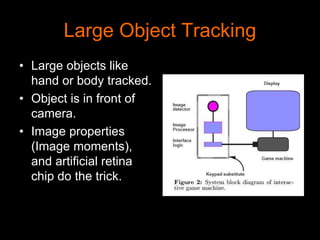
Large Object Tracking 
• Large objects like 
hand or body tracked. 
• Object is in front of 
camera. 
• Image properties 
(Image moments), 
and artificial retina 
chip do the trick.
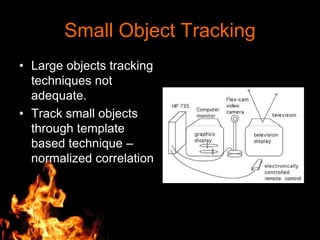
Small Object Tracking 
• Large objects tracking 
techniques not 
adequate. 
• Track small objects 
through template 
based technique – 
normalized correlation
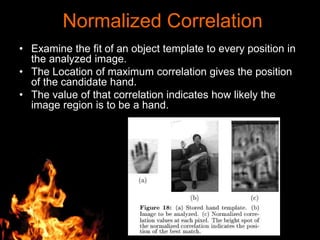
Normalized Correlation 
• Examine the fit of an object template to every position in 
the analyzed image. 
• The Location of maximum correlation gives the position 
of the candidate hand. 
• The value of that correlation indicates how likely the 
image region is to be a hand.
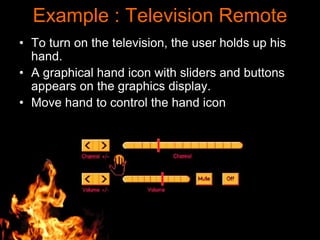
Example : Television Remote 
• To turn on the television, the user holds up his 
hand. 
• A graphical hand icon with sliders and buttons 
appears on the graphics display. 
• Move hand to control the hand icon
Conclusion 
• Simple vision algorithms with restrictive 
interactivity allows human-computer 
interaction possible. 
• Advances in algorithms and availability of 
low-cost hardware will make interactive 
human-computer interactions possible in 
everyday life.
References 
[1] R. Bajcsy. Active perception. IEEE Proceedings, 76(8):996-1006, 1988. 
[2] A. Blake and M. Isard. 3D position, attitude and shape input using video tracking of 
hands and lips. In Proc. SIGGRAPH 94,pages 185{192, 1994. In Computer 
Graphics, Annual Conference Series. 
[3] T. Darrell, P. Maes, B. Blumberg, and A. P.Pentland. Situated vision and behavior for 
interactive environments. Technical Report 261, M.I.T. Media Laboratory, Perceptual 
Computing Group, 20 Ames St., Cambridge, MA 02139, 1994. 
[4] I. Essa, editor. International Workshop on Automatic Face- and Gesture- 
Recognition.IEEE Computer Society, Killington, Vermont, 1997. 
[5] W. T. Freeman and M. Roth. Orientation histograms for hand gesture recognition. In 
M. Bichsel, editor, Intl. Workshop on automatic face and gesture-recognition, Zurich, 
Switzerland, 1995. Dept. of Computer Science, University of Zurich, CH-8057. 
[6] W. T. Freeman and C. Weissman. Television control by hand gestures. In M. Bichsel, 
editor, Intl. Workshop on automatic face and gesture recognition, Zurich, Switzerland, 
1995. Dept. of Computer Science, University of Zurich, CH-8057.
End of the Presentation 
Thank You

Computer vision for interactive computer graphics

  • 1.
    Name: Alam Shah ID:10-17685-3 Course Instructor: KHAN, MD. AL-FARABI
  • 2.
    Computer Vision forInteractive Computer Graphics A thesis work done by the authors- M. Roth, K. Tanaka, C. Weissman, W. Yerazunis TR99-02 January 1999
  • 3.
    What is computerVision? Computer vision is a field that includes methods for acquiring, processing, analyzing and understanding images and high-dimensional data from the real world in order to produce numerical or symbolic information
  • 4.
    Why we usecomputer Vision? • Human-computer interaction • Computers interpret user movements, gestures and glances via fundamental visual algorithms. • Visual algorithms: tracking, shape recognition and motion analysis • Interactive apps : response time is fast, algorithms work for different subject and environment and economical.
  • 5.
    Tracking Objects •Different methods and techniques are used to track objects from the real world • Interactive applications can track two types of objects – 1. Large objects 2. Small objects
  • 6.
    Large Object Tracking • Large objects like hand or body tracked. • Object is in front of camera. • Image properties (Image moments), and artificial retina chip do the trick.
  • 7.
    Small Object Tracking • Large objects tracking techniques not adequate. • Track small objects through template based technique – normalized correlation
  • 8.
    Normalized Correlation •Examine the fit of an object template to every position in the analyzed image. • The Location of maximum correlation gives the position of the candidate hand. • The value of that correlation indicates how likely the image region is to be a hand.
  • 9.
    Example : TelevisionRemote • To turn on the television, the user holds up his hand. • A graphical hand icon with sliders and buttons appears on the graphics display. • Move hand to control the hand icon
  • 10.
    Conclusion • Simplevision algorithms with restrictive interactivity allows human-computer interaction possible. • Advances in algorithms and availability of low-cost hardware will make interactive human-computer interactions possible in everyday life.
  • 11.
    References [1] R.Bajcsy. Active perception. IEEE Proceedings, 76(8):996-1006, 1988. [2] A. Blake and M. Isard. 3D position, attitude and shape input using video tracking of hands and lips. In Proc. SIGGRAPH 94,pages 185{192, 1994. In Computer Graphics, Annual Conference Series. [3] T. Darrell, P. Maes, B. Blumberg, and A. P.Pentland. Situated vision and behavior for interactive environments. Technical Report 261, M.I.T. Media Laboratory, Perceptual Computing Group, 20 Ames St., Cambridge, MA 02139, 1994. [4] I. Essa, editor. International Workshop on Automatic Face- and Gesture- Recognition.IEEE Computer Society, Killington, Vermont, 1997. [5] W. T. Freeman and M. Roth. Orientation histograms for hand gesture recognition. In M. Bichsel, editor, Intl. Workshop on automatic face and gesture-recognition, Zurich, Switzerland, 1995. Dept. of Computer Science, University of Zurich, CH-8057. [6] W. T. Freeman and C. Weissman. Television control by hand gestures. In M. Bichsel, editor, Intl. Workshop on automatic face and gesture recognition, Zurich, Switzerland, 1995. Dept. of Computer Science, University of Zurich, CH-8057.
  • 12.
    End of thePresentation Thank You